
Mediation and Moderation Its a multivariate world out

- Slides: 20
Mediation and Moderation It’s a multivariate world out there… Todd D. Little, Director Institute for Measurement, Methodology, Analysis and Policy
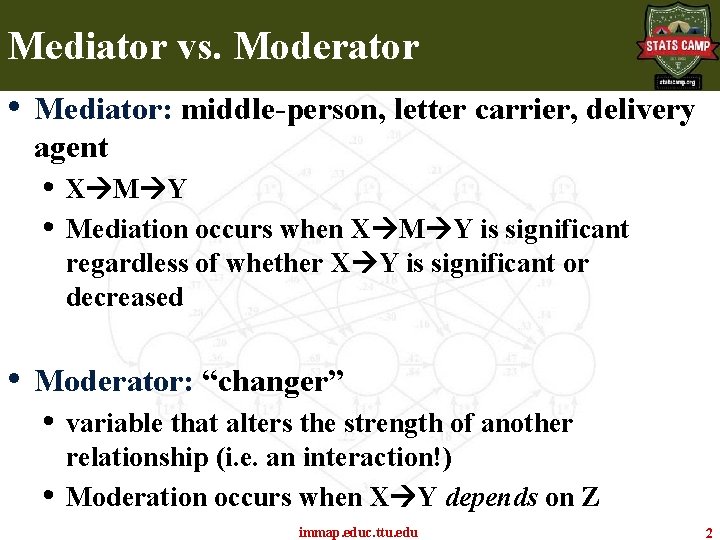
Mediator vs. Moderator • Mediator: middle-person, letter carrier, delivery agent • X M Y • Mediation occurs when X M Y is significant regardless of whether X Y is significant or decreased • Moderator: “changer” • variable that alters the strength of another • relationship (i. e. an interaction!) Moderation occurs when X Y depends on Z immap. educ. ttu. edu 2
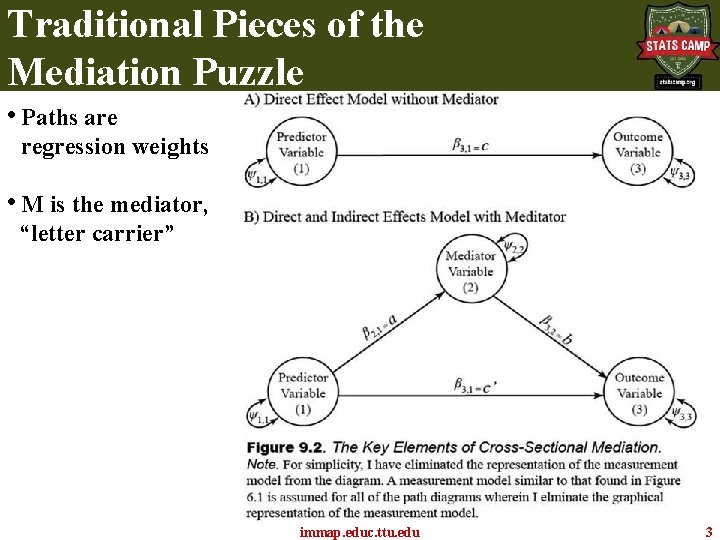
Traditional Pieces of the Mediation Puzzle • Paths are regression weights • M is the mediator, “letter carrier” immap. educ. ttu. edu 3
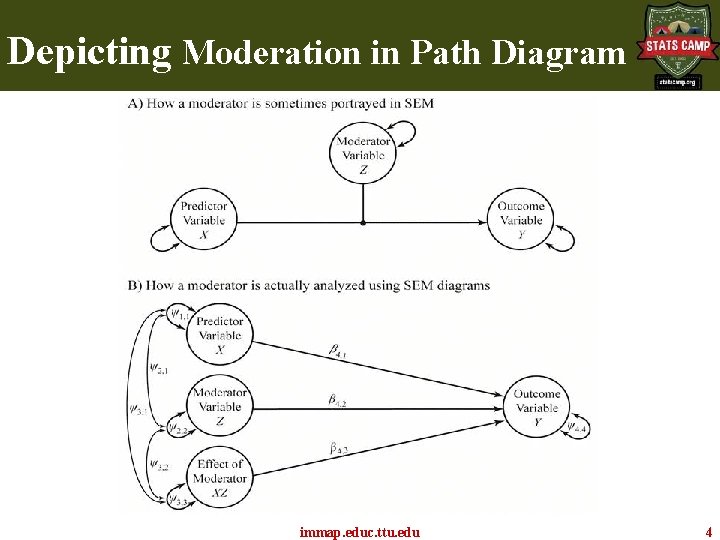
Depicting Moderation in Path Diagram immap. educ. ttu. edu 4
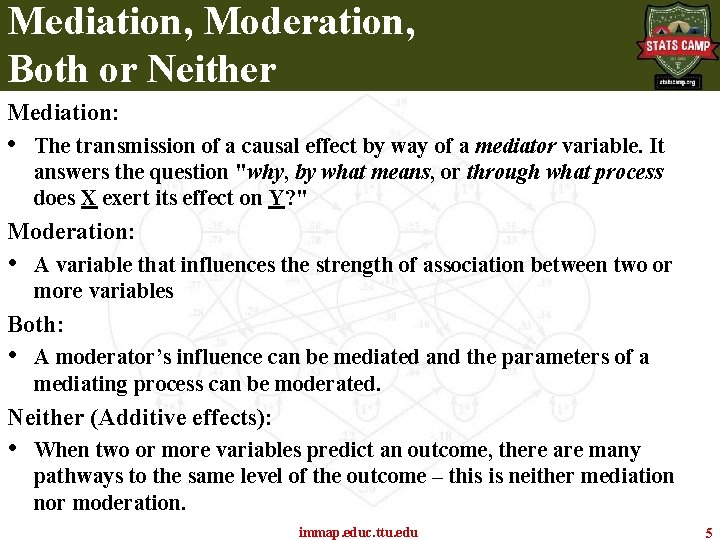
Mediation, Moderation, Both or Neither Mediation: • The transmission of a causal effect by way of a mediator variable. It answers the question "why, by what means, or through what process does X exert its effect on Y? " Moderation: • A variable that influences the strength of association between two or more variables Both: • A moderator’s influence can be mediated and the parameters of a mediating process can be moderated. Neither (Additive effects): • When two or more variables predict an outcome, there are many pathways to the same level of the outcome – this is neither mediation nor moderation. immap. educ. ttu. edu 5
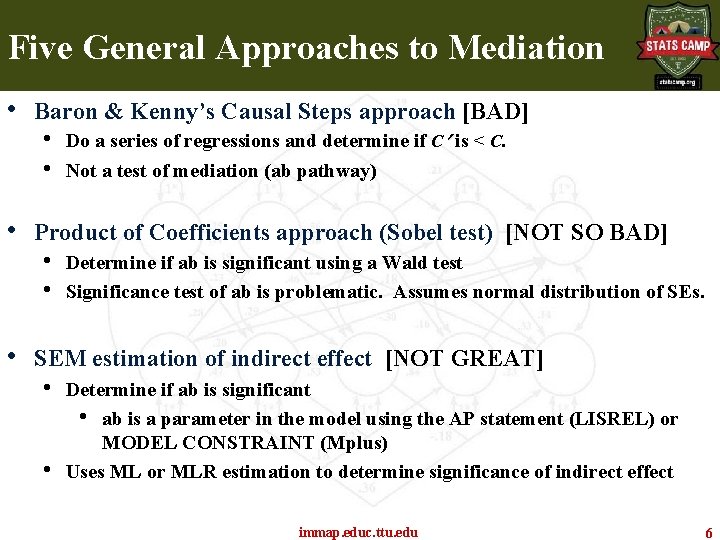
Five General Approaches to Mediation • • Baron & Kenny’s Causal Steps approach [BAD] • • Not a test of mediation (ab pathway) Product of Coefficients approach (Sobel test) [NOT SO BAD] • • • Do a series of regressions and determine if C’is < C. Determine if ab is significant using a Wald test Significance test of ab is problematic. Assumes normal distribution of SEs. SEM estimation of indirect effect [NOT GREAT] • • Determine if ab is significant • ab is a parameter in the model using the AP statement (LISREL) or MODEL CONSTRAINT (Mplus) Uses ML or MLR estimation to determine significance of indirect effect immap. educ. ttu. edu 6
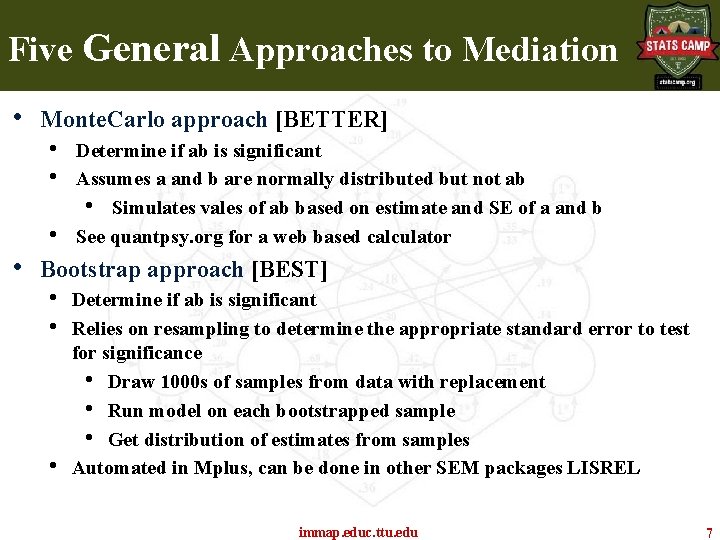
Five General Approaches to Mediation • Monte. Carlo approach [BETTER] • • Determine if ab is significant Assumes a and b are normally distributed but not ab • Simulates vales of ab based on estimate and SE of a and b See quantpsy. org for a web based calculator Bootstrap approach [BEST] • • • Determine if ab is significant Relies on resampling to determine the appropriate standard error to test for significance • Draw 1000 s of samples from data with replacement • Run model on each bootstrapped sample • Get distribution of estimates from samples Automated in Mplus, can be done in other SEM packages LISREL immap. educ. ttu. edu 7
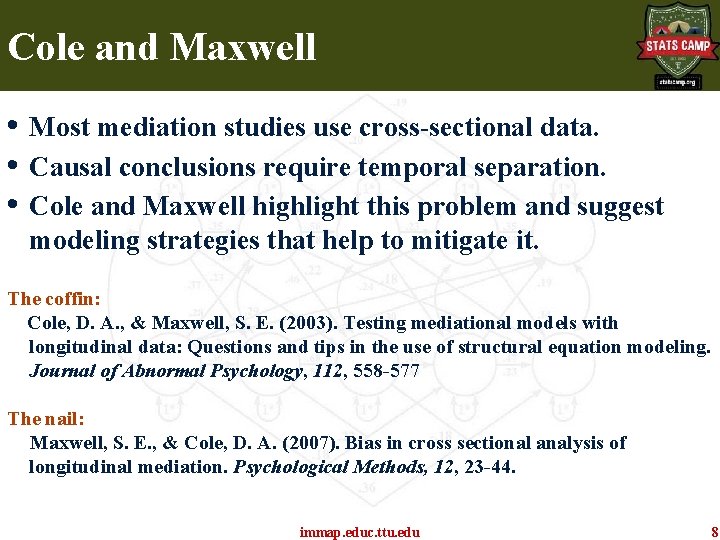
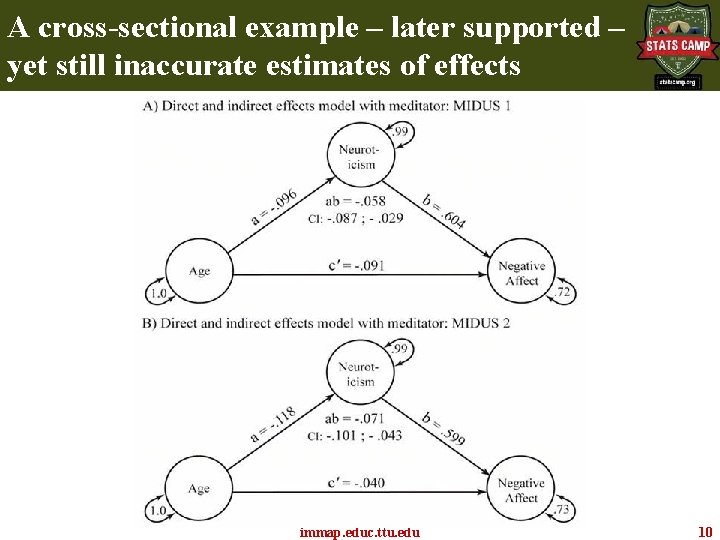
Cole and Maxwell • Most mediation studies use cross-sectional data. • Causal conclusions require temporal separation. • Cole and Maxwell highlight this problem and suggest modeling strategies that help to mitigate it. The coffin: Cole, D. A. , & Maxwell, S. E. (2003). Testing mediational models with longitudinal data: Questions and tips in the use of structural equation modeling. Journal of Abnormal Psychology, 112, 558 -577 The nail: Maxwell, S. E. , & Cole, D. A. (2007). Bias in cross sectional analysis of longitudinal mediation. Psychological Methods, 12, 23 -44. immap. educ. ttu. edu 8
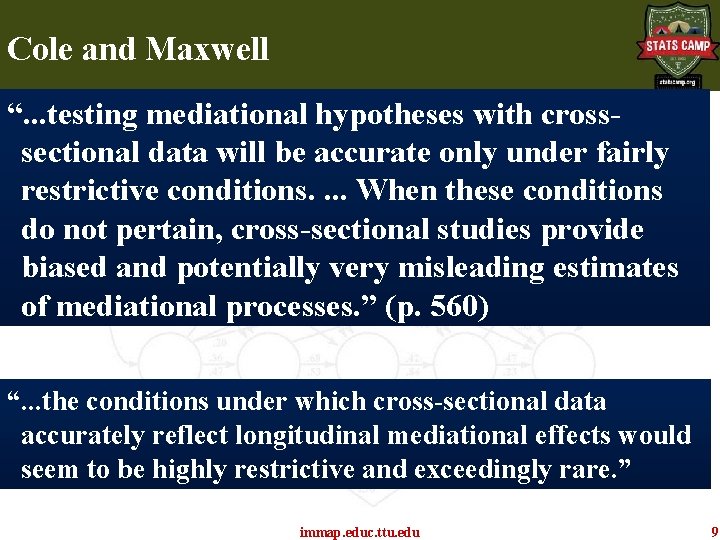
Cole and Maxwell “. . . testing mediational hypotheses with crosssectional data will be accurate only under fairly restrictive conditions. . When these conditions do not pertain, cross-sectional studies provide biased and potentially very misleading estimates of mediational processes. ” (p. 560) “. . . the conditions under which cross-sectional data accurately reflect longitudinal mediational effects would seem to be highly restrictive and exceedingly rare. ” immap. educ. ttu. edu 9
A cross-sectional example – later supported – yet still inaccurate estimates of effects immap. educ. ttu. edu 10
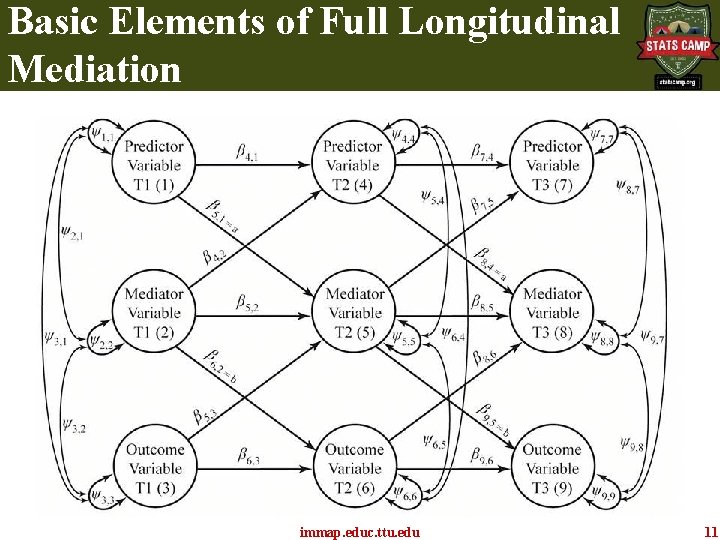
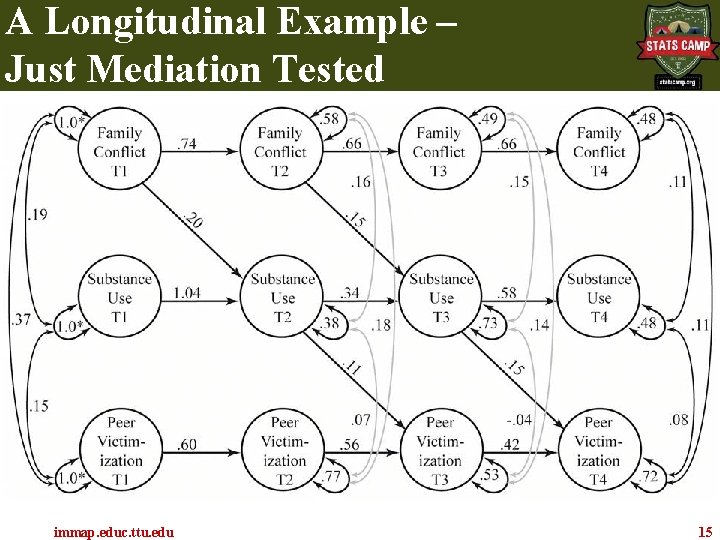
Basic Elements of Full Longitudinal Mediation immap. educ. ttu. edu 11
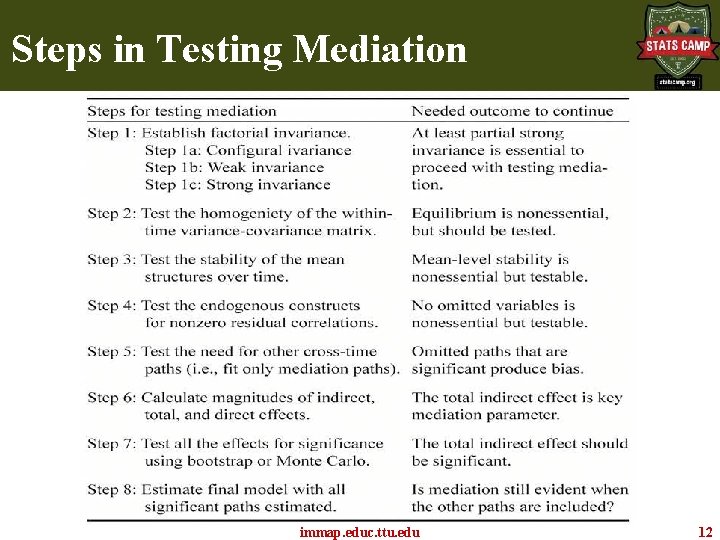
Steps in Testing Mediation immap. educ. ttu. edu 12
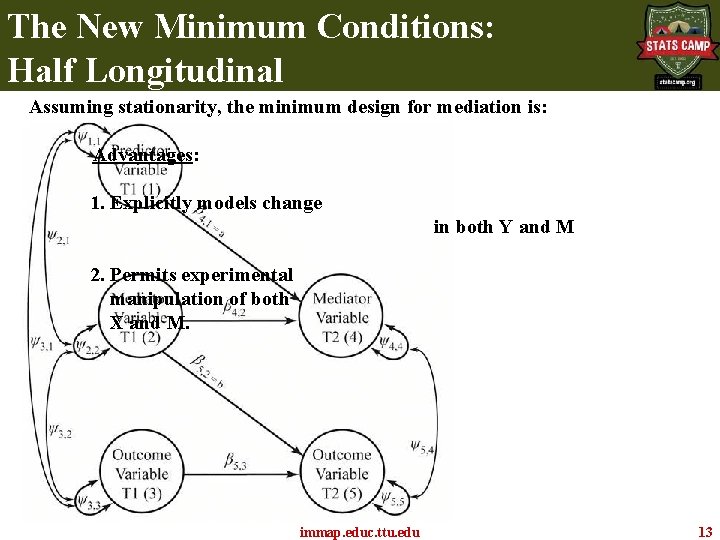
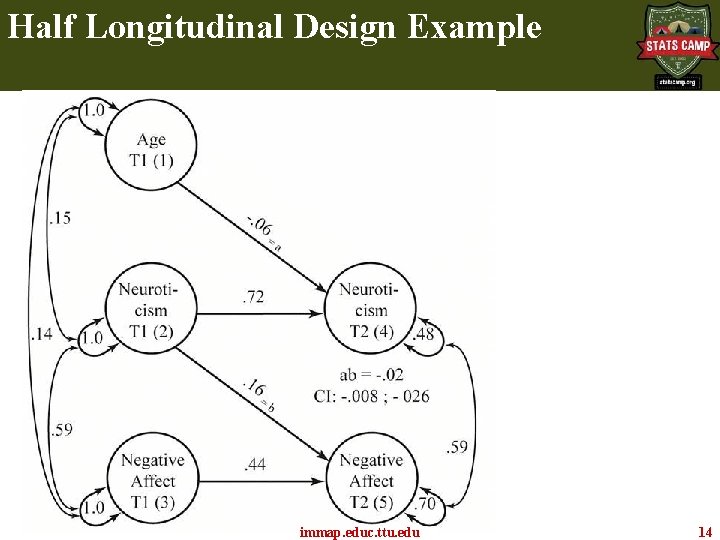
The New Minimum Conditions: Half Longitudinal Assuming stationarity, the minimum design for mediation is: Advantages: 1. Explicitly models change in both Y and M 2. Permits experimental manipulation of both X and M. immap. educ. ttu. edu 13
Half Longitudinal Design Example immap. educ. ttu. edu 14
A Longitudinal Example – Just Mediation Tested immap. educ. ttu. edu 15
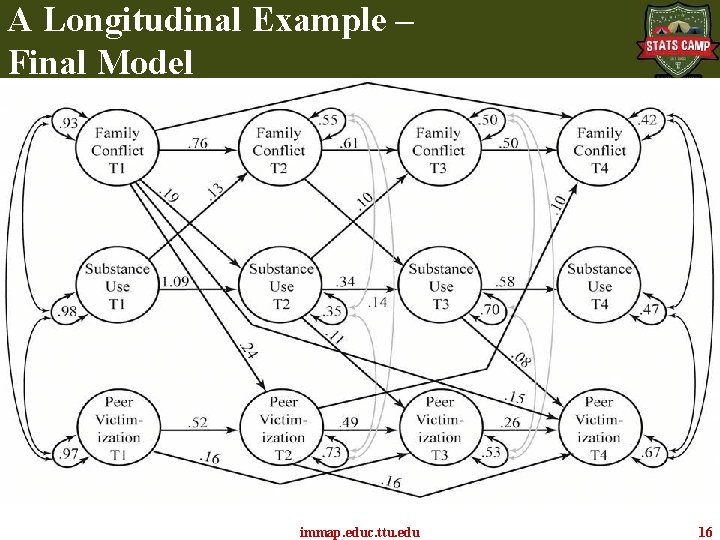
A Longitudinal Example – Final Model immap. educ. ttu. edu 16
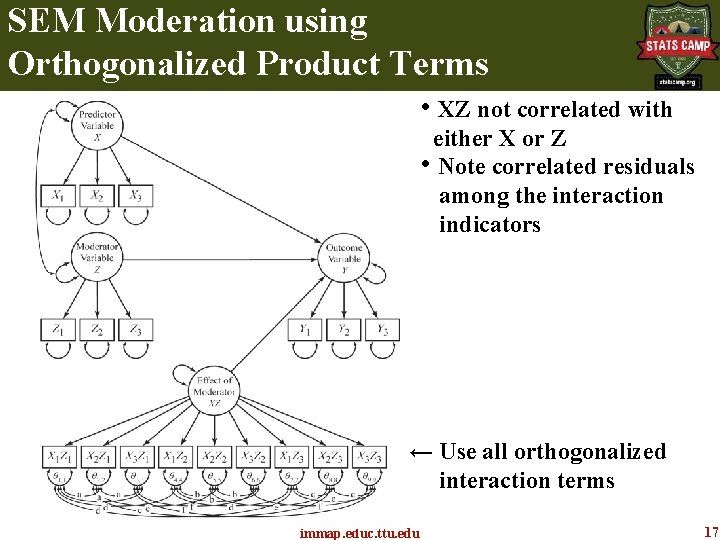
SEM Moderation using Orthogonalized Product Terms • XZ not correlated with either X or Z • Note correlated residuals among the interaction indicators ← Use all orthogonalized interaction terms immap. educ. ttu. edu 17
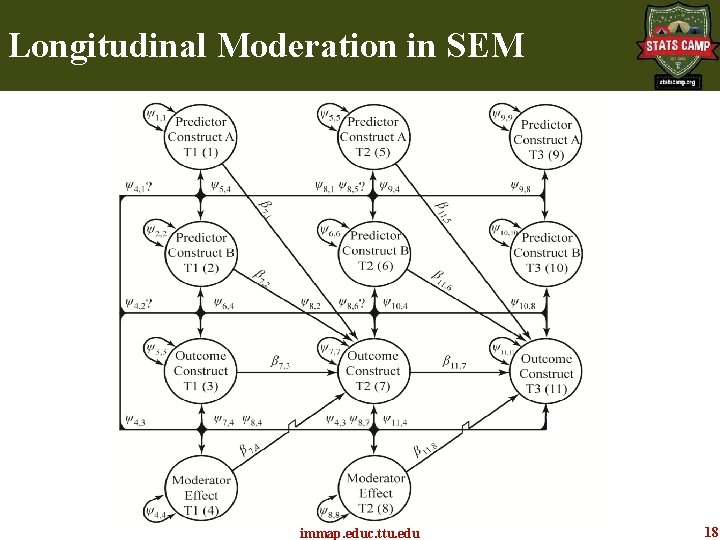
Longitudinal Moderation in SEM immap. educ. ttu. edu 18
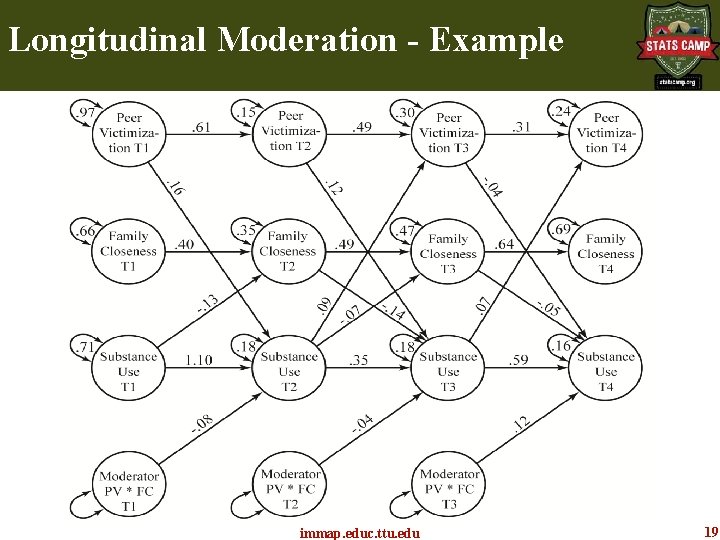
Longitudinal Moderation - Example immap. educ. ttu. edu 19
Recommended Readings Little, T. D. (2013). Longitudinal structural equation modeling. New York, NY: Guilford. § What can I say… Cole, D. A. , & Maxwell, S. E. (2003). Testing mediational models with longitudinal data: Questions and tips in the use of structural equation modeling. Journal of Abnormal Psychology, 112, 558 -577. § The coffin. Maxwell, S. E. , & Cole, D. A. (2007). Bias in cross sectional analysis of longitudinal mediation. Psychological Methods, 12, 23 -44. § The nail in the lid of the coffin. Hayes, A. F. (2013). Introduction to mediation, moderation, and conditional process modeling: a regression based approach. New York, NY: Guildford § An integration of mediation and moderation as condition process modeling. Jose, P. E. (2013). Doing statistical mediation and moderation. New York, NY: Guilford. § An accessible first course on mediation and moderation. immap. educ. ttu. edu 20