
The Adjudicators Role and Responsibilities of the CEC

The Adjudicators: Role and Responsibilities of the CEC Donald E. Cutlip, MD, FACP, FACC, FSCAI Professor of Medicine Harvard Medical School Beth Israel Deaconess Medical Center Harvard Clinical Research Institute
Disclosures • Salary support from Harvard Clinical Research Institute (HCRI) who performs contracted research services for multiple cardiac device companies. • Principal Investigator for the Cobra Pz. F SHIELD trial, sponsored by Celonova. All funds paid to HCRI.
Background • Multicenter, often global, clinical trials with follow-up for clinical endpoints are the standard. • Standardized endpoint definitions recognized as essential for assessment within and across various therapeutic clinical trials. • Validity of clinical trial outcomes requires confidence in the complete reporting of endpoints and consistent interpretation across geography and time. • Endpoint adjudication by a Clinical Events Committee helps assure complete, accurate and standardized reporting of outcomes.

Objectives of the CEC (Process) What does the statement, “all events were adjudicated by an independent CEC”, mean to the reader? • Accurate and unbiased adjudication of all suspected endpoint events according to prespecified definitions. • Consistent adjudication decisions when required data are missing or possible exceptions occur. • Complete ascertainment of all potential events. • Verify completeness and validity of data available for review.
Who are the adjudicators? • Clinical experts engaged in active clinical practice. – Regional or national clinical leader – Educator or published clinical expertise • Independent from trial sponsor and investigators. – Not an investigator in the current trial – Usually not from a center involved in current trial – No real or perceived conflict with sponsor (consultant, investigator in other trials, etc) – Usually not involved as investigator or other role with sponsor of a competing trial

CEC – Selection and Training? • Specialists within a therapeutic area related to the adjudicated endpoints. – Single versus multi-specialty • Trained in the clinical trial protocol – Understanding of therapeutic intervention – Knowledge of endpoint definitions (ideally CEC should approve definitions before trial begins) • Trained in procedures to maintain masking of members to treatment group, clinical center etc.

Management of the CEC Maintaining Independence • In most cases, several of the CEC processes will require management outside the CEC panel. – Contracting and payment of members – Communication between data center, sponsor, investigators and CEC – Scheduling meetings and reporting results – Assuring complete availability of data and compiling for CEC review – Protecting the masking of CEC members – Management group should not otherwise be vested in the trial or its outcome
Ascertainment of Suspected Events • CEC must be assured that all potential events are being presented for adjudication. • CEC manual of operations should specify a process for event identification and the minimum data required for adjudication. • CEC should receive reports of frequency of missing critical event data and plans for identification of potential events in such cases. • Event identification should include screening of investigator reports, key CRF fields, safety monitor reports, and central/core laboratory data – “Triggers”.
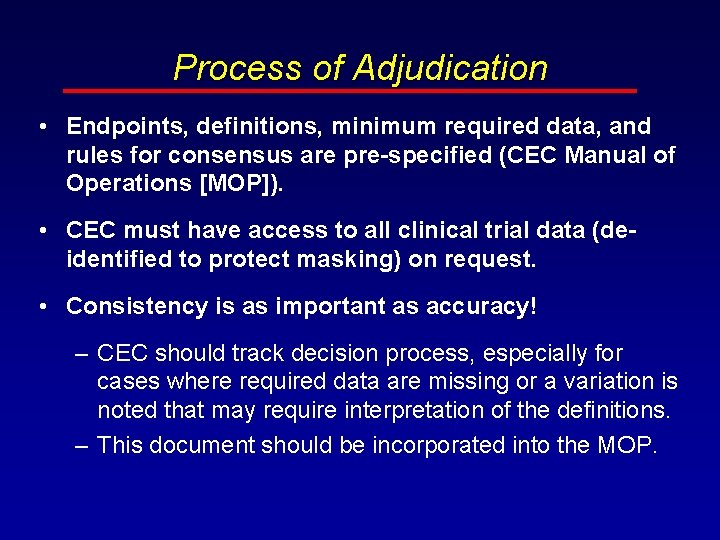
Process of Adjudication • Endpoints, definitions, minimum required data, and rules for consensus are pre-specified (CEC Manual of Operations [MOP]). • CEC must have access to all clinical trial data (deidentified to protect masking) on request. • Consistency is as important as accuracy! – CEC should track decision process, especially for cases where required data are missing or a variation is noted that may require interpretation of the definitions. – This document should be incorporated into the MOP.

The CEC Meeting • Consensus full panel (face-to-face, web based, teleconference) – Value of multiple observers and discussion – Especially useful for multi-disciplinary CECs – Limitations: can be less efficient and dynamic relative to trial enrollment • Independent review – Most common model is 2 independent reviewers and then 3 rd review for discordance – Discordant review may be 3 rd reviewer or consensus panel (preferred) – Especially useful for large studies or fast enrollment
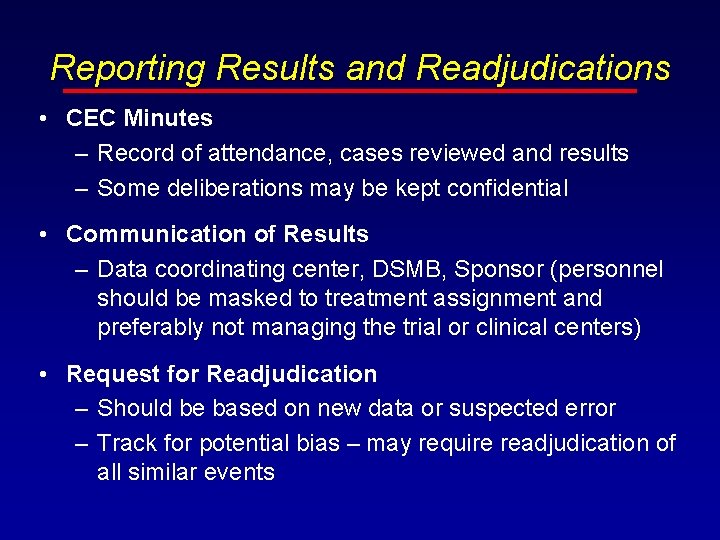
Reporting Results and Readjudications • CEC Minutes – Record of attendance, cases reviewed and results – Some deliberations may be kept confidential • Communication of Results – Data coordinating center, DSMB, Sponsor (personnel should be masked to treatment assignment and preferably not managing the trial or clinical centers) • Request for Readjudication – Should be based on new data or suspected error – Track for potential bias – may require readjudication of all similar events
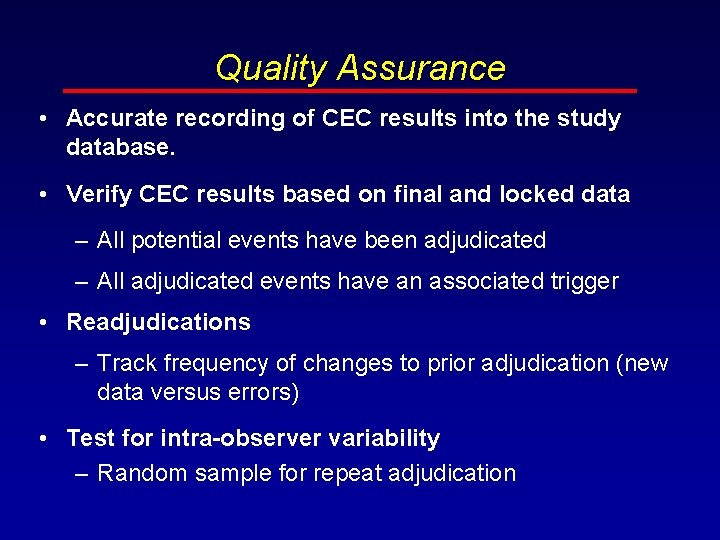
Quality Assurance • Accurate recording of CEC results into the study database. • Verify CEC results based on final and locked data – All potential events have been adjudicated – All adjudicated events have an associated trigger • Readjudications – Track frequency of changes to prior adjudication (new data versus errors) • Test for intra-observer variability – Random sample for repeat adjudication
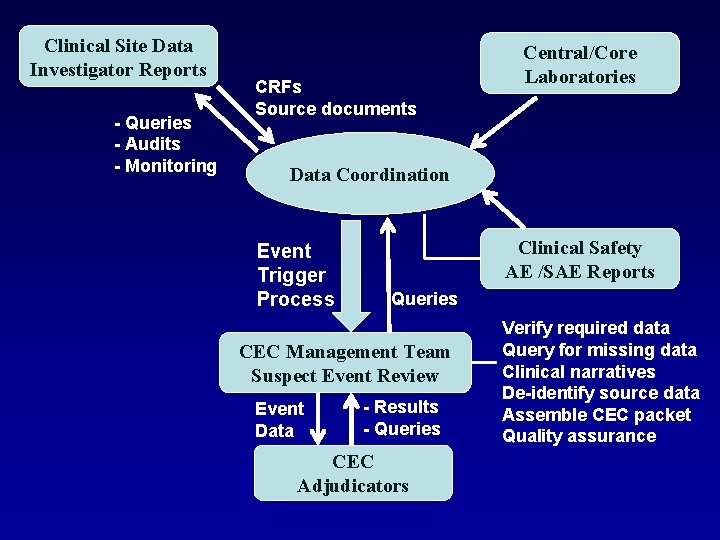
Clinical Site Data Investigator Reports - Queries - Audits - Monitoring CRFs Source documents Central/Core Laboratories Data Coordination Event Trigger Process Clinical Safety AE /SAE Reports Queries CEC Management Team Suspect Event Review Event Data - Results - Queries CEC Adjudicators Verify required data Query for missing data Clinical narratives De-identify source data Assemble CEC packet Quality assurance
- Slides: 13