World Squash Federation Coach Education Programme Level 3



- Slides: 41
World Squash Federation Coach Education Programme Level 3 Periodisation for Squash
"If you don't know where you are going, don't be surprised to arrive somewhere else. " � In terms of sports performance, that means if you fail to plan the development of your athletes properly, you will not be able to maximize their potential. � The planning process in sports is called "Periodization". Maj(R)S. Maniam
Workshop Outcomes � By the end of this workshop, you should have an understanding of the following: 1. What, Why, When and How of Periodisation 2. The Phases and Cycles in Periodisation 3. Meaning and use of Tapering , Transition and Peaking Index 4. How all above is used to formulate an Annual Squash Plan � Maj(R)S. Maniam
OVERVIEW � To compete at the elite level squash players require to develop and be proficient in a range of attributes. � Ideally players use a periodised approach to training for optimal long-term development, which allow them to sequentially develop these attributes over a desired period of time
PERIODISATION � Periodisation is the art and science of planning and integrating all training components (technical, tactical, physical and psychological) along with social factors (sleep, nutrition, hydration, drug education, career guidance) � Into a sequence that will optimize the development of an athlete and lead to peak performance at the desired time, while avoiding plateau and overtraining. � In a nutshell it means when and what type of stress you place on the body Maj(R)S. Maniam
TYPES OF PERIODISATION � CLASSIC LINEAR PERIODISATION � UNDULATING � CONJUGATIVE PERIODISATION Maj(R)S. Maniam
Classic Linear Periodisation � Progressing a training stress or fitness characteristic in a linear fashion. � This is roughly equivalent to “progressive overload” for single or multiple factors. Normally concentrating on one motor ability per phase without changes in exercise. � Any change from one session to the next is some form of progressive overload. More weight on the bar, more reps, more sets, etc. � Progress with more weight with the same number of reps, or more reps with the same weight. Maj(R)S. Maniam
Undulating Periodisation � Changing the training volume and/or intensity to expose the body to different stressors. � Weights, reps, and sets can change day to day and week to week, but there are normally no changes in exercises, and the overall average volume and intensity remains the same. Maj(R)S. Maniam
Conjugative periodisation � Regularly changing training stressors (exercises) with the purpose of training different physical characteristics (like maximal strength and explosiveness, for example) simultaneously. � There is no one-size-fits-all best training plan, but almost all successful training plans have all three of these elements – linearity, conjugation, and undulation
Periodisation Cycles � Microcycle ◦ 5 -7 days. ◦ Normally a week � Mesocycle ◦ Major training phase within a year (4 -6 weeks) ◦ Normally a month � Macrocycle ◦ A training year ◦ It refers to the overall training period, usually representing a year or two. There are longer cycles as well for the Olympian, being 4 or 8 years.
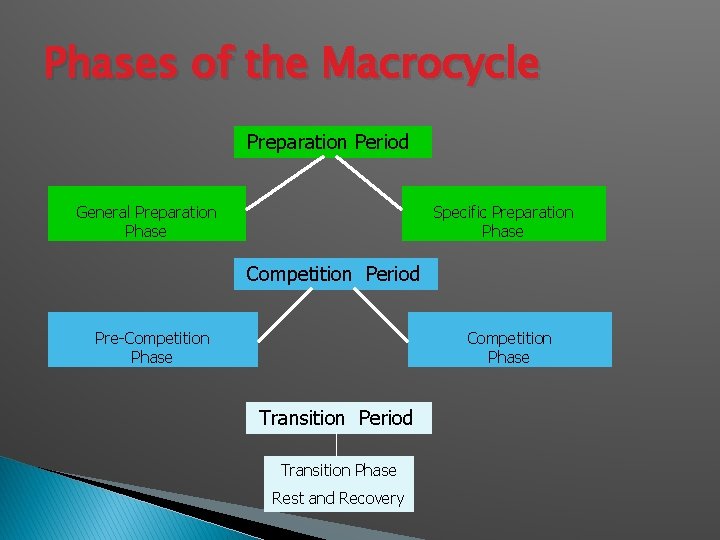
Phases of the Macrocycle Preparation Period General Preparation Phase Specific Preparation Phase Competition Period Pre-Competition Phase Transition Period Transition Phase Rest and Recovery
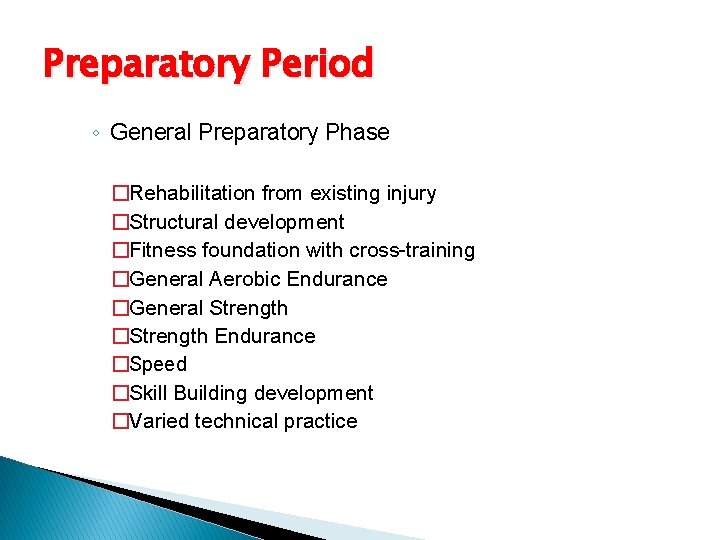
Preparatory Period ◦ General Preparatory Phase �Rehabilitation from existing injury �Structural development �Fitness foundation with cross-training �General Aerobic Endurance �General Strength �Strength Endurance �Speed �Skill Building development �Varied technical practice
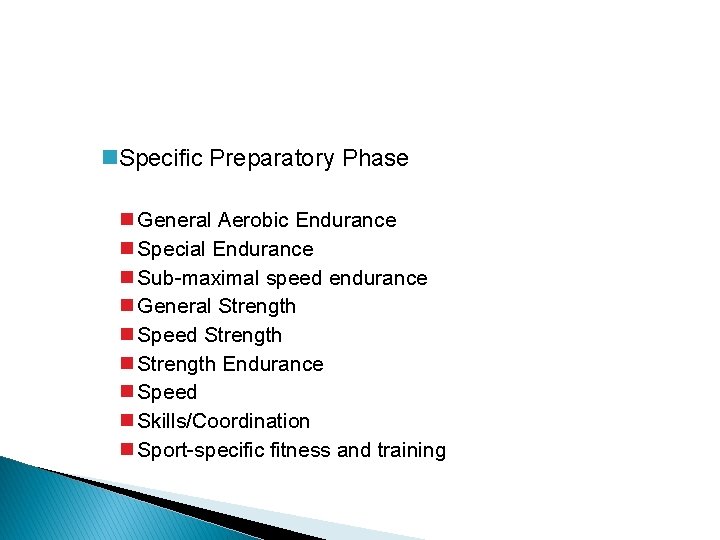
n. Specific Preparatory Phase n General Aerobic Endurance n Special Endurance n Sub-maximal speed endurance n General Strength n Speed Strength n Strength Endurance n Speed n Skills/Coordination n Sport-specific fitness and training
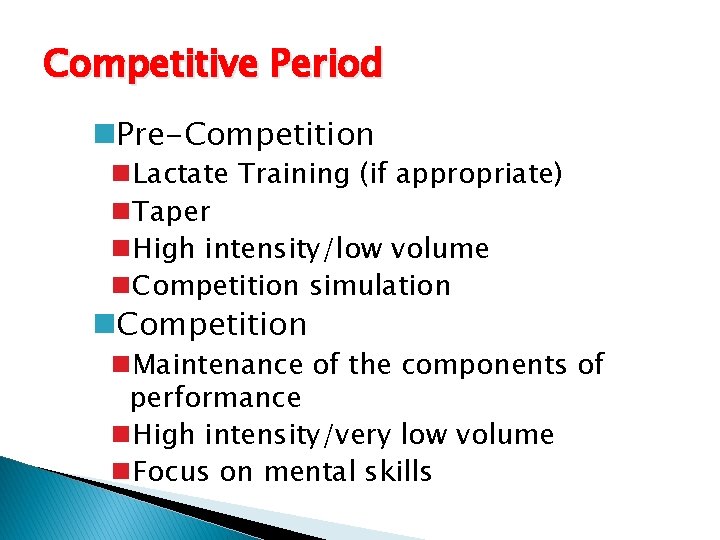
Competitive Period n. Pre-Competition n. Lactate Training (if appropriate) n. Taper n. High intensity/low volume n. Competition simulation n. Competition n. Maintenance of the components of performance n. High intensity/very low volume n. Focus on mental skills
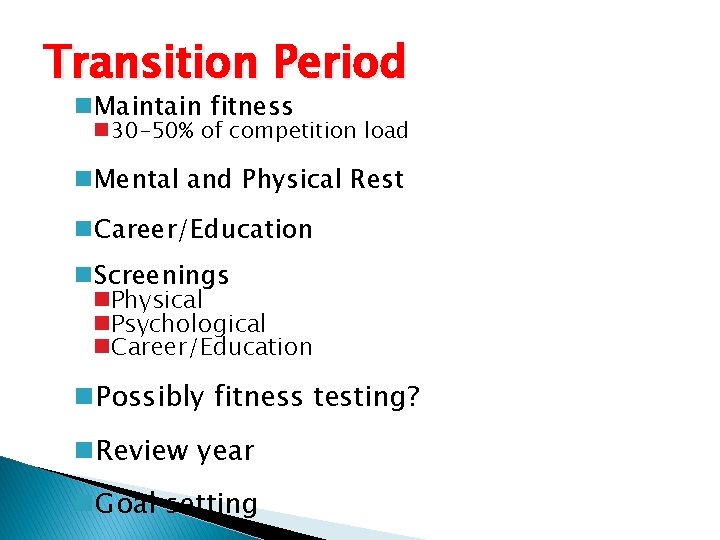
Transition Period n. Maintain fitness n 30 -50% of competition load n. Mental and Physical Rest n. Career/Education n. Screenings n. Physical n. Psychological n. Career/Education n. Possibly fitness testing? n. Review year n. Goal setting
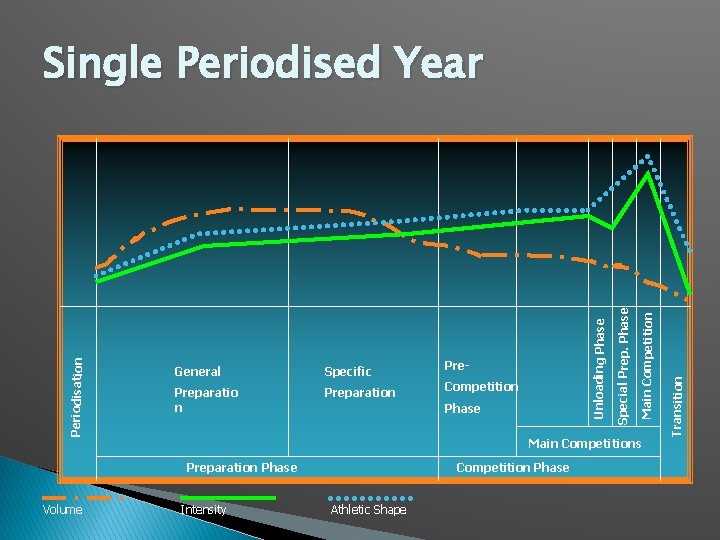
Preparatio n Preparation Competition Phase Main Competitions Preparation Phase Volume Intensity Competition Phase Athletic Shape Transition Pre- Main Competition Specific Special Prep. Phase General Unloading Phase Periodisation Single Periodised Year
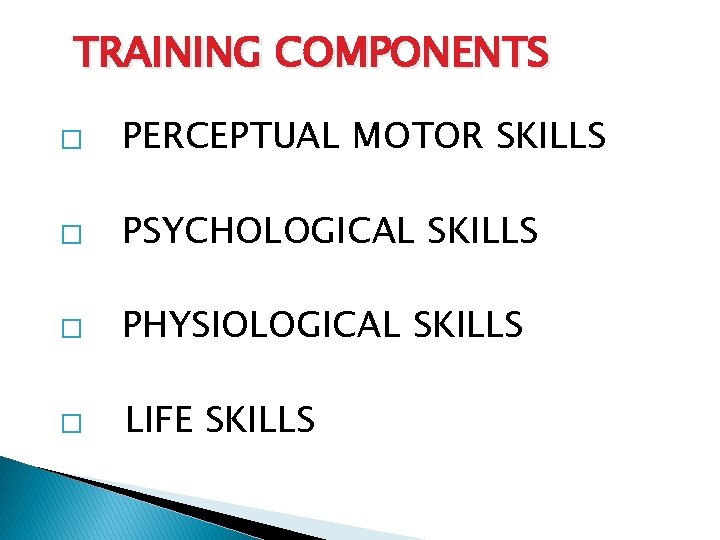
TRAINING COMPONENTS � PERCEPTUAL MOTOR SKILLS � PSYCHOLOGICAL SKILLS � PHYSIOLOGICAL SKILLS � LIFE SKILLS
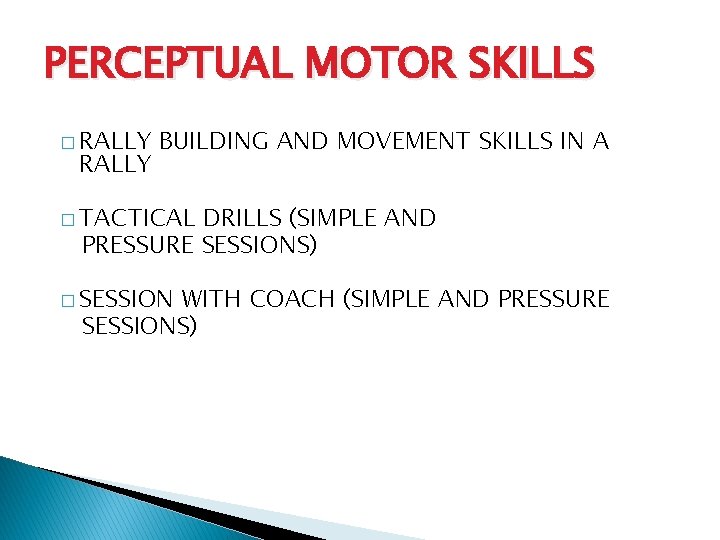
PERCEPTUAL MOTOR SKILLS � RALLY BUILDING AND MOVEMENT SKILLS IN A � TACTICAL DRILLS (SIMPLE AND PRESSURE SESSIONS) � SESSION WITH COACH (SIMPLE AND PRESSURE SESSIONS)
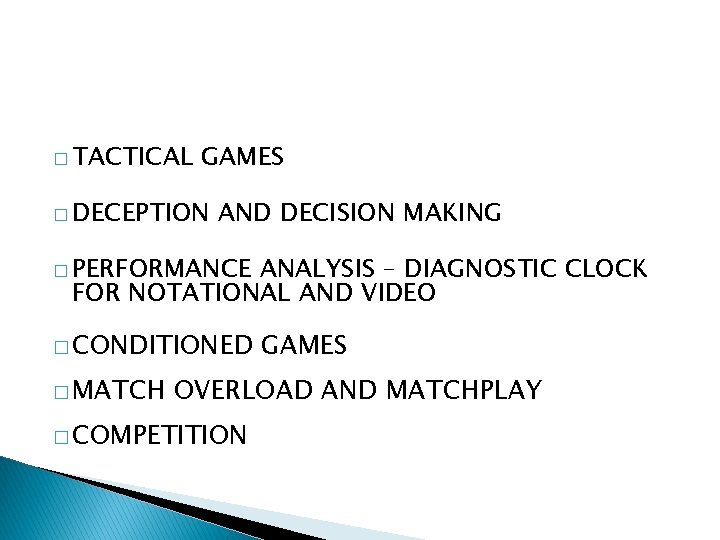
� TACTICAL GAMES � DECEPTION AND DECISION MAKING � PERFORMANCE ANALYSIS – DIAGNOSTIC CLOCK FOR NOTATIONAL AND VIDEO � CONDITIONED � MATCH GAMES OVERLOAD AND MATCHPLAY � COMPETITION
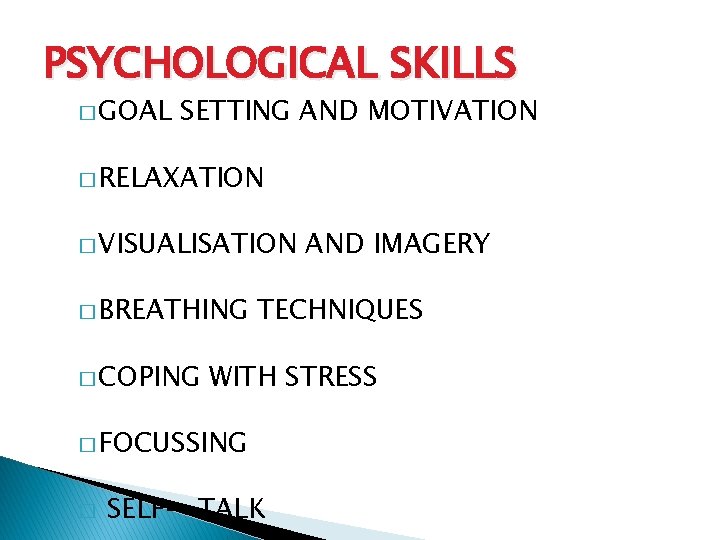
PSYCHOLOGICAL SKILLS � GOAL SETTING AND MOTIVATION � RELAXATION � VISUALISATION � BREATHING � COPING TECHNIQUES WITH STRESS � FOCUSSING � AND IMAGERY SELF- TALK
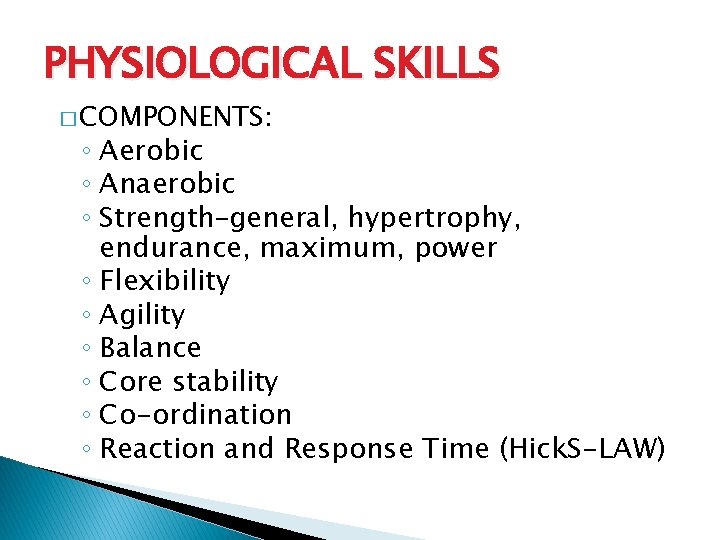
PHYSIOLOGICAL SKILLS � COMPONENTS: ◦ Aerobic ◦ Anaerobic ◦ Strength–general, hypertrophy, endurance, maximum, power ◦ Flexibility ◦ Agility ◦ Balance ◦ Core stability ◦ Co-ordination ◦ Reaction and Response Time (Hick. S-LAW)
LIFE SKILLS � Nutrition � Athlete Career Guidance � Athlete Education Guidance � Rest and Recovery Patterns � Drugs � Habits – Counselling
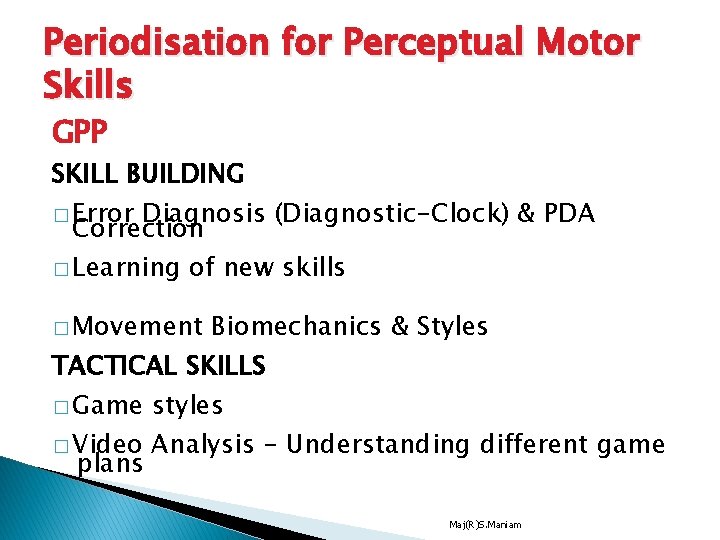
Periodisation for Perceptual Motor Skills GPP SKILL BUILDING � Error Diagnosis (Diagnostic-Clock) & PDA Correction � Learning of new skills � Movement Biomechanics & Styles TACTICAL SKILLS � Game � Video plans styles Analysis - Understanding different game Maj(R)S. Maniam
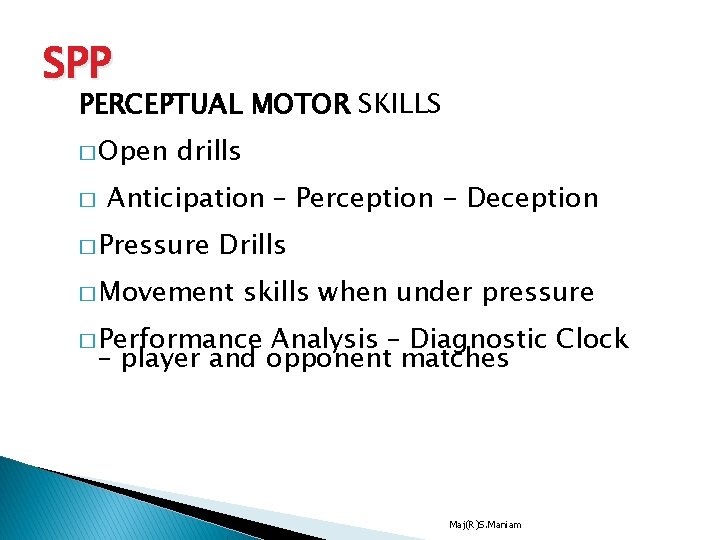
SPP PERCEPTUAL MOTOR SKILLS � Open � drills Anticipation – Perception - Deception � Pressure Drills � Movement skills when under pressure � Performance Analysis – Diagnostic Clock – player and opponent matches Maj(R)S. Maniam
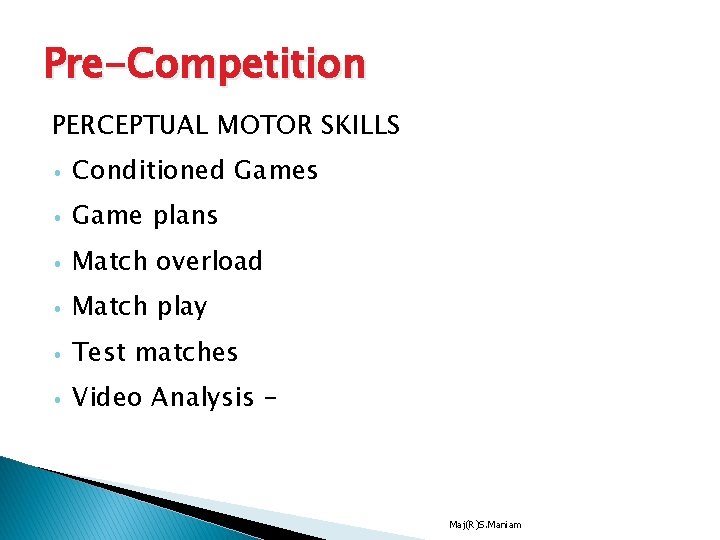
Pre-Competition PERCEPTUAL MOTOR SKILLS • Conditioned Games • Game plans • Match overload • Match play • Test matches • Video Analysis - Maj(R)S. Maniam
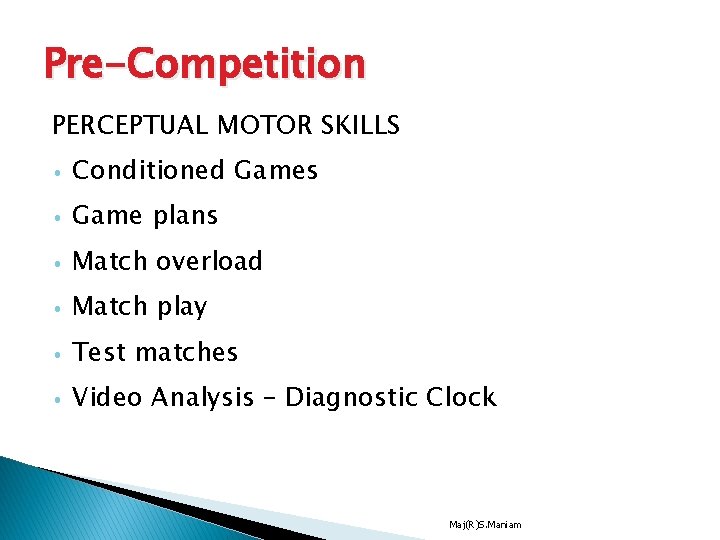
Pre-Competition PERCEPTUAL MOTOR SKILLS • Conditioned Games • Game plans • Match overload • Match play • Test matches • Video Analysis – Diagnostic Clock Maj(R)S. Maniam
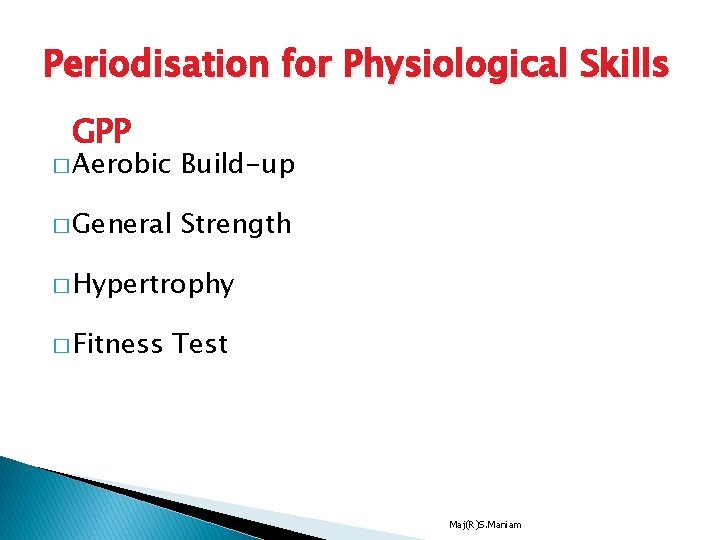
Periodisation for Physiological Skills GPP � Aerobic Build-up � General Strength � Hypertrophy � Fitness Test Maj(R)S. Maniam
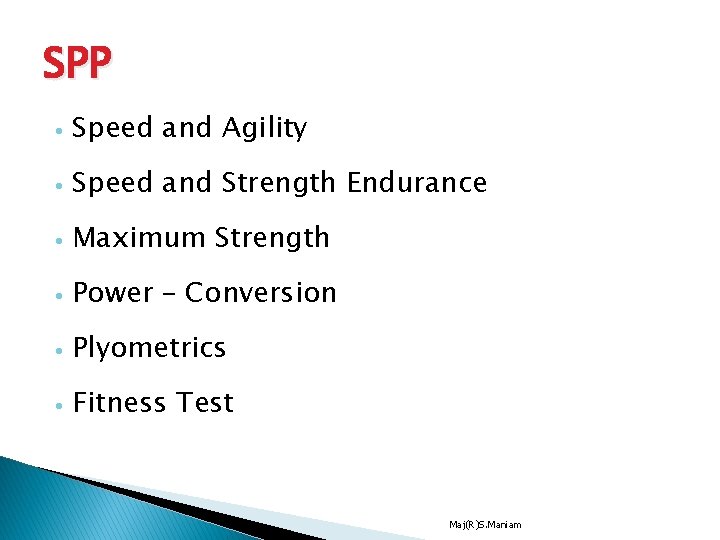
SPP • Speed and Agility • Speed and Strength Endurance • Maximum Strength • Power – Conversion • Plyometrics • Fitness Test Maj(R)S. Maniam
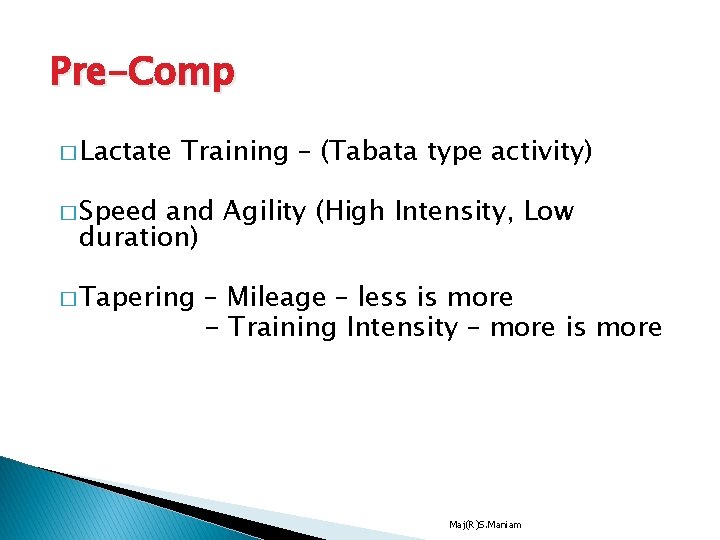
Pre-Comp � Lactate Training – (Tabata type activity) � Speed and Agility (High Intensity, Low duration) � Tapering – Mileage – less is more - Training Intensity – more is more Maj(R)S. Maniam
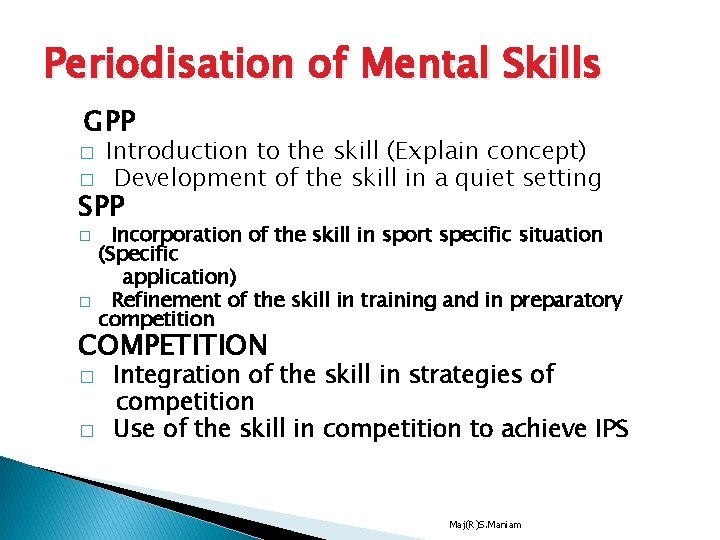
Periodisation of Mental Skills GPP � � Introduction to the skill (Explain concept) Development of the skill in a quiet setting SPP � � Incorporation of the skill in sport specific situation (Specific application) Refinement of the skill in training and in preparatory competition COMPETITION � � Integration of the skill in strategies of competition Use of the skill in competition to achieve IPS Maj(R)S. Maniam
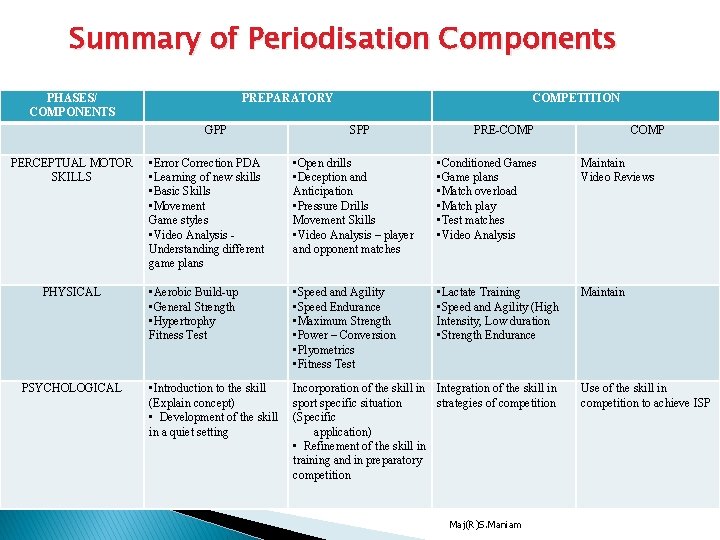
Summary of Periodisation Components PHASES/ COMPONENTS PREPARATORY GPP PERCEPTUAL MOTOR SKILLS PHYSICAL PSYCHOLOGICAL COMPETITION SPP PRE-COMP • Error Correction PDA • Learning of new skills • Basic Skills • Movement Game styles • Video Analysis Understanding different game plans • Open drills • Deception and Anticipation • Pressure Drills Movement Skills • Video Analysis – player and opponent matches • Conditioned Games • Game plans • Match overload • Match play • Test matches • Video Analysis Maintain Video Reviews • Aerobic Build-up • General Strength • Hypertrophy Fitness Test • Speed and Agility • Speed Endurance • Maximum Strength • Power – Conversion • Plyometrics • Fitness Test • Lactate Training • Speed and Agility (High Intensity, Low duration • Strength Endurance Maintain • Introduction to the skill (Explain concept) • Development of the skill in a quiet setting Incorporation of the skill in Integration of the skill in sport specific situation strategies of competition (Specific application) • Refinement of the skill in training and in preparatory competition Maj(R)S. Maniam Use of the skill in competition to achieve ISP
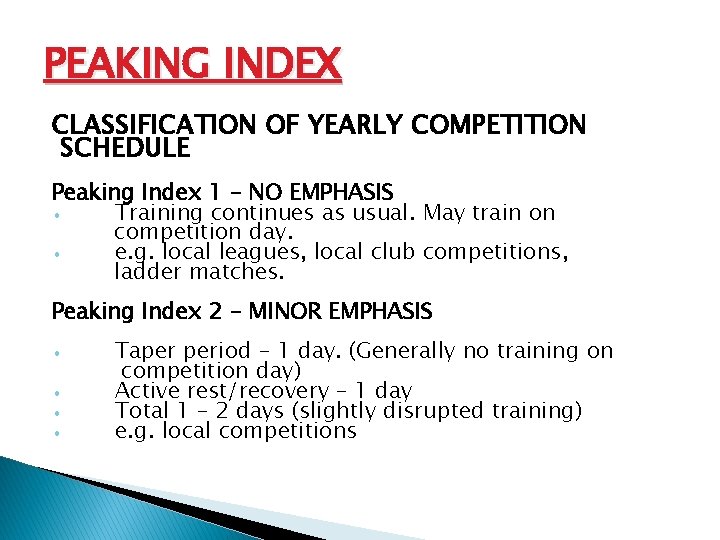
PEAKING INDEX CLASSIFICATION OF YEARLY COMPETITION SCHEDULE Peaking Index 1 - NO EMPHASIS • Training continues as usual. May train on competition day. • e. g. local leagues, local club competitions, ladder matches. Peaking Index 2 - MINOR EMPHASIS • • Taper period – 1 day. (Generally no training on competition day) Active rest/recovery – 1 day Total 1 – 2 days (slightly disrupted training) e. g. local competitions
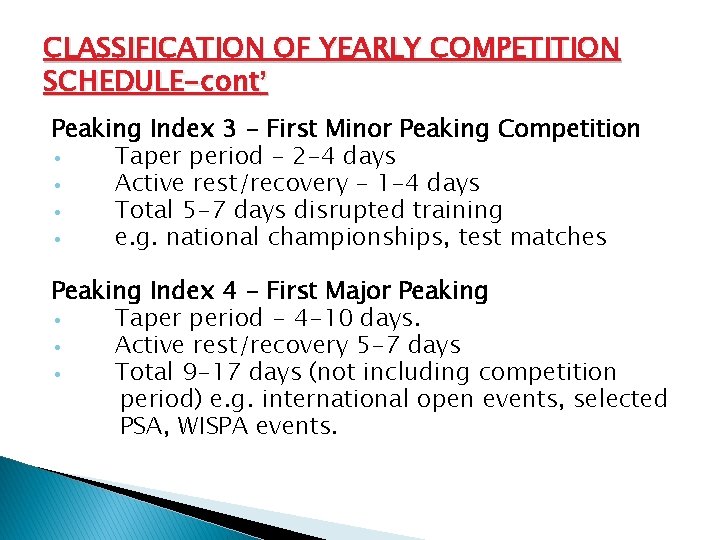
CLASSIFICATION OF YEARLY COMPETITION SCHEDULE-cont’ Peaking Index 3 - First Minor Peaking Competition • Taper period – 2 -4 days • Active rest/recovery – 1 -4 days • Total 5 -7 days disrupted training • e. g. national championships, test matches Peaking Index 4 - First Major Peaking • Taper period - 4 -10 days. • Active rest/recovery 5 -7 days • Total 9 -17 days (not including competition period) e. g. international open events, selected PSA, WISPA events.
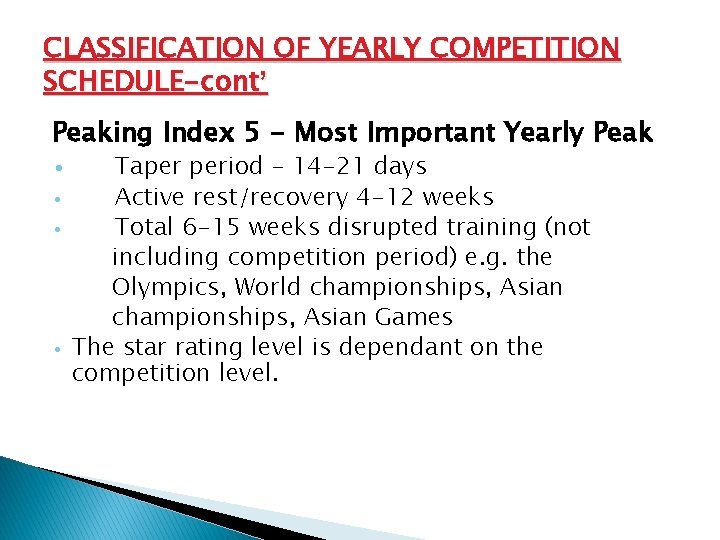
CLASSIFICATION OF YEARLY COMPETITION SCHEDULE-cont’ Peaking Index 5 - Most Important Yearly Peak • • Taper period – 14 -21 days Active rest/recovery 4 -12 weeks Total 6 -15 weeks disrupted training (not including competition period) e. g. the Olympics, World championships, Asian Games The star rating level is dependant on the competition level.
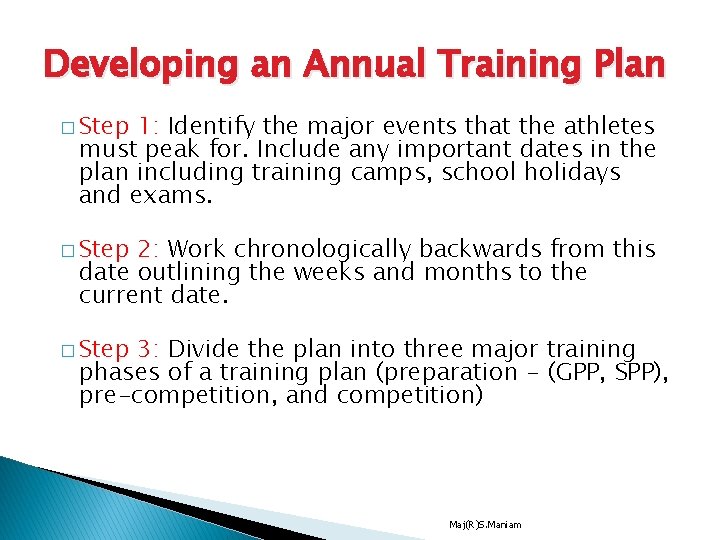
Developing an Annual Training Plan � Step 1: Identify the major events that the athletes must peak for. Include any important dates in the plan including training camps, school holidays and exams. � Step 2: Work chronologically backwards from this date outlining the weeks and months to the current date. � Step 3: Divide the plan into three major training phases of a training plan (preparation - (GPP, SPP), pre-competition, and competition) Maj(R)S. Maniam
� Step 4: Break each phase into the desired messo cycles and micro cycles incorporating appropriate loading and unloading (recovery) periods. A general recommendation is to have a four-week messo cycle where you have three weeks of loading followed by one week unloading or recovery. � Step 5: Determine target training load percentages for each phase. � Step 6: Incorporate a method of monitoring the progress of the athletes into the plan, e. g. time trials, fitness tests, game rehearsals etc. Maj(R)S. Maniam
Designing a weekly plan – Micro Cycle � � � Step 1: Identify which phase the particular week occurs in and observe the target training load percentages for that phase Step 2: Observe the time, distance or performance target for that week Step 3: Determine the time and/or distance for each training zone for that week Step 4: Select the suitable training protocols to achieve these training goals " Step 5: Record and monitor your plan Maj(R)S. Maniam
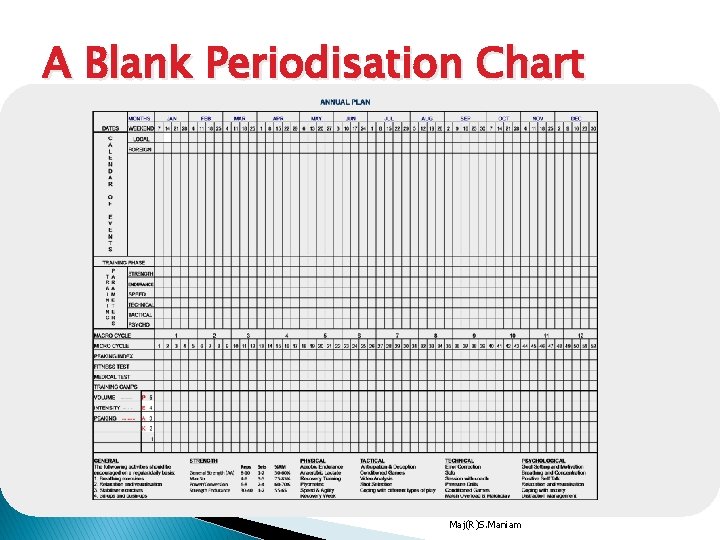
A Blank Periodisation Chart Maj(R)S. Maniam
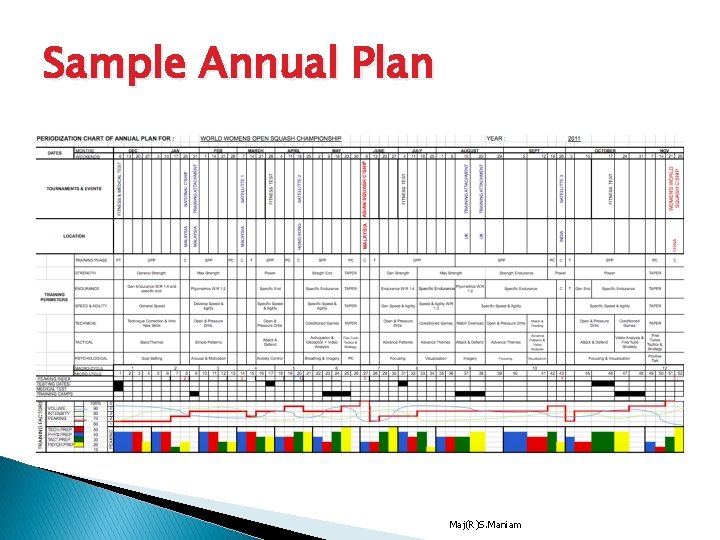
Sample Annual Plan Maj(R)S. Maniam
SUMMARY n n Periodisation is best thought of as a way of organising your long term training towards an eventual goal for improved performance of hitting a peak on a particular date. If you want to build the best all round performance, some form of periodisation will undoubtedly form the bedrock of your training scheme.
� THANK YOU Maj(R)S. Maniam