WORLD HISTORY II Chapter 1 The Renaissance Reformation

- Slides: 19
WORLD HISTORY II Chapter 1: The Renaissance & Reformation Section 4: Reformation Ideas Spread
Objectives • Describe the new ideas that Protestant sects embraced. • Understand why England formed a new church. • Analyze how the Catholic Church reformed itself. • Explain why many groups faced persecution during the Reformation.
How did the Reformation bring about two different religious paths in Europe?
As the Reformation continued, hundreds of new Protestant sects appeared. • Some broke away from the mainline churches. • Many followed the teachings of Luther, Calvin, or Zwingli, but some were more radical.
One new sect was the Anabaptists. • Anabaptists rejected the baptism of infants. • Some radical Anabaptists favored the abolition of private property and sought to speed up God’s judgment day. • But most Anabaptists were peaceful, calling for religious toleration and separation of church and state. Today’s Baptists, Mennonites, and Amish all have Anabaptist origins.
The English Reformation was not due to reformers, but rather to a king—Henry VIII. In 1527 Henry sought an annulment from his wife Catherine, who had only borne a daughter, Mary Tudor. He wished to marry a young noble-woman, Anne Boleyn. He hoped she would bear him a male heir. When the pope refused to annul the marriage, the king took over the English Church.
Parliament placed the Church of England under Henry VIII’s control. Thomas Cranmer was appointed archbishop. • Archbishop Cranmer annulled the marriage. • Henry married Anne Boleyn. They had a daughter, Elizabeth. • Catholics who opposed Henry were executed. • The Catholic Church canonized Sir Thomas More, one of those killed.
Henry had Catholic property confiscated and distributed to nobles to gain their support. In 1547 Henry was succeeded by his nine-yearold son Edward favored the Protestant religion.
Parliament passed several laws to make the English or “Anglican” Church more Protestant. Thomas Cranmer drew up The Book of Common Prayer, which became required reading at all Anglican services. While still in his teens, young Edward died and was succeeded by Mary Tudor. Mary tried to restore Catholicism and had many Protestants burned at the stake for heresy.
In 1558 25 -year-old Elizabeth took the throne. The “Elizabethan era” would unite England avoid future religious wars. • She compromised between Catholics and Protestants. • She did not allow herself to be put at the head of the Anglican Church. The service was translated from Latin to English.
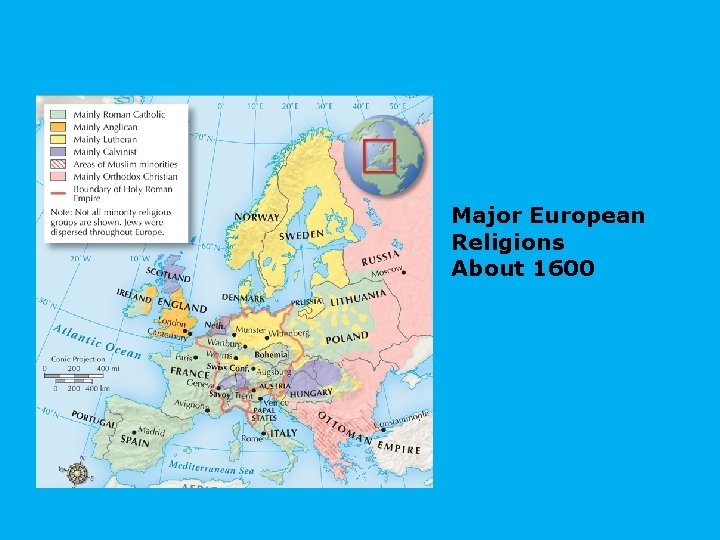
Major European Religions About 1600
From 1530 to 1540, Pope Leo led a movement to reform the Catholic Church. This effort was also called the Counter-Reformation. • In 1545 Pope Leo called the Council of Trent to end corruption and worldliness in the Church and settle issues of doctrine. • The Council declared that salvation comes through both faith and good works.
Pope Leo also strengthened the Inquisition to fight against Protestantism. The Inquisition was a special court set up during the Middle Ages. • The Inquisition used secret testimony, torture, and executions to root out Protestant heresy. • It prepared a list of immoral or irreligious books Catholics could not use, including the writings of Calvin and Luther.
In 1540, the Pope recognized a new religious order, the Society of Jesus, or Jesuits. Ignatius of Loyola, a Spanish knight, founded the order as “soldiers of God. ” • Jesuits followed strict moral and spiritual rules. • Their rigorous training included complete obedience to the Church. • They ran schools and traveled to distant lands as missionaries.
Teresa of Avila established an order of nuns. • Her order lived in isolation, eating and sleeping little. • They dedicated themselves to prayer and meditation. • After her death, Teresa was canonized. During the Counter. Reformation, many Catholics felt renewed feelings of intense faith.
By 1600, a majority of Europeans remained Catholic, but Protestantism had a major foothold on the continent. • The Catholic Reformation succeeding in bringing back many Protestants and in reforming the Church. • Religious conflict influenced political debate, which erupted into war throughout much of Europe.
Heightened passions about religion also resulted in intolerance and persecution. • Between 1450 and 1750, tens of thousands were killed as witches, especially in the German states, Switzerland, and France. Most were women. • Belief in witchcraft represented twin beliefs in Christianity and magic. Witches were seen as agents of the devil and thus anti-Christian.
Jews faced increasing persecution and restrictions during the Reformation. From the 1550 s, many Jews migrated to the Ottoman empire or the Netherlands. • They were expelled from Spain in 1492. • In 1516 Venice ordered Jews to live in a separate part of the city called a ghetto. • Luther called for their expulsion in the north. • In the 1550 s, the Pope added new restrictions.
How did the Reformation bring about two different religious paths in Europe? Throughout Europe, Catholic monarchs and the Catholic Church fought back against the Protestant challenge. They took steps to reform the Church and to restore its spiritual leadership of the Christian world. Still, Protestant ideas continued to spread.