WIR SCHAFFEN WISSEN HEUTE FR MORGEN Patryk Socha
- Slides: 14
WIR SCHAFFEN WISSEN – HEUTE FÜR MORGEN Patryk Socha : : Ph. D student : : Paul Scherrer Institut Radiation-hard Electron Monitor (RADEM) for ESA JUICE mission Instruments for ESA‘s Distributed Space Weather Sensor System, Darmstadt, 23. 10. 2019
Agenda 1. 2. 3. 4. 5. 6. 7. 8. Introduction Radiation monitors development RADEM requirements and properties Scientific output RADEM build and models Performance tests Future plans for radiation monitors Summary Page 2
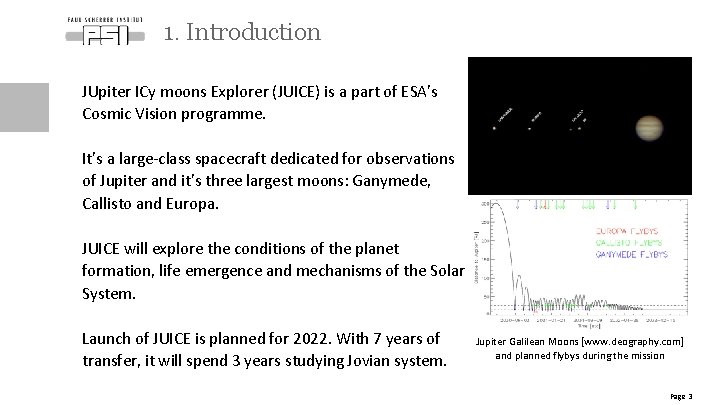
1. Introduction JUpiter ICy moons Explorer (JUICE) is a part of ESA’s Cosmic Vision programme. It’s a large-class spacecraft dedicated for observations of Jupiter and it’s three largest moons: Ganymede, Callisto and Europa. JUICE will explore the conditions of the planet formation, life emergence and mechanisms of the Solar System. Launch of JUICE is planned for 2022. With 7 years of transfer, it will spend 3 years studying Jovian system. Jupiter Galilean Moons [www. deography. com] and planned flybys during the mission Page 3
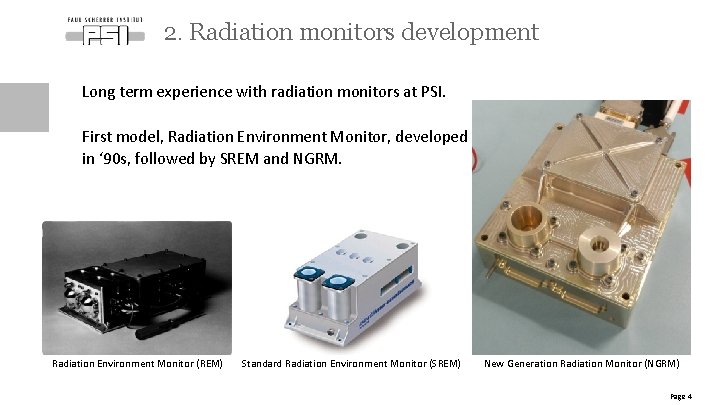
2. Radiation monitors development Long term experience with radiation monitors at PSI. First model, Radiation Environment Monitor, developed in ‘ 90 s, followed by SREM and NGRM. Radiation Environment Monitor (REM) Standard Radiation Environment Monitor (SREM) New Generation Radiation Monitor (NGRM) Page 4
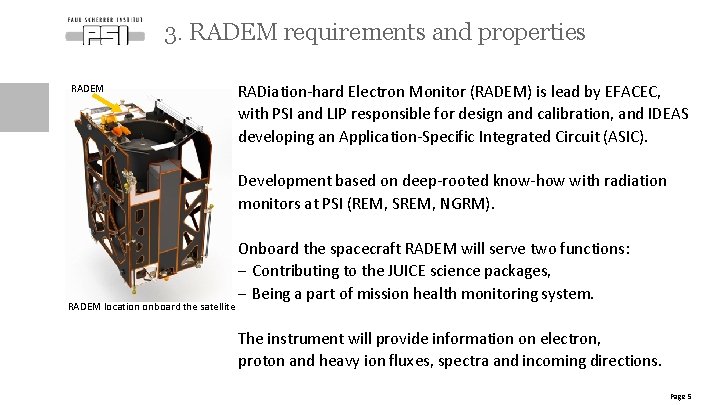
3. RADEM requirements and properties RADEM RADiation-hard Electron Monitor (RADEM) is lead by EFACEC, with PSI and LIP responsible for design and calibration, and IDEAS developing an Application-Specific Integrated Circuit (ASIC). Development based on deep-rooted know-how with radiation monitors at PSI (REM, SREM, NGRM). RADEM location onboard the satellite Onboard the spacecraft RADEM will serve two functions: - Contributing to the JUICE science packages, - Being a part of mission health monitoring system. The instrument will provide information on electron, proton and heavy ion fluxes, spectra and incoming directions. Page 5
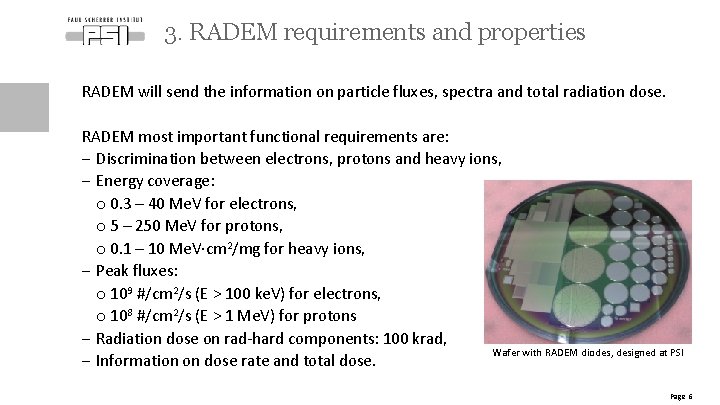
3. RADEM requirements and properties RADEM will send the information on particle fluxes, spectra and total radiation dose. RADEM most important functional requirements are: - Discrimination between electrons, protons and heavy ions, - Energy coverage: o 0. 3 – 40 Me. V for electrons, o 5 – 250 Me. V for protons, o 0. 1 – 10 Me. V·cm 2/mg for heavy ions, - Peak fluxes: o 109 #/cm 2/s (E > 100 ke. V) for electrons, o 108 #/cm 2/s (E > 1 Me. V) for protons - Radiation dose on rad-hard components: 100 krad, Wafer with RADEM diodes, designed at PSI - Information on dose rate and total dose. Page 6
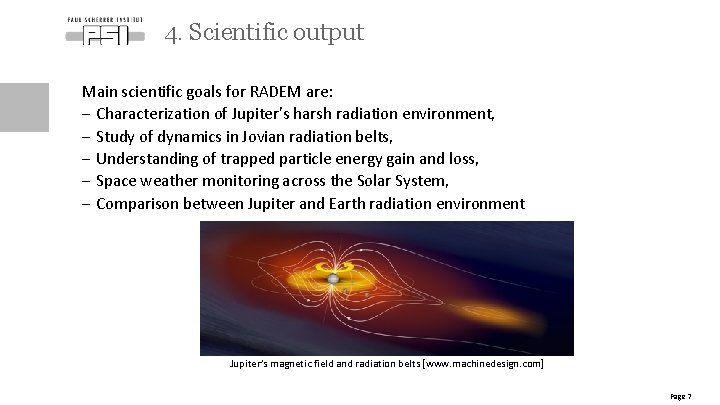
4. Scientific output Main scientific goals for RADEM are: - Characterization of Jupiter’s harsh radiation environment, - Study of dynamics in Jovian radiation belts, - Understanding of trapped particle energy gain and loss, - Space weather monitoring across the Solar System, - Comparison between Jupiter and Earth radiation environment Jupiter’s magnetic field and radiation belts [www. machinedesign. com] Page 7
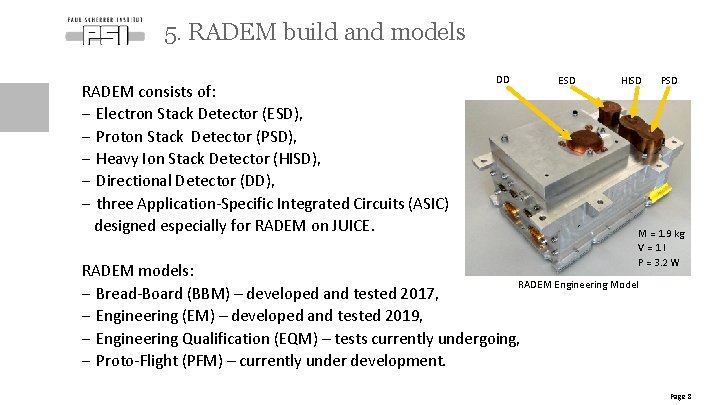
5. RADEM build and models RADEM consists of: - Electron Stack Detector (ESD), - Proton Stack Detector (PSD), - Heavy Ion Stack Detector (HISD), - Directional Detector (DD), - three Application-Specific Integrated Circuits (ASIC) designed especially for RADEM on JUICE. DD ESD HISD PSD M = 1. 9 kg V=1 l P = 3. 2 W RADEM models: RADEM Engineering Model - Bread-Board (BBM) – developed and tested 2017, - Engineering (EM) – developed and tested 2019, - Engineering Qualification (EQM) – tests currently undergoing, - Proto-Flight (PFM) – currently under development. Page 8
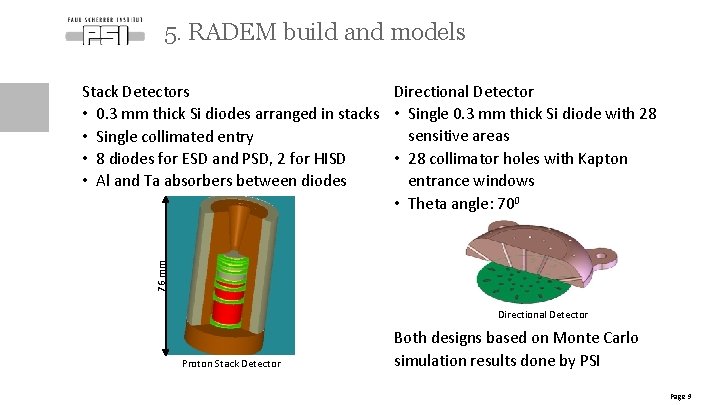
5. RADEM build and models 76 mm Directional Detector Stack Detectors • 0. 3 mm thick Si diodes arranged in stacks • Single 0. 3 mm thick Si diode with 28 sensitive areas • Single collimated entry • 28 collimator holes with Kapton • 8 diodes for ESD and PSD, 2 for HISD entrance windows • Al and Ta absorbers between diodes • Theta angle: 700 Directional Detector Proton Stack Detector Both designs based on Monte Carlo simulation results done by PSI Page 9
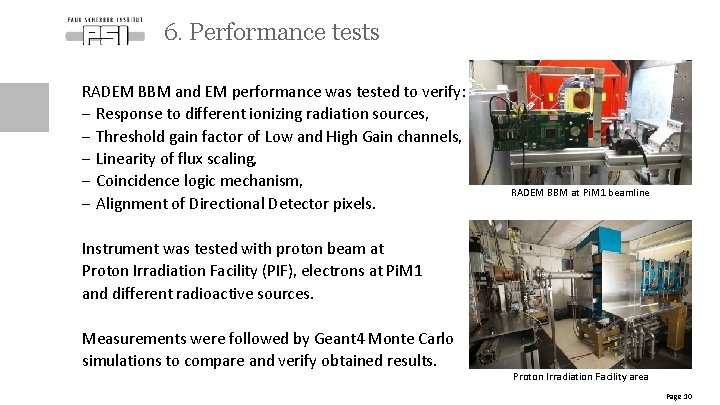
6. Performance tests RADEM BBM and EM performance was tested to verify: - Response to different ionizing radiation sources, - Threshold gain factor of Low and High Gain channels, - Linearity of flux scaling, - Coincidence logic mechanism, - Alignment of Directional Detector pixels. RADEM BBM at Pi. M 1 beamline Instrument was tested with proton beam at Proton Irradiation Facility (PIF), electrons at Pi. M 1 and different radioactive sources. Measurements were followed by Geant 4 Monte Carlo simulations to compare and verify obtained results. Proton Irradiation Facility area Page 10
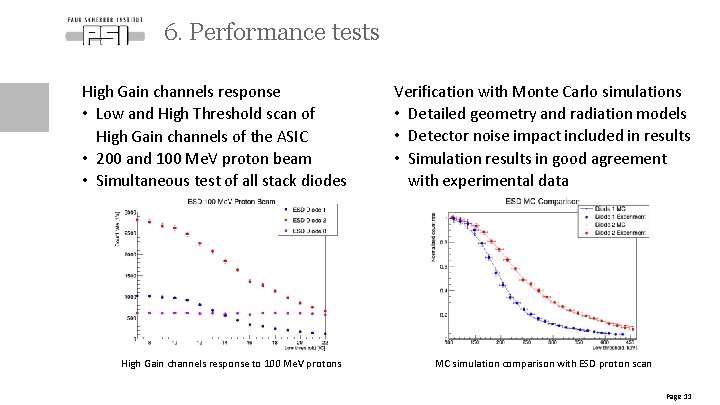
6. Performance tests High Gain channels response • Low and High Threshold scan of High Gain channels of the ASIC • 200 and 100 Me. V proton beam • Simultaneous test of all stack diodes High Gain channels response to 100 Me. V protons Verification with Monte Carlo simulations • Detailed geometry and radiation models • Detector noise impact included in results • Simulation results in good agreement with experimental data MC simulation comparison with ESD proton scan Page 11
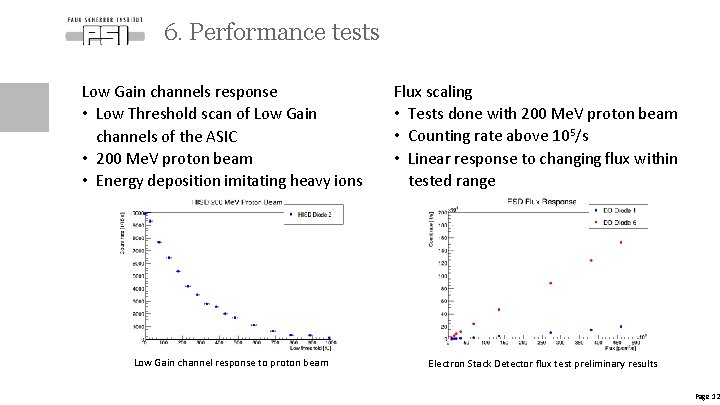
6. Performance tests Low Gain channels response • Low Threshold scan of Low Gain channels of the ASIC • 200 Me. V proton beam • Energy deposition imitating heavy ions Low Gain channel response to proton beam Flux scaling • Tests done with 200 Me. V proton beam • Counting rate above 105/s • Linear response to changing flux within tested range Electron Stack Detector flux test preliminary results Page 12
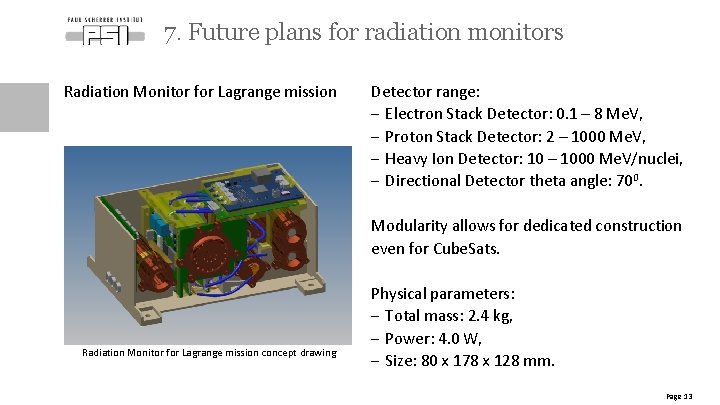
7. Future plans for radiation monitors Radiation Monitor for Lagrange mission Detector range: - Electron Stack Detector: 0. 1 – 8 Me. V, - Proton Stack Detector: 2 – 1000 Me. V, - Heavy Ion Detector: 10 – 1000 Me. V/nuclei, - Directional Detector theta angle: 700. Modularity allows for dedicated construction even for Cube. Sats. Radiation Monitor for Lagrange mission concept drawing Physical parameters: - Total mass: 2. 4 kg, - Power: 4. 0 W, - Size: 80 x 178 x 128 mm. Page 13
Wir schaffen Wissen – heute für morgen 8. Summary RADEM functionalities were verified and compared with MC simulations Final models are currently under development The instrument is planned to be delivered by the end of 2020 Continuous development of radiation monitors at PSI Page 14