Water Rights Permitting Process What TCEQ is looking



- Slides: 43
Water Rights Permitting Process What TCEQ is looking for to make an application administratively complete Water Rights Permitting & Availability Section Water Availability Division
Topics Overview of Water Rights • Application Review Process • Permitting • Hydrology • Environmental • Conservation • Q & A Session •
Permitting Review of Water Rights Joshua Schauer Project Manager Water Rights Permitting Team
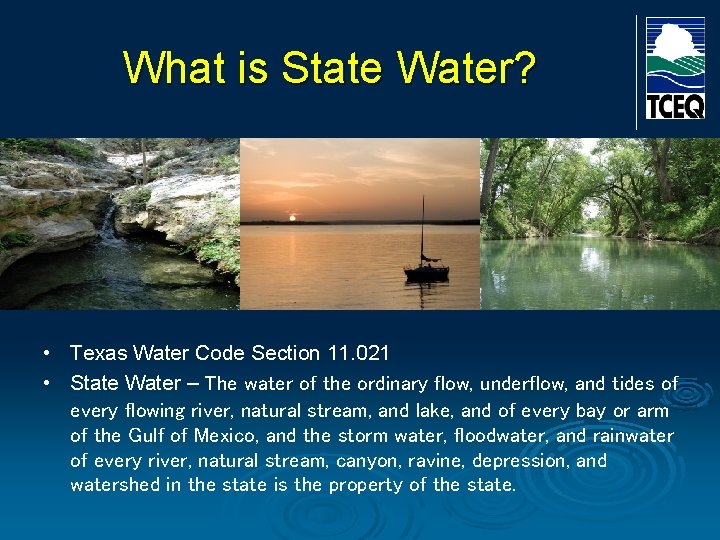
What is State Water? • Texas Water Code Section 11. 021 • State Water – The water of the ordinary flow, underflow, and tides of every flowing river, natural stream, and lake, and of every bay or arm of the Gulf of Mexico, and the storm water, floodwater, and rainwater of every river, natural stream, canyon, ravine, depression, and watershed in the state is the property of the state.
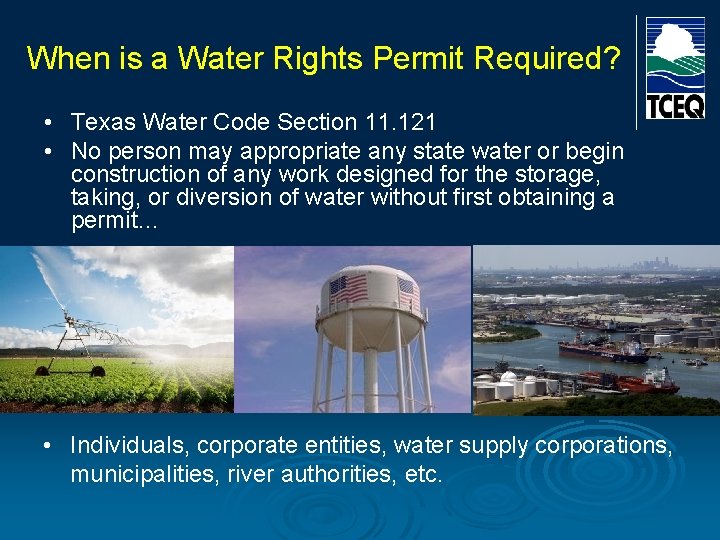
When is a Water Rights Permit Required? • Texas Water Code Section 11. 121 • No person may appropriate any state water or begin construction of any work designed for the storage, taking, or diversion of water without first obtaining a permit… • Individuals, corporate entities, water supply corporations, municipalities, river authorities, etc.
Types of Water Rights Perpetual Rights • • • Water Use Permits Certificates of Adjudication Certified Filings and Claims (rare) Temporary Permits • Issued for a period of 3 years or less • 10 acre-feet or more and/or more than one year • 10 acre-feet or less and less than one year (Regional Office or Watermaster) Term Right • Issued to use appropriated but unused water
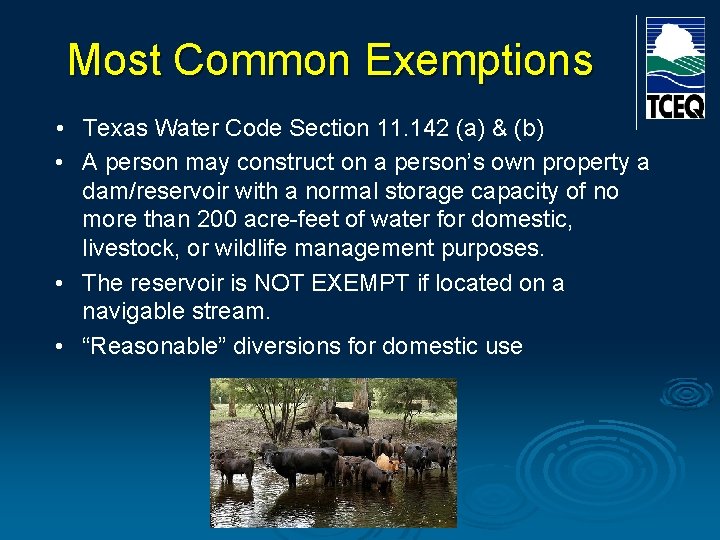
Most Common Exemptions • Texas Water Code Section 11. 142 (a) & (b) • A person may construct on a person’s own property a dam/reservoir with a normal storage capacity of no more than 200 acre-feet of water for domestic, livestock, or wildlife management purposes. • The reservoir is NOT EXEMPT if located on a navigable stream. • “Reasonable” diversions for domestic use
Application Process
Pre-Application Meeting • Not mandatory but highly recommended • Speeds up the process and helps make sure your application is administratively complete when it is submitted to TCEQ. • Who will attend? • Applicant • Consultants and attorneys • Technical staff (Permitting, Hydrology, Conservation, Environmental, Legal, Dam Safety)
Water Rights Application The water rights application consists of two reports and an instruction packet: w Instructions for Completing the Water Rights Permitting Application (TCEQ-10214 a-inst) w Administrative Information Checklist and Administrative Report (TCEQ-10214 b) w Technical Information Report (TCEQ-10214 c) Both forms and the instructions are available on the TCEQ website at: https: //www. tceq. texas. gov/permitting/water_rights/wrpermitting/wr_applications. html
General Information TCEQ evaluates each water right application to determine if it can be granted. This involves a review to ensure: • the application is administratively complete, with all the information we need to evaluate it Title 30, Texas Administrative Code, Chapter 295 • technical requirements are met, such as water availability, conservation, and environmental aspects Title 30, Texas Administrative Code, Chapters 288, 297, 298
Project Manager - Application Review • The project manager is the applicant’s main point of contact at the TCEQ. • Ensures that all application details (amounts, uses, etc. ) are consistent • Updates/creates Central Registry entries • Calculates application and notice fees • Determines whether courtesy information should be given (Water Use Fee assessment)
Project Manager - Application Review TCEQ staff reviews: • • Legal name of the Applicant Signature authority Outstanding fees and penalties TWDB surveys Ownership Deeds for land irrigated and inundated Proper consents or contracts ZIP Codes
Hydrology Review of Water Right Applications Alisa Patterson, P. E. Hydrologist Surface Water Availability Team
Topics Supplemental Worksheets • Diversion • Dam/Reservoir • Maps • Alternate Sources of Water •
Common Information for All Supplemental Worksheets Locational Information • Coordinates in decimal degrees to 6 decimal places Watercourse Information • • Maps Stream or reservoir
Diversion Point Worksheets Diversion Point Number • This is helpful when there are multiple diversion points Diversion Rate Information • • Number of points and the maximum rate in gallons per minute (gpm) Clarification if the rate will be a maximum combined rate between multiple points
Dam/Reservoir Worksheets Reservoir number • This is helpful when there are multiple reservoirs Type of reservoir • On-channel or off-channel Capacity • Acre-feet
Maps Acceptable Maps • • USGS 7. 5 Minute Topographic Aerial Photography Google Earth Others (see Application Instruction Packet: Additional Instructions Relating to Map Requirements) Information to Add to Maps • • • All Diversion points All Discharge points All Reservoirs
Alternate Sources of Water Groundwater • • • Well location (lat/long) and aquifer Groundwater Conservation District permit Evidence that the well can produce the amount needed Surface Water • Contract or Lease Agreement
Environmental Review of Water Right Applications Jade Rutledge Aquatic Scientist Resource Protection Team
Environmental Flow Standards • In 2007, the 80 th Legislature passed Senate Bill 3 relating to the development, management, and preservation of the water resources of the state. • S. B. 3 changed the process for incorporating environmental protection into water rights permits for new appropriations of water.
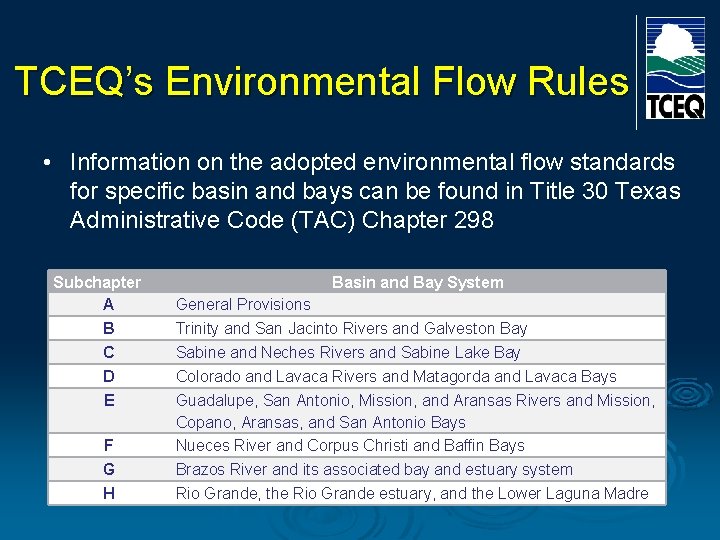
TCEQ’s Environmental Flow Rules • Information on the adopted environmental flow standards for specific basin and bays can be found in Title 30 Texas Administrative Code (TAC) Chapter 298 Subchapter A B C D E F G H Basin and Bay System General Provisions Trinity and San Jacinto Rivers and Galveston Bay Sabine and Neches Rivers and Sabine Lake Bay Colorado and Lavaca Rivers and Matagorda and Lavaca Bays Guadalupe, San Antonio, Mission, and Aransas Rivers and Mission, Copano, Aransas, and San Antonio Bays Nueces River and Corpus Christi and Baffin Bays Brazos River and its associated bay and estuary system Rio Grande, the Rio Grande estuary, and the Lower Laguna Madre
Applications subject to Environmental Flow Reviews • Environmental flow standards apply to an application requesting a new appropriation of water in a basin that has adopted standards (SB 3 basins) • No technical information is required to be submitted for environmental flow reviews
Non-SB 3 Environmental Reviews Non-SB 3 reviews are conducted in accordance with Texas Water Code Sections: • • 11. 042 – Bed and Banks Authorizations 11. 147 – Effects on Bays and Estuaries and Instream Uses 11. 150 – Effects on Water Quality 11. 152 – Effects on Fish and Wildlife Habitat
Applications subject to Non-SB 3 Environmental Reviews • Non-SB 3 environmental reviews apply to any application (including new appropriations) in non-SB 3 basins (Canadian, Red, Sulphur and Cypress Creek Basins) OR • Applications requesting a diversion point move in an SB 3 basin (excluding the mainstem of the Rio Grande below Lake Amistad) • Application Worksheet 5. 0 is required to be submitted for these types of applications
Non-SB 3 Environmental Reviews - Required Application Information • Color photographs of the stream and riparian areas (upstream and downstream) • Description of the waterbody, flow characteristics, waterbody aesthetics and known recreational uses • Impingement and entrainment
Non-SB 3 Environmental Reviews - Information for Dams/Reservoirs • Description of area to be inundated if a new proposed dam/reservoir • Project number and name of USACE project manager if 404 Permit is required • Identification of alternate source of water to maintain the reservoir, if applicable
Non-SB 3 Environmental Reviews Information on Alternate Sources of Water • Well depth and name of source aquifer (if groundwater) • Water chemistry including: • • • Chlorides Sulfates Total Dissolved Solids (TDS) p. H Temperature
Water Conservation Review Trent Jennings Water Conservation Specialist Resource Protection Team
Title 30 TAC Chapter 288 • Rules and requirements for Water Conservation Plans are governed by Title 30 TAC Sections 288. 2, 288. 3, 288. 4 and 288. 5 • Rules and requirements for Drought Contingency Plans are governed by Title 30 TAC Sections 288. 20, 288. 21 and 288. 22
Water Conservation Plans (WCP) • Water Conservation - everyday practices or techniques intended to reduce water consumption, reduce loss or waste of water, improve the efficiency in the use of water and increase recycling & reuse so that a water supply is available for future use.
Drought Contingency Plans (DCP) • A strategy or combination of strategies for temporary and potentially recurring water supply shortages and other water supply emergencies.
Drought Contingency vs. Water Conservation = all the time Drought Contingency = when necessary
Water Right Applications • An application for a new water right and certain applications to amend existing water rights require the submission of a WCP and a DCP. • The TCEQ evaluates WCPs in accordance with agency rule requirements in Title 30 TAC Chapter 288 for applications requesting consumptive uses of water including municipal, industrial, mining, and agricultural purposes. • The TCEQ also determines consistency with State and Regional Water Plans for water rights applications.
Municipal WCP Elements • • • Utility Profile Record Management (Retail use only) 5 & 10 year goals for water savings Meter calibration and replacement Water loss accounting Public education program Non-promotional water rates Implementation and Enforcement Coordination with your RWPG
Utility Profile Population and customer data • Water use data in gallons per capita per day (GPCD) • Water supply system data • Wastewater system data •
DCPs for Water Rights Applications • DCPs are required for municipal water rights applications. • TCEQ requires retail and wholesale public water suppliers and irrigation districts to develop drought contingency plans.
DCP Plan Elements • • • Public Involvement Ongoing Education Notification Procedures Triggering Criteria Response Stages Quantified Targets Management Measures Variances Enforcement & Adoption of the DCP
Non-Water Rights Submittals Required for: • Non-irrigation (municipal and industrial) water rights holders of 1, 000 acre-feet or more and • Irrigation water rights holders of 10, 000 acre-feet or more WCPs are required to be submitted to TCEQ every 5 years
Non-Water Rights Submittals Required for: • Retail public water suppliers with 3, 300 or more connections, wholesale water suppliers, and irrigation districts are required to submit their DCP to the TCEQ every 5 years. • Retail public water suppliers with less than 3, 300 connections must prepare and adopt a drought contingency plan and make the plan available for inspection by TCEQ, but they are not required to submit plans to TCEQ.
Reminders • DCPs should be revised as often as necessary especially as your triggers change over time. • Note: May 1, 2019 was the deadline to submit revised WCPs and DCPs for non-water right submittals to TCEQ.
Contact Information & Website Water Availability Division Water Rights Permitting & Availability Section 512 -239 -4691 https: //www. tceq. texas. gov/permitting/water_righ ts/wawr_permits. html