Washington Association Medical Staff Services Professionals Kennewick Washington


- Slides: 19
Washington Association Medical Staff Services Professionals Kennewick, Washington “How to Prevent and Treat Medical Staff Services Professional Burnout” Jon Burroughs, MD, MBA, FACHE, FAAPL April 25, 2019
“Optimizing MSP Wellness” Part 1: Identifying and Treating Burnout
Anonymous Survey: On a scale of 0 (indifferent and sickened) to 5 (average) to 10 (euphoric and transcendental), how do you feel about your current job? Note: Please do NOT identify yourself
The Concept of Burnout is Relatively New and the Symptoms are Ancient Herbert Freudenberger (1974): “Burnout” and “Stress” are NOT the same: I. Emotional exhaustion II. Depersonalization and cynicism III. Poor personal performance
Stress v. Burnout: Over-engagement v. Disengagement Over-reactive v. Indifferent Urgency v. Hopelessness Energy fatigue v. No energy or motivation Physical damage v. Emotional damage Strong personal and emotional values v. Valueless and complete detachment Over-investment in work v. No investment in work (or anything else)
Please write down the one or two most destructive elements of your job that may cause you to want to leave it one day
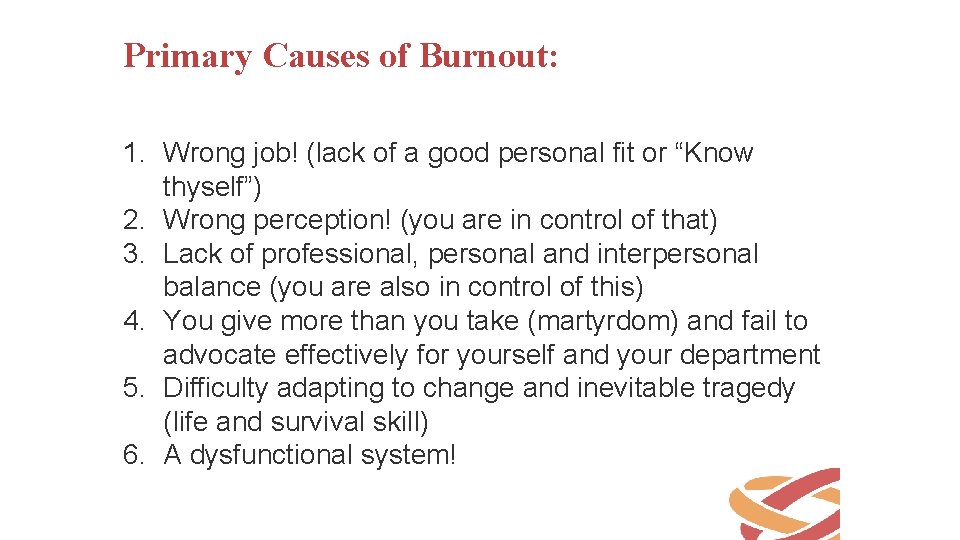
Primary Causes of Burnout: 1. Wrong job! (lack of a good personal fit or “Know thyself”) 2. Wrong perception! (you are in control of that) 3. Lack of professional, personal and interpersonal balance (you are also in control of this) 4. You give more than you take (martyrdom) and fail to advocate effectively for yourself and your department 5. Difficulty adapting to change and inevitable tragedy (life and survival skill) 6. A dysfunctional system!
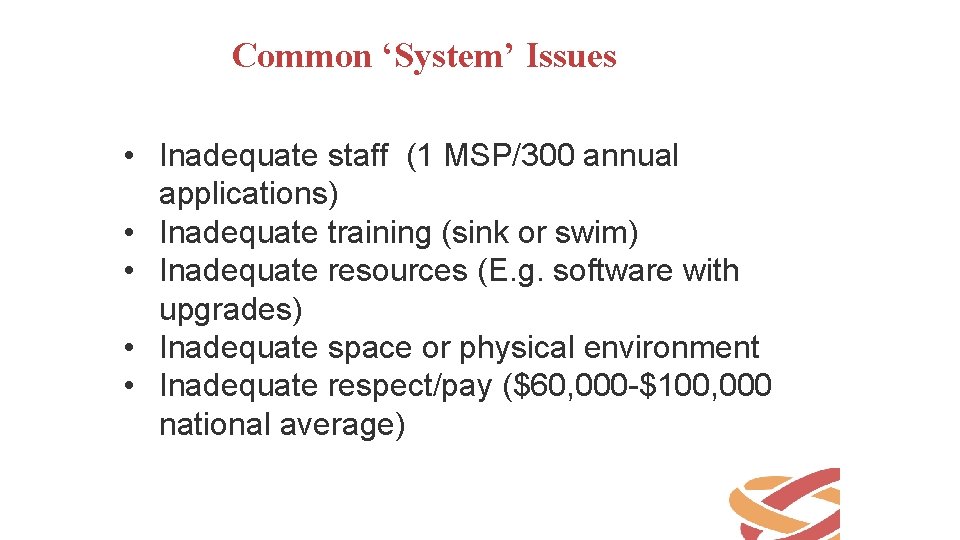
Common ‘System’ Issues • Inadequate staff (1 MSP/300 annual applications) • Inadequate training (sink or swim) • Inadequate resources (E. g. software with upgrades) • Inadequate space or physical environment • Inadequate respect/pay ($60, 000 -$100, 000 national average)
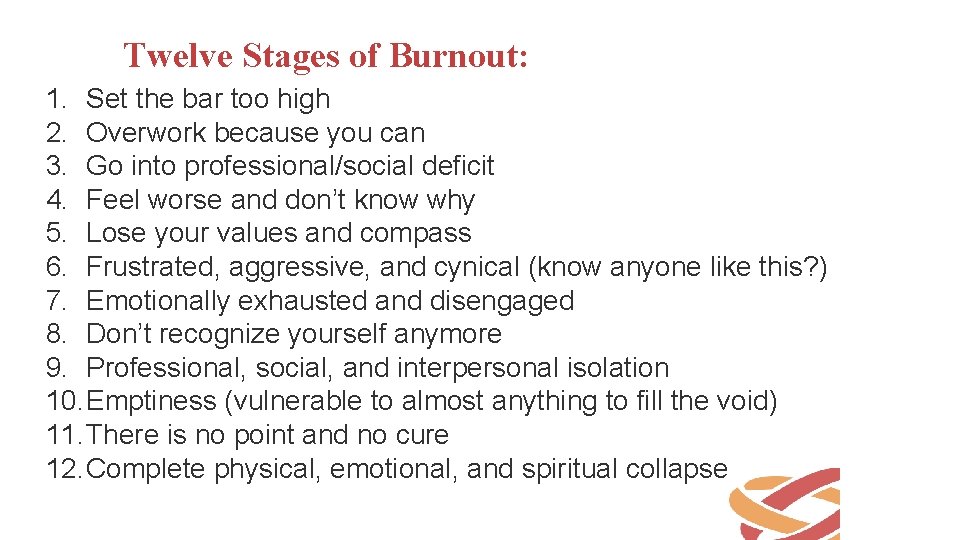
Twelve Stages of Burnout: 1. Set the bar too high 2. Overwork because you can 3. Go into professional/social deficit 4. Feel worse and don’t know why 5. Lose your values and compass 6. Frustrated, aggressive, and cynical (know anyone like this? ) 7. Emotionally exhausted and disengaged 8. Don’t recognize yourself anymore 9. Professional, social, and interpersonal isolation 10. Emptiness (vulnerable to almost anything to fill the void) 11. There is no point and no cure 12. Complete physical, emotional, and spiritual collapse
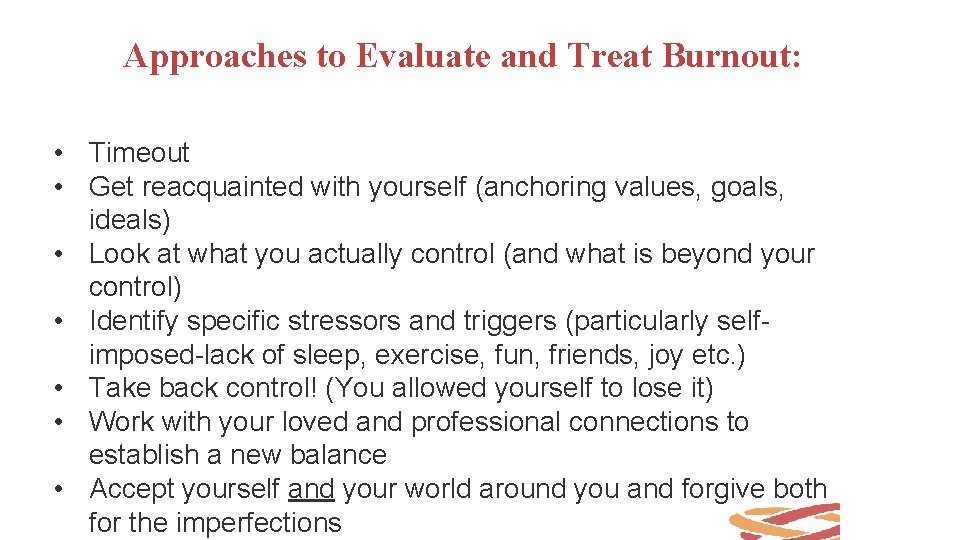
Approaches to Evaluate and Treat Burnout: • Timeout • Get reacquainted with yourself (anchoring values, goals, ideals) • Look at what you actually control (and what is beyond your control) • Identify specific stressors and triggers (particularly selfimposed-lack of sleep, exercise, fun, friends, joy etc. ) • Take back control! (You allowed yourself to lose it) • Work with your loved and professional connections to establish a new balance • Accept yourself and your world around you and forgive both for the imperfections
Sometimes help is necessary: • Personal counseling/coaching • Professional counseling/coaching (particularly with MSP/business acumen) • Medication • Vocational counseling (optimum job fit)
If the problem is ‘the job’…. . • • • Consider renegotiating the job itself Clarify the job description Do a job analysis to see what you actually do! Ask for new or different duties Ask for some time off to regroup and recreate Have someone with business acumen do a business plan for optimizing: staff, resources, environment, and interpersonal dynamics
“Optimizing MSP Wellness” Part 2: Prevention of MSP Burnout (a better approach)
On the job…. • Can you advocate for yourself and your staff? • Can you identify stressors early and not wait for them to grow? • Can you ‘speak to power’ in a respectful and assertive way? • Can you lay out the business argument for adequate staff, resources, tools, equipment etc. ? • Can you delegate and empower others? • Can you stop disrespect and condescension in its tracks? • Can you establish an appropriate balance between service and control?
Know thyself- “To Thyself be True” • Are you realistic about who you are and what your fundamental needs are? • Do you have a good balance between attending to others and nourishing your own mind, body, and spirit? • Did you lose your way? Can you find your way back to YOUR path? • Will your family, loved ones, and professional colleagues support you on YOUR path? • Can you accept yourself AND your path?
Please Share with the Group The one or two things that have been most impactful in keeping yourself on a positive path that avoids the temptations of burnout?
Take back your Power; it never belonged to anyone else in the first place! “Become the change you want to see. ” Mahatma Gandhi
Questions and Discussion
Thank You for your Participation! Jon Burroughs, MD, MBA, FACHE, FAAPL jburroughs@burroughshealthcare. com; 603 -733 -8156