
CERTIFIED CLINICAL TRAUMA PROFESSIONAL Trauma PTSD Grief Loss




- Slides: 69
CERTIFIED CLINICAL TRAUMA PROFESSIONAL: Trauma, PTSD, Grief & Loss International Association of Trauma Professionals J. Eric Gentry, Ph. D, LMHC Board-Certified Expert in Traumatic Stress
Day II Welcome
International Association of Trauma Professionals Certifications: • • FREE MEMBERSHIP!!!!! • • • CCTP: Certified Trauma Professional/Certified Clinical Trauma Professional CCFP: Certified Compassion Fatigue Professional CETP: Certified Expert Trauma Professional Certified SANATIVE Professional CSOTP: Certified Sex Offender Treatment Professional CYTP: Certified Youth Trauma Professional CFTP: Certified Family Trauma Professional QTIP: Qualified Trauma-Informed Professional Certified Master Trauma Professional Certified Anger Management Specialist Certified Gambling Addiction Professional www. traumapro. net
Resources www. traumapro. net/resources Password: iatp 2 go CAPSULE 8: Survey of Effective Treatments
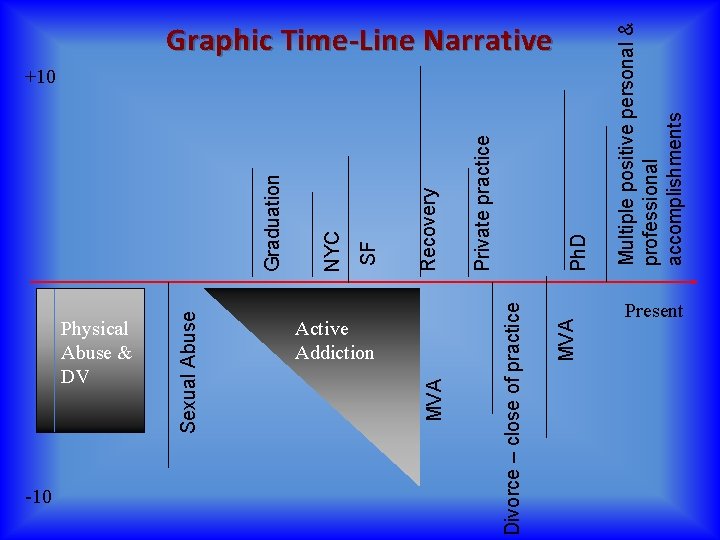
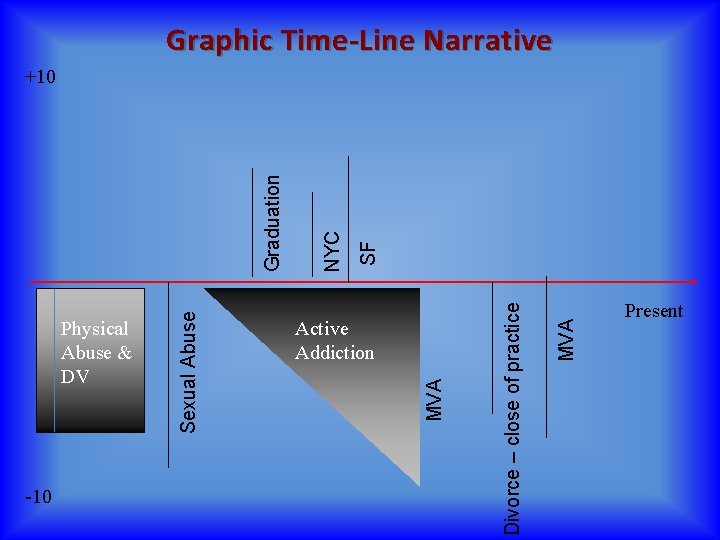
Graphic Time Line • Use Part 1 of TRS • 5 min – all the difficult/painful/traumatic experiences • 5 min – all the positive experiences • 30 min – verbal narrative International Association of Trauma Professionals 5
Graphic Time Life. Line Birth Present
Physical Abuse & DV MVA Active Addiction MVA Divorce – close of practice -10 Sexual Abuse +10 Multiple positive personal & professional accomplishments Ph. D Private practice Recovery SF NYC Graduation Graphic Time Line Narrative Present
Graphic Time Line Narrative MVA NYC SF Divorce – close of practice -10 Active Addiction MVA Physical Abuse & DV Sexual Abuse Graduation +10 Present
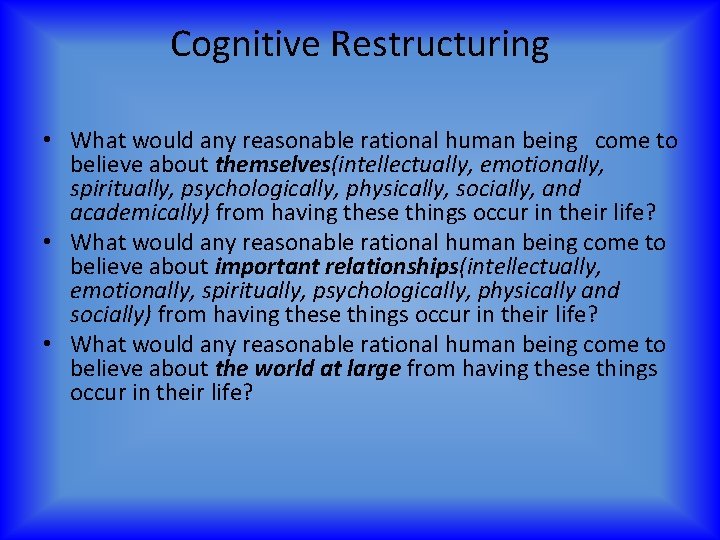
Cognitive Restructuring • What would any reasonable rational human being come to believe about themselves(intellectually, emotionally, spiritually, psychologically, physically, socially, and academically) from having these things occur in their life? • What would any reasonable rational human being come to believe about important relationships(intellectually, emotionally, spiritually, psychologically, physically and socially) from having these things occur in their life? • What would any reasonable rational human being come to believe about the world at large from having these things occur in their life?
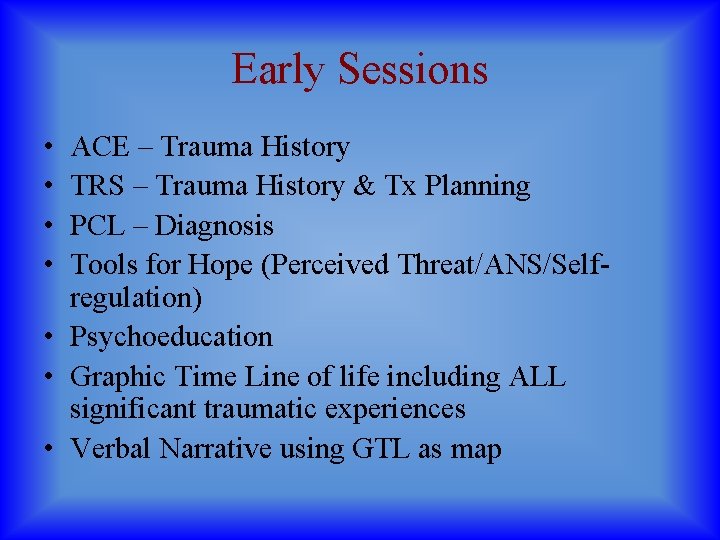
Early Sessions • • ACE – Trauma History TRS – Trauma History & Tx Planning PCL – Diagnosis Tools for Hope (Perceived Threat/ANS/Selfregulation) • Psychoeducation • Graphic Time Line of life including ALL significant traumatic experiences • Verbal Narrative using GTL as map
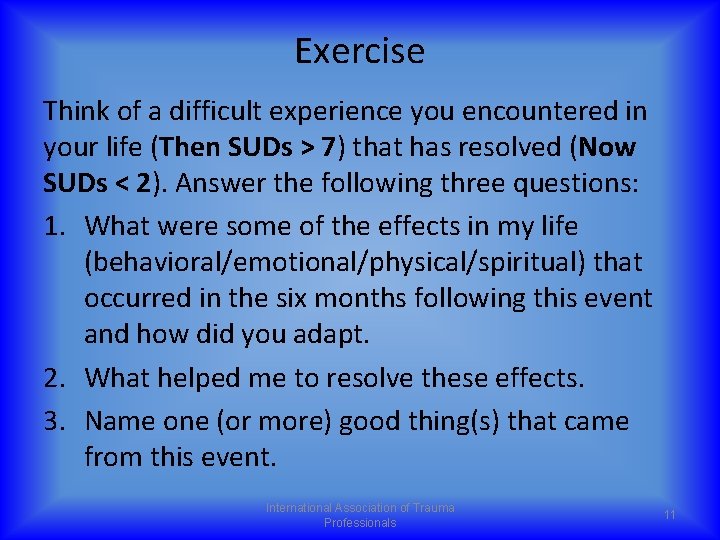
Exercise Think of a difficult experience you encountered in your life (Then SUDs > 7) that has resolved (Now SUDs < 2). Answer the following three questions: 1. What were some of the effects in my life (behavioral/emotional/physical/spiritual) that occurred in the six months following this event and how did you adapt. 2. What helped me to resolve these effects. 3. Name one (or more) good thing(s) that came from this event. International Association of Trauma Professionals 11
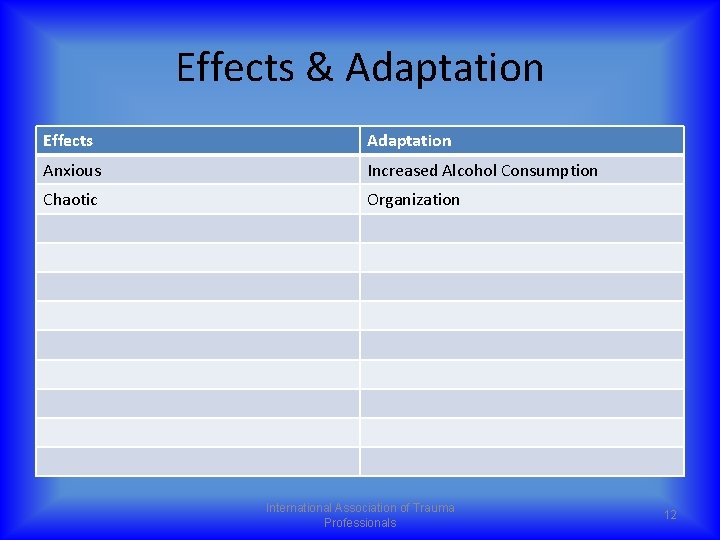
Effects & Adaptation Effects Adaptation Anxious Increased Alcohol Consumption Chaotic Organization International Association of Trauma Professionals 12
Healing Tools International Association of Trauma Professionals 13
What Good Came From Our Adaption Healing Tools International Association of Trauma Professionals 14
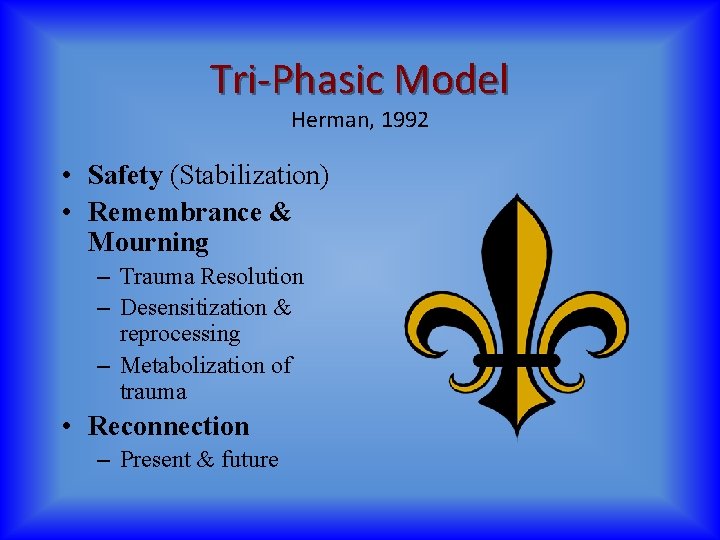
Tri-Phasic Model Herman, 1992 • Safety (Stabilization) • Remembrance & Mourning – Trauma Resolution – Desensitization & reprocessing – Metabolization of trauma • Reconnection – Present & future
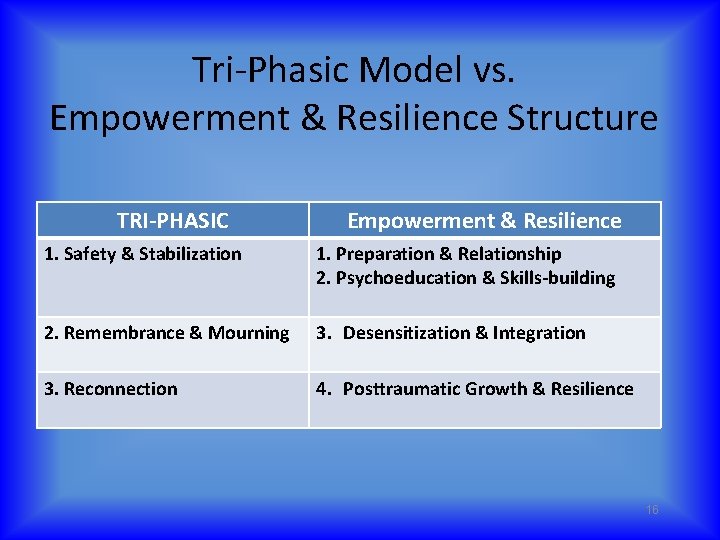
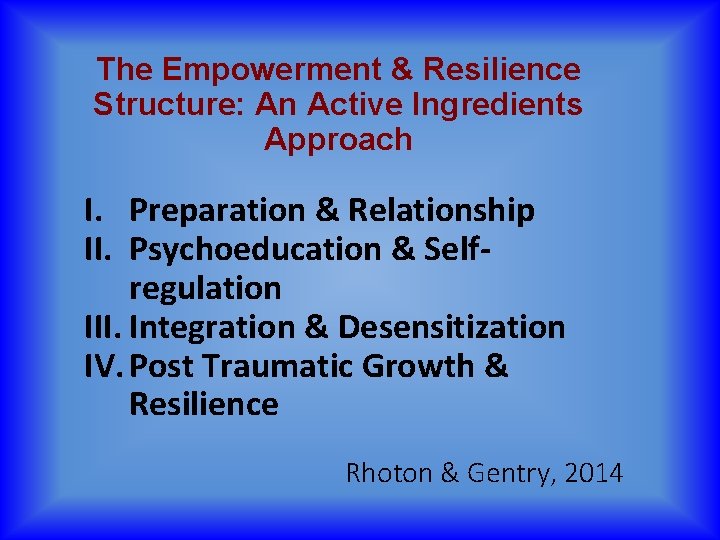
Tri-Phasic Model vs. Empowerment & Resilience Structure TRI PHASIC Empowerment & Resilience 1. Safety & Stabilization 1. Preparation & Relationship 2. Psychoeducation & Skills building 2. Remembrance & Mourning 3. Desensitization & Integration 3. Reconnection 4. Posttraumatic Growth & Resilience 16
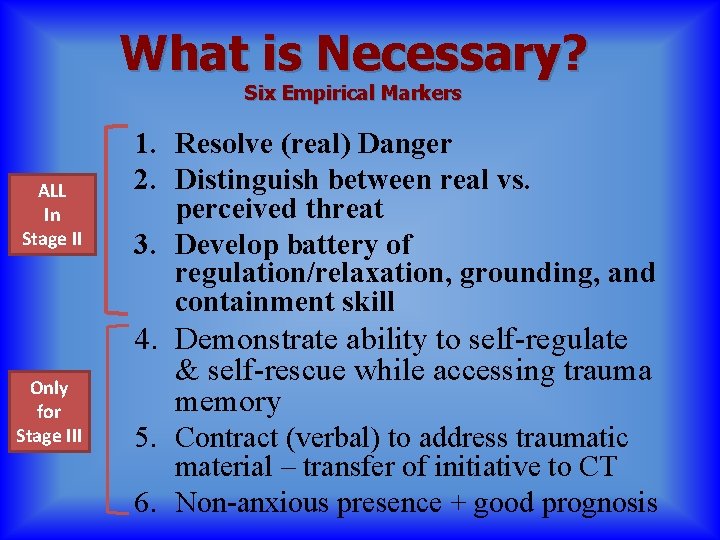
What is Necessary? Six Empirical Markers ALL In Stage II Only for Stage III 1. Resolve (real) Danger 2. Distinguish between real vs. perceived threat 3. Develop battery of regulation/relaxation, grounding, and containment skill 4. Demonstrate ability to self-regulate & self-rescue while accessing trauma memory 5. Contract (verbal) to address traumatic material – transfer of initiative to CT 6. Non-anxious presence + good prognosis
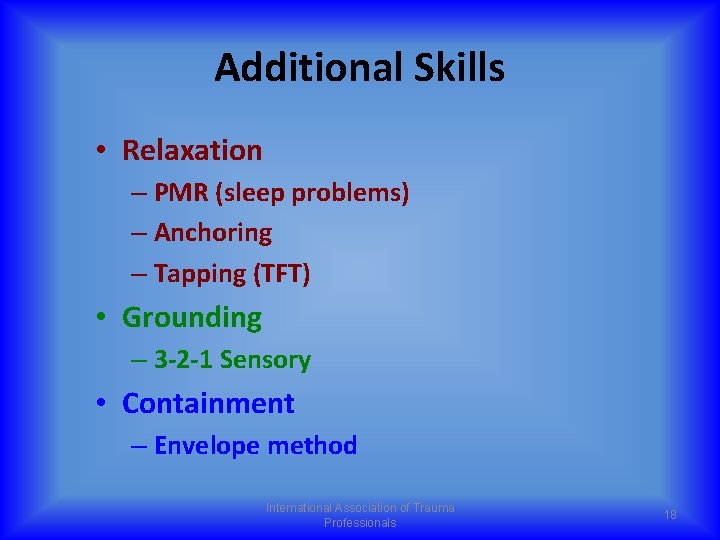
Additional Skills • Relaxation – PMR (sleep problems) – Anchoring – Tapping (TFT) • Grounding – 3 2 1 Sensory • Containment – Envelope method International Association of Trauma Professionals 18
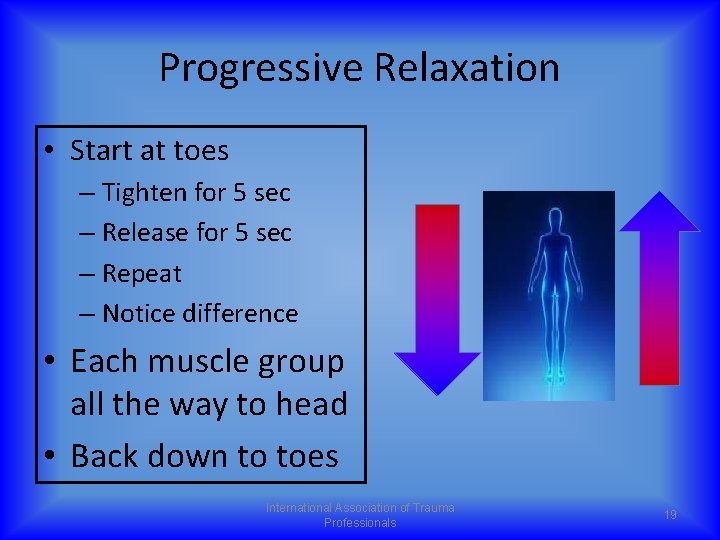
Progressive Relaxation • Start at toes – Tighten for 5 sec – Release for 5 sec – Repeat – Notice difference • Each muscle group all the way to head • Back down to toes International Association of Trauma Professionals 19
Anchoring - NLP • Draw pix of place from hx or imagination that is safe & comfortable (5 min) • “May I approach you? ” • Experiment – flashbacks of “good” stuff • Anchor (squeeze) stone while telling story • Carry stone for week – Squeeze when anxious – Squeeze when comfortable • Report next week International Association of Trauma Professionals 20
Thought Field Therapy (TFT) Callahan What is Thought Field Therapy® (TFT)? • Thought Field Therapy (TFT) is a little-known, but highly effective, drug-free and non-invasive way to reduce or eliminate even chronic pain without the risk of medications. • TFT was discovered and developed by California clinical psychologist, Dr. Roger Callahan. It works with nature’s healing system combining the acupressure meridian system and modern psychology. • While there is increasing evidence as to its effectiveness for TFT (even more with EFT), especially with pain, we are using TFT here as a SELF-HELP METHOD for ANXIETY REDUCTION – not a treatment for traumatic stress!
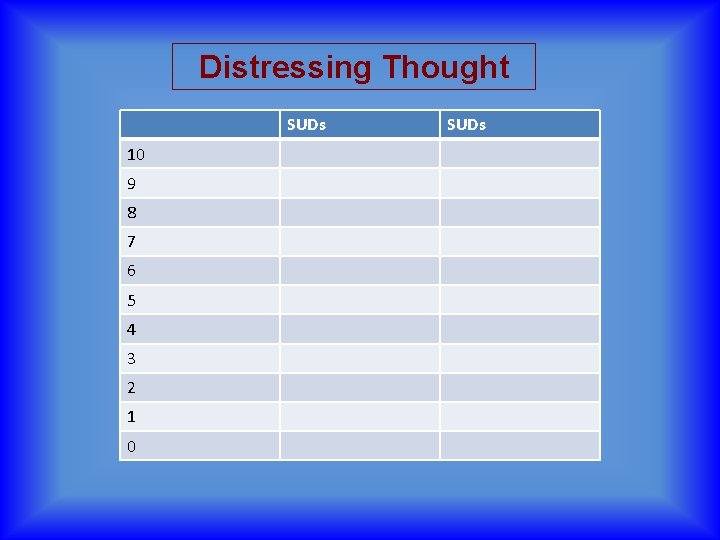
Distressing Thought SUDs 10 9 8 7 6 5 4 3 2 1 0 SUDs
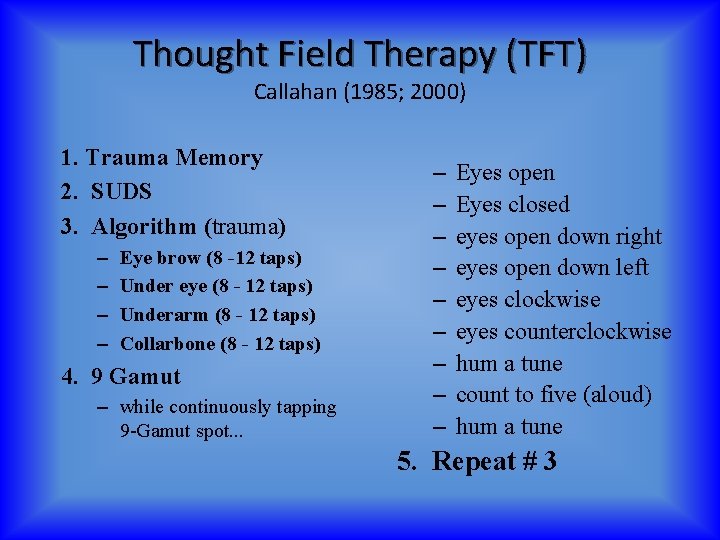
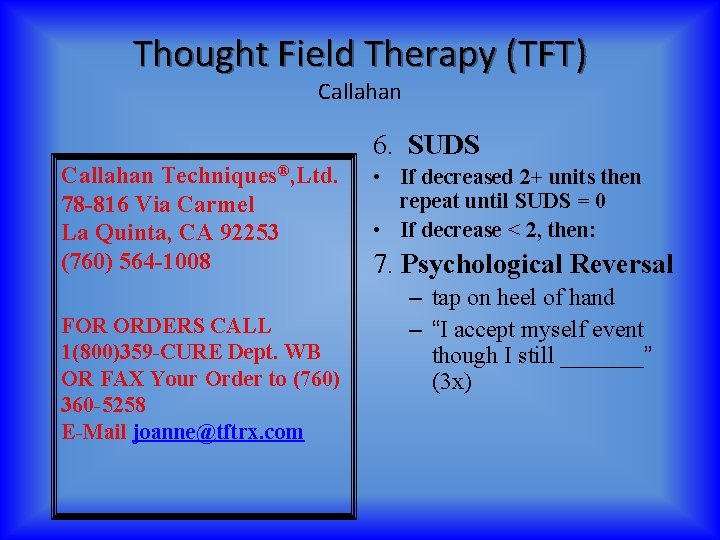
Thought Field Therapy (TFT) Callahan (1985; 2000) 1. Trauma Memory 2. SUDS 3. Algorithm (trauma) – – Eye brow (8 -12 taps) Under eye (8 - 12 taps) Underarm (8 - 12 taps) Collarbone (8 - 12 taps) 4. 9 Gamut – while continuously tapping 9 -Gamut spot. . . – – – – – Eyes open Eyes closed eyes open down right eyes open down left eyes clockwise eyes counterclockwise hum a tune count to five (aloud) hum a tune 5. Repeat # 3
Thought Field Therapy (TFT) Callahan 6. SUDS Callahan Techniques®, Ltd. 78 -816 Via Carmel La Quinta, CA 92253 (760) 564 -1008 FOR ORDERS CALL 1(800)359 -CURE Dept. WB OR FAX Your Order to (760) 360 -5258 E-Mail joanne@tftrx. com • If decreased 2+ units then repeat until SUDS = 0 • If decrease < 2, then: 7. Psychological Reversal – tap on heel of hand – “I accept myself event though I still _______” (3 x)
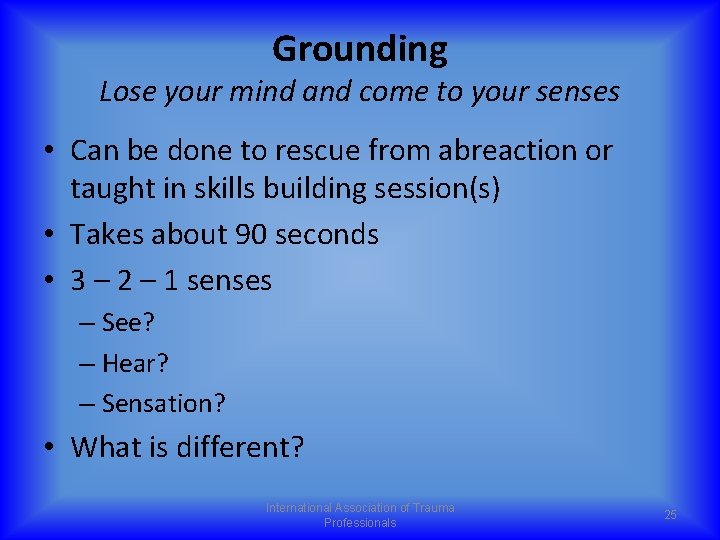
Grounding Lose your mind and come to your senses • Can be done to rescue from abreaction or taught in skills building session(s) • Takes about 90 seconds • 3 – 2 – 1 senses – See? – Hear? – Sensation? • What is different? International Association of Trauma Professionals 25
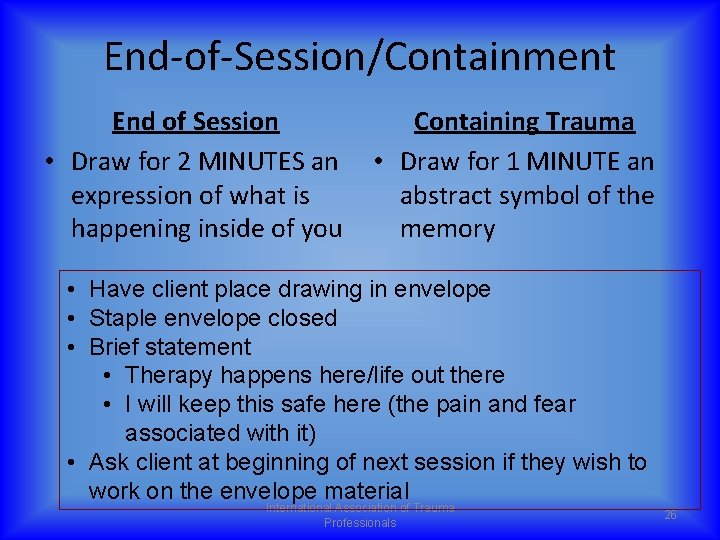
End-of-Session/Containment Containing Trauma End of Session • Draw for 2 MINUTES an • Draw for 1 MINUTE an abstract symbol of the expression of what is memory happening inside of you • Have client place drawing in envelope • Staple envelope closed • Brief statement • Therapy happens here/life out there • I will keep this safe here (the pain and fear associated with it) • Ask client at beginning of next session if they wish to work on the envelope material International Association of Trauma Professionals 26
Desensitization & Integration STAGE III International Association of Trauma Professionals 27
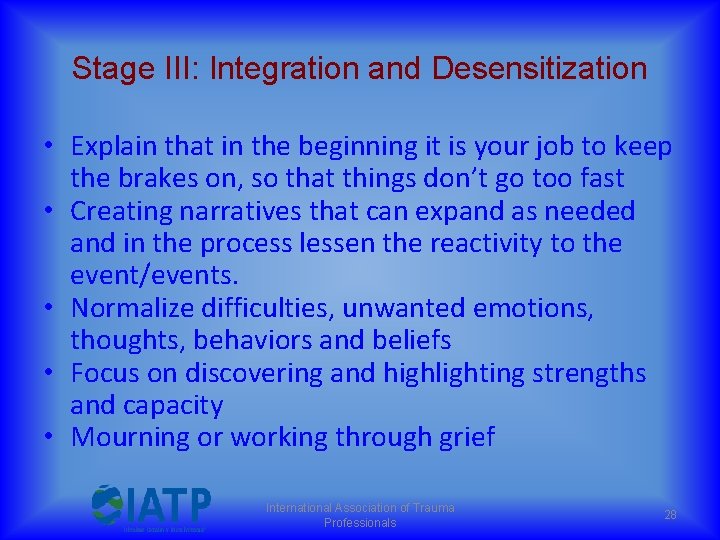
Stage III: Integration and Desensitization • Explain that in the beginning it is your job to keep the brakes on, so that things don’t go too fast • Creating narratives that can expand as needed and in the process lessen the reactivity to the event/events. • Normalize difficulties, unwanted emotions, thoughts, behaviors and beliefs • Focus on discovering and highlighting strengths and capacity • Mourning or working through grief International Association of Trauma Professionals 28
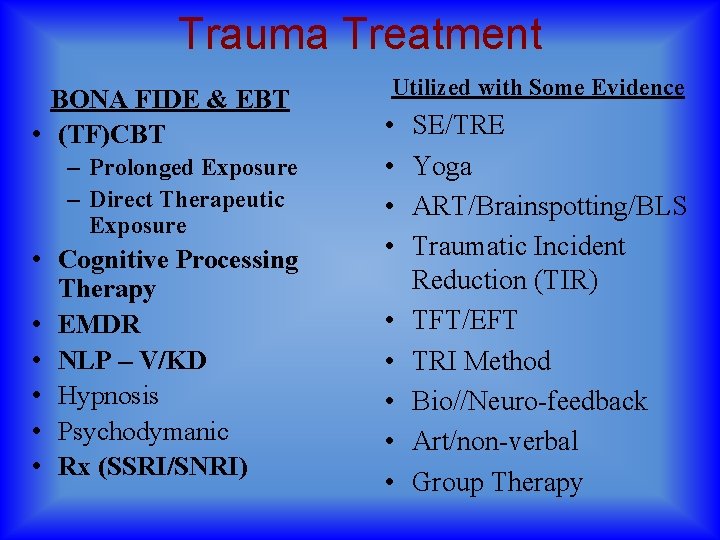
Trauma Treatment BONA FIDE & EBT • (TF)CBT – Prolonged Exposure – Direct Therapeutic Exposure • Cognitive Processing Therapy • EMDR • NLP – V/KD • Hypnosis • Psychodymanic • Rx (SSRI/SNRI) Utilized with Some Evidence • • • SE/TRE Yoga ART/Brainspotting/BLS Traumatic Incident Reduction (TIR) TFT/EFT TRI Method Bio//Neuro-feedback Art/non-verbal Group Therapy
Desensitization & Integration Trauma Memory Processing The IATP 5 -Narrative Model (Gentry, 2004; 2011; 2014)
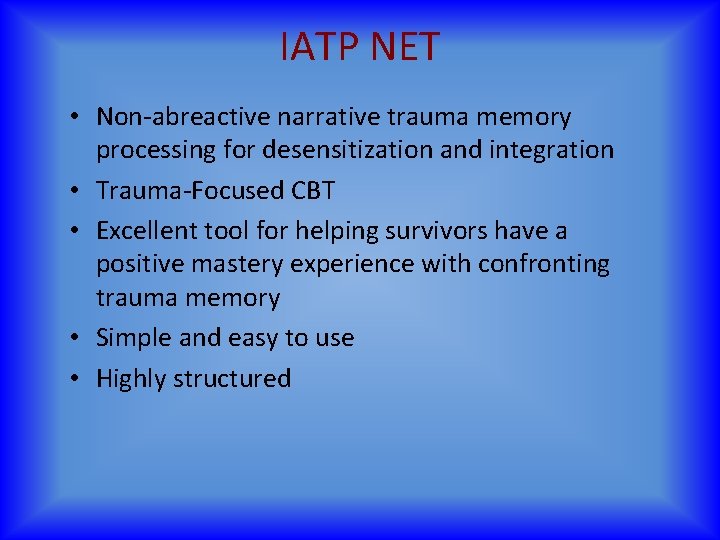
IATP NET • Non-abreactive narrative trauma memory processing for desensitization and integration • Trauma-Focused CBT • Excellent tool for helping survivors have a positive mastery experience with confronting trauma memory • Simple and easy to use • Highly structured
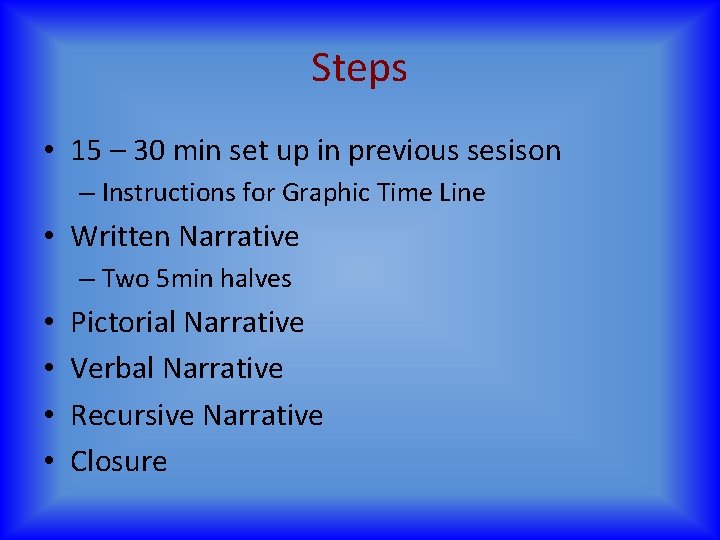
Steps • 15 – 30 min set up in previous sesison – Instructions for Graphic Time Line • Written Narrative – Two 5 min halves • • Pictorial Narrative Verbal Narrative Recursive Narrative Closure
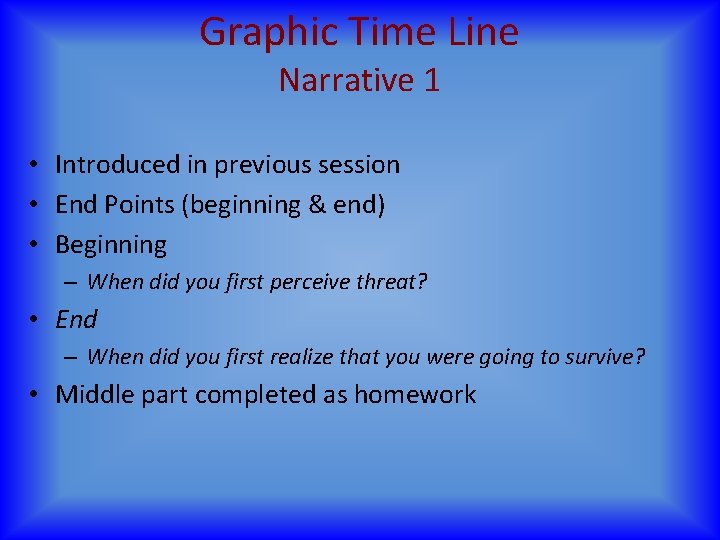
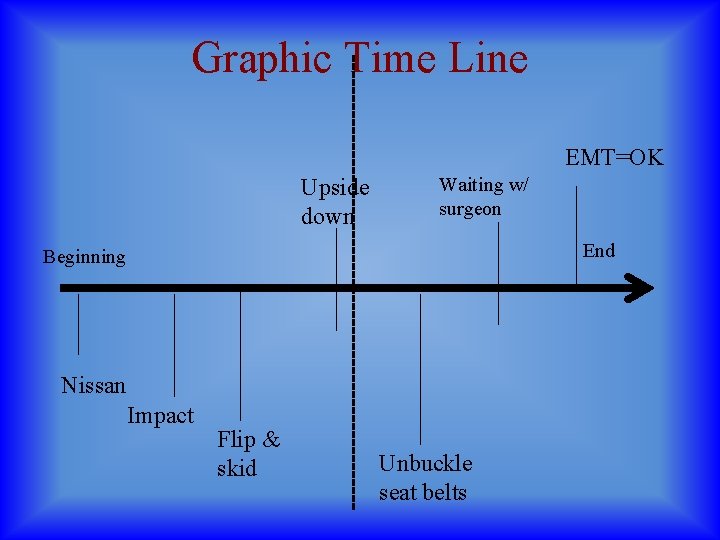
Graphic Time Line Narrative 1 • Introduced in previous session • End Points (beginning & end) • Beginning – When did you first perceive threat? • End – When did you first realize that you were going to survive? • Middle part completed as homework
Graphic Time Line EMT=OK Upside down Waiting w/ surgeon End Beginning Nissan Impact Flip & skid Unbuckle seat belts
International Association of Trauma Professionals 35
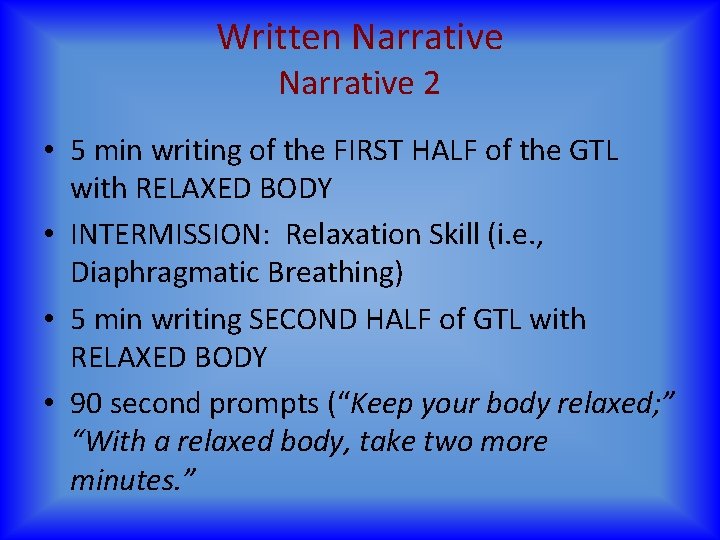
Written Narrative 2 • 5 min writing of the FIRST HALF of the GTL with RELAXED BODY • INTERMISSION: Relaxation Skill (i. e. , Diaphragmatic Breathing) • 5 min writing SECOND HALF of GTL with RELAXED BODY • 90 second prompts (“Keep your body relaxed; ” “With a relaxed body, take two more minutes. ”
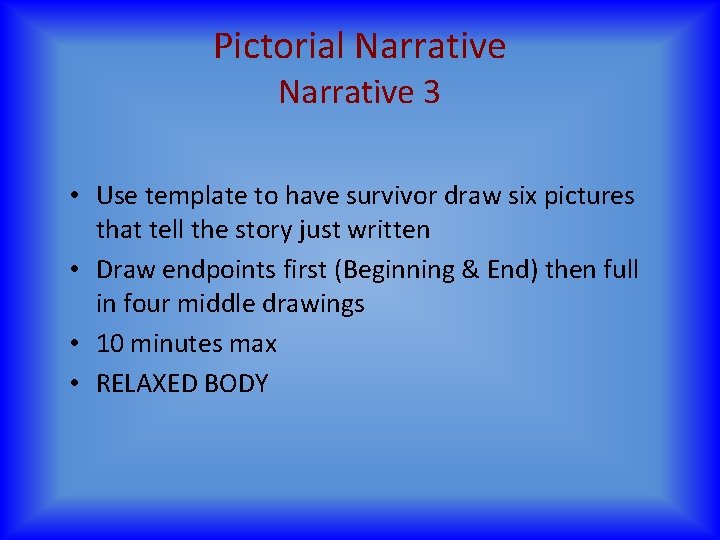
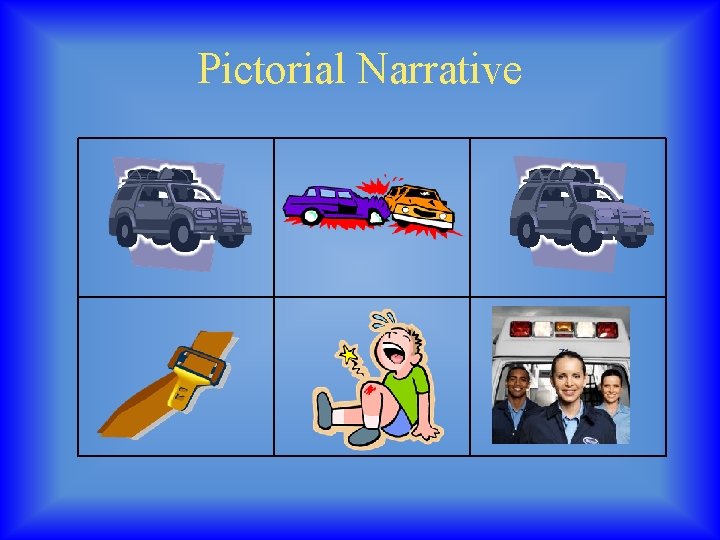
Pictorial Narrative 3 • Use template to have survivor draw six pictures that tell the story just written • Draw endpoints first (Beginning & End) then full in four middle drawings • 10 minutes max • RELAXED BODY
Pictorial Narrative
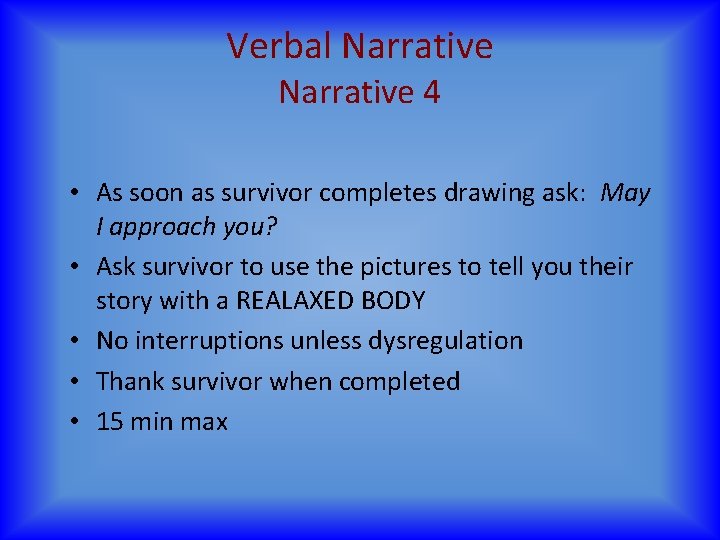
Verbal Narrative 4 • As soon as survivor completes drawing ask: May I approach you? • Ask survivor to use the pictures to tell you their story with a REALAXED BODY • No interruptions unless dysregulation • Thank survivor when completed • 15 min max
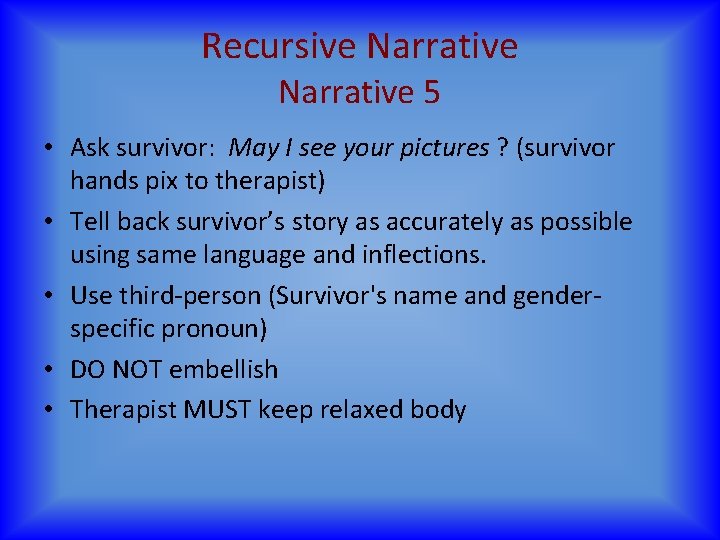
Recursive Narrative 5 • Ask survivor: May I see your pictures ? (survivor hands pix to therapist) • Tell back survivor’s story as accurately as possible using same language and inflections. • Use third-person (Survivor's name and genderspecific pronoun) • DO NOT embellish • Therapist MUST keep relaxed body
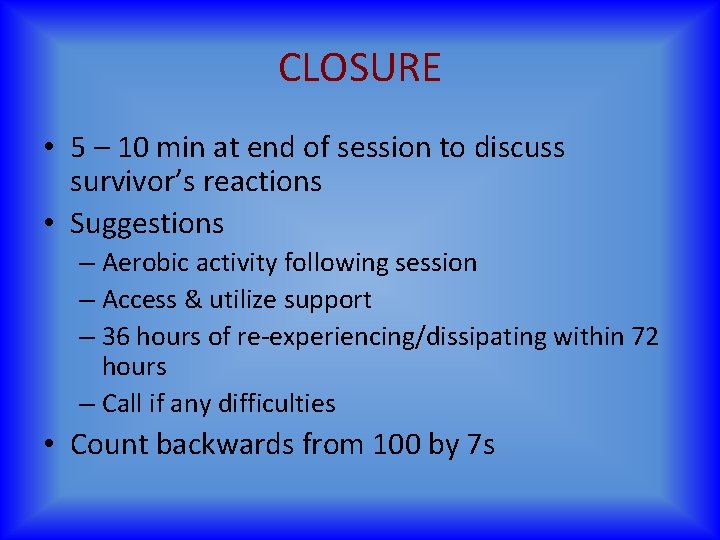
CLOSURE • 5 – 10 min at end of session to discuss survivor’s reactions • Suggestions – Aerobic activity following session – Access & utilize support – 36 hours of re-experiencing/dissipating within 72 hours – Call if any difficulties • Count backwards from 100 by 7 s
Grieving allows us to heal, to remember with love rather than pain It is a sorting process One by one you let go of things that are gone And you mourn for them One by one you take hold of the things that have become part of Who you are and build again --Rachel Naomi Remen In Worden, 2009 Counseling or Therapy? GRIEF & MOURNING
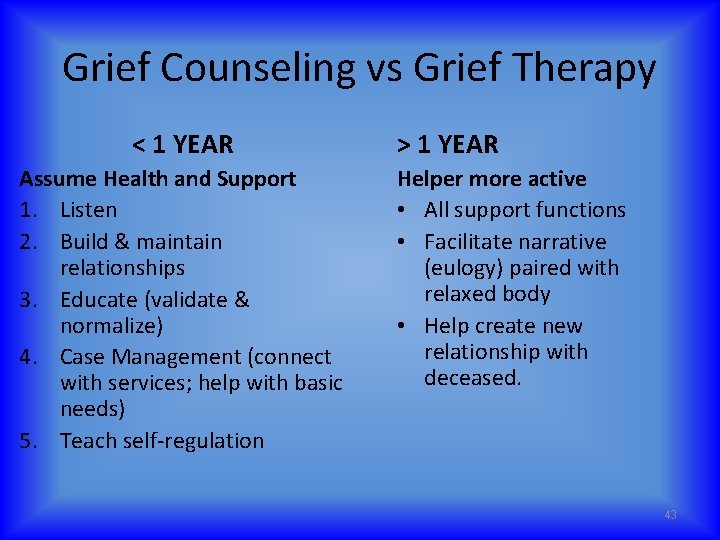
Grief Counseling vs Grief Therapy < 1 YEAR Assume Health and Support 1. Listen 2. Build & maintain relationships 3. Educate (validate & normalize) 4. Case Management (connect with services; help with basic needs) 5. Teach self-regulation > 1 YEAR Helper more active • All support functions • Facilitate narrative (eulogy) paired with relaxed body • Help create new relationship with deceased. 43
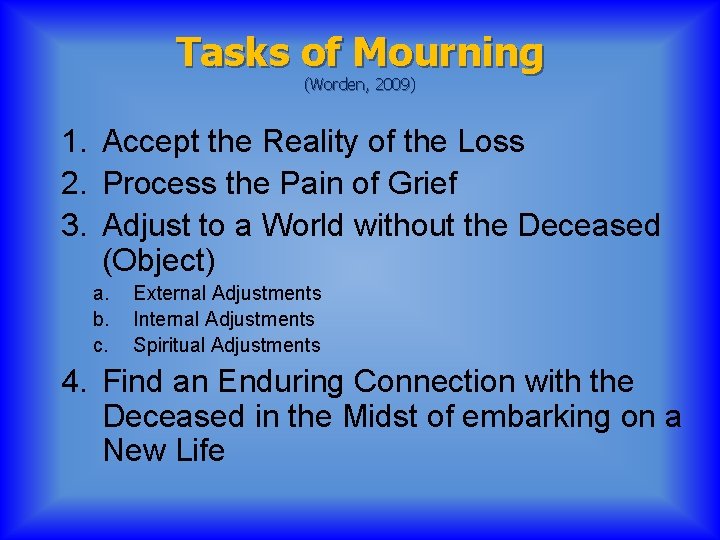
Tasks of Mourning (Worden, 2009) 1. Accept the Reality of the Loss 2. Process the Pain of Grief 3. Adjust to a World without the Deceased (Object) a. b. c. External Adjustments Internal Adjustments Spiritual Adjustments 4. Find an Enduring Connection with the Deceased in the Midst of embarking on a New Life
GRIEF
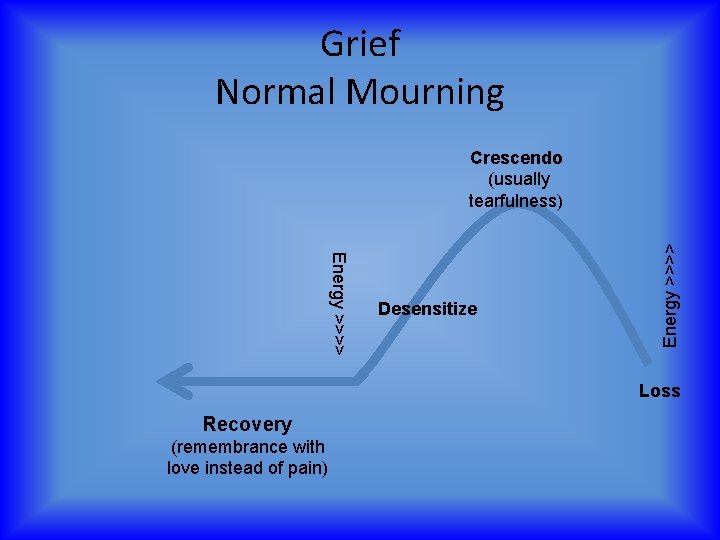
Grief Normal Mourning Energy >>>> Desensitize Energy >>>> Crescendo (usually tearfulness) Loss Recovery (remembrance with love instead of pain)
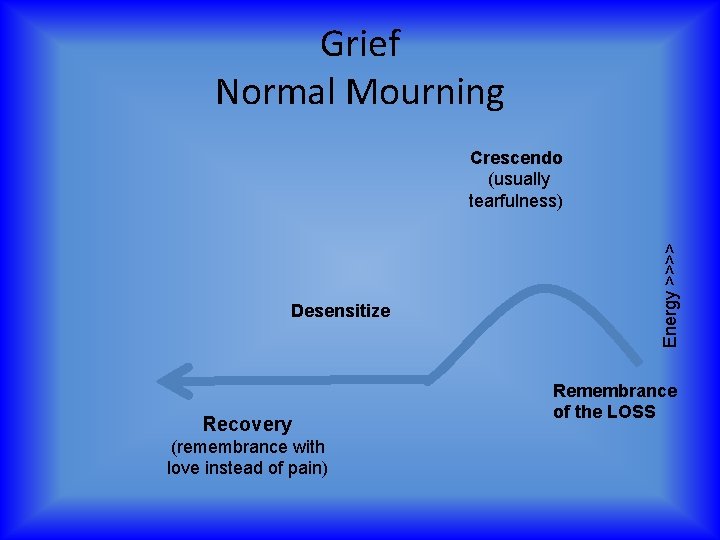
Grief Normal Mourning Desensitize Recovery (remembrance with love instead of pain) Energy >>>> Crescendo (usually tearfulness) Remembrance of the LOSS
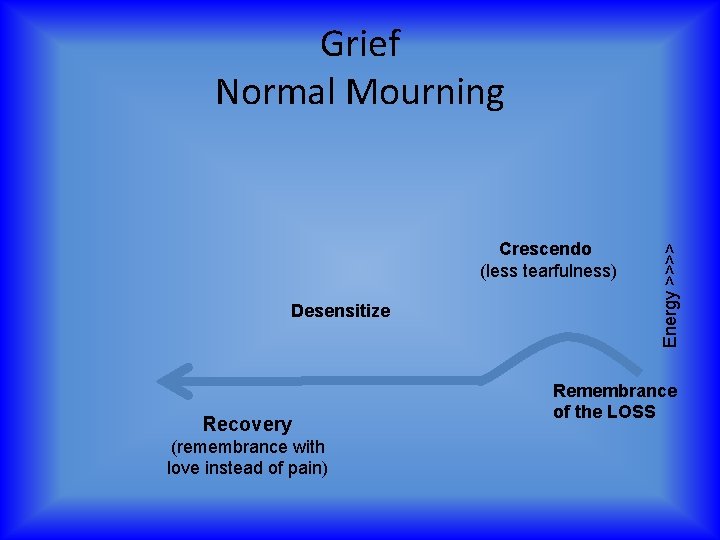
Crescendo (less tearfulness) Desensitize Recovery (remembrance with love instead of pain) Energy >>>> Grief Normal Mourning Remembrance of the LOSS
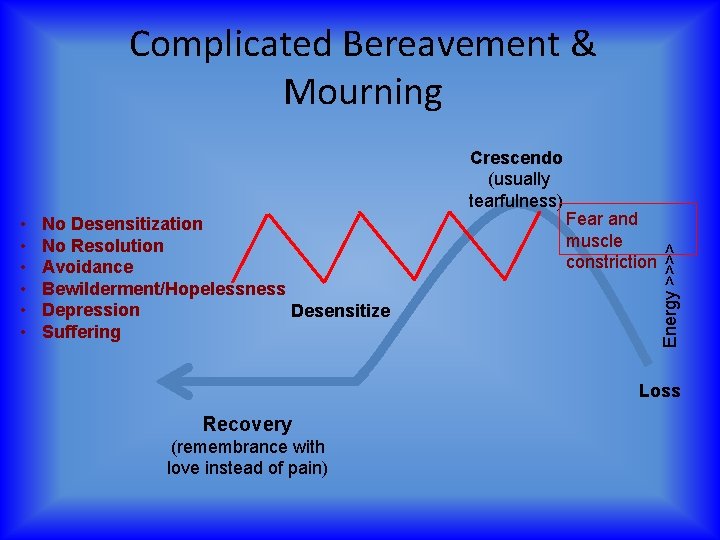
Crescendo (usually tearfulness) • • • No Desensitization No Resolution Avoidance Bewilderment/Hopelessness Depression Desensitize Suffering Fear and muscle constriction Energy >>>> Complicated Bereavement & Mourning Loss Recovery (remembrance with love instead of pain)
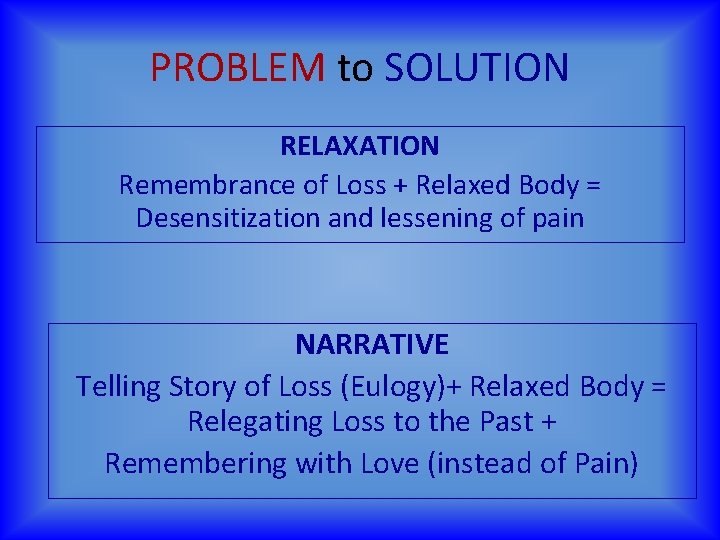
PROBLEM to SOLUTION RELAXATION Remembrance of Loss + Relaxed Body = Desensitization and lessening of pain NARRATIVE Telling Story of Loss (Eulogy)+ Relaxed Body = Relegating Loss to the Past + Remembering with Love (instead of Pain)
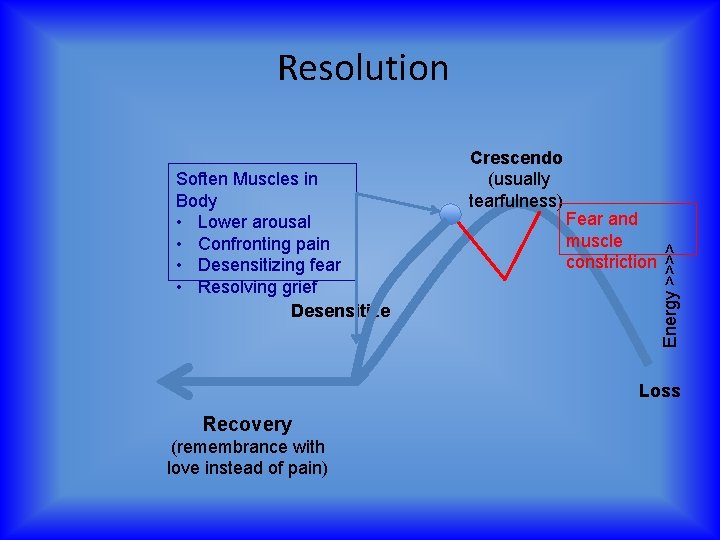
Soften Muscles in Body • Lower arousal • Confronting pain • Desensitizing fear • Resolving grief Desensitize Crescendo (usually tearfulness) Fear and muscle constriction Energy >>>> Resolution Loss Recovery (remembrance with love instead of pain)
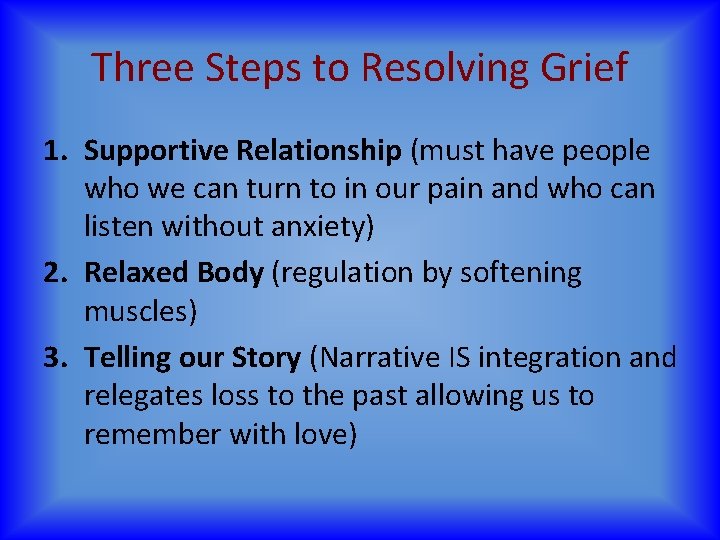
Three Steps to Resolving Grief 1. Supportive Relationship (must have people who we can turn to in our pain and who can listen without anxiety) 2. Relaxed Body (regulation by softening muscles) 3. Telling our Story (Narrative IS integration and relegates loss to the past allowing us to remember with love)
Posttraumatic Growth & Resilience STAGE IV International Association of Trauma Professionals 53
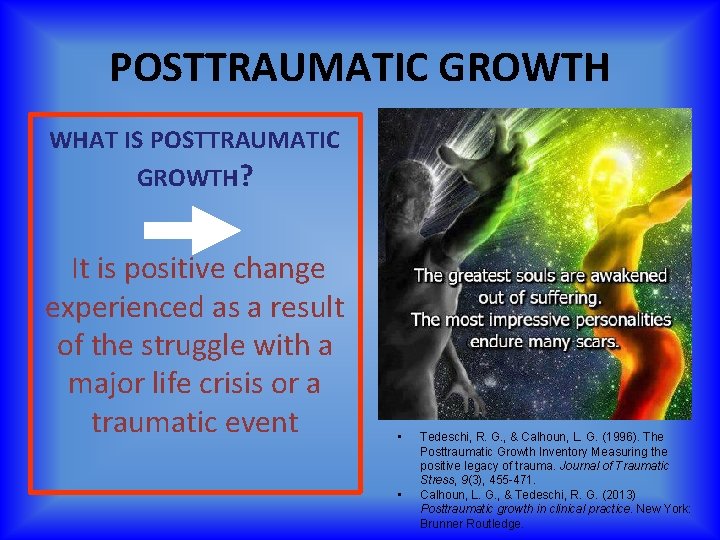
POSTTRAUMATIC GROWTH WHAT IS POSTTRAUMATIC GROWTH? It is positive change experienced as a result of the struggle with a major life crisis or a traumatic event • • Tedeschi, R. G. , & Calhoun, L. G. (1996). The Posttraumatic Growth Inventory Measuring the positive legacy of trauma. Journal of Traumatic Stress, 9(3), 455 -471. Calhoun, L. G. , & Tedeschi, R. G. (2013) Posttraumatic growth in clinical practice. New York: Brunner Routledge.
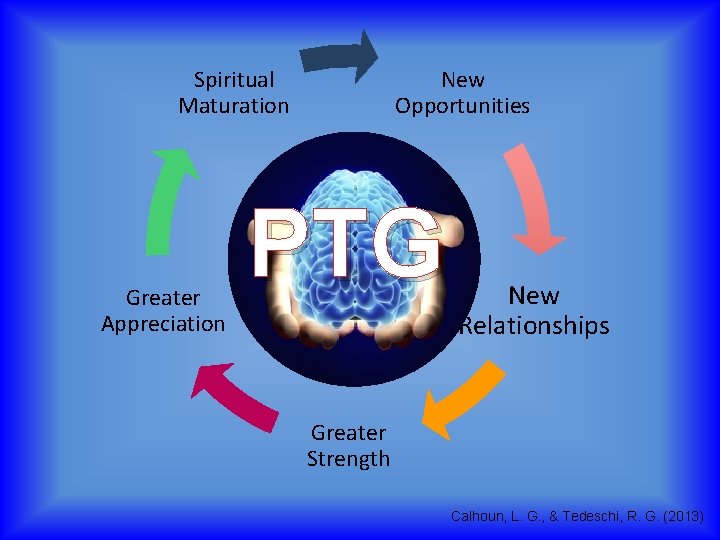
Spiritual Maturation Greater Appreciation New Opportunities PTG New Relationships Greater Strength Calhoun, L. G. , & Tedeschi, R. G. (2013)
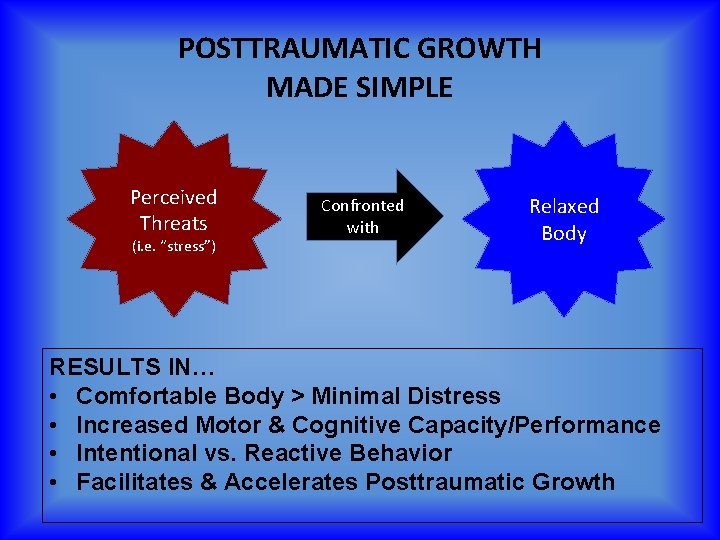
POSTTRAUMATIC GROWTH MADE SIMPLE Perceived Threats (i. e. “stress”) Confronted with Relaxed Body RESULTS IN… • Comfortable Body > Minimal Distress • Increased Motor & Cognitive Capacity/Performance • Intentional vs. Reactive Behavior • Facilitates & Accelerates Posttraumatic Growth
Healing Trauma Through Principle. Based Living Forward Facing Trauma Therapy
International Association of Trauma Professionals 58
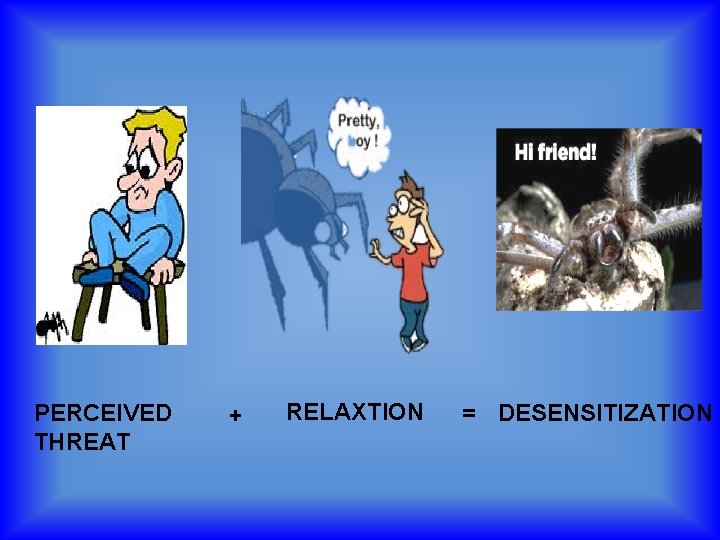
PERCEIVED THREAT + RELAXTION = DESENSITIZATION
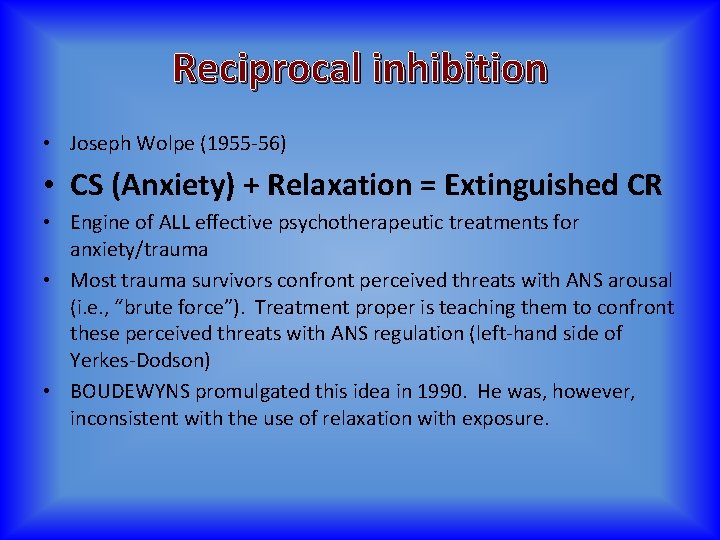
Reciprocal inhibition • Joseph Wolpe (1955 -56) • CS (Anxiety) + Relaxation = Extinguished CR • Engine of ALL effective psychotherapeutic treatments for anxiety/trauma • Most trauma survivors confront perceived threats with ANS arousal (i. e. , “brute force”). Treatment proper is teaching them to confront these perceived threats with ANS regulation (left-hand side of Yerkes-Dodson) • BOUDEWYNS promulgated this idea in 1990. He was, however, inconsistent with the use of relaxation with exposure.
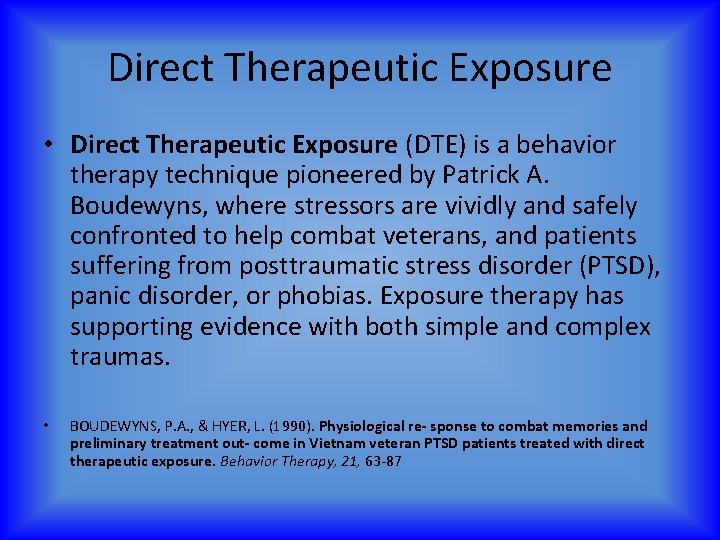
Direct Therapeutic Exposure • Direct Therapeutic Exposure (DTE) is a behavior therapy technique pioneered by Patrick A. Boudewyns, where stressors are vividly and safely confronted to help combat veterans, and patients suffering from posttraumatic stress disorder (PTSD), panic disorder, or phobias. Exposure therapy has supporting evidence with both simple and complex traumas. • BOUDEWYNS, P. A. , & HYER, L. (1990). Physiological re sponse to combat memories and preliminary treatment out come in Vietnam veteran PTSD patients treated with direct therapeutic exposure. Behavior Therapy, 21, 63 -87
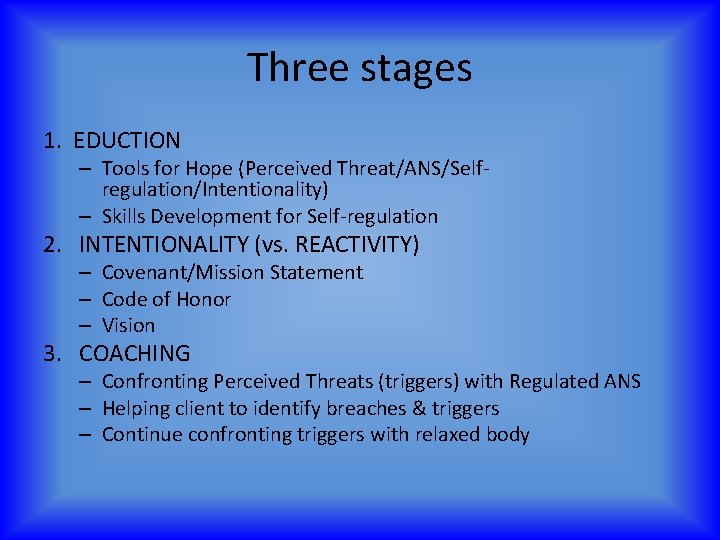
Three stages 1. EDUCTION – Tools for Hope (Perceived Threat/ANS/Selfregulation/Intentionality) – Skills Development for Self-regulation 2. INTENTIONALITY (vs. REACTIVITY) – Covenant/Mission Statement – Code of Honor – Vision 3. COACHING – Confronting Perceived Threats (triggers) with Regulated ANS – Helping client to identify breaches & triggers – Continue confronting triggers with relaxed body
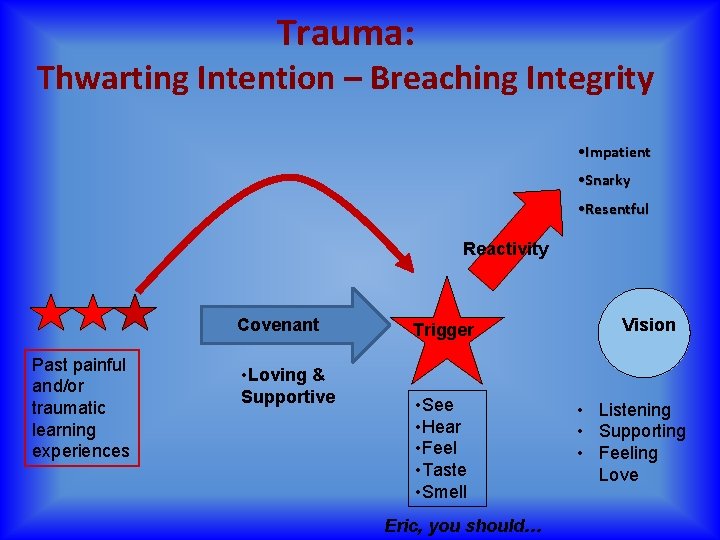
Trauma: Thwarting Intention – Breaching Integrity • Impatient • Snarky • Resentful Reactivity Covenant Past painful and/or traumatic learning experiences • Loving & Supportive Trigger • See • Hear • Feel • Taste • Smell Eric, you should… Vision • Listening • Supporting • Feeling Love
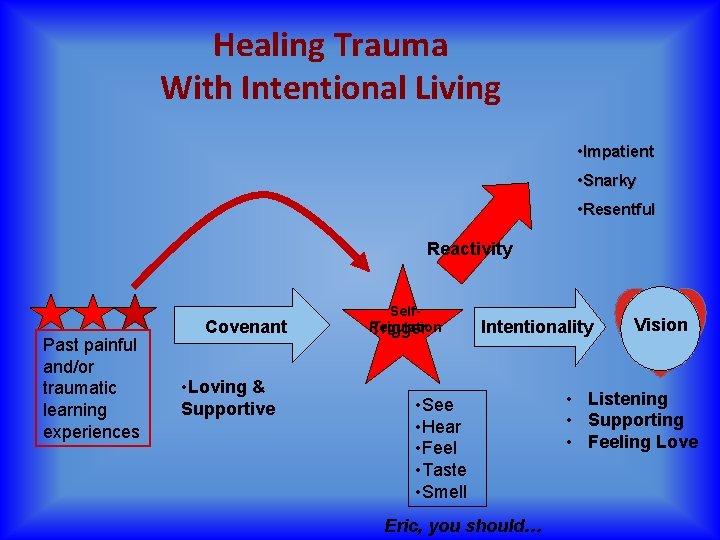
Healing Trauma With Intentional Living • Impatient • Snarky • Resentful Reactivity Past painful and/or traumatic learning experiences Covenant • Loving & Supportive Self. Regulation Trigger Intentionality • See • Hear • Feel • Taste • Smell Eric, you should… Vision • Listening • Supporting • Feeling Love
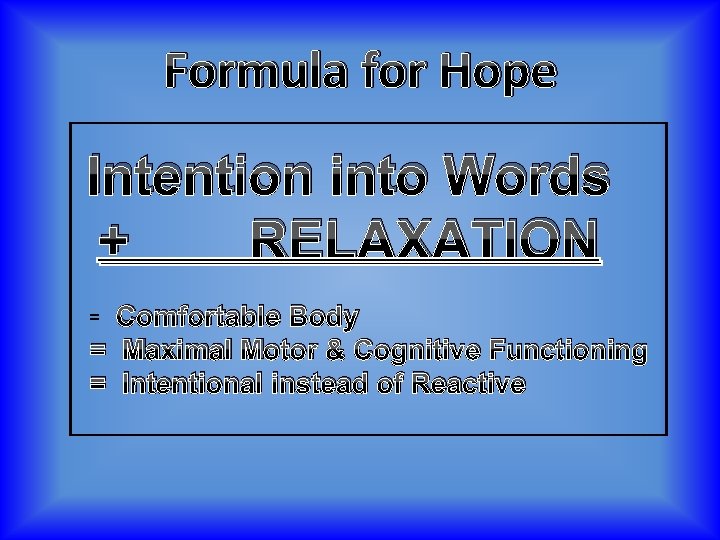
Formula for Hope Intention into Words + RELAXATION Comfortable Body = Maximal Motor & Cognitive Functioning = Intentional instead of Reactive =
The Empowerment & Resilience Structure: An Active Ingredients Approach I. Preparation & Relationship II. Psychoeducation & Self regulation III. Integration & Desensitization IV. Post Traumatic Growth & Resilience Rhoton & Gentry, 2014
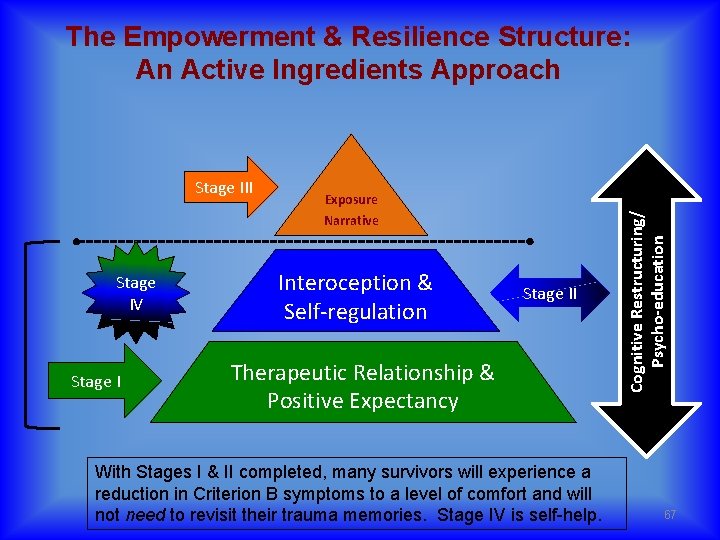
Stage III Stage IV Stage I Exposure Narrative Interoception & Self-regulation Stage II Therapeutic Relationship & Positive Expectancy With Stages I & II completed, many survivors will experience a reduction in Criterion B symptoms to a level of comfort and will not need to revisit their trauma memories. Stage IV is self-help. Cognitive Restructuring/ Psycho education The Empowerment & Resilience Structure: An Active Ingredients Approach 67
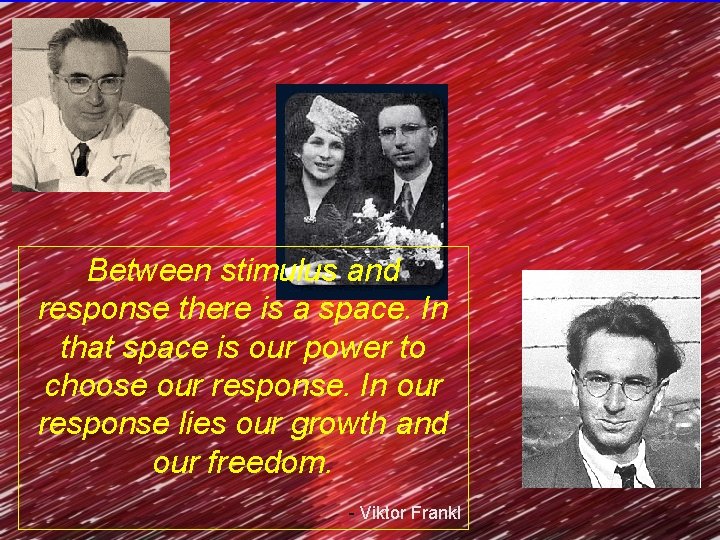
Between stimulus and response there is a space. In that space is our power to choose our response. In our response lies our growth and our freedom. - Viktor Frankl
J. Eric Gentry, Ph. D, LMHC PO Box 15729 Sarasota, FL 34277 (941) 720 -0143 eg@compassionunlimited. com www. traumapro. net www. kleenmusic. com