Visualizing Environmental Science The Ocean and Fisheries Chapter



- Slides: 30
Visualizing Environmental Science The Ocean and Fisheries Chapter 11 © 2017 John Wiley & Sons, Inc. All rights reserved.
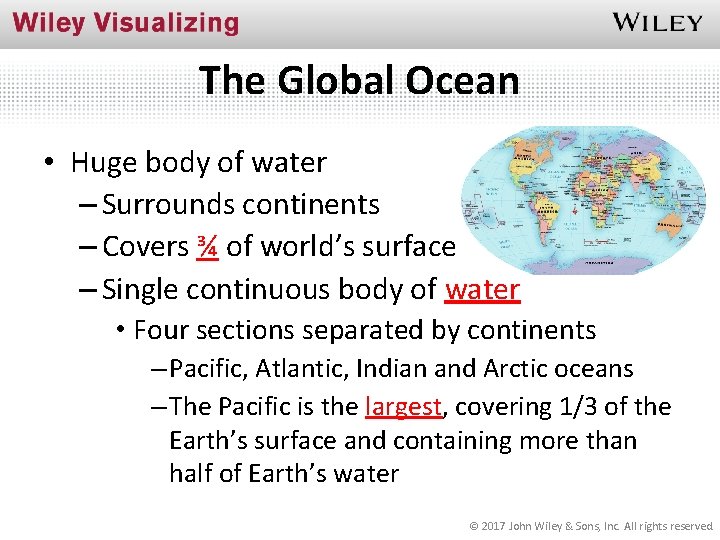
The Global Ocean • Huge body of water – Surrounds continents – Covers ¾ of world’s surface – Single continuous body of water • Four sections separated by continents – Pacific, Atlantic, Indian and Arctic oceans – The Pacific is the largest, covering 1/3 of the Earth’s surface and containing more than half of Earth’s water © 2017 John Wiley & Sons, Inc. All rights reserved.
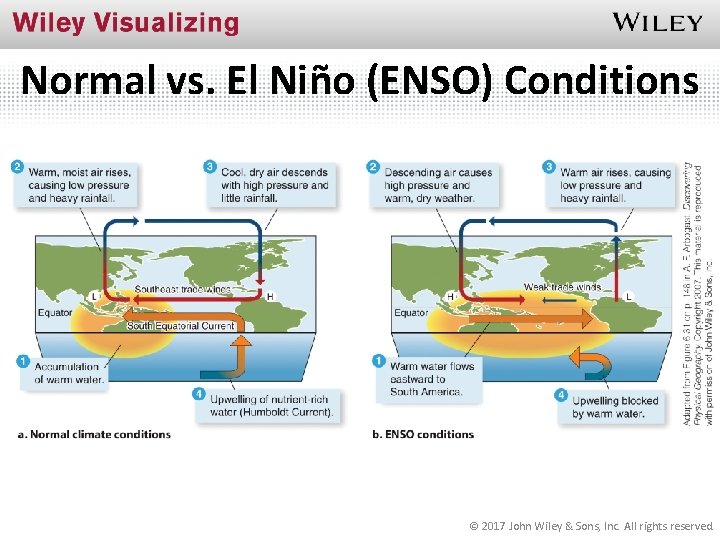
Ocean-Atmosphere Interaction • Wind from atmosphere affects ocean currents • Heat from ocean affects atmospheric circulation • El Niño-Southern Oscillation (ENSO) – A periodic, large-scale warming of surface waters of the tropical eastern Pacific Ocean that temporarily alters both ocean and atmospheric circulation patterns • El Niño-Southern Oscillation (ENSO) – Responsible for world’s interannual climate variability – Ocean currents slow down or stop; this is known as El Niño © 2017 John Wiley & Sons, Inc. All rights reserved.
Normal vs. El Niño (ENSO) Conditions © 2017 John Wiley & Sons, Inc. All rights reserved.
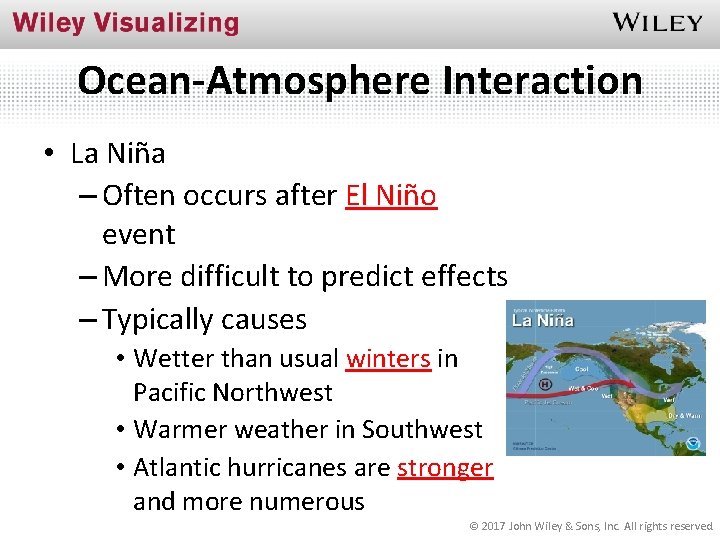
Ocean-Atmosphere Interaction • La Niña – Often occurs after El Niño event – More difficult to predict effects – Typically causes • Wetter than usual winters in Pacific Northwest • Warmer weather in Southwest • Atlantic hurricanes are stronger and more numerous © 2017 John Wiley & Sons, Inc. All rights reserved.
Human Impacts on the Ocean • Fisheries and aquaculture, marine shipping, marine pollution, coastal development, offshore mining, and global climate change, all contribute to marine environment degradation • Paradox: ocean provides food but is used as dumping ground – Pollution increasingly threatens the world’s fisheries – 80% of ocean pollution comes from human activities on land © 2017 John Wiley & Sons, Inc. All rights reserved.
Problems and Challenges for the Fishing Industry • World’s annual fish harvest – 1950 - 19 million tons – 2000 - 95 million tons – 2012 - 91 million tons • No nation has legal claim to the open ocean – Resources are susceptible to overuse and degradation – Many species have been harvested to the point where their numbers are severely depleted • Many nations have extended their limits of jurisdiction to 320 km (200 mi) offshore, to prevent overharvesting © 2017 John Wiley & Sons, Inc. All rights reserved.
Problems and Challenges for the Fishing Industry • At least 30% of world’s fish stocks are overexploited, and 57% are fully exploited – Growing human population requires protein – Bycatch (the fishes, marine mammals, sea turtles, seabirds, and other animals caught unintentionally in a commercial fishing catch) exceeds 7. 7 million tons annually • Modern commercial fishing methods have led to the collapse of formerly productive fisheries due to overfishing – Drift nets, trawls, purse seines, and longlines are so efficient that they can depopulate a fishery past the point of recovery © 2017 John Wiley & Sons, Inc. All rights reserved.
Aquaculture: Fish Farming • Aquaculture – Fish farming: Growing of aquatic organisms for human consumption • Developing nations produce more seafood from aquaculture than they harvest from the ocean • Fish farms have dense populations – Lots of polluting waste – Cause net loss of wild fish (raised fish tend to be carnivorous) – Ocean ranching: Deep-water, off-shore aquaculture • Doesn’t harm coastline, but less oversight to prevent pollution • Risk of reduced genetic diversity in wild fish populations due to interbreeding with farmed fish © 2017 John Wiley & Sons, Inc. All rights reserved.
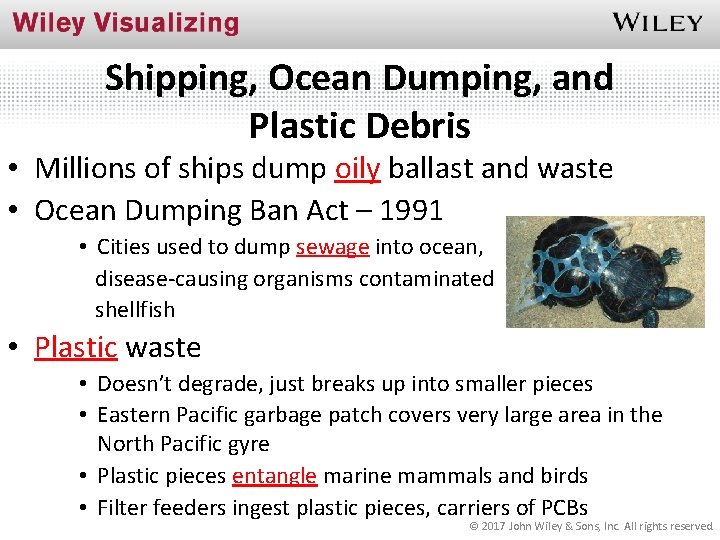
Shipping, Ocean Dumping, and Plastic Debris • Millions of ships dump oily ballast and waste • Ocean Dumping Ban Act – 1991 • Cities used to dump sewage into ocean, disease-causing organisms contaminated shellfish • Plastic waste • Doesn’t degrade, just breaks up into smaller pieces • Eastern Pacific garbage patch covers very large area in the North Pacific gyre • Plastic pieces entangle marine mammals and birds • Filter feeders ingest plastic pieces, carriers of PCBs © 2017 John Wiley & Sons, Inc. All rights reserved.
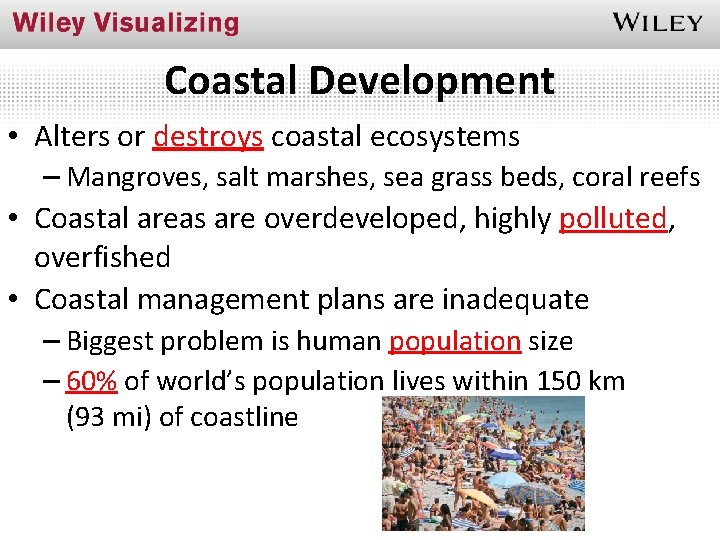
Coastal Development • Alters or destroys coastal ecosystems – Mangroves, salt marshes, sea grass beds, coral reefs • Coastal areas are overdeveloped, highly polluted, overfished • Coastal management plans are inadequate – Biggest problem is human population size – 60% of world’s population lives within 150 km (93 mi) of coastline
Human Impacts on Coral Reefs • Coral formations are important ecosystems, and they are being degraded and destroyed – Silt washing downstream from clear-cut forests is smothering reefs – Bleaching = stressed corals expel zooxanthellae; correlated with warming ocean waters and increased dissolved CO 2 levels – High salinity from freshwater diversion projects – Overfishing of top predators – Pollution from ocean dumping and coastal pollution © 2017 John Wiley & Sons, Inc. All rights reserved.
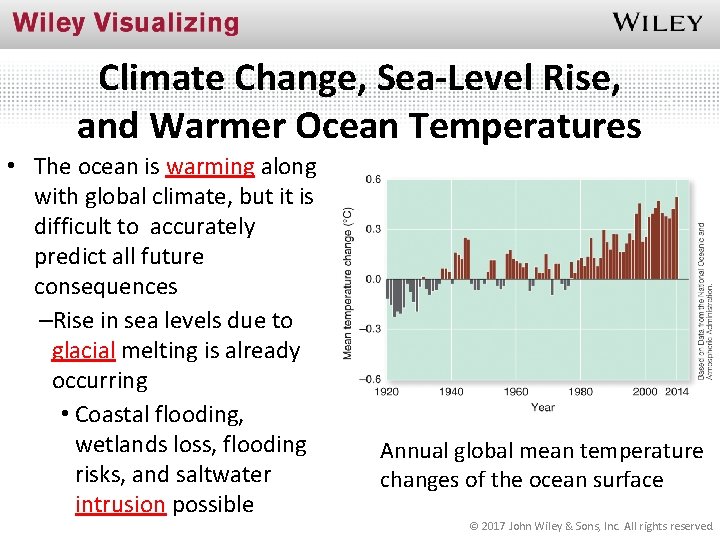
Climate Change, Sea-Level Rise, and Warmer Ocean Temperatures • The ocean is warming along with global climate, but it is difficult to accurately predict all future consequences –Rise in sea levels due to glacial melting is already occurring • Coastal flooding, wetlands loss, flooding risks, and saltwater intrusion possible Annual global mean temperature changes of the ocean surface © 2017 John Wiley & Sons, Inc. All rights reserved.
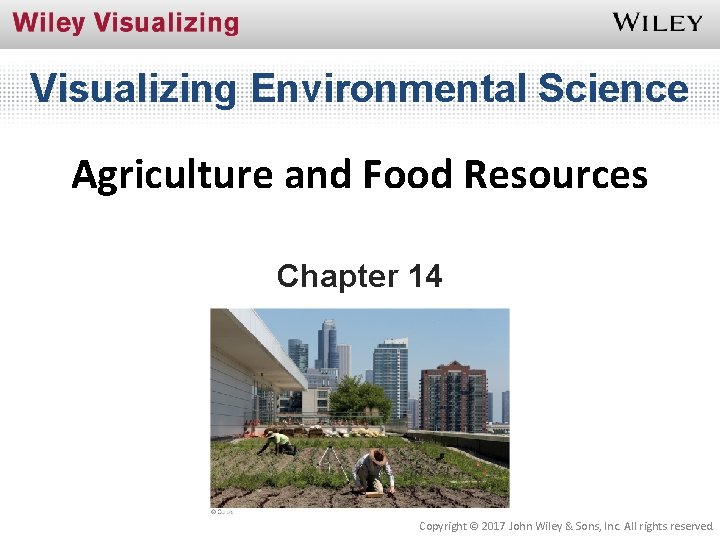
Visualizing Environmental Science Agriculture and Food Resources Chapter 7 Chapter 14 [chapter opener image] Copyright © 2017 John Wiley & Sons, Inc. All rights reserved.
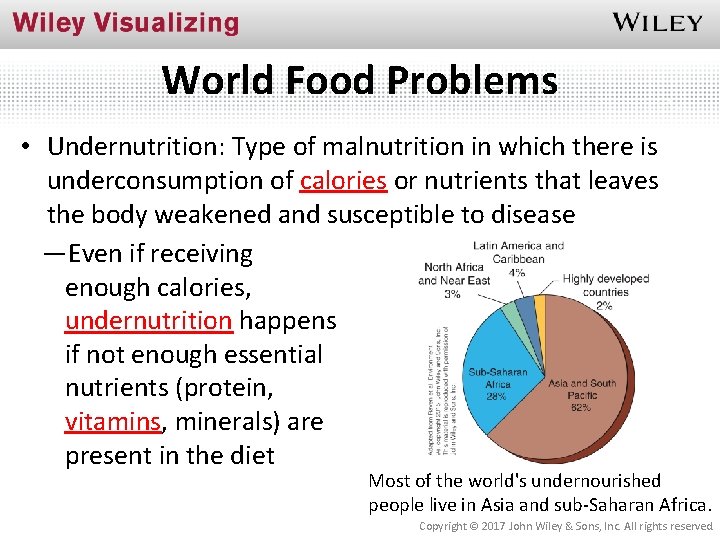
World Food Problems • Undernutrition: Type of malnutrition in which there is underconsumption of calories or nutrients that leaves the body weakened and susceptible to disease —Even if receiving enough calories, undernutrition happens if not enough essential nutrients (protein, vitamins, minerals) are present in the diet Most of the world's undernourished people live in Asia and sub-Saharan Africa. Copyright © 2017 John Wiley & Sons, Inc. All rights reserved.
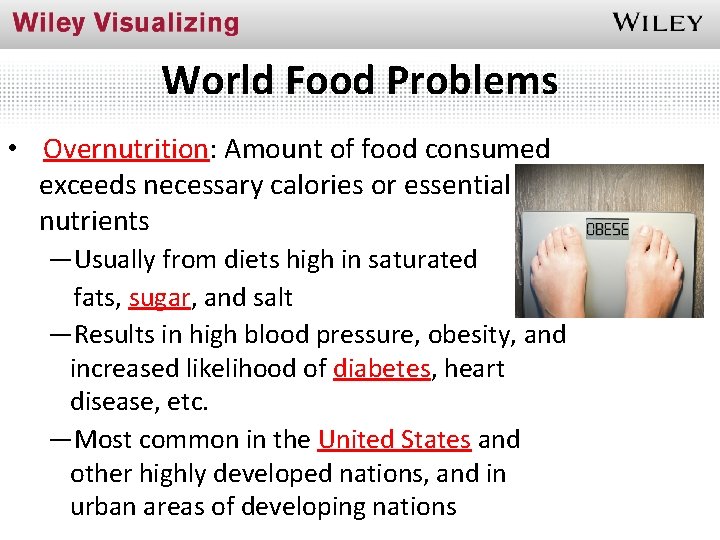
World Food Problems • Overnutrition: Amount of food consumed exceeds necessary calories or essential nutrients —Usually from diets high in saturated fats, sugar, and salt —Results in high blood pressure, obesity, and increased likelihood of diabetes, heart disease, etc. —Most common in the United States and other highly developed nations, and in urban areas of developing nations
Poverty and Food • Main cause of undernutrition and food insecurity is poverty • Solutions – Increase sustainable production of food – Improve food distribution – Promote economic development – Ensure education and opportunities for women and small scale farmers, who produce significant amounts of basic nutrition in some regions Copyright © 2017 John Wiley & Sons, Inc. All rights reserved.
The Principal Types of Agriculture • Industrialized agriculture – Utilized in highly developed and some developing countries – High-input: Requires large capital and energy inputs, less land, and less manual labor than traditional methods • Significantly dependent on fossil fuels • Produces high yields • Monoculture cultivation predominates • Soil degradation, pesticide resistance common Copyright © 2017 John Wiley & Sons, Inc. All rights reserved.
The Principal Types of Agriculture • Subsistence agriculture – Utilized by most farmers in most developing countries – Traditional agricultural methods that depend on labor and a large amount of land • Just enough food to feed farmer and family – Cultivation methods vary depending on area • Shifting cultivation • Slash-and-burn agriculture • Nomadic herding • Intercropping • Polyculture Copyright © 2017 John Wiley & Sons, Inc. All rights reserved.
Challenges of Producing More Crops and Livestock • Challenges • Decline in farmland • Declining numbers of domesticated varieties • Continuing to improve crop and livestock yields • Addressing environmental impacts – Agribusiness conglomerates are replacing the family farm • Victim of urbanization, suburban sprawl – Parking lots, housing developments, shopping malls Copyright © 2017 John Wiley & Sons, Inc. All rights reserved.
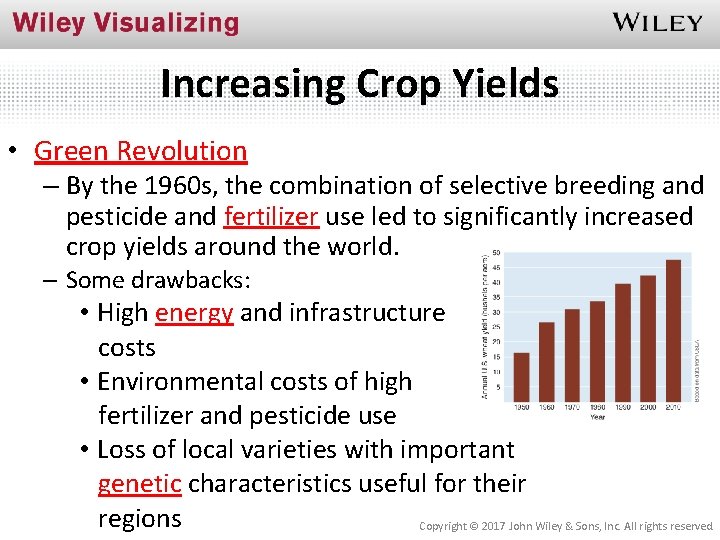
Increasing Crop Yields • Green Revolution – By the 1960 s, the combination of selective breeding and pesticide and fertilizer use led to significantly increased crop yields around the world. – Some drawbacks: • High energy and infrastructure costs • Environmental costs of high fertilizer and pesticide use • Loss of local varieties with important genetic characteristics useful for their regions Copyright © 2017 John Wiley & Sons, Inc. All rights reserved.
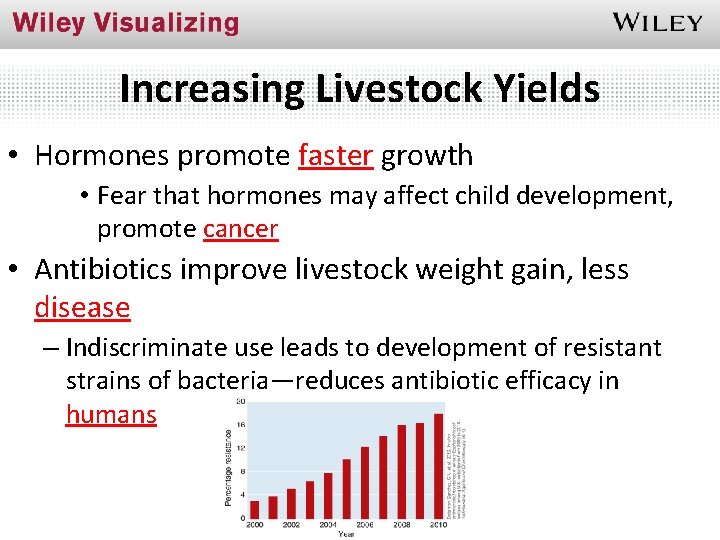
Increasing Livestock Yields • Hormones promote faster growth • Fear that hormones may affect child development, promote cancer • Antibiotics improve livestock weight gain, less disease – Indiscriminate use leads to development of resistant strains of bacteria—reduces antibiotic efficacy in humans
Genetic Modification • Genetic engineering • Manipulation of genes to produce a particular trait – Controversial – Has the potential to produce genetically modified (GM) plants that can be: • More nutritious food plants that contain all essential amino acids or that would be rich in vitamins • Resistant to viral diseases, drought, heat, cold, herbicides, salinity, insect pests, etc. Copyright © 2017 John Wiley & Sons, Inc. All rights reserved.
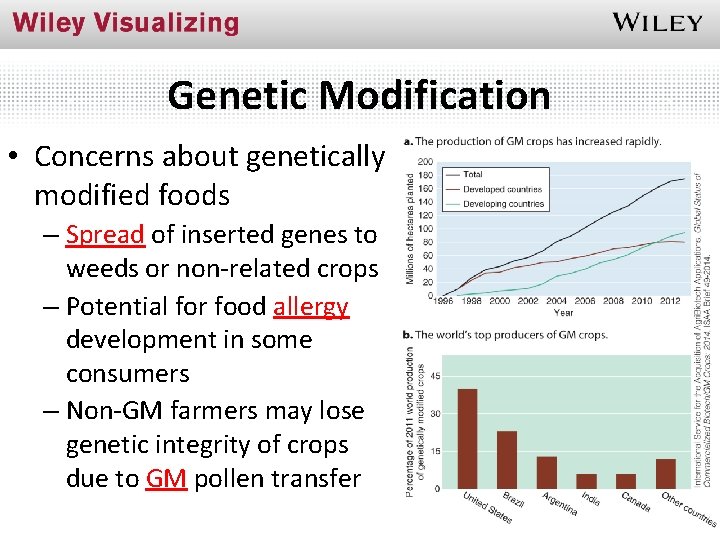
Genetic Modification • Concerns about genetically modified foods – Spread of inserted genes to weeds or non-related crops – Potential for food allergy development in some consumers – Non-GM farmers may lose genetic integrity of crops due to GM pollen transfer
Environmental Impacts • Industrialized agriculture has many environmental effects – Increased carbon footprint – Water pollution • Animal wastes, fertilizers, and pesticides, are an important cause of surface water pollution – Air pollution • Due to agricultural use of fossil fuels, pesticides, fertilizers • Impacts of industrialized agriculture: – Pesticide (toxic chemicals used to kill pests) resistance and residues Copyright © 2017 John Wiley & Sons, Inc. All rights reserved.
Environmental Impacts • Impacts of industrialized agriculture: – Land degradation • Reduction in the potential ability of the land to support crops/livestock • Soil erosion, compaction, salinization – Habitat fragmentation • Breakup of large areas of habitat into small, isolated patches • Many species are endangered due to habitat loss to agriculture Copyright © 2017 John Wiley & Sons, Inc. All rights reserved.
Moving to Sustainable Agriculture • Food production in its current state may not be sustainable • Sustainable agriculture combines modern with traditional techniques – Diversification of crops and livestock – Breeding of disease resistant varieties – Water and energy conservation – Crop rotation, no-till farming to preserve soil quality (No-till farming involves planting crops over the previous dead crops without disturbing the soil) – Pesticides which are used should disintegrate rapidly and not persist in the environment Copyright © 2017 John Wiley & Sons, Inc. All rights reserved.
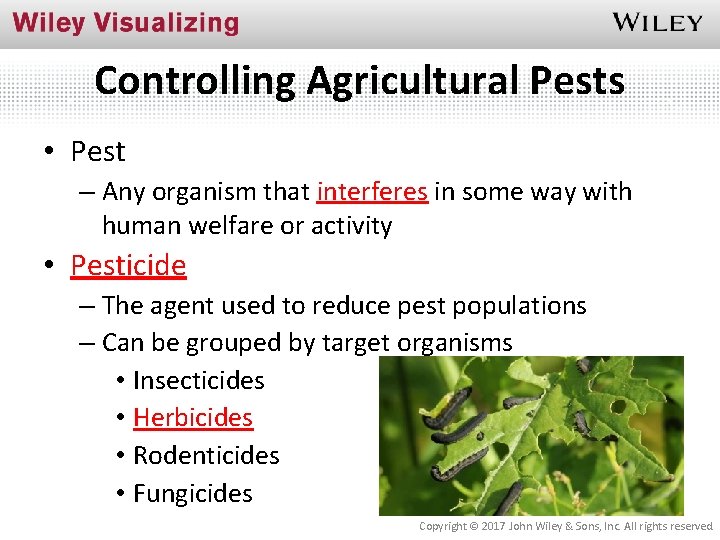
Controlling Agricultural Pests • Pest – Any organism that interferes in some way with human welfare or activity • Pesticide – The agent used to reduce pest populations – Can be grouped by target organisms • Insecticides • Herbicides • Rodenticides • Fungicides Copyright © 2017 John Wiley & Sons, Inc. All rights reserved.
Benefits of Pesticides • Effectively control organisms that spread disease • Protect crops from pests and pathogens – 1/3 of crops are destroyed by pests • Monocultures (single species grown in large areas) amplify effect of pests • Genetic resistance – In the 60 years of wide pesticide use, at least 520 species of insects and mites and at least 200 plant species have evolved genetic resistance to certain pesticides Copyright © 2017 John Wiley & Sons, Inc. All rights reserved.
Case Study • Organic agriculture – No use of commercial inorganic fertilizers or pesticides – Organic Food Production Act of 1990 • Specifies guidelines for organic production and labeling • Federal standards for organic certification went into effect in 2002 – In 2011, 2 million hectares farmed organically in the U. S. – Rapid growth in organic agriculture in U. S. today • U. S. sales of organic products increased from $3 billion in 2008 to $35 billion in 2014 Copyright © 2017 John Wiley & Sons, Inc. All rights reserved.