VIII New Protestant Approaches in Philosophy of Religion
- Slides: 26
VIII. New Protestant Approaches in Philosophy of Religion
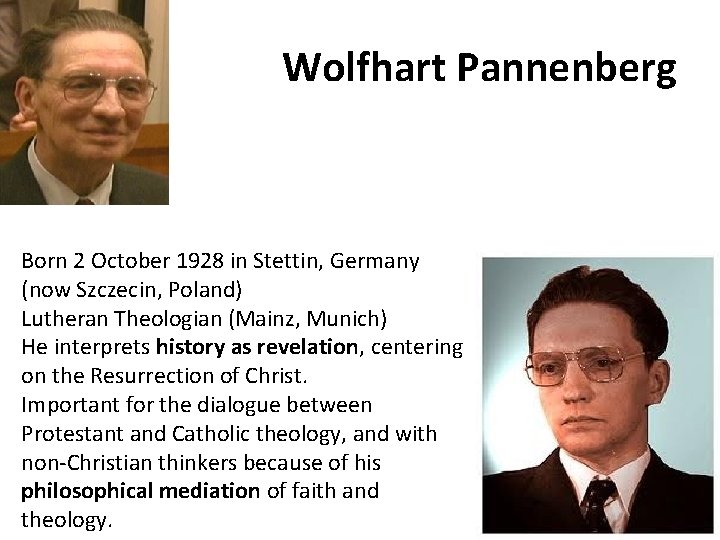
Wolfhart Pannenberg Born 2 October 1928 in Stettin, Germany (now Szczecin, Poland) Lutheran Theologian (Mainz, Munich) He interprets history as revelation, centering on the Resurrection of Christ. Important for the dialogue between Protestant and Catholic theology, and with non-Christian thinkers because of his philosophical mediation of faith and theology.
Opera magna • 1968. Revelation As History (edited volume). New York: The Macmillan Company. • 1968. Jesus: God and Man. Philadelphia: Westminster Press. • 1969. Basic Questions in Theology. Westminster Press • 1970. What Is Man? Philadelphia: Fortress Press. • 1972. The Apostles' Creed in Light of Today's Questions. Westminster Press. • 1976. Theology and the Philosophy of Science. Westminster Press. • 1985. Anthropology in Theological Perspective. T&T Clark • 1988– 1994. Systematic Theology I-III. T & T Clark
Pannenberg‘s conversion “The most incisive change of mind happened when I became a Christian. Since I had not enjoyed the privilege of being raised in a Christian family, commitment to the study of Christian theology could not come about by a smooth and imperceptible process. Nor did it follow from a unique experience of conversion. Rather, it was the result of a series of experiences. The single most important experience occurred in early January 1945, when I was 16 years old. On a lonely two-hour walk home from my piano lesson, seeing an otherwise ordinary sunset, I was suddenly flooded by light and absorbed in a sea of light which, although it did not extinguish the humble awareness of my finite existence, overflowed the barriers that normally separate us from the surrounding world. Several months earlier I had narrowly escaped an American bombardment at Berlin; a few weeks later my family would have to leave our East German home because of the Russian offensive. I did not know at the time that January 6 was the day of Epiphany, nor did I realize that in that moment Jesus Christ had claimed my life as a witness to the transfiguration of this world in the illuminating power and judgment of his glory. But there began a period of craving to understand the meaning of life, and since philosophy did not seem to offer the ultimate answers to such a quest, I finally decided to probe the Christian tradition more seriously than I had considered worthwhile before. ” http: //www. religion-online. org/showarticle. asp? title=1710 http: //books. google. de/books? hl=de&lr=&id=4 Kmk 2 sn. BFc. MC&oi=fnd&pg=PA 180&dq=wolfhart+pannenberg+revelation+as+history&ots=2 izrperg. U&sig=AKEJDPyy 5 w. Jj. HQHNvw 7 btccr-7 o#v=onepage&q=wolfhart%20 pannenberg%20 revelation%20 as%20 history&f=false
For Pannenberg‘ s theology the sequence – „light-experience“ and later interpretation of this experience in Christian terms – became decisive: it follows Schleiermacher’s idea of a general religious feeling and its secondary confessional interpretation. Schleiermacher: “the finite with its limits which constitute its distinctiveness, is carved out of the infinite”. “Alles Endliche besteht nur durch die Bestimmung seiner Grenzen, die aus dem Unendlichen gleichsam herausgeschnitten werden müssen. “ (Zweite Rede „Über das Wesen der Religion“) Pannenberg: this “means that all secular experience of the world, as experience of the infinite, implies that the finite is a presentation of the infinite, the universum. But this is not thematic in the awareness of profane experience. But only religious awareness expressly sees the infinite and totality in the finite …” (Systematic Theol. I 165). BUT: Pannenberg’s personal experience did not permit him to reduce religion to the realm of consciousness.
Revelation as history (1961) • Religion has its place not only in consciousness, but in history. • Revelation does not only occur in history, it occurs as history. • God‘s revelation is evident to the eyes of those who want to see it. Revelation is addressed to natural reason, it is no occult knowledge. • Faith is not based on the Pneuma, but on historical reasons; the Pneuma is a consequence of one‘s faith.
Consequences of Pannenberg‘s approach Critiques of • Existential theology (Bultmann) • Dialectic theoloy (Barth, Jüngel) Moderate critique of • Theology as a mere explication of human consciousness (Schleiermacher) • Natural theology
Critique of Existential Theology Pannenberg criticizes R. Bultmann and his program of demythologization, since this program reduces the history of salvation to an existential moment: (i. e. the biblical message of the eschatological end of the world happens in the moment in which the gospel’s word strikes me and finishes my inauthentic existence [uneigentliches Dasein = M. Heidegger] and launches me into an authentic form of life. ) Pannenberg wants to gain back the realm of history as the realm of God’s revelation.
Critique of the Dialectic Theology • W. Pannnberg’s emphasis of historical reason and philosophy is a part of his critique of Karl Barth’s dialectic theology and its “positivism” of a just given revelation. Expected consequence: Christianity locks itself up in a Ghetto and loses its mission for all people. • Other intention: Non-Christian religions have to gain a positive reputation by Christian Theology.
Critique and reception of natural theology • Affirmation of the older protestant dogmatics‘ concept of a natural theology; only beginning with K. Barth natural theology became an ecumenical problem. Rm 1, 20 would speak of a real and realized possibility to know God through creation. • From its historical origin in the Stoa, natural theology has to be understood as the philosophical research for the true nature of God (no proofs of God‘s existence): how to think the divine reality? • In this sense, the Church-Fathers received natural theology and developed it to demonstrate the logic of the Christian understanding of God.
Critique and reception of natural theology • Older protestant dogmatics and catholic Baroque Scholasticism reinterpret natural theology as a program to prove God’s existence. Natural no longer means in accordance with the nature of God but in accordance with the human nature: what human nature permits to know of God, where are the limits of human nature in reference to supernatural revelation? • Pannenberg claims that the destruction of human nature by sin, cannot destroy every form of a rational mediation of faith.
The ‚natural‘ Knowledge of God • Pannenberg affirms the natural knowledge of God which he distinguishes from natural theology. • He describes this – in accordance to Schleiermacher – as a primordial, nonthematical knowledge or intuition of the infinitude and totality of reality = religious Apriori (E. Troeltsch). “Intuition of an indefinite infinite, of a mystery of being which transcends and upholds human life, and gives us the courage to trust it, achieves a differentiation from finite things only in the course of experience. ” (Sys. Th I: 117) Religion helps to interpret this experience, natural theology refers to it. • Pannenberg quotes Rahner and his idea of a general question of being which presupposes a general intuition of illimitable being including the infinitude. Questioning God is due to an original experience of an answer. (cf. Jacobi: immediate experienced certainty as a motif of reflexive questioning for certainty. )
The range of proofs of God‘s existence and attributes: a concept of God • Pannenberg respects the tradition of the proofs for God‘s existence. Their results: (1) there is no real, all people convincing proof of God‘s existence, because God can be known only through God himself. (2) The proofs establish a) anthropological and cosmological points of contact for theological reflection about the concept of God in his revelation; they show the necessity to rise above the finitude of human existence to the thought of the absolute and infinite b) criteria for theological concept of God. “The thought of God has reality only in the positive religions. ” (Sys. Th I: 106).
Philosophical mediation and criterion of religious truth • Pannenberg’s personal experience and Schleiermacher’s idea of infinite’s presence have conceptual consequences: Pannenberg declares Hegel’s concept of the “true, authentic infinite” a philosophically accessible criterion to think and represent the infinite in philosophy, religion and theology: the absolute / God cannot be a reality exclusively beyond the finite world; in its transcendence it / he is present in the finite.
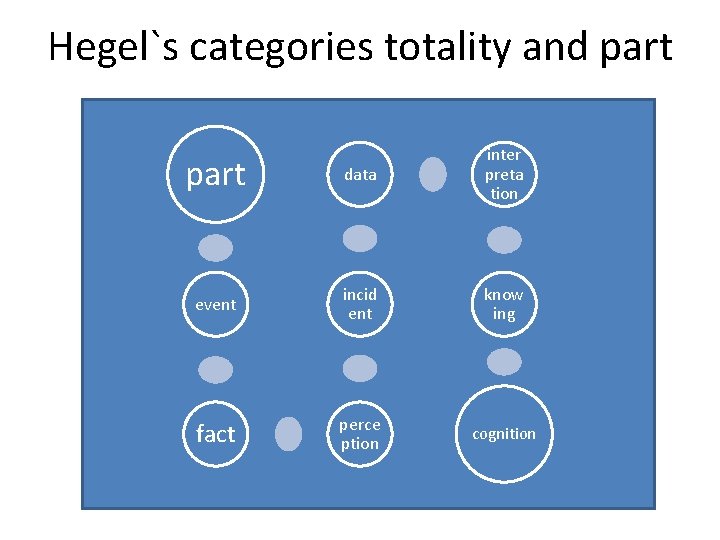
Hegel`s categories totality and part data inter preta tion event incid ent know ing fact perce ption cognition
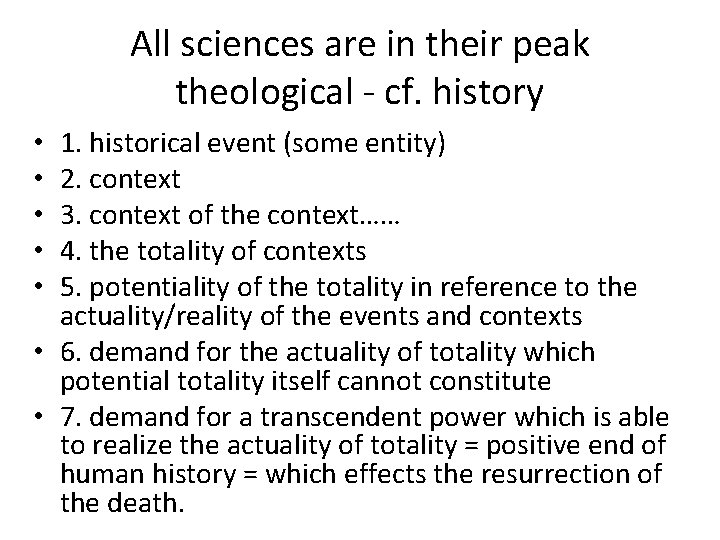
All sciences are in their peak theological - cf. history 1. historical event (some entity) 2. context 3. context of the context…… 4. the totality of contexts 5. potentiality of the totality in reference to the actuality/reality of the events and contexts • 6. demand for the actuality of totality which potential totality itself cannot constitute • 7. demand for a transcendent power which is able to realize the actuality of totality = positive end of human history = which effects the resurrection of the death. • • •
Verification of religion • „…the question as to the truth of religious statements about God finds an answer in the sphere of experience of the world, as the world, including humanity and its history, shows itself to be determined by God. “ (Sys. Th I 159) • Pannenberg presents God as „the alldetermining reality“ (159). Since reality is an open process, there always new challenges for the understanding of God. Even the strife (debatability, disputability, controversy = Strittigkeit – strittig: contested, in dispute) of God belongs to this concept of God, nothing stands “outside” of the alldetermining reality which is God, not even atheism: God’s latency (hiddeness) enables atheism.
Pannenberg‘s „Hegelianism“ • Pannenberg regards „the history of religion as history of the manifestation of the unity of deity which God himself controls on the path of self-revelation“ (Sys. Th I 149). • One deity, one God, one concept of religion, one history of religion(s) = as the one and only dispute about the nature of the deity. • “The manifestation of divine reality even within the unresolved conflicts of religious and ideological truth claims is called revelation. ” (Sys. Th I 171) “manifestation of God in the history of the religions” (ibd. )
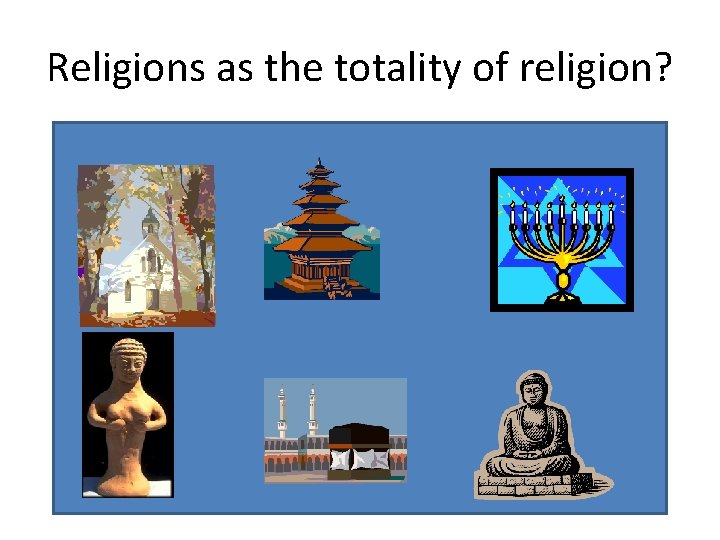
Religions as the totality of religion?
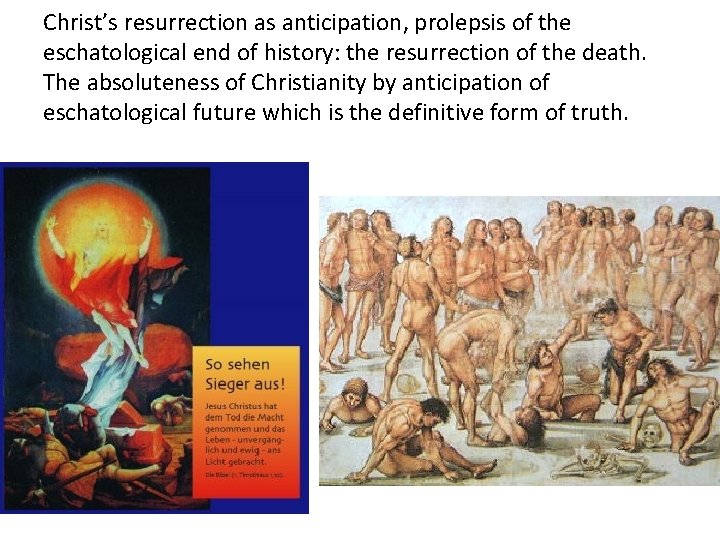
Christ’s resurrection as anticipation, prolepsis of the eschatological end of history: the resurrection of the death. The absoluteness of Christianity by anticipation of eschatological future which is the definitive form of truth.
Dogmatic consequences of the method: retroactive causality From escatological end everything • The history belongs to God‘s Dasein, because God decides finds its verification: God, creation, and determinates himself to history of salvation…. . be determined by history. History decides about God‘s 1 Cor 15, 22 For as in Adam all die, so also in Christ all will reality. be made alive. 23 But each in his own order: Christ the first fruits, after that those who are Christ's at His coming, 24 then comes the end, when He hands over the kingdom to the God and Father, when He has abolished all rule and all authority and power. 25 For He must reign until He has put all His enemies under His feet. 26 The last enemy that will be abolished is death. 27 For HE HAS PUT ALL THINGS IN SUBJECTION UNDER HIS FEET. But when He says, "All things are put in subjection, " it is evident that He is excepted who put all things in subjection to Him. 28 When all things are subjected to Him, then the Son Himself also will be subjected to the One who subjected all things to Him, so that God may be all in all. • Trinitarian perspective: God has to become „all in all “ 1 Cor 15, 28 • Dependence of the deity of the Father by the Son.
Analogy - Doxology • Critique of analogy: fixed unity as middle-term • Theological thinking of God have to be doxological: theology does not speak ABOUT God, but to God, without knowing how the content of it concepts concern God‘s reality. Doxology
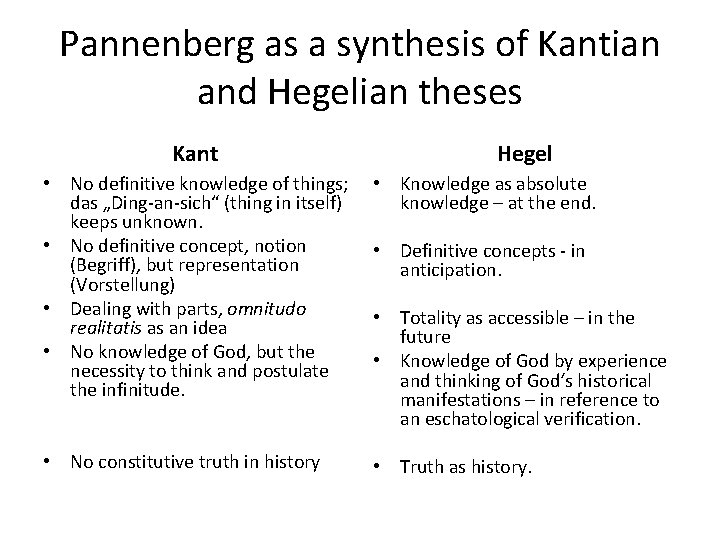
Pannenberg as a synthesis of Kantian and Hegelian theses Kant Hegel • No definitive knowledge of things; das „Ding-an-sich“ (thing in itself) keeps unknown. • No definitive concept, notion (Begriff), but representation (Vorstellung) • Dealing with parts, omnitudo realitatis as an idea • No knowledge of God, but the necessity to think and postulate the infinitude. • Knowledge as absolute knowledge – at the end. • No constitutive truth in history • Truth as history. • Definitive concepts - in anticipation. • Totality as accessible – in the future • Knowledge of God by experience and thinking of God‘s historical manifestations – in reference to an eschatological verification.
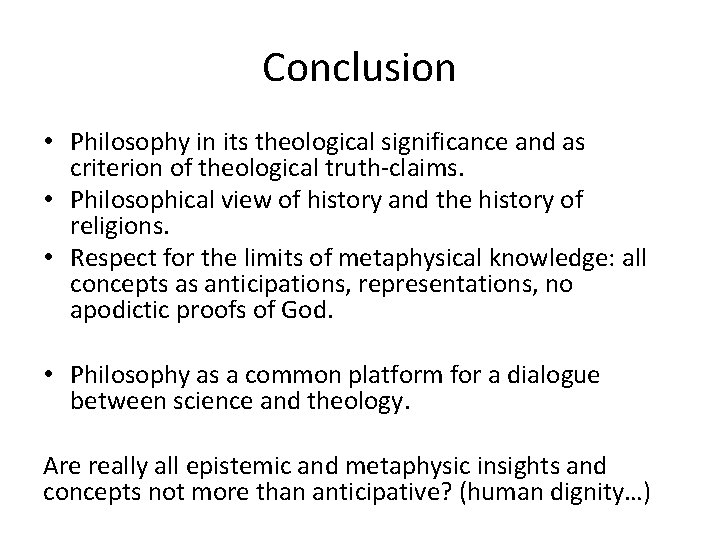
Conclusion • Philosophy in its theological significance and as criterion of theological truth-claims. • Philosophical view of history and the history of religions. • Respect for the limits of metaphysical knowledge: all concepts as anticipations, representations, no apodictic proofs of God. • Philosophy as a common platform for a dialogue between science and theology. Are really all epistemic and metaphysic insights and concepts not more than anticipative? (human dignity…)
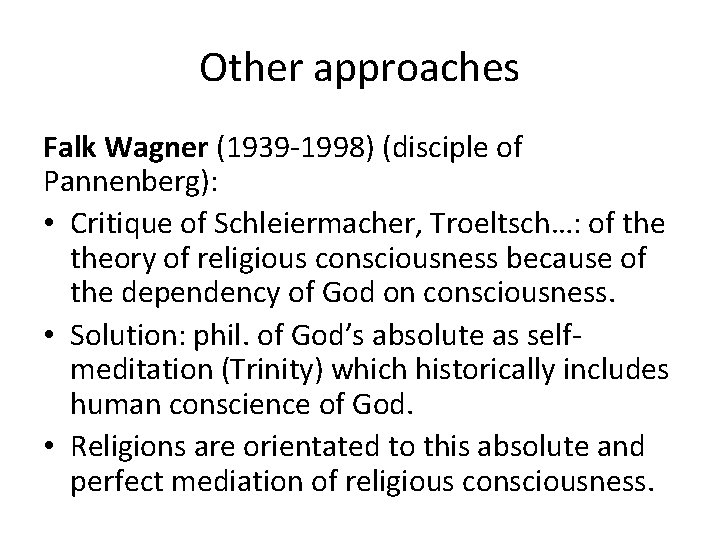
Other approaches Falk Wagner (1939 -1998) (disciple of Pannenberg): • Critique of Schleiermacher, Troeltsch…: of theory of religious consciousness because of the dependency of God on consciousness. • Solution: phil. of God’s absolute as selfmeditation (Trinity) which historically includes human conscience of God. • Religions are orientated to this absolute and perfect mediation of religious consciousness.
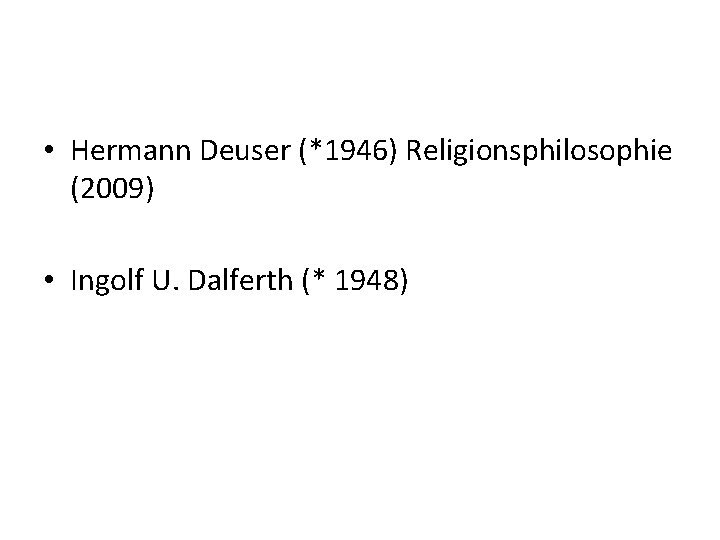
• Hermann Deuser (*1946) Religionsphilosophie (2009) • Ingolf U. Dalferth (* 1948)