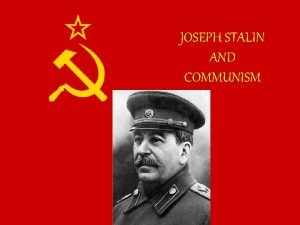
USSR under Stalin 1927 53 Joseph Stalin 1879






- Slides: 31
USSR under Stalin 1927 -53
Joseph Stalin (1879 -1953) • 1. born in Georgia of Russia as a son of a poor ex-serf family • 2. strong-willed, good organizing skills, but cruel and insidious • 3. follower of Lenin’s Bolsheviks, responsible for party discipline, fundraising and propaganda • 4. CPSU Secretary. General since 1922
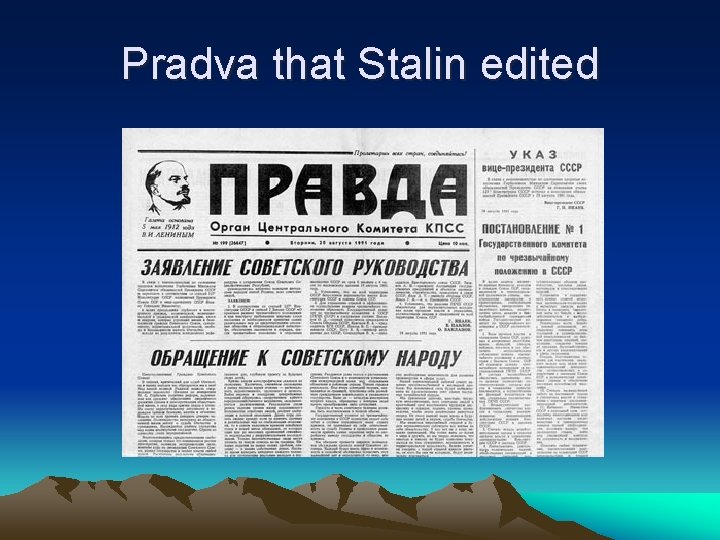
Pradva that Stalin edited
Power Struggle with Leon Trotsky • In 1924 Lenin died. • Stalin competed for supreme power with Trotsky in 1924 -27. • Merits of Trotsky: • 1. intelligent • 2. oratory • 3. helped win the Civil War with his Red Army • 4. Commissar of War in the USSR
Differences between Stalin and Trotsky • 1. Trotsky supported immediate worldwide socialist revolutions, while Stalin preferred “Socialism in One Country”. • 2. Trotsky supported the immediate implementation of collective farms, but Stalin would like to postpone it. • In the CPSU Congress of 1927, Trotsky was expelled from the party.
Why did Stalin defeat Trotsky? • 1. Trotsky was a Jewish, traditionally not welcomed by other Russians. • 2. Trotsky did not join the Bolsheviks until the eve of the October Revolution 1917. • 3. Trotsky was too brilliant a military genius that Old Bolsheviks feared that he would be another Napoleon. • 4. As the CPSU Secretary-General, Stalin had put supporters in the Party.
Socialism in One Country: Reasons • 1. As the first communist country, the USSR received hostility of capitalist western powers. The Comintern added to the western suspicion. • 2. In the Civil War of 1918 -22, western powers had supported the White Russians. Even Japan invaded Siberia. The USSR felt insecure. • 3. The USSR was not invited to join the Paris Peace Conference of 1918 -19, but was forced to give up many territories. She was isolated. • 4. The USSR needed internal consolidation.
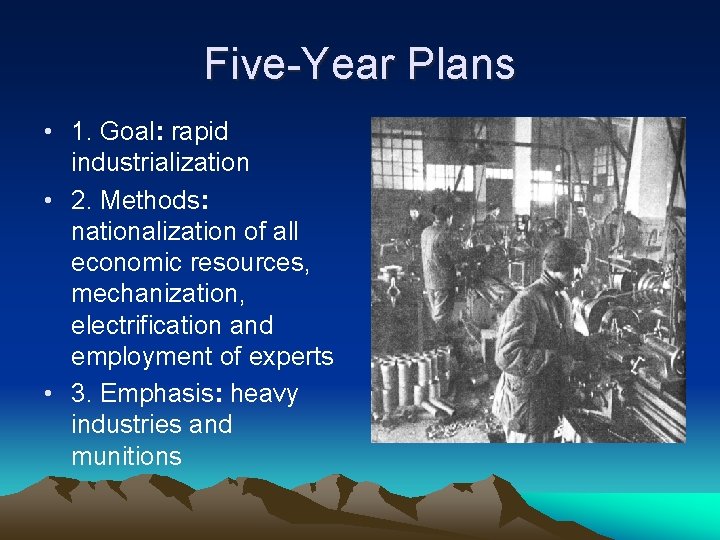
Five-Year Plans • 1. Goal: rapid industrialization • 2. Methods: nationalization of all economic resources, mechanization, electrification and employment of experts • 3. Emphasis: heavy industries and munitions
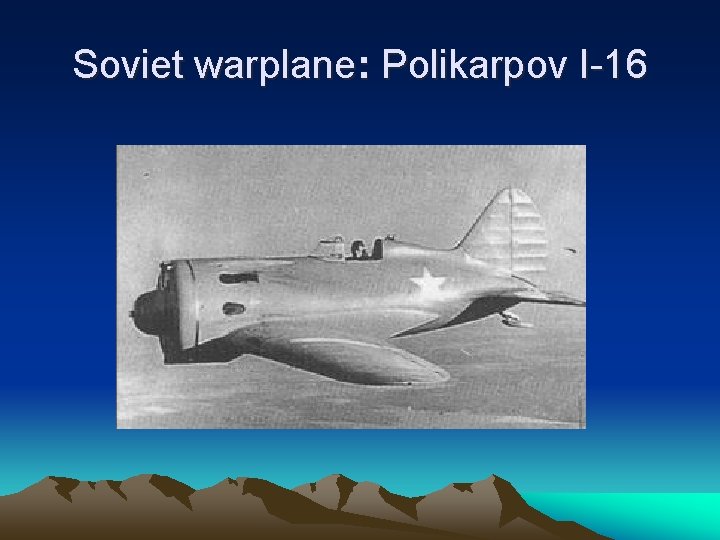
Soviet warplane: Polikarpov I-16
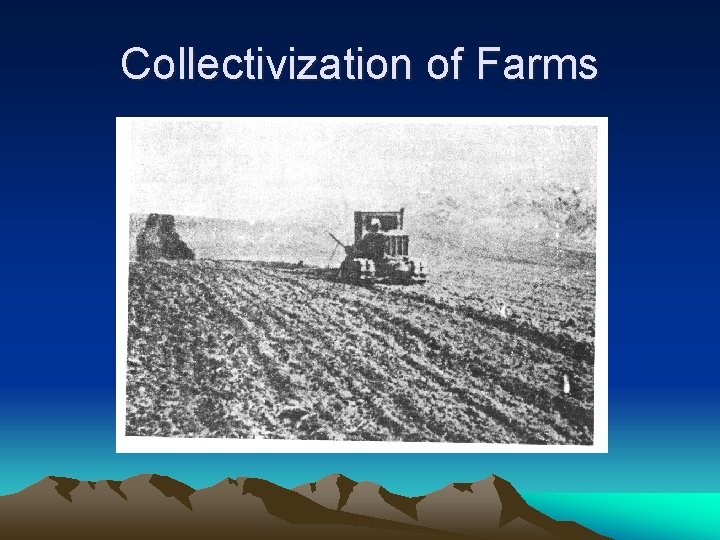
Collectivization of Farms
Agricultural Reforms • 1. Farms and private landholdings were merged into great collective farms. • 2. The strategy of mechanization was adopted. • 3. Over 200, 000 kulaks were killed or sent to concentration camps.
Stalin’s speech in 1929 • “We must break down the resistance of the Kulaks and deprive this class of its existence. We must eliminate the Kulaks as a class. We must smash the Kulaks …. We must strike at the Kulaks so hard as to prevent them from rising to their feet again. We must annihilate them as a social class. ”
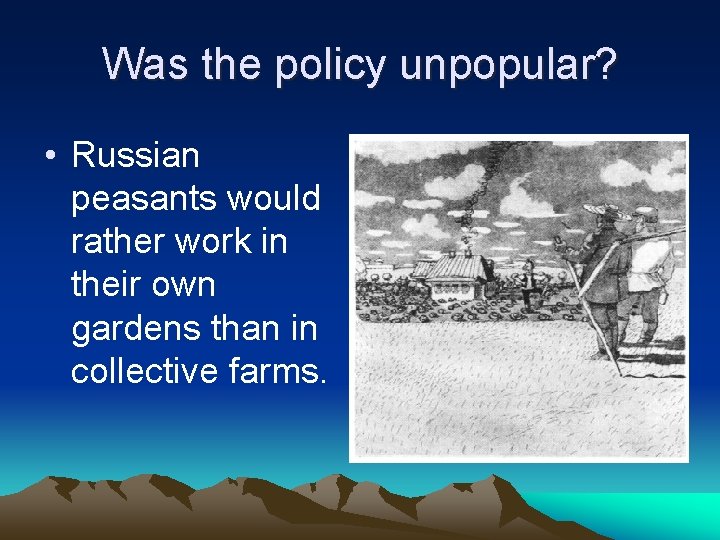
Was the policy unpopular? • Russian peasants would rather work in their own gardens than in collective farms.
Results of Stalin’s Five-Year Plans First Five-Year Plan Second Five-Year Plan 1928 1932 1937 Industrial production (million rubles) 18. 3 43. 3 95. 5 Coal (million tons) 35. 4 64. 3 128. 0 Pig iron (million tons) 3. 3 6. 2 14. 5 Steel (million tons) 4. 0 5. 9 17. 7 Agricultural Grain harvest production (million tons) 73. 3 69. 6 75. 0 Cattle (million heads) 70. 5 40. 7 63. 2 Sheep and Goats (million heads) 146. 7 52. 1 61. 1
Great Purge 1936 -39 • Aim: to achieve personal dictatorship by removing anyone who might threaten his supreme position • Results: • 1. All Old Bolsheviks were tried and executed. • 2. 500, 000 party members and 1/5 of army officers “disappeared”. • 3. 1/4 of CPSU Central Committee members were shot to death. • 4. Millions of common people were arrested by the NKVD (later KGB), exiled, sent to concentration camps or simply killed.
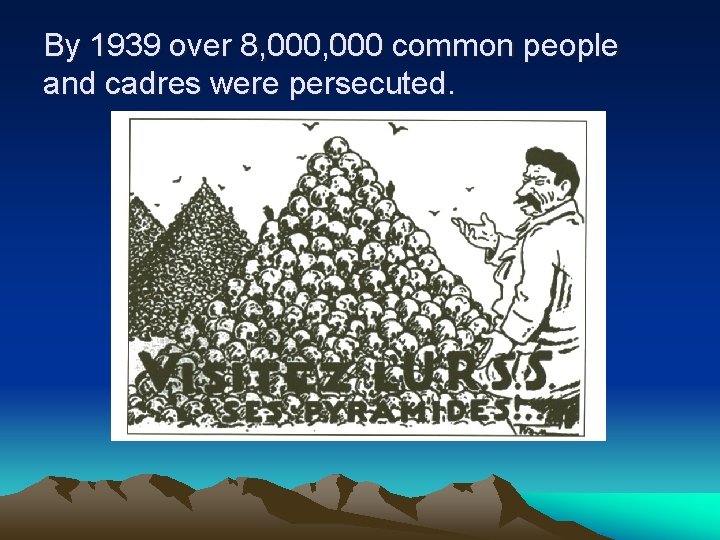
By 1939 over 8, 000 common people and cadres were persecuted.
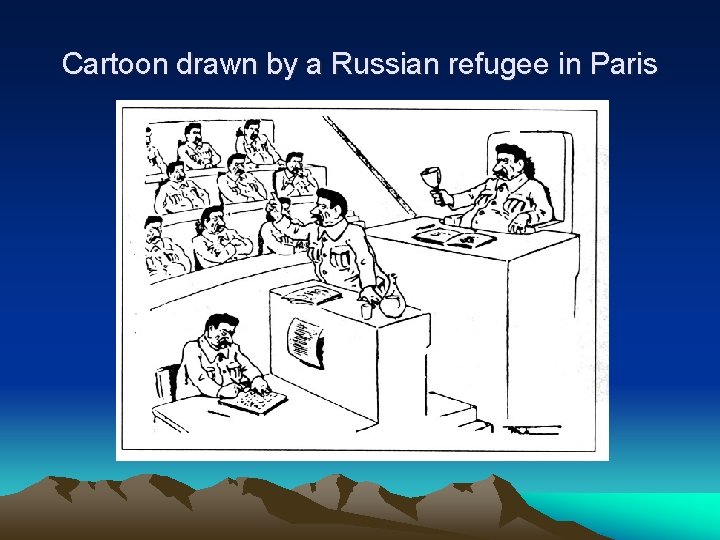
Cartoon drawn by a Russian refugee in Paris
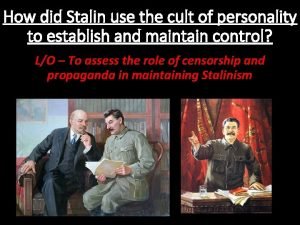
Legitimacy of Stalin’s Rule • In the beginning, Stalin posed to be Lenin’s close friend and successor. • Note that it is a fake photograph. • Later on, he made his own glorification.
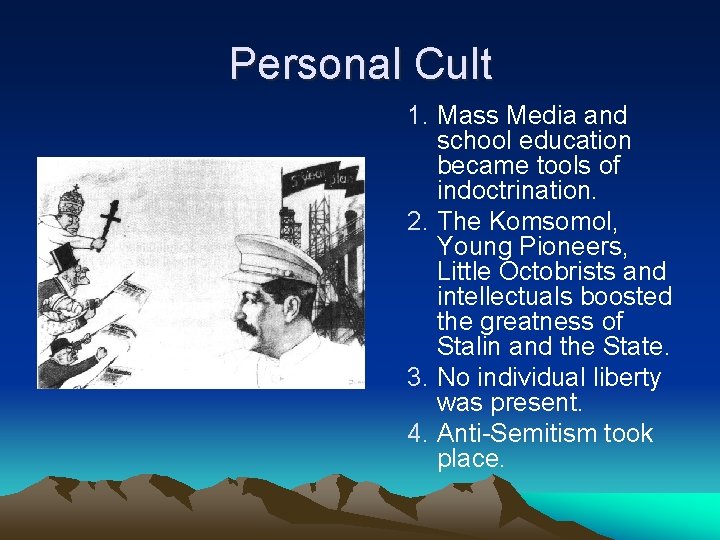
Personal Cult 1. Mass Media and school education became tools of indoctrination. 2. The Komsomol, Young Pioneers, Little Octobrists and intellectuals boosted the greatness of Stalin and the State. 3. No individual liberty was present. 4. Anti-Semitism took place.
Social Welfare • 1. The 1936 Constitution stated that Russian people were entitled to enjoy old age pension and sickness allowance. • 2. Labour codes protected workers’ rights. • 3. There was the State Health Insurance Scheme. • 4. There was compulsory primary and secondary education. • 5. Higher education institutes were widely established with emphasis on scientific studies.
Results of Stalin’s Home Policies • 1. By 1939 the USSR became third largest industrial power, next only to the U. S. and Germany. • 2. The agricultural productivity did not increase so quickly as Stalin had expected. • 3. The bureaucracy was inefficient, simply full of “yes -men”. • 4. Uncountable human lives were sacrificed. • 5. The lack of consumer goods led to the low living standard among Russians. • 6. Strong armaments enabled the USSR to resist the Nazi invasion and finally win the Second World War. After that, she became a superpower.
Stalin’s Foreign Policies • Periodization: • 1. In 1927 -35, Stalin tried to maintain friendly relations with western capitalist powers because of the increasing threat of Nazi Germany. • 2. In 1935 -41 Stalin maintained peaceful relations with Hitler to earn a breathing space for the USSR.
1927 -35 • 1. Bound to “Socialism in One Country”, Stalin was not eager to export socialist revolutions outside the USSR. • 2. In 1933 Adolf Hitler rose to power in Germany. Stalin sensed the serious Nazi threat. • 3. In the same year Stalin dissolved the Comintern to show goodwill to the West. • 4. In 1934 the USSR joined the League of Nations. • 5. In 1935 the USSR signed treaties with France and Czechoslovakia against possible German attacks.
1935 -41 • 1. Seeing the collapse the Stresa Front and the secret Anglo-German naval agreement in 1935, Stalin was no longer confident of the West in face of Nazi Germany. • 2. The British Appeasement Policy like that at the Munich Conference 1939 discredited the Western anti-Nazi determination in Stalin’s eyes.
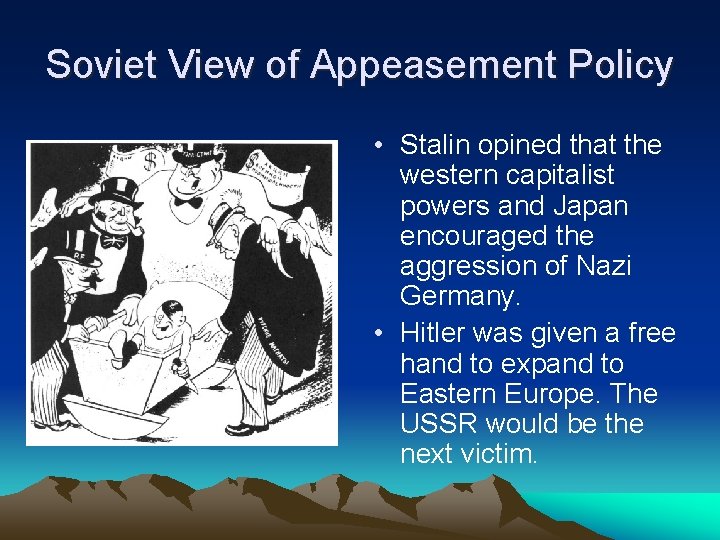
Soviet View of Appeasement Policy • Stalin opined that the western capitalist powers and Japan encouraged the aggression of Nazi Germany. • Hitler was given a free hand to expand to Eastern Europe. The USSR would be the next victim.
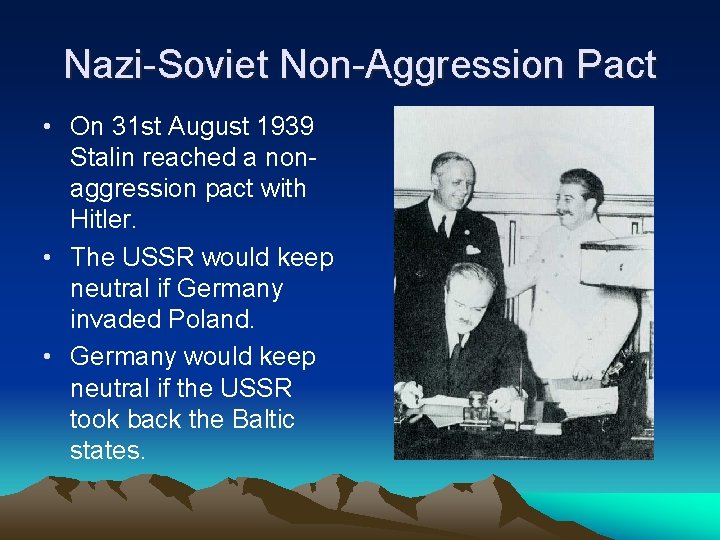
Nazi-Soviet Non-Aggression Pact • On 31 st August 1939 Stalin reached a nonaggression pact with Hitler. • The USSR would keep neutral if Germany invaded Poland. • Germany would keep neutral if the USSR took back the Baltic states.
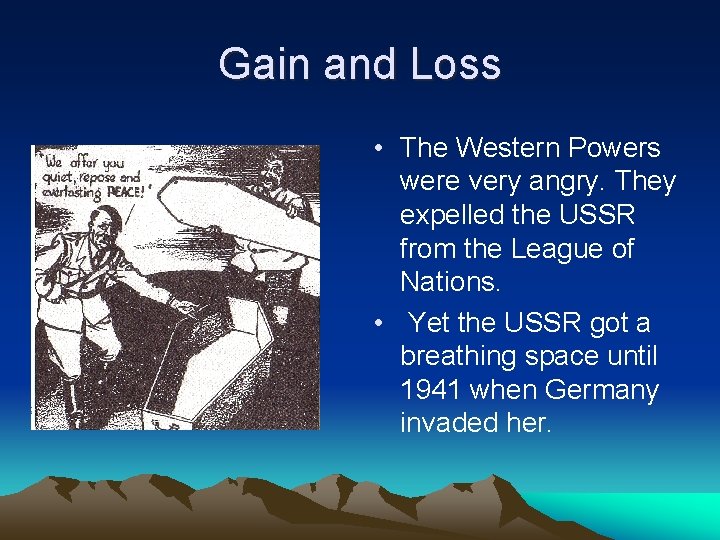
Gain and Loss • The Western Powers were very angry. They expelled the USSR from the League of Nations. • Yet the USSR got a breathing space until 1941 when Germany invaded her.
War with Nazi Germany • In 1941 -45 the USSR joined the Second World War to resist German invasion. • Patriotic propaganda was seen everywhere. • Stalin became the “Father of the Nation”.
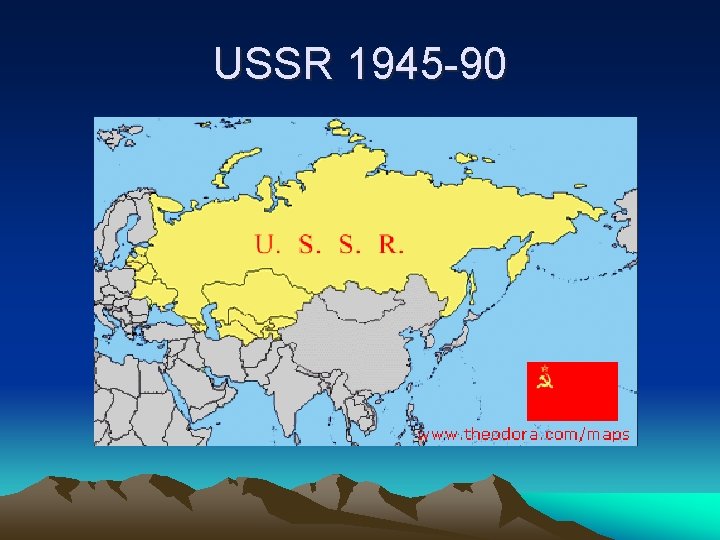
1945 -53 • With regard to the victory over the Axis Powers, “the U. S. paid the money, Britain paid with the time, and the USSR paid with blood”. The Soviet casualties amounted to 20 million. • After the War the USSR expanded quickly. There were 15 republics in the federation. • Many Eastern European countries became communist and Soviet “satellites”.
Cold War • 1. The USSR conflicted with the U. S. over the treatment of postwar Germany, the Greek Civil War, the Marshall Plan, the Berlin Blockade and the Korean War, etc. • 2. To counter the NATO, in 1953 the Communist bloc formed the Warsaw Pact. • 3. Stalin died in the same year. All what he had done was sooner officially denied by Khrushchev. Even his corpse was beaten.
USSR 1945 -90