
APUSH Review WWII Joseph Stalin Soviet Union Benito

APUSH Review
WWII • Joseph Stalin (Soviet Union) • Benito Mussolini (Italy) • Adolf Hitler (Germany) • Francisco Franco (Spain • Hideki Tojo (Japan) • Neville Chamberlain / Winston Churchill (England) • FDR / Truman (U. S. )
• German invasion: • • • Austria (No fight) Sudetenland (West Czech) Rest of Czech Poland (Starts WWII) France Turns to Britain (Unsuccessful) • Axis Powers – Germany, Italy, and Japan • Allied Powers – United States, Great Britain, Soviet Union (eventually)
• first peace-time draft • Hitler breaks agreement with Stalin and invades Soviet Union • U. S. is now sending supplies to Soviets and British • Japan launches invasion in China (Hideki Tojo) • Tojo reaches out to Hirohito (emperor) • Plan attack on U. S. • December 7, 1941 - Pearl Harbor = largest U. S. naval base in the Pacific -> FDR “Infamy” speech • Women begin to fill jobs of the men in factories • The Manhattan Project • Code name for the research and work on the atomic bomb
• War Production Board • Which companies would convert from peacetime to wartime production? • Strike Hitler and Europe first then move to Pacific • Battle of Stalingrad • Hitler wanted to capture oil fields and Stalingrad (major industrial center) • 1. 1 Mil USSR soldiers killed (more than U. S. all war • Launch Operation Torch led by Dwight D. Eisenhower in North Africa against Gen. Erwin Rommel (“Desert Fox”) • Tuskegee Airmen and 92 nd “Buffaloes” • D-Day (June 6, 1944) • Force of 3 million British, American, and Canadian troops • Plan to attack Normandy in Northern France
• Battle of the Bulge = Hitler responds with one last effort and offensive • FDR does not see the end of the war – dies from stroke on April 12, 1945 • Harry Truman becomes new president • Doolittle’s Raid • Pearl Harbor like bombing of Tokyo • Battle of Coral Sea • 5 day battle stopping Japanese from making it to Australia • Battle of Midway • Island located North-west of Hawaii • Guadalcanal (Solomon Islands) = 1 st Allied offensive attack • Became known as “Island of Death” • Kamikaze
• Iwo Jima • Most heavily defended spot • 20, 700 Japanese troops in trenches and caves • More than 6 k marines die, only 200 Japanese survive • Okinawa (Final Assault) • Plagued with almost 2 k kamikaze attacks • 30 ships and 5 k deaths • Truman decides to use the bomb • 2 bombs = Little Boy (Hiroshima) and Fat Man (Nagasaki) • Result • Germany split into 4 (U. S. , USSR, France, Britain) • Stalin agrees to free-elections in Soviet occupied territories, joined the war in the Pacific, and agrees to help create United Nations • Nuremburg Trials • Discovery of Hitler’s death camps • Allies have trial for 24 Nazi leaders • 12 sentenced to death • Occupation of Japan • Under General Mc. Arthur • Arrested Hideki Tojo to prison guards • 7 sentenced to death • Japanese Internment
Cold War • U. S. and Soviet Union become rival superpowers of the world post WWII • Communism vs Capitalism • Potsdam Conference -> U. S. , Great Britain, Soviet Union meet near Berlin • Stalin not honoring Yalta conference talks -> not allowing free elections in Poland • Policy of containment suggested • Not allowing the extension of communist rule to other countries • Split between Democratic West and Communist East in Europe becomes known as the “Iron Curtain” • Truman Doctrine • Britain supporting Greece and Turkey from Communist takeover • Economy hurt by war so asked U. S. to pick up where it left off • Truman decided to accept the challenge • “it must be the policy of the united States to support free peoples who are resisting attempted subjugation by armed minorities or by outside pressures” • Marshall Plan • Secretary of State, George Marshall, proposes plan to help any European country in need of aid
• Britain, France, and U. S. decide to combine their 3 zones into one nation (Berlin) • Did not guarantee access to Berlin to the Soviets by road or rail • Soviets shut down all highway and rail routes to West Berlin leaving people with enough food to last only 5 weeks • Resulted in the Berlin Airlift • U. S. and British attempt at flying food/supplies into West Berlin • • • Leads to formation of West Germany and East Germany Birth of NATO Alger Hiss / The Rosenbergs…. Spies? Mc. Carthyism Soviets get atomic bomb • Truman decides to go bigger (H-bomb) • Force of 1 million tons of TNT (67 x more powerful than bomb dropped on Hiroshima) • Race to see who could develop the H-bomb first • U. S. wins race but only for less than a year
• Eisenhower becomes President • U. S. begins to rely on newly formed Central Intelligence Agency (CIA) • Warsaw Pact • Created own “NATO” in the Warsaw Pact with 7 other Eastern European countries • Summit in Geneva • Eisenhower travels to Geneva, Switzerland to meet with Soviet leaders • “Open skies” proposal -> allow flight over each other’s territory to guard against surprise nuclear attacks (Soviet’s reject his offer) • Nikita Khrushchev takes power after Stalin’s death • Thought communism could take over the world peacefully • Soviets lead the way into the Space Race when they launched Sputnik • Followed shortly by the U. S. launching their own satellite
Crises over Cuba • U. S. cuts ties with Cuba after election of Fidel Castro • Openly declared himself a Communist and welcomed the aid of the Soviet Union • Eisenhower gave permission to the CIA to train Cuban exiles for an invasion of Cuba • JFK approves of this hesitantly • Invade through Bahia de Cochinos (Bay of Pigs) • Went terribly wrong and was unsuccessful
Cuban Missile Crisis • Soviet Union vows to protect Cuba • JFK warns that the U. S. would not tolerate offensive nuclear weapons in Cuba • American planes reveal Soviet missile bases in Cuba with missiles ready to be launched (could reach America in minutes) • JFK warns public and informs them that a launch of the missiles would confirm and all-out attack on the Soviet Union • For the next 6 days the U. S. tries to prevent the Soviets from sending more missiles by boat to Cuba
Korean War • Post- WWII Japanese troops North of 38 th parallel surrendered to the Soviets, South surrendered to the Americans • Two nations form -> one communist the other democratic • North Korea becomes Democratic People’s Republic of Korea led by Kim Il Sung • South Korea sets up shop in Seoul under Syngman Rhee • Armistice signed = nothing accomplished
Vietnam War • France or China or Japan? • Japan gains control in 1940 • Vietminh -> goal to win independence from foreign rule • After defeat of Japan in WWII, Ho Chi Minh declares Vietnam an independent nation • U. S. involvement begins in 1950 • France is reattempting control over Vietnam post WWII • Want to strengthen relationship and stop spread of communism • Fund nearly $1 bil over 4 years • France, Great Britain, Soviet Union, China, U. S. , Laos, and Cambodia meet with Vietminh in Geneva, Switzerland • Create the Geneva Accords -> temporarily divided Vietnam along the 17 th parallel • Begin providing aid to South Vietnam • Election to unify country in 1956 • Ngo Dinh Diem (S. Vietnam’s Pres. ) refused to take place in election • Diem limits opposition of any kind, offered little land distribution to the peasants, and restricted Buddhist practices • Vietcong (Communist opposition group) begins attacking Diem gov’t, assassinating thousands of people • Ho Chi Minh Trail -> path used to supply weapons and aid to Vietcong from North Vietnam
• Kennedy administration 1961 • Increased financial aid to Diem and sent military advisors to help train S. Vietnamese military • Diem and JFK both assassinated • Before his death JFK announced intent of removing troops from Vietnam • LBJ begins to escalate the war • S. Vietnam becomes more unstable • Vietcong attack kills 8 Americans • • LBJ starts “Operation Rolling Thunder” First sustained bombing of N. Vietnam March of 1965 -> first American combat troops begin arriving in S. Vietnam June of 1965 -> 50 k + U. S. soldiers fighting the Vietcong • Most of nation supports LBJ in attempting to stop spread of Communism • Begins dispatching 10 s of thousands of soldiers • Jungle terrain + guerilla tactics proves to be difficult to U. S. military • Vietcong used hit and run strategy with knowing the terrain better than the U. S. troops • Attacked in both cities and countryside (difficult to tell who was a citizen and who was military) • Used network of tunnels • Punji sticks • Peppered land with booby traps and land mines
• Plan to defeat Vietcong through attrition -> wearing them down • More rebels to dies the quicker the surrender • Not the case -> Vietcong receive aid from China and Soviet Union • U. S. want to avoid N. Vietnamese gaining support from the S. Vietnam rural population • Want to win over citizens = no place for Vietcong to hide? • U. S. begins using napalm (gasoline based bombs) and Agent Orange (leaf killing toxic chemical) • Search and destroy missions -> finding citizens helping Vietcong and killing their livestock/burning villages • Vietnam became America’s first “living room war” • Credibility gap -> What the LBJ administration reported and the reality
• Surprise attack by the Vietcong and N. Vietnamese military on many cities • Caused many more Americans to turn against the war • Tet Offensive • Launched an attack on over 100 towns and cities in S. Vietnam and U. S. airbases • Carry attack on to the U. S. embassy in Saigon killing 5 Americans • Continued for about 1 month before U. S. and S. Vietnamese regain control • Tet offensive changes the mindset of many Americans • Walter Cronkite (one of most respected journalists) -> “more certain than ever that the bloody experience of Vietnam is to end in a stale mate” • New Defense Secretary Clark Clifford claims the war to be “unwinnable” • Summer of 1969, Nixon announces first U. S. troops withdrawal • Although withdrawing troops, the fighting still continued with N. Vietnam • Negotiations to end war were going nowhere • U. S and S. Vietnam insist that all N. Vietnam troops from the South and S. Vietnam’s ruler stayed in his position • N. Vietnam and Vietcong demand that U. S troops withdraw from S. Vietnam and the S. Vietnam gov’t step aside for a coalition gov’t including Vietcong • Nixon confers with National Security Advisor Henry Kissinger • Vietnamization -> called for the gradual withdrawal of U. S. troops in order for S. Vietnam to take on a more active combat role in the war • Over 3 years U. S. numbers drop from 500 K + to less than 25 K
• 58 K Americans killed, 303 K wounded • North and South Vietnam deaths = 2 mil + • Divided U. S. attempted to come to grips with unsuccessful war • Troops were not greeted as heroes but received a “cold hand” • PTSD, drug use, and suicide become a problem • Unveiling of Vietnam Veterans Memorial in D. C. • N. Vietnam initially extends welcome to S. Vietnam • Then imprison 400 K+ in labor camps • U. S. policy changes: • Gov’t abolishes the draft • Decrease the President’s war-making powers • War Powers Act -> must notify Congress within 48 hrs / cannot stay longer than 90 days
Anti-War Protests • Fighting a war in a faraway place + questionable cause = resistance going to Vietnam • Begin to look for ways around the draft • Medical exemptions, talked in front of lenient draft board, joined National Guard/Coast Guard for exemption from Vietnam service • College deferment -> enrollment in a university would suspend draft status • Most fighters in Vietnam end up being lower class whites/minorities (working class) • Students begin to become more active in social and political activities • Become powerful and vocal group of protestors during Vietnam • New Left -> growing youth movement that demanded changes in American society • LBJ begins requiring college students to be in good academic standing in order to be granted deferment • SDS begins encouraging people to skip the draft to Canada or Switzerland • Reasons for youth opposition: • Belief that U. S. should not be involved in Vietnam’s civil war • Argument that U. S. could not police the entire world • Morally unjust • Returning veterans begin to protest the war
• Popular music groups -> Peter, Paul, and Mary and Joan Baez • #1 song = “Eve of Destruction” by Barry Mc. Guire • “Hell no, we won’t go!” • Group of 30 k+ demonstrators lock arms and march onto the Pentagon steps • Met with tear gas and clubs • Divided into the doves (opposed war) and hawks (continue war) • People begin to think that protests are an act of “disloyalty” • “Support our troops” and “America- love it or leave it”
Civil Rights • Desegregation campaign lead mainly by NAACP • Focus on inequality of school systems • Brown v. Board of Ed. of Topeka -> outlawed segregation of schools • Crisis in Little Rock • Becoming gradually ok with decision • Governor of Arkansas publically against desegregation • Ordered National Guard to turn away “Little Rock Nine” • Arkansas National Guard taken into federal hands (allowed students in) • Montgomery Bus Boycot • • Rosa Parks -> arrested for not giving up her seat Led by Martin Luther King Jr. 381 days of not riding buses 1956 -> Supreme Court outlaws bus segregation
• In Chicago, Congress of Racial Equality (CORE) stages first sit-ins • Sat at white-counters and refused to leave until served • North Carolina Agriculture and Technical College students stage sit-in in Woolworth’s store • Television was there to capture the scene • White beating , jeering at, pouring food over students who refused to fight back • CORE members were to take bus trip across the South (freedom riders); 2 buses • Test Supreme Court decision banning segregated buses • Hoped to spark violent reaction • Alabama -> white racists get on bus 1 • Reach Birmingham -> mob waiting for bus 1 • Bus 2 continues -> attacked in Anniston, AL • Bus companies refuse to take them any further • New freedom riders arrive in Birmingham • Again bus driver refuses to transport them (take over white waiting room) • Robert Kennedy convinces drivers to proceed • Alabama officials say they will protect riders when they get to Montgomery (doesn’t happen) • Got the violent reaction they wanted and 400 U. S. Marshals escorted them into Jackson
• JFK pushes for new Civil Rights bill • Guaranteed equal access to all public accommodations • To help persuade passage of bill -> Americans asked to march on Washington, D. C. • 250 k (75 k white) make the trip • MLK’s “I Have a Dream” speech calling for racial peace and harmony • More violence follows weeks later including JFK’s assassination • Leads to LBJ signing Civil Rights Act of 1964 • SCLC begins conducting major voting rights campaigns in Selma, AL • Jimmy Lee Jackson (demonstrator) was shot and killed • MLK Jr. responds by calling for 50 mile march from Selma to Montgomery • Police retaliated brutally (captured on TV) • Demonstrators now numbering 25 k try again in late March with federal protection • Passage of Voting Rights Act of 1965 • Eliminated so-called literacy tests and allowed federal officials to register members that were denied by local officials
• De Facto Segregation -> exists by practice and custom • Have to change people’s attitudes • De Jure Segregation -> segregation by law • Changed by repealing laws • Malcolm X • “If you think we are here to tell you to love the white man, you have come to the wrong place. ” • James Meredith (integrated Ole Miss) was shot by a white racist on a journey from the Tennessee border to Jackson, Mississippi • MLK of SCLC, Floyd Mc. Kissick of CORE, and Stokely Carmichael of SNCC decide to finish the trip • SNCC and CORE members were militant shouting slogans that followers of Malcolm X once did • “We shall overcome” vs. “We shall overrun” • Carmichael arrested for setting up a tent on the grounds of an all-black high school and was beaten • Carmichael calls for Black Power -> “call for black people to begin to define their own goals… and to lead their own organizations”
• Black Panthers • • • Political Party Dressed in black leather jackets, black berets, and sunglasses Aimed to fight police brutality in the ghettos Advocated self-sufficiency for African-American communities Argued that African Americans should be exempt from military service because an unfair number of black youths had been drafted to serve in Vietnam • MLK objects to the Black Power movement • Believed that preaching violence could only end in grief • Began to plan a Poor People’s March on Washington, D. C. • Addresses crowd in Memphis • “I may not get there with you but… we as a people will get to the Promise Land. ” • The next day MLK was shot and killed on his hotel balcony by James Earl Ray • Kerner Commission -> appointed to study causes of urban violence • Named one major cause in it’s report -> white racism • Called for the nation to create new jobs, construct new housing, and end de facto segregation • • End to de jure segregation Civil Rights Act of 1968 -> eliminated discrimination in housing Greater pride in African American’s racial identity Substantial political gains
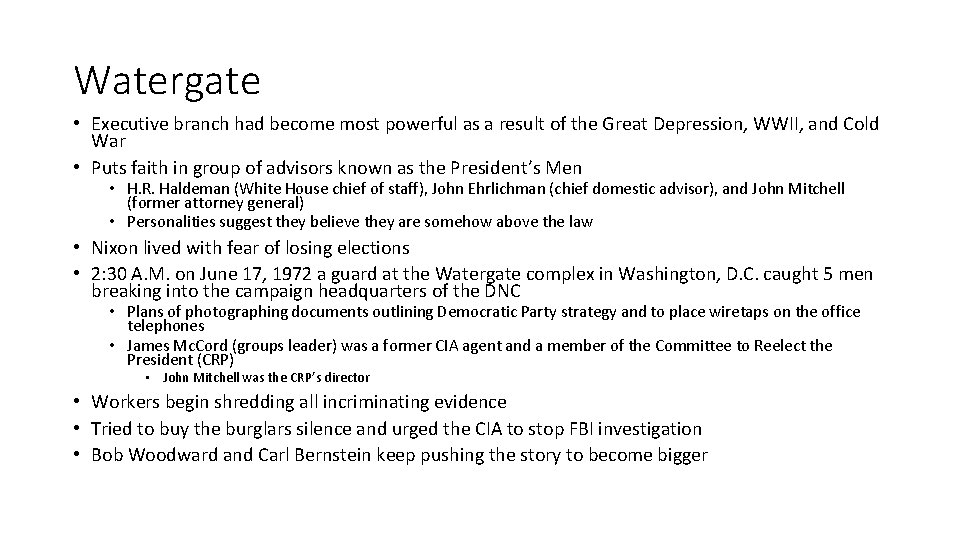
Watergate • Executive branch had become most powerful as a result of the Great Depression, WWII, and Cold War • Puts faith in group of advisors known as the President’s Men • H. R. Haldeman (White House chief of staff), John Ehrlichman (chief domestic advisor), and John Mitchell (former attorney general) • Personalities suggest they believe they are somehow above the law • Nixon lived with fear of losing elections • 2: 30 A. M. on June 17, 1972 a guard at the Watergate complex in Washington, D. C. caught 5 men breaking into the campaign headquarters of the DNC • Plans of photographing documents outlining Democratic Party strategy and to place wiretaps on the office telephones • James Mc. Cord (groups leader) was a former CIA agent and a member of the Committee to Reelect the President (CRP) • John Mitchell was the CRP’s director • Workers begin shredding all incriminating evidence • Tried to buy the burglars silence and urged the CIA to stop FBI investigation • Bob Woodward and Carl Bernstein keep pushing the story to become bigger
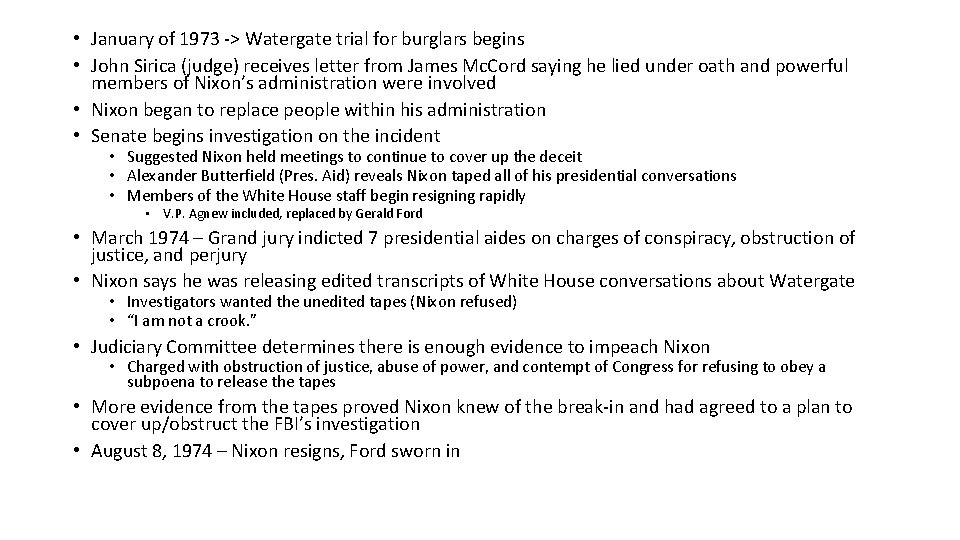
• January of 1973 -> Watergate trial for burglars begins • John Sirica (judge) receives letter from James Mc. Cord saying he lied under oath and powerful members of Nixon’s administration were involved • Nixon began to replace people within his administration • Senate begins investigation on the incident • Suggested Nixon held meetings to continue to cover up the deceit • Alexander Butterfield (Pres. Aid) reveals Nixon taped all of his presidential conversations • Members of the White House staff begin resigning rapidly • V. P. Agnew included, replaced by Gerald Ford • March 1974 – Grand jury indicted 7 presidential aides on charges of conspiracy, obstruction of justice, and perjury • Nixon says he was releasing edited transcripts of White House conversations about Watergate • Investigators wanted the unedited tapes (Nixon refused) • “I am not a crook. ” • Judiciary Committee determines there is enough evidence to impeach Nixon • Charged with obstruction of justice, abuse of power, and contempt of Congress for refusing to obey a subpoena to release the tapes • More evidence from the tapes proved Nixon knew of the break-in and had agreed to a plan to cover up/obstruct the FBI’s investigation • August 8, 1974 – Nixon resigns, Ford sworn in
“Tear Down This Wall” • http: //www. historyplace. com/speeches/reagan-tear-down. htm
- Slides: 28