UPS Unpacking the Standards for Quality Assessment Writing


- Slides: 32
UPS: Unpacking the Standards for Quality Assessment Writing -based on Margaret Kilgo’s Research Model
UPS GOALS When I leave this training… I will have a better understanding of the depth and complexity of my content standards. I will be able to better evaluate my students with assessments that are aligned to the TEKS.
STUDENT EXPECTATIONS TELL YOU THE… Cognitive Rigor The level at which students are expected to perform in order to adequately meet the standard Content Context The content items for which students must demonstrate understanding at the appropriate cognitive level in order to adequately meet the standard Situations in which the content is applicable and transferable
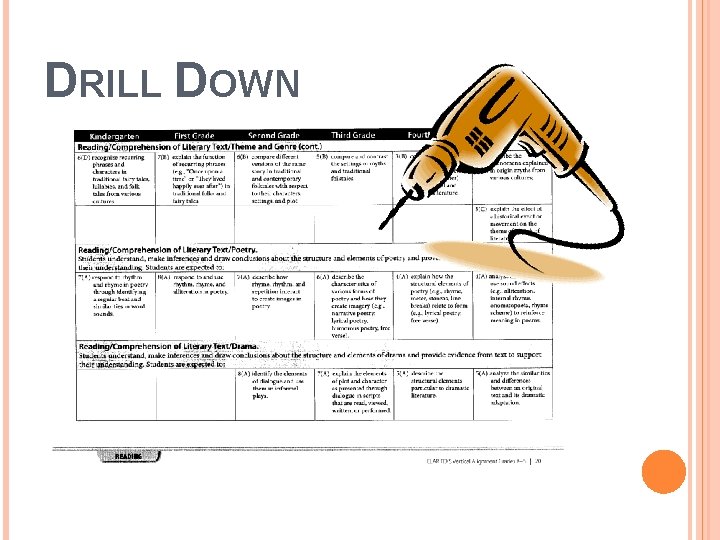
DRILL DOWN
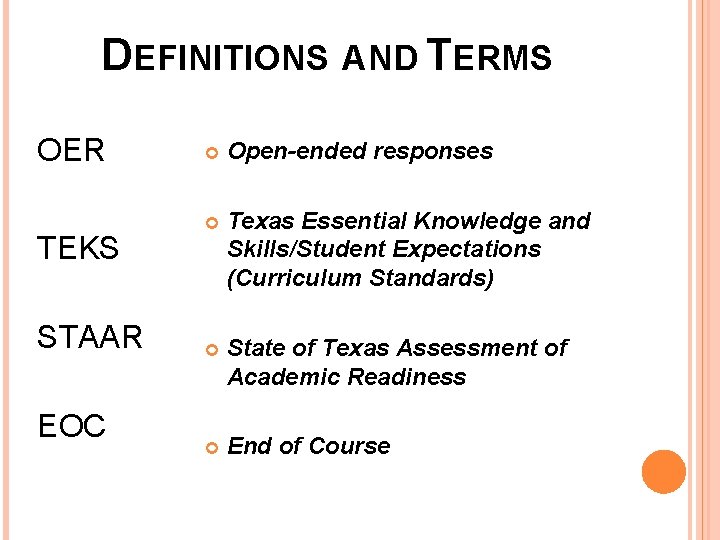
DEFINITIONS AND TERMS OER TEKS STAAR EOC Open-ended responses Texas Essential Knowledge and Skills/Student Expectations (Curriculum Standards) State of Texas Assessment of Academic Readiness End of Course
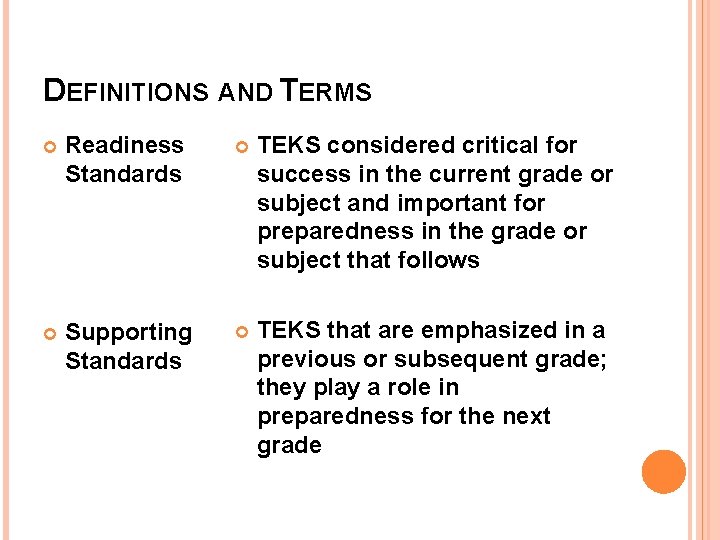
DEFINITIONS AND TERMS Readiness Standards TEKS considered critical for success in the current grade or subject and important for preparedness in the grade or subject that follows Supporting Standards TEKS that are emphasized in a previous or subsequent grade; they play a role in preparedness for the next grade
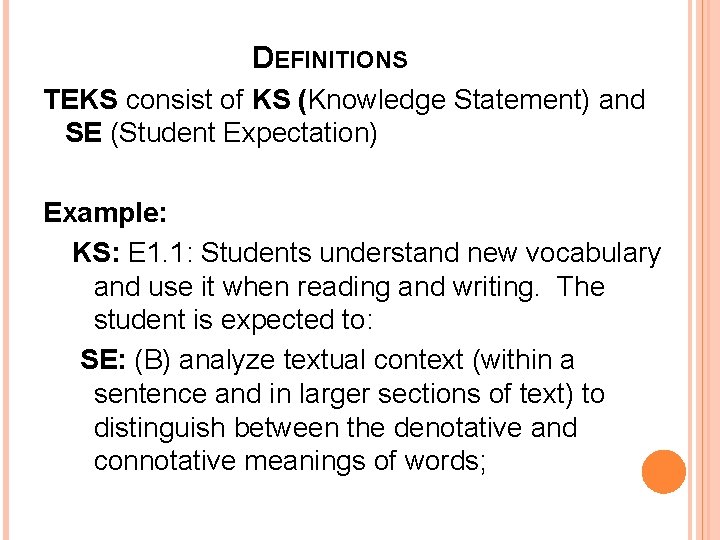
DEFINITIONS TEKS consist of KS (Knowledge Statement) and SE (Student Expectation) Example: KS: E 1. 1: Students understand new vocabulary and use it when reading and writing. The student is expected to: SE: (B) analyze textual context (within a sentence and in larger sections of text) to distinguish between the denotative and connotative meanings of words;
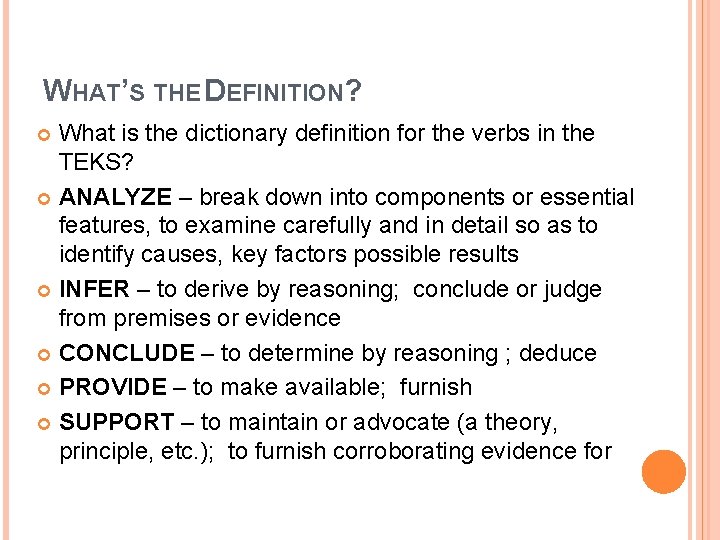
WHAT’S THE DEFINITION? What is the dictionary definition for the verbs in the TEKS? ANALYZE – break down into components or essential features, to examine carefully and in detail so as to identify causes, key factors possible results INFER – to derive by reasoning; conclude or judge from premises or evidence CONCLUDE – to determine by reasoning ; deduce PROVIDE – to make available; furnish SUPPORT – to maintain or advocate (a theory, principle, etc. ); to furnish corroborating evidence for
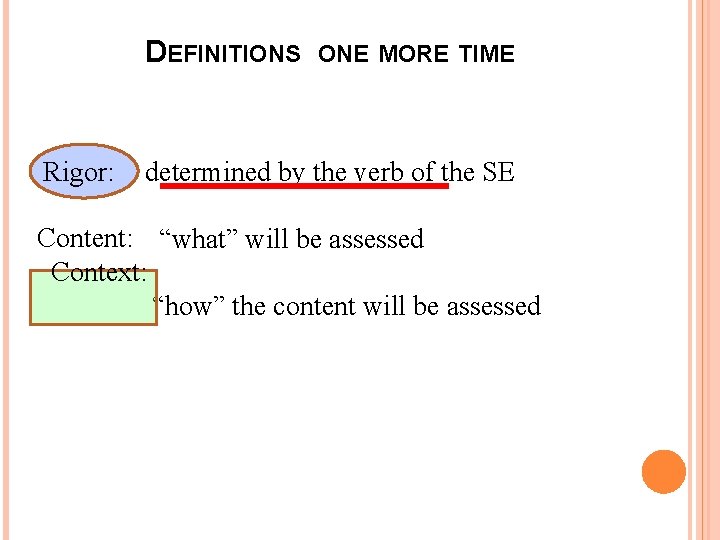
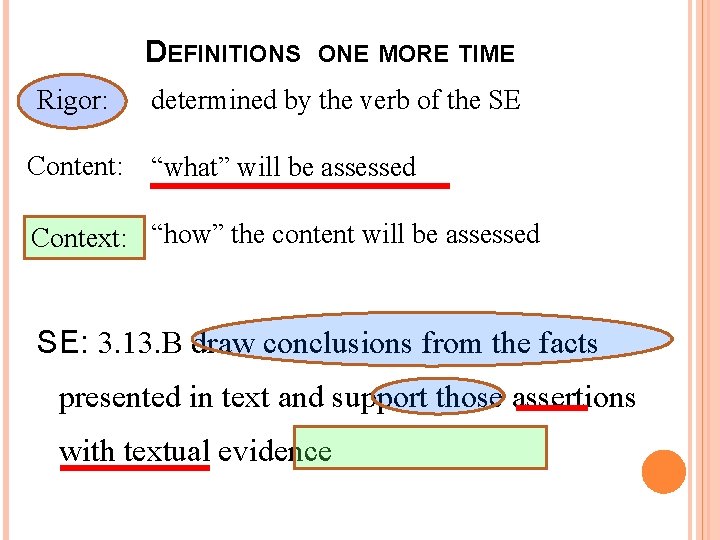
DEFINITIONS Rigor: ONE MORE TIME determined by the verb of the SE Content: “what” will be assessed Context: “how” the content will be assessed
RIGOR Cognition rigor comes from the VERB in the TEKS Rigor is not based on Bloom’s Taxonomy, but on definition of the verbs in the TEKS. Example KS: Student analyze, make inferences and draw conclusions about expository text and provide evidence from text to support their understanding. Students expected to: 13 B draw conclusions from the facts presented in text and support those assertions with textual evidence.
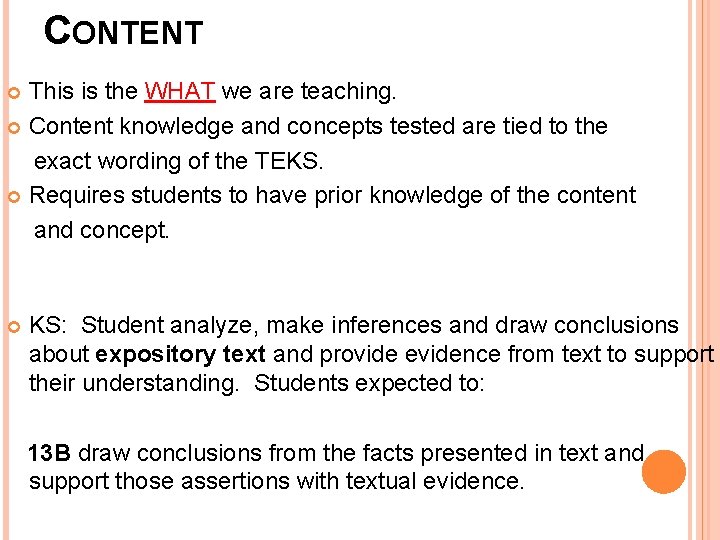
CONTENT This is the WHAT we are teaching. Content knowledge and concepts tested are tied to the exact wording of the TEKS. Requires students to have prior knowledge of the content and concept. KS: Student analyze, make inferences and draw conclusions about expository text and provide evidence from text to support their understanding. Students expected to: 13 B draw conclusions from the facts presented in text and support those assertions with textual evidence.
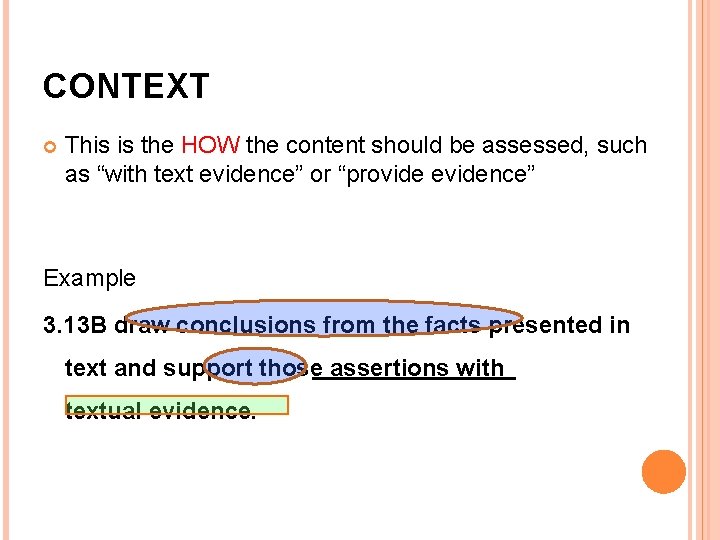
CONTEXT This is the HOW the content should be assessed, such as “with text evidence” or “provide evidence” Example 3. 13 B draw conclusions from the facts presented in text and support those assertions with textual evidence.
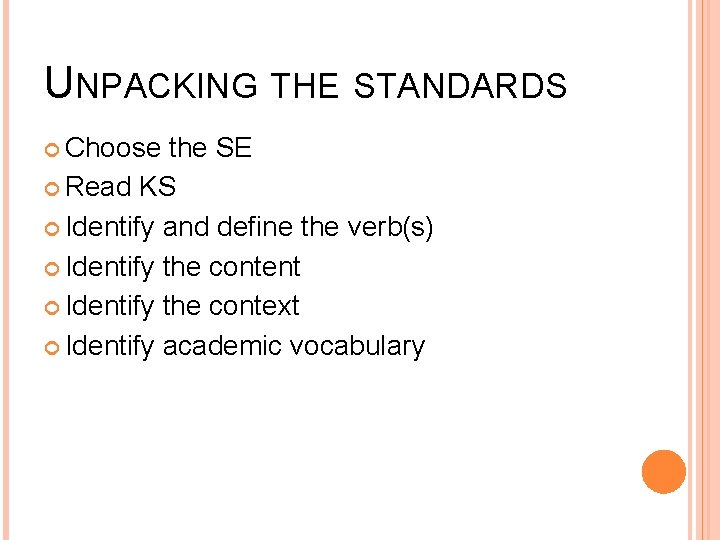
UNPACKING THE STANDARDS Choose the SE Read KS Identify and define the verb(s) Identify the content Identify the context Identify academic vocabulary
DEFINITIONS Rigor: ONE MORE TIME determined by the verb of the SE Content: “what” will be assessed Context: “how” the content will be assessed SE: 3. 13. B draw conclusions from the facts presented in text and support those assertions with textual evidence
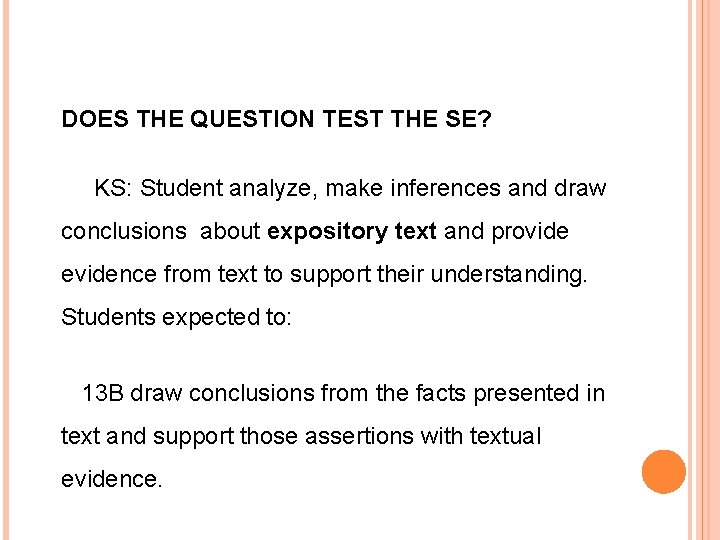
DOES THE QUESTION TEST THE SE? KS: Student analyze, make inferences and draw conclusions about expository text and provide evidence from text to support their understanding. Students expected to: 13 B draw conclusions from the facts presented in text and support those assertions with textual evidence.
PRACTICE TIME Try it with a genre, a grade level SE and by dipping back to the KS statement.
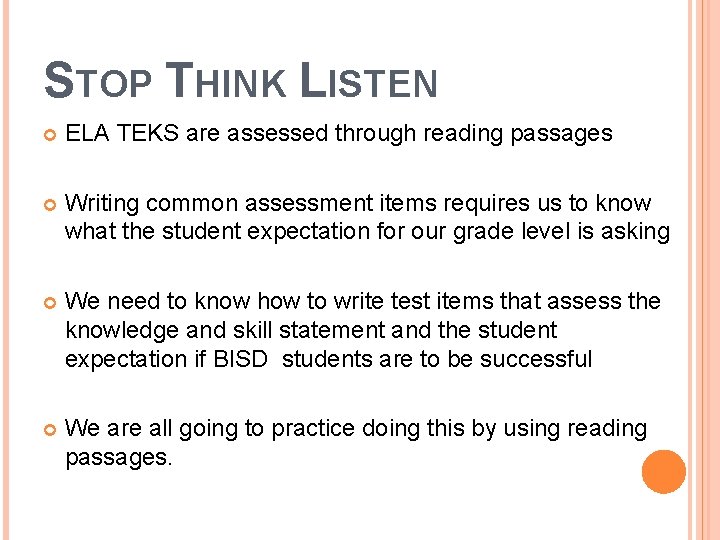
STOP THINK LISTEN ELA TEKS are assessed through reading passages Writing common assessment items requires us to know what the student expectation for our grade level is asking We need to know how to write test items that assess the knowledge and skill statement and the student expectation if BISD students are to be successful We are all going to practice doing this by using reading passages.
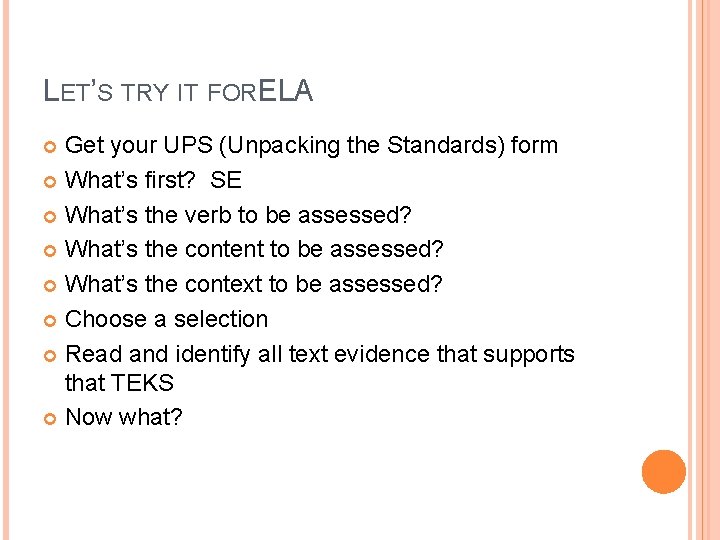
LET’S TRY IT FORELA Get your UPS (Unpacking the Standards) form What’s first? SE What’s the verb to be assessed? What’s the content to be assessed? What’s the context to be assessed? Choose a selection Read and identify all text evidence that supports that TEKS Now what?
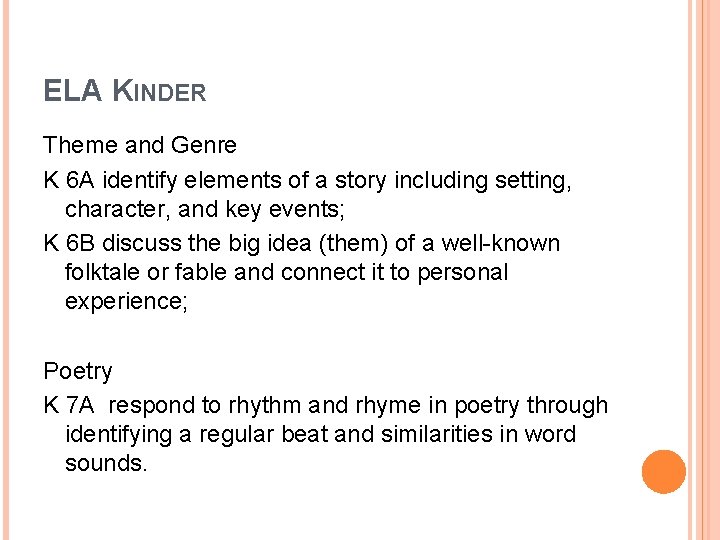
ELA KINDER Theme and Genre K 6 A identify elements of a story including setting, character, and key events; K 6 B discuss the big idea (them) of a well-known folktale or fable and connect it to personal experience; Poetry K 7 A respond to rhythm and rhyme in poetry through identifying a regular beat and similarities in word sounds.
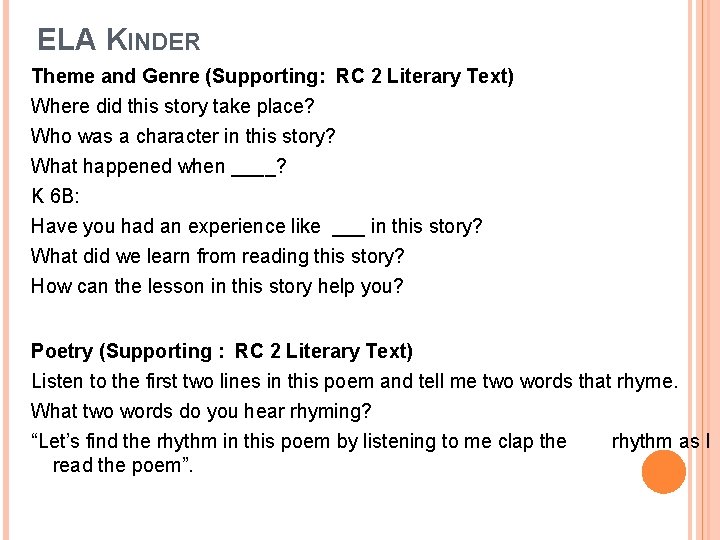
ELA KINDER Theme and Genre (Supporting: RC 2 Literary Text) Where did this story take place? Who was a character in this story? What happened when ____? K 6 B: Have you had an experience like ___ in this story? What did we learn from reading this story? How can the lesson in this story help you? Poetry (Supporting : RC 2 Literary Text) Listen to the first two lines in this poem and tell me two words that rhyme. What two words do you hear rhyming? “Let’s find the rhythm in this poem by listening to me clap the rhythm as I read the poem”.
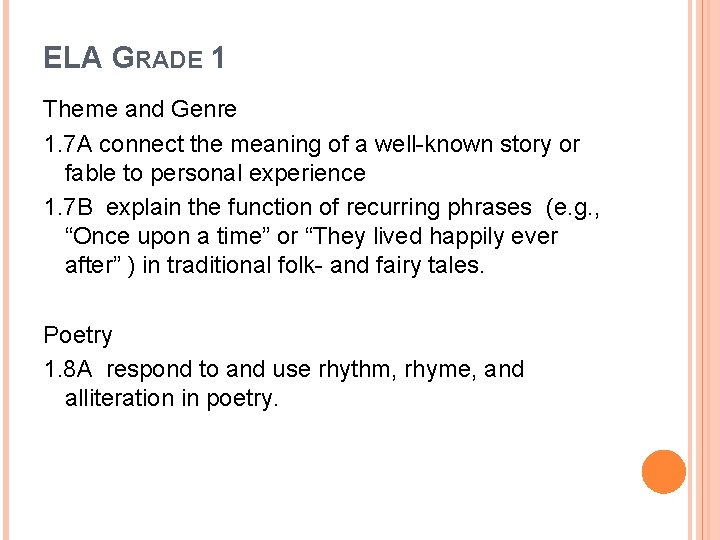
ELA GRADE 1 Theme and Genre 1. 7 A connect the meaning of a well-known story or fable to personal experience 1. 7 B explain the function of recurring phrases (e. g. , “Once upon a time” or “They lived happily ever after” ) in traditional folk- and fairy tales. Poetry 1. 8 A respond to and use rhythm, rhyme, and alliteration in poetry.
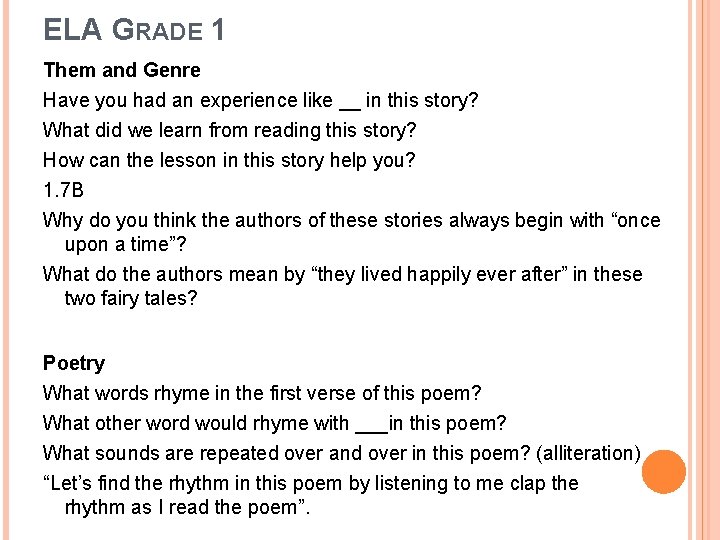
ELA GRADE 1 Them and Genre Have you had an experience like __ in this story? What did we learn from reading this story? How can the lesson in this story help you? 1. 7 B Why do you think the authors of these stories always begin with “once upon a time”? What do the authors mean by “they lived happily ever after” in these two fairy tales? Poetry What words rhyme in the first verse of this poem? What other word would rhyme with ___in this poem? What sounds are repeated over and over in this poem? (alliteration) “Let’s find the rhythm in this poem by listening to me clap the rhythm as I read the poem”.
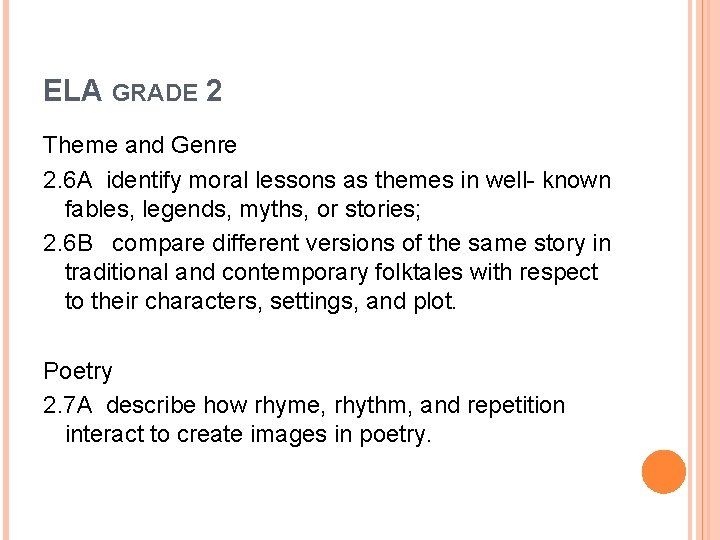
ELA GRADE 2 Theme and Genre 2. 6 A identify moral lessons as themes in well- known fables, legends, myths, or stories; 2. 6 B compare different versions of the same story in traditional and contemporary folktales with respect to their characters, settings, and plot. Poetry 2. 7 A describe how rhyme, rhythm, and repetition interact to create images in poetry.
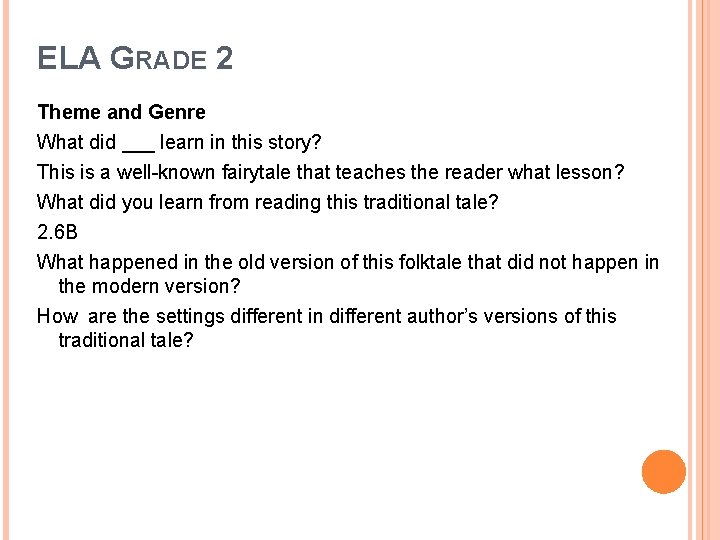
ELA GRADE 2 Theme and Genre What did ___ learn in this story? This is a well-known fairytale that teaches the reader what lesson? What did you learn from reading this traditional tale? 2. 6 B What happened in the old version of this folktale that did not happen in the modern version? How are the settings different in different author’s versions of this traditional tale?
ELA GRADE 2 Poetry Listen for rhyming words in this poem and tell me what you see in your mind. Let’s read this poem on the __ together. Let’s read it again and listen for rhyming words. Let’s read it again and listen to me as I clap the rhythm. How would you describe what you see in your mind when we read and clap the rhythm of the poem?
PULLING IT ALL TOGETHER Traveling Heads Together
ELEMENTARY ELA TAKE A PICTURE OF YOUR ASSESSMENT ITEMS OR TYPE INTO BODY OF AN E-MAIL AND SEND TO: bisdups. elak-1@blogger. com bisdups. ela 2 -3@blogger. com bisdups. ela 4 -5@blogger. com
ELEMENTARY ELA VIEW THE POSTS HERE: K-1 2 -3 4 -5
STARTING WITH THE END IN MIND Now that we have the assessment items, what about the instruction?
IMPLICATIONS FOR STAAR Teach and assess TEKS to the extreme of the TEKS/SE. Go to the farthest depth (thinking cognitive alignment) and complexity (concept, context, & vocabulary alignment)
FINAL THOUGHTS What did you gain from this? I will have a better understanding of the depth and complexity of my content standards. I will be able to better evaluate my students with assessments that are aligned to the TEKS. Exit ticket Dots on exit poster