Unit Five MiniLesson Agenda Eriksons PsychoSocial Development Theory

- Slides: 43
Unit Five Mini-Lesson Agenda: Erikson’s Psycho-Social Development Theory In this mini-lesson, I will • Process the assignment requirements • Present information on Erikson’s theory of psychosocial development – the topic of unit five submission assignment
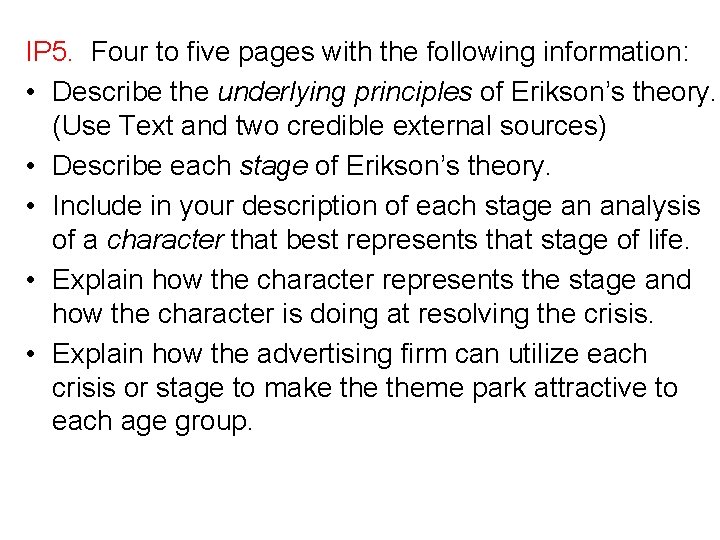
IP 5. Four to five pages with the following information: • Describe the underlying principles of Erikson’s theory. (Use Text and two credible external sources) • Describe each stage of Erikson’s theory. • Include in your description of each stage an analysis of a character that best represents that stage of life. • Explain how the character represents the stage and how the character is doing at resolving the crisis. • Explain how the advertising firm can utilize each crisis or stage to make theme park attractive to each age group.
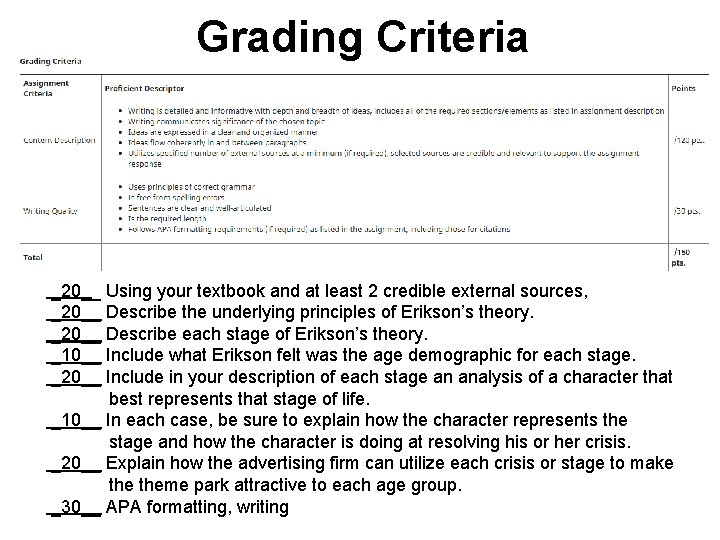
Grading Criteria _20__ Using your textbook and at least 2 credible external sources, _20__ Describe the underlying principles of Erikson’s theory. _20__ Describe each stage of Erikson’s theory. _10__ Include what Erikson felt was the age demographic for each stage. _20__ Include in your description of each stage an analysis of a character that best represents that stage of life. _10__ In each case, be sure to explain how the character represents the stage and how the character is doing at resolving his or her crisis. _20__ Explain how the advertising firm can utilize each crisis or stage to make theme park attractive to each age group. _30__ APA formatting, writing
Erikson’s Psycho-Social Development Theory Kent Van Cleave, Ph. D.
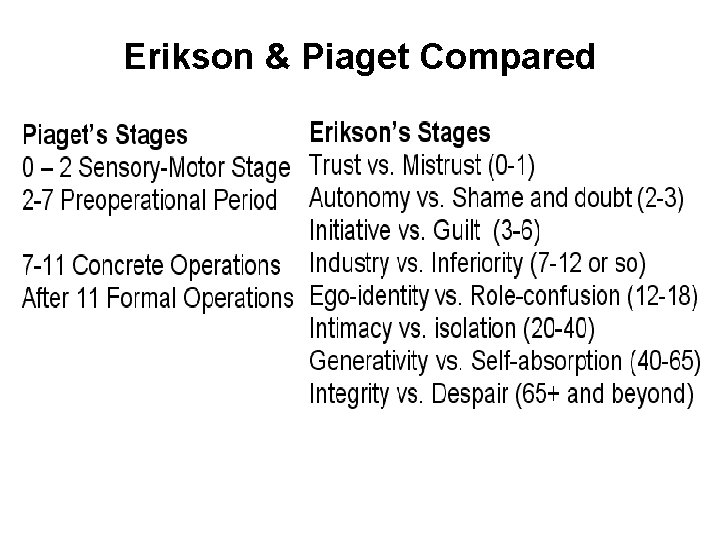
Piaget & Erikson Piaget studied cognitive development. Erikson studied ego development (personality). It is useful to see how Piaget’s and Erikson’s stages correlate across the life span. The cognitive capabilities that give rise to Piaget’s milestones also give rise to Erikson’s stages. Both are tied to the physical development of the brain.
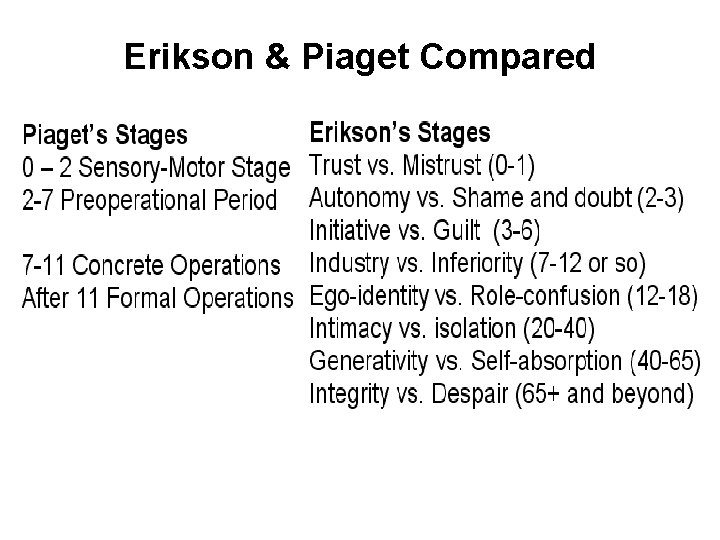
Erikson & Piaget Compared
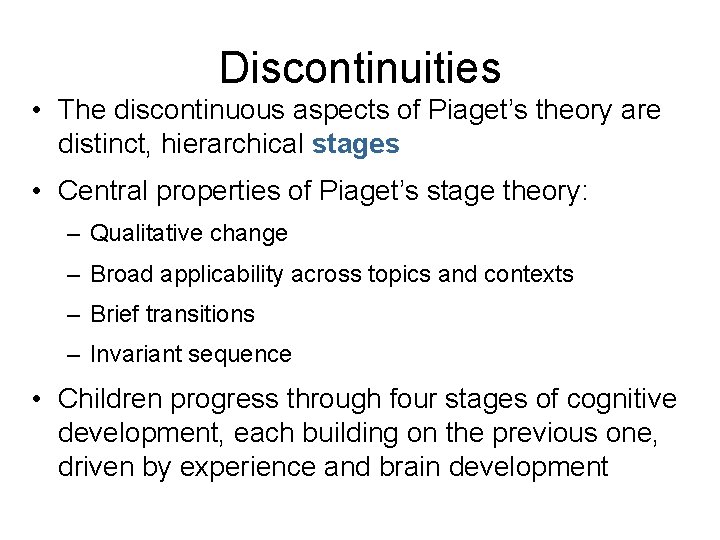
Discontinuities • The discontinuous aspects of Piaget’s theory are distinct, hierarchical stages • Central properties of Piaget’s stage theory: – Qualitative change – Broad applicability across topics and contexts – Brief transitions – Invariant sequence • Children progress through four stages of cognitive development, each building on the previous one, driven by experience and brain development
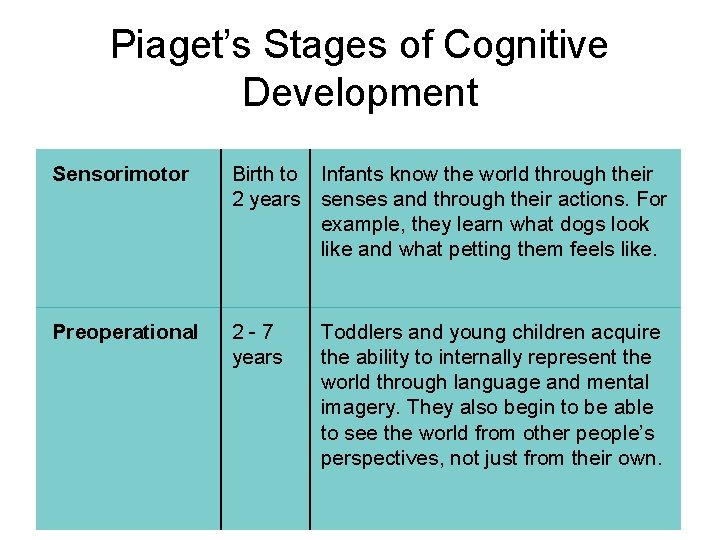
Piaget’s Stages of Cognitive Development Sensorimotor Birth to Infants know the world through their 2 years senses and through their actions. For example, they learn what dogs look like and what petting them feels like. Preoperational 2 -7 years Toddlers and young children acquire the ability to internally represent the world through language and mental imagery. They also begin to be able to see the world from other people’s perspectives, not just from their own.
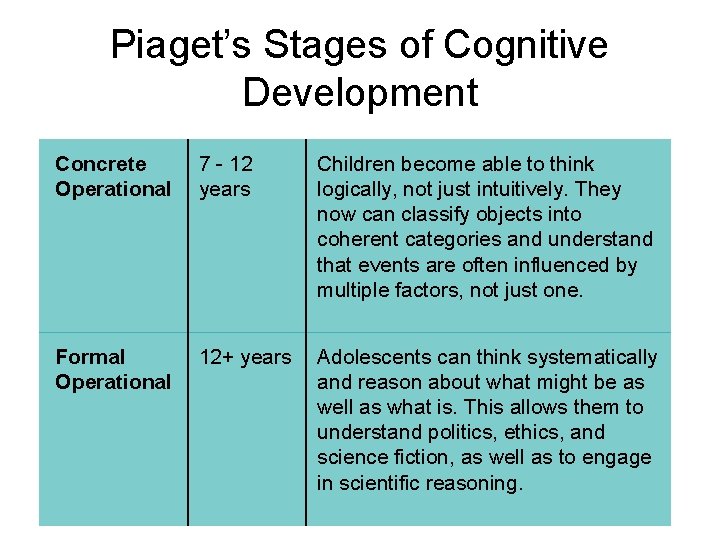
Piaget’s Stages of Cognitive Development Concrete Operational 7 - 12 years Children become able to think logically, not just intuitively. They now can classify objects into coherent categories and understand that events are often influenced by multiple factors, not just one. Formal Operational 12+ years Adolescents can think systematically and reason about what might be as well as what is. This allows them to understand politics, ethics, and science fiction, as well as to engage in scientific reasoning.
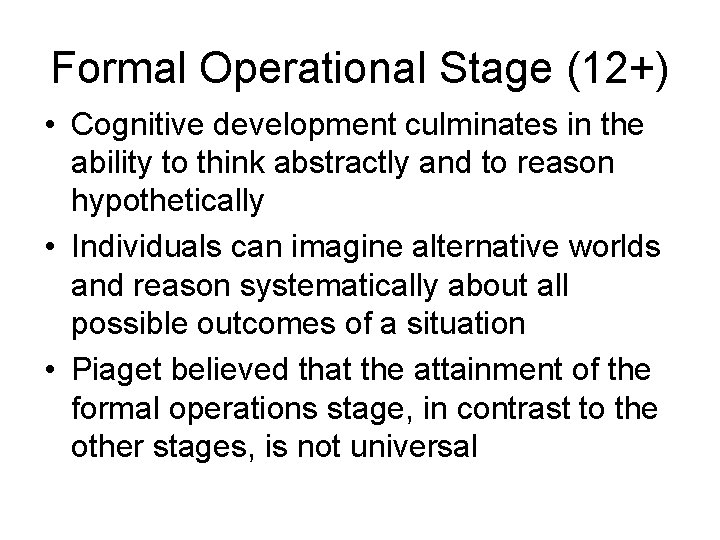
Formal Operational Stage (12+) • Cognitive development culminates in the ability to think abstractly and to reason hypothetically • Individuals can imagine alternative worlds and reason systematically about all possible outcomes of a situation • Piaget believed that the attainment of the formal operations stage, in contrast to the other stages, is not universal
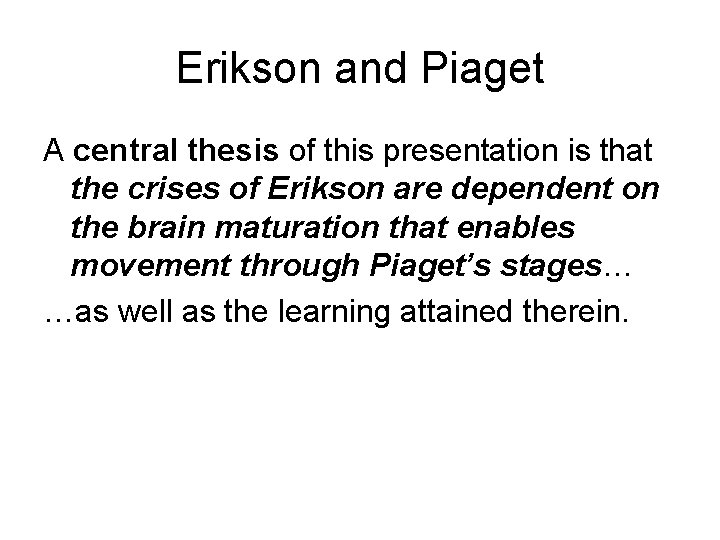
Erikson and Piaget A central thesis of this presentation is that the crises of Erikson are dependent on the brain maturation that enables movement through Piaget’s stages… …as well as the learning attained therein.
Erikson’s Psycho-Social Development Theory Erikson developed a stage theory of personality development across the life cycle. Most people focus on the stages of Erikson’s theory, but the stages are only PART of the picture. There are some basic principles that apply across all the stages, and provide continuity within the stages.
Erikson’s Principles Some basic principles: • Epigenetic principle – inherited forces determine characteristics of the stages. So both biological and social forces are at work. • Crisis – Each stage has a crisis – a polar issue (e. g. , trust vs. mistrust) • Need to develop basic strengths.
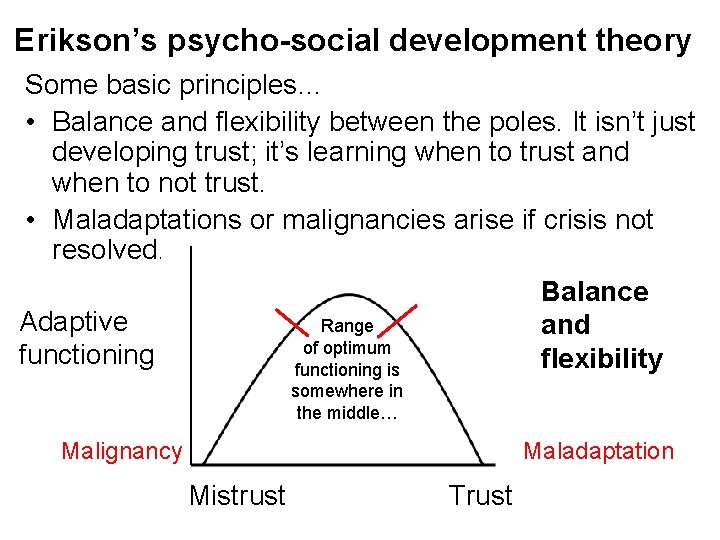
Erikson’s psycho-social development theory Some basic principles… • Balance and flexibility between the poles. It isn’t just developing trust; it’s learning when to trust and when to not trust. • Maladaptations or malignancies arise if crisis not resolved. Adaptive functioning Balance and flexibility Range of optimum functioning is somewhere in the middle… Malignancy Maladaptation Mistrust Trust
Erikson’s Theory Not achieving balance leads to one extreme or the other – e. g. , too trusting, or too mistrustful. Maladaptation is adopting the positive extreme (too much trust = sensory distortion). Malignancy is adopting the negative extreme (too much mistrust = withdrawal). The results of the resolution of a crisis (stage), whether successful or not, are carried forward to the next crisis and provide the foundation for its resolution.
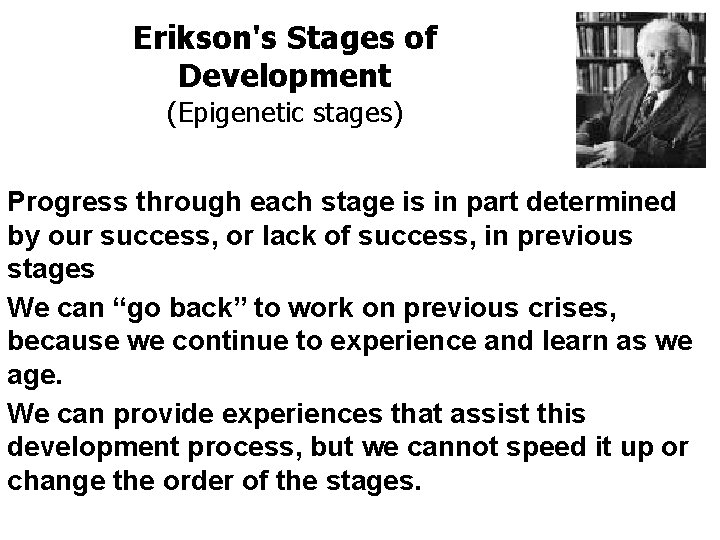
Erikson's Stages of Development (Epigenetic stages) Progress through each stage is in part determined by our success, or lack of success, in previous stages We can “go back” to work on previous crises, because we continue to experience and learn as we age. We can provide experiences that assist this development process, but we cannot speed it up or change the order of the stages.
Erikson & Piaget Compared
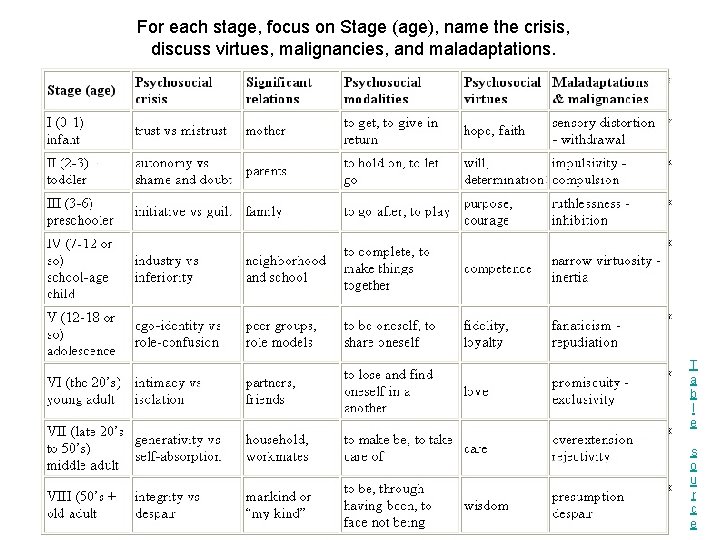
For each stage, focus on Stage (age), name the crisis, discuss virtues, malignancies, and maladaptations. T a b l e s o u r c e
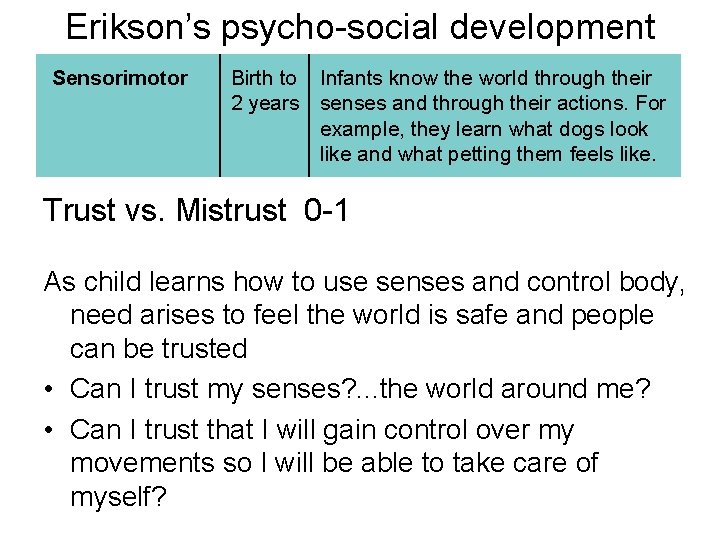
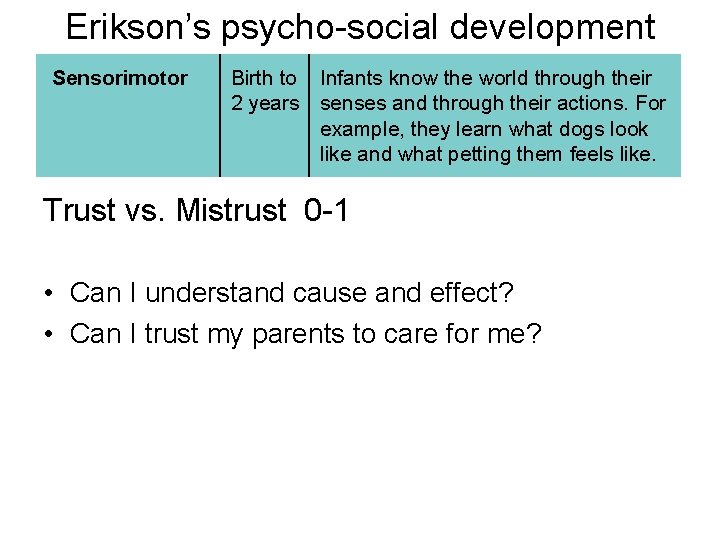
Erikson’s psycho-social development Sensorimotor Birth to Infants know the world through their 2 years senses and through their actions. For example, they learn what dogs look like and what petting them feels like. Trust vs. Mistrust 0 -1 As child learns how to use senses and control body, need arises to feel the world is safe and people can be trusted • Can I trust my senses? . . . the world around me? • Can I trust that I will gain control over my movements so I will be able to take care of myself?
Erikson’s psycho-social development Sensorimotor Birth to Infants know the world through their 2 years senses and through their actions. For example, they learn what dogs look like and what petting them feels like. Trust vs. Mistrust 0 -1 • Can I understand cause and effect? • Can I trust my parents to care for me?
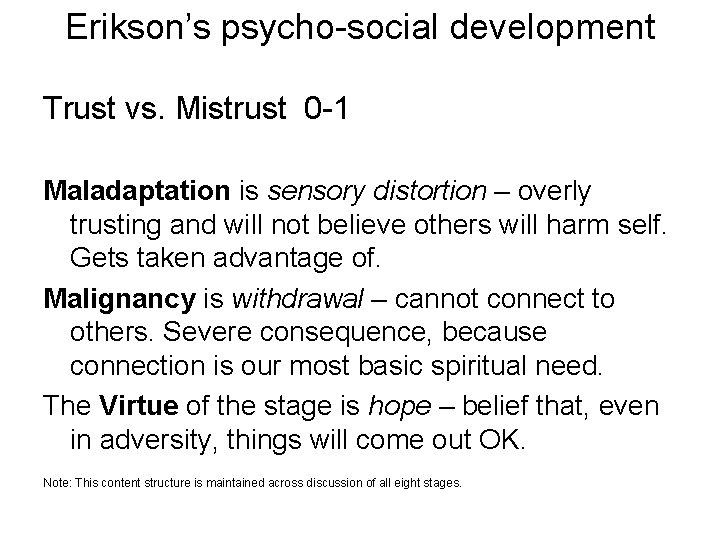
Erikson’s psycho-social development Trust vs. Mistrust 0 -1 Maladaptation is sensory distortion – overly trusting and will not believe others will harm self. Gets taken advantage of. Malignancy is withdrawal – cannot connect to others. Severe consequence, because connection is our most basic spiritual need. The Virtue of the stage is hope – belief that, even in adversity, things will come out OK. Note: This content structure is maintained across discussion of all eight stages.
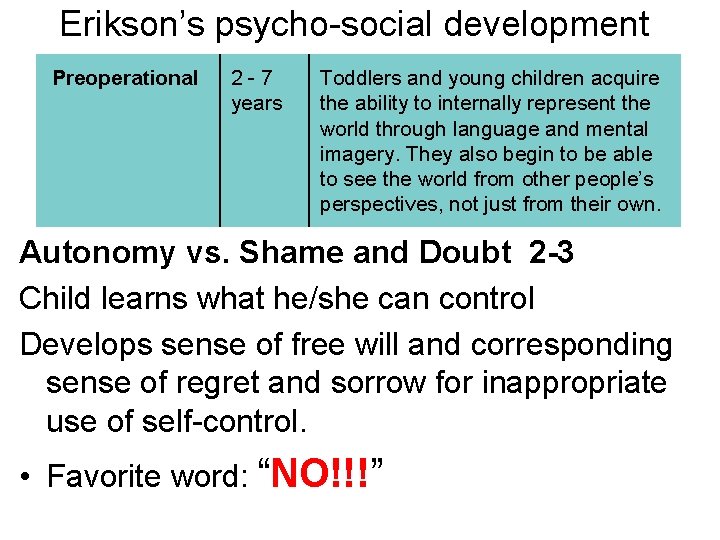
Erikson’s psycho-social development Preoperational 2 -7 years Toddlers and young children acquire the ability to internally represent the world through language and mental imagery. They also begin to be able to see the world from other people’s perspectives, not just from their own. Autonomy vs. Shame and Doubt 2 -3 Child learns what he/she can control Develops sense of free will and corresponding sense of regret and sorrow for inappropriate use of self-control. • Favorite word: “NO!!!”
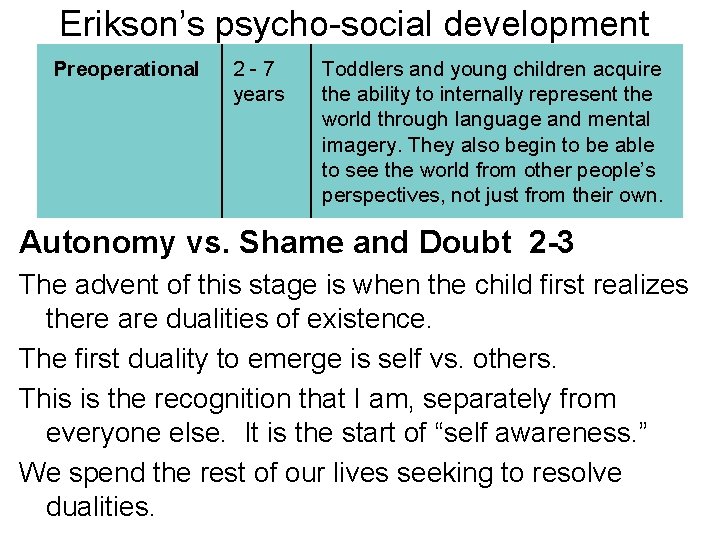
Erikson’s psycho-social development Preoperational 2 -7 years Toddlers and young children acquire the ability to internally represent the world through language and mental imagery. They also begin to be able to see the world from other people’s perspectives, not just from their own. Autonomy vs. Shame and Doubt 2 -3 The advent of this stage is when the child first realizes there are dualities of existence. The first duality to emerge is self vs. others. This is the recognition that I am, separately from everyone else. It is the start of “self awareness. ” We spend the rest of our lives seeking to resolve dualities.
Erikson’s psycho-social development Autonomy vs. Shame and Doubt 2 -3 Maladaptation is impulsiveness – a tendency to engage without considering whether you are competent to do so. Malignancy is compulsiveness – a tendency to link your self-esteem to how well you do things. The virtue of the stage is willpower – the tendency/ability to persevere in the face of adversity
Erikson’s psycho-social development Preoperational 2 -7 years Toddlers and young children acquire the ability to internally represent the world through language and mental imagery. They also begin to be able to see the world from other people’s perspectives, not just from their own. Initiative vs. Guilt 3 -6 Learn to begin action, to explore, to imagine as well as feeling remorse for actions. Initiative means responding positively towards our adversities and challenges. Guilt means being responsible for one’s action. This is the advent of moral judgment.
Erikson’s psycho-social development Initiative vs. Guilt 3 -6 Learn they can have ideas, and carry them out. • Learn initiative and new skills. • Learn to use imagination; try out their ideas. • Plan and form an imaginal concept of the future to work towards. • Learn consequences of behavior.
Erikson’s psycho-social development Initiative vs. Guilt 3 -6 The maladaptation of the stage is ruthlessness. It is a tendency to pursue one’s own initiatives without considering the wants, needs, perspectives of others. The malignancy is inhibition, a tendency to not take any initiative for fear of resulting guilt. The virtue of the stage is purpose; despite your limitations and past failures, you work towards an imagined future that you believe will be fulfilling.
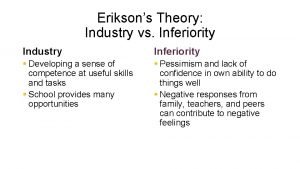
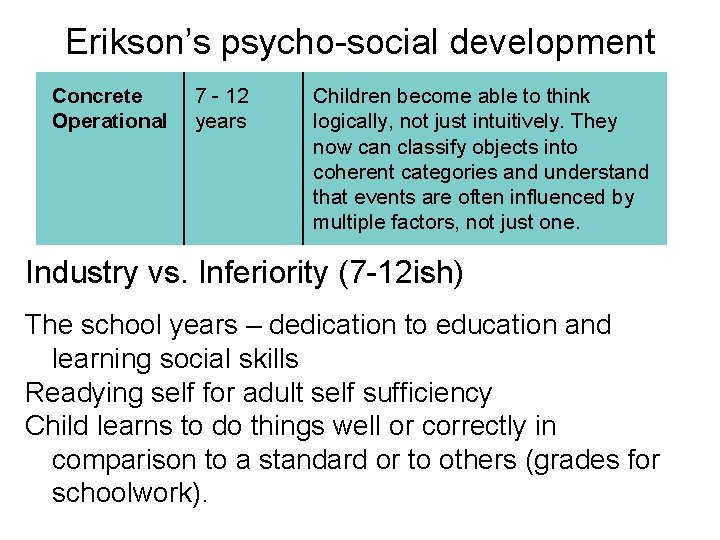
Erikson’s psycho-social development Concrete Operational 7 - 12 years Children become able to think logically, not just intuitively. They now can classify objects into coherent categories and understand that events are often influenced by multiple factors, not just one. Industry vs. Inferiority (7 -12 ish) The school years – dedication to education and learning social skills Readying self for adult self sufficiency Child learns to do things well or correctly in comparison to a standard or to others (grades for schoolwork).
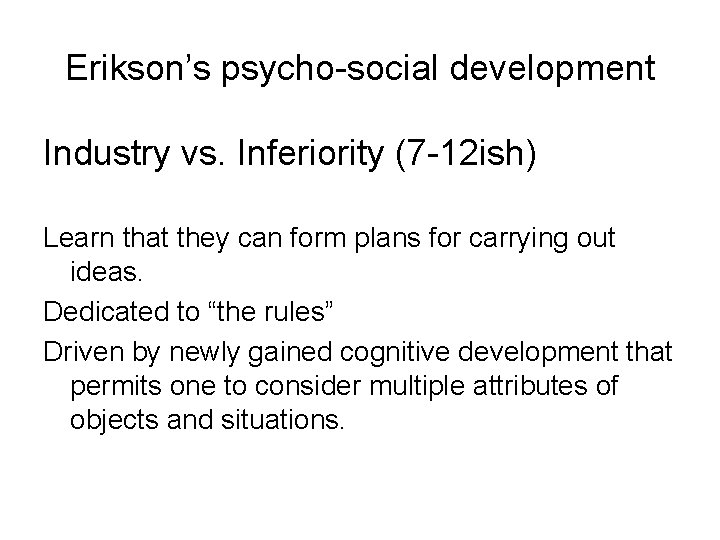
Erikson’s psycho-social development Industry vs. Inferiority (7 -12 ish) Learn that they can form plans for carrying out ideas. Dedicated to “the rules” Driven by newly gained cognitive development that permits one to consider multiple attributes of objects and situations.
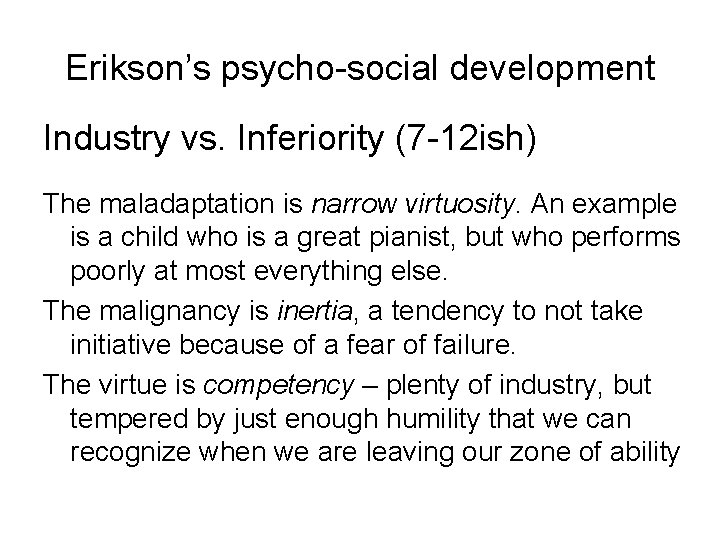
Erikson’s psycho-social development Industry vs. Inferiority (7 -12 ish) The maladaptation is narrow virtuosity. An example is a child who is a great pianist, but who performs poorly at most everything else. The malignancy is inertia, a tendency to not take initiative because of a fear of failure. The virtue is competency – plenty of industry, but tempered by just enough humility that we can recognize when we are leaving our zone of ability
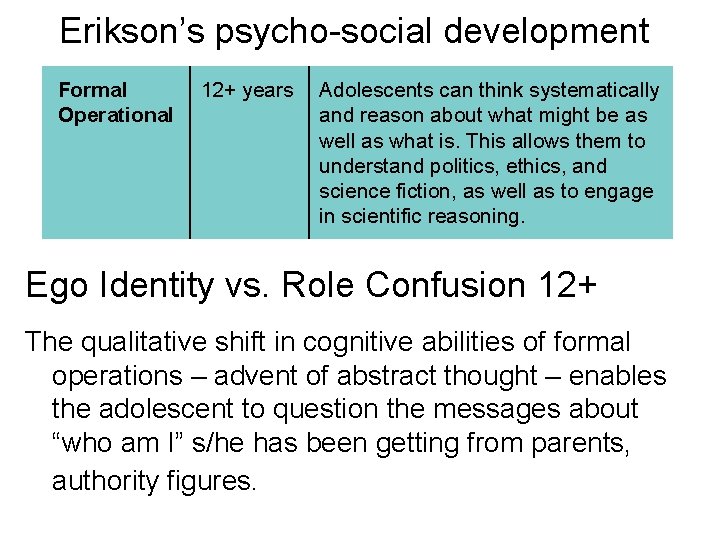
Erikson’s psycho-social development Formal Operational 12+ years Adolescents can think systematically and reason about what might be as well as what is. This allows them to understand politics, ethics, and science fiction, as well as to engage in scientific reasoning. Ego Identity vs. Role Confusion 12+ The qualitative shift in cognitive abilities of formal operations – advent of abstract thought – enables the adolescent to question the messages about “who am I” s/he has been getting from parents, authority figures.
Erikson’s psycho-social development Ego Identity vs. Role Confusion 12+ The central task is to develop an adult identity. Must develop self-identity, but also social identity Knowing who you are and your place in society Take all you've learned about life and yourself and mold it into a unified self-image Unified self-image refers to similarities of selfidentity and social-identity The more similar the two are, the more psychologically healthy one is
Erikson’s psycho-social development Ego Identity vs. Role Confusion 12+ Feel must differentiate self from parents Turn to peers for reference Try out adult roles and behaviors A critical period of spiritual growth – connection to oneself, beginnings of understanding one’s purpose Probably the most difficult of the stages
Erikson’s psycho-social development Ego Identity vs. Role Confusion 12+ Maladaptation is fanaticism, a belief that one’s own perspectives and choices are the only ones that are correct. Malignancy is repudiation, a tendency to reject a self-identity as well as becoming a part of the adult society. Repudiators are susceptible to cults and gangs. The virtue of the stage is fidelity, the ability to engage in society and conform to its standards, despite recognizing society’s limitations and inconsistencies.
Erikson’s Psycho-Social Development The remaining stages are less dependent on brain development… …more dependent on learning, and physical and social changes due to ageing.
Intimacy vs. Isolation 20 -40 Intimacy is a reciprocal sharing of self with others – both the good and the less good Develop ability to give and receive love; begin to make long-term commitment to relationships Create new family unit to replace parents’ family unit, with self in parent role Success means you have good source of positive feedback about your self but also that you can recognize and accept your shortcomings (after all, others you are intimate with do…). This facilitates continuing self development
Intimacy vs. Isolation 20 -40 The maladaptation is promiscuity, a tendency to become too intimate, too easily. The socially promiscuous often reveal personal details to strangers that make the stranger uncomfortable with that level of disclosure. The malignancy is exclusion, a tendency to isolate oneself from any form of intimacy. Along with that exclusion often comes a generally negative attitude towards others and to society as a whole. The virtue of the stage is love. This includes not only the love of family and significant others, but also people in general.
Generativity vs. Stagnation As one establishes oneself in a career, and children leave home, one shifts some of the focus from bettering children to bettering the community / society An extension of love into the future, concern for future generations
Generativity vs. Stagnation May take generative role in society: teaching, writing, invention, the arts and sciences, social activism With stagnation, may have midlife crisis – a rejection of self Maladaptation is overextension – take on too many generative roles Malignancy is rejectivity – not participating in or contributing to society The virtue is care. One has the capacity to care about others and society in general.
Integrity vs. Despair (60’s and beyond) Develop a sense of acceptance of life as it was lived and the importance of the people and relationships that individual developed over the lifespan Accepting death. If we feel good about what we have done, we accept the disengagement of old age and impending death. Our sense of self includes a feeling of completeness.
Integrity vs. Despair (60’s and beyond) Maladaptation is presumption, in which a person assumes one has come to ego integrity without actually facing the issues of the end of life. Malignancy is disdain, in which one is in contempt of one’s own life, and life in general. Virtue is wisdom, an ability to pass on one’s learned lessons to others. Older people tend to be more spiritually integrated, and wisdom comes from the union of mind and spirit.
Other Stage Theories Other stage theories of development include Kohlberg and his stages of moral development, and Fowler, and his stages of faith development. • Kohlberg: http: //www. nd. edu/~rbarger/kohlberg. html • Fowler: http: //faculty. plts. edu/gpence/html/fowler. htm
Reference Boeree, C. G. (2006). Erikson. Retrieved from http: //webspace. ship. edu/cgboer/erikson. h tml