UNIT 4 GROUP DYNAMICS Group In any organization



- Slides: 34
UNIT 4 GROUP DYNAMICS
Group In any organization employees generally work as various groups. A group is defined as two or more people with a unifying relationship, interacting and interdependent, who have joined together, formally or informally, to achieve certain objectives. If a group exists in an organization it means that its members are motivated to join and perceive the group as a unified unit of interacting people. The members contribute in varying amounts to the group processes in terms of time, energy, etc. They agree or disagree to take decisions through various forms of interaction.
Group dynamics � � � Kurt Lewin, widely accepted as the father of group dynamics, coined and popularized the term, Group Dynamics, in the 1930’s. Group dynamics describes how a group should be organized and managed. Here, democratic leadership, member participation and overall cooperation are emphasized.
� Group dynamics consists of a set of techniques such as role playing, brainstorming, group therapy, sensitivity training, team building, transactional analysis, focus groups, leaders groups, Johari Window, etc. � It deals with the internal nature of groups, that is, how groups are formed, what are the structures and processes, and how they function and affect the individual members, other groups and the organization as a whole.
Why do people join groups? � � � No single reason can be given to the question. People join different groups depending on the benefits provided by each group. People join groups mostly for security, status, self-esteem, affiliation, power and goal attainment as explained in the next slide
� � � Security: Individuals feel that they can reduce the insecurity of being alone. People feel stronger or confident when they are in a group. . [e. g. Construction workers joining as a group under a particular contractor] Status: To feel more important and to get recognition for status people join high-profile, influential or popular/visible groups. [e. g. People joining Lion’s club or Rotary club] Self-esteem: As people feel that their value of self-esteem gets enhanced they join groups. . [e. g. Business people becoming members of elite clubs] Affiliation: As social beings, people’s social needs are met in groups. Regular interactions satisfy members’ social needs. [e. g. Residents becoming members of local residents’ welfare associations] Power: As unity is strength, what cannot be accomplished as individuals can be attained as a group. There is power in numbers. [e. g. Employees joining trade unions] Goal attainment: As many tasks cannot be carried out by individual persons, a group of persons is needed. Groups help pooling of knowledge, talents or power to accomplish difficult tasks. [e. g. Formation of voluntary organizations to help local society]
Types of Groups 1. Groups are classified into different categories Dyad: It is the simplest form of group consisting of just two persons. But in reality groups are more complex. 2. Small Group and Primary Group: Though these two terms are often used interchangeably technically there is a difference. The sole criterion of a small group is that the size is small
3. Membership and Reference Groups: In membership groups the members actually become members of the group based on certain criteria such as lawyers becoming members of Bar Council of India or doctors joining Indian Medical Association. Reference groups are the groups to which an individual would like to belong [(e. g. ) People identifying themselves as disciples or followers of Sathya Sai or Amritanandarmayi. ] 4. In-groups and Out-groups: In-group members are those who have or share the dominant values and wield more influence such as the ‘Caucus’ in the office of the Prime Minister which has a greater say than others. Out-group members do not wield so much power as in-group members (e. g. Ministers in the cabinet committee. )
5. Command Group and Task Group: command group has members who directly report to a particular manager such as all marketing executives doing similar nature of group and all reporting to the marketing manager. Task groups also represent individuals working together as determined by the organization. But unlike the command group, the task groups’ boundaries are not limited to any particular hierarchical level. It can cross command relationship. Selecting a place to start a branch office for a company requires a group of experts from different functional areas such production, marketing, finance and HR department. These experts, for this particular task of selecting a suitable place, need not report to their functional heads. Most of the task groups are temporary, as these groups are dismantled once the tasks are accomplished.
6. Interest Groups and Friendship Groups: In interest group, people join together for a particular objective. That is, they have a common interest. Employees who join together to have their working hours changed, to get their dismissed colleague reinstated or to have better food in the canteen represent the formation of a united body to further their common interest. (e. g. Employees’ Association). Friendship groups are formed by individuals who have one or more common characteristics. These are social groups, mostly outside the work situation, based on similar age, ethnicity, heritage etc. People organizing camps for blood/eye donation or antipollution form friendship groups.
7. Formal group and Informal Group: Formal group is a designated work group defined by an organization’s structure. Examples are functional departments (finance, operations, marketing or human resources), Cross-functional or Task Groups, Grievances Committee, Executive Committee and even the Board of Directors. Informal group is neither formally structured nor organizationally determined. These types of groups appear in response to the needs of people for social contact such as friendship group, interest group, recreation club, sports club etc. Show fig 85 in chapter 10
Formal vs Informal Group � Show table on page 254 on chapter 10
Stages of group development � � � Studies revealed that the members of a group must go through several stages of development before forming an effective group. The members are expected to know each other, understand their respective roles, compare their individualistic behaviour and learn to coordinate with each other. The following is the five-stage model of group development
� � 1 st Stage: Forming The first stage is characterized by uncertainty and confusion. The members are not sure about the purpose, structure, task or leadership. However, they try to discover their expectations, evaluate the value of membership, and the importance of leadership. They tend to be polite and the leaders help in setting initial norms.
� 2 nd stage: Storming � It is marked by intra-group conflict and confrontation. Members get emotional. There is disagreement regarding roles/duties. It is really a difficult stage. Members will compete for group roles and influence goals and means.
� 3 rd stage: Norming � In this stage the members try to understand each other and opt for cooperation and coordination. They will have a “we” feeling. Roles are established, team objectives are decided, cohesion is developed and mental models are formed.
� 4 th stage: Performing � At this stage, the group becomes functional. The members commit themselves for effective accomplishment of tasks based on the agreed norms. There is a climate of mutual support and members feel comfortable.
� 5 th stage: Adjourning � In the case of temporary groups, it is the final stage of closing all the activities. The groups as in any project or particular task disband after accomplishing the objectives. In informal groups, their activities come to an end when the members leave the organization. show Fig 86 on page 258 of chapter 10
Group cohesiveness � � � It is the degree to which group members are bound together and are motivated to stay as a group with mutual attractions. Relationship between cohesiveness and productivity depends on performance related norms of the groups. High cohesiveness and high performing norms such as output, quality, cooperation with external environ, etc lead to high productivity High cohesiveness and low performing norms result in low productivity. Low cohesiveness and high performance norms may increase productivity but the increase is less than that of high cohesiveness and high norms combination.
Factors that increase group cohesiveness � � � � Agreement on group goals: Every member should agree upon the common goals. More interactions among the group members: There must be free interaction. Group member’s mutual attractiveness: Members should like each other. Healthy intergroup competition: There must be competition among the sub-groups, but it must be constructive. Favourable evaluation: If the activities of the group are appreciated members stick together. Similarity of members: Members of similar nature stay together for long. Difficult entry: Higher the difficulty in entering into a group, higher will be the cohesiveness among members. Group success: Naturally, success of the group binds the members closely.
Factors that decrease group cohesiveness � Disagreement on goals. � Large size of the group. � Unpleasant experiences of the members. � Unhealthy intragroup competition/rivalry. � Domination by one or more members.
POWER What is Power? � Power is the capacity of an individual, team, group or organization to influence others. � It is the probability that one person within a social setup is in a position to carry out his own will / wish despite resistance from others. � It is the potential ability to influence behaviour, to change the course of events, to overcome resistance and to make people do things which they normally refuse.
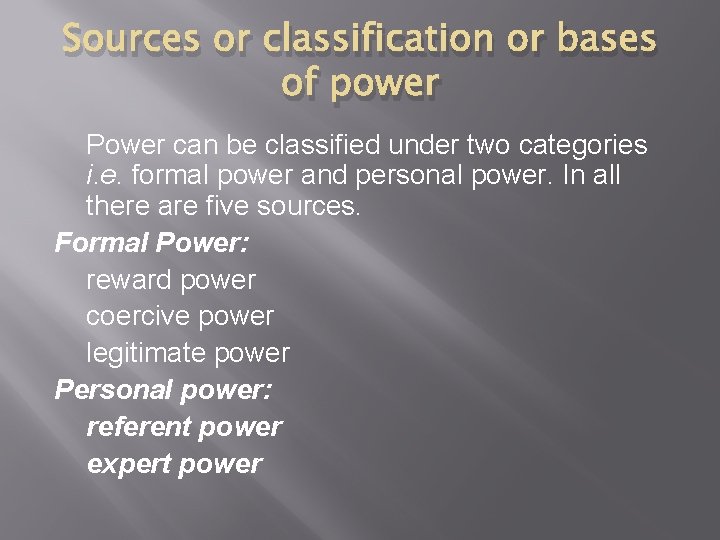
Sources or classification or bases of power Power can be classified under two categories i. e. formal power and personal power. In all there are five sources. Formal Power: reward power coercive power legitimate power Personal power: referent power expert power
Politics Organizational politics is behaviour of an individual which others perceive as self – serving tactics for the individual’s personal gain at the cost of other persons or even the organization. Political behaviour, which is closely associated with organizational politics are activities of an individual which are not required of the individual’s formal role.
Nature of Organizational Politics � � � Politics in organization is a fact of life. There is politics in every group / organization. Personal experiences, hunches and anecdotes have shown that organizational behaviour is often political in nature. Politics is not a simple process: It varies from organization to organization and even from unit to unit within an organization. Organizations are composed of groups [coalition] which compete with one another for resources resulting in politics. The groups [coalitions] always seek to protect their interests, positions and power and hence indulge in politics. Unequal distribution of power results in dehumanizing leading to different political behaviour.
Reasons/Factors which encourage organizational politics � � There are certain areas that are relevant to the degree to which organization are political rather than rational. Resources: There will be more politics when the resources are critical or their availability is low. New and ‘unclaimed’ resources will also create politics. Decisions: Uncertain decisions, ambiguous decisions, decisions where there is no agreement and long range strategic decisions encourage politics. Goals: When the goals are not clear or ambiguous people will play politics. Technology and external environment: There will be politics when the technology adopted is highly complex and the external environ is volatile / turbulent. Organizational change: People play politics to resist any change. Any attempt for reorganization or to bring in planned organizational development leads to politics.
Consequences of organizational politics � � Organizational politics, when exceeds certain limits, lead to: Decreased job satisfaction Increased anxiety and stress Increased turnover Reduced performance
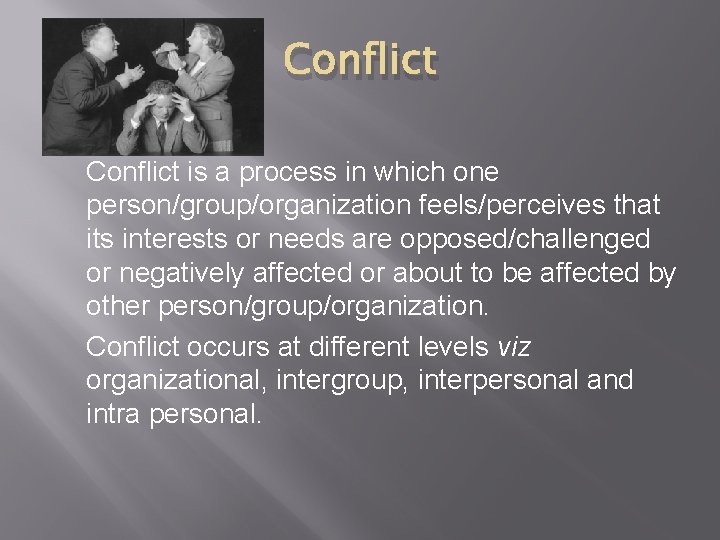
Conflict is a process in which one person/group/organization feels/perceives that its interests or needs are opposed/challenged or negatively affected or about to be affected by other person/group/organization. Conflict occurs at different levels viz organizational, intergroup, interpersonal and intra personal.
Types of Conflict Whether a conflict is functional or dysfunctional depends on the type of conflict. There are different types of conflict. � Task Conflict: It is related to the content and goals of the work. Low to moderate levels of task conflict increases group performance as it stimulates discussion and generates new ideas to perform certain tasks. � Process Conflict: It is concerned with how the work gets done. For process conflict to be functional and productive, it must be kept at low level. When there is intense argument about who should do, what should be done or when to be done it becomes dysfunctional. � Relationship Conflict: It focuses on interpersonal relationships. This conflict is always dysfunctional. Friction and interpersonal animosity inherent in relationship conflicts increase personality clashes and decrease mutual understanding hindering completion of organizational tasks.
Managing conflicts /Conflict resolutions Conflicts can be solved through Interpersonal approach as well as Structural approach.
Interpersonal conflict management style 1. 2. 3. 4. Avoiding Competing Compromising Problem solving
Structural approaches to conflict management � � � Concentrating on superordinate goals Reducing employee’s diversity Increasing resources Reducing task interdependence Adequate communication Clarifying rules and procedures.
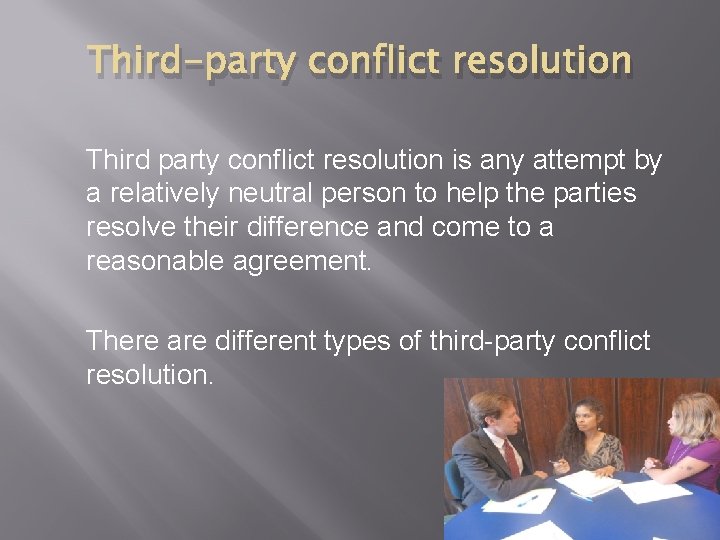
Third-party conflict resolution Third party conflict resolution is any attempt by a relatively neutral person to help the parties resolve their difference and come to a reasonable agreement. There are different types of third-party conflict resolution.
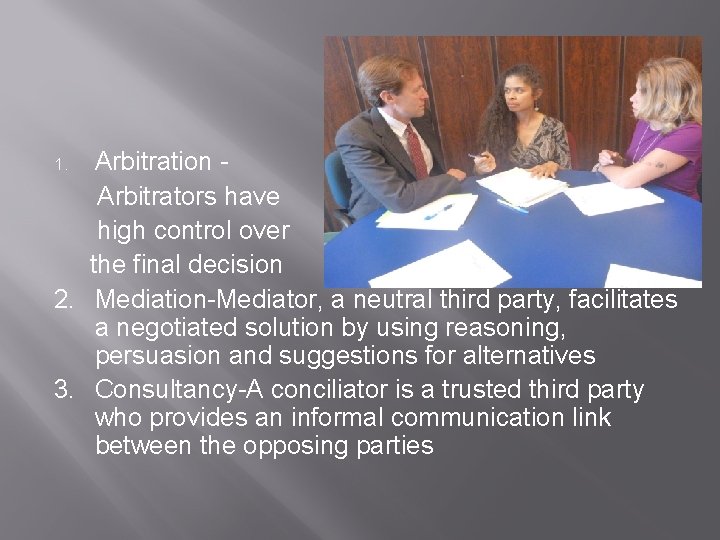
Arbitration Arbitrators have high control over the final decision 2. Mediation-Mediator, a neutral third party, facilitates a negotiated solution by using reasoning, persuasion and suggestions for alternatives 3. Consultancy-A conciliator is a trusted third party who provides an informal communication link between the opposing parties 1.