
Lecture 7 GROUPS AND TEAMS DYNAMICS AND EFFECTIVENESS
- Slides: 18
Lecture 7 GROUPS AND TEAMS: DYNAMICS AND EFFECTIVENESS For use with MARTIN, ORGANIZATIONAL BEHAVIOUR AND MANAGEMENT 3 e ISBN 1 -86152 -948 -1 Copyright © 2005 Cengage Learning 1
Some implications of the existence of groups: • A need for communication and interaction between its members will exist • A need for communication and interaction between the group and other groups both internally and externally • There exists a need for the group to achieve the objectives set for it • Groups can often not achieve the desired objectives without the co-operation and support of other individuals and groups • A need to channel and control activities of members within the group exists • Group social needs and aspirations must be facilitated for the group to be successful at both personal and organizational levels • There exists a need to take account of the potential impact of the social and political dimensions of the activities of the group For use with MARTIN, ORGANIZATIONAL BEHAVIOUR AND MANAGEMENT 3 e ISBN 1 -86152 -948 -1 Copyright © 2005 Cengage Learning 2
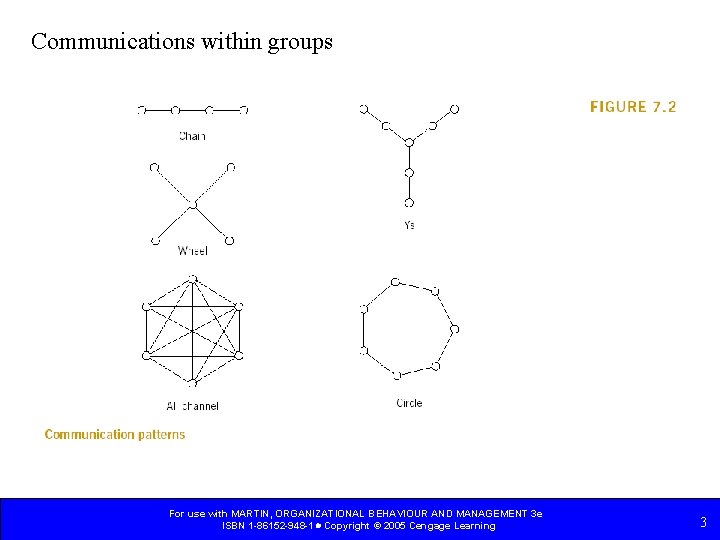
Communications within groups For use with MARTIN, ORGANIZATIONAL BEHAVIOUR AND MANAGEMENT 3 e ISBN 1 -86152 -948 -1 Copyright © 2005 Cengage Learning 3
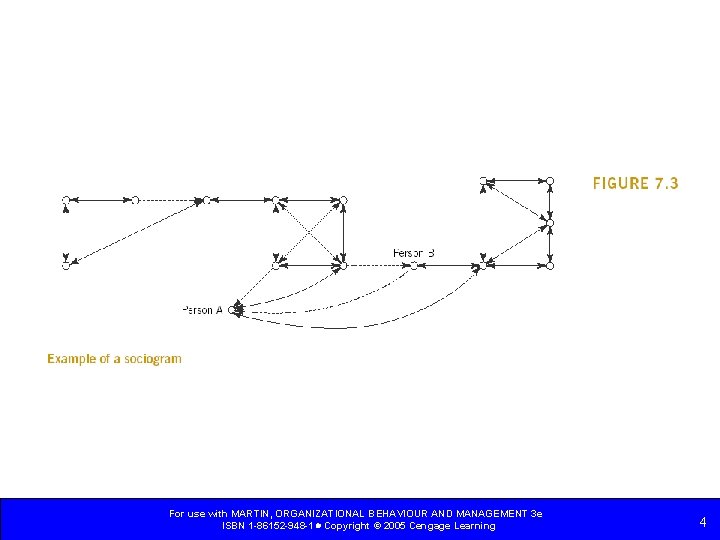
For use with MARTIN, ORGANIZATIONAL BEHAVIOUR AND MANAGEMENT 3 e ISBN 1 -86152 -948 -1 Copyright © 2005 Cengage Learning 4
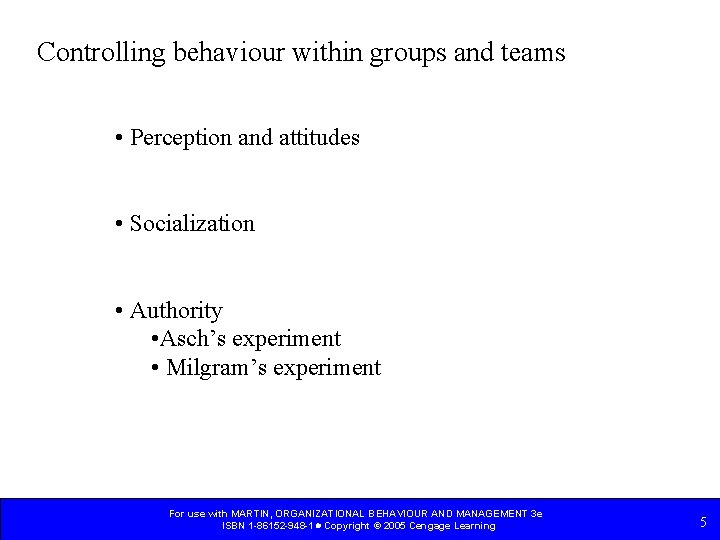
Controlling behaviour within groups and teams • Perception and attitudes • Socialization • Authority • Asch’s experiment • Milgram’s experiment For use with MARTIN, ORGANIZATIONAL BEHAVIOUR AND MANAGEMENT 3 e ISBN 1 -86152 -948 -1 Copyright © 2005 Cengage Learning 5
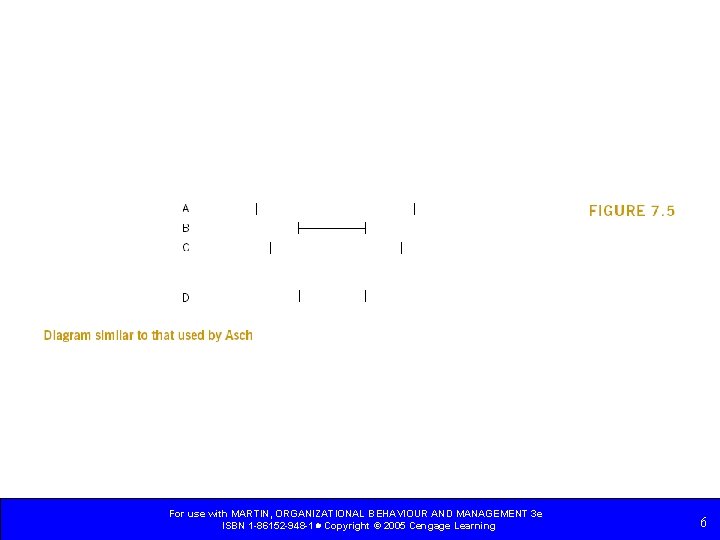
For use with MARTIN, ORGANIZATIONAL BEHAVIOUR AND MANAGEMENT 3 e ISBN 1 -86152 -948 -1 Copyright © 2005 Cengage Learning 6
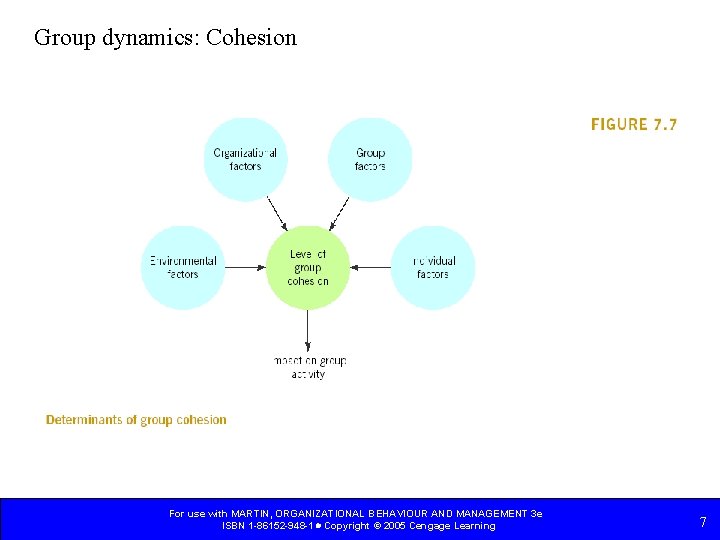
Group dynamics: Cohesion For use with MARTIN, ORGANIZATIONAL BEHAVIOUR AND MANAGEMENT 3 e ISBN 1 -86152 -948 -1 Copyright © 2005 Cengage Learning 7
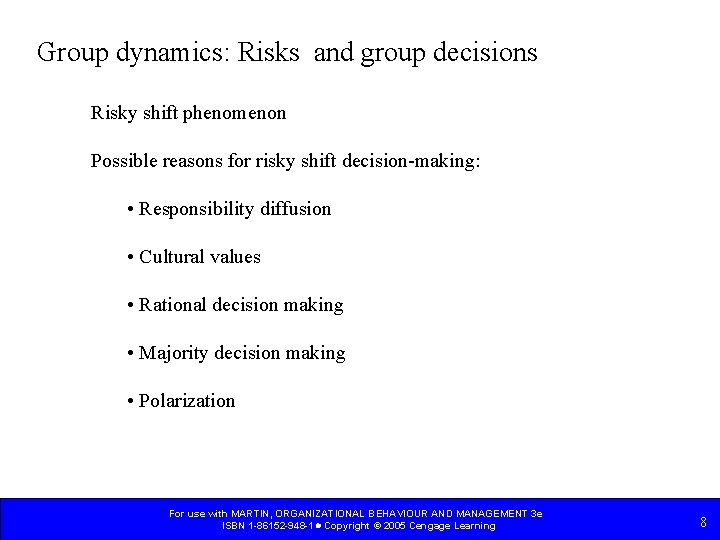
Group dynamics: Risks and group decisions Risky shift phenomenon Possible reasons for risky shift decision-making: • Responsibility diffusion • Cultural values • Rational decision making • Majority decision making • Polarization For use with MARTIN, ORGANIZATIONAL BEHAVIOUR AND MANAGEMENT 3 e ISBN 1 -86152 -948 -1 Copyright © 2005 Cengage Learning 8
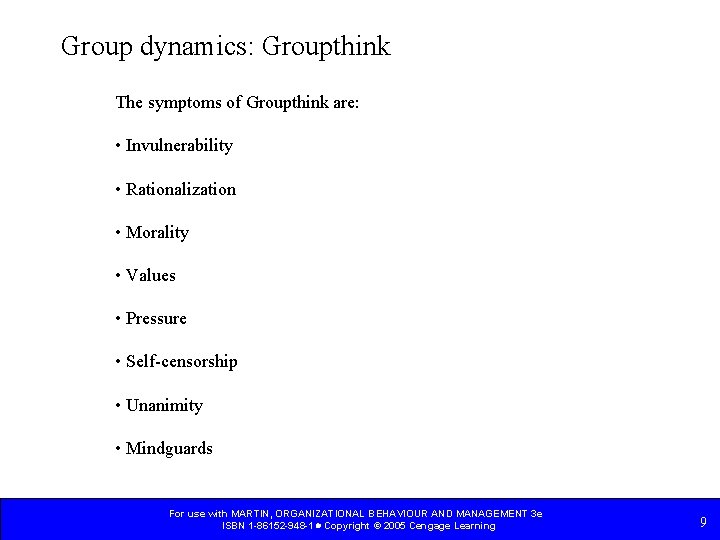
Group dynamics: Groupthink The symptoms of Groupthink are: • Invulnerability • Rationalization • Morality • Values • Pressure • Self-censorship • Unanimity • Mindguards For use with MARTIN, ORGANIZATIONAL BEHAVIOUR AND MANAGEMENT 3 e ISBN 1 -86152 -948 -1 Copyright © 2005 Cengage Learning 9
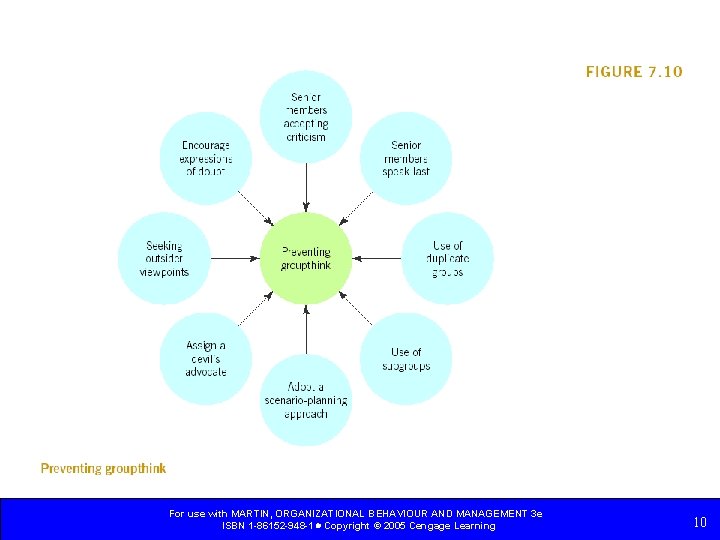
For use with MARTIN, ORGANIZATIONAL BEHAVIOUR AND MANAGEMENT 3 e ISBN 1 -86152 -948 -1 Copyright © 2005 Cengage Learning 10
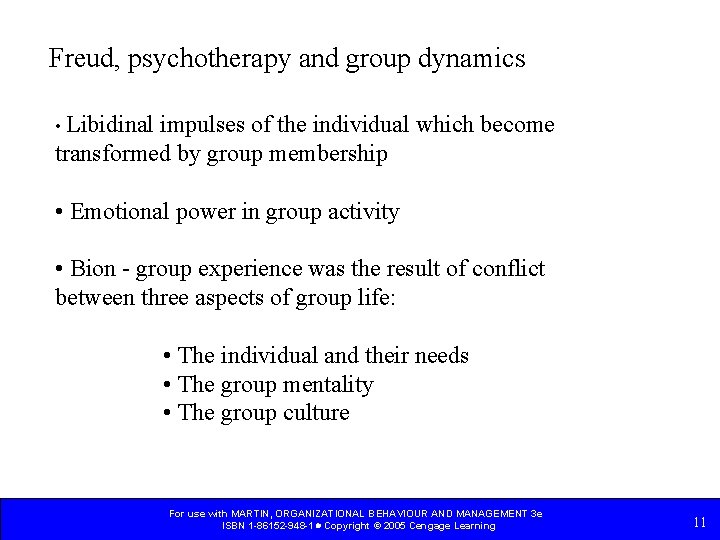
Freud, psychotherapy and group dynamics • Libidinal impulses of the individual which become transformed by group membership • Emotional power in group activity • Bion - group experience was the result of conflict between three aspects of group life: • The individual and their needs • The group mentality • The group culture For use with MARTIN, ORGANIZATIONAL BEHAVIOUR AND MANAGEMENT 3 e ISBN 1 -86152 -948 -1 Copyright © 2005 Cengage Learning 11
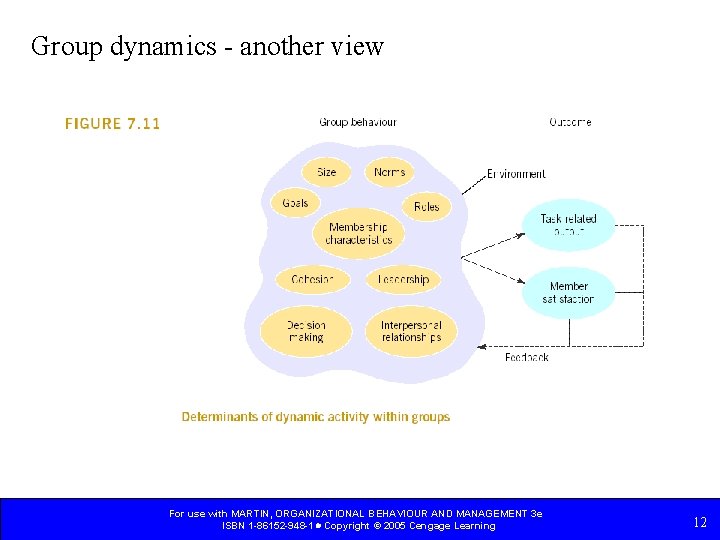
Group dynamics - another view For use with MARTIN, ORGANIZATIONAL BEHAVIOUR AND MANAGEMENT 3 e ISBN 1 -86152 -948 -1 Copyright © 2005 Cengage Learning 12
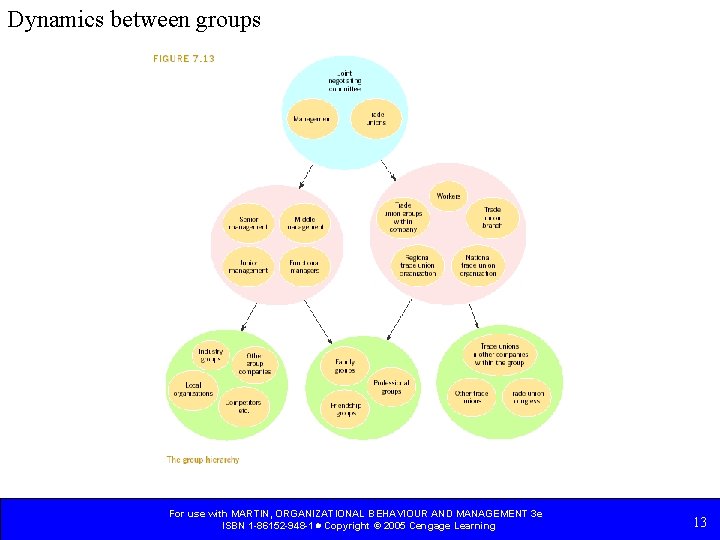
Dynamics between groups For use with MARTIN, ORGANIZATIONAL BEHAVIOUR AND MANAGEMENT 3 e ISBN 1 -86152 -948 -1 Copyright © 2005 Cengage Learning 13
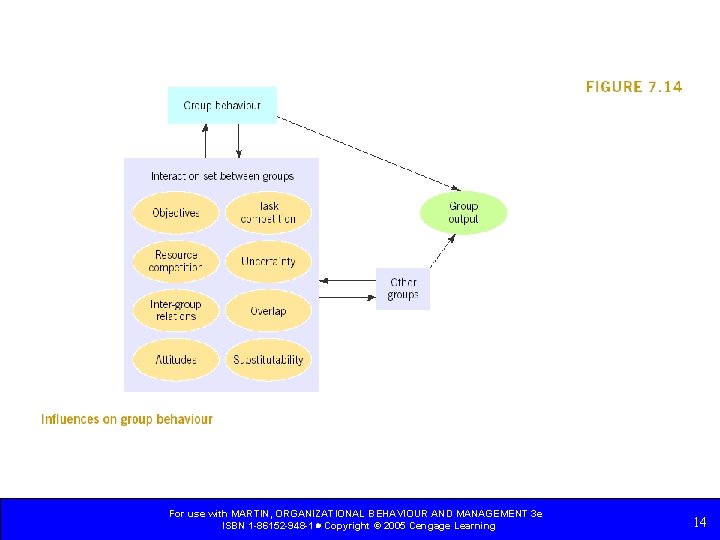
For use with MARTIN, ORGANIZATIONAL BEHAVIOUR AND MANAGEMENT 3 e ISBN 1 -86152 -948 -1 Copyright © 2005 Cengage Learning 14
Successful or winning teams - Belbin • An individual in the chair who could make use of the role to ensure an effective process • A strong plant • A good range of mental ability spread across the individuals within the group • Wide team role coverage within the group • A match between team roles and personal attributes • The ability of the team to compensate for role imbalances For use with MARTIN, ORGANIZATIONAL BEHAVIOUR AND MANAGEMENT 3 e ISBN 1 -86152 -948 -1 Copyright © 2005 Cengage Learning 15
The Margerison-Mc. Cann Team Management Wheel • Creator-Innovators • Explorer-Promoters • Assessor-Developers • Thruster-Organisers • Concluder-Producers • Controller-Inspectors • Upholder-Maintainers • Reporter-Advisors • Linker For use with MARTIN, ORGANIZATIONAL BEHAVIOUR AND MANAGEMENT 3 e ISBN 1 -86152 -948 -1 Copyright © 2005 Cengage Learning 16
High-performing teams - Margerison and Mc. Cann • Accept that all team members have a responsibility to undertake the linking role • Have high expectations and set high targets • Gain high levels of job satisfaction • Experience high levels of co-operation • Provide team managers who lead by example • Develop teams that have a balance of roles matched to skills • Experience high degrees of autonomy • Learn quickly from mistakes Develop teams that are customer oriented • Display good problem-solving skills and review group performance • Be motivated to perform For use with MARTIN, ORGANIZATIONAL BEHAVIOUR AND MANAGEMENT 3 e ISBN 1 -86152 -948 -1 Copyright © 2005 Cengage Learning 17
The reasons that teams fail - Margerison and Mc. Cann • A lack of balance across the team roles • A lack of effective linking between roles • A lack of effective relationship management within the team • A lack of effective information management within the team • The existence of impoverished decision-making processes • The tendency to want to take decisions too early in the process For use with MARTIN, ORGANIZATIONAL BEHAVIOUR AND MANAGEMENT 3 e ISBN 1 -86152 -948 -1 Copyright © 2005 Cengage Learning 18