
Organisation Behaviour UNITV Group Behaviour Mrs Surbhi Roy
Organisation Behaviour UNIT-V Group Behaviour Mrs. Surbhi Roy IAMR

Definition of a Group �Two or more individuals, interacting regularly and who have come together to achieve particular objectives. Robbins �A collection of people who share most a sense of shared purpose, interdependence, interaction and ability to act in a unitary manner. Mullins
Factors of Group Formation 1. Psychological- interest, personality, perception 2. 3. 4. 5. matching with other individuals Social- to satisfy the religion, caste & culture related social need. Security - the feeling of insecurity over unexpected developments such as sudden health problem, termination, suspension or local problems. Happen especially at new place. Economic- accidental or obligatory needs like money for marriage, medical care, house construction etc. Interaction, interest and influence- similarity of job increase the interaction and sittings together.
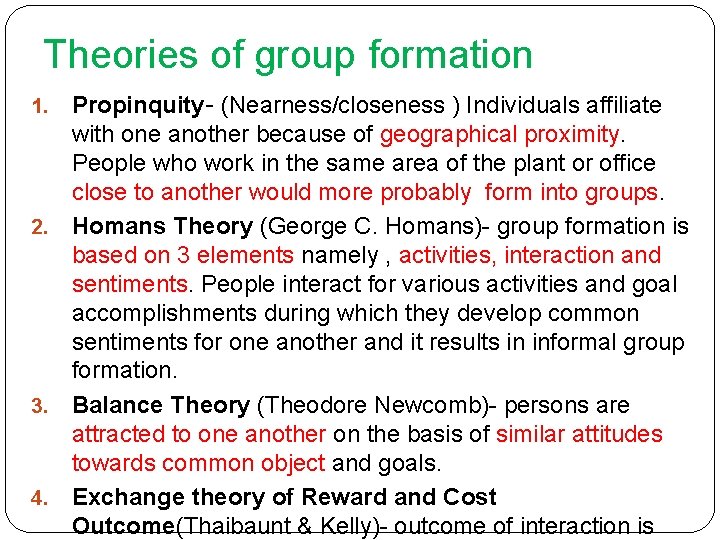
Theories of group formation Propinquity- (Nearness/closeness ) Individuals affiliate with one another because of geographical proximity. People who work in the same area of the plant or office close to another would more probably form into groups. 2. Homans Theory (George C. Homans)- group formation is based on 3 elements namely , activities, interaction and sentiments. People interact for various activities and goal accomplishments during which they develop common sentiments for one another and it results in informal group formation. 3. Balance Theory (Theodore Newcomb)- persons are attracted to one another on the basis of similar attitudes towards common object and goals. 4. Exchange theory of Reward and Cost Outcome(Thaibaunt & Kelly)- outcome of interaction is 1.
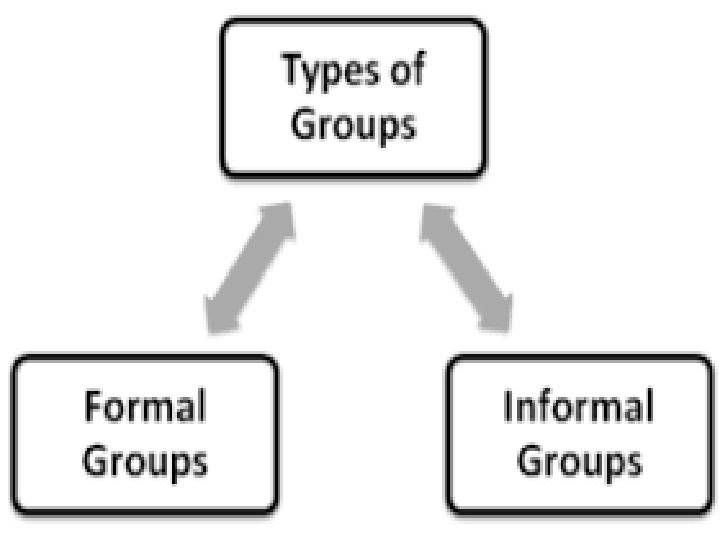
CLASSIFICATION OF GROUPS Formal- formed by the organisations in order to help the org to achieve its specific goals(eg-quality control group, discipline committee, purchase committee, etc. Types of Formal Groups: 1. Command Group- based on basic reporting relationship in org. (finance, personnel, mkt. ) leader of command group plays important role.

Formal Group 2. The committees- collection of people brought together by the organisation to accomplish goals. It is dispersed after goal achievement. 3. The team- formed for some specific purpose. It has high level of interaction and work together very intensely to achieve goal. 4. Self managed work teams- team itself responsible to accomplish its goals. Team is empowered to discipline its members. Hiring and firing is done by team itself.

Informal All groups that are neither formally structured nor organisationally determined. They emerge naturally in org. it is just like shadow of the formal org. TYPES 1. 2. Friendship groups- group of those who enjoy each other’s company and love to socialize with each other on the job or off the job. Interest group- people form on the basis of common interest or goal to achieve. The interest of the members may be ignored or neglected by the organisation. Members of this group try to achieve their goal by uniting their efforts.
WHY DO PEOPLE JOIN GROUPS? �Security �Status �Self-Esteem �Affiliation �Power �Goal Achievement
Group Dynamics - Group dynamics are the forces that emerge and take shape as members interact with each other over the life of a group. - Group dynamics is the study of groups and its processes. It includes various relevant fields of psychology, sociology and communication studies. - Group dynamics is primarily concerned with small group behaviour which include norms, roles, relations, development, need to belong, social influence and effects on behaviour.
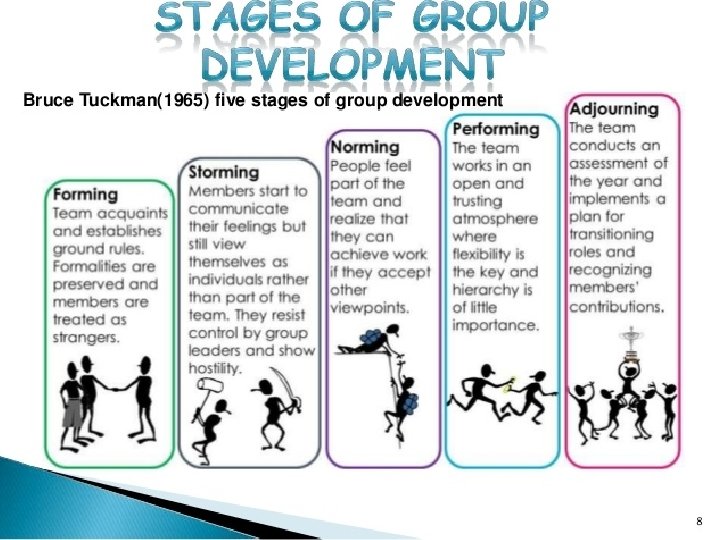
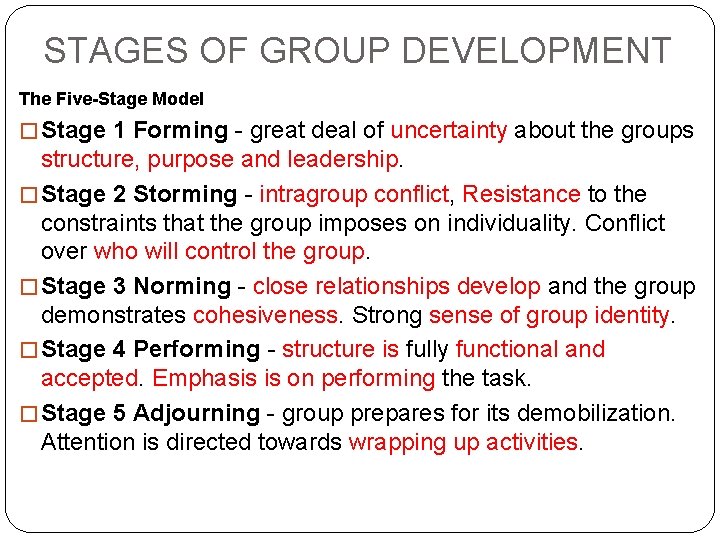
STAGES OF GROUP DEVELOPMENT The Five-Stage Model � Stage 1 Forming - great deal of uncertainty about the groups structure, purpose and leadership. � Stage 2 Storming - intragroup conflict, Resistance to the constraints that the group imposes on individuality. Conflict over who will control the group. � Stage 3 Norming - close relationships develop and the group demonstrates cohesiveness. Strong sense of group identity. � Stage 4 Performing - structure is fully functional and accepted. Emphasis is on performing the task. � Stage 5 Adjourning - group prepares for its demobilization. Attention is directed towards wrapping up activities.
Group Norm �Norm is a principle of right action binding upon the members of a group and serving to guide, control or regulate proper and acceptable behaviour. �Rules of behaviour that are the part of the ideology of the group norms – -tend to reflect the values of the group -specify the proper and inappropriate actions as well as reward and punishment.
Advantage of Group Norms 1. Enable the groups to accomplish their goals 2. Help the group to control and regulate the behaviour of its members. 3. Enables a group to survive in the phase of threat and competition from other groups. 4. Helps the group and its members to express group’s values and give the group a unique identity. 5. Enhance the predictability of the group members in terms of performance & appearance.
Types of Norms 1. Performance norms- how to do the job? ; expected level of outcome; how hard members should work? 2. Appearance norms- appropriate dress when together; loyalty to the work group; when to look busy 3. Social interaction norms – with whom can we be socialise? ; who can we be friends with on and off the job? ; regulates social interactions inside and outside the group. 4. Resource allocation norms- who should be assigned to job? ; how much pay increase should each member get? ; who should receive the next
GROUP STRUCTURE �Norms - Acceptable standards of behaviour within a group that are shared by the groups members. �Status - A socially defined position or rank given to groups or group members by others. �Size of the group �Social Loafing - The tendency of individuals to expend less effort when working collectively than when working individually.
GROUP STRUCTURE-Composition Most group activities require a variety of skills and knowledge. Research studies show that heterogeneous groups (those composed of dissimilar individuals in terms of gender, personalities, opinions, abilities, skills and perspectives) are likely to perform more effectively.

Group Cohesiveness • It represents the bonding among the members of the group. • Factors affecting group cohesiveness: 1. Degree of dependency- more dependency more attraction and more cohesiveness 2. Size- Inverse relationship (small size-more cohesiveness) 3. Homogeneity & stable membership- stable relationship enhance cohesiveness 4. Location of the group- if the members are located close to each other, they interact frequently & freely. Group cohesion would be high.
Group Cohesiveness 5. Group status- a group with high status and with high success is more attractive to its members. 6. Group leadership- qualities of the group leader determine the cohesiveness. 7. Competition- affects the group cohesiveness 8. Outside pressure- increase cohesiveness to face the challange.
Group Cohesiveness -The attractiveness of a group to its members and their desire to retain membership. -To Encourage Group Cohesiveness: �Make the group smaller. �Encourage agreement with group goals. �Increase the time members spend together. �Increase the status of the group. �Stimulate competition with other groups. �Give rewards to the group rather than the members.
Assignment Q. 1 – What are the factors affecting group formation? Discuss. Q. 2 – What are the stages of group formation? Discuss. Q. 3 - What do you mean by cohesiveness? And how is it important for the group and organisation? Submit on my email I’d Surbhi. contact@gmail. com
- Slides: 27