UNIT 1 LESSON 3 The Constitution 1 Lesson
- Slides: 18
UNIT 1 LESSON 3 The Constitution 1
Lesson 3 – Learning Objective and Warmup Students will be able to explain the compromises made in the Constitution and identify the opposing forces in the struggle for ratification of the Constitution. 1. COLLABORATE: Hypothetical situation - Virginia has 10 people and New Jersey has 2. Should a new government give Virginia 10 votes and New Jersey 2, or should Virginia get 1 vote and New Jersey get 1 vote? Which one of these is “most fair” in your opinion? 2. CRITICAL THINKING: How do you define “fair” when it comes to running our government? 3. REVIEW: What was our first constitution called? Why didn’t it work?
• Students will be at to: 1. Identify and explain two compromises that were made at the Constitutional Convention and how each of these compromises “benefitted” both sides involved. 2. Who were the opposing forces in the struggle for ratification of the Constitution? • Check for Understanding: VA vs NJ Plan? 3/5 Compromise? Federalists vs Anti-Fed? • Materials: Unit 1, Lesson 3 Notes and Reading Federalists vs Anti-Federalists (Sup) Anatomy of the Constitution Preamble Dress Code Quiz
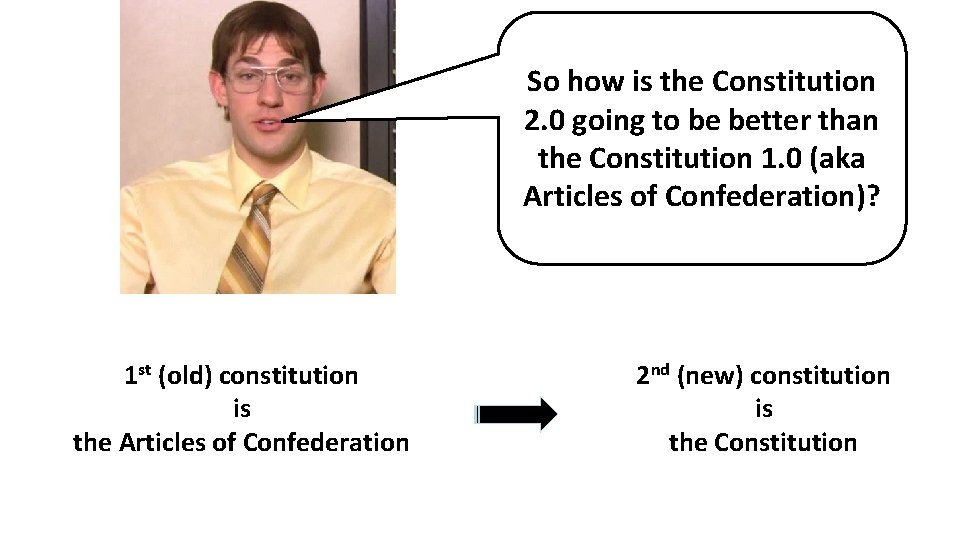
So how is the Constitution 2. 0 going to be better than the Constitution 1. 0 (aka Articles of Confederation)? 1 st (old) constitution is the Articles of Confederation 2 nd (new) constitution is the Constitution
COMPROMISES ON CONGRESS Virginia Plan = Wanted to create a congress with representation based on POPULATION of the state. • Favored large states
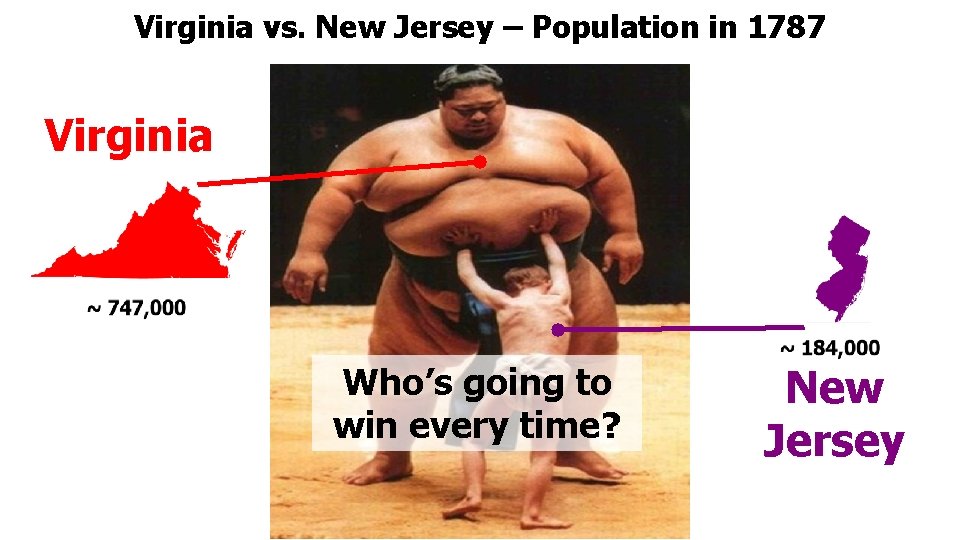
Virginia vs. New Jersey – Population in 1787 Virginia Who’s going to win every time? New Jersey
COMPROMISES ON CONGRESS New Jersey Plan = Wanted to create a congress with representation being EQUAL for all states (regardless of size, population, or money). • Favored small states
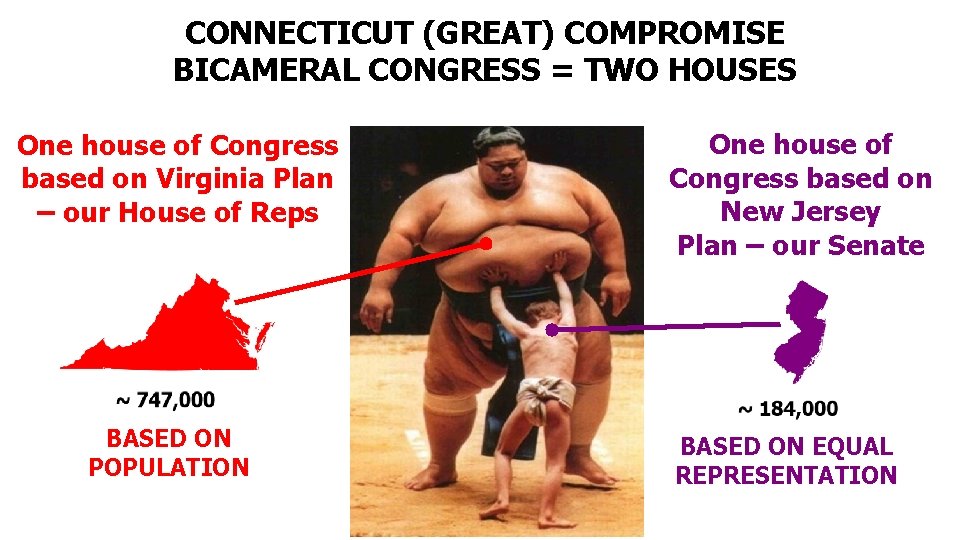
COMPROMISES ON CONGRESS Connecticut (Great) Compromise = Officially created a BICAMERAL (TWO HOUSES) congress. • Upper house – Senate – representation equal for all states. • Lower house – House of Representatives – representation based on population of the state.
CONNECTICUT (GREAT) COMPROMISE BICAMERAL CONGRESS = TWO HOUSES One house of Congress based on Virginia Plan – our House of Reps BASED ON POPULATION One house of Congress based on New Jersey Plan – our Senate BASED ON EQUAL REPRESENTATION
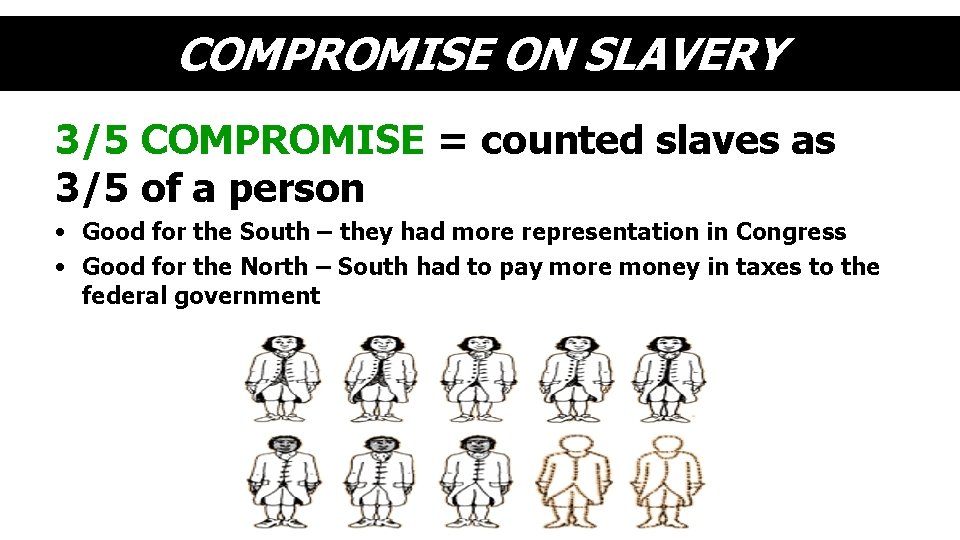
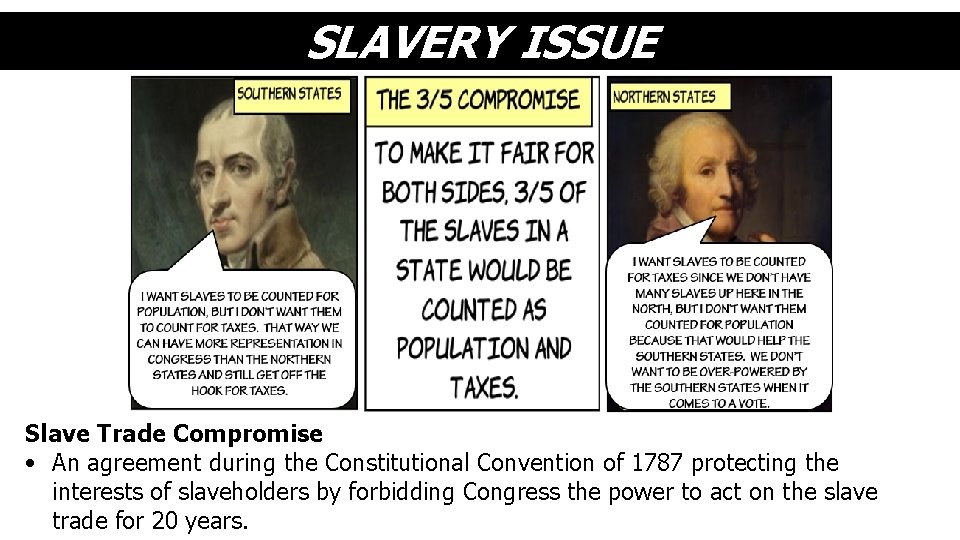
COMPROMISE ON SLAVERY 3/5 COMPROMISE = counted slaves as 3/5 of a person • Good for the South – they had more representation in Congress • Good for the North – South had to pay more money in taxes to the federal government
COMPROMISE ON SLAVERY What was the Slave Trade Compromise? • CONGRESS WOULDN’T PROHIBIT SLAVE TRADE BEFORE 1808 AND STATES WERE REQUIRED TO RETURN FUGITIVE SLAVES TO THEIR OWNERS
SLAVERY ISSUE Slave Trade Compromise • An agreement during the Constitutional Convention of 1787 protecting the interests of slaveholders by forbidding Congress the power to act on the slave trade for 20 years.
RATIFYING (APPROVING) THE CONSTITUTION Who were the Federalists? • PEOPLE WHO FAVORED RATIFICATION OF THE CONSTITUTION Who were the Anti-Federalists? • PEOPLE WHO WERE AGAINST THE RATIFICATION OF THE CONSTITUTION. MAD THAT THERE WAS NO BILL OF RIGHTS.
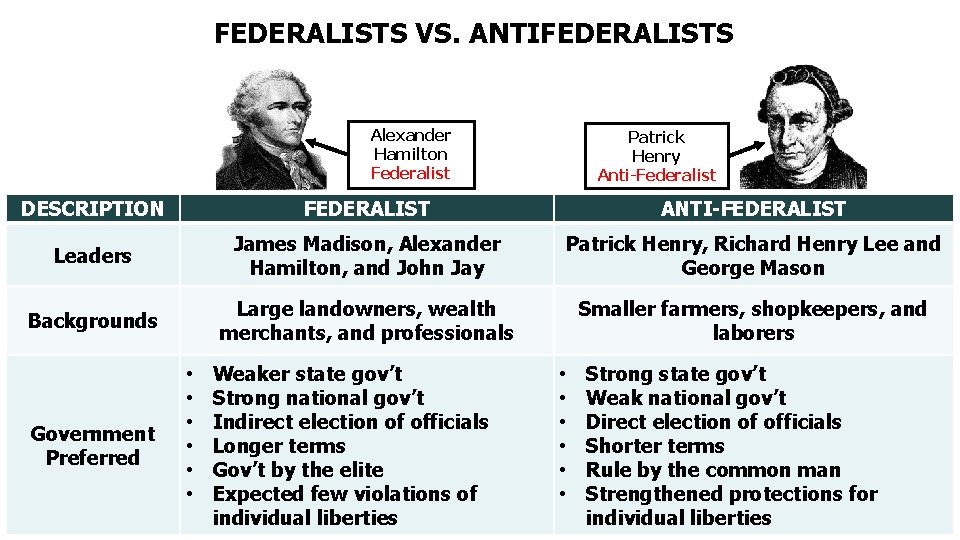
FEDERALISTS VS. ANTIFEDERALISTS Alexander Hamilton Federalist Patrick Henry Anti-Federalist DESCRIPTION FEDERALIST ANTI-FEDERALIST Leaders James Madison, Alexander Hamilton, and John Jay Patrick Henry, Richard Henry Lee and George Mason Backgrounds Large landowners, wealth merchants, and professionals Smaller farmers, shopkeepers, and laborers Government Preferred • • • Weaker state gov’t Strong national gov’t Indirect election of officials Longer terms Gov’t by the elite Expected few violations of individual liberties • • • Strong state gov’t Weak national gov’t Direct election of officials Shorter terms Rule by the common man Strengthened protections for individual liberties
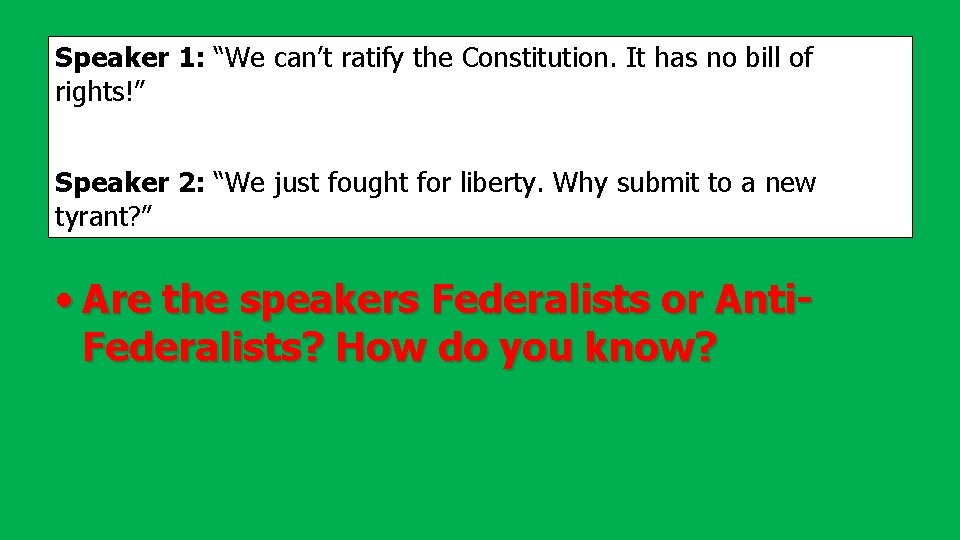
Speaker 1: “We can’t ratify the Constitution. It has no bill of rights!” Speaker 2: “We just fought for liberty. Why submit to a new tyrant? ” • Are the speakers Federalists or Anti. Federalists? How do you know?
RATIFYING (APPROVING) THE CONSTITUTION The Federalist were a collection of essays in support of the Constitution. Who wrote them? • JAMES MADISON (FATHER OF THE CONSTITUTION), ALEXANDER HAMILTON, AND JOHN JAY What year did George Washington become president and the Constitution come into effect? • 1789
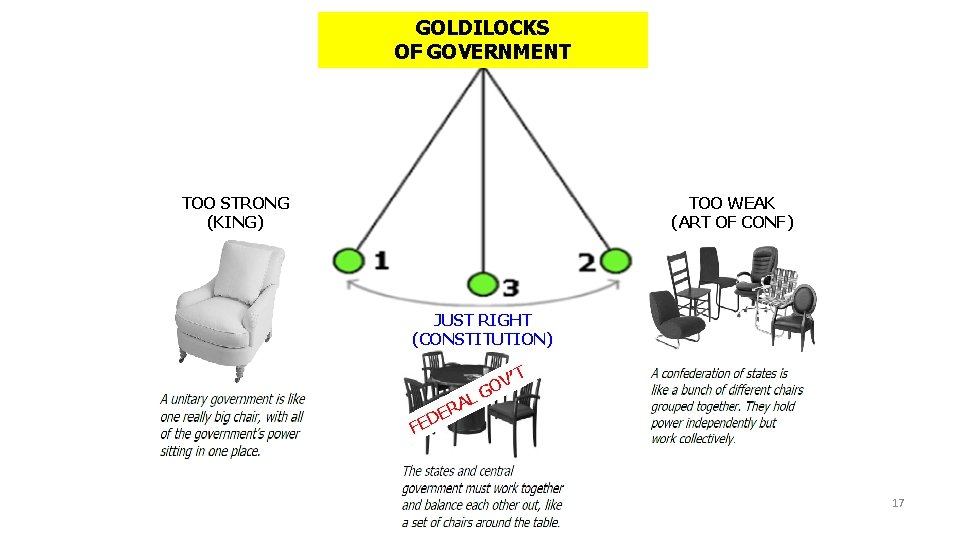
GOLDILOCKS OF GOVERNMENT TOO STRONG (KING) TOO WEAK (ART OF CONF) JUST RIGHT (CONSTITUTION) ’T V O G AL R DE FE 17
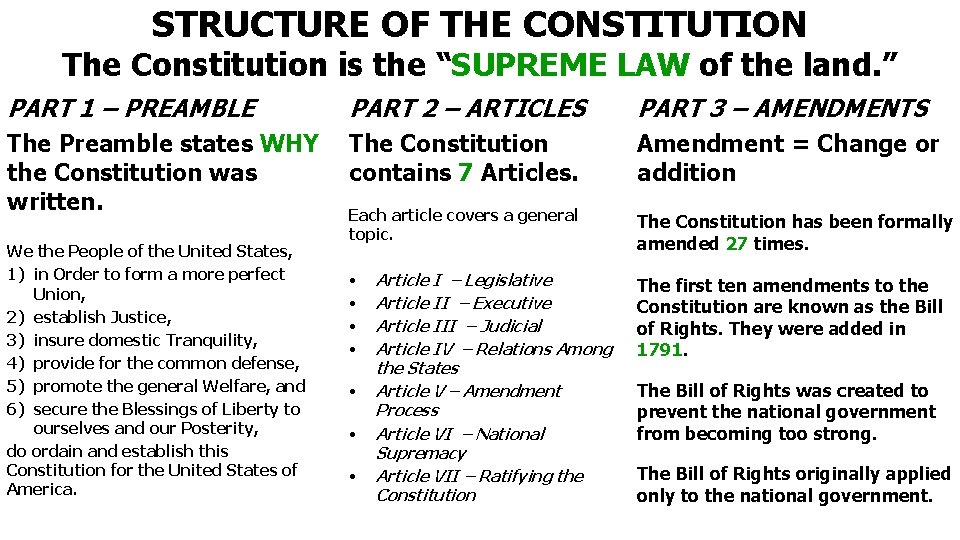
STRUCTURE OF THE CONSTITUTION The Constitution is the “SUPREME LAW of the land. ” PART 1 – PREAMBLE PART 2 – ARTICLES The Preamble states WHY The Constitution the Constitution was contains 7 Articles. written. Each article covers a general We the People of the United States, 1) in Order to form a more perfect Union, 2) establish Justice, 3) insure domestic Tranquility, 4) provide for the common defense, 5) promote the general Welfare, and 6) secure the Blessings of Liberty to ourselves and our Posterity, do ordain and establish this Constitution for the United States of America. topic. • • Article I – Legislative Article II – Executive Article III – Judicial Article IV – Relations Among the States Article V – Amendment Process Article VI – National Supremacy Article VII – Ratifying the Constitution PART 3 – AMENDMENTS Amendment = Change or addition The Constitution has been formally amended 27 times. The first ten amendments to the Constitution are known as the Bill of Rights. They were added in 1791. The Bill of Rights was created to prevent the national government from becoming too strong. The Bill of Rights originally applied only to the national government.