UN Peacekeeping Doctrine WHAT KIND OF MILITARY OPERATION
- Slides: 28
UN Peacekeeping Doctrine
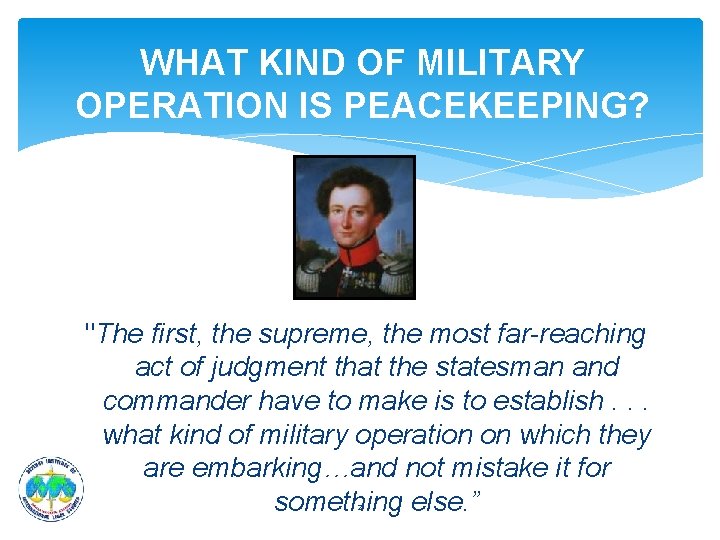
WHAT KIND OF MILITARY OPERATION IS PEACEKEEPING? "The first, the supreme, the most far-reaching act of judgment that the statesman and commander have to make is to establish. . . what kind of military operation on which they are embarking…and not mistake it for something else. ” 2
3
WHAT IS DOCTRINE? Represents summary of clear-cut opinions on a specific subject. ØFor the military: Doctrine expresses a system of fundamentals and principles which direct activities of armed forces when executing military operational tasks. ØPeacekeeping is one of many “operational military tasks. ” ØDoctrine provides common frame of reference for conducting tasks 5
MILITARY DOCTRINE Level of military planning between national strategy and unit level tactics, techniques and procedures Why is Doctrine important? Doctrine provides a shared way of thinking about military problems and operations, such as Peacekeeping. It does not: § Direct how specific military problems will be solved § Provide specific steps to solve a problem § Direct a commander to take specific action Commanders are always expected to exercise their own judgment in carrying out their missions! 6
MILITARY DOCTRINE Should change as the nature of warfare changes § Implementing and changing a military doctrine is highly complex and time consuming § Operational “Military Doctrine” supports political goals § Military doctrine is basis for developing military capabilities and shaping forces: § Organization (Force Structure and Design), Training, Leader Development Programs, Facilities, Materiel, and Soldiers § May be shared between several nations Doctrine is not Dogma! 7
MILITARY DOCTRINE BOTTOM LINE § Combines elements that are timeless with elements that ebb and flow § Value is in providing a proven and commonly understood set of principles and practices for the employment of military forces in operational missions and tasks Peacekeeping “Lessons Learned” have emphasized desirability of a common “Doctrine” for Peacekeeping 8
UN PEACEKEEPING DOCTRINE HELPS BRING STRATEGIC AND OPERATIONAL CLARITY 9
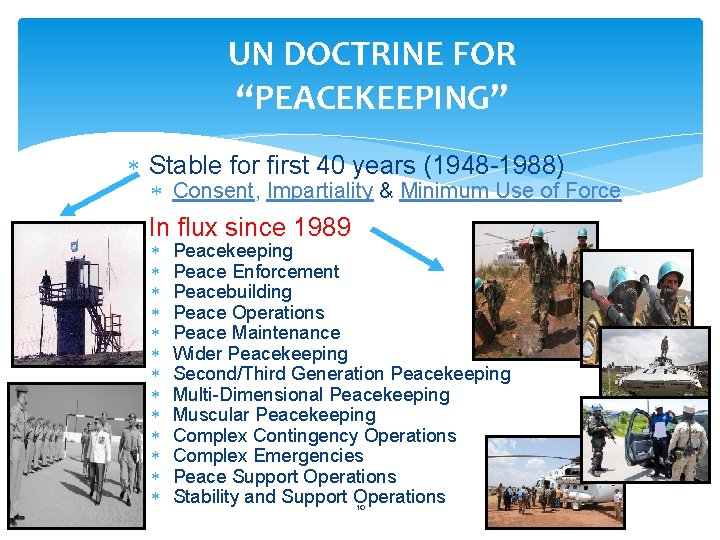
UN DOCTRINE FOR “PEACEKEEPING” Stable for first 40 years (1948 -1988) Consent, Impartiality & Minimum Use of Force In flux since 1989 Peacekeeping Peace Enforcement Peacebuilding Peace Operations Peace Maintenance Wider Peacekeeping Second/Third Generation Peacekeeping Multi-Dimensional Peacekeeping Muscular Peacekeeping Complex Contingency Operations Complex Emergencies Peace Support Operations Stability and Support Operations 10
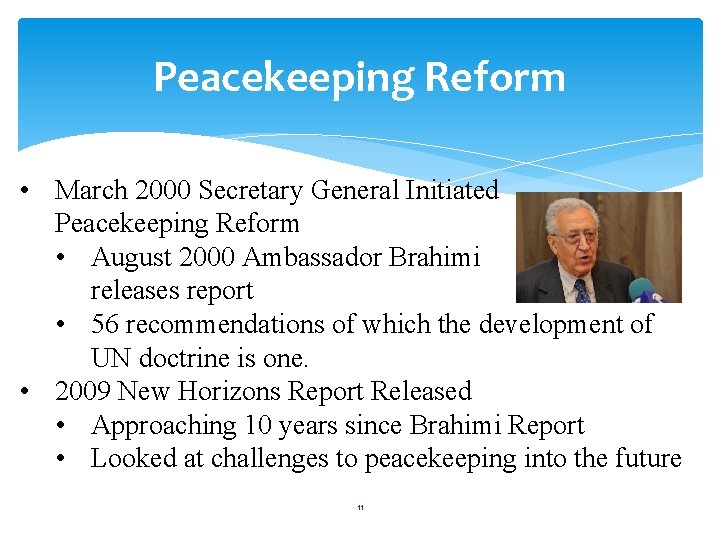
Peacekeeping Reform • March 2000 Secretary General Initiated Peacekeeping Reform • August 2000 Ambassador Brahimi releases report • 56 recommendations of which the development of UN doctrine is one. • 2009 New Horizons Report Released • Approaching 10 years since Brahimi Report • Looked at challenges to peacekeeping into the future 11
MAJOR CRITICISM OF UN PEACEKEEPING § Lack of coherent UN doctrinal guidance for Member States Needed to train forces for UN Peacekeeping § Peace Operations 2010 Reform Agenda 5 -year effort focused on improving UN Peacekeeping in areas of: People Partnerships Doctrine Organization Resources 2007 Focus: UN Peacekeeping Doctrine 12 2008 Doctrine Finalized in
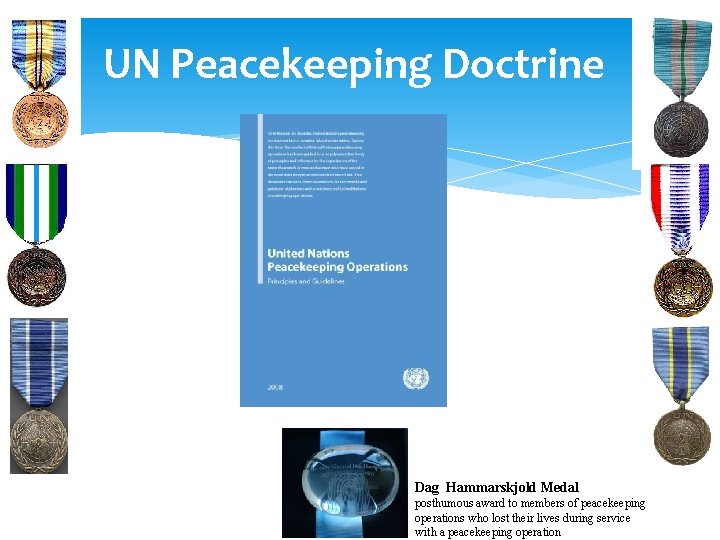
UN Peacekeeping Doctrine Dag Hammarskjold Medal 13 posthumous award to members of peacekeeping operations who lost their lives during service with a peacekeeping operation
2008 UN Doctrine for UN Peacekeeping Part I § Evolution of UN Peacekeeping Part II § Planning for UN Peacekeeping § Integrated Mission Planning Process Part III § The Art of Successful Mandate Implementation § Managing UN Peacekeeping § Supporting and Sustaining Peacekeeping § Transition and Exit 14
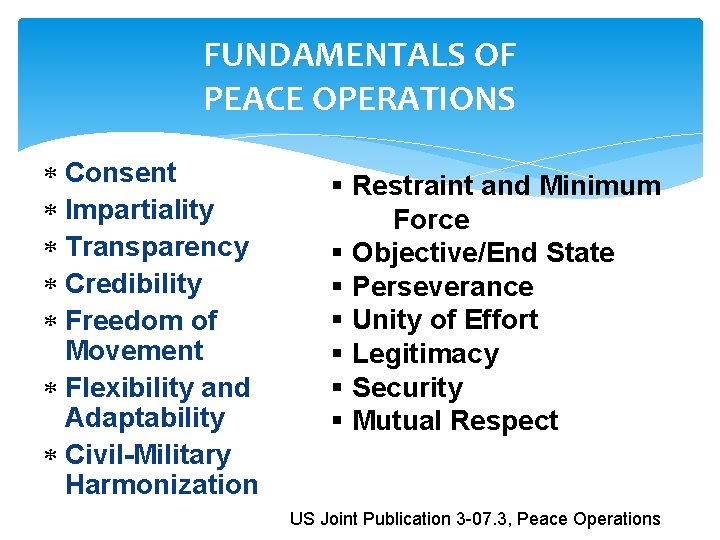
FUNDAMENTALS OF PEACE OPERATIONS Consent Impartiality Transparency Credibility Freedom of Movement Flexibility and Adaptability Civil-Military Harmonization § Restraint and Minimum Force § Objective/End State § Perseverance § Unity of Effort § Legitimacy § Security § Mutual Respect US Joint Publication 3 -07. 3, Peace Operations
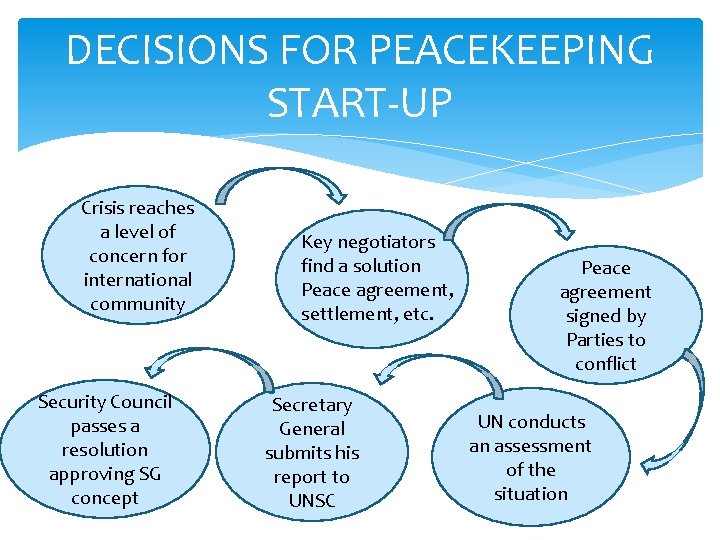
DECISIONS FOR PEACEKEEPING START-UP Crisis reaches a level of concern for international community Security Council passes a resolution approving SG concept Key negotiators find a solution Peace agreement, settlement, etc. Secretary General submits his report to UNSC Peace agreement signed by Parties to conflict UN conducts an assessment of the situation
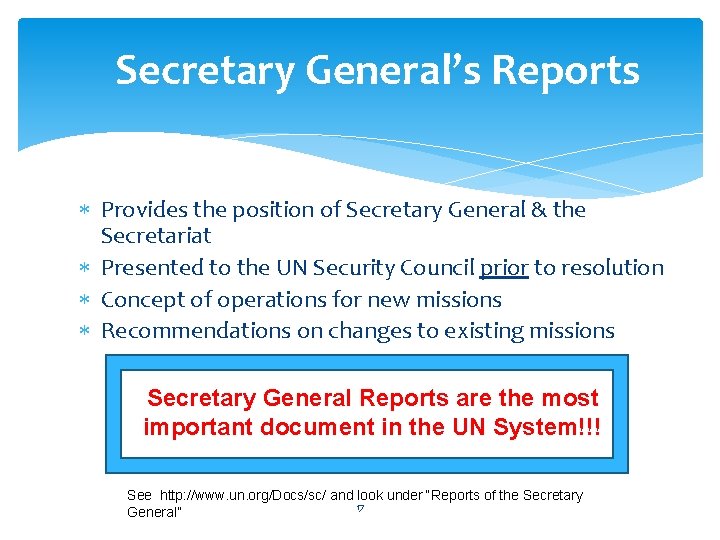
Secretary General’s Reports Provides the position of Secretary General & the Secretariat Presented to the UN Security Council prior to resolution Concept of operations for new missions Recommendations on changes to existing missions Secretary General Reports are the most important document in the UN System!!! See http: //www. un. org/Docs/sc/ and look under “Reports of the Secretary 17 General”
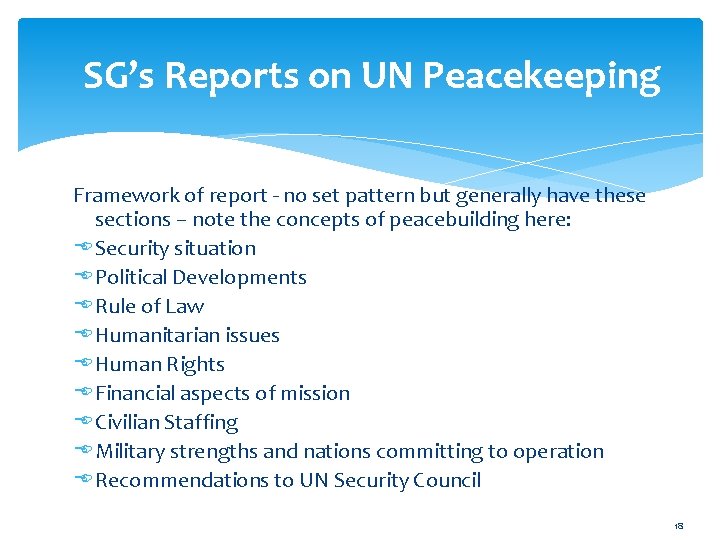
SG’s Reports on UN Peacekeeping Framework of report - no set pattern but generally have these sections – note the concepts of peacebuilding here: Security situation Political Developments Rule of Law Humanitarian issues Human Rights Financial aspects of mission Civilian Staffing Military strengths and nations committing to operation Recommendations to UN Security Council 18
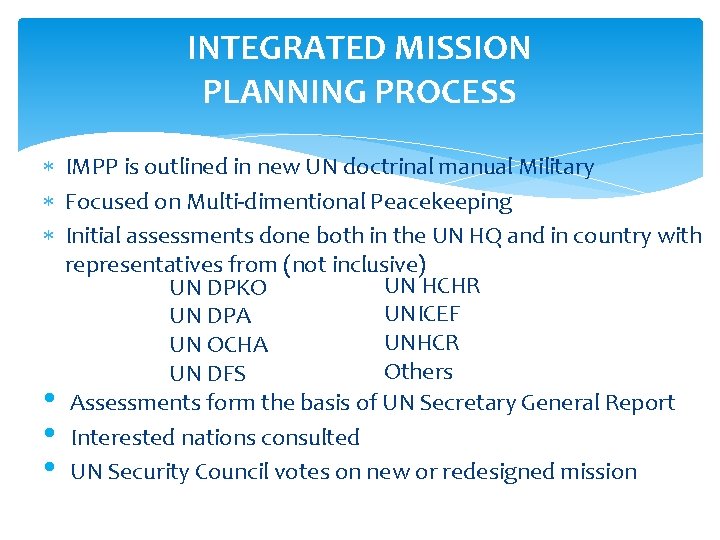
INTEGRATED MISSION PLANNING PROCESS IMPP is outlined in new UN doctrinal manual Military Focused on Multi-dimentional Peacekeeping Initial assessments done both in the UN HQ and in country with representatives from (not inclusive) UN HCHR UN DPKO UNICEF UN DPA UNHCR UN OCHA Others UN DFS • Assessments form the basis of UN Secretary General Report • Interested nations consulted • UN Security Council votes on new or redesigned mission
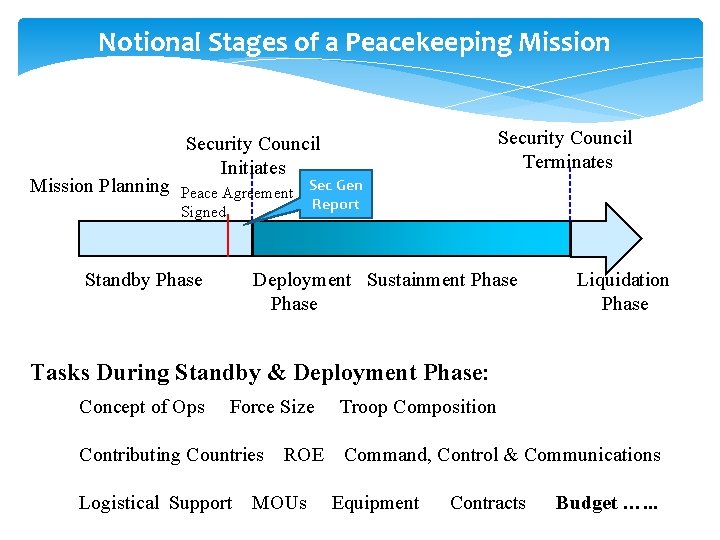
Notional Stages of a Peacekeeping Mission Planning Security Council Terminates Security Council Initiates Peace Agreement Signed Standby Phase Sec Gen Report Deployment Sustainment Phase Liquidation Phase Tasks During Standby & Deployment Phase: Concept of Ops Force Size Contributing Countries Logistical Support Troop Composition ROE Command, Control & Communications MOUs Equipment Contracts Budget …. . .
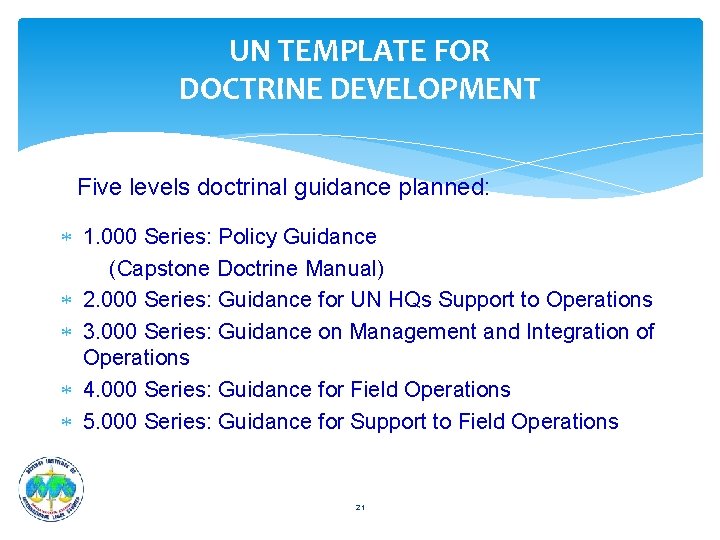
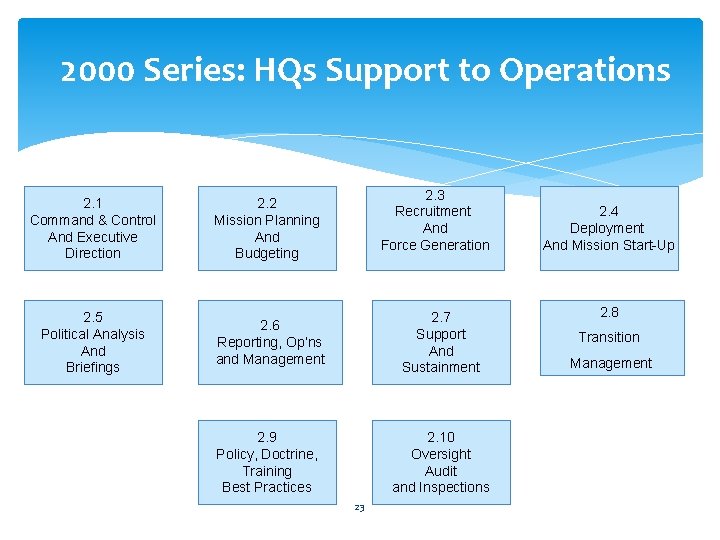
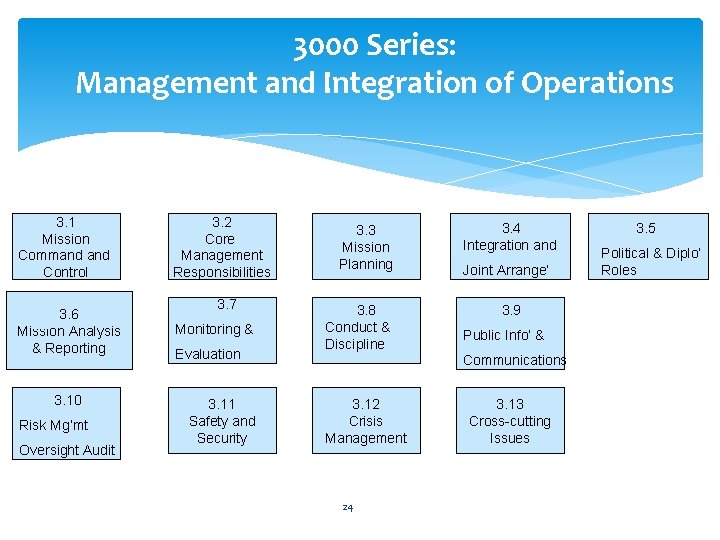
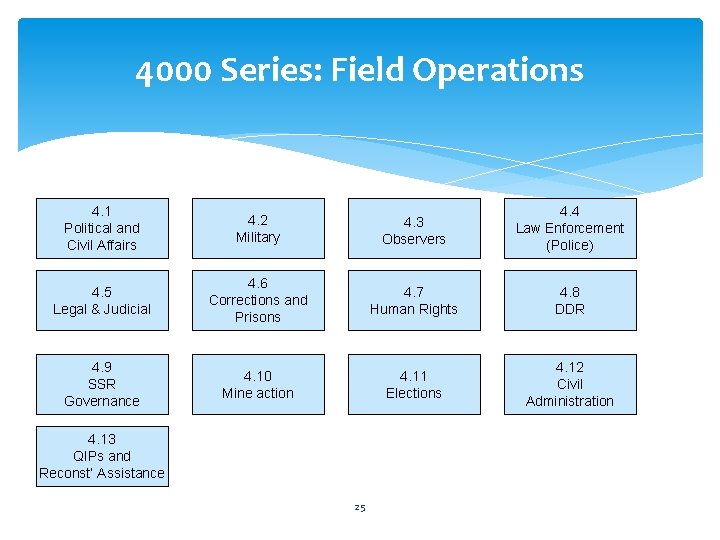
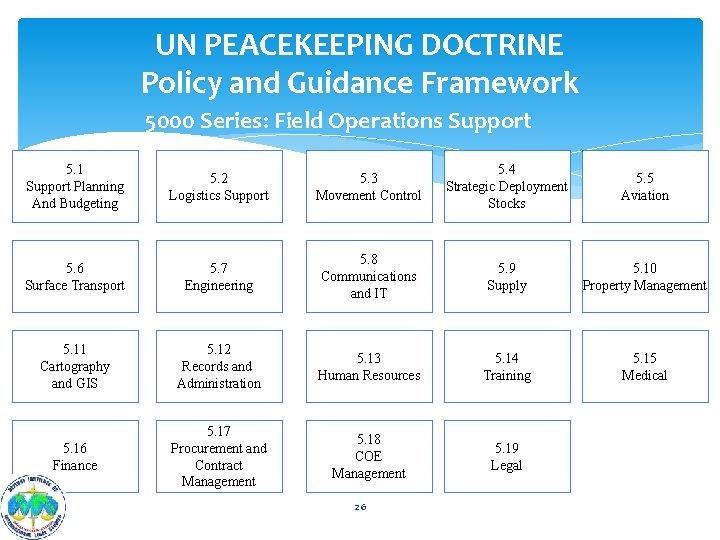
UN TEMPLATE FOR DOCTRINE DEVELOPMENT Five levels doctrinal guidance planned: 1. 000 Series: Policy Guidance (Capstone Doctrine Manual) 2. 000 Series: Guidance for UN HQs Support to Operations 3. 000 Series: Guidance on Management and Integration of Operations 4. 000 Series: Guidance for Field Operations 5. 000 Series: Guidance for Support to Field Operations 21
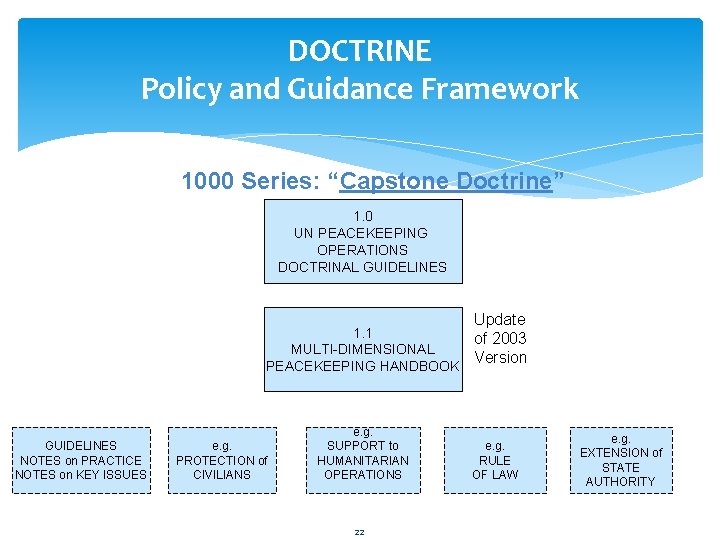
DOCTRINE Policy and Guidance Framework 1000 Series: “Capstone Doctrine” 1. 0 UN PEACEKEEPING OPERATIONS DOCTRINAL GUIDELINES 1. 1 MULTI-DIMENSIONAL PEACEKEEPING HANDBOOK GUIDELINES NOTES on PRACTICE NOTES on KEY ISSUES e. g. PROTECTION of CIVILIANS e. g. SUPPORT to HUMANITARIAN OPERATIONS 22 Update of 2003 Version e. g. RULE OF LAW e. g. EXTENSION of STATE AUTHORITY
2000 Series: HQs Support to Operations 2. 3 Recruitment And Force Generation 2. 1 Command & Control And Executive Direction 2. 2 Mission Planning And Budgeting 2. 5 Political Analysis And Briefings 2. 6 Reporting, Op’ns and Management 2. 7 Support And Sustainment 2. 9 Policy, Doctrine, Training Best Practices 2. 10 Oversight Audit and Inspections 23 2. 4 Deployment And Mission Start-Up 2. 8 Transition Management
3000 Series: Management and Integration of Operations 3. 1 Mission Command Control 3. 6 Mission Analysis & Reporting 3. 10 Risk Mg’mt Oversight Audit 3. 2 Core Management Responsibilities 3. 7 Monitoring & Evaluation 3. 11 Safety and Security 3. 3 Mission Planning 3. 8 Conduct & Discipline 3. 4 Integration and Joint Arrange’ 3. 9 Public Info’ & Communications 3. 12 Crisis Management 24 3. 13 Cross-cutting Issues 3. 5 Political & Diplo’ Roles
4000 Series: Field Operations 4. 1 Political and Civil Affairs 4. 2 Military 4. 3 Observers 4. 4 Law Enforcement (Police) 4. 5 Legal & Judicial 4. 6 Corrections and Prisons 4. 7 Human Rights 4. 8 DDR 4. 9 SSR Governance 4. 10 Mine action 4. 11 Elections 4. 12 Civil Administration 4. 13 QIPs and Reconst’ Assistance 25
UN PEACEKEEPING DOCTRINE Policy and Guidance Framework 5000 Series: Field Operations Support 5. 1 Support Planning And Budgeting 5. 2 Logistics Support 5. 3 Movement Control 5. 4 Strategic Deployment Stocks 5. 5 Aviation 5. 6 Surface Transport 5. 7 Engineering 5. 8 Communications and IT 5. 9 Supply 5. 10 Property Management 5. 11 Cartography and GIS 5. 12 Records and Administration 5. 13 Human Resources 5. 14 Training 5. 15 Medical 5. 16 Finance 5. 17 Procurement and Contract Management 5. 18 COE Management 5. 19 Legal 26
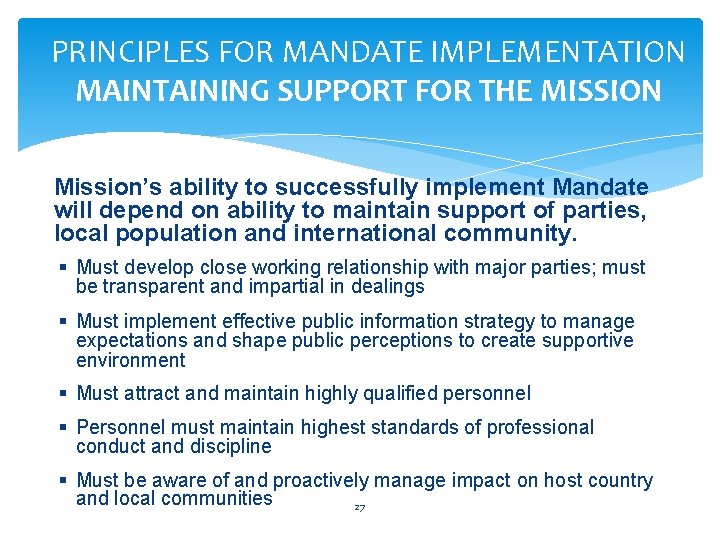
PRINCIPLES FOR MANDATE IMPLEMENTATION MAINTAINING SUPPORT FOR THE MISSION Mission’s ability to successfully implement Mandate will depend on ability to maintain support of parties, local population and international community. § Must develop close working relationship with major parties; must be transparent and impartial in dealings § Must implement effective public information strategy to manage expectations and shape public perceptions to create supportive environment § Must attract and maintain highly qualified personnel § Personnel must maintain highest standards of professional conduct and discipline § Must be aware of and proactively manage impact on host country and local communities 27
28
Initial consultation As a conflict develops, worsens, or approaches resolution, the UN is frequently involved in a number of consultations to determine the best response by the international community. These consultations would likely involve: All relevant United Nations actors 29