
The Doctrine of Correctness How usage determined the
- Slides: 14
“The Doctrine of Correctness” How usage determined the standard Heinrich-Heine-Universität Düsseldorf HS Standardization of the English Language Anglistisches Institut Prof. Dr. Busse WS 2005/06 - 3. 2. 2006 Referent: Daniel Brinckmann
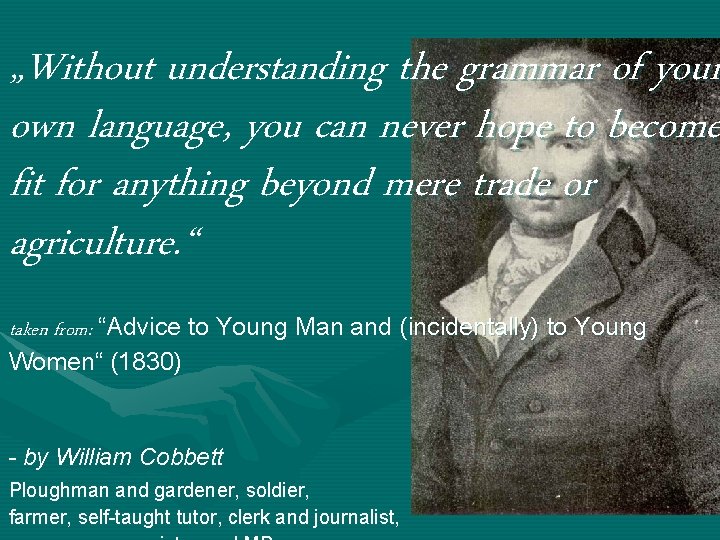
„Without understanding the grammar of your own language, you can never hope to become fit for anything beyond mere trade or agriculture. “ taken from: “Advice to Young Man and (incidentally) to Young Women“ (1830) - by William Cobbett Ploughman and gardener, soldier, farmer, self-taught tutor, clerk and journalist,
18 th Century England • Industrialization → rural change, sustained migration • Birth hour of large-scale industry and mass-production • Urbanization, , establishment of “product-consumer-relations“ and “markets“→ inspired by Adam Smith, fueled by trade with products from the colonies • towns grow to dense centres of economy: - growing demand for literacy, establishment of new professions - centres of education, culture and information: e. g. London, Birmingham, Oxford • • • laws forced parents to send children to schools Rising middle class Introduction of the press (news media)
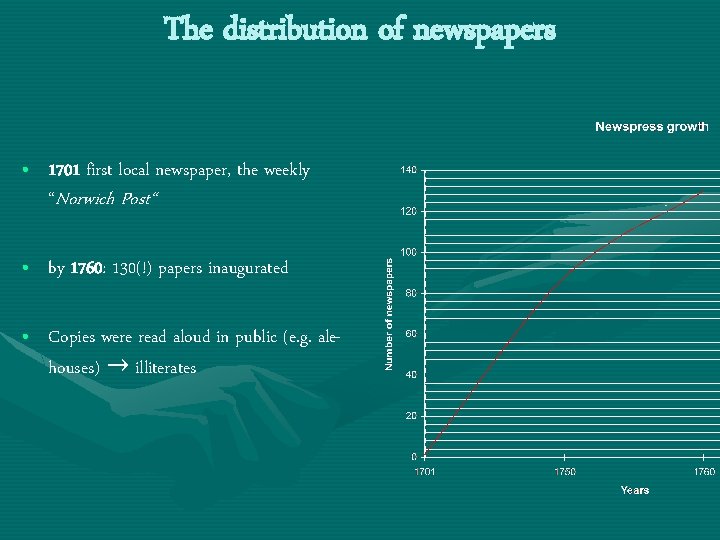
The distribution of newspapers • 1701 first local newspaper, the weekly “Norwich Post“ • by 1760: 130(!) papers inaugurated • Copies were read aloud in public (e. g. alehouses) → illiterates
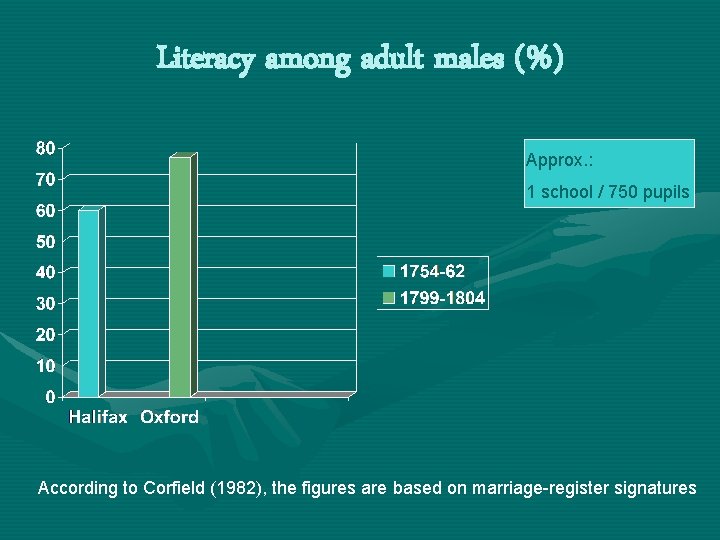
Literacy among adult males (%) Approx. : 1 school / 750 pupils According to Corfield (1982), the figures are based on marriage-register signatures
How literacy changed a nation • The PROPER USE of language is still an indication for a distinctive social class, BUT general LITERACY is no longer a privilege of the wealthy (cp. sunday schools) • “language prevents you from being the willing slave of the rich“ (William Cobbett in “Advice t a Youth“) • Lingustic skillfulness now offers the ascent on the social ladder (cp. William Cobbett) • Over the decades, speaking and writing (standard) English qualification becomes an essential → abilities can determine position in society
The social effects of growing literacy • “Proper use of language“ is a weapon of empowerment – “gives you superiority over the far greater part of men“ a real and practical William Cobbett (1830) → Growing awareness of social injustice and government → corruption in public self-determination by literacy and language came to be cornerstones society of a new matured • „Tyranny has no enemy so formidable as the pen“ Thomas Spence (1823)
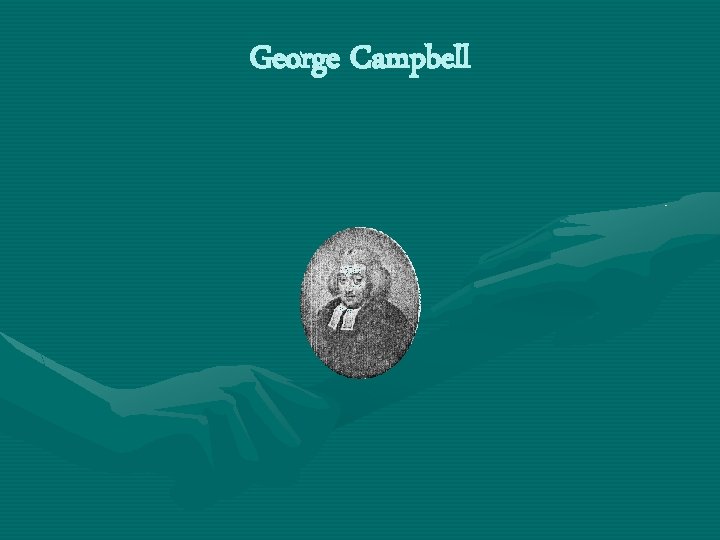
George Campbell
Language is determined by its use (descriptive linguistics, as presented by Campbell) • „Language is the only vehicle to produce a certain effect upon the minds of others“ • Language and its use is revealed as being a “species of fashion“ (forever-changing) • Grammar: “a collection of general observations digested [. . . ], comprising all the modes previously and independently established, by which the significations, derivations, and combination words [. . . ] are ascertained“. “Exceptions [from the rules] stand on the same basis as the rules“ Grammar originates in the use that prevailed over the time.
Dimensions of language use according to Campbell (1776): 1. Reputable use is the way, the „great and rich“ speak, as they are “wiser and more knowing“ (they are not forced to spend their whole lives working) 2. National use is choice on top, as opposed by provincial and foreign use → distribution is another criteria for evaluation of a standard 3. Present use should be the “standard of the present language“ 4. uction of discourse theory (detecting individual world fields) → Introd “Matters of science, [history, romance, travels, moral essays, familiar letters, ] whose terms from the nature of things [. . . ] are not within the reach of the ordinary reader“. → less “currency“ (worth) than the language understood by anyone
Emergence of a language standard according to Campbell (1776): “present, reputable, national use“ is superior to “provincial, vulgar or scientific use“ • Nevertheless, what passes his “test“ is what suits his own taste. . . • The use of language made in newspapers, magazines, trade, schools & universities contributed to a fixed standard • Effort to unite the British nation and the Empire under the banner of a uniform standard
Universal grammar for anyone • “The Doctrine of Correctness“ was devised by and for the rising middle-classes (Leonard 1929) → Campbell‘s “The Philosophy of Rhetoric“ (1776) tells of barbarisms with the “vulgar“ still associated • Thomas Spence and William Cobbett, as they were autodidacts themselves, wrote their grammars for “the laborious part of the people“
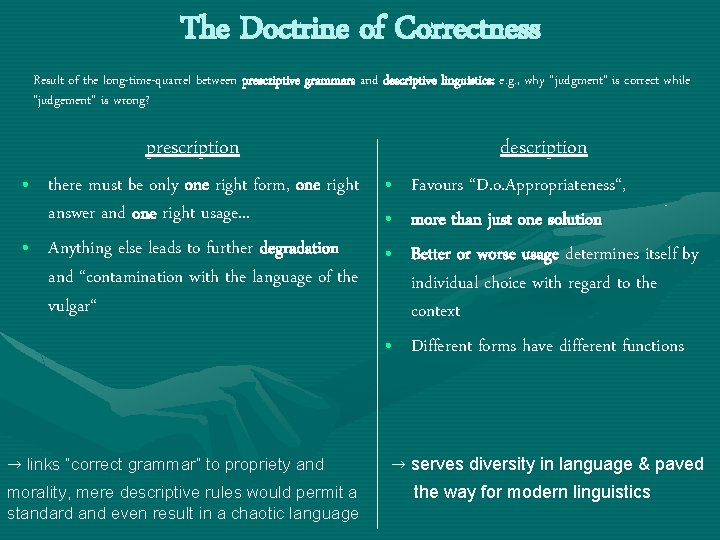
The Doctrine of Correctness Result of the long-time-quarrel between prescriptive grammars and descriptive linguistics: e. g. , why “judgment“ is correct while “judgement“ is wrong? prescription description • there must be only one right form, one right • Favours “D. o. Appropriateness“, answer and one right usage. . . • more than just one solution • Anything else leads to further degradation • Better or worse usage determines itself by and “contamination with the language of the individual choice with regard to the vulgar“ context • Different forms have different functions → links “correct grammar“ to propriety and morality, mere descriptive rules would permit a standard and even result in a chaotic language → serves diversity in language & paved the way for modern linguistics
Bibliography • Leonard, Sterling A. : “The Doctrine of Correctness in English Usage, 1700 -1800“, Madison, 1929 • “A Brief History of English Usage“ in: “Webster‘s Dictionary of English Usage“, Merria -Webster Inc. Publishers, 1989 • Cobbett, William: „“Advice to Young Men (and incidentally) to young Women“, Oxfo University Press, 1980. Originally published in book form in 1830. • Sambrook, James: “William Cobbett“, Routhledge & Megan Paul, 1973 • Duff, Gerald: “Letters of William Cobett“, Institut f. Englische Sprache und Literatur, Universität Salzburg, 1974 • Douglas, David C. : “English Historical Documents XI - 1783 -1832“, & Spottiswoode, 1971 • Corfield, Penelope J. : „The Impact of English Towns 1700 -1800“, Oxford University Press, 1982 • Campbell, George: „The Philosophy of Rhetoric“, Harper & Brothers, 1873 • www. bartleby. com/68/20/1520. html • www. bedfordstmartins. com/bb/comp 8. html Ey