
Consequences of the Acte Clair Doctrine for the
- Slides: 6
Consequences of the Acte Clair Doctrine for the Greek Courts – Questions of Temporal Effect Lisbon, 17 – 18 September 2007 Dr. Georgios Matsos, LL. M. Thessaloniki, Greece
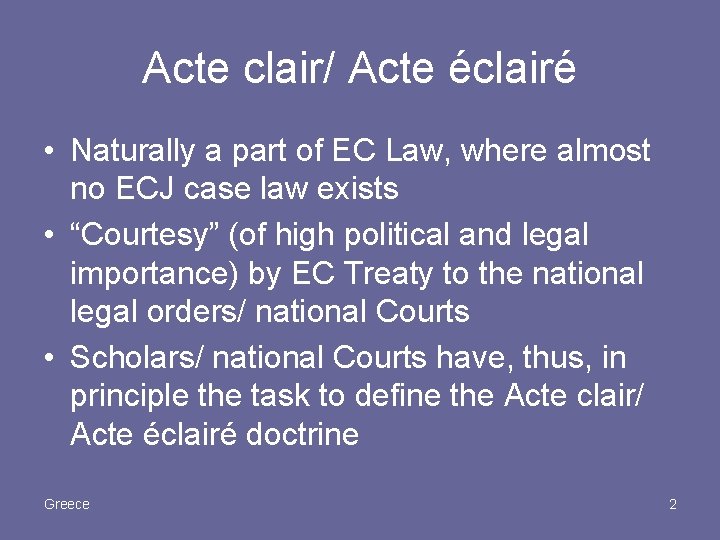
Acte clair/ Acte éclairé • Naturally a part of EC Law, where almost no ECJ case law exists • “Courtesy” (of high political and legal importance) by EC Treaty to the national legal orders/ national Courts • Scholars/ national Courts have, thus, in principle the task to define the Acte clair/ Acte éclairé doctrine Greece 2
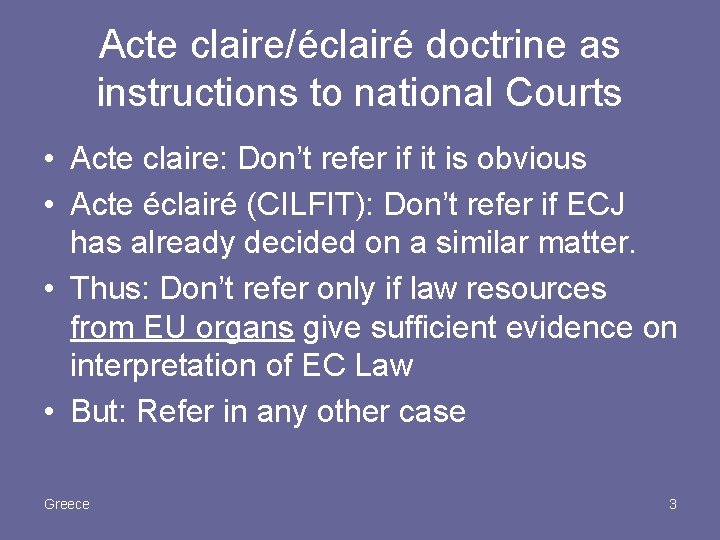
Acte claire/éclairé doctrine as instructions to national Courts • Acte claire: Don’t refer if it is obvious • Acte éclairé (CILFIT): Don’t refer if ECJ has already decided on a similar matter. • Thus: Don’t refer only if law resources from EU organs give sufficient evidence on interpretation of EC Law • But: Refer in any other case Greece 3
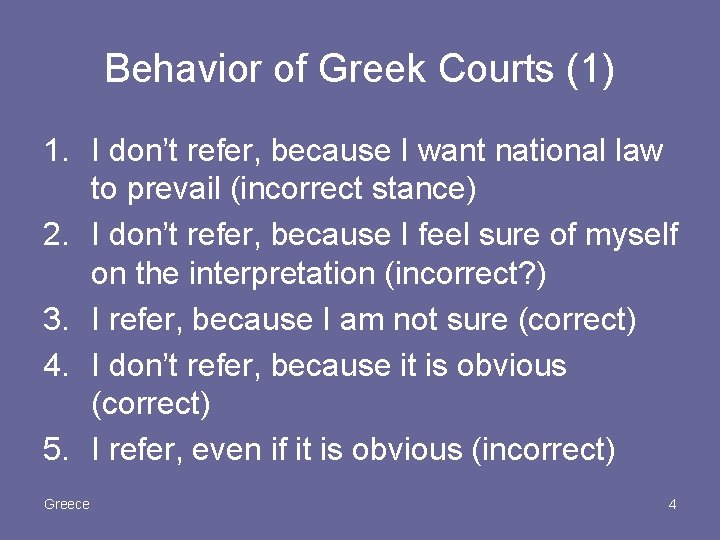
Behavior of Greek Courts (1) 1. I don’t refer, because I want national law to prevail (incorrect stance) 2. I don’t refer, because I feel sure of myself on the interpretation (incorrect? ) 3. I refer, because I am not sure (correct) 4. I don’t refer, because it is obvious (correct) 5. I refer, even if it is obvious (incorrect) Greece 4
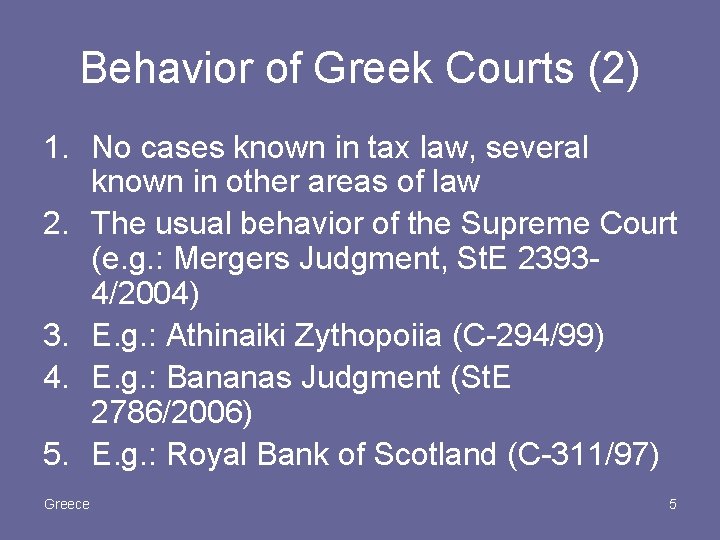
Behavior of Greek Courts (2) 1. No cases known in tax law, several known in other areas of law 2. The usual behavior of the Supreme Court (e. g. : Mergers Judgment, St. E 23934/2004) 3. E. g. : Athinaiki Zythopoiia (C-294/99) 4. E. g. : Bananas Judgment (St. E 2786/2006) 5. E. g. : Royal Bank of Scotland (C-311/97) Greece 5
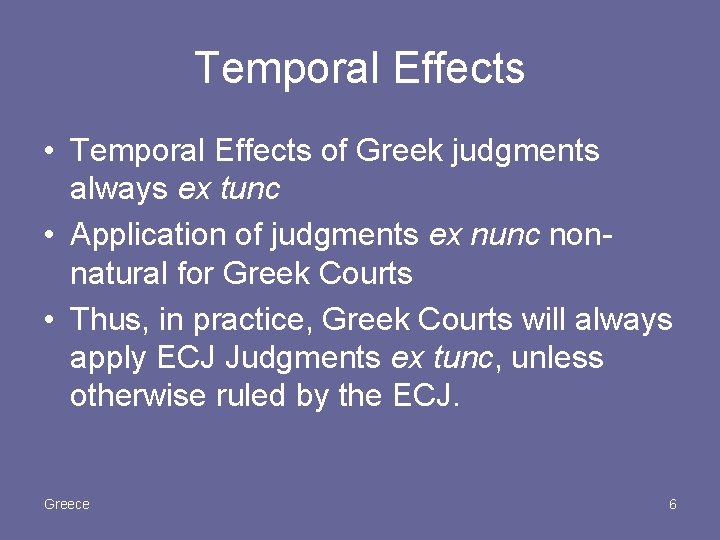
Temporal Effects • Temporal Effects of Greek judgments always ex tunc • Application of judgments ex nunc nonnatural for Greek Courts • Thus, in practice, Greek Courts will always apply ECJ Judgments ex tunc, unless otherwise ruled by the ECJ. Greece 6