Tools to Know and Love Copyright The REACH

- Slides: 22
Tools to Know and Love Copyright © The REACH Institute. All rights reserved.
Learning Objectives • Distinguish the differences between tool types • State the advantages and disadvantages of different types of tools • Identify tools that might work in your practice • Use the Pediatric Symptom Checklist (PSC) Copyright © The REACH Institute. All rights reserved.
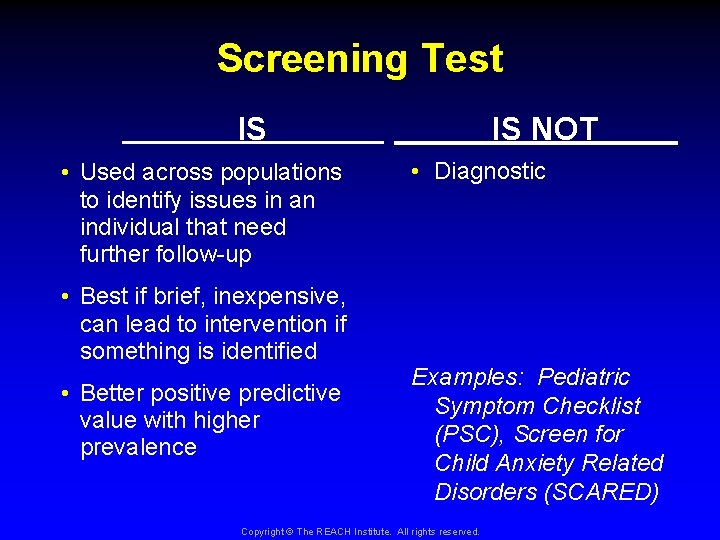
Screening Test IS • Used across populations to identify issues in an individual that need further follow-up • Best if brief, inexpensive, can lead to intervention if something is identified • Better positive predictive value with higher prevalence IS NOT • Diagnostic Examples: Pediatric Symptom Checklist (PSC), Screen for Child Anxiety Related Disorders (SCARED) Copyright © The REACH Institute. All rights reserved.
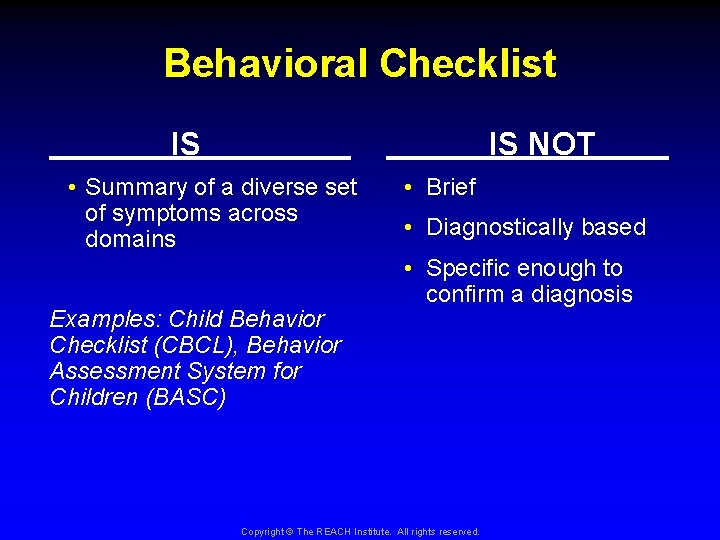
Behavioral Checklist IS IS NOT • Summary of a diverse set of symptoms across domains Examples: Child Behavior Checklist (CBCL), Behavior Assessment System for Children (BASC) • Brief • Diagnostically based • Specific enough to confirm a diagnosis Copyright © The REACH Institute. All rights reserved.
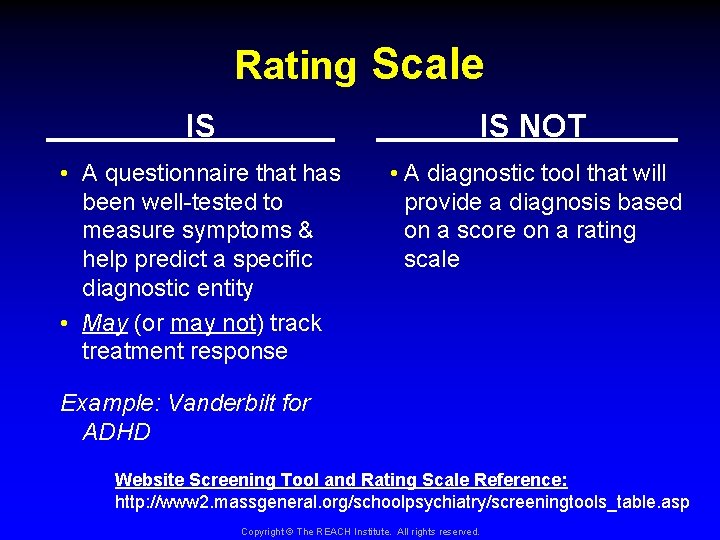
Rating Scale IS IS NOT • A questionnaire that has been well-tested to measure symptoms & help predict a specific diagnostic entity • May (or may not) track treatment response • A diagnostic tool that will provide a diagnosis based on a score on a rating scale Example: Vanderbilt for ADHD Website Screening Tool and Rating Scale Reference: http: //www 2. massgeneral. org/schoolpsychiatry/screeningtools_table. asp Copyright © The REACH Institute. All rights reserved.
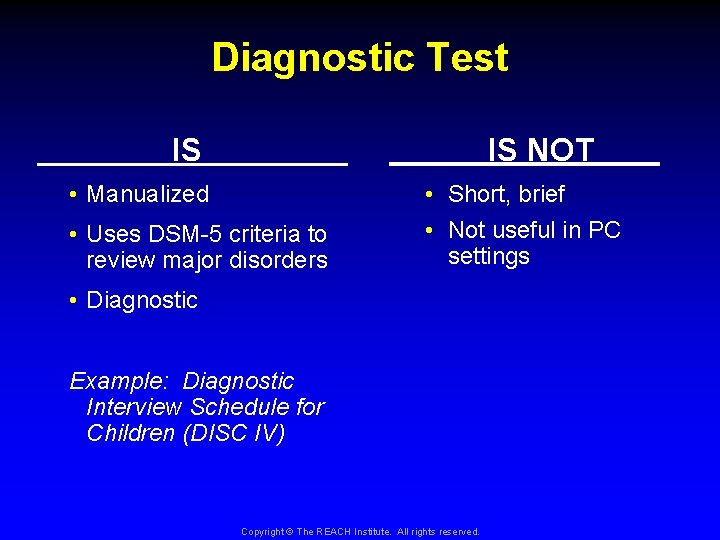
Diagnostic Test IS NOT IS • Manualized • Uses DSM-5 criteria to review major disorders • Short, brief • Not useful in PC settings • Diagnostic Example: Diagnostic Interview Schedule for Children (DISC IV) Copyright © The REACH Institute. All rights reserved.
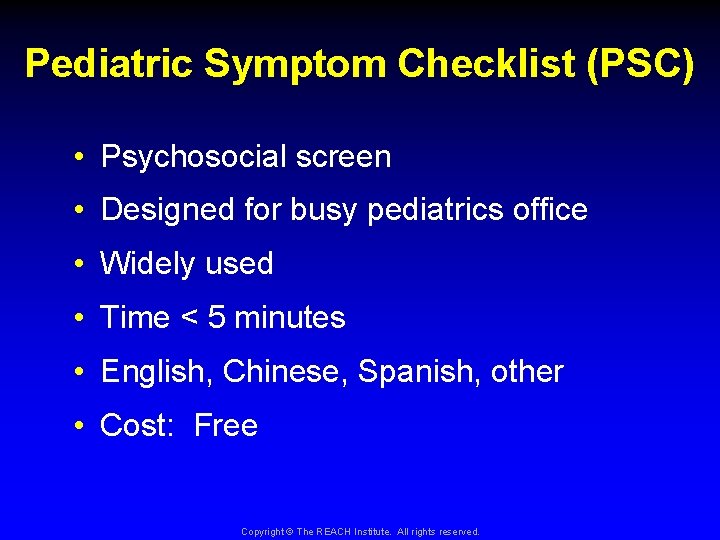
Pediatric Symptom Checklist (PSC) • Psychosocial screen • Designed for busy pediatrics office • Widely used • Time < 5 minutes • English, Chinese, Spanish, other • Cost: Free Copyright © The REACH Institute. All rights reserved.
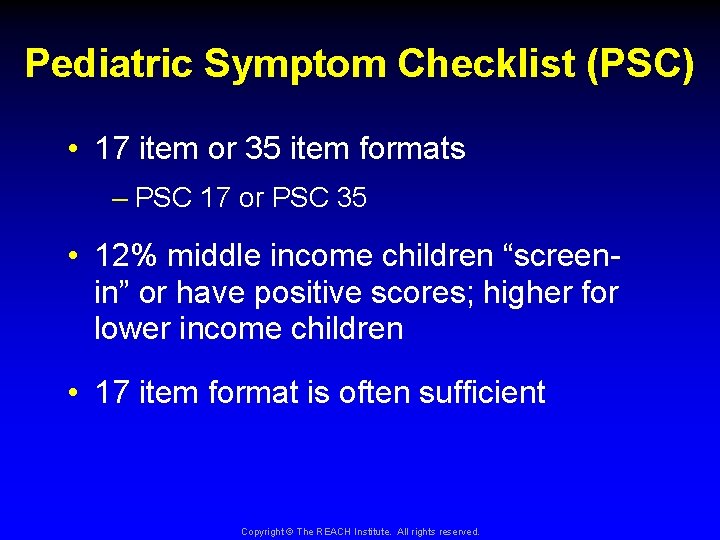
Pediatric Symptom Checklist (PSC) • 17 item or 35 item formats – PSC 17 or PSC 35 • 12% middle income children “screenin” or have positive scores; higher for lower income children • 17 item format is often sufficient Copyright © The REACH Institute. All rights reserved.
Pediatric Symptom Checklist (PSC) Parent and Youth versions • Parent Version – Parent C 1. 2 & 1. 6 Youth C 1. 3 & 1. 7 – Ages 4 and up – Parent completes Copyright © The REACH Institute. All rights reserved.
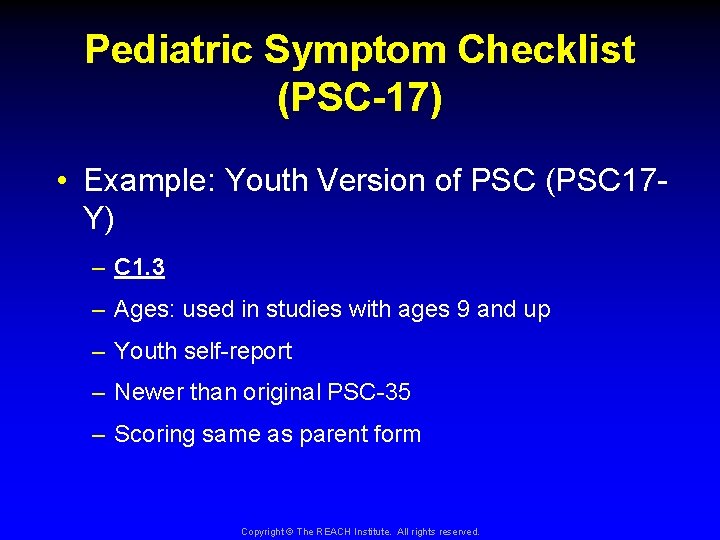
Pediatric Symptom Checklist (PSC-17) • Example: Youth Version of PSC (PSC 17 Y) – C 1. 3 – Ages: used in studies with ages 9 and up – Youth self-report – Newer than original PSC-35 – Scoring same as parent form Copyright © The REACH Institute. All rights reserved.
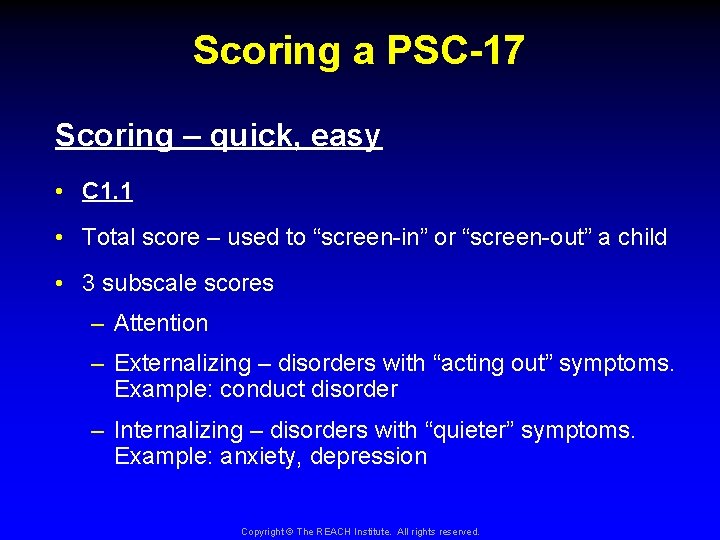
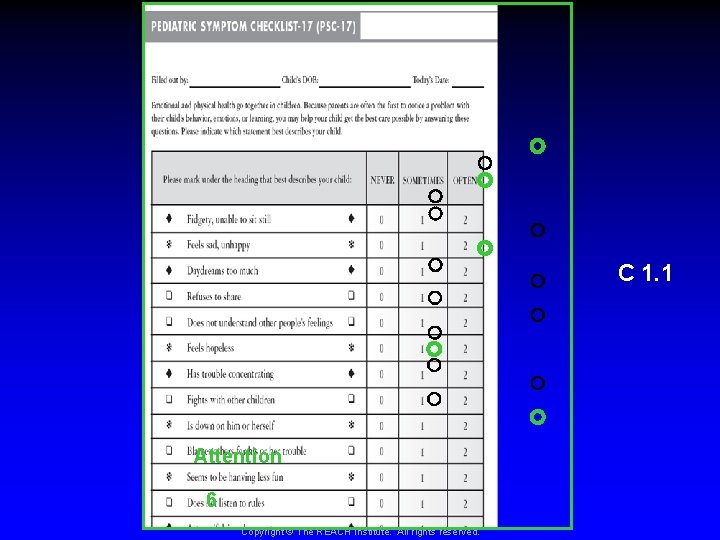
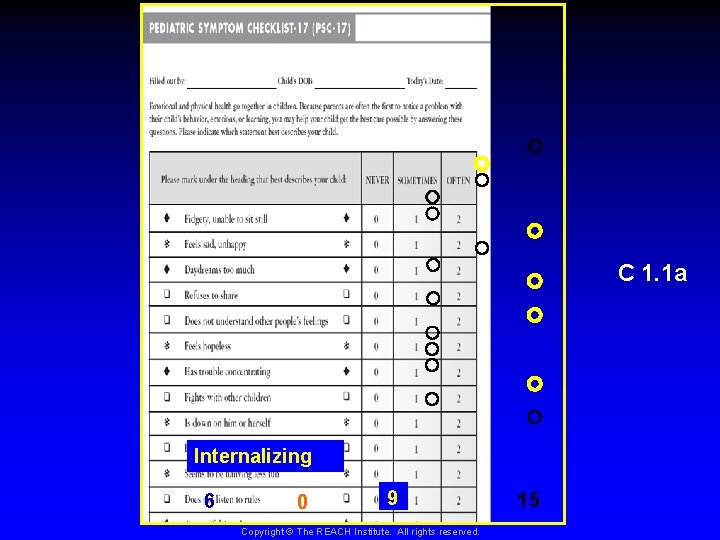
Scoring a PSC-17 Scoring – quick, easy • C 1. 1 • Total score – used to “screen-in” or “screen-out” a child • 3 subscale scores – Attention – Externalizing – disorders with “acting out” symptoms. Example: conduct disorder – Internalizing – disorders with “quieter” symptoms. Example: anxiety, depression Copyright © The REACH Institute. All rights reserved.
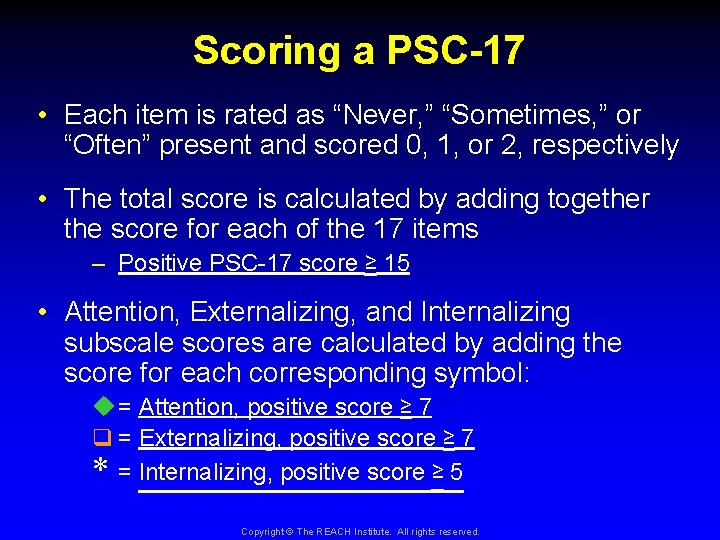
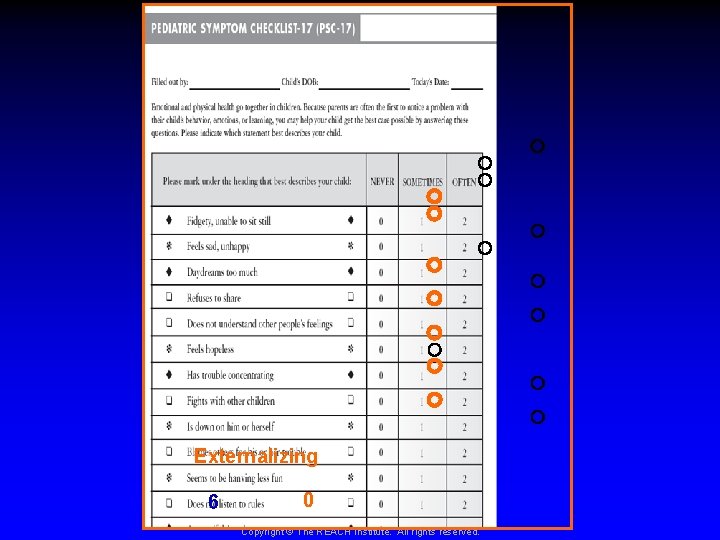
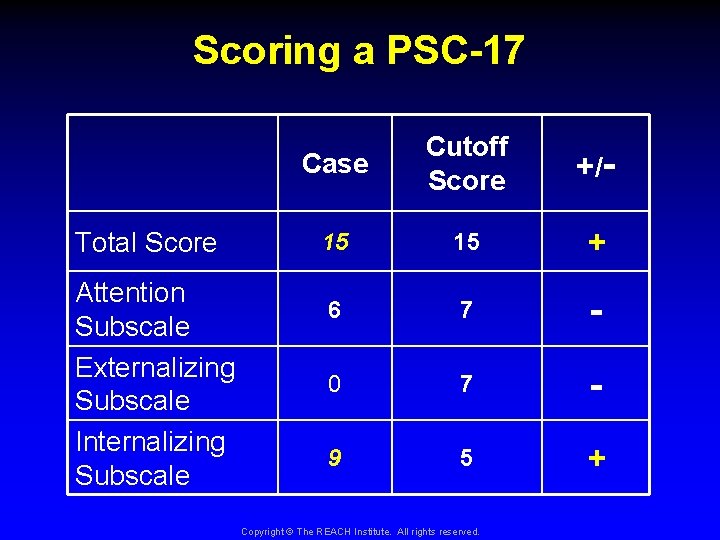
Scoring a PSC-17 • Each item is rated as “Never, ” “Sometimes, ” or “Often” present and scored 0, 1, or 2, respectively • The total score is calculated by adding together the score for each of the 17 items – Positive PSC-17 score ≥ 15 • Attention, Externalizing, and Internalizing subscale scores are calculated by adding the score for each corresponding symbol: u = Attention, positive score ≥ 7 q = Externalizing, positive score ≥ 7 * = Internalizing, positive score ≥ 5 Copyright © The REACH Institute. All rights reserved.
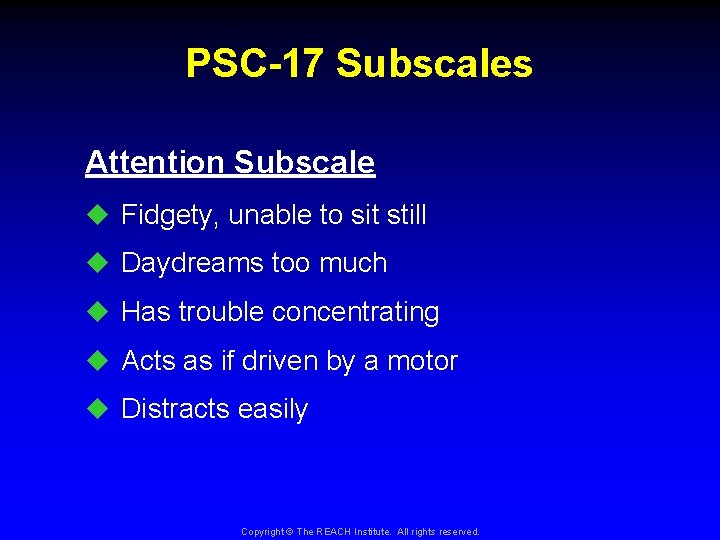
PSC-17 Subscales Attention Subscale l u Fidgety, unable to sit still u Daydreams too much u Has trouble concentrating u Acts as if driven by a motor u Distracts easily Copyright © The REACH Institute. All rights reserved.
C 1. 1 Attention 6 Copyright © The REACH Institute. All rights reserved.
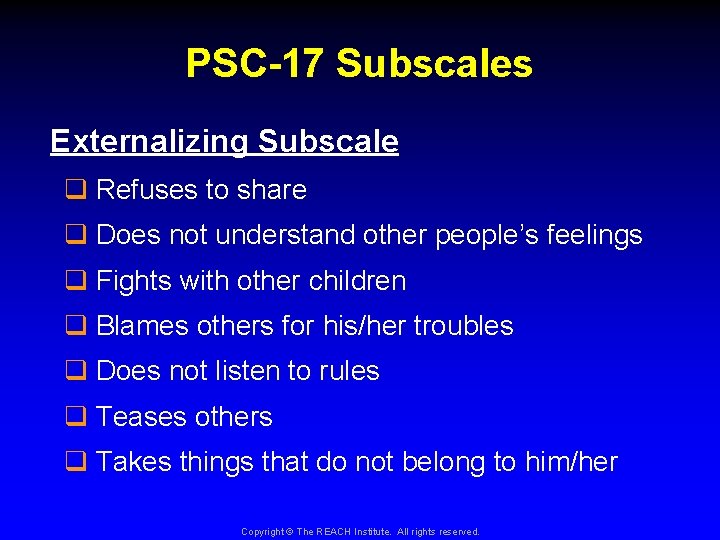
PSC-17 Subscales Externalizing Subscale q Refuses to share q Does not understand other people’s feelings q Fights with other children q Blames others for his/her troubles q Does not listen to rules q Teases others q Takes things that do not belong to him/her Copyright © The REACH Institute. All rights reserved.
Externalizing 6 0 Copyright © The REACH Institute. All rights reserved.
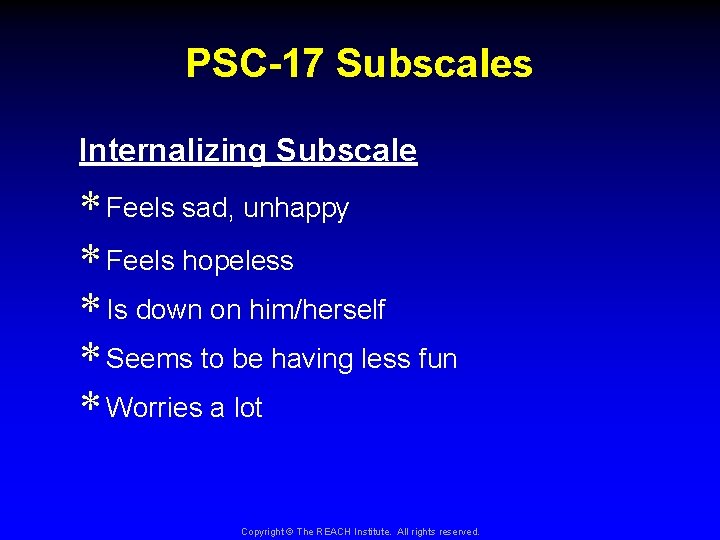
PSC-17 Subscales Internalizing Subscale * Feels sad, unhappy * Feels hopeless * Is down on him/herself * Seems to be having less fun * Worries a lot Copyright © The REACH Institute. All rights reserved.
C 1. 1 a Internalizing 6 0 9 Copyright © The REACH Institute. All rights reserved. 15
Scoring a PSC-17 Total Score Attention Subscale Externalizing Subscale Internalizing Subscale Case Cutoff Score + /- 15 15 + 6 7 - 0 7 - 9 5 + Copyright © The REACH Institute. All rights reserved.
Table Activity • Review Strengths and Difficulties Questionnaire (SDQ – C 1. 9), and PSC (C 1. 5) in workbook • As a group: Determine how you might use these tools efficiently in your practice for screening, then pick the scale your group likes the best. • SCRIBES: On your flipchart, write the scale your group likes best, that might work in your practice. Indicate why and justify your choice: – Who might hand the scale out to parents/patients? – When during the visit (beginning, middle, end), – Who might score it? Copyright © The REACH Institute. All rights reserved.
Wrapping Up • Reliable and valid tools are available to improve identification and assessment of mental health problems • Can be used efficiently in clinical practice • Can improve reliability of diagnosis • Can be used to track clinical course and outcomes • Part of the “Standard of Care” • Look at your Mental Health Card during the break! Copyright © The REACH Institute. All rights reserved.
REMINDER: Please fill out Unit C evaluation Copyright © The REACH Institute. All rights reserved.