The Wright Stuff Chemistry Tutorial REDOX REACTIONS 1

- Slides: 14
The Wright Stuff Chemistry Tutorial REDOX REACTIONS 1 Press Pg. Dn or left click for the next slide
Oxidation Numbers First, the definition. F The oxidation number of an element is the charge which the atom would have if the element was acting as an ion in the species being studied. F This can seem a bit strange at times, especially when you know that the compound you are examining is covalent. But it enables us to easily work out whether an element is oxidised or reduced in a reaction. We just compare the oxidation number before and after the reaction and work out whether it has gained or lost electrons. There a series of simple rules we use to calculate the oxidation number of an element. 2
Oxidation Numbers F 3 The rules are given in order of importance. If you reach a rule which gives you data to work from and a later rule appears to contradict the earlier result, just ignore it, you use the earlier result. I. e. later rules do not overrule earlier decisions that you have already made.
Oxidation Numbers F F 4 The oxidation number of an uncombined element is zero. I. e. the element in the element itself is zero. The algebraic sum of the oxidation numbers of all the atoms in a compound equals zero. The algebraic sum of the oxidation numbers of all the atoms in an ion equals the charge on the ion. Algebraic sum means take account of the sign of the charge. Learn these rules.
Oxidation Numbers But where do you start? We find that some atoms always have the same oxidation number in their compounds or ions. As stated earlier, the first rules overrule the later rules. F F F 5 Fluorine is always ALWAYS -1 in its compounds. Group I metals are always ALWAYS +1 in compounds. Group II metals are always +2 in their compounds. Oxygen is almost always -2 in compounds, except in peroxides (H 2 O 2, ROOR, etc. ) where it is -1. (Or when overruled by one of the above rules. ) Halides are often -1, but other numbers are often possible. Hydrogen can be +1 or -1. (If it is the first element given in a formula, it is usually +1, if given second or third, it may be -1. If in doubt, the most electronegative element is +ve and the other element will be -ve. )
Oxidation Numbers Let’s look at these rules in action in a simple problem. F 6 Calculate the oxidation number of Mn in KMn. O 4. K and O are in our table of known oxidation numbers, and KMn. O 4 is a compound. K is +1 (Group I metal) and oxygen is almost always -2. K + Mn + (4 x O) = 0 (that’s a zero) So +1 + Mn + (4 x -2) = 0 i. e. +1 + Mn - 8 = 0 i. e. Mn - 7 = 0 so Mn = +7 (We say +7 and not 7, because it is a charge. ) Easy? It’s just simple arithmatic, not chemistry.
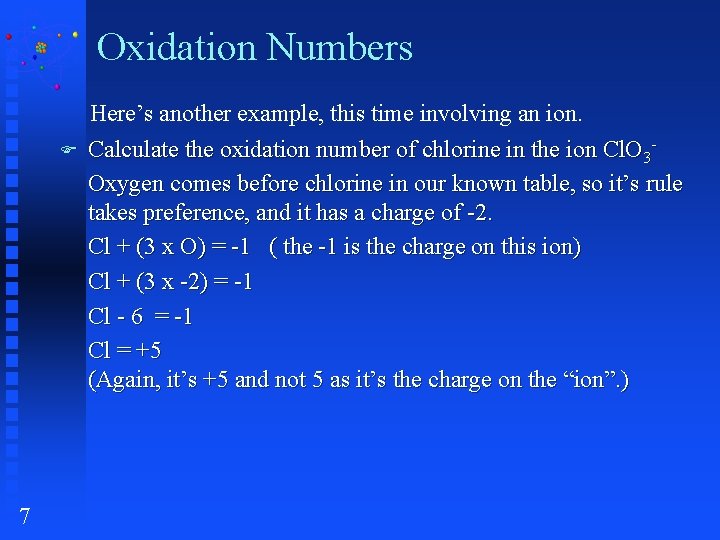
Oxidation Numbers F 7 Here’s another example, this time involving an ion. Calculate the oxidation number of chlorine in the ion Cl. O 3 Oxygen comes before chlorine in our known table, so it’s rule takes preference, and it has a charge of -2. Cl + (3 x O) = -1 ( the -1 is the charge on this ion) Cl + (3 x -2) = -1 Cl - 6 = -1 Cl = +5 (Again, it’s +5 and not 5 as it’s the charge on the “ion”. )
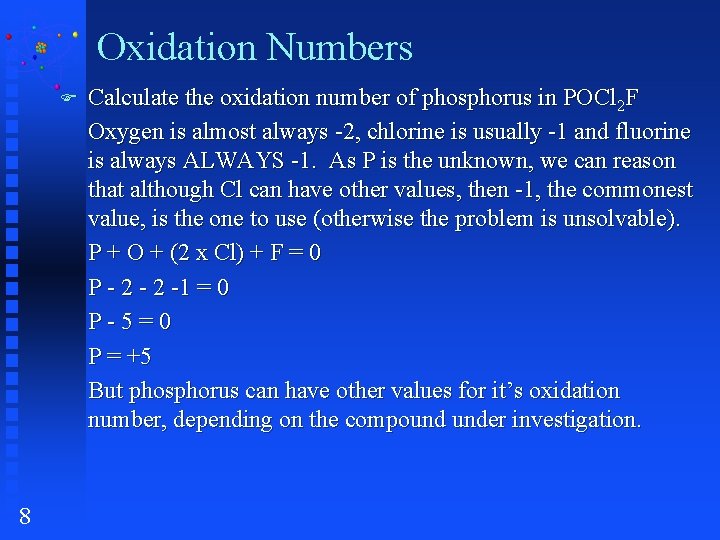
Oxidation Numbers F 8 Calculate the oxidation number of phosphorus in POCl 2 F Oxygen is almost always -2, chlorine is usually -1 and fluorine is always ALWAYS -1. As P is the unknown, we can reason that although Cl can have other values, then -1, the commonest value, is the one to use (otherwise the problem is unsolvable). P + O + (2 x Cl) + F = 0 P - 2 -1 = 0 P-5=0 P = +5 But phosphorus can have other values for it’s oxidation number, depending on the compound under investigation.
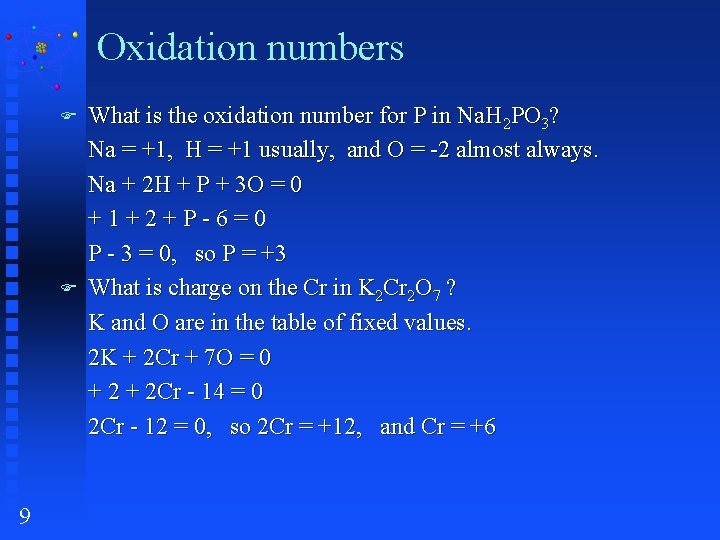
Oxidation numbers F F 9 What is the oxidation number for P in Na. H 2 PO 3? Na = +1, H = +1 usually, and O = -2 almost always. Na + 2 H + P + 3 O = 0 +1+2+P-6=0 P - 3 = 0, so P = +3 What is charge on the Cr in K 2 Cr 2 O 7 ? K and O are in the table of fixed values. 2 K + 2 Cr + 7 O = 0 + 2 Cr - 14 = 0 2 Cr - 12 = 0, so 2 Cr = +12, and Cr = +6
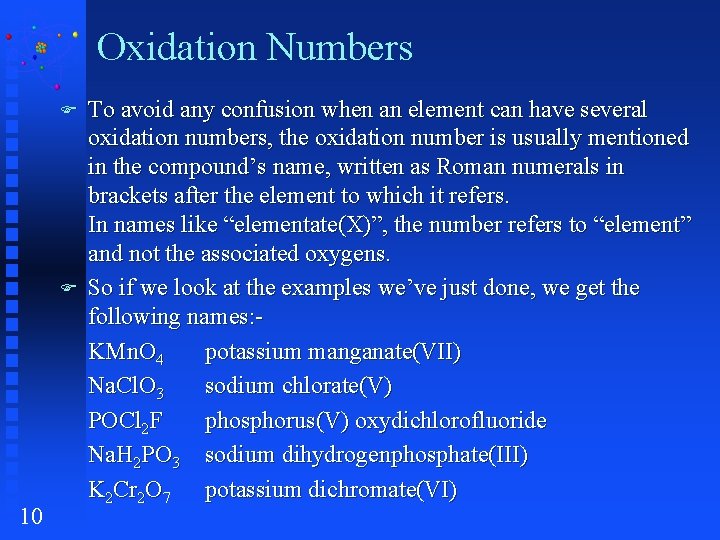
Oxidation Numbers F F 10 To avoid any confusion when an element can have several oxidation numbers, the oxidation number is usually mentioned in the compound’s name, written as Roman numerals in brackets after the element to which it refers. In names like “elementate(X)”, the number refers to “element” and not the associated oxygens. So if we look at the examples we’ve just done, we get the following names: KMn. O 4 potassium manganate(VII) Na. Cl. O 3 sodium chlorate(V) POCl 2 F phosphorus(V) oxydichlorofluoride Na. H 2 PO 3 sodium dihydrogenphosphate(III) K 2 Cr 2 O 7 potassium dichromate(VI)
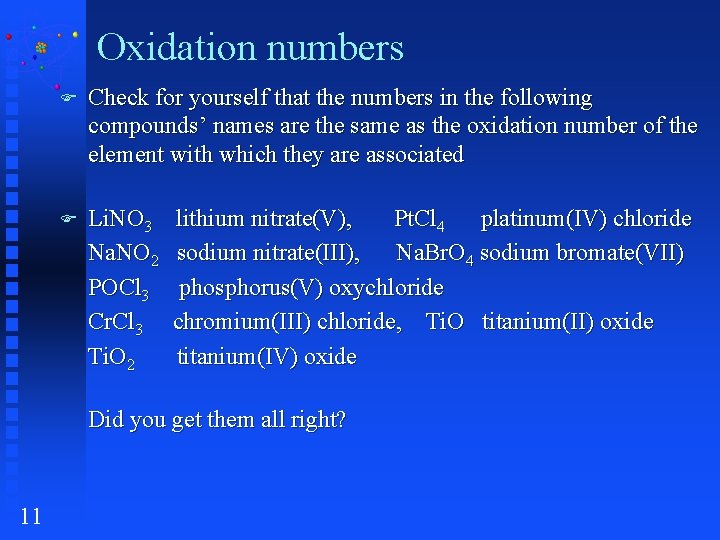
Oxidation numbers F Check for yourself that the numbers in the following compounds’ names are the same as the oxidation number of the element with which they are associated F Li. NO 3 Na. NO 2 POCl 3 Cr. Cl 3 Ti. O 2 lithium nitrate(V), Pt. Cl 4 platinum(IV) chloride sodium nitrate(III), Na. Br. O 4 sodium bromate(VII) phosphorus(V) oxychloride chromium(III) chloride, Ti. O titanium(II) oxide titanium(IV) oxide Did you get them all right? 11
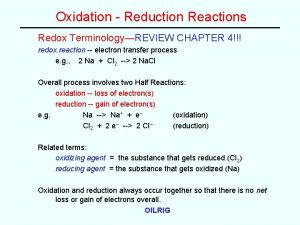
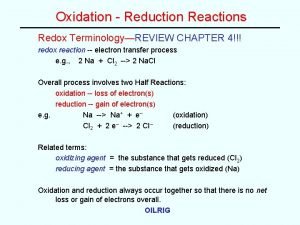
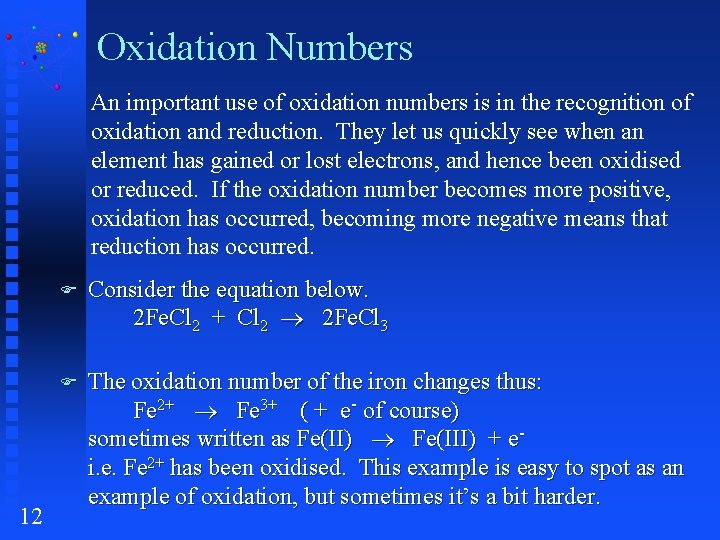
Oxidation Numbers An important use of oxidation numbers is in the recognition of oxidation and reduction. They let us quickly see when an element has gained or lost electrons, and hence been oxidised or reduced. If the oxidation number becomes more positive, oxidation has occurred, becoming more negative means that reduction has occurred. 12 F Consider the equation below. 2 Fe. Cl 2 + Cl 2 ® 2 Fe. Cl 3 F The oxidation number of the iron changes thus: Fe 2+ ® Fe 3+ ( + e- of course) sometimes written as Fe(II) ® Fe(III) + ei. e. Fe 2+ has been oxidised. This example is easy to spot as an example of oxidation, but sometimes it’s a bit harder.
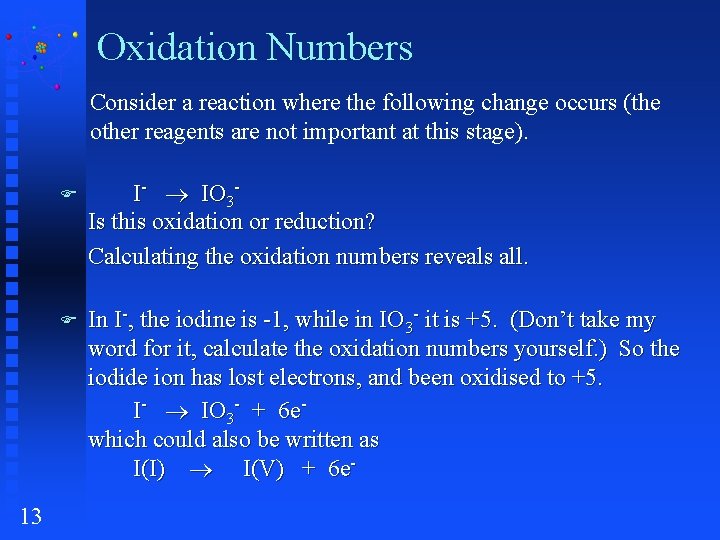
Oxidation Numbers Consider a reaction where the following change occurs (the other reagents are not important at this stage). 13 F I- ® IO 3 Is this oxidation or reduction? Calculating the oxidation numbers reveals all. F In I-, the iodine is -1, while in IO 3 - it is +5. (Don’t take my word for it, calculate the oxidation numbers yourself. ) So the iodide ion has lost electrons, and been oxidised to +5. I- ® IO 3 - + 6 ewhich could also be written as I(I) ® I(V) + 6 e-
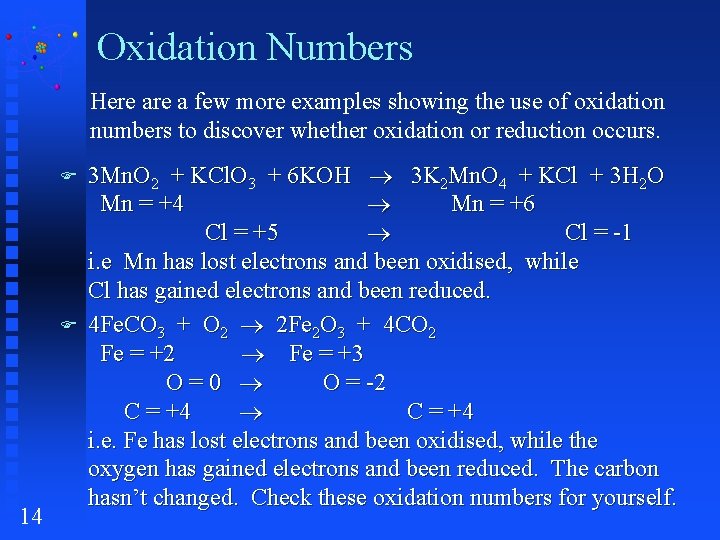
Oxidation Numbers Here a few more examples showing the use of oxidation numbers to discover whether oxidation or reduction occurs. F F 14 3 Mn. O 2 + KCl. O 3 + 6 KOH ® 3 K 2 Mn. O 4 + KCl + 3 H 2 O Mn = +4 ® Mn = +6 Cl = +5 ® Cl = -1 i. e Mn has lost electrons and been oxidised, while Cl has gained electrons and been reduced. 4 Fe. CO 3 + O 2 ® 2 Fe 2 O 3 + 4 CO 2 Fe = +2 ® Fe = +3 O=0 ® O = -2 C = +4 ® C = +4 i. e. Fe has lost electrons and been oxidised, while the oxygen has gained electrons and been reduced. The carbon hasn’t changed. Check these oxidation numbers for yourself.