The shape of the twophase lens Note 1
- Slides: 22
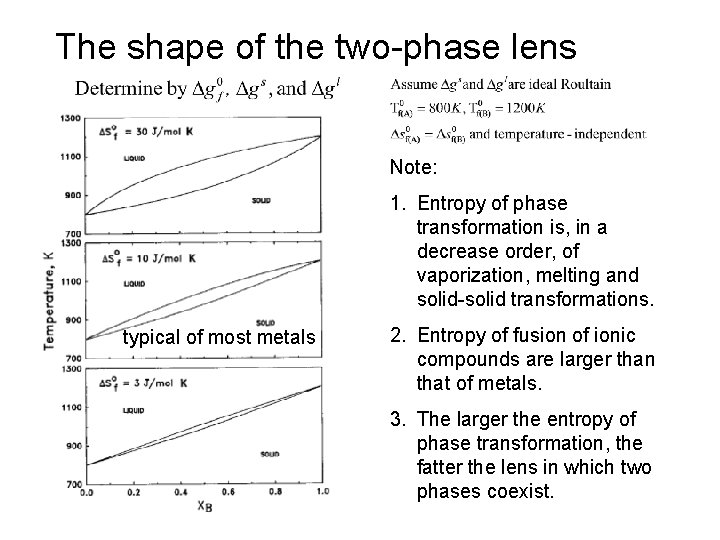
The shape of the two-phase lens Note: 1. Entropy of phase transformation is, in a decrease order, of vaporization, melting and solid-solid transformations. typical of most metals 2. Entropy of fusion of ionic compounds are larger than that of metals. 3. The larger the entropy of phase transformation, the fatter the lens in which two phases coexist.
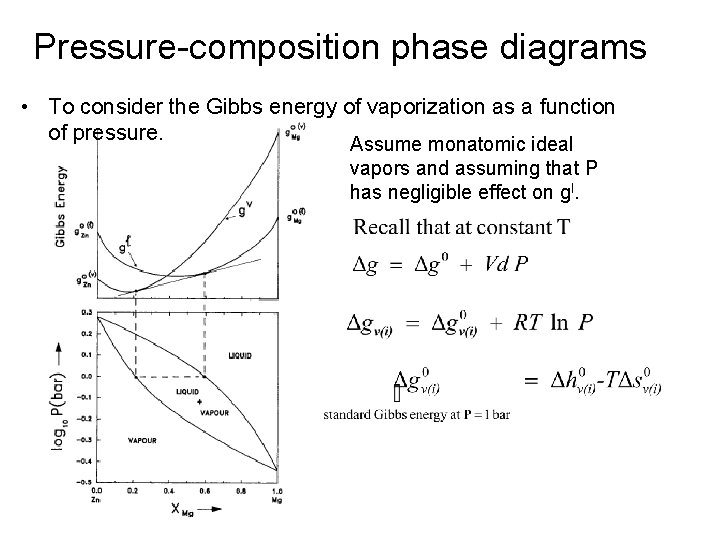
Pressure-composition phase diagrams • To consider the Gibbs energy of vaporization as a function of pressure. Assume monatomic ideal vapors and assuming that P has negligible effect on gl.
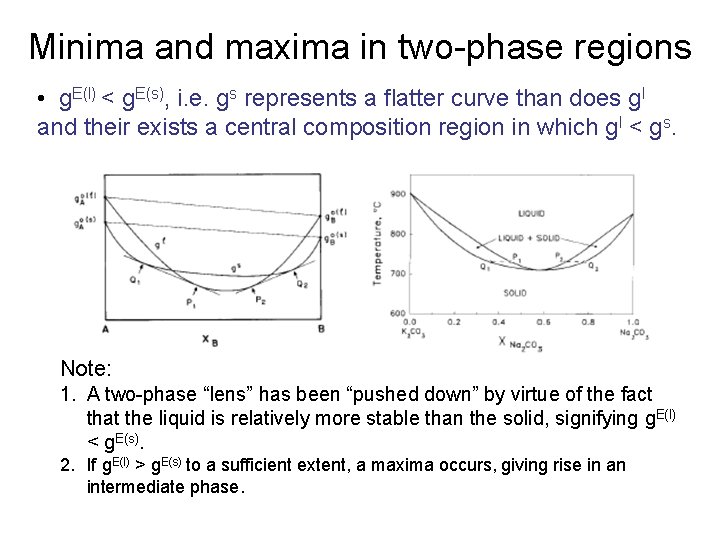
Minima and maxima in two-phase regions • g. E(l) < g. E(s), i. e. gs represents a flatter curve than does gl and their exists a central composition region in which gl < gs. Note: 1. A two-phase “lens” has been “pushed down” by virtue of the fact that the liquid is relatively more stable than the solid, signifying g. E(l) < g. E(s). 2. If g. E(l) > g. E(s) to a sufficient extent, a maxima occurs, giving rise in an intermediate phase.
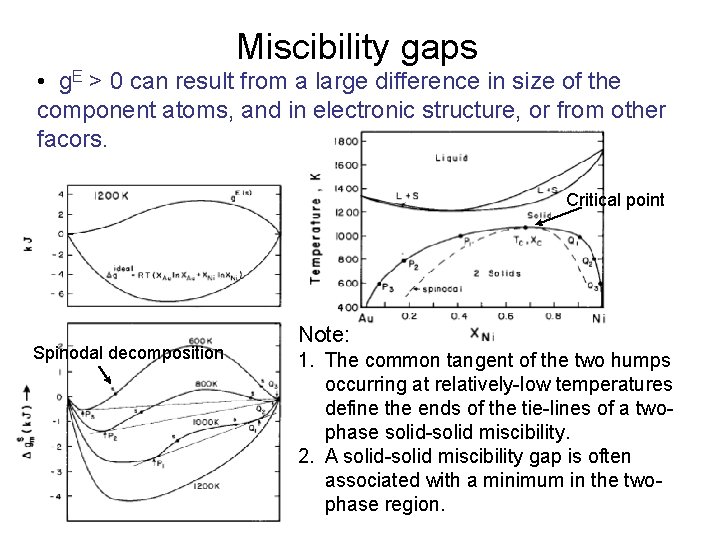
Miscibility gaps • g. E > 0 can result from a large difference in size of the component atoms, and in electronic structure, or from other facors. Critical point Spinodal decomposition Note: 1. The common tangent of the two humps occurring at relatively-low temperatures define the ends of the tie-lines of a twophase solid-solid miscibility. 2. A solid-solid miscibility gap is often associated with a minimum in the twophase region.
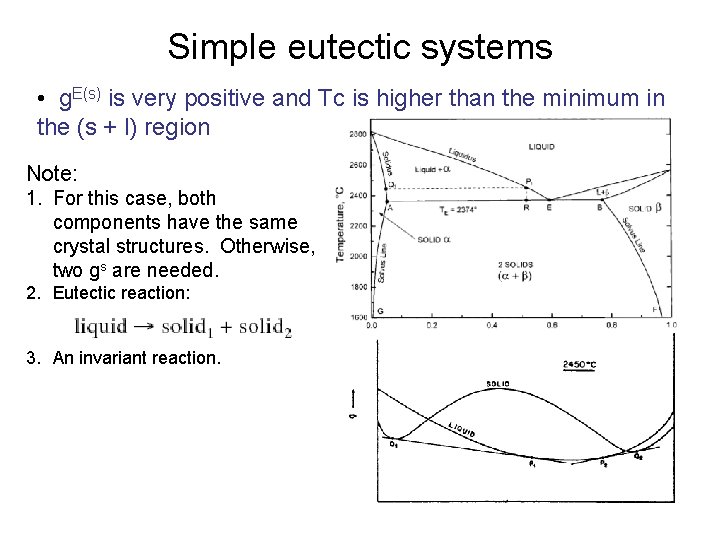
Simple eutectic systems • g. E(s) is very positive and Tc is higher than the minimum in the (s + l) region Note: 1. For this case, both components have the same crystal structures. Otherwise, two gs are needed. 2. Eutectic reaction: 3. An invariant reaction.
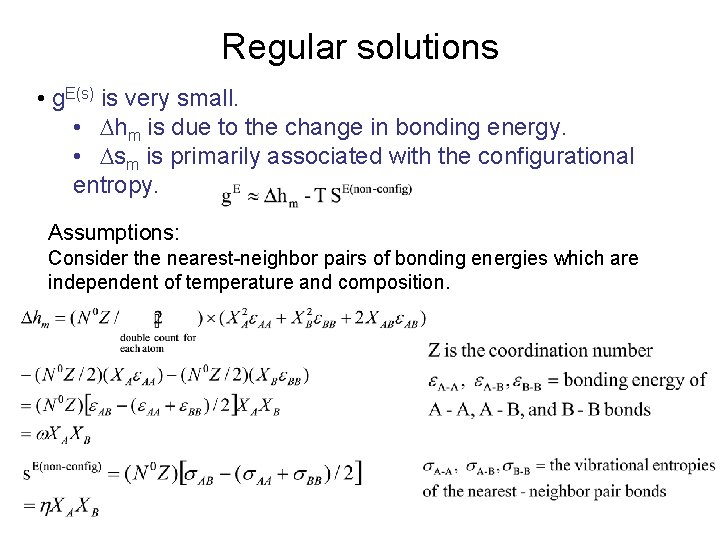
Regular solutions • g. E(s) is very small. • Dhm is due to the change in bonding energy. • Dsm is primarily associated with the configurational entropy. Assumptions: Consider the nearest-neighbor pairs of bonding energies which are independent of temperature and composition.
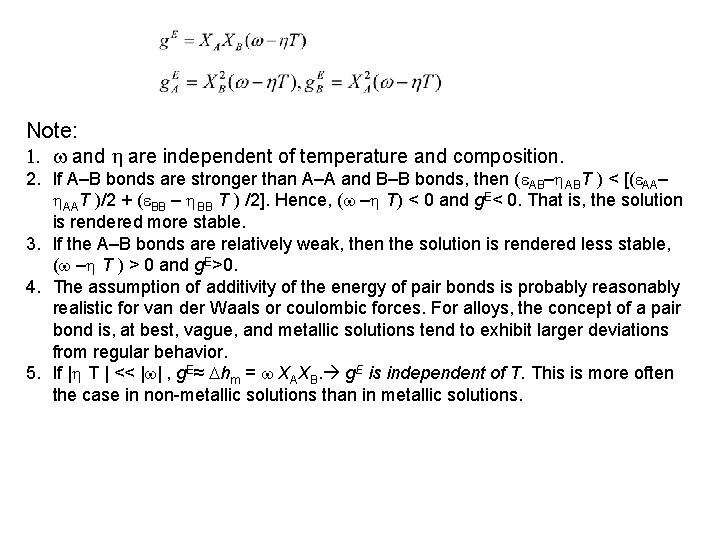
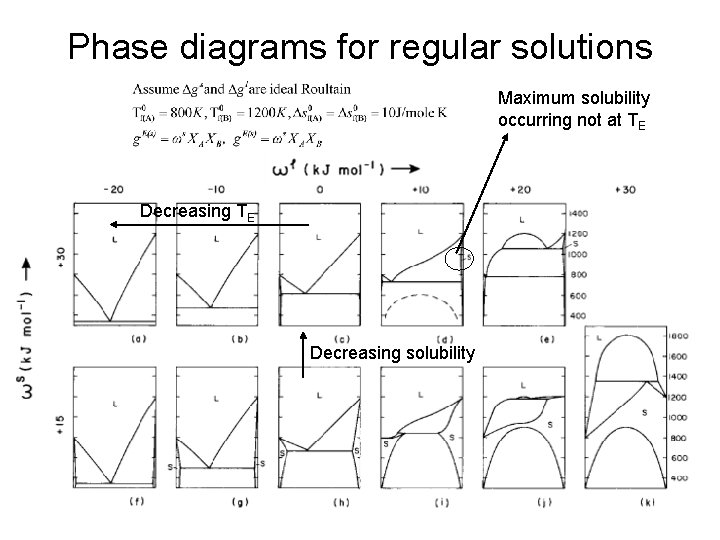
Note: 1. w and h are independent of temperature and composition. 2. If A–B bonds are stronger than A–A and B–B bonds, then (e. AB–h. ABT ) < [(e. AA– h. AAT )/2 + (e. BB – h. BB T ) /2]. Hence, (w –h T) < 0 and g. E< 0. That is, the solution is rendered more stable. 3. If the A–B bonds are relatively weak, then the solution is rendered less stable, (w –h T ) > 0 and g. E>0. 4. The assumption of additivity of the energy of pair bonds is probably reasonably realistic for van der Waals or coulombic forces. For alloys, the concept of a pair bond is, at best, vague, and metallic solutions tend to exhibit larger deviations from regular behavior. 5. If |h T | << |w| , g. E≈ Dhm = w XAXB. g. E is independent of T. This is more often the case in non-metallic solutions than in metallic solutions.
Phase diagrams for regular solutions Maximum solubility occurring not at TE Decreasing solubility
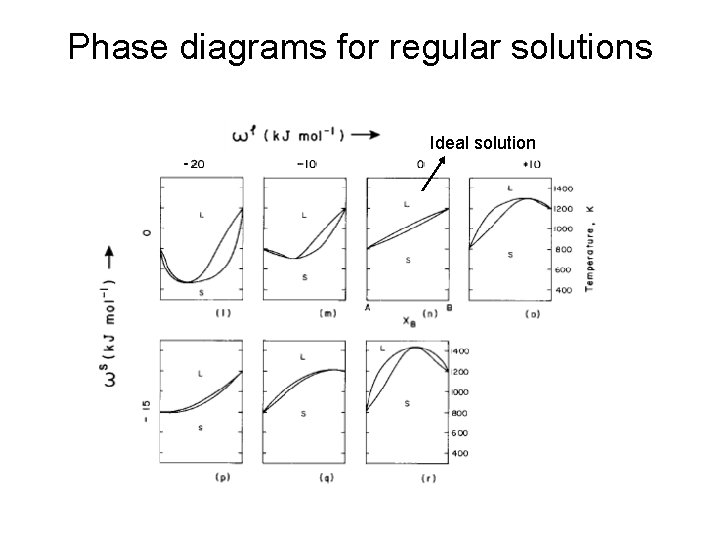
Phase diagrams for regular solutions Ideal solution
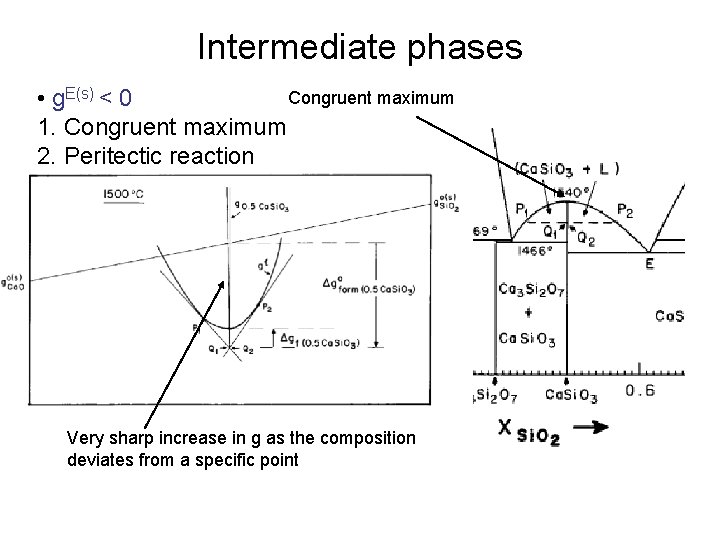
Intermediate phases Congruent maximum • g. E(s) < 0 1. Congruent maximum 2. Peritectic reaction Very sharp increase in g as the composition deviates from a specific point
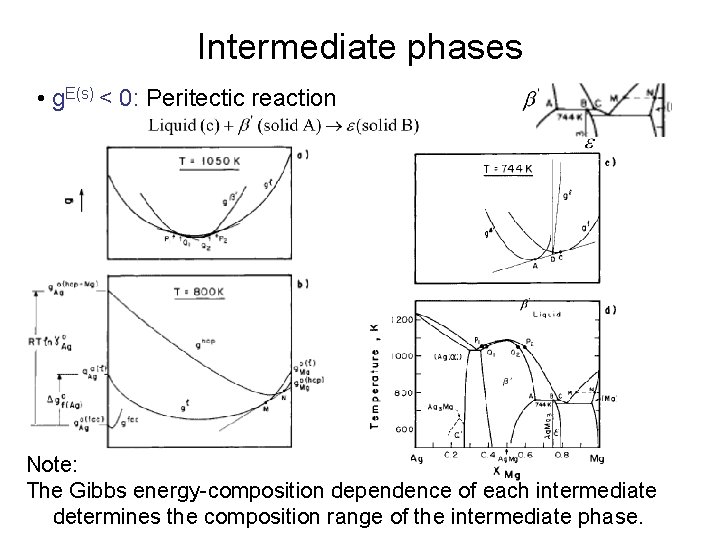
Intermediate phases • g. E(s) < 0: Peritectic reaction Note: The Gibbs energy-composition dependence of each intermediate determines the composition range of the intermediate phase.
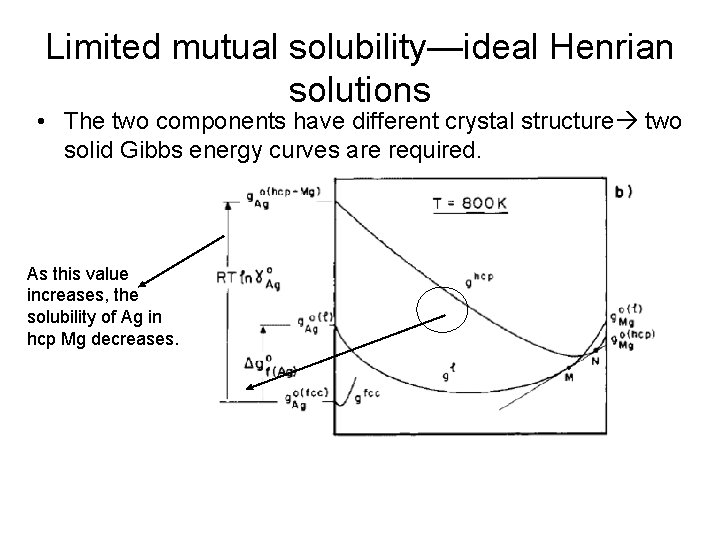
Limited mutual solubility—ideal Henrian solutions • The two components have different crystal structure two solid Gibbs energy curves are required. As this value increases, the solubility of Ag in hcp Mg decreases.
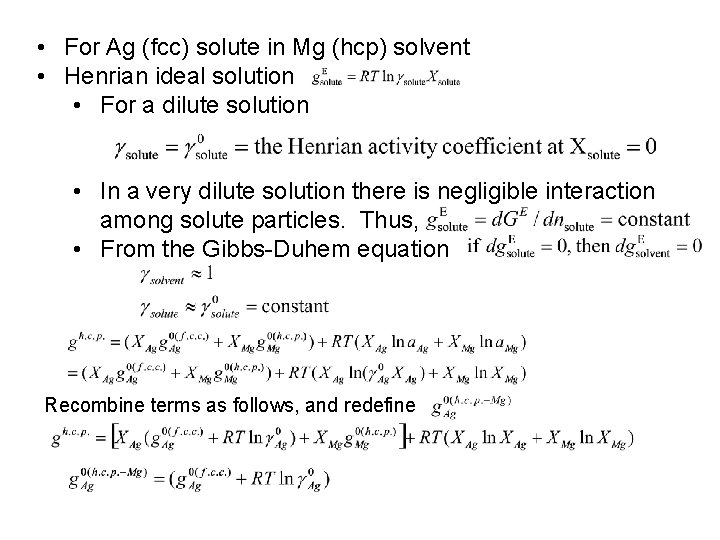
• For Ag (fcc) solute in Mg (hcp) solvent • Henrian ideal solution • For a dilute solution • In a very dilute solution there is negligible interaction among solute particles. Thus, • From the Gibbs-Duhem equation Recombine terms as follows, and redefine
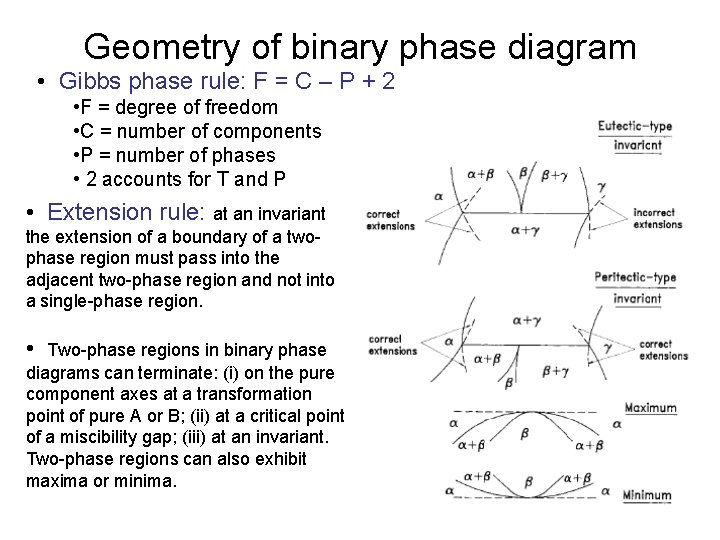
Geometry of binary phase diagram • Gibbs phase rule: F = C – P + 2 • F = degree of freedom • C = number of components • P = number of phases • 2 accounts for T and P • Extension rule: at an invariant the extension of a boundary of a twophase region must pass into the adjacent two-phase region and not into a single-phase region. • Two-phase regions in binary phase diagrams can terminate: (i) on the pure component axes at a transformation point of pure A or B; (ii) at a critical point of a miscibility gap; (iii) at an invariant. Two-phase regions can also exhibit maxima or minima.
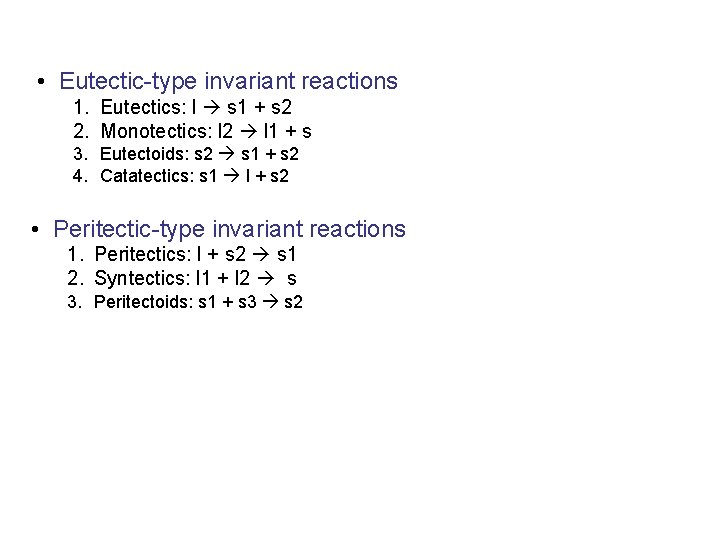
• Eutectic-type invariant reactions 1. Eutectics: l s 1 + s 2 2. Monotectics: l 2 l 1 + s 3. Eutectoids: s 2 s 1 + s 2 4. Catatectics: s 1 l + s 2 • Peritectic-type invariant reactions 1. Peritectics: l + s 2 s 1 2. Syntectics: l 1 + l 2 s 3. Peritectoids: s 1 + s 3 s 2
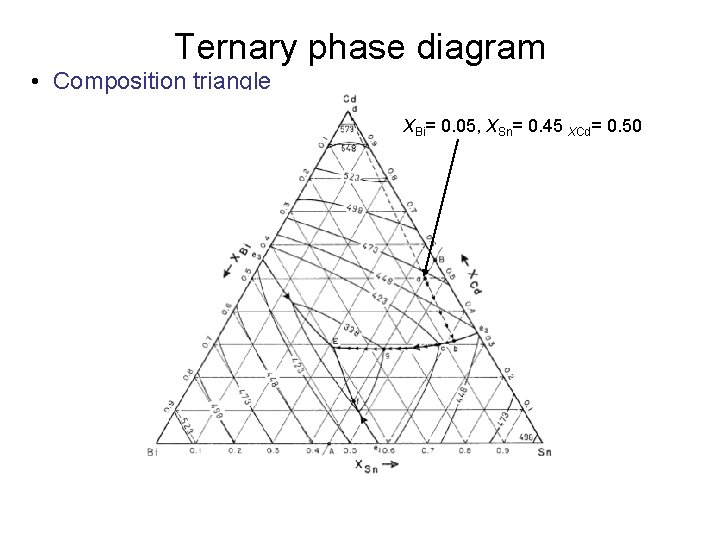
Ternary phase diagram • Composition triangle XBi= 0. 05, XSn= 0. 45 XCd= 0. 50
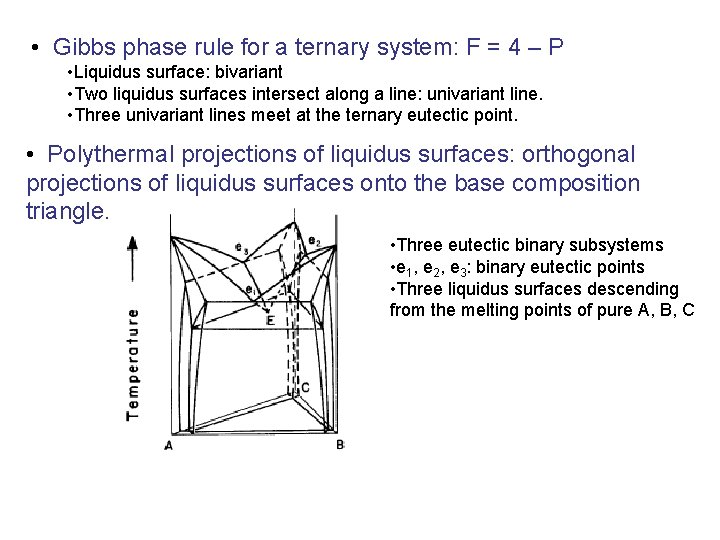
• Gibbs phase rule for a ternary system: F = 4 – P • Liquidus surface: bivariant • Two liquidus surfaces intersect along a line: univariant line. • Three univariant lines meet at the ternary eutectic point. • Polythermal projections of liquidus surfaces: orthogonal projections of liquidus surfaces onto the base composition triangle. • Three eutectic binary subsystems • e 1, e 2, e 3: binary eutectic points • Three liquidus surfaces descending from the melting points of pure A, B, C
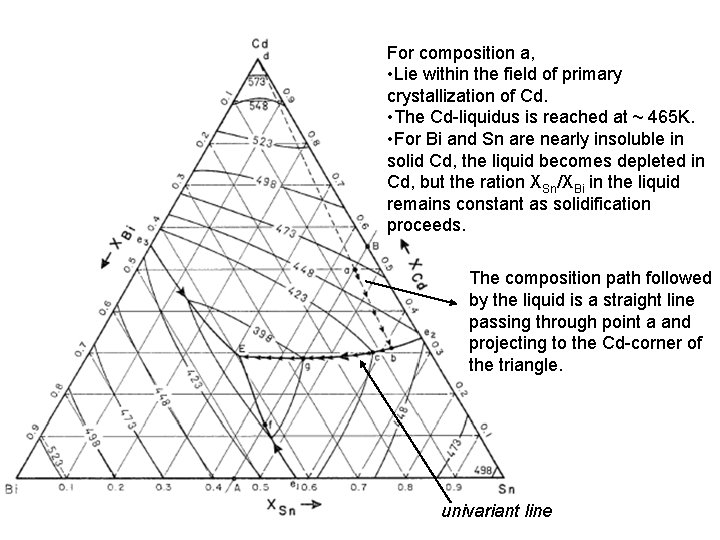
For composition a, • Lie within the field of primary crystallization of Cd. • The Cd-liquidus is reached at ~ 465 K. • For Bi and Sn are nearly insoluble in solid Cd, the liquid becomes depleted in Cd, but the ration XSn/XBi in the liquid remains constant as solidification proceeds. The composition path followed by the liquid is a straight line passing through point a and projecting to the Cd-corner of the triangle. univariant line
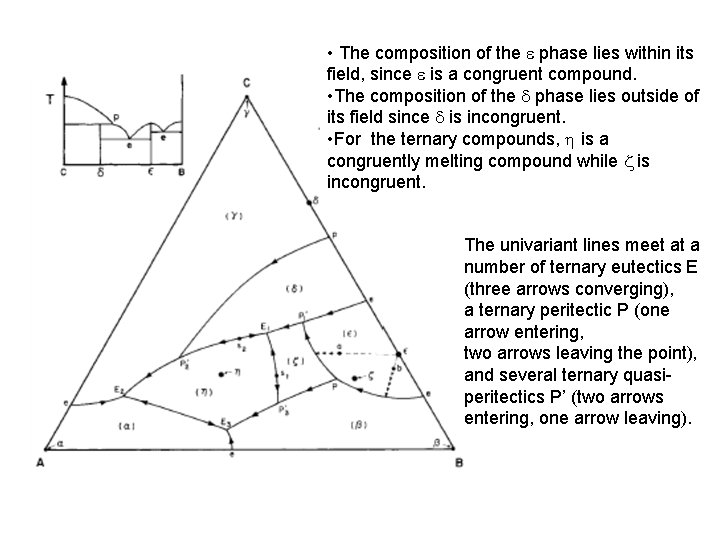
• For equilibrium cooling, a straight line joining a point on the crystallization path at any T to the overall composition point a will extend through the composition, on the solidus surface, of the solid phase in equilibrium with the liquid at that temperature. The relative proportions of the solid and liquid phases is given by the lever rule. • As the composition of the liquid has reached point b at ~ 435 K, for tile-line dab, (moles of l)/(moles of Cd) = da/ab • Upon further cooling, the liquid composition follows the univariant valley from b to E while Cd and Sn-rich solids coprecipitate as a binary eutectic mixture. • When the liquidus composition attains the ternary eutectic composition E at T ≈ 380 K the invariant ternary eutectic reaction occurs: liquid s 1 + s 2 + s 3 • For an A-B-C ternary alloy • • A–B and C–A are simple eutectic systems the binary subsystem B–C contains one congruent binary phase, e, and one incongruent binary phase, d. Note: the e and d phases are called binary compounds since they have compositions within a binary subsystem. Assume all compounds and pure solid A, B, C to be stoichiometric. The fields of primary crystallization of all the solids are indicated in parentheses.
• The composition of the e phase lies within its field, since e is a congruent compound. • The composition of the d phase lies outside of its field since d is incongruent. • For the ternary compounds, h is a congruently melting compound while z is incongruent. The univariant lines meet at a number of ternary eutectics E (three arrows converging), a ternary peritectic P (one arrow entering, two arrows leaving the point), and several ternary quasiperitectics P’ (two arrows entering, one arrow leaving).
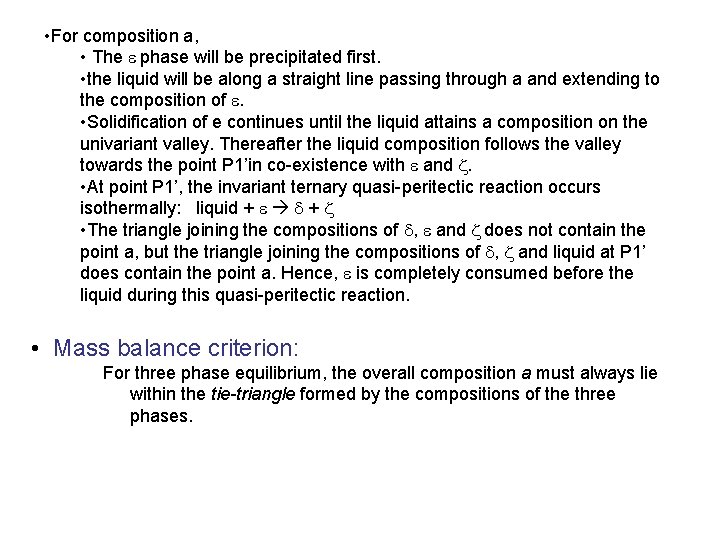
• For composition a, • The e phase will be precipitated first. • the liquid will be along a straight line passing through a and extending to the composition of e. • Solidification of e continues until the liquid attains a composition on the univariant valley. Thereafter the liquid composition follows the valley towards the point P 1’in co-existence with e and z. • At point P 1’, the invariant ternary quasi-peritectic reaction occurs isothermally: liquid + e d + z • The triangle joining the compositions of d, e and z does not contain the point a, but the triangle joining the compositions of d, z and liquid at P 1’ does contain the point a. Hence, e is completely consumed before the liquid during this quasi-peritectic reaction. • Mass balance criterion: For three phase equilibrium, the overall composition a must always lie within the tie-triangle formed by the compositions of the three phases.