The RPE at CERN q 2 Definition and



- Slides: 14
The RPE at CERN
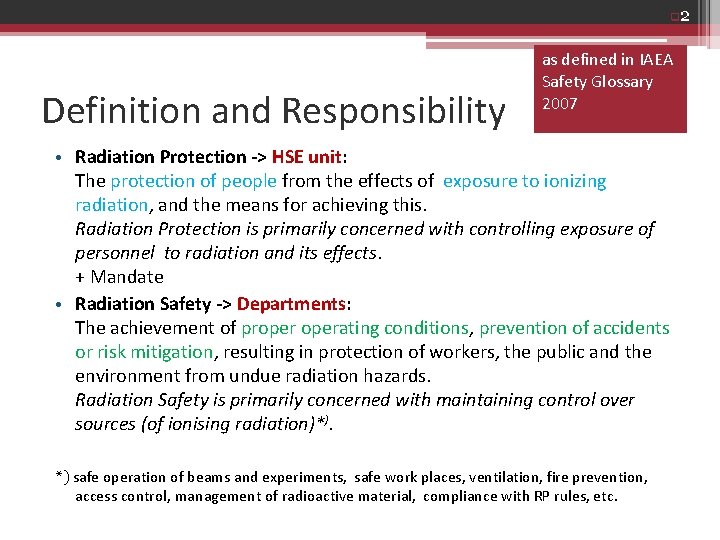
q 2 Definition and Responsibility as defined in IAEA Safety Glossary 2007 • Radiation Protection -> HSE unit: The protection of people from the effects of exposure to ionizing radiation, and the means for achieving this. Radiation Protection is primarily concerned with controlling exposure of personnel to radiation and its effects. + Mandate • Radiation Safety -> Departments: The achievement of properating conditions, prevention of accidents or risk mitigation, resulting in protection of workers, the public and the environment from undue radiation hazards. Radiation Safety is primarily concerned with maintaining control over sources (of ionising radiation)*). *) safe operation of beams and experiments, safe work places, ventilation, fire prevention, access control, management of radioactive material, compliance with RP rules, etc.
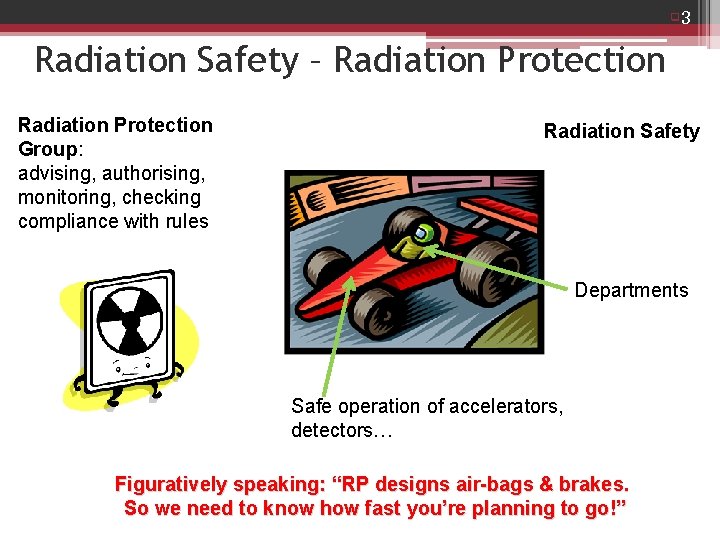
q 3 Radiation Safety – Radiation Protection Group: advising, authorising, monitoring, checking compliance with rules Radiation Safety Departments Safe operation of accelerators, detectors… Figuratively speaking: “RP designs air-bags & brakes. So we need to know how fast you’re planning to go!”
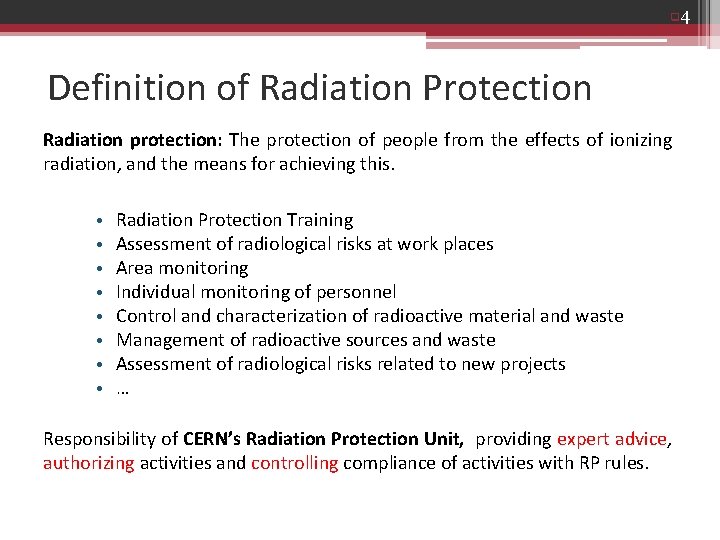
q 4 Definition of Radiation Protection Radiation protection: The protection of people from the effects of ionizing radiation, and the means for achieving this. • • Radiation Protection Training Assessment of radiological risks at work places Area monitoring Individual monitoring of personnel Control and characterization of radioactive material and waste Management of radioactive sources and waste Assessment of radiological risks related to new projects … Responsibility of CERN’s Radiation Protection Unit, providing expert advice, authorizing activities and controlling compliance of activities with RP rules.
q 5 CERN is large and dynamic • Research institute: ▫ research environment (“unstructured”) ▫ “living” facilities (continuous modifications and up-grades) ▫ “living” research (numerous experiments and test beams) • Hadron accelerator complex: ▫ unprecedented large amount of radiation areas LEP was a clean ▫ complex equipment machine ▫ important ambient dose equivalent rates ▫ unprecedented large amount of activated material (solids, liquids, gas, air) • Long History: ▫ Old facilities and therefore infrastructure not up to radiation safety and radiation protection standards
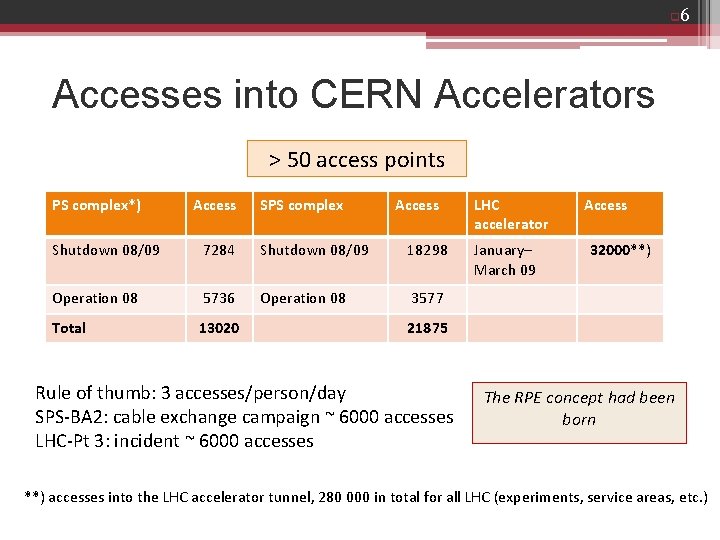
q 6 Accesses into CERN Accelerators > 50 access points PS complex*) Access SPS complex Access Shutdown 08/09 7284 Shutdown 08/09 18298 Operation 08 5736 Operation 08 3577 Total 13020 LHC accelerator January– March 09 Access 32000**) 21875 Rule of thumb: 3 accesses/person/day SPS-BA 2: cable exchange campaign ~ 6000 accesses LHC-Pt 3: incident ~ 6000 accesses The RPE concept had been born **) accesses into the LHC accelerator tunnel, 280 000 in total for all LHC (experiments, service areas, etc. )
q 7 Motivation for RPE scheme Overall tendency: Increased beam intensities & increased energies -> increased radiation levels and radiation hazards AND what is “new” about LHC era: • For the first time since long physicists of experimental collaborations will be exposed to pronounced radiation risks and will receive non-negligible individual doses (up to few m. Sv/year) during maintenance of their detectors (ATLAS, CMS). • Equipment groups who never worked before in radiation areas and with radioactive material will become radiation workers (power supply group, cryogenics group, superconducting magnets team, etc. )
q 8 Motivation for RPE scheme But • All experiments need more RP availability (valid since decades for ISOLDE, exp. Halls) • LHC experiments require RP availability 24 h/24 h, 7 d/7 d during all the year • Workshops and other “auxiliary” activities need more RP availability • RP requires link persons in experiments and equipment groups with deeper understanding of RP rules and practices and who might support in RP in its tasks (responsibility stays with RP) • . . and last not least: improve RP at CERN by increasing awareness and competences -> Idea of RPE (Radiation Protection Experts) for LHC experiments had been born in 2006 (similar scheme exists at DESY and PSI)
Radiation Protection Expert (RPE) CERN Requirements: ▫ University degree or technical training ▫ Good knowledge in working with ionizing radiation or in radiation areas ▫ A certificate received after a successful participation in a radiation protection course for Radiation Protection Experts given by a body certified by a national authority. The course includes information on CERN specific radiation protection aspects (CERN specific risks, CERN’s rules and regulations in radiation protection) ▫ In addition: “in field” training - accompanied by RP ▫ Joint nomination by the Technical Coordinator and DGS-RP – based on successful participation in the course and appropriate “in field” conduct.
q 10 RPEs of LHC experiments today RP activity is limited to Supervised Areas: • • Monitoring radiation levels RP veto Radiation surveys of experimental area Controlling material from areas outside “Zone Operationelle” Documentation Shut-down planning ALARA RPEs for LHC experiments has proven to be a successful scheme
Overall Responsibility The overall responsibility in matters of radiation protection at CERN lies with the DGS-RP group leader.
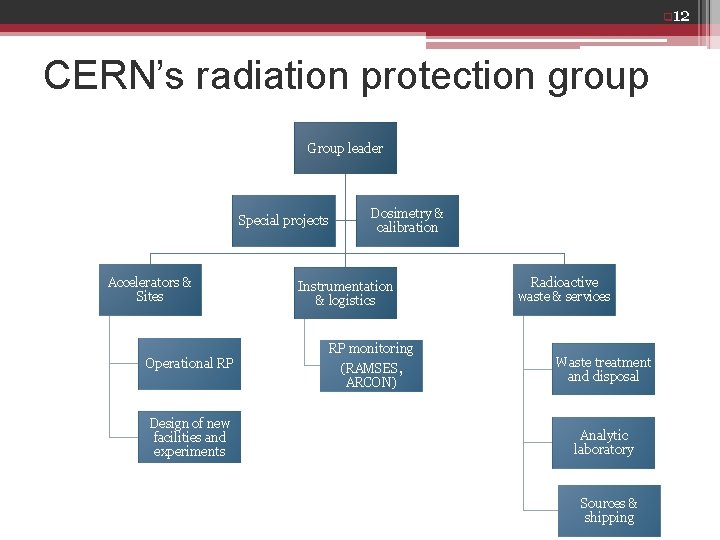
q 12 CERN’s radiation protection group Group leader Special projects Accelerators & Sites Operational RP Design of new facilities and experiments Dosimetry & calibration Instrumentation & logistics RP monitoring (RAMSES, ARCON) Radioactive waste & services Waste treatment and disposal Analytic laboratory Sources & shipping
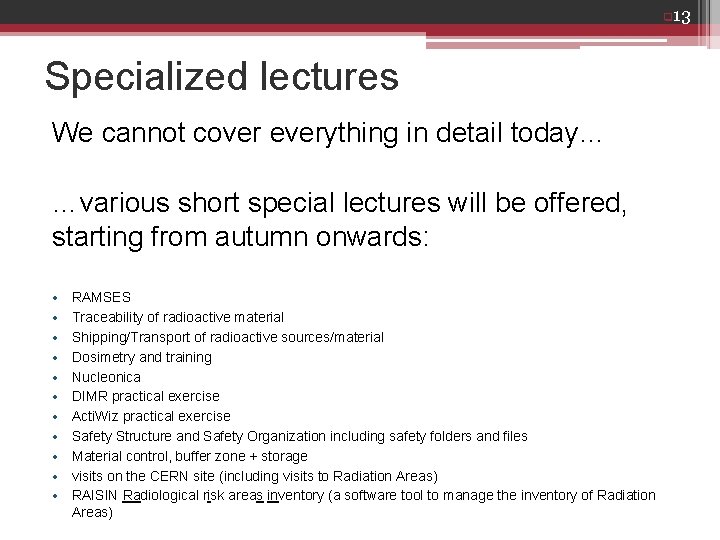
q 13 Specialized lectures We cannot cover everything in detail today… …various short special lectures will be offered, starting from autumn onwards: • • • RAMSES Traceability of radioactive material Shipping/Transport of radioactive sources/material Dosimetry and training Nucleonica DIMR practical exercise Acti. Wiz practical exercise Safety Structure and Safety Organization including safety folders and files Material control, buffer zone + storage visits on the CERN site (including visits to Radiation Areas) RAISIN Radiological risk areas inventory (a software tool to manage the inventory of Radiation Areas)
q 14