The Right to a Fair Trial Throughout History

- Slides: 24
The Right to a Fair Trial Throughout History By Kip Clungeon and Max Milton 1 st Period
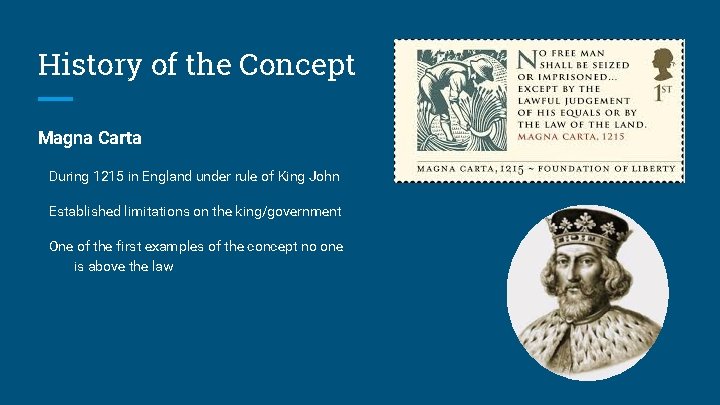
History of the Concept Magna Carta During 1215 in England under rule of King John Established limitations on the king/government One of the first examples of the concept no one is above the law
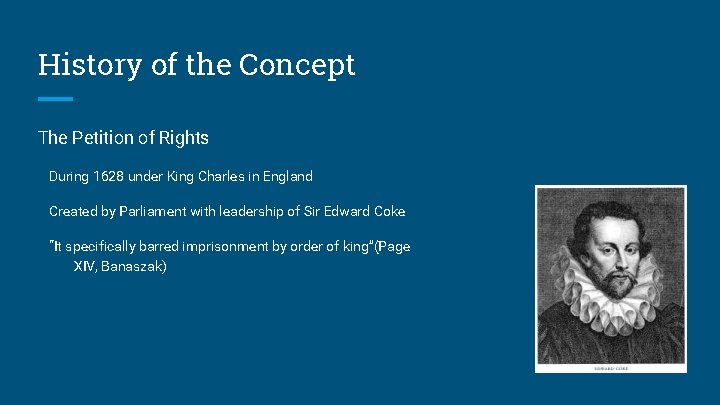
History of the Concept The Petition of Rights During 1628 under King Charles in England Created by Parliament with leadership of Sir Edward Coke “It specifically barred imprisonment by order of king”(Page XIV, Banaszak)
History of the Concept Massachusetts Body of Liberties & Concessions and Agreements of West New Jersey During 1641 in the Colonies Established the rights of a due process of law, trial by jury, and right to challenge and dismiss potential jurors
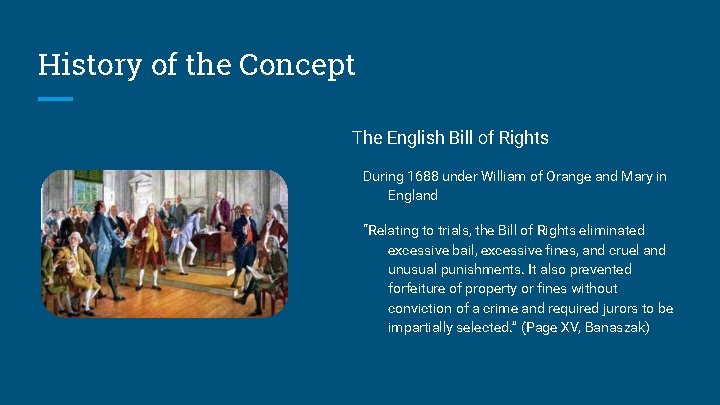
History of the Concept The English Bill of Rights During 1688 under William of Orange and Mary in England “Relating to trials, the Bill of Rights eliminated excessive bail, excessive fines, and cruel and unusual punishments. It also prevented forfeiture of property or fines without conviction of a crime and required jurors to be impartially selected. ” (Page XV, Banaszak)
How it is Implemented In Our Constitution 5 th Amendment No one can be deprived of life, liberty, or property without due process of law 6 th Amendment ● Right to speedy trial ● Right to public trial ● Right to impartial jury No private property can be taken for public use without just compensation ● Right to assistance of counsel for his defense
Powell Vs Alabama Brief Background: African-Americans accused of rape were not given a fair counsel. Decision: 7 -2 in favor of Powell. Significance: The counsel is a significant part of the due process of law that needs to be upheld.
Betts Vs Brady Brief Background: Betts (accused of robbery) was not given an attorney when he requested one. Decision: 6 -3 in favor of Brady. Significance: The Supreme Court found that the issue to right to an attorney varies and should be left to each individual state.
Mayberry Vs Pennsylvania Brief Background: A defendant in a state criminal contempt proceeding who insulted the judge during the course of the defendant's trial in the state court and was sentenced by that judge, argued for entitlement under the Due Process Clause of the Fourteenth Amendment to a public trial before another judge. Decision: Unanimous decision for Mayberry. Significance: Displays how a person can argue an unfair trial and request a new one.
Mapp Vs Ohio Brief Background: Mapp was arrested and sentenced to jail using evidence obtained without a proper warrant while searching for a bomber. Decision: 5 -3 in favor of Mapp. Significance: The Court determined that evidence obtained through a search that violates the Fourth Amendment is inadmissible in state courts.
Carey Vs Musladin Brief Background: While being trialed for murder, the jury wore buttons with the victim's face on it. This caused issue on whether this violated his right to an impartial jury. Decision: 9 -0 in favor of Musladin. Significance: It showed that wearing buttons with the victim's face ion it was an individual decision made by each member of the jury and therefore did not violate the defendant's right to an impartial jury.
Sheppard Vs Maxwell How did the case reach Supreme Court? Through The United States court of Appeals for the Sixth Circuit Law Reviewed: “What threshold must be crossed before a trial is said to be so prejudicial, due to context and publicity, as to interfere with a defendant's Fifth Amendment due process right to a fair trial? : Upheld Or Overturned: 8 -1 in favor of the conclusion that Sheppard was not given a fair trial. The law was Upheld.
Sheppard Vs Maxwell Supreme Court Opinion Summary Majority Opinion: Mr. Justice Clark delivered the majority opinion. In the opinion it is stated that, “ Since the state trial judge did not fulfill his duty to protect Sheppard from the inherently prejudicial publicity… We must reverse the denial of the habeas petition” This quote shows the straightforwardness of the Justices in this case. They were able to conclude that it was obvious that the prejudice that spread throughout the community negatively affected the trial and ultimately nullified it. Dissenting Opinion: Mr. Justice Black was the only member to not vote in favor of Sheppard and he decided to deliver his dissenting opinion. In this Black argues that since the judge failed to protect the jury from prejudice which would lead to Sheppard not having a fair trial instead of him being released on the grounds of jury bias.
Gideon Vs Wainwright How did the case reach Supreme Court: Bay County Circuit Court Law Reviewed: “Does the Sixth Amendment's right to counsel in criminal cases extend to felony defendants in state courts? ” Upheld or Overturned: In a 9 -0 Unanimous Decision it was decided that the Sixth Amendment's right to counsel does apply to felony cases in state courts.
Gideon Vs Wainwright Supreme Court Opinions: Majority Opinion: Mr. Justice Black delivered the majority opinion. In this majority opinion Black states, “ A defendant's need for a lawyer is nowhere better stated than in the moving words of Mr. Justice Sutherland in Powell v. Alabama: ‘the right to be heard would be, in many cases, of little avail if it did not comprehend the right to be heard by counsel. Even the intelligent and educated layman has small and sometimes no skill in the science of law. ’” This quote show the majority’s opinion by the fact that believe that the right to an attorney extends beyond that of capital crimes. In how the common man is not suited to defend himself in court regardless of their skill or profession. Therefore to protect innocence the right to an attorney is given. Concurring Opinions: Mr. Justice Clark agrees with the majority but decides to write his concurring opinion. In this Opinion Clark argues that “The constitution makes no distinction between capital and noncapital cases” and to have varying rules depending on the sanctions involved would violate the Fourteenth Amendment. The second concurring opinion was written by Mr. Justice Harlan believes that certain cases used as precedence should be reviewed and overturned smoother, and wishes to state that just because the Supreme Court uses precedences does not mean that all cases will go down as law. Because any form of this would completely disregard the actual purpose of the American Legal System.
Gentile Vs State Bar of Nevada How did the case reach Supreme Court: Supreme Court of Nevada Law Reviewed: May the speech of attorneys involved in a criminal case be more limited than that of the press at large, if such limitation clearly gives notice to the ones it is intended to affect? Upheld or Overturned: 5 -4 in favor of Gentile
Gentile Vs State Bar of Nevada Supreme Court Opinions: Majority Opinion: Mr. Justice Kennedy delivered the majority opinion. In this opinion the following quote lies, “ To the extent the press and public rely upon attorneys for the information because attorneys are well informed, this may prove the value to the public of speech by members of the bar. … The First Amendment does not permit suppression of speech because of its power to command assent. ” This quote states that the public tend to rely on attorneys and other high officials in the American Law System for credible information, but the The First Amendment does not offer an argument for the concealing of these higher official's speech just because they might have “power to command assent”. This is the reasoning behind reversing the judgement in favor of Gentile. Dissenting Opinion: Mr. Chief Justice Rehnquist delivered a dissenting opinion with Justice White, Justice Souter and Justice Scalia. In this opinion Rehnquist argues that The First Amendment needs to become stricter if it is held before an attorney. He also believed that the statements made by Gentile had to of given the Petitioner “‘a substantial likelihood of materially prejudice the adjudication of his client’s case. ’” Pushing their opinion that the lower courts obtained the correct verdict and were against the reversal.
Nebraska Press Association Vs Stuart How did the case reach Supreme Court: Nebraska Supreme Court Law Reviewed: Is the judge’s order to (First, Fourteenth, and Sixth Amendment conflicting) Upheld or Overturned: In a 9 -1 unanimous decision it was decided that the judge’s order to restrain the case from the public was for a fair trial.
Nebraska Press Association Vs Stuart Supreme Court Opinions Mr. Chief Justice Burger delivered the opinion. “ They did not address themselves directly to the situation presented by this case; their chief concern was the need for freedom of expression in the political arena and in the dialogue in ideas. But they recognized that there were risks to private rights from an unfettered press. Jefferson for example” This statement shows us that the majority justices saw the removal of the information into the media as a violation of the freedom of the press, but how that must be done to protect the trial from being ruined with prejudice from the public. Concurring Opinions: The first concurring opinion was given by Mr. Justice White. In his opinion White states that there is no justifiable reason for the press to have orders stated in this case with respect. The second and final concurring opinion was delivered by Mr. Justice Brennan and collaborated with Mr. Justice Stewart and Mr. Justice Marshall. In this opinion they believe that “Judges have at their disposal a broad spectrum of devices for ensuring that fundamental fairness is accorded the accused” and “ Public Affairs in a free society cannot depend on the preliminary grace of judicial Censors. ”
Smith Vs Illinois How did the case reach Supreme Court: State Appellate Court Law Reviewed: Confrontation (right to confront accuser, call and cross-examine witnesses) Upheld or Overturned: 8 -1 in favor of Smith
Smith Vs Illinois Supreme Court Opinion Summary Majority: Mr. Justice Stewart delivered the opinion. “‘The question ‘Where do you live? ’ was not only an appropriate preliminary to the cross-examination of the witness, but, on its face, without any such declaration of purpose as was made by counsel here, was an essential step in identifying the witness. . . ; ’” This is the position of the majority Justices when they decided 8 -1 in favor of the fact that Smith was denied his rights to a fair trial. They felt that the questions asked were a proper part of the cross examination not questions used to humiliate the witness. Concurring: Mr. Justice White concurred. White justified this by his argument that the questions did not break any bounds of the cross examination process and how the reason for objecting the questions were not given. Dissenting: Mr. Justice Harlan dissented. Harlan believed that the Judge’s objected to these questions because the cross examiner already held the information he wanted. It did not violate the Sixth Amendment’s Incorporation Grounds.
Bibliography Banaszak, Ronald A. Fair Trial Rights of the Accused: A Documentary History. Westport, CT: Greenwood, 2002. Print. "Sheppard v. Maxwell. " Oyez. Chicago-Kent College of Law at Illinois Tech, n. d. Sep 27, 2016. <https: //www. oyez. org/cases/1965/490> Houk. "Sheppard v Maxwell. " Sheppard v Maxwell. N. p. , n. d. Web. 27 Sept. 2016. <http: //law 2. umkc. edu/faculty/projects/ftrials/conlaw/sheppard. html>. Houk. "Sheppard v. Maxwell 384 U. S. 333 (1966). " Justia Law. N. p. , n. d. Web. 27 Sept. 2016. <https: //supreme. justia. com/cases/federal/us/384/333/case. html>. "Nebraska Press Association v. Stuart. " Oyez. Chicago-Kent College of Law at Illinois Tech, n. d. Sep 27, 2016. <https: //www. oyez. org/cases/1975/75 -817> "Nebraska Press Association v Stuart. " Nebraska Press Association v Stuart. N. p. , n. d. Web. 27 Sept. 2016. <http: //law 2. umkc. edu/faculty/projects/ftrials/conlaw/nebpress. html>. "Nebraska Press Assn. v. Stuart 427 U. S. 539 (1976). " Justia Law. N. p. , n. d. Web. 27 Sept. 2016. <https: //supreme. justia. com/cases/federal/us/427/539/case. html>.
Bibliography "Gideon v. Wainwright. " LII / Legal Information Institute. N. p. , n. d. Web. 27 Sept. 2016. <https: //www. law. cornell. edu/supremecourt/text/372/335>. "Facts and Case Summary - Carey v. Musladin. " United States Courts. N. p. , n. d. Web. 27 Sept. 2016. <http: //www. uscourts. gov/educationalresources/educational-activities/facts-and-case-summary-carey-v-musladin>. "Landmark Cases of the U. S. Supreme Court. " Mapp v. Ohio. N. p. , n. d. Web. 27 Sept. 2016. <http: //landmarkcases. org/en/landmark/cases/mapp_v_ohio#Tab=Background>. "Find. Law's United States Supreme Court Case and Opinions. " Findlaw. N. p. , n. d. Web. 27 Sept. 2016. <http: //caselaw. findlaw. com/us-supreme -court/400/455. html>. "Smith v. Illinois. " Oyez. Chicago-Kent College of Law at Illinois Tech, n. d. Sep 27, 2016. <https: //www. oyez. org/cases/1967/158> "Find. Law's United States Supreme Court Case and Opinions. " Findlaw. N. p. , n. d. Web. 27 Sept. 2016. <http: //caselaw. findlaw. com/us-supreme -court/390/129. html>. "Smith v. Illinois 390 U. S. 129 (1968). " Justia Law. N. p. , n. d. Web. 27 Sept. 2016. <https: //supreme. justia. com/cases/federal/us/390/129/case. html>.
Bibliography "Betts v. Brady. " Casebriefs Betts v Brady Comments. N. p. , n. d. Web. 27 Sept. 2016. <http: //www. casebriefs. com/blog/law/criminalprocedure/criminal-procedure-keyed-to-israel/the-right-to-counsel-transcripts-and-other-aids-poverty-equality-and-the-adversarysystem/betts-v-brady/>. "Powell v. Alabama. " Casebriefs Powell v Alabama Comments. N. p. , n. d. Web. 27 Sept. 2016. <http: //www. casebriefs. com/blog/law/criminalprocedure/criminal-procedure-keyed-to-saltzburg/the-right-to-counsel/powell-v-alabama-2/>.