The Importance of Intellectual Property Salome Mc Veigh


- Slides: 36
The Importance of Intellectual Property Salome Mc. Veigh & Claire Adamson Business Start-up Team Careers Service www. careers. ncl. ac. uk
Session Outline § § Survey of your current understanding What is intellectual property and why is it important? How do you protect Intellectual property? Team Exercise to identify types of IP within everyday objects § Guest Speaker (Max Robinson). § Timing § Introduction to IP (1 hour) § Max Robinson Entrepreneur In Residence (30 mins) § Phil Harley Business Development (15 mins) § Questions (15 mins) © www. careers. ncl. ac. uk
Objectives § By the end of the session you will have been: § Introduced to the concept of IP and its importance in business § Made aware of all 5 forms of IP § Have developed the skills necessary to recognise forms of IP in any product/ service. © www. careers. ncl. ac. uk
Exercise 1 § What do you understand by Intellectual Property (IP) © www. careers. ncl. ac. uk
Types of IP § Patents § Copyright § Trade Marks § Design § Confidential information/ know-how. © www. careers. ncl. ac. uk
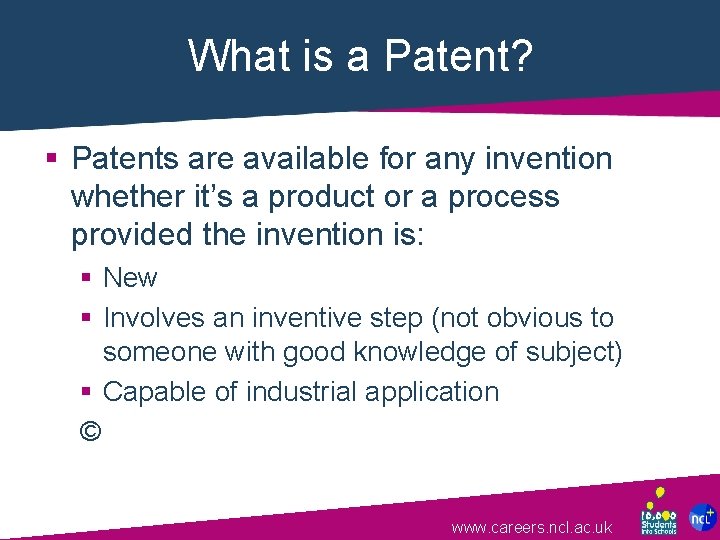
What is a Patent? § Patents are available for any invention whether it’s a product or a process provided the invention is: § New § Involves an inventive step (not obvious to someone with good knowledge of subject) § Capable of industrial application © www. careers. ncl. ac. uk
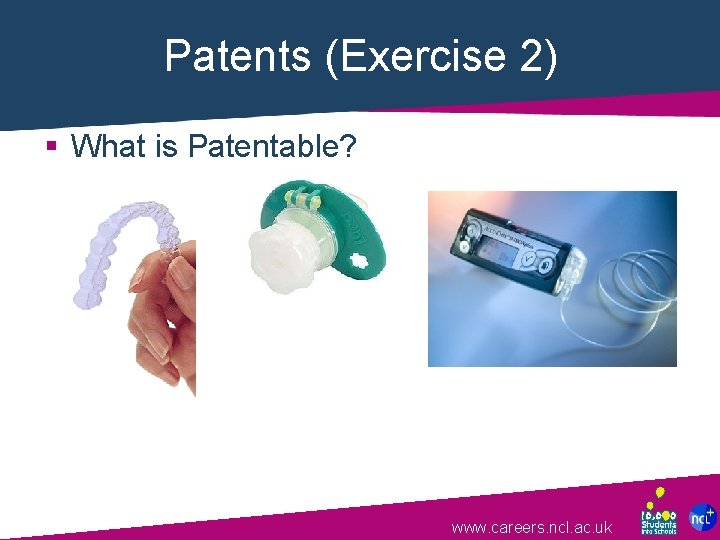
Patents (Exercise 2) § What is Patentable? www. careers. ncl. ac. uk
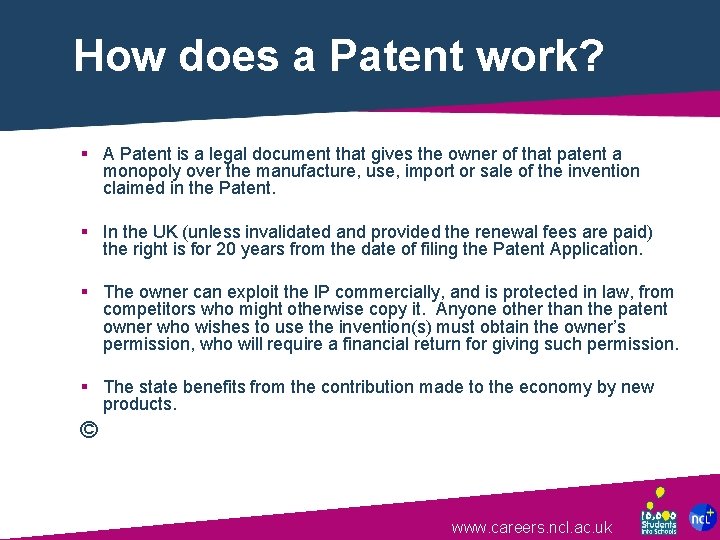
How does a Patent work? § A Patent is a legal document that gives the owner of that patent a monopoly over the manufacture, use, import or sale of the invention claimed in the Patent. § In the UK (unless invalidated and provided the renewal fees are paid) the right is for 20 years from the date of filing the Patent Application. § The owner can exploit the IP commercially, and is protected in law, from competitors who might otherwise copy it. Anyone other than the patent owner who wishes to use the invention(s) must obtain the owner’s permission, who will require a financial return for giving such permission. § The state benefits from the contribution made to the economy by new products. © www. careers. ncl. ac. uk
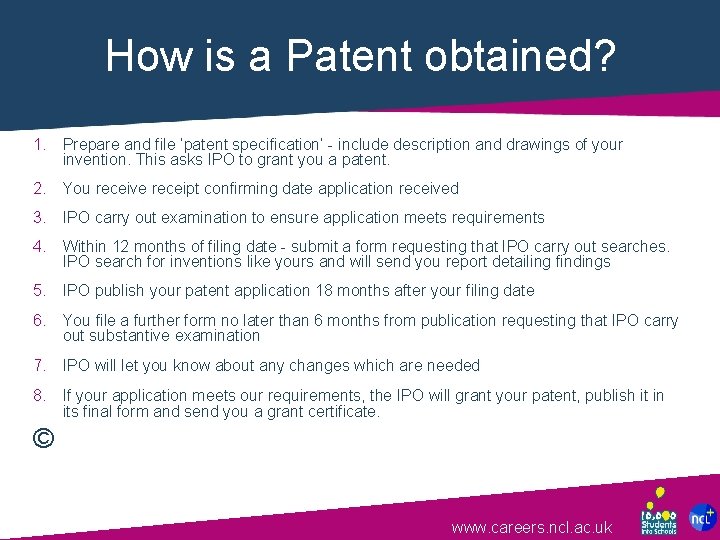
How is a Patent obtained? 1. Prepare and file ‘patent specification’ - include description and drawings of your invention. This asks IPO to grant you a patent. 2. You receive receipt confirming date application received 3. IPO carry out examination to ensure application meets requirements 4. Within 12 months of filing date - submit a form requesting that IPO carry out searches. IPO search for inventions like yours and will send you report detailing findings 5. IPO publish your patent application 18 months after your filing date 6. You file a further form no later than 6 months from publication requesting that IPO carry out substantive examination 7. IPO will let you know about any changes which are needed 8. If your application meets our requirements, the IPO will grant your patent, publish it in its final form and send you a grant certificate. © www. careers. ncl. ac. uk
§ The grant is territory restricted. That is a patent granted in the UK IPO is effective only in the UK. § To protect a Patent outside of the UK you would need to apply for e. g. a European or International Patent. © www. careers. ncl. ac. uk
Timeline & Costs Timeline: § It can take 3 -4 years from filing to grant § Any granted patents not exploited within 5 years may be revoked Costs: § The normal amount the UK IPO charge to process a UK patent application is £ 200. § It is free to apply for grant of a patent § £ 30 (application fee) for a preliminary examination § £ 100 for a search § £ 70 for a substantive examination © www. careers. ncl. ac. uk
Patent Hints § Do not make details of your invention known before filing § If you want to work with others e. g. potential investors use Non Disclosure or Confidentiality Agreement § Do research yourself: § ww. ipo. gov. uk § www. Esp@cenet. com § www. ideas 21. co. uk § Free advice is available from the UK IPO or your local Patent Advice Centre (Northumbria University) © www. careers. ncl. ac. uk
What is Copyright § A right to prevent unauthorised reproduction of your original works and to recover damages for infringement § Un-registerable right in most of the world § Registerable in the USA © www. careers. ncl. ac. uk
What is copyright? § Copyright is the automatic right – no forms to fill in as it is automatic – provides people who produce creative work to take ownership over what they have created § The C in a circle is internationally recognised § Copyright is used by a wide range of people – authors, artists, musicians – lasts for 70 years after authors death § As a property rights to works can be passed on as part of an estate sold licensed or given away § Copyright material can earn revenue long after the original author has passed away © www. careers. ncl. ac. uk
Who uses Copyright? § Authors, Artists, Photographers Musicians § We all use copyright § As an automatic right it is up to the rights owner to prove he/she has been copied § Rightful owner can stop others from using but you have to prove ownership – retain original! § Musicians rely upon rights as a means of earning royalties from their creations § Copyright also protects the moral rights of the owner – to be identified and have some say in how their work is used § You can protect your work with a few simple steps © www. careers. ncl. ac. uk
Copyright-restricted acts § § § Copying the work Issuing copies of the work to the public Rent or lend copies of the work Perform, show or play the work in public Broadcast or include the work in a cable programme § Make an adoptation of the work © www. careers. ncl. ac. uk
Copyright-restricted acts § § § Copying the work Issuing copies of the work to the public Rent or lend copies of the work Perform, show or play the work in public Broadcast or include the work in a cable programme § Make an adoptation of the work © www. careers. ncl. ac. uk
Copyright-Software specific permitted acts § Making of back-up copies § De-compilation to obtain otherwise unavailable interoperability information § Necessary copying or adaptation by lawful user (e. g. to correct errors) © www. careers. ncl. ac. uk
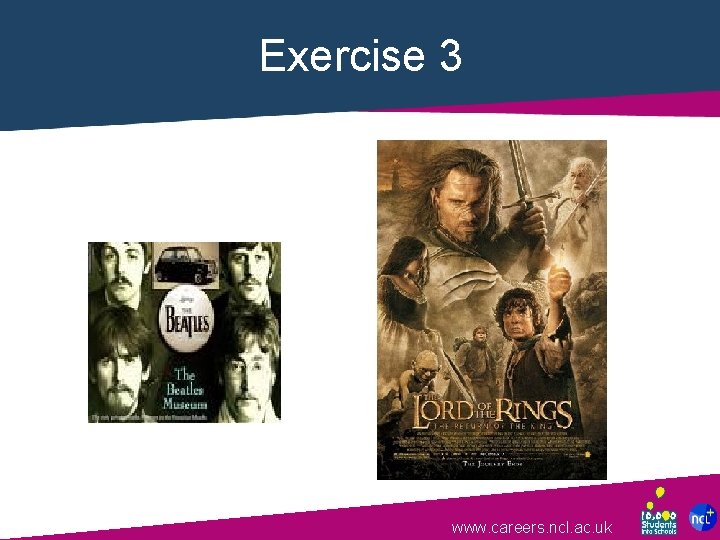
Exercise 3 www. careers. ncl. ac. uk
Trade Marks § A badge of origin, a sign which is capable of distinguishing goods or services of one company from those of another § Distinguished by an R in a circle. Trade marks are the only form of intellectual Property which can last forever provided they are kept in force § As a society we are brand aware and TMs provide the opportunity for us all to effectively brand ourselves and to protect our brands. § Related classes through registration§ Lotus Car example © www. careers. ncl. ac. uk
What can be registered § Name Shape § Domain Name Slogan § Colour Logo § Music © www. careers. ncl. ac. uk
Slogans as registered Trade Marks Just Do It I’m Lovin it Don’t leave home without it Always cutting prices Work, Rest & Play Once you pop, you can’t stop © www. careers. ncl. ac. uk
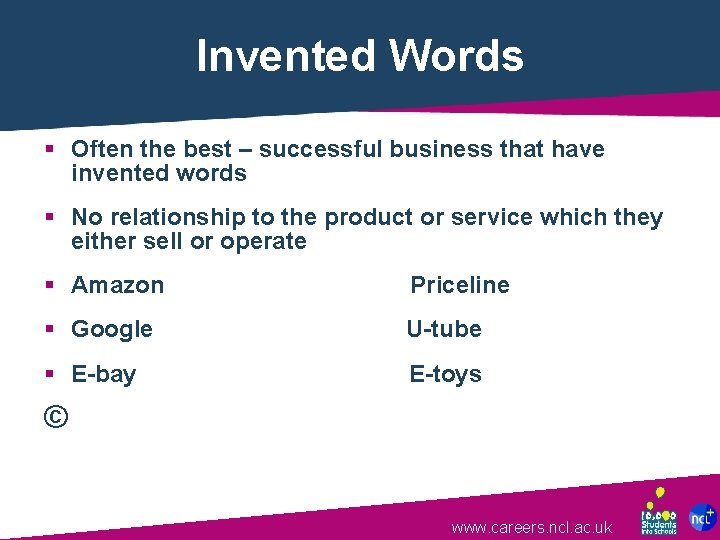
Invented Words § Often the best – successful business that have invented words § No relationship to the product or service which they either sell or operate § Amazon Priceline § Google U-tube § E-bay E-toys © www. careers. ncl. ac. uk
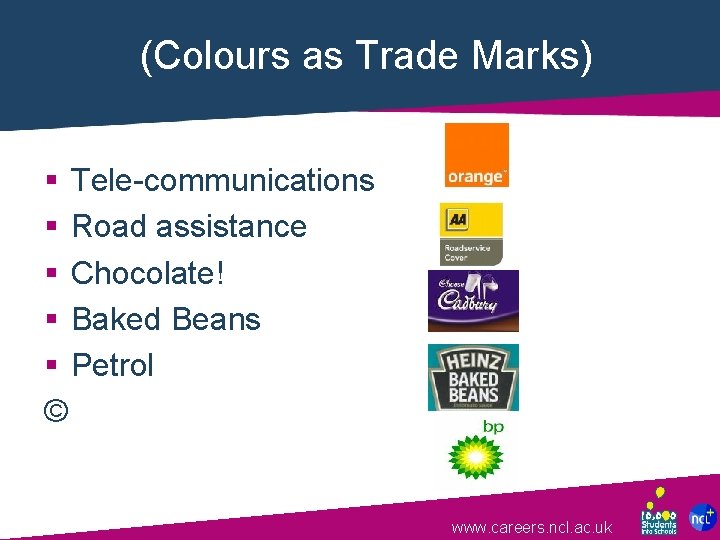
(Colours as Trade Marks) § Tele-communications § Road assistance § Chocolate! § Baked Beans § Petrol © www. careers. ncl. ac. uk
Trade mark Hints § Create distinctive brand – this is your opportunity to create a brand identity. § Check up on the Patent Office database to establish if others have adopted this brand or something similar § Your brand will exist in a class which is the most appropriate for your field of business § Do your ground work before you set up a business mistakes are expensive to rectify and can destroy consumer confidence § DIY but you may need to use the services of a Trade mark agent who can add value to your application © www. careers. ncl. ac. uk
Trade Mark Quiz § Exercise 4 www. careers. ncl. ac. uk
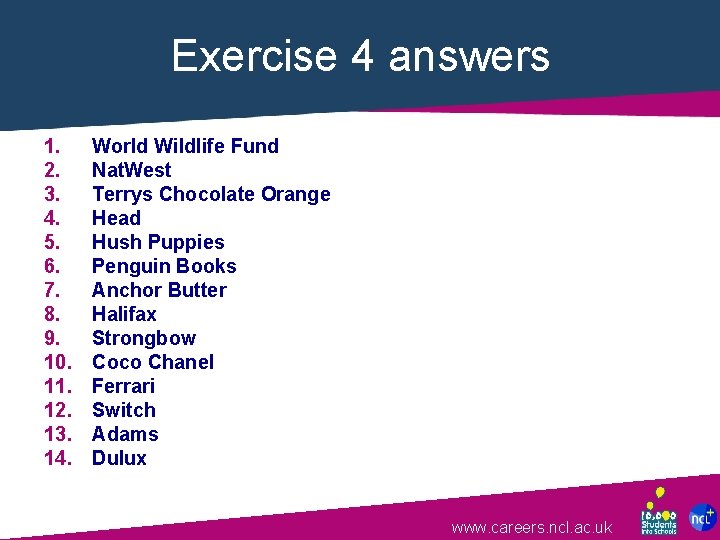
Exercise 4 answers 1. 2. 3. 4. 5. 6. 7. 8. 9. 10. 11. 12. 13. 14. World Wildlife Fund Nat. West Terrys Chocolate Orange Head Hush Puppies Penguin Books Anchor Butter Halifax Strongbow Coco Chanel Ferrari Switch Adams Dulux www. careers. ncl. ac. uk
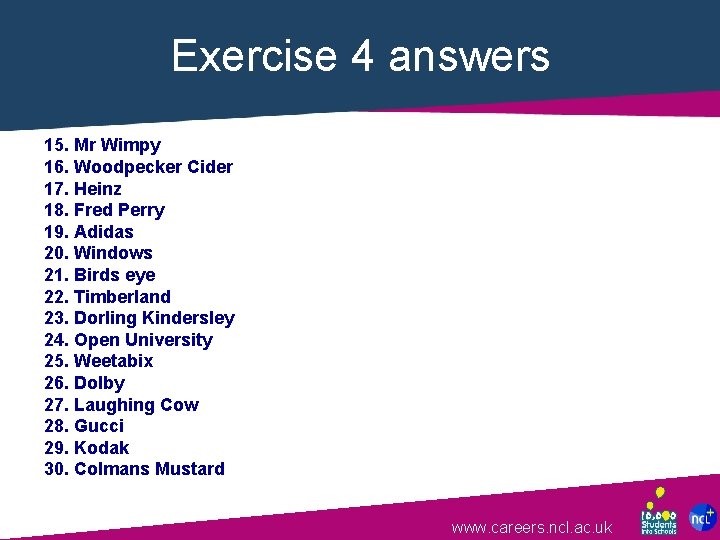
Exercise 4 answers 15. Mr Wimpy 16. Woodpecker Cider 17. Heinz 18. Fred Perry 19. Adidas 20. Windows 21. Birds eye 22. Timberland 23. Dorling Kindersley 24. Open University 25. Weetabix 26. Dolby 27. Laughing Cow 28. Gucci 29. Kodak 30. Colmans Mustard www. careers. ncl. ac. uk
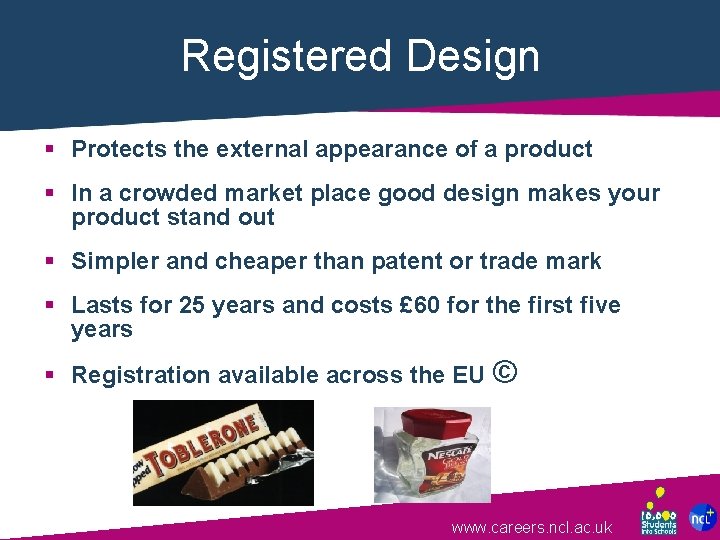
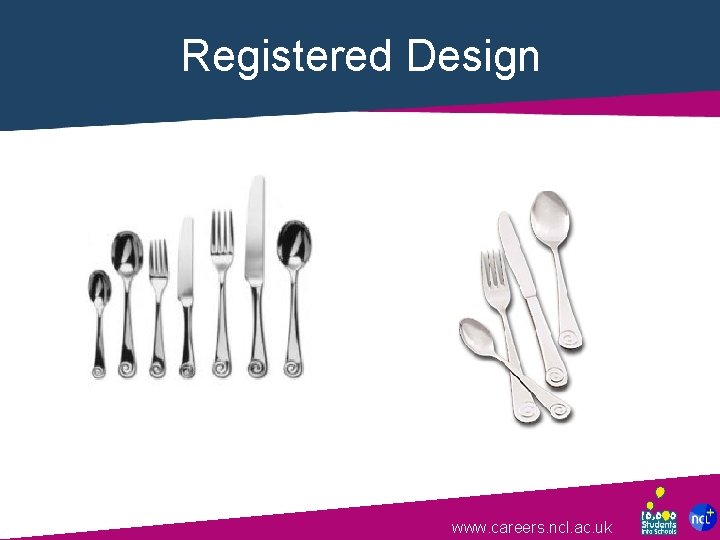
Registered Design § Protects the external appearance of a product § In a crowded market place good design makes your product stand out § Simpler and cheaper than patent or trade mark § Lasts for 25 years and costs £ 60 for the first five years § Registration available across the EU © www. careers. ncl. ac. uk
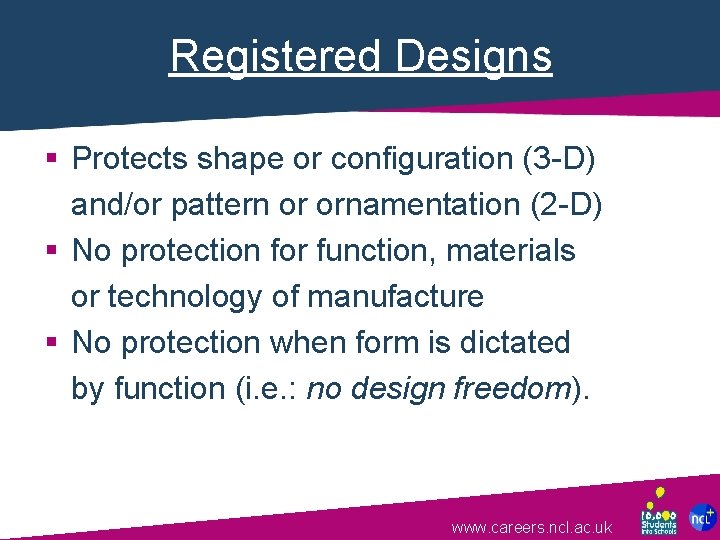
Registered Designs § Protects shape or configuration (3 -D) and/or pattern or ornamentation (2 -D) § No protection for function, materials or technology of manufacture § No protection when form is dictated by function (i. e. : no design freedom). www. careers. ncl. ac. uk
Registered Design www. careers. ncl. ac. uk
Registered Designs § Royalties for past sales of £ 103, 302. 81 § £ 46, 750 towards costs § A licensing deal has now been agreed § Alice Welch MD said in January 2006 “having built our brand on a strong design history, it is critical to us that our customers do not mistake an inferior product/copy to be our design. Therefore we at Robert Welch take IP very seriously and will pursue anybody who copy/pass off our designs” § Useful link www. acid. co. uk www. careers. ncl. ac. uk
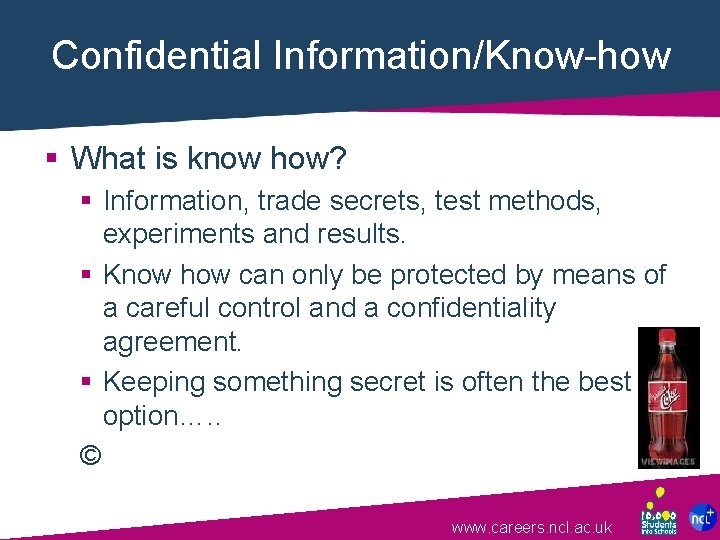
Confidential Information/Know-how § What is know how? § Information, trade secrets, test methods, experiments and results. § Know how can only be protected by means of a careful control and a confidentiality agreement. § Keeping something secret is often the best option…. . © www. careers. ncl. ac. uk
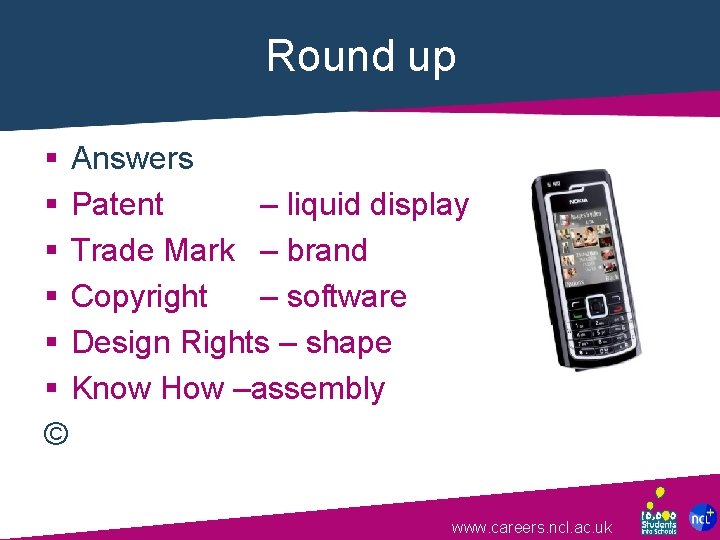
Round up Nokia N-series www. careers. ncl. ac. uk
Round up § Answers § Patent – liquid display § Trade Mark – brand § Copyright – software § Design Rights – shape § Know How –assembly © www. careers. ncl. ac. uk
Round up Exercise § Watch … how many types of IP apply… www. careers. ncl. ac. uk