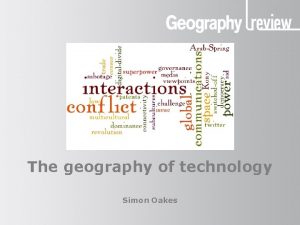
The geography of technology Simon Oakes The geography
- Slides: 16
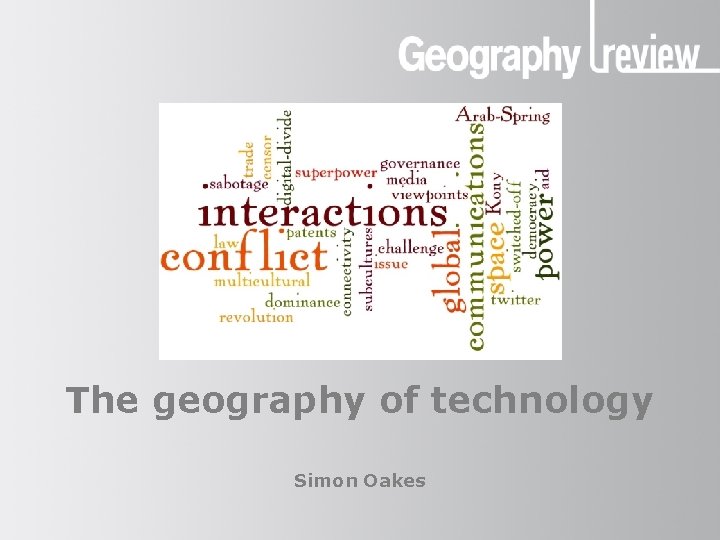
The geography of technology Simon Oakes
The geography of technology Presentation title What this presentation covers 1. Key terms and concepts. 2. How access to information and communications technology (ICT) is increasing globally. 3. ICT and development studies. 4. ICT and conflict studies.
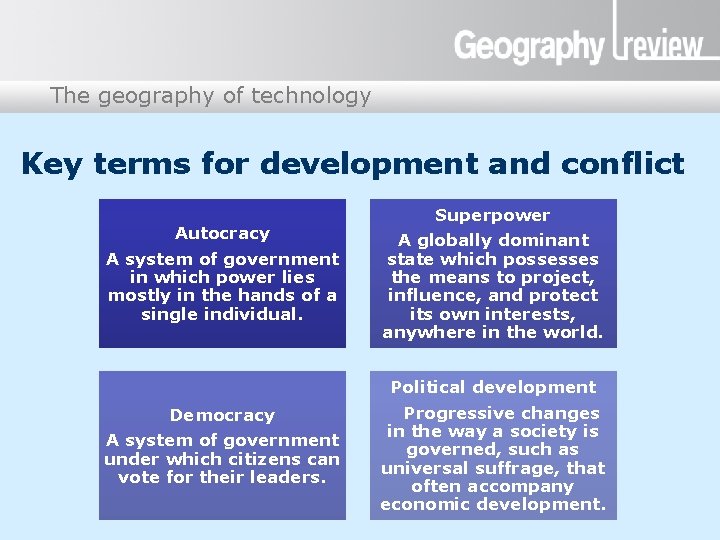
The geography of technology Presentation title Key terms for development and conflict Autocracy A system of government in which power lies mostly in the hands of a single individual. Superpower A globally dominant state which possesses the means to project, influence, and protect its own interests, anywhere in the world. Democracy A system of government under which citizens can vote for their leaders. Political development Progressive changes in the way a society is governed, such as universal suffrage, that often accompany economic development.
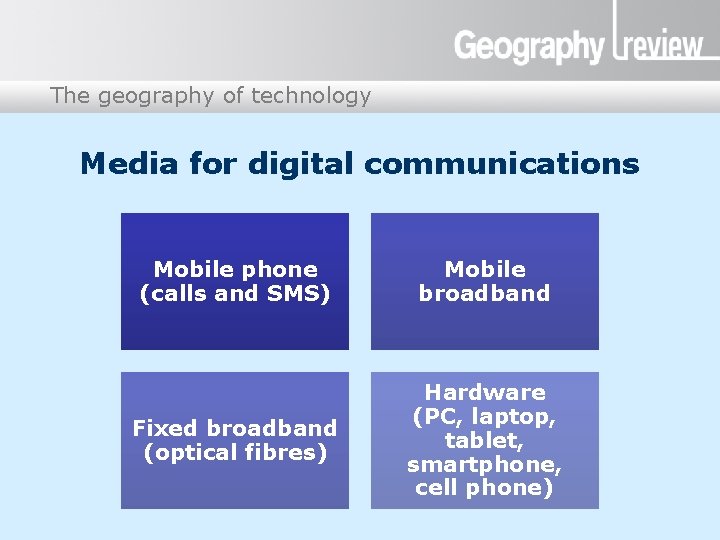
The geography of technology Presentation title Media for digital communications Mobile phone (calls and SMS) Mobile broadband Fixed broadband (optical fibres) Hardware (PC, laptop, tablet, smartphone, cell phone)
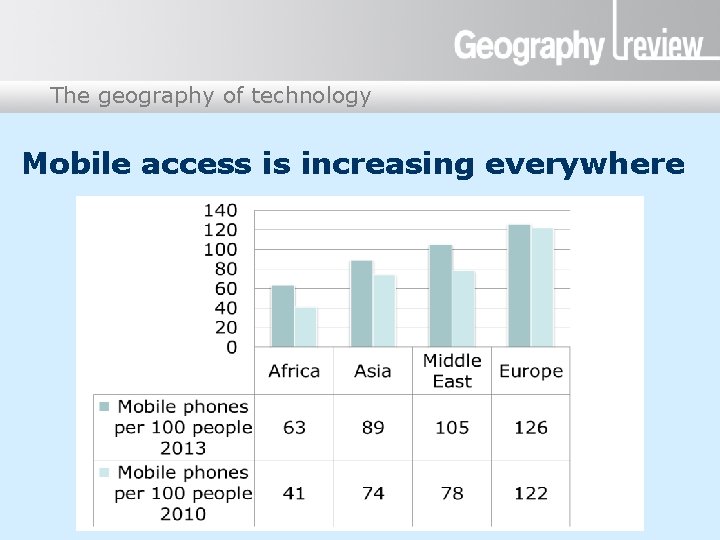
The geography of technology Presentation title Mobile access is increasing everywhere
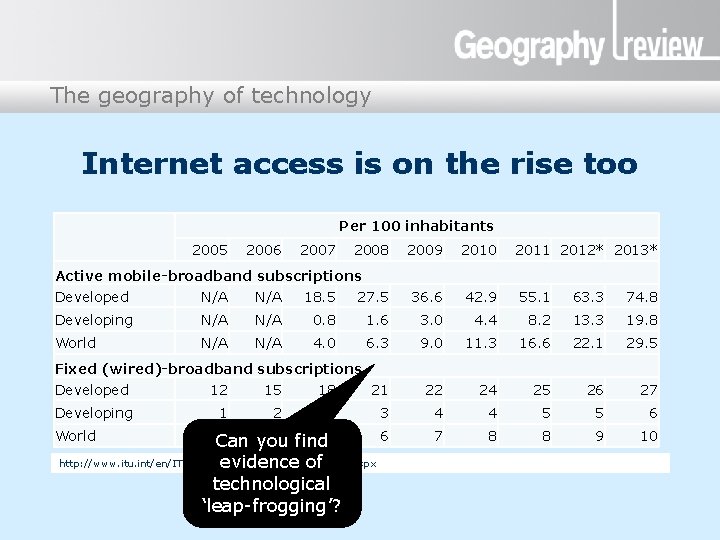
The geography of technology Presentation title Internet access is on the rise too Per 100 inhabitants 2005 2006 2007 2008 2009 2010 2011 2012* 2013* Active mobile-broadband subscriptions Developed N/A 18. 5 27. 5 36. 6 42. 9 55. 1 63. 3 74. 8 Developing N/A 0. 8 1. 6 3. 0 4. 4 8. 2 13. 3 19. 8 World N/A 4. 0 6. 3 9. 0 11. 3 16. 6 22. 1 29. 5 Fixed (wired)-broadband subscriptions Developed 12 15 18 21 22 24 25 26 27 3 4 4 5 5 6 3 4 5 6 Can you find http: //www. itu. int/en/ITU-D/Statistics/Pages/stat/default. aspx evidence of technological ‘leap-frogging’? 7 8 8 9 10 Developing World 1 2 2
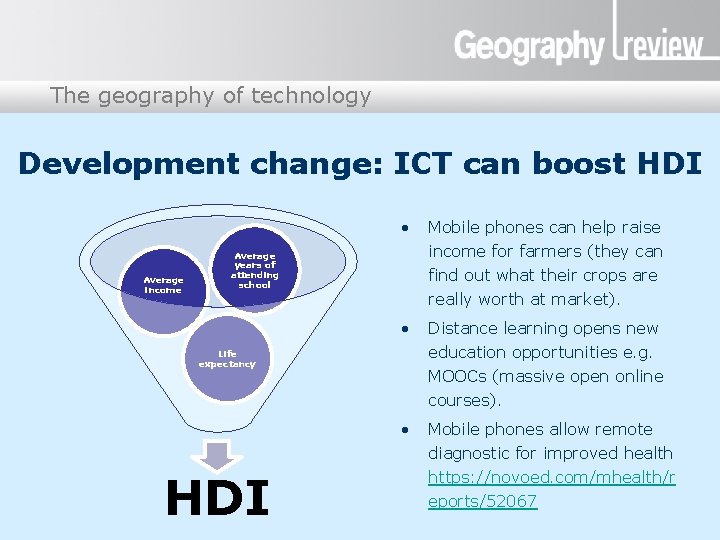
The geography of technology Presentation title Development change: ICT can boost HDI • Average income Average years of attending school find out what their crops are really worth at market). • Distance learning opens new education opportunities e. g. MOOCs (massive open online courses). • Mobile phones allow remote diagnostic for improved health https: //novoed. com/mhealth/r eports/52067 Life expectancy HDI Mobile phones can help raise income for farmers (they can
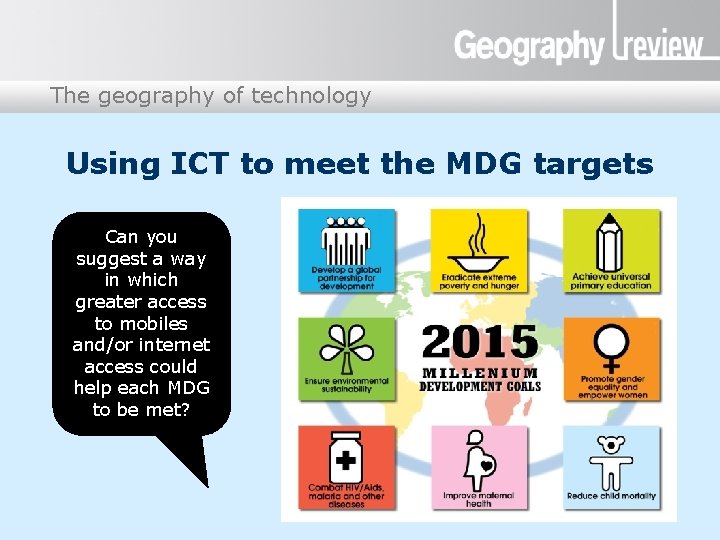
The geography of technology Presentation title Using ICT to meet the MDG targets Can you suggest a way in which greater access to mobiles and/or internet access could help each MDG to be met?
The geography of technology Presentation title ICT and political development • The uprisings in Egypt and Tunisia during 2011 are sometimes described as the Facebook revolution. Movements against the regimes of Mubarak and Ben Ali, respectively, were organised online. • The television station Al-Jazeera, based in Qatar, also helped to publicise the protests. • Mass protests in Brazil and Indonesia have been staged against government corruption and failure to deliver public services, coordinated via Face. Book. • Although these were local protest movements, they made use of a global messaging medium, Facebook. The protestors were therefore able to gain worldwide support for their actions.
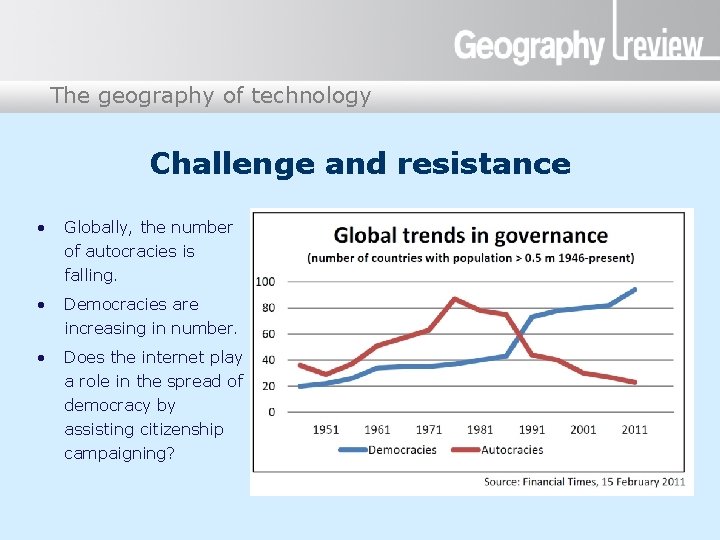
The geography of technology Presentation title Challenge and resistance • Globally, the number of autocracies is falling. • Democracies are increasing in number. • Does the internet play a role in the spread of democracy by assisting citizenship campaigning?
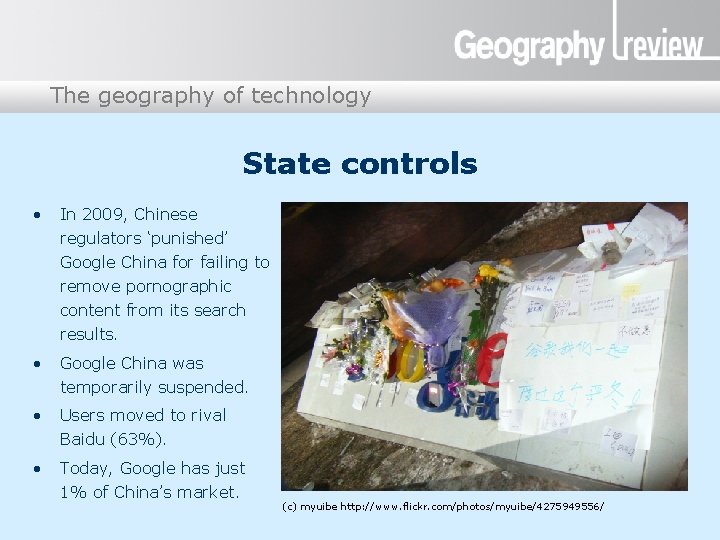
The geography of technology Presentation title State controls • In 2009, Chinese regulators ‘punished’ Google China for failing to remove pornographic content from its search results. • Google China was temporarily suspended. • Users moved to rival Baidu (63%). • Today, Google has just 1% of China’s market. (c) myuibe http: //www. flickr. com/photos/myuibe/4275949556/
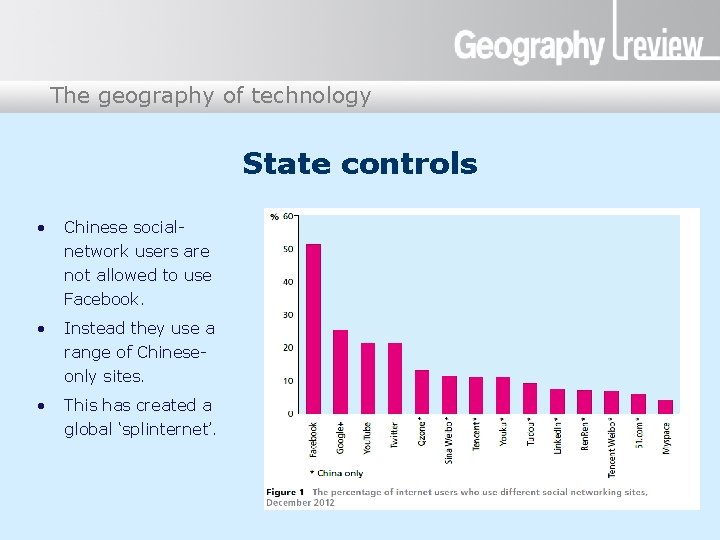
The geography of technology Presentation title State controls • Chinese socialnetwork users are not allowed to use Facebook. • Instead they use a range of Chineseonly sites. • This has created a global ‘splinternet’.
The geography of technology Presentation title Challenge and resistance • Pakistani schoolgirl Malala Yousafzai, who survived a shooting, wrote a blog for the BBC website, campaigning for the education of girls in the Swat Valley. • Imagestate Media (John Foxx) / The Web Online SS 28 News of local injustices can ‘go viral’. The ‘KONY 2012’ online campaign drew the world’s attention to atrocities perpetrated by the Lord’s Resistance Army (LRA) militia group in central Africa, prompting military intervention by the African Union.
The geography of technology Presentation title The governance of cyberspace • Twitter users can be held in contempt of court: footballer Joey Barton sent a Tweet to 1 million followers in which he expressed an opinion about a live trial, potentially influencing the jury. • Lord Mc. Alpine successfully sued the authors of Tweets that made damaging allegations about his character. • Greater effort is now being made to ensure that Twitter users are bound by similar conventions to traditional media: http: //www. theregister. co. uk/2012/11/22/law_commission_public_consulta tion_on_internet_and_contempt/
The geography of technology Presentation title High-tech superpower conflict • The Pentagon’s computer system suffers 6 million hostile probes every day. • A US security report has linked the stealing of American corporate secrets with online espionage by China’s People’s Liberation Army. • Leaked information online poses another serious threat to national security (Julian Assange, Bradley Manning). • There is a danger of global jihadists, or other terrorist groups, hacking into the operating system of a nuclear power station and triggering a disaster. • The US Defence Secretary has named cyberspace as the ‘fifth space’ of military operations (alongside land, sea, air and outer space). • USCybercom, a specialised military command, has been established to tackle cyber-security threats in the USA.
The geography of technology Presentation title Drone warfare in Pakistan • The USA's drone missile attacks in Pakistan, Yemen and Somalia – part of its global ‘war on terror’ – are controversial. • ‘Hellfire missile' operators in Nevada, USA, fly remote-controlled missiles into northern Pakistan. • The intended target is suspected terrorists. As many as 3, 500 people have been killed by drones to date, around 10% of them civilians. • The rules that govern this kind of conflict are disputed. According to one view, the USA is executing people for crimes they may or may not have committed without a trial and is in breach of the Universal Declaration of Human Rights. • The USA claims its actions are legitimised by war law (despite the fact that it is not at war with any of the countries where drone attacks occur).