The Cheese Has Moved The Next Generation NCLEX

- Slides: 18
The Cheese Has Moved! The Next Generation NCLEX©
Evidence of Unsafe Care • • • Preventable adverse events are the leading cause of death in the US One in 10 Clients globally are harmed while receiving healthcare 43 million Client safety incidents occur per year global Medication errors cost 42 billion dollars annually An Urgent call to action (World Health Organization, 2017)
Researching the Change Research indicates that only 23% of new nursing graduates who have graduated and were successful on NCLEX are “clinically competent” (Kavanagh, 2017)
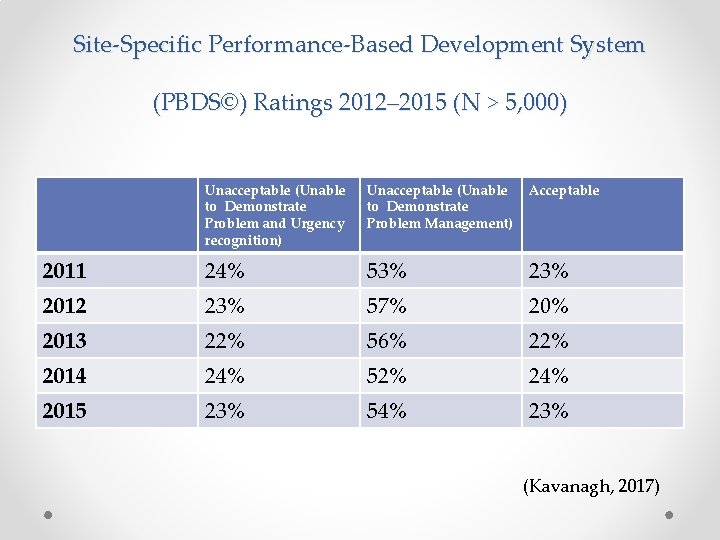
Site-Specific Performance-Based Development System (PBDS©) Ratings 2012– 2015 (N > 5, 000) Unacceptable (Unable to Demonstrate Problem and Urgency recognition) Unacceptable (Unable to Demonstrate Problem Management) Acceptable 2011 24% 53% 2012 23% 57% 2013 22% 56% 22% 2014 24% 52% 24% 2015 23% 54% 23% (Kavanagh, 2017)
Initial Recommendations from Research • Educators must focus on practice readiness rather than knowledge acquisition and knowledge use • Clinical reasoning or nursing judgment is the desired outcome • Utilize performance assessments for licensure and that performance evaluations be included during the academic programs (Kavanagh, 2017)
Current Findings • Significant improvements to NCLEX-RN© exam • Evaluation of clinical performance, such as a separate Objective Structured Clinical Exam, has not yet been added as a national standard. • Item Writers Workshop NGN creating fidelity-based case studies (write half the time, review others half the time)
Process of Evaluating Nursing Judgment • Using the Technology Enhanced Items (TEI), NCSBN initiated exam items designed to evaluate Nursing Clinical Judgment (NCJ) • NCJ by definition “form hypotheses, take actions, and evaluate outcomes” • What’s happening? What action will be taken NOW? What are the outcomes of action? Reassess when? • Implemented Next Generation NCLEX (NGN) items July 2017 -2018 (data collection last 4 quarters) • Validating items and collected data for NGN (Dickson, Lou, Kim, Woo, Muntean, & Bergstrom, 2016)
TEI Introduction • • • Extended Multiple response Extended drag and drop Enhanced hot spot items Cloze (Includes clinical scenario) Dynamic Exhibits-all of the above plus time enhancements • “Constructed response items”
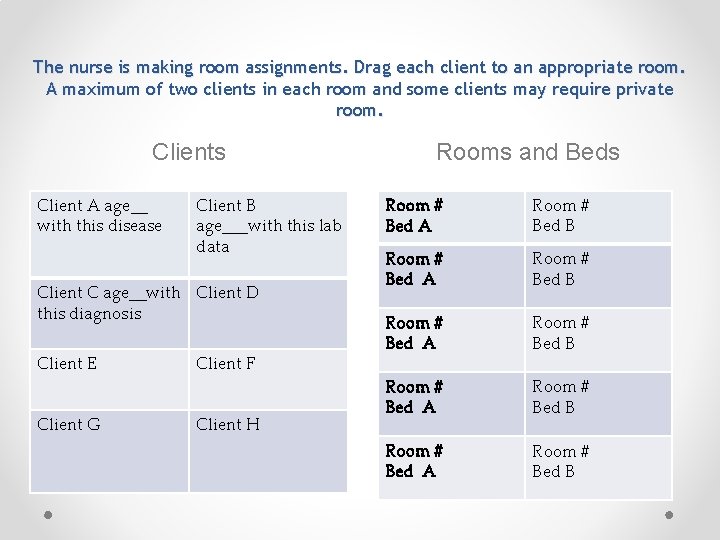
ENHANCED DRAG AND DROP • The following 8 Clients need room placement in the emergency department. There are 5 rooms available all with double beds. Some Clients may need private room utilization. • Drag and drop the Clients into the rooms.
The nurse is making room assignments. Drag each client to an appropriate room. A maximum of two clients in each room and some clients may require private room. Clients Client A age__ with this disease Client B age___with this lab data Client C age__with Client D this diagnosis Client E Client G Client F Client H Rooms and Beds Room # Bed A Room # Bed B Room # Bed A Room # Bed B
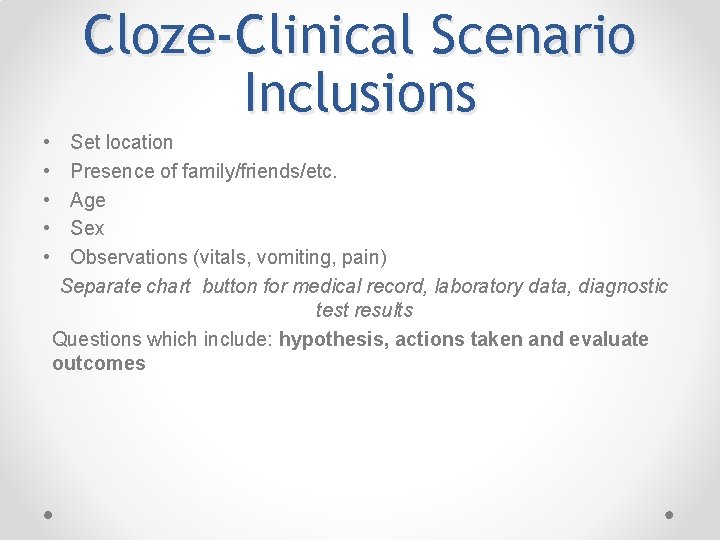
Cloze-Clinical Scenario Inclusions • • • Set location Presence of family/friends/etc. Age Sex Observations (vitals, vomiting, pain) Separate chart button for medical record, laboratory data, diagnostic test results Questions which include: hypothesis, actions taken and evaluate outcomes
Dynamic Exhibits and Constructed Response Utilizes time in the process Read the case study that follows. Note the client’s progress and nursing interventions over time. Then refer to the case study to answer the questions.
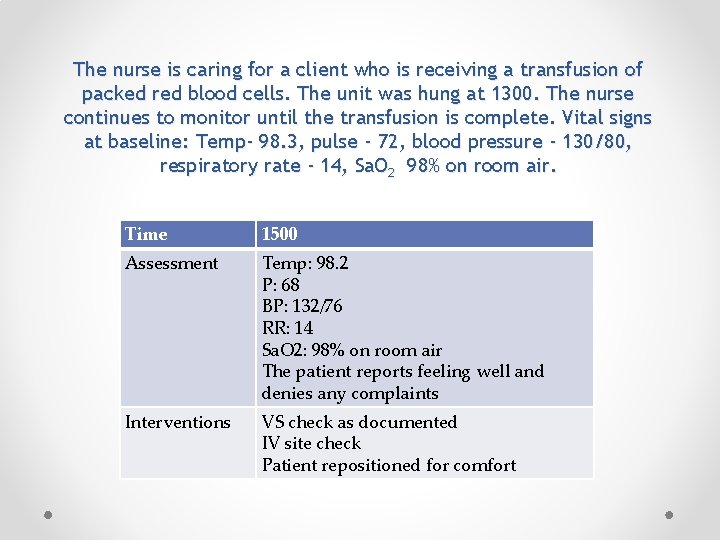
The nurse is caring for a client who is receiving a transfusion of packed red blood cells. The unit was hung at 1300. The nurse continues to monitor until the transfusion is complete. Vital signs at baseline: Temp- 98. 3, pulse - 72, blood pressure - 130/80, respiratory rate - 14, Sa. O 2 98% on room air. Time 1500 Assessment Temp: 98. 2 P: 68 BP: 132/76 RR: 14 Sa. O 2: 98% on room air The patient reports feeling well and denies any complaints Interventions VS check as documented IV site check Patient repositioned for comfort
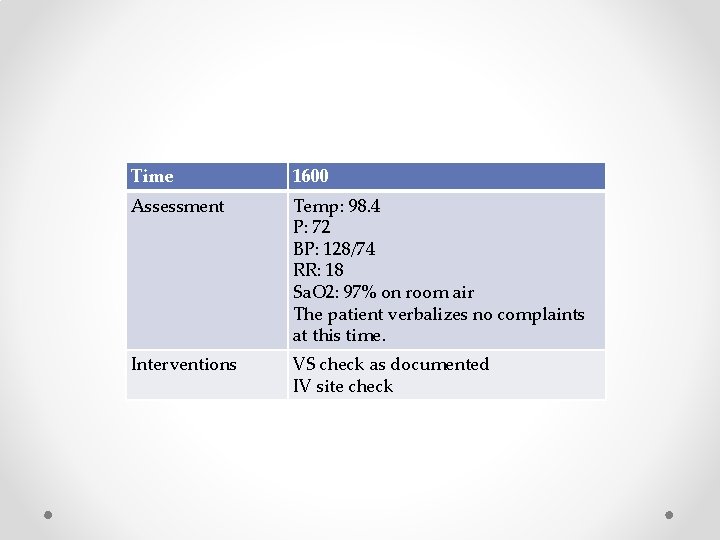
Time 1600 Assessment Temp: 98. 4 P: 72 BP: 128/74 RR: 18 Sa. O 2: 97% on room air The patient verbalizes no complaints at this time. Interventions VS check as documented IV site check
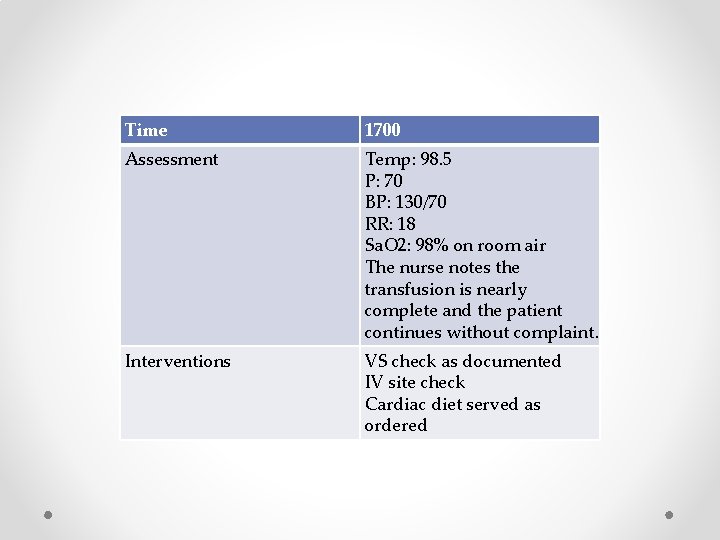
Time 1700 Assessment Temp: 98. 5 P: 70 BP: 130/70 RR: 18 Sa. O 2: 98% on room air The nurse notes the transfusion is nearly complete and the patient continues without complaint. Interventions VS check as documented IV site check Cardiac diet served as ordered
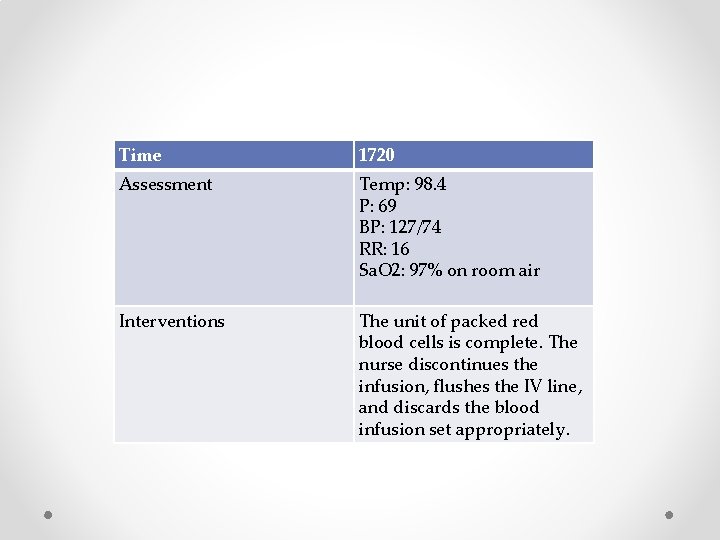
Time 1720 Assessment Temp: 98. 4 P: 69 BP: 127/74 RR: 16 Sa. O 2: 97% on room air Interventions The unit of packed red blood cells is complete. The nurse discontinues the infusion, flushes the IV line, and discards the blood infusion set appropriately.
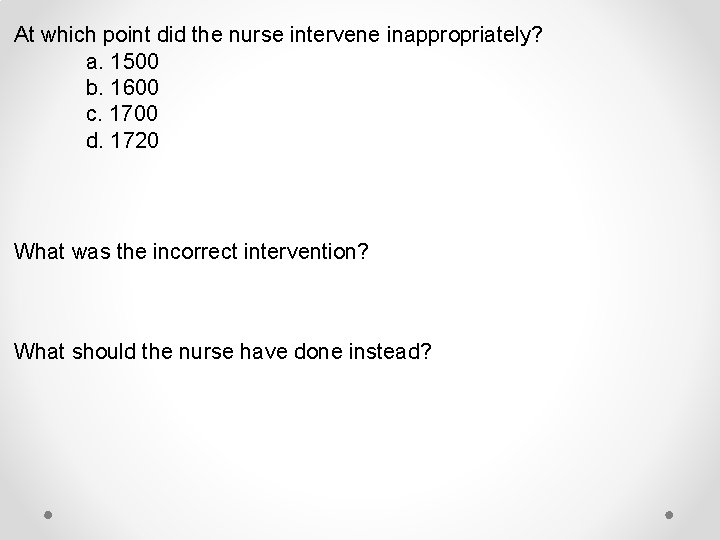
At which point did the nurse intervene inappropriately? a. 1500 b. 1600 c. 1700 d. 1720 What was the incorrect intervention? What should the nurse have done instead?
Works Cited Kavanagh, J. a. (2017). A Crisis in Competency: The Strategic and Ethical Imperative to Assessing New Graduate Nurses' Clinical Reasoning. Nursing Education Perspectives , 38 (2), 57 -62.