Tennessees New Child Support Guidelines Income Shares 1






- Slides: 48
Tennessee’s New Child Support Guidelines Income Shares 1
Purpose • Captures actual child-rearing expenses at various levels of parental income and then prorates these expenses between both parents • Requires consideration of the income of both parents – Allows child to share in the financial resources of both parents – Each parent is responsible for his/her pro-rata share of the child support obligation 2
Basic Concepts • Custodial Parent is now referred to as the Primary Residential Parent (PRP) • Non-Custodial Parent is now referred to as the Alternate Residential Parent (ARP) • Two parenting situations – Standard – one PRP/ARP for all children – Split – two PRPs/ARPs for all children 3
Definitions • PRP – the parent with whom the child resides more than 50% of the time • ARP – the parent with whom the child resides less than 50% of the time 4
Definitions • Standard Parenting – all children under the order have the same PRP and the same ARP • Split Parenting – one parent is the PRP/ARP for at least one child under the order and the other parent is PRP/ARP for at least one other child under the order 5
Tools for Calculation of Support 6
Tools for Calculation of Support • Worksheets – Child Support Worksheet – to be used in all cases for calculation of the child support obligation – Credit Worksheet – to be used when calculating credits for a parent’s qualified other children – Worksheets are Excel - based and perform all necessary calculations – Calculation results on the Credit Worksheet are automatically transferred to the Child Support Worksheet 7
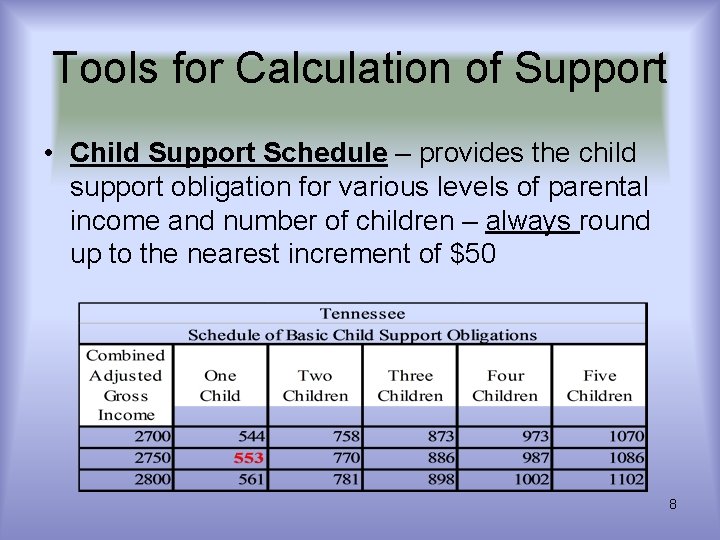
Tools for Calculation of Support • Child Support Schedule – provides the child support obligation for various levels of parental income and number of children – always round up to the nearest increment of $50 8
Gross Income Calculations 9
Gross Income Calculations • Gross Income – From all non-exempt sources – same is in current Guidelines – Both parents of the child – Do not consider income of a non-parent caretaker – No deductions for federal income taxes or FICA contributions, except for self-employed parents – these taxes are taken into consideration on the Child Support Schedule in each child support obligation 10
Gross Income Calculations – Willful and Voluntary (Under)Unemployment – • Generally the same as in current Guidelines • Determination now applies to both parents • Applies to any intentional act of the parent – Imputed Income – • $ 35, 851 for males • $ 26, 450 for females • From American Community Survey of 2002 for full time Tennessee workers 11
Gross Income Calculations • Adjusted Gross Income (AGI) – Gross Income minus the following: • Self-employment taxes paid by the parent • Amounts paid on pre-existing child support orders • Support provided to qualified other children of the parent – The AGI of each parent is combined to determine the percentage of income (PI) for each parent 12
Credits for Qualified Other Children 13
Credits for Qualified Other Children • Other children – are those children not presently before the tribunal for the establishment or modification of a child support order • Other children are qualified if: – The parent is legally responsible for the child’s financial support – The parent is actually providing financial support to the child • Credits are available to either parent 14
Definitions • A person is legally responsible for a child if a child is – Born of the person’s body, – Born of the person’s marriage, – The legally adopted child of the person; – Voluntarily acknowledged by the person, or – Otherwise determined to be the child of the person 15
Credits for Qualified Other Children • Pre-existing support orders – Pre-existing determined from the date the order was initially entered – Credit allowed for the average monthly amount actually paid 12 months prior to hearing, up to the amount of the order – Does not include amounts paid on arrears 16
Credits for Qualified Other Children • Children not subject of pre-existing child support orders – Credit available up to 75% of the amount of a theoretical order, using • Income of the parent seeking the credit – Credit for self-employment taxes paid – No credit for pre-existing orders • Number of qualified other children – Do not consider the income of or support provided by a child’s other parent 17
Definitions • Theoretical Order – – A hypothetical order which allows the finder of fact to determine the amount of a child support obligation if an order existed. – Used to determine the amount of credit allowed as a deduction from a parent’s gross income for a parent’s qualified other child who is not under a pre-existing child support order. 18
Credits for Qualified Other Children – In-Home Children • Those qualified children who reside with the parent more than 50% of the time • The amount of the credit allowed for these children is 75% of a theoretical order – Not-In-Home Children • Total of all qualified children residing with the parent less than 50% of the time, without regard to the child’s primary household • The amount of the credit allowed for these children is the lesser of: – 75% of a theoretical order – Support actually provided – established by documentary proof 19
Definitions • Documentary proof of monetary support – Physical evidence of monetary payments to the child’s caretaker, such as canceled checks or money orders – Evidence of payment of child support under a subsequent child support order, such as a payment history from a tribunal clerk or child support office or from the Department’s internet child support payment history – “In kind” remuneration such as food, clothing, formula, or diapers is not acceptable for this credit 20
Basic Child Support Obligation 21
Basic Child Support Obligation • Amount of basic support to be provided by both parents is determined on the Child Support Schedule by cross-referencing the combined adjusted gross income (AGI) of both parents with the number of children for whom support is being calculated – amount does not include – – Adjustments for additional expenses Adjustments for parenting time Adjustments for deviations Uninsured medical expenses • This amount is allocated between the parents according to the percentage of income (PI) of each parent 22
Definitions • Percentage of Income (PI) – the PI for each parent is calculated by dividing each parent’s AGI by the combined AGI of both parents 23
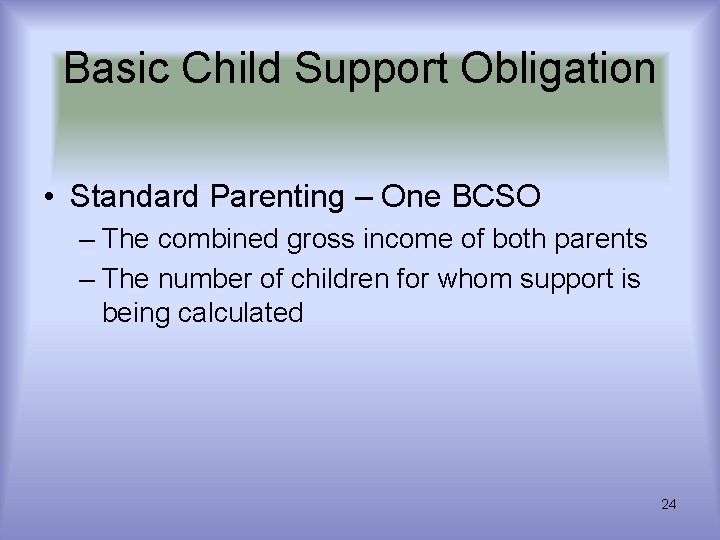
Basic Child Support Obligation • Standard Parenting – One BCSO – The combined gross income of both parents – The number of children for whom support is being calculated 24
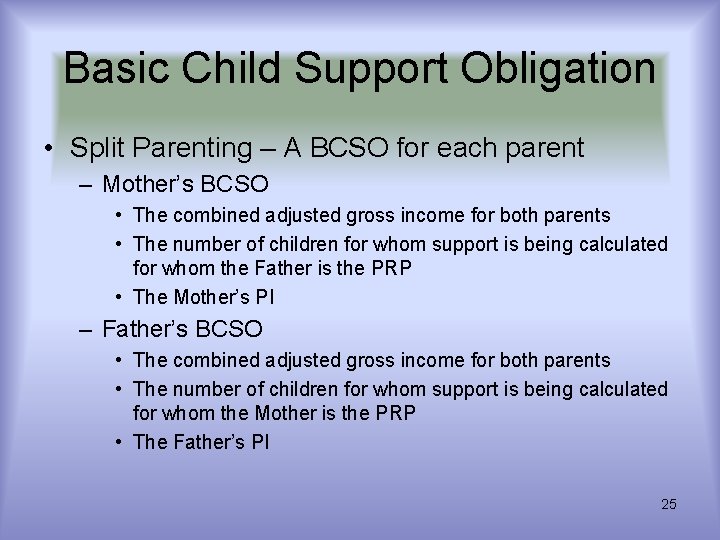
Basic Child Support Obligation • Split Parenting – A BCSO for each parent – Mother’s BCSO • The combined adjusted gross income for both parents • The number of children for whom support is being calculated for whom the Father is the PRP • The Mother’s PI – Father’s BCSO • The combined adjusted gross income for both parents • The number of children for whom support is being calculated for whom the Mother is the PRP • The Father’s PI 25
Policy • Income Shares vs. the Flat Percentage – Economic studies reveal that, as income increases, the dollar amount spent on childrearing expenses increases but the percentage of income spent on child-rearing expenses decreases – Accordingly, flat percentages have statistically been too low at lower incomes and too high at higher incomes 26
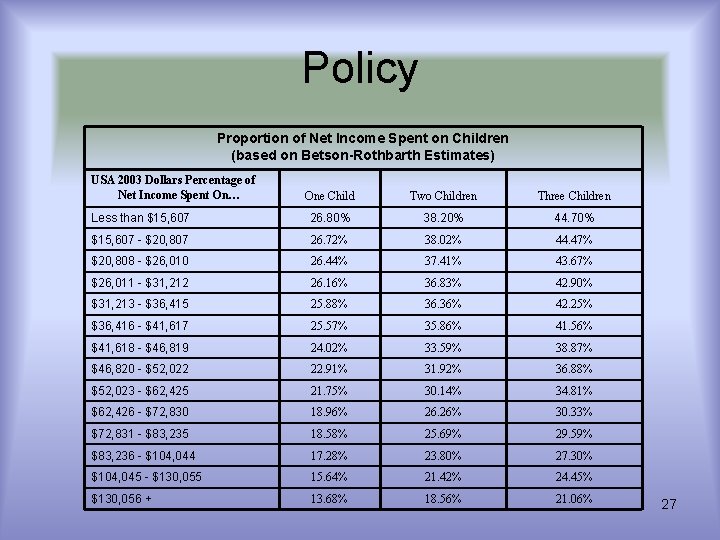
Policy Proportion of Net Income Spent on Children (based on Betson-Rothbarth Estimates) USA 2003 Dollars Percentage of Net Income Spent On… One Child Two Children Three Children Less than $15, 607 26. 80% 38. 20% 44. 70% $15, 607 - $20, 807 26. 72% 38. 02% 44. 47% $20, 808 - $26, 010 26. 44% 37. 41% 43. 67% $26, 011 - $31, 212 26. 16% 36. 83% 42. 90% $31, 213 - $36, 415 25. 88% 36. 36% 42. 25% $36, 416 - $41, 617 25. 57% 35. 86% 41. 56% $41, 618 - $46, 819 24. 02% 33. 59% 38. 87% $46, 820 - $52, 022 22. 91% 31. 92% 36. 88% $52, 023 - $62, 425 21. 75% 30. 14% 34. 81% $62, 426 - $72, 830 18. 96% 26. 26% 30. 33% $72, 831 - $83, 235 18. 58% 25. 69% 29. 59% $83, 236 - $104, 044 17. 28% 23. 80% 27. 30% $104, 045 - $130, 055 15. 64% 21. 42% 24. 45% $130, 056 + 13. 68% 18. 56% 21. 06% 27
Definitions • Parenting time adjustment to the ARP’s portion of the BCSO based upon the ARP’s parenting time with the child 28
Basic Child Support Obligation • Parenting Time Adjustment – Reduction to BCSO – Parenting time with the child greater than 120 days • • • 121 - 136 days = 10% reduction 137 - 151 days = 20% reduction 152 - 166 days = 30% reduction 167 - 181 days = 40% reduction 182+ days = 50% reduction 29
Basic Child Support Obligation • Parenting Time Adjustment – Increase to BCSO – Parenting time with child less than 54 days • 53 – 39 days = 10% increase • 38 – 24 days = 20% increase • 23 – 9 days = 30% increase • 8 – 0 days = 35% increase 30
Definitions • Days – a parent gets credit for a day of parenting time if the child spends the majority of a 24 hour calendar day with or under the control of a parent and that parent expends a reasonable amount of resources on the child during this time period (such as the cost of a meal or other such costs directly related to the care and supervision of the child) 31
Treatment of Expenses 32
Treatment of Expenses • Amounts actually paid by a parent or other caretaker • Basic Expenses – Such as: • Food • Clothing • Housing – Included in the BCSO 33
Treatment of Expenses • Additional Expenses – Mandatory Expenses • Child’s healthcare premium – Expense attributable only to child for whom support is being calculated – Allocated according to parent’s PI – Added on to BCSO • Work-related childcare – Projected over next 12 months and averaged for a monthly amount – Includes only amounts actually paid – Allocated according to parent’s PI – Added on to BCSO 34
Treatment of Expenses • Uninsured Medical Expenses – No calculations on the Worksheet – Order shall provide for payment of expenses according to parent’s PI or as otherwise specified by the tribunal – Recurring amounts added to the Presumptive Child Support Order (PCSO) 35
Definitions • Uninsured Medical Expenses medical expenses which include, but are not limited to, health insurance co-payments, deductibles, and such other costs as are reasonably necessary for orthodontia, dental treatment, asthma treatments, physical therapy, vision care, and any acute or chronic medical/health problem, or mental illness, including counseling or other medical or mental health expenses, that are not covered by insurance. 36
Treatment of Expenses – Extraordinary Expenses • May be added to the Presumptive Child Support Order as a deviation in the discretion of the tribunal • Extraordinary Education Expenses • Special Expenses - can be added to the BCSO when the expense exceeds 7% of the BCSO 37
Summary of Calculations • Basic Child Support Obligation (BCSO) – – Obtained from the Child Support Schedule – Based on number of children and combined AGI of both parents • Adjusted Support Obligation (ASO) – BCSO adjusted for parenting time, the health insurance premium, and child care
Summary of Calculations • Presumptive Child Support Order (PCSO) – The ASO adjusted by the total amount of the health insurance premium and/or the work-related child care paid through payroll deduction; and/or – The ASO adjusted for the statutory threshold • Final Child Support Order (FCSO) – The PCSO adjusted for deviations and uninsured medical expenses – In the absence of such adjustments, the PCSO is the FCSO
Child Support Order • High-Income Threshold – Absent rebuttal, the PCSO is limited to the following amounts • • • $2100 for one child $3200 for two children $4100 for three children $4600 for four children $5000 for five children – With rebuttal, additional amounts may be added to the PCSO as a deviation – Also applicable to the calculation of a theoretical order 40
Child Support Order • Deviations – Must consider the best interests of child for whom support is being calculated – Order shall include guideline amount and findings in support of deviation – Reasons • • Same as current Guidelines Extraordinary Expenses Rebuttal of high-income threshold Low income of either parent 41
Child Support Order • Modifications – Generally require a significant variance – No significant variance needed if • Providing for healthcare needs • Eliminating a previous deviation due to a change in circumstances • Retroactive Support – – From birth of the child or separation of the parties – Using Guidelines in effect at the time of the order 42
Modification 43
Modification • After implementation of the Rules, a significant variance is – At least a 15% change in the ARP’s gross income - and/or – A change in the number of children for whom the ARP is legally responsible – and/or – The child for whom support is being calculated becoming disabled – and/or – The parties entering into an agreed order for modification of the support obligation in compliance with these Rules – and – – At least a 15% (or 7. 5%) change in the support obligation – After January 1, 2006, a significant variance will be a 15% (or 7. 5%) change in the support obligation – 7. 5% applies to low-income parents 44
Definitions • Low-income parent – – a parent who, when working at his/her full capacity according to his/her education and experience and not willfully and voluntarily unemployed or underemployed, has adjusted gross income at or below the federal poverty level for a single adult – The federal poverty standards will be available at www. state. tn. us/humanserv – Current amount is $9310 annual gross income 45
Modification • Hardship Deviation – When modifying an order under Income Shares that was established under the current Guidelines • For the first modification, whenever it should occur • Can be applied only one time – Can limit the amount of the modification if: • Decrease would impair the household of the PRP • Increase would impair the household of the ARP – Deviation cannot be used in a subsequent action to create a significant variance 46
Learning Tools • Income Shares Tutorial on the Department’s website – includes – All pertinent documents – A detailed walkthrough of a support calculation – Interactive examples – FAQs • www. state. tn. us/humanserv/ is/incomeshares. htm 47
48