Teacher Education Strategic Initiatives Steering Committee Meeting 2

- Slides: 33
Teacher Education Strategic Initiatives Steering Committee Meeting - #2 Monday, November 9 and Tuesday, November 10, 2015 1
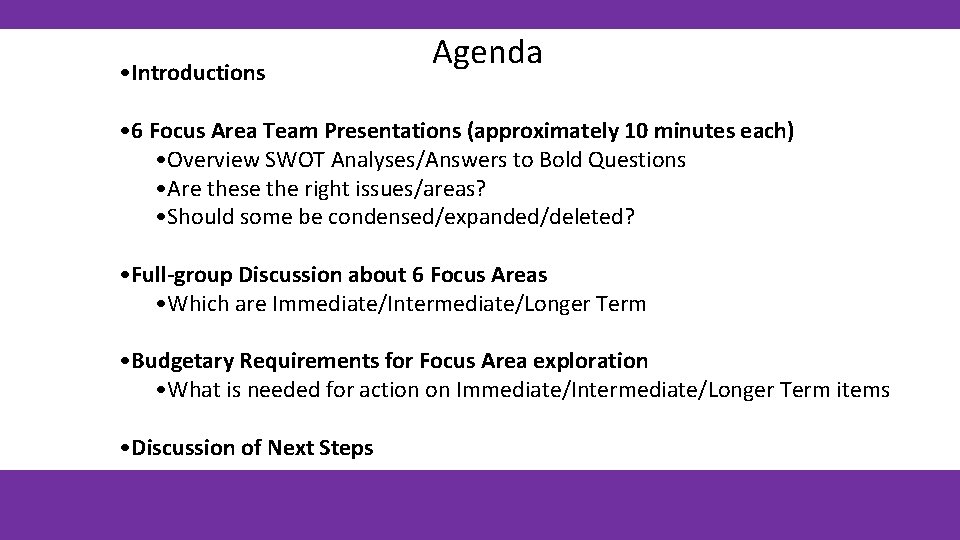
• Introductions Agenda • 6 Focus Area Team Presentations (approximately 10 minutes each) • Overview SWOT Analyses/Answers to Bold Questions • Are these the right issues/areas? • Should some be condensed/expanded/deleted? • Full-group Discussion about 6 Focus Areas • Which are Immediate/Intermediate/Longer Term • Budgetary Requirements for Focus Area exploration • What is needed for action on Immediate/Intermediate/Longer Term items • Discussion of Next Steps 2
Focus Area # 1 – Building a Campus Community that Values Education • SWOT Analysis • Bold and Distinctive Questionnaire 3
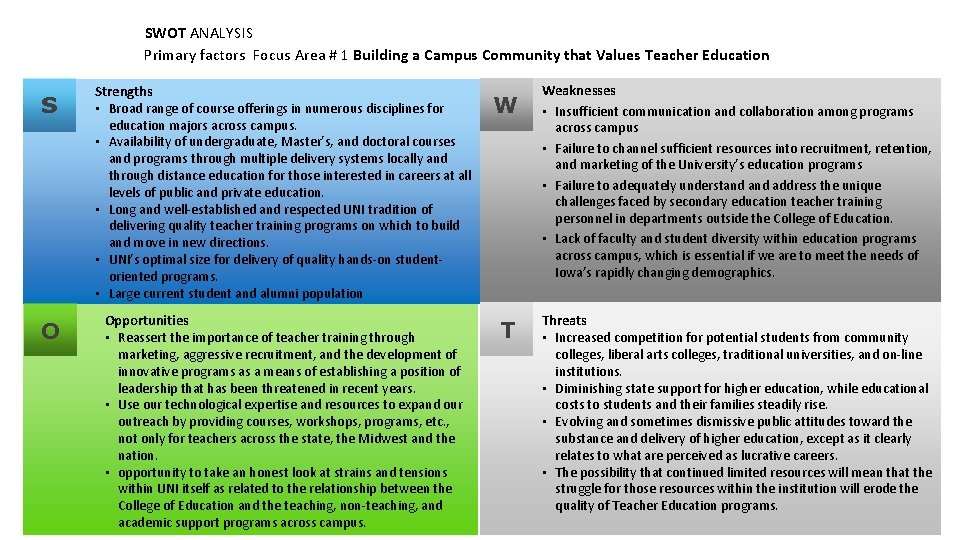
SWOT ANALYSIS Primary factors Focus Area # 1 Building a Campus Community that Values Teacher Education S O Strengths • Broad range of course offerings in numerous disciplines for education majors across campus. • Availability of undergraduate, Master’s, and doctoral courses and programs through multiple delivery systems locally and through distance education for those interested in careers at all levels of public and private education. • Long and well-established and respected UNI tradition of delivering quality teacher training programs on which to build and move in new directions. • UNI’s optimal size for delivery of quality hands-on studentoriented programs. • Large current student and alumni population Opportunities • Reassert the importance of teacher training through marketing, aggressive recruitment, and the development of innovative programs as a means of establishing a position of leadership that has been threatened in recent years. • Use our technological expertise and resources to expand our outreach by providing courses, workshops, programs, etc. , not only for teachers across the state, the Midwest and the nation. • opportunity to take an honest look at strains and tensions within UNI itself as related to the relationship between the College of Education and the teaching, non-teaching, and academic support programs across campus. W T Weaknesses • Insufficient communication and collaboration among programs across campus • Failure to channel sufficient resources into recruitment, retention, and marketing of the University’s education programs • Failure to adequately understand address the unique challenges faced by secondary education teacher training personnel in departments outside the College of Education. • Lack of faculty and student diversity within education programs across campus, which is essential if we are to meet the needs of Iowa’s rapidly changing demographics. Threats • Increased competition for potential students from community colleges, liberal arts colleges, traditional universities, and on-line institutions. • Diminishing state support for higher education, while educational costs to students and their families steadily rise. • Evolving and sometimes dismissive public attitudes toward the substance and delivery of higher education, except as it clearly relates to what are perceived as lucrative careers. • The possibility that continued limited resources will mean that the struggle for those resources within the institution will erode the quality of Teacher Education programs.
Focus Area # 2 – Develop Collaborative Culture/Public Schools Connectivity • SWOT Analysis • Bold and Distinctive Questionnaire 5
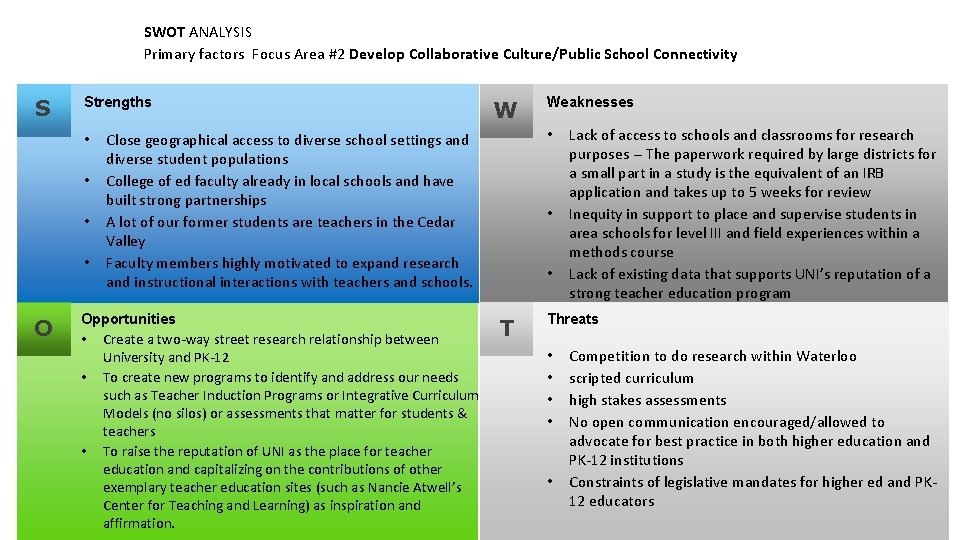
SWOT ANALYSIS Primary factors Focus Area #2 Develop Collaborative Culture/Public School Connectivity S Strengths • • O W • Close geographical access to diverse school settings and diverse student populations College of ed faculty already in local schools and have built strong partnerships A lot of our former students are teachers in the Cedar Valley Faculty members highly motivated to expand research and instructional interactions with teachers and schools. Opportunities • Create a two-way street research relationship between University and PK-12 • To create new programs to identify and address our needs such as Teacher Induction Programs or Integrative Curriculum Models (no silos) or assessments that matter for students & teachers • To raise the reputation of UNI as the place for teacher education and capitalizing on the contributions of other exemplary teacher education sites (such as Nancie Atwell’s Center for Teaching and Learning) as inspiration and affirmation. Weaknesses • • T Lack of access to schools and classrooms for research purposes -- The paperwork required by large districts for a small part in a study is the equivalent of an IRB application and takes up to 5 weeks for review Inequity in support to place and supervise students in area schools for level III and field experiences within a methods course Lack of existing data that supports UNI’s reputation of a strong teacher education program Threats • • • Competition to do research within Waterloo scripted curriculum high stakes assessments No open communication encouraged/allowed to advocate for best practice in both higher education and PK-12 institutions Constraints of legislative mandates for higher ed and PK 12 educators
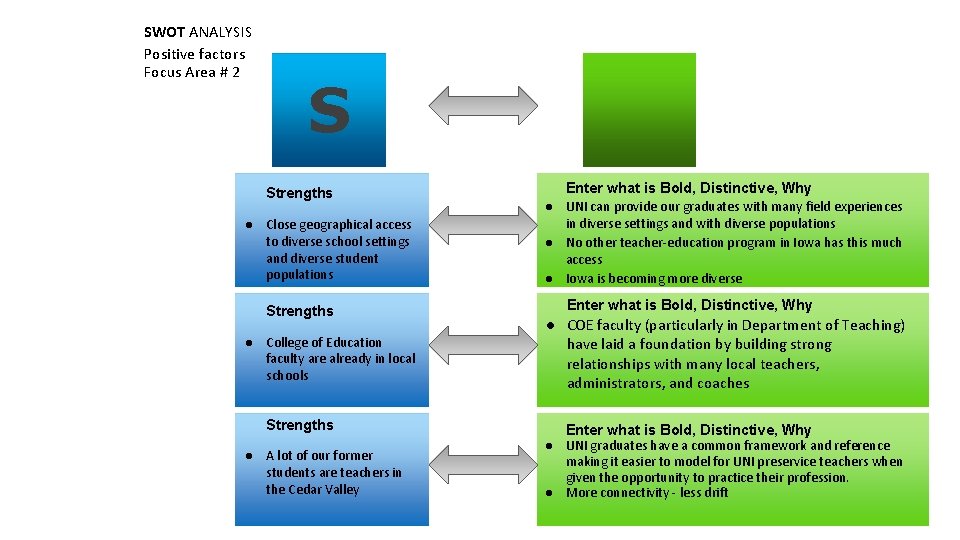
SWOT ANALYSIS Positive factors Focus Area # 2 S Strengths ● Close geographical access to diverse school settings and diverse student populations Strengths ● College of Education faculty are already in local schools Strengths ● A lot of our former students are teachers in the Cedar Valley Enter what is Bold, Distinctive, Why ● UNI can provide our graduates with many field experiences in diverse settings and with diverse populations ● No other teacher-education program in Iowa has this much access ● Iowa is becoming more diverse Enter what is Bold, Distinctive, Why ● COE faculty (particularly in Department of Teaching) have laid a foundation by building strong relationships with many local teachers, administrators, and coaches Enter what is Bold, Distinctive, Why ● UNI graduates have a common framework and reference making it easier to model for UNI preservice teachers when given the opportunity to practice their profession. ● More connectivity - less drift
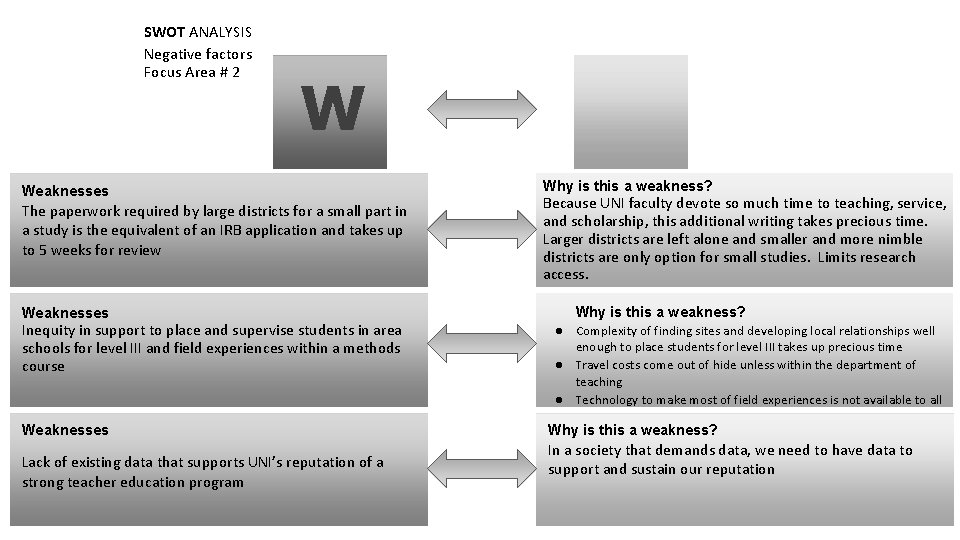
SWOT ANALYSIS Negative factors Focus Area # 2 W Weaknesses The paperwork required by large districts for a small part in a study is the equivalent of an IRB application and takes up to 5 weeks for review Weaknesses Inequity in support to place and supervise students in area schools for level III and field experiences within a methods course Weaknesses Lack of existing data that supports UNI’s reputation of a strong teacher education program Why is this a weakness? Because UNI faculty devote so much time to teaching, service, and scholarship, this additional writing takes precious time. Larger districts are left alone and smaller and more nimble districts are only option for small studies. Limits research access. Why is this a weakness? ● Complexity of finding sites and developing local relationships well enough to place students for level III takes up precious time ● Travel costs come out of hide unless within the department of teaching ● Technology to make most of field experiences is not available to all Why is this a weakness? In a society that demands data, we need to have data to support and sustain our reputation
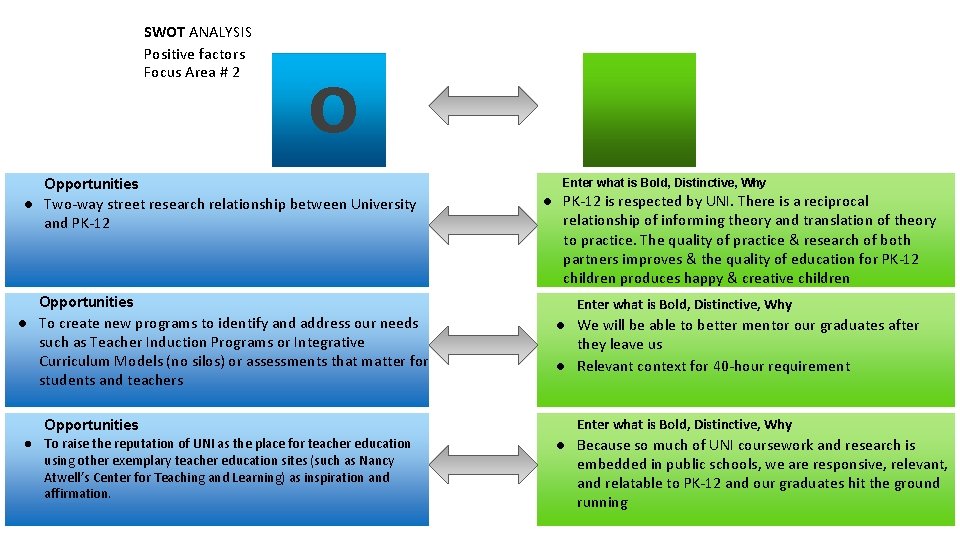
SWOT ANALYSIS Positive factors Focus Area # 2 O Opportunities ● Two-way street research relationship between University and PK-12 Opportunities ● To create new programs to identify and address our needs such as Teacher Induction Programs or Integrative Curriculum Models (no silos) or assessments that matter for students and teachers Opportunities ● To raise the reputation of UNI as the place for teacher education using other exemplary teacher education sites (such as Nancy Atwell’s Center for Teaching and Learning) as inspiration and affirmation. Enter what is Bold, Distinctive, Why ● PK-12 is respected by UNI. There is a reciprocal relationship of informing theory and translation of theory to practice. The quality of practice & research of both partners improves & the quality of education for PK-12 children produces happy & creative children Enter what is Bold, Distinctive, Why ● We will be able to better mentor our graduates after they leave us ● Relevant context for 40 -hour requirement Enter what is Bold, Distinctive, Why ● Because so much of UNI coursework and research is embedded in public schools, we are responsive, relevant, and relatable to PK-12 and our graduates hit the ground running
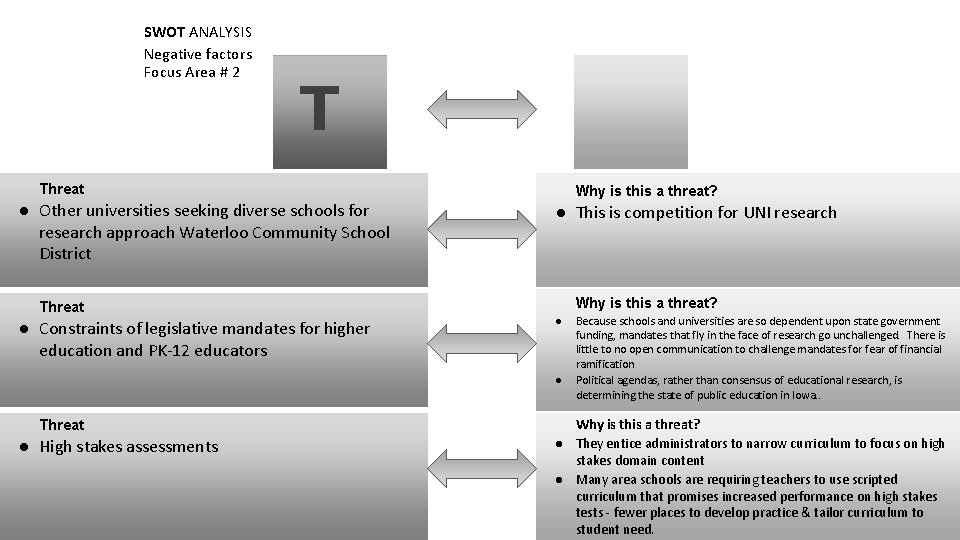
SWOT ANALYSIS Negative factors Focus Area # 2 T Threat ● Other universities seeking diverse schools for research approach Waterloo Community School District Threat ● Constraints of legislative mandates for higher education and PK-12 educators Why is this a threat? ● This is competition for UNI research Why is this a threat? ● ● Threat ● High stakes assessments Because schools and universities are so dependent upon state government funding, mandates that fly in the face of research go unchallenged. There is little to no open communication to challenge mandates for fear of financial ramification Political agendas, rather than consensus of educational research, is determining the state of public education in Iowa. . Why is this a threat? ● They entice administrators to narrow curriculum to focus on high stakes domain content ● Many area schools are requiring teachers to use scripted curriculum that promises increased performance on high stakes tests - fewer places to develop practice & tailor curriculum to student need.
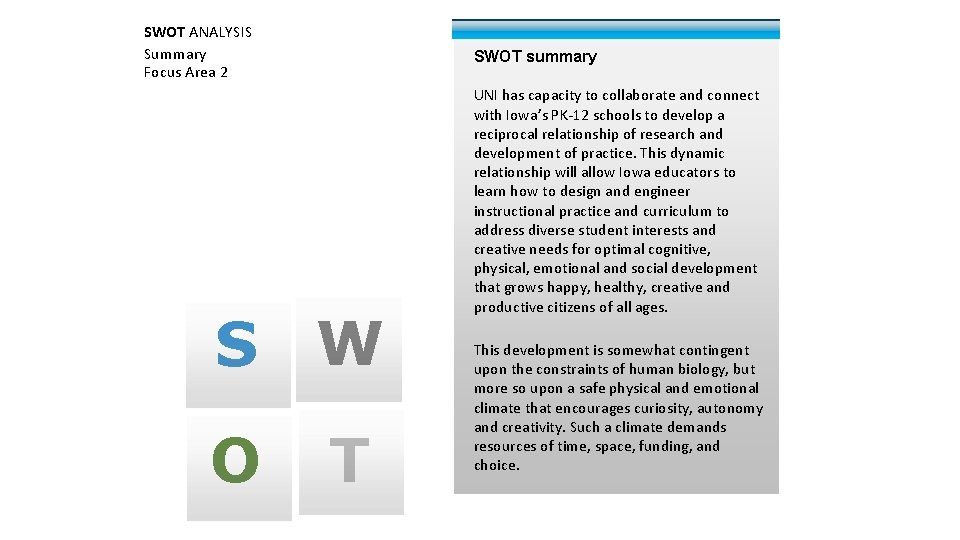
SWOT ANALYSIS Summary Focus Area 2 SWOT summary S W O T UNI has capacity to collaborate and connect with Iowa’s PK-12 schools to develop a reciprocal relationship of research and development of practice. This dynamic relationship will allow Iowa educators to learn how to design and engineer instructional practice and curriculum to address diverse student interests and creative needs for optimal cognitive, physical, emotional and social development that grows happy, healthy, creative and productive citizens of all ages. This development is somewhat contingent upon the constraints of human biology, but more so upon a safe physical and emotional climate that encourages curiosity, autonomy and creativity. Such a climate demands resources of time, space, funding, and choice.
Focus Area # 3 – Clinical/Field Experiences • SWOT Analysis • Bold and Distinctive Questionnaire 12
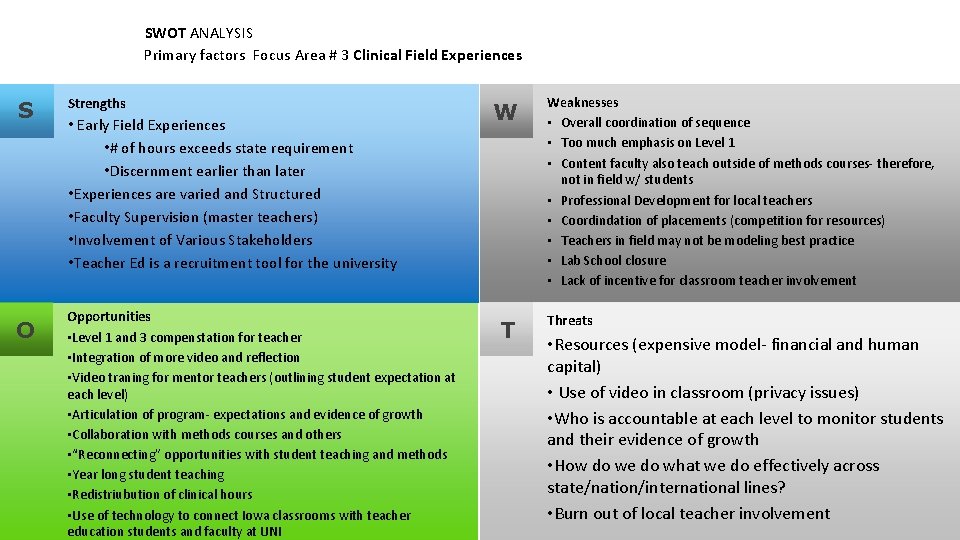
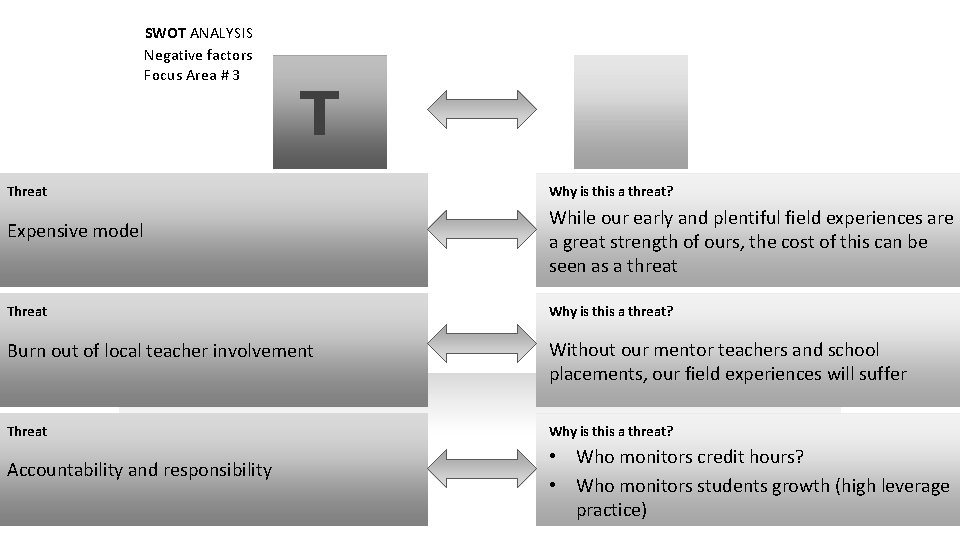
SWOT ANALYSIS Primary factors Focus Area # 3 Clinical Field Experiences S O Strengths • Early Field Experiences • # of hours exceeds state requirement • Discernment earlier than later • Experiences are varied and Structured • Faculty Supervision (master teachers) • Involvement of Various Stakeholders • Teacher Ed is a recruitment tool for the university Opportunities • Level 1 and 3 compenstation for teacher • Integration of more video and reflection • Video traning for mentor teachers (outlining student expectation at each level) • Articulation of program- expectations and evidence of growth • Collaboration with methods courses and others • “Reconnecting” opportunities with student teaching and methods • Year long student teaching • Redistriubution of clinical hours • Use of technology to connect Iowa classrooms with teacher education students and faculty at UNI W T Weaknesses • Overall coordination of sequence • Too much emphasis on Level 1 • Content faculty also teach outside of methods courses- therefore, not in field w/ students • Professional Development for local teachers • Coordindation of placements (competition for resources) • Teachers in field may not be modeling best practice • Lab School closure • Lack of incentive for classroom teacher involvement Threats • Resources (expensive model- financial and human capital) • Use of video in classroom (privacy issues) • Who is accountable at each level to monitor students and their evidence of growth • How do we do what we do effectively across state/nation/international lines? • Burn out of local teacher involvement
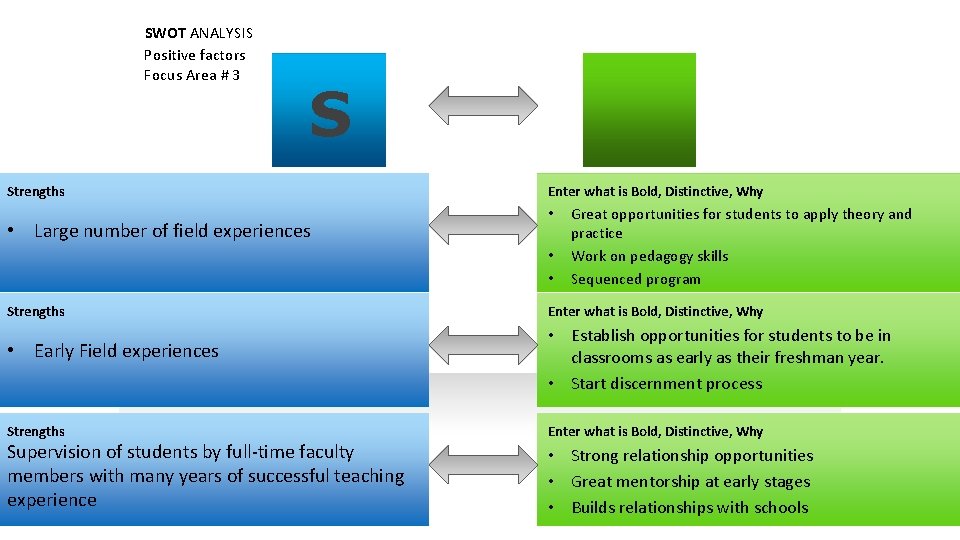
SWOT ANALYSIS Positive factors Focus Area # 3 S Strengths • Large number of field experiences Enter what is Bold, Distinctive, Why • • • Strengths • Early Field experiences Strengths Supervision of students by full-time faculty members with many years of successful teaching experience Great opportunities for students to apply theory and practice Work on pedagogy skills Sequenced program Enter what is Bold, Distinctive, Why • Establish opportunities for students to be in classrooms as early as their freshman year. • Start discernment process Enter what is Bold, Distinctive, Why • Strong relationship opportunities • Great mentorship at early stages • Builds relationships with schools
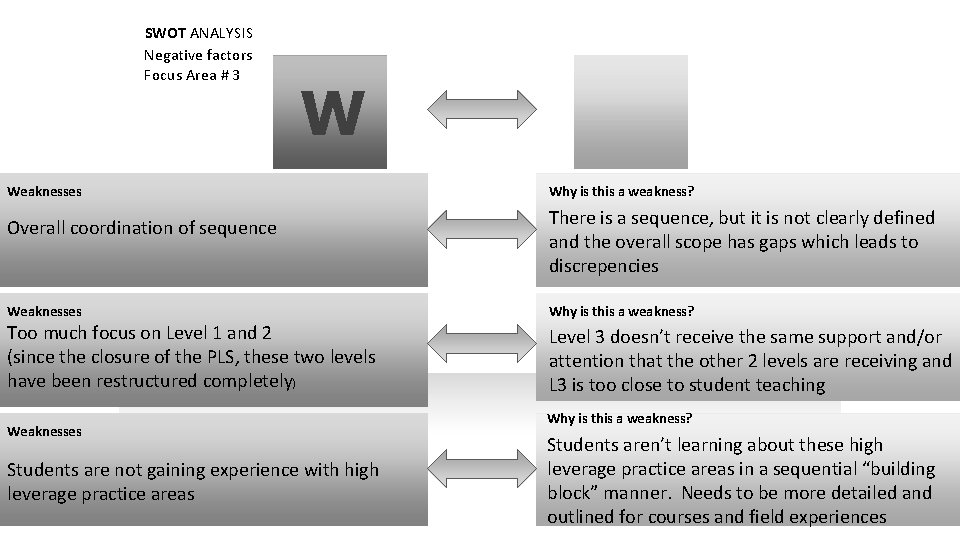
SWOT ANALYSIS Negative factors Focus Area # 3 W Weaknesses Overall coordination of sequence Weaknesses Too much focus on Level 1 and 2 (since the closure of the PLS, these two levels have been restructured completely) Weaknesses Students are not gaining experience with high leverage practice areas Why is this a weakness? There is a sequence, but it is not clearly defined and the overall scope has gaps which leads to discrepencies Why is this a weakness? Level 3 doesn’t receive the same support and/or attention that the other 2 levels are receiving and L 3 is too close to student teaching Why is this a weakness? Students aren’t learning about these high leverage practice areas in a sequential “building block” manner. Needs to be more detailed and outlined for courses and field experiences
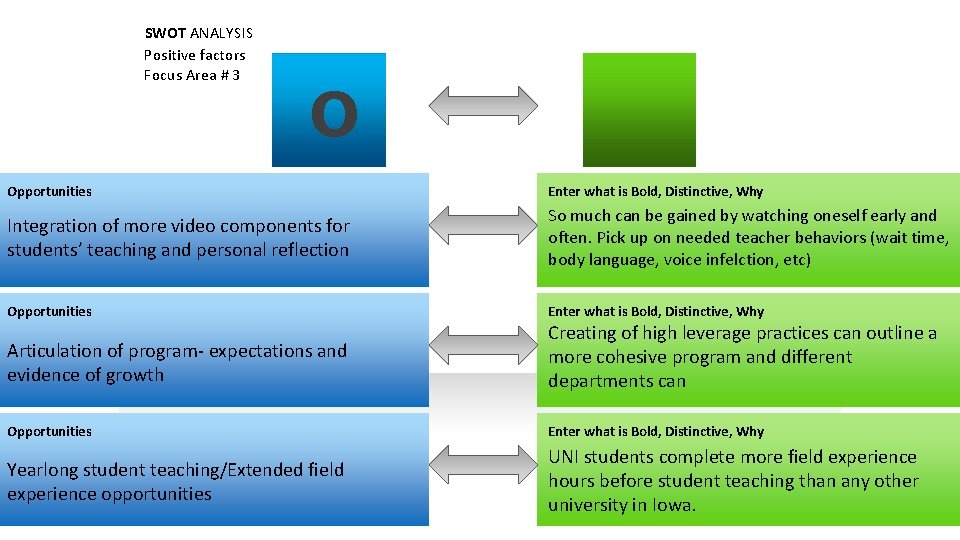
SWOT ANALYSIS Positive factors Focus Area # 3 O Opportunities Enter what is Bold, Distinctive, Why Integration of more video components for students’ teaching and personal reflection So much can be gained by watching oneself early and often. Pick up on needed teacher behaviors (wait time, body language, voice infelction, etc) Opportunities Enter what is Bold, Distinctive, Why Articulation of program- expectations and evidence of growth Creating of high leverage practices can outline a more cohesive program and different departments can Opportunities Enter what is Bold, Distinctive, Why Yearlong student teaching/Extended field experience opportunities UNI students complete more field experience hours before student teaching than any other university in Iowa.
SWOT ANALYSIS Negative factors Focus Area # 3 T Threat Expensive model Why is this a threat? While our early and plentiful field experiences are a great strength of ours, the cost of this can be seen as a threat Threat Why is this a threat? Burn out of local teacher involvement Without our mentor teachers and school placements, our field experiences will suffer Threat Why is this a threat? Accountability and responsibility • Who monitors credit hours? • Who monitors students growth (high leverage practice)
Focus Area # 4 – Create New Curriculum • SWOT Analysis • Bold and Distinctive Questionnaire 18
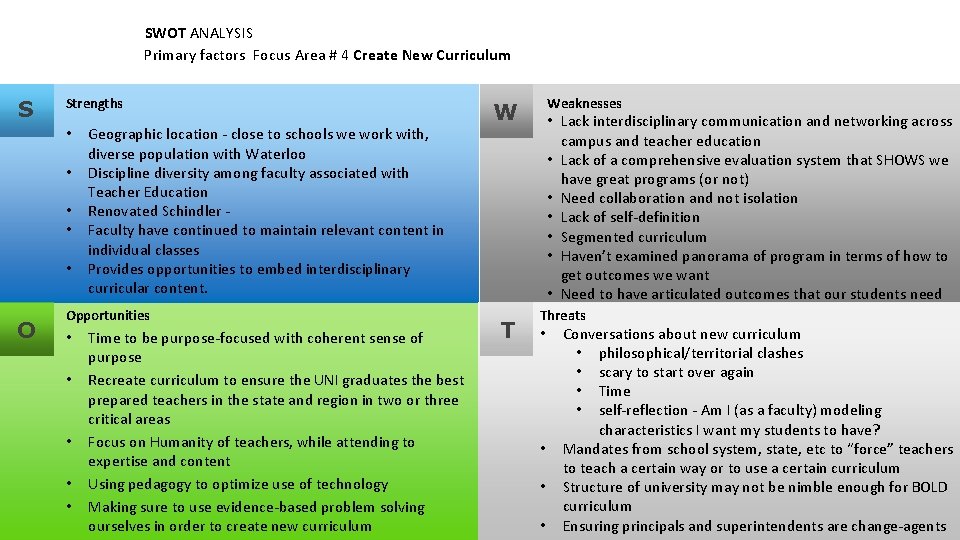
SWOT ANALYSIS Primary factors Focus Area # 4 Create New Curriculum S Strengths • • • O Geographic location - close to schools we work with, diverse population with Waterloo Discipline diversity among faculty associated with Teacher Education Renovated Schindler Faculty have continued to maintain relevant content in individual classes Provides opportunities to embed interdisciplinary curricular content. Opportunities • • • Time to be purpose-focused with coherent sense of purpose Recreate curriculum to ensure the UNI graduates the best prepared teachers in the state and region in two or three critical areas Focus on Humanity of teachers, while attending to expertise and content Using pedagogy to optimize use of technology Making sure to use evidence-based problem solving ourselves in order to create new curriculum Weaknesses W T • Lack interdisciplinary communication and networking across campus and teacher education • Lack of a comprehensive evaluation system that SHOWS we have great programs (or not) • Need collaboration and not isolation • Lack of self-definition • Segmented curriculum • Haven’t examined panorama of program in terms of how to get outcomes we want • Need to have articulated outcomes that our students need Threats • • Conversations about new curriculum • philosophical/territorial clashes • scary to start over again • Time • self-reflection - Am I (as a faculty) modeling characteristics I want my students to have? Mandates from school system, state, etc to “force” teachers to teach a certain way or to use a certain curriculum Structure of university may not be nimble enough for BOLD curriculum Ensuring principals and superintendents are change-agents
Focus Area # 5 – Continuing Growth Model • SWOT Analysis • Bold and Distinctive Questionnaire 20
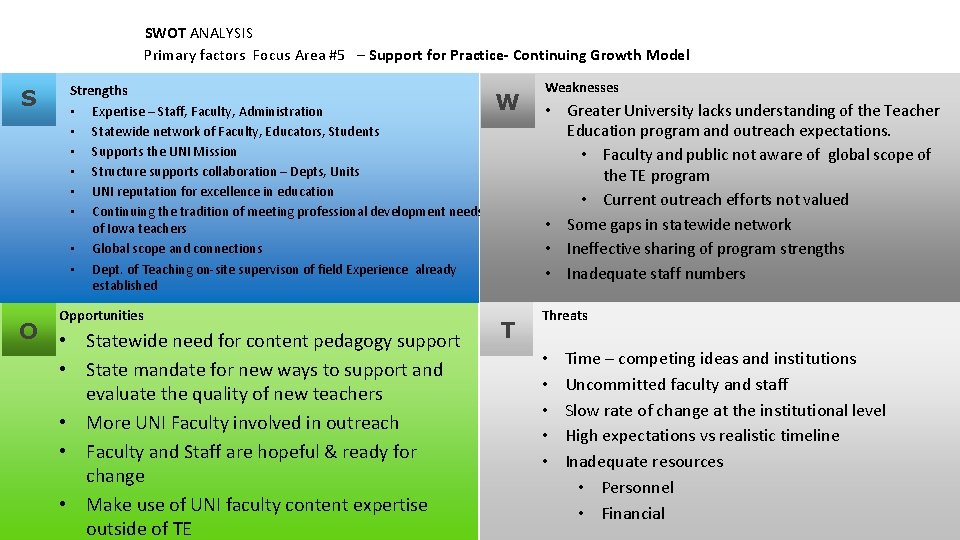
SWOT ANALYSIS Primary factors Focus Area #5 – Support for Practice- Continuing Growth Model S Strengths • Expertise – Staff, Faculty, Administration • Statewide network of Faculty, Educators, Students • Supports the UNI Mission • Structure supports collaboration – Depts, Units • UNI reputation for excellence in education • Continuing the tradition of meeting professional development needs of Iowa teachers • Global scope and connections • Dept. of Teaching on-site supervison of field Experience already established Opportunities O • Statewide need for content pedagogy support • State mandate for new ways to support and evaluate the quality of new teachers • More UNI Faculty involved in outreach • Faculty and Staff are hopeful & ready for change • Make use of UNI faculty content expertise outside of TE W T Weaknesses • Greater University lacks understanding of the Teacher Education program and outreach expectations. • Faculty and public not aware of global scope of the TE program • Current outreach efforts not valued • Some gaps in statewide network • Ineffective sharing of program strengths • Inadequate staff numbers Threats • • • Time – competing ideas and institutions Uncommitted faculty and staff Slow rate of change at the institutional level High expectations vs realistic timeline Inadequate resources • Personnel • Financial
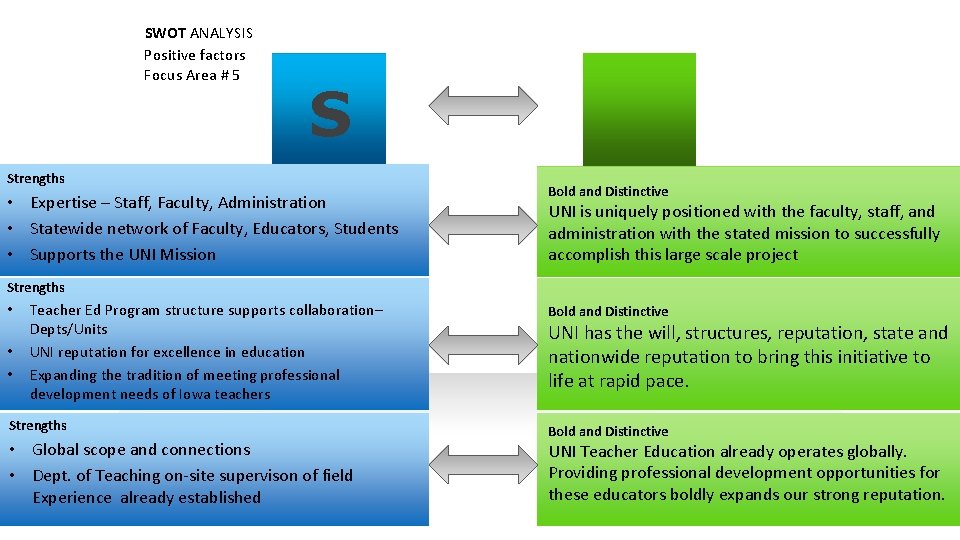
SWOT ANALYSIS Positive factors Focus Area # 5 S Strengths • Expertise – Staff, Faculty, Administration • Statewide network of Faculty, Educators, Students • Supports the UNI Mission Bold and Distinctive UNI is uniquely positioned with the faculty, staff, and administration with the stated mission to successfully accomplish this large scale project Strengths • • • Teacher Ed Program structure supports collaboration– Depts/Units UNI reputation for excellence in education Expanding the tradition of meeting professional development needs of Iowa teachers Strengths • Global scope and connections • Dept. of Teaching on-site supervison of field Experience already established Bold and Distinctive UNI has the will, structures, reputation, state and nationwide reputation to bring this initiative to life at rapid pace. Bold and Distinctive UNI Teacher Education already operates globally. Providing professional development opportunities for these educators boldly expands our strong reputation.
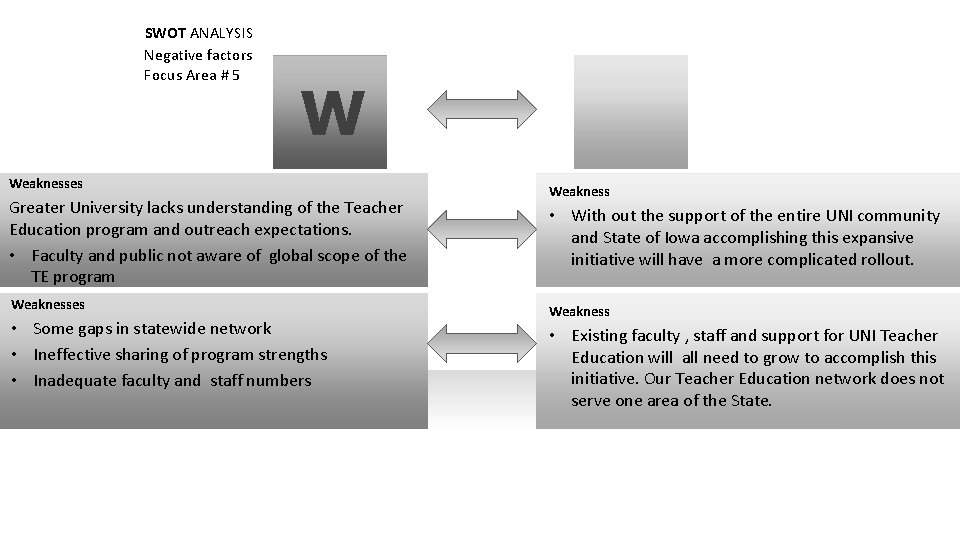
SWOT ANALYSIS Negative factors Focus Area # 5 W Weaknesses Greater University lacks understanding of the Teacher Education program and outreach expectations. • Faculty and public not aware of global scope of the TE program • Current outreach efforts not valued Weaknesses • Some gaps in statewide network • Ineffective sharing of program strengths • Inadequate faculty and staff numbers Weakness • With out the support of the entire UNI community and State of Iowa accomplishing this expansive initiative will have a more complicated rollout. Weakness • Existing faculty , staff and support for UNI Teacher Education will all need to grow to accomplish this initiative. Our Teacher Education network does not serve one area of the State.
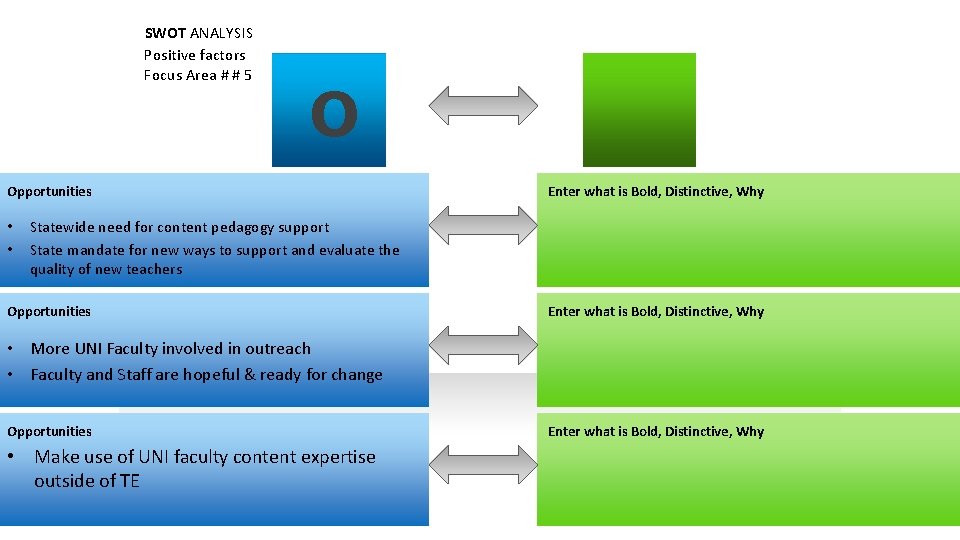
SWOT ANALYSIS Positive factors Focus Area # # 5 O Opportunities • • Enter what is Bold, Distinctive, Why Statewide need for content pedagogy support State mandate for new ways to support and evaluate the quality of new teachers Opportunities Enter what is Bold, Distinctive, Why • More UNI Faculty involved in outreach • Faculty and Staff are hopeful & ready for change Opportunities • Make use of UNI faculty content expertise outside of TE Enter what is Bold, Distinctive, Why
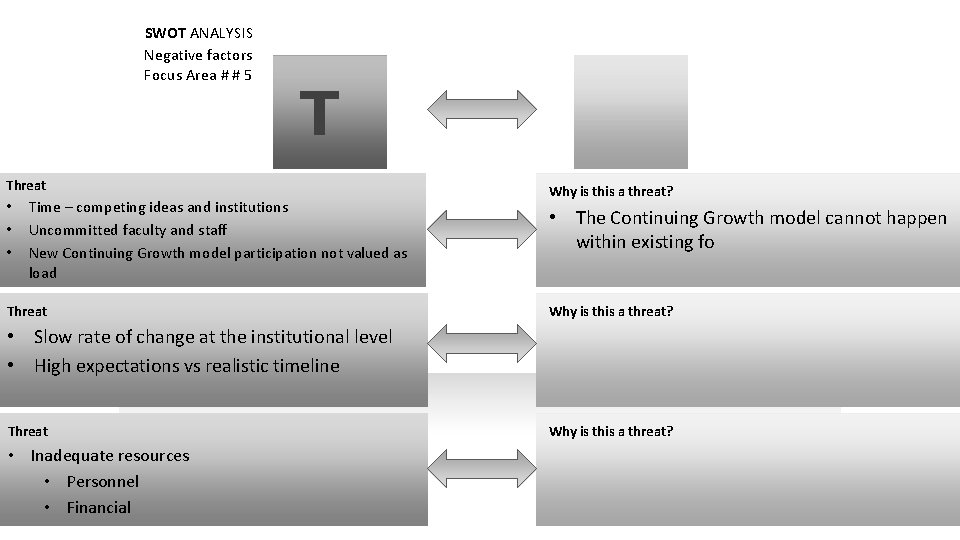
SWOT ANALYSIS Negative factors Focus Area # # 5 T Threat • • • Time – competing ideas and institutions Uncommitted faculty and staff New Continuing Growth model participation not valued as load Threat Why is this a threat? • The Continuing Growth model cannot happen within existing fo Why is this a threat? • Slow rate of change at the institutional level • High expectations vs realistic timeline Threat • Inadequate resources • Personnel • Financial Why is this a threat?
SWOT ANALYSIS Summary Focus Area: 5 SWOT summary S W O T The Continuing Growth Model Builds upon expanded on and off site faculty and staff to create and deliver a structured program of professional development for all practicing teachers in the State of Iowa and selective international schools.
Focus Area # 6 – Global Education/Ideas/Perspectives • SWOT Analysis • Bold and Distinctive Questionnaire 27
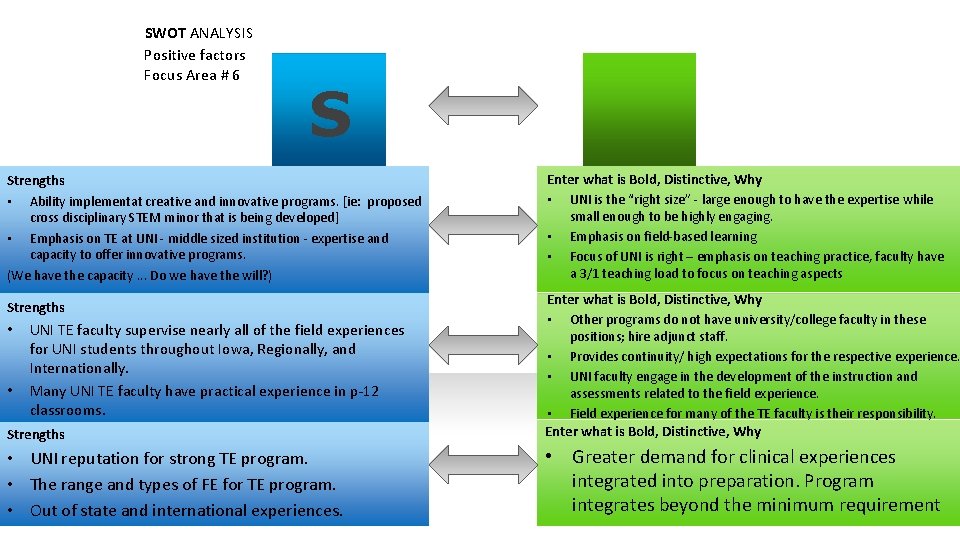
SWOT ANALYSIS Positive factors Focus Area # 6 S Strengths • Ability implementat creative and innovative programs. [ie: proposed cross disciplinary STEM minor that is being developed] • Emphasis on TE at UNI - middle sized institution - expertise and capacity to offer innovative programs. (We have the capacity. . . Do we have the will? ) Enter what is Bold, Distinctive, Why • UNI is the “right size” - large enough to have the expertise while small enough to be highly engaging. • Emphasis on field-based learning • Focus of UNI is right – emphasis on teaching practice, faculty have a 3/1 teaching load to focus on teaching aspects Strengths Enter what is Bold, Distinctive, Why • Other programs do not have university/college faculty in these positions; hire adjunct staff. • Provides continuity/ high expectations for the respective experience. • UNI faculty engage in the development of the instruction and assessments related to the field experience. • Field experience for many of the TE faculty is their responsibility. Enter what is Bold, Distinctive, Why • UNI reputation for strong TE program. • The range and types of FE for TE program. • Out of state and international experiences. • Greater demand for clinical experiences integrated into preparation. Program integrates beyond the minimum requirement Strengths • • UNI TE faculty supervise nearly all of the field experiences for UNI students throughout Iowa, Regionally, and Internationally. Many UNI TE faculty have practical experience in p-12 classrooms.
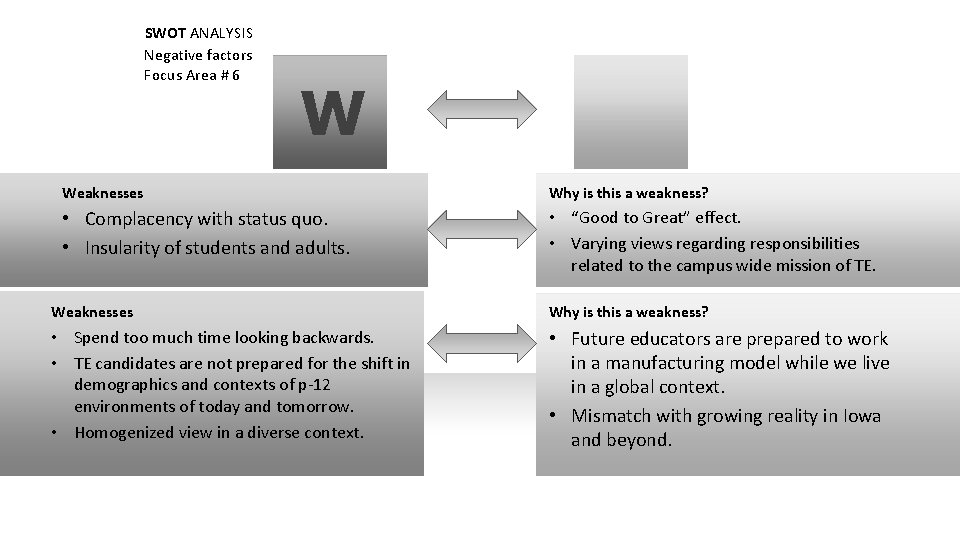
SWOT ANALYSIS Negative factors Focus Area # 6 W Weaknesses Why is this a weakness? • Complacency with status quo. • Insularity of students and adults. • “Good to Great” effect. • Varying views regarding responsibilities related to the campus wide mission of TE. Weaknesses Why is this a weakness? • Spend too much time looking backwards. • TE candidates are not prepared for the shift in demographics and contexts of p-12 environments of today and tomorrow. • Homogenized view in a diverse context. • Future educators are prepared to work in a manufacturing model while we live in a global context. • Mismatch with growing reality in Iowa and beyond.
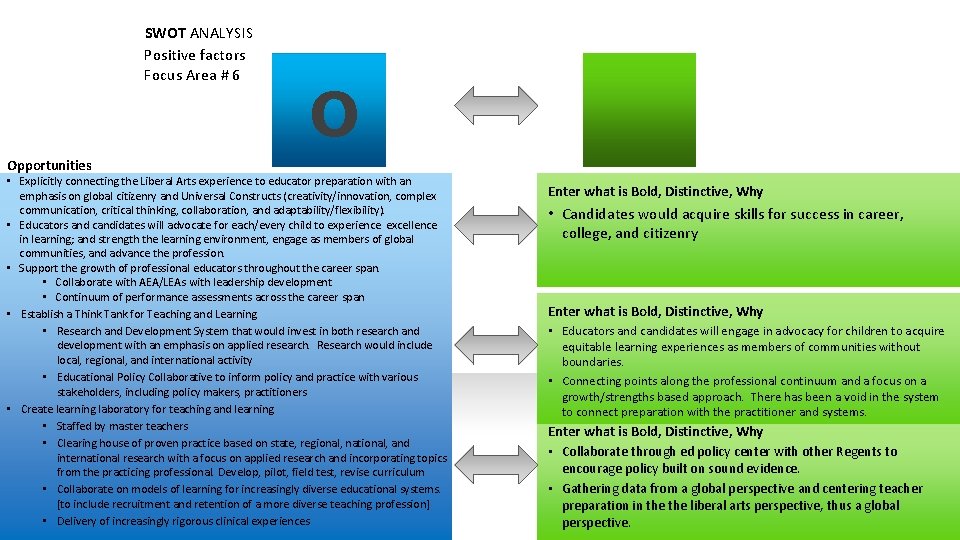
SWOT ANALYSIS Positive factors Focus Area # 6 O Opportunities • Explicitly connecting the Liberal Arts experience to educator preparation with an emphasis on global citizenry and Universal Constructs (creativity/innovation, complex communication, critical thinking, collaboration, and adaptability/flexibility). • Educators and candidates will advocate for each/every child to experience excellence in learning; and strength the learning environment, engage as members of global communities, and advance the profession. • Support the growth of professional educators throughout the career span. • Collaborate with AEA/LEAs with leadership development • Continuum of performance assessments across the career span • Establish a Think Tank for Teaching and Learning • Research and Development System that would invest in both research and development with an emphasis on applied research. Research would include local, regional, and international activity • Educational Policy Collaborative to inform policy and practice with various stakeholders, including policy makers, practitioners • Create learning laboratory for teaching and learning • Staffed by master teachers • Clearing house of proven practice based on state, regional, national, and international research with a focus on applied research and incorporating topics from the practicing professional. Develop, pilot, field test, revise curriculum • Collaborate on models of learning for increasingly diverse educational systems. [to include recruitment and retention of a more diverse teaching profession] • Delivery of increasingly rigorous clinical experiences Enter what is Bold, Distinctive, Why • Candidates would acquire skills for success in career, college, and citizenry Enter what is Bold, Distinctive, Why • Educators and candidates will engage in advocacy for children to acquire equitable learning experiences as members of communities without boundaries. • Connecting points along the professional continuum and a focus on a growth/strengths based approach. There has been a void in the system to connect preparation with the practitioner and systems. Enter what is Bold, Distinctive, Why • Collaborate through ed policy center with other Regents to encourage policy built on sound evidence. • Gathering data from a global perspective and centering teacher preparation in the liberal arts perspective, thus a global perspective.
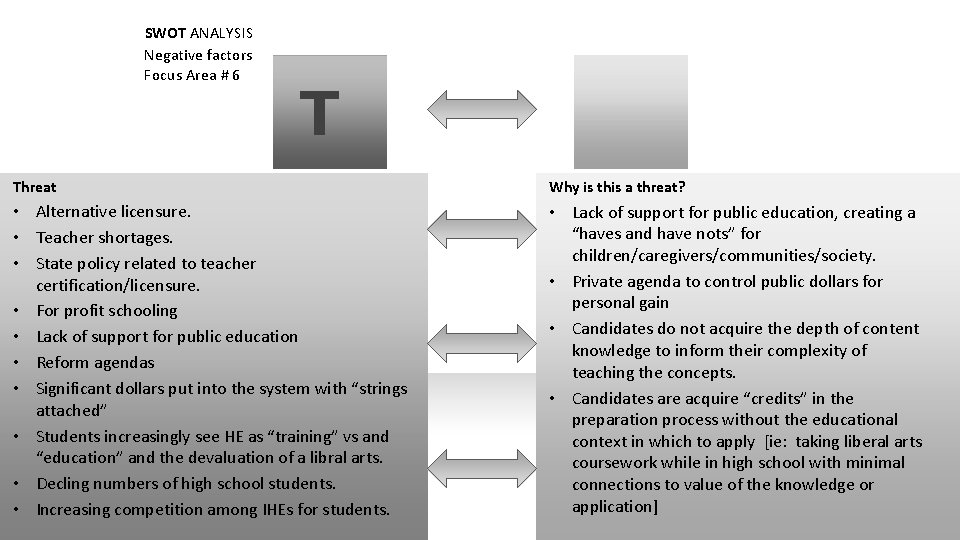
SWOT ANALYSIS Negative factors Focus Area # 6 T Threat Why is this a threat? • Alternative licensure. • Teacher shortages. • State policy related to teacher certification/licensure. • For profit schooling • Lack of support for public education • Reform agendas • Significant dollars put into the system with “strings attached” • Students increasingly see HE as “training” vs and “education” and the devaluation of a libral arts. • Decling numbers of high school students. • Increasing competition among IHEs for students. • Lack of support for public education, creating a “haves and have nots” for children/caregivers/communities/society. • Private agenda to control public dollars for personal gain • Candidates do not acquire the depth of content knowledge to inform their complexity of teaching the concepts. • Candidates are acquire “credits” in the preparation process without the educational context in which to apply [ie: taking liberal arts coursework while in high school with minimal connections to value of the knowledge or application]
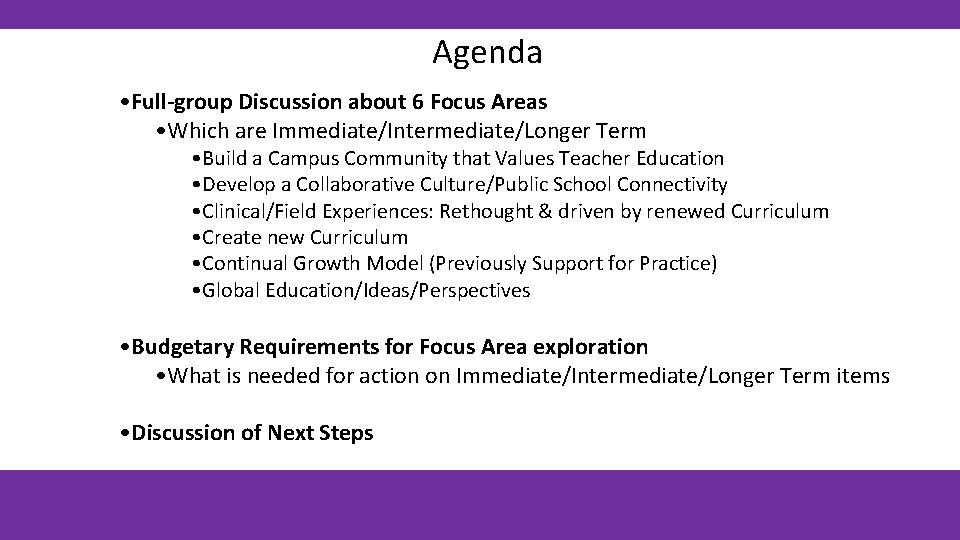
Agenda • Full-group Discussion about 6 Focus Areas • Which are Immediate/Intermediate/Longer Term • Build a Campus Community that Values Teacher Education • Develop a Collaborative Culture/Public School Connectivity • Clinical/Field Experiences: Rethought & driven by renewed Curriculum • Create new Curriculum • Continual Growth Model (Previously Support for Practice) • Global Education/Ideas/Perspectives • Budgetary Requirements for Focus Area exploration • What is needed for action on Immediate/Intermediate/Longer Term items • Discussion of Next Steps 32
Teacher Education Strategic Initiatives (TESI) Questions? Need Resources? Want us to Attend Focus Area Team Meetings? Nick Pace Nick. pace@uni. edu Cindy Diehl Yang Cindy. diehlyang@uni. edu 33