
ASI Agency for Strategic Initiatives National Technology Initiative


- Slides: 10
ASI: Agency for Strategic Initiatives National Technology Initiative. Aero. Net Market Development Roadmap Within the Framework of the 3 rd Meeting of the Strategic Council On Investment in New Industries Speaker: Sergey Zhukov Ekaterinburg| 8 July 2015
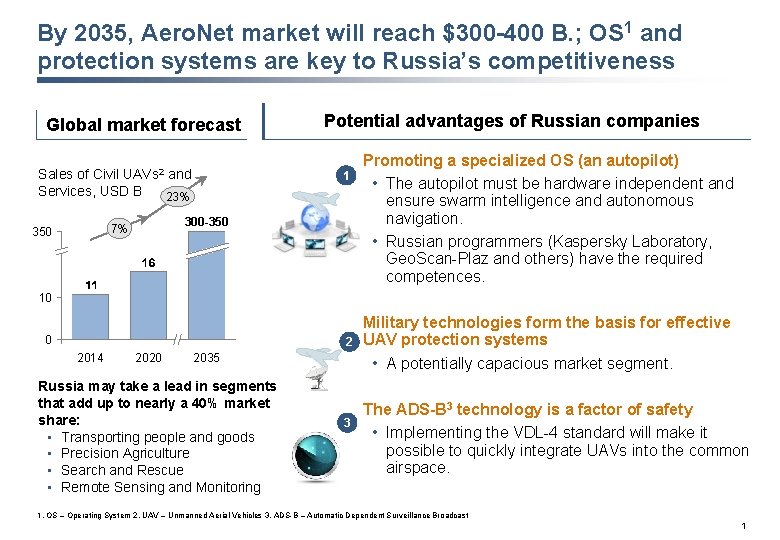
By 2035, Aero. Net market will reach $300 -400 B. ; OS 1 and protection systems are key to Russia’s competitiveness Global market forecast Sales of Civil UAVs 2 and Services, USD B 23% 1 300 -350 7% 350 Potential advantages of Russian companies Promoting a specialized OS (an autopilot) • The autopilot must be hardware independent and ensure swarm intelligence and autonomous navigation. • Russian programmers (Kaspersky Laboratory, Geo. Scan-Plaz and others) have the required competences. 10 0 2 2014 2020 2035 Russia may take a lead in segments that add up to nearly a 40% market share: • Transporting people and goods • Precision Agriculture • Search and Rescue • Remote Sensing and Monitoring 3 Military technologies form the basis for effective UAV protection systems • A potentially capacious market segment. The ADS-B 3 technology is a factor of safety • Implementing the VDL-4 standard will make it possible to quickly integrate UAVs into the common airspace. 1. OS – Operating System 2. UAV – Unmanned Aerial Vehicles 3. ADS-B – Automatic Dependent Surveillance Broadcast 1
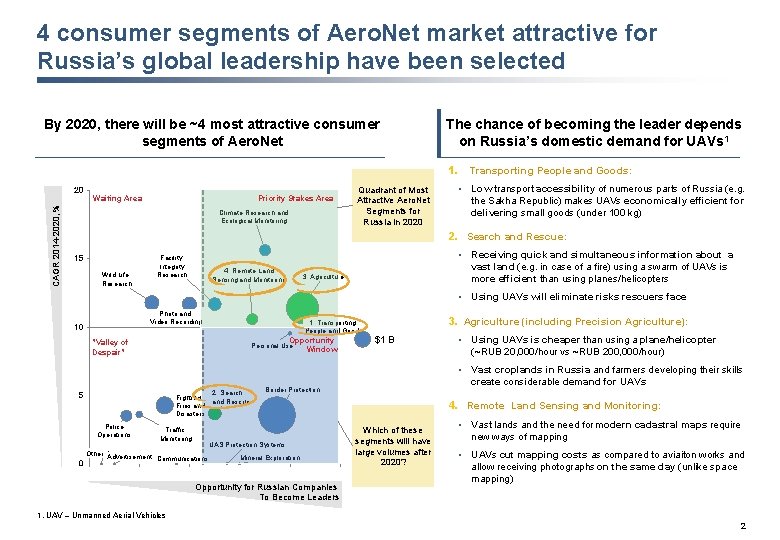
4 consumer segments of Aero. Net market attractive for Russia’s global leadership have been selected By 2020, there will be ~4 most attractive consumer segments of Aero. Net The chance of becoming the leader depends on Russia’s domestic demand for UAVs 1 1. CAGR 2014 -2020, % Waiting Area Priority Stakes Area Climate Research and Ecological Monitoring Quadrant of Most Attractive Aero. Net Segments for Russia in 2020 Transporting People and Goods: • Low transport accessibility of numerous parts of Russia (e. g. the Sakha Republic) makes UAVs economically efficient for delivering small goods (under 100 kg) 2. Search and Rescue: Facility Integrity Research Wild Life Research 4. Remote Land Sensing and Monitoring • Receiving quick and simultaneous information about a vast land (e. g. in case of a fire) using a swarm of UAVs is more efficient than using planes/helicopters 3. Agriculture • Using UAVs will eliminate risks rescuers face Photo and Video Recording 1. Transporting People and Goods Opportunity Window "Valley of Despair" Personal Use Fighting Fires and Disasters Police Operations Other Uses Advertisement Traffic Monitoring 2. Search and Rescue $1 B Mineral Exploration Opportunity for Russian Companies To Become Leaders • Using UAVs is cheaper than using a plane/helicopter (~RUB 20, 000/hour vs ~RUB 200, 000/hour) • Vast croplands in Russia and farmers developing their skills create considerable demand for UAVs Border Protection UAS Protection Systems Communications 3. Agriculture (including Precision Agriculture): 4. Remote Land Sensing and Monitoring: Which of these segments will have large volumes after 2020? • Vast lands and the need for modern cadastral maps require new ways of mapping • UAVs cut mapping costs as compared to aviaiton works and allow receiving photographs on the same day (unlike space mapping) 1. UAV – Unmanned Aerial Vehicles 2
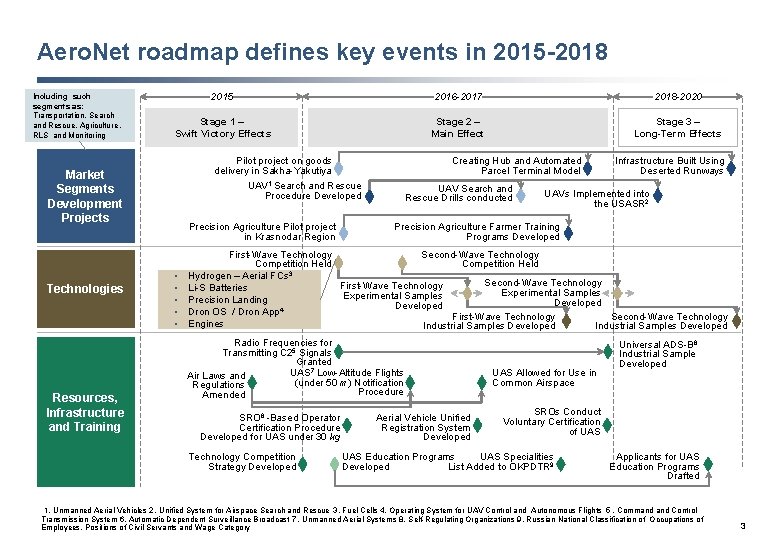
Aero. Net roadmap defines key events in 2015 -2018 Including such segments as: Transportation, Search and Rescue, Agriculture, RLS and Monitoring 2015 2016 -2017 2018 -2020 Stage 1 – Swift Victory Effects Stage 2 – Main Effect Stage 3 – Long-Term Effects Pilot project on goods delivery in Sakha-Yakutiya Market Segments Development Projects Technologies Resources, Infrastructure and Training Creating Hub and Automated Parcel Terminal Model UAV 1 Search and Rescue Procedure Developed Precision Agriculture Pilot project in Krasnodar Region • • • UAV Search and Rescue Drills conducted Infrastructure Built Using Deserted Runways UAVs Implemented into the USASR 2 Precision Agriculture Farmer Training Programs Developed First-Wave Technology Second-Wave Technology Competition Held Hydrogen – Aerial FCs 3 Second-Wave Technology First-Wave Technology Li-S Batteries Experimental Samples Precision Landing Developed 4 Dron OS / Dron App First-Wave Technology Second-Wave Technology Engines Industrial Samples Developed Radio Frequencies for Transmitting C 25 Signals Granted UAS 7 Low-Altitude Flights Air Laws and (under 50 m) Notification Regulations Procedure Amended SRO 8 -Based Operator Certification Procedure Developed for UAS under 30 kg Technology Competition Strategy Developed Aerial Vehicle Unified Registration System Developed UAS Allowed for Use in Common Airspace Universal ADS-B 6 Industrial Sample Developed SROs Conduct Voluntary Certification of UAS Education Programs UAS Specialities Developed List Added to OKPDTR 9 Applicants for UAS Education Programs Drafted 1. Unmanned Aerial Vehicles 2. Unified System for Airspace Search and Rescue 3. Fuel Cells 4. Operating System for UAV Control and Autonomous Flights 5. Command Control Transmission System 6. Automatic Dependent Surveillance Broadcast 7. Unmanned Aerial Systems 8. Self-Regulating Organizations 9. Russian National Classification of Occupations of Employees, Positions of Civil Servants and Wage Category 3
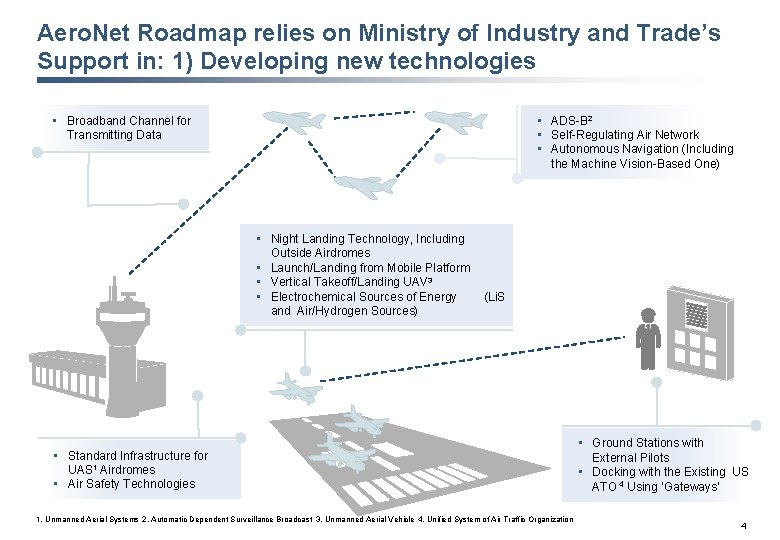
Aero. Net Roadmap relies on Ministry of Industry and Trade’s Support in: 1) Developing new technologies • Broadband Channel for Transmitting Data • ADS-B 2 • Self-Regulating Air Network • Autonomous Navigation (Including the Machine Vision-Based One) • Night Landing Technology, Including Outside Airdromes • Launch/Landing from Mobile Platform • Vertical Takeoff/Landing UAV 3 • Electrochemical Sources of Energy and Air/Hydrogen Sources) (Li. S • Standard Infrastructure for UAS 1 Airdromes • Air Safety Technologies 1. Unmanned Aerial Systems 2. Automatic Dependent Surveillance Broadcast 3. Unmanned Aerial Vehicle 4. Unified System of Air Traffic Organization • Ground Stations with External Pilots • Docking with the Existing US ATO 4 Using ‘Gateways’ 4
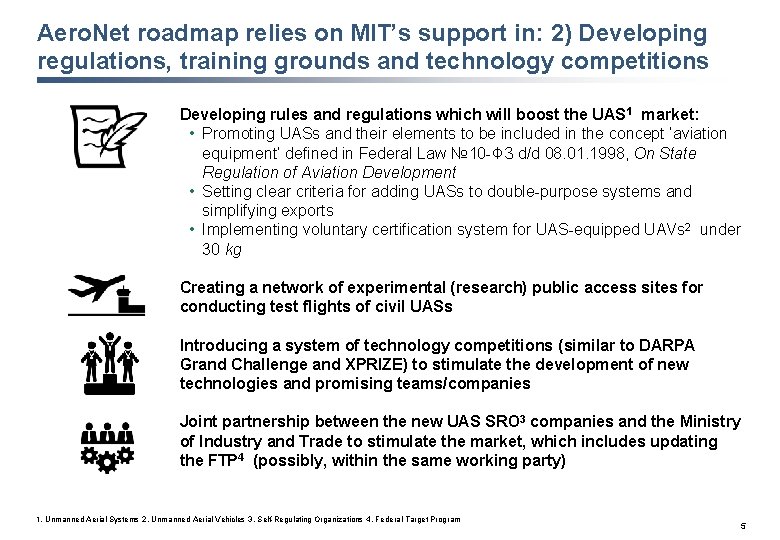
Aero. Net roadmap relies on MIT’s support in: 2) Developing regulations, training grounds and technology competitions Developing rules and regulations which will boost the UAS 1 market: • Promoting UASs and their elements to be included in the concept ‘aviation equipment‘ defined in Federal Law № 10 -ФЗ d/d 08. 01. 1998, On State Regulation of Aviation Development • Setting clear criteria for adding UASs to double-purpose systems and simplifying exports • Implementing voluntary certification system for UAS-equipped UAVs 2 under 30 kg Creating a network of experimental (research) public access sites for conducting test flights of civil UASs Introducing a system of technology competitions (similar to DARPA Grand Challenge and XPRIZE) to stimulate the development of new technologies and promising teams/companies Joint partnership between the new UAS SRO 3 companies and the Ministry of Industry and Trade to stimulate the market, which includes updating the FTP 4 (possibly, within the same working party) 1. Unmanned Aerial Systems 2. Unmanned Aerial Vehicles 3. Self-Regulating Organizations 4. Federal Target Program 5
Appendices – Aero. Net Market Development Roadmap 6
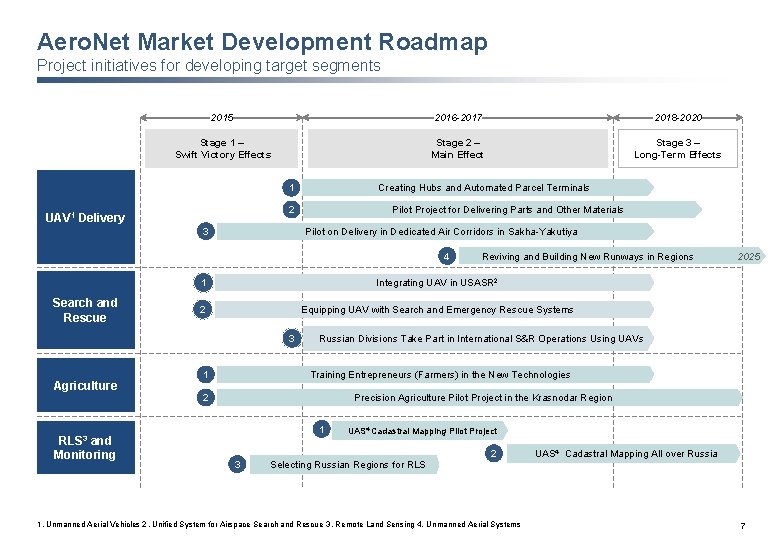
Aero. Net Market Development Roadmap Project initiatives for developing target segments 2015 2016 -2017 2018 -2020 Stage 1 – Swift Victory Effects Stage 2 – Main Effect Stage 3 – Long-Term Effects Creating Hubs and Automated Parcel Terminals 1 2 UAV 1 Delivery Pilot Project for Delivering Parts and Other Materials Pilot on Delivery in Dedicated Air Corridors in Sakha-Yakutiya 3 4 Search and Rescue 1 Integrating UAV in USASR 2 2 Equipping UAV with Search and Emergency Rescue Systems 3 Agriculture 2025 Russian Divisions Take Part in International S&R Operations Using UAVs Training Entrepreneurs (Farmers) in the New Technologies 1 Precision Agriculture Pilot Project in the Krasnodar Region 2 and Monitoring Reviving and Building New Runways in Regions 1 RLS 3 3 UAS 4 Cadastral Mapping Pilot Project 2 Selecting Russian Regions for RLS 1. Unmanned Aerial Vehicles 2. Unified System for Airspace Search and Rescue 3. Remote Land Sensing 4. Unmanned Aerial Systems UAS 4 Cadastral Mapping All over Russia 7
Aero. Net Market Development Roadmap Key technologies development initiatives 2015 2016 -2017 2018 -2020 Stage 1 – Swift Victory Effects Stage 2 – Main Effect Stage 3 – Long-Term Effects Developing ADS-B 1 for using UAVs 2 in the common airspace 1 Aero. Net General Technologies 2 Dron OS / Dron App 3 3 Developing Fuel Cell technology (FC) for civil UAVs UAV positioning systems, including local navigation 1 Transportation Precision Landing 2 Speed Vertical Takeoff/Landing UAVs 3 Search and Rescue 1 UAV Swarm Control 2 User-Friendly Unified Control Interface 3 Resistance to Extreme Environments 4 Agriculture 2022 UAV Autonomous Operation and Decision Support 1 Processing and Interpreting the Obtained Data 2 Creating UAS 4 for Adding Crop Control Substances 3 Perfecting the Existing or Searching New Sensors 1. Automatic Dependent Surveillance Broadcast 2. Unmanned Aerial Vehicles 3. Operating System for UAV Control and Autonomous Flights 4. Unmanned Aerial Systems 8
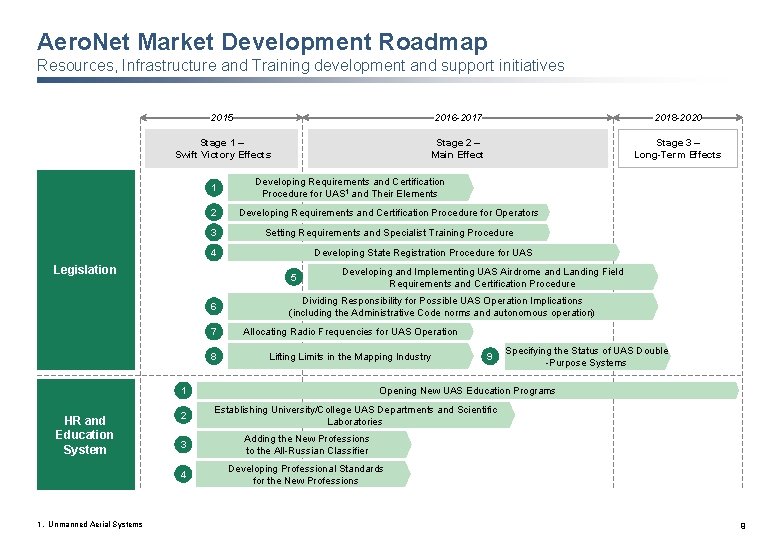
Aero. Net Market Development Roadmap Resources, Infrastructure and Training development and support initiatives 2015 2016 -2017 2018 -2020 Stage 1 – Swift Victory Effects Stage 2 – Main Effect Stage 3 – Long-Term Effects 1 Developing Requirements and Certification Procedure for UAS 1 and Their Elements 2 Developing Requirements and Certification Procedure for Operators 3 Setting Requirements and Specialist Training Procedure Developing State Registration Procedure for UAS 4 Legislation 5 6 Developing and Implementing UAS Airdrome and Landing Field Requirements and Certification Procedure Dividing Responsibility for Possible UAS Operation Implications (including the Administrative Code norms and autonomous operation) 7 Allocating Radio Frequencies for UAS Operation 8 Lifting Limits in the Mapping Industry 1 HR and Education System 1. Unmanned Aerial Systems 2 9 Specifying the Status of UAS Double -Purpose Systems Opening New UAS Education Programs Establishing University/College UAS Departments and Scientific Laboratories 3 Adding the New Professions to the All-Russian Classifier 4 Developing Professional Standards for the New Professions 9