Tax Efficient Portfolio Construction and Longevity Planning Presented
- Slides: 59
Tax Efficient Portfolio Construction and Longevity Planning Presented by: Thomas Sartor, CFA October 30, 2018
Disclosures • • The Financial Advisory Group, Inc. is not a CPA firm or a law firm. The following should not be construed as advice or investment recommendations Historical performance results for investment indices and/or categories have been provided for general comparison purposes only. Past results are not indicative of future results. To the extent that any individual utilizes any economic calculator , monte carlo simulation or forward looking statement within individual acknowledges and understands that the information resulting from the use of any such calculator/device/simulation , is not, and should not be construed, in any manner whatsoever, as the receipt of, or a substitute for, personalized individual advice from The Financial Advisory Group, or from any other investment professional.
Overview • Constructing Tax Efficient Portfolios • Planning for Longevity • Tax burden in retirement: RMDs + after tax savings • Sequence of Return Risk
Question • Raise your hand if you spend time doing personal financial planning beyond just tax preparation • Leave your hands up if you also make investment recommendations
Facts and Circumstances • No two clients are exactly alike • Recommendations should be made based upon individuals facts and circumstances
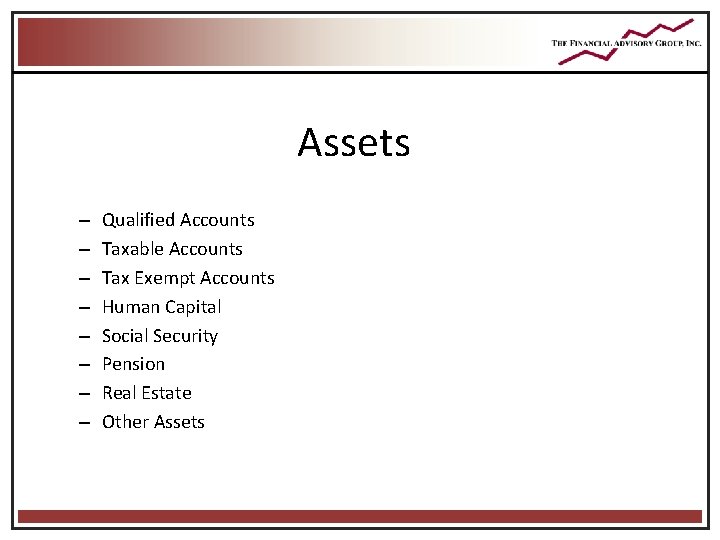
Assets – – – – Qualified Accounts Taxable Accounts Tax Exempt Accounts Human Capital Social Security Pension Real Estate Other Assets
• In the accumulation phase – identify excess (savings) and balance saving/investing between qualified and after tax assets for retirement distribution planning. • In both accumulation and distribution phase – incorporate all assets and all liabilities into planning. Try to avoid looking at assets and liabilities in isolation (bucketing)
Liabilities – Lifestyle – Debt • Mortgage • Student Loans – Fund Retirement • Cash Flow Needs • Taxes • Inflation – Other Liabilities
Tax Efficient Portfolio Construction
Asset Liability Matching • Construct a portfolio using your assets to meet current and future liabilities. • Goals-Based – Primary • Don’t run out of money – Secondary • Generational wealth transfer? • Charitable intent? • Others?
Investment Policy Statement • • Return Risk Time Horizon Taxes Liquidity Needs Legal Unique Circumstances
Portfolio Yield • Constructing portfolio with ‘yield target’ can result in a non-optimal asset allocation and unforeseen concentrated risks. • Mixture of price appreciation and income is better from both a taxation and total return perspective. – Income: Generally less volatile but also less tax efficient. May be taxed at higher rates and cannot control the timing of taxation. – Price Appreciation: Generally more volatile but also more tax efficient. Taxed at lower rates and can control the timing of taxation. Gains can be deferred and losses can be realized. • Focus on total return, not just income.
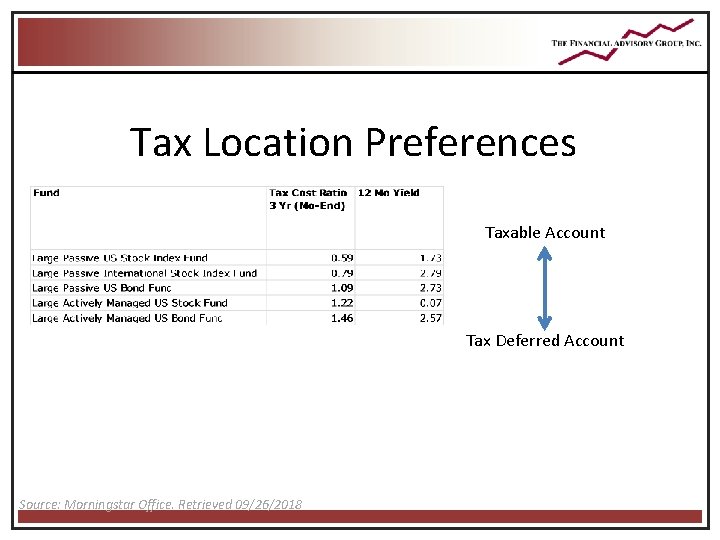
Tax Location • Tax Efficient Assets -> Taxable Accounts • Tax Inefficient Assets -> Tax Deferred/Exempt Accounts
Tax Location Preferences Taxable Account Tax Deferred Account Source: Morningstar Office. Retrieved 09/26/2018
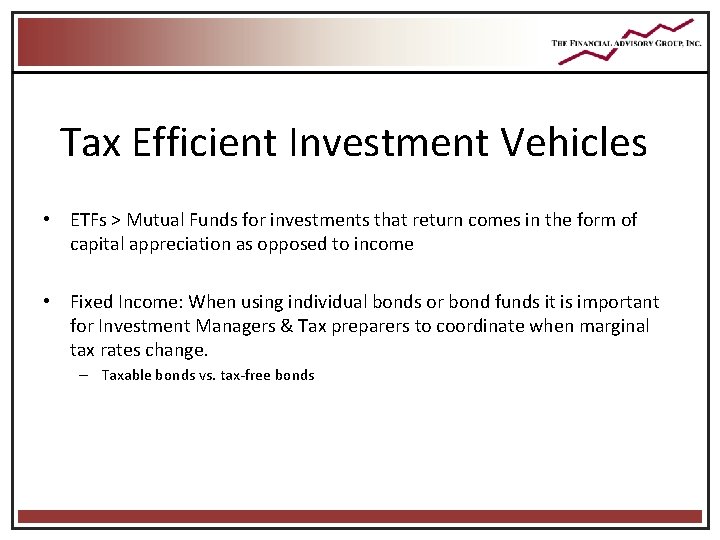
Tax Efficient Investment Vehicles • ETFs > Mutual Funds for investments that return comes in the form of capital appreciation as opposed to income • Fixed Income: When using individual bonds or bond funds it is important for Investment Managers & Tax preparers to coordinate when marginal tax rates change. – Taxable bonds vs. tax-free bonds
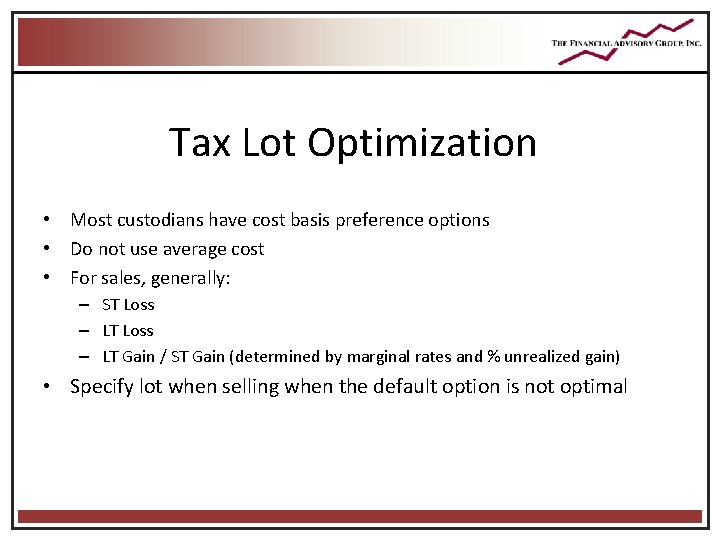
Tax Lot Optimization • Most custodians have cost basis preference options • Do not use average cost • For sales, generally: – ST Loss – LT Gain / ST Gain (determined by marginal rates and % unrealized gain) • Specify lot when selling when the default option is not optimal
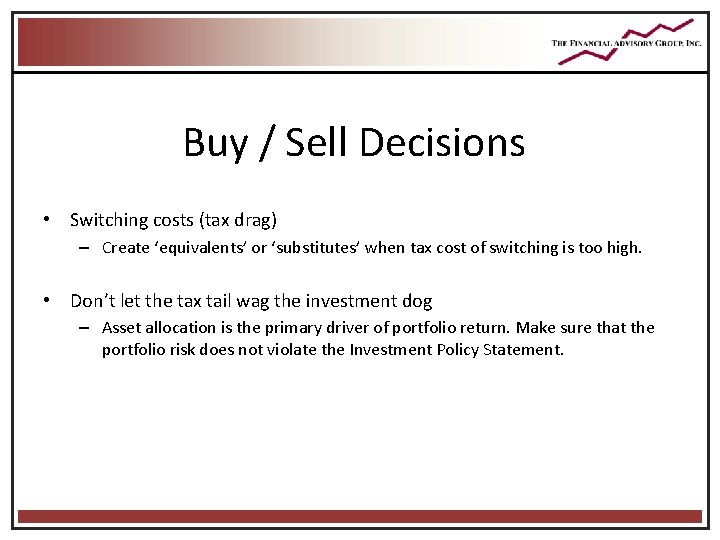
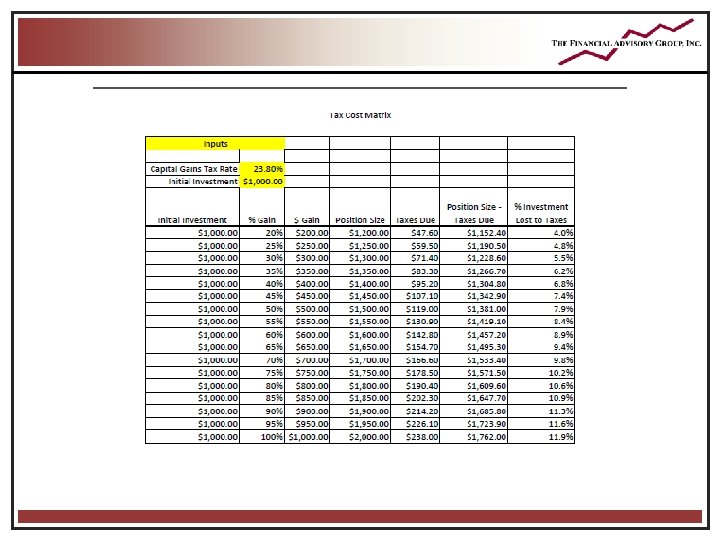
Buy / Sell Decisions • Switching costs (tax drag) – Create ‘equivalents’ or ‘substitutes’ when tax cost of switching is too high. • Don’t let the tax tail wag the investment dog – Asset allocation is the primary driver of portfolio return. Make sure that the portfolio risk does not violate the Investment Policy Statement.
Tax Loss Harvesting • Not just in December! • Scan for short term tax lots throughout the year at a loss that are approaching 365 days
Low Basis Concentrated Positions • Hedging Strategies – Options strategies – collars • Exchange Funds • Charitable Intent • Wait for step up in basis
Dealing with Legacy Securities • Charitable intent? Donate • Use equivalencies / hold instead of substitute securities
Charitable Intent • Generally: Appreciated property > QCDs – Under certain conditions QCDs may make sense.
Donor Advised Funds • Bundle donations for years in which taxable income is higher.
Longevity Planning
Setting Expectations • Most clients do not have sufficient assets to ‘immunize’ future liabilities without taking some portfolio risk given today’s low interest rates. Even if they do, with little standard of living risk it may make more sense to be more aggressive. • Drawdown of portfolio is normal in retirement (certainly in real terms). Set expectations that amortization of capital in retirement is likely.
Communication • Tax Preparation / Investment Management / Financial Planning / Estate Planning
Meeting Cash Flow Needs • Customization / Flexibility is key • Sources of retirement income – – – Social Security Retirement Accounts (RMDs) Pensions After-Tax Accounts Guaranteed Income Other Sources • Real Estate related income, Life Insurance, Royalties
RMDs • Difficult to avoid RMDs – planning adequately for them is therefore important – Incorporate tax projections / cash flow discussions into regular client meetings. – In some cases if a client is still working and has a qualified plan (and are less than 5% owner) may consider rolling in assets if possible. • If assets are staying in the portfolio – sell most tax efficient asset in the IRA and purchase it back in the taxable account.
Roth Conversions • Backdoor Roth IRA strategy for clients with income and no other IRA assets • Current tax rate vs. future tax rate • Filling up lower tax brackets • In the context of taxable estates
Facing Retirement Risks • Inflation • Longevity Risk • Public Policy Risk – Tax law changes – Estate law changes – Social Security changes • Healthcare • Elder Care / Child Care • Market Risk – Sequence of return risk is key!
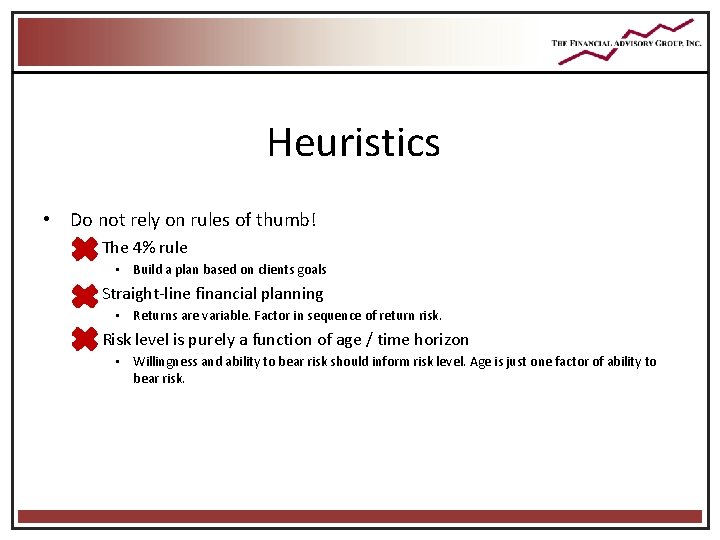
Heuristics • Do not rely on rules of thumb! – The 4% rule • Build a plan based on clients goals – Straight-line financial planning • Returns are variable. Factor in sequence of return risk. – Risk level is purely a function of age / time horizon • Willingness and ability to bear risk should inform risk level. Age is just one factor of ability to bear risk.
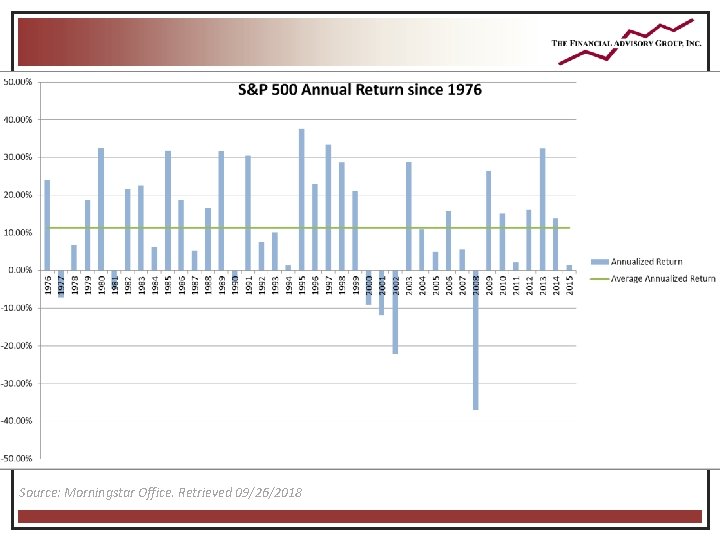
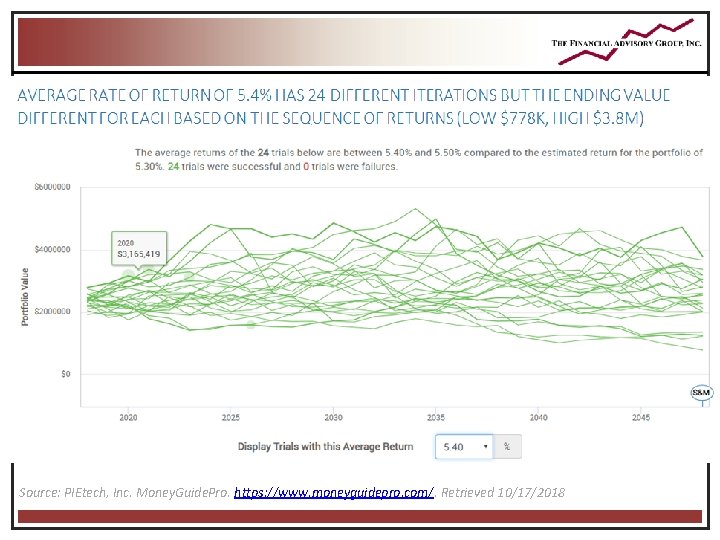
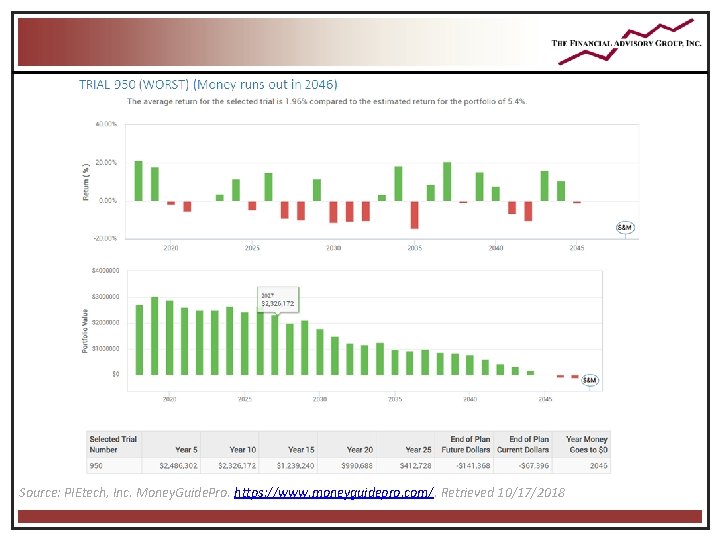
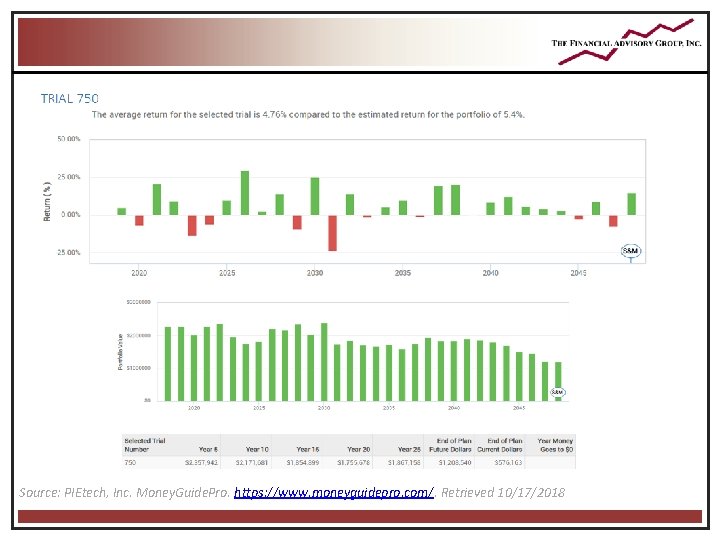
Sequence of return risk • Average return can be is misleading • Very difficult to recover from setbacks early in retirement.
Source: Morningstar Office. Retrieved 09/26/2018
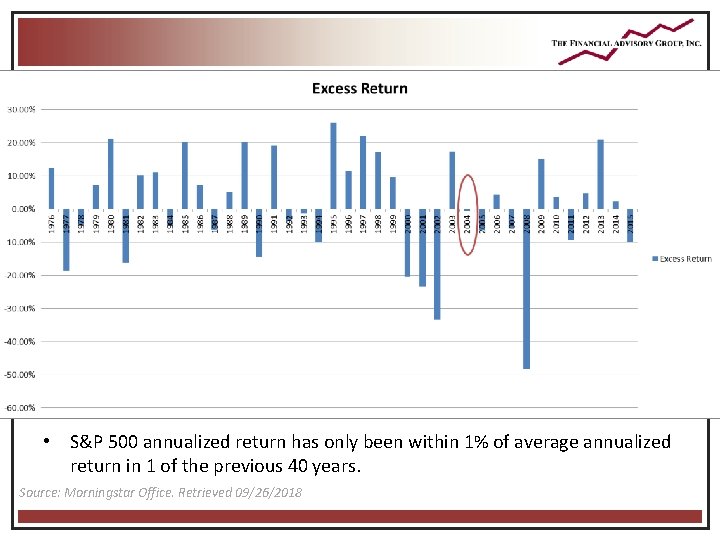
• S&P 500 annualized return has only been within 1% of average annualized return in 1 of the previous 40 years. Source: Morningstar Office. Retrieved 09/26/2018
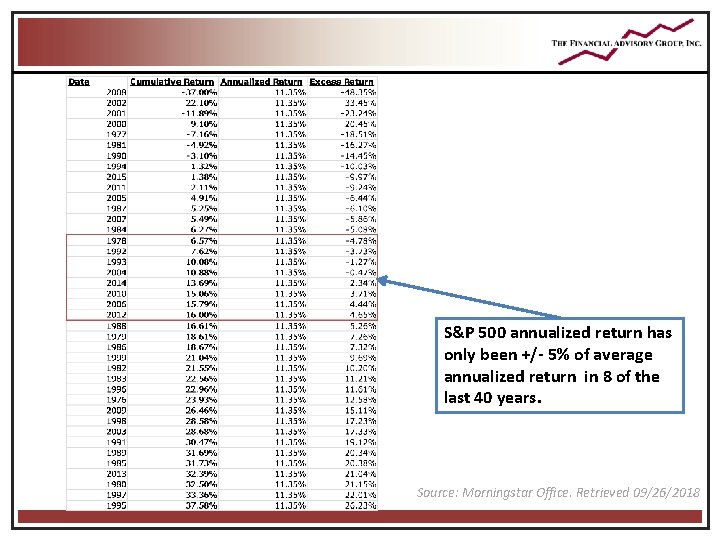
S&P 500 annualized return has only been +/- 5% of average annualized return in 8 of the last 40 years. Source: Morningstar Office. Retrieved 09/26/2018
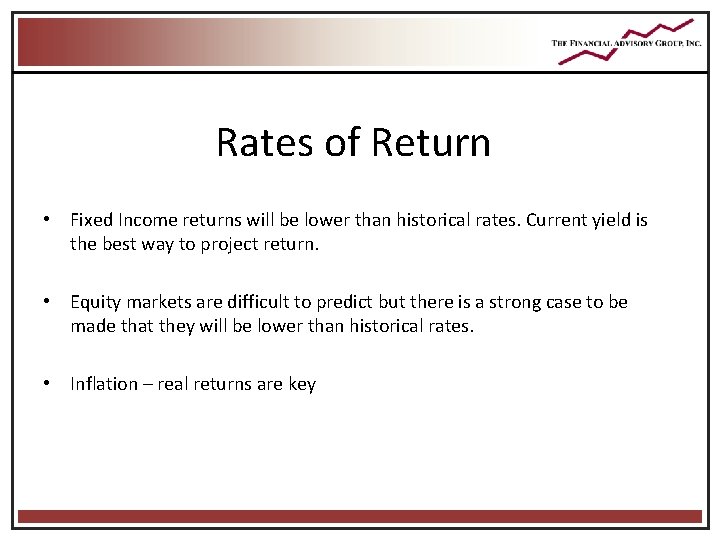
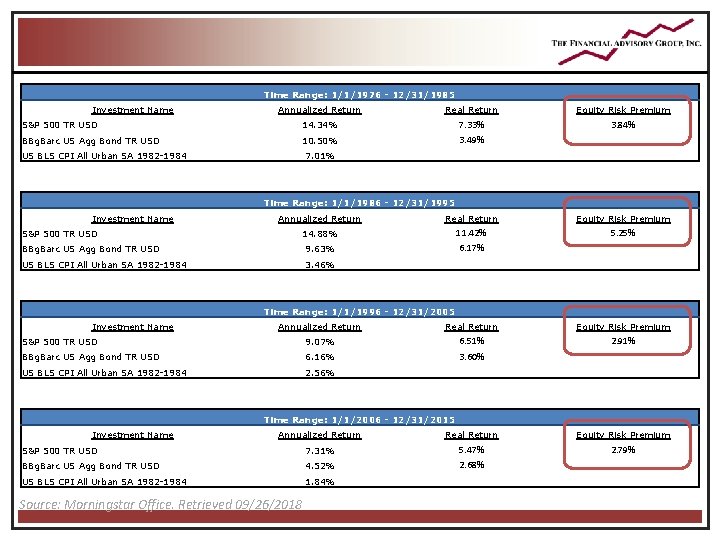
Rates of Return • Fixed Income returns will be lower than historical rates. Current yield is the best way to project return. • Equity markets are difficult to predict but there is a strong case to be made that they will be lower than historical rates. • Inflation – real returns are key
A Note on Forecasting • I don’t like them • The following slides are not intended to be a forward looking forecast – they are intended to use historical data to present a case that rates of return may be lower in the future
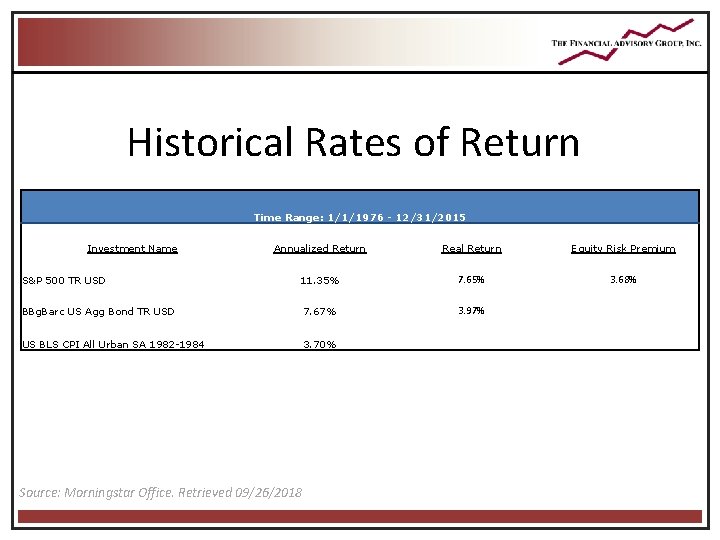
Historical Rates of Return Time Range: 1/1/1976 - 12/31/2015 Investment Name Annualized Return Real Return Equity Risk Premium 11. 35% 7. 65% 3. 68% BBg. Barc US Agg Bond TR USD 7. 67% 3. 97% US BLS CPI All Urban SA 1982 -1984 3. 70% S&P 500 TR USD Source: Morningstar Office. Retrieved 09/26/2018
Time Range: 1/1/1976 - 12/31/1985 Investment Name Annualized Return Real Return Equity Risk Premium S&P 500 TR USD 14. 34% 7. 33% 3. 84% BBg. Barc US Agg Bond TR USD 10. 50% 3. 49% 7. 01% Annualized Return Real Return Equity Risk Premium US BLS CPI All Urban SA 1982 -1984 Time Range: 1/1/1986 - 12/31/1995 Investment Name 14. 88% 11. 42% 5. 25% BBg. Barc US Agg Bond TR USD 9. 63% 6. 17% US BLS CPI All Urban SA 1982 -1984 3. 46% Annualized Return Real Return Equity Risk Premium 9. 07% 6. 51% 2. 91% BBg. Barc US Agg Bond TR USD 6. 16% 3. 60% US BLS CPI All Urban SA 1982 -1984 2. 56% Annualized Return Real Return Equity Risk Premium S&P 500 TR USD 7. 31% 5. 47% 2. 79% BBg. Barc US Agg Bond TR USD 4. 52% 2. 68% 1. 84% S&P 500 TR USD Time Range: 1/1/1996 - 12/31/2005 Investment Name S&P 500 TR USD Time Range: 1/1/2006 - 12/31/2015 Investment Name US BLS CPI All Urban SA 1982 -1984 Source: Morningstar Office. Retrieved 09/26/2018
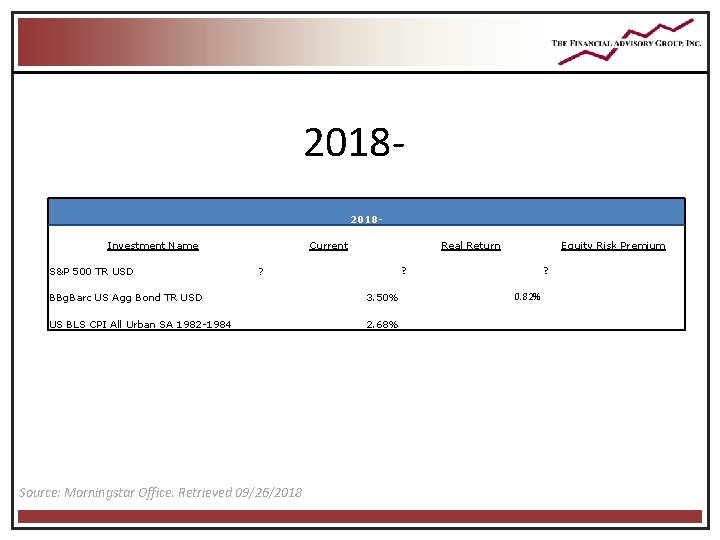
2018 Investment Name S&P 500 TR USD Current Real Return ? ? BBg. Barc US Agg Bond TR USD 3. 50% US BLS CPI All Urban SA 1982 -1984 2. 68% Source: Morningstar Office. Retrieved 09/26/2018 Equity Risk Premium ? 0. 82%
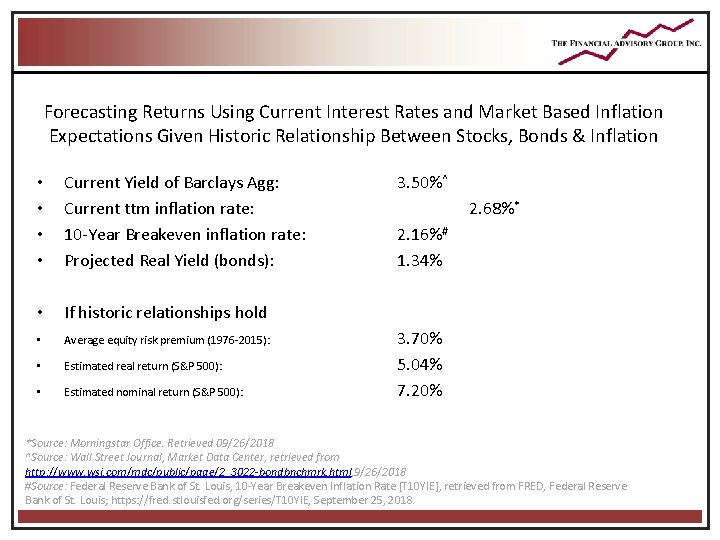
Forecasting Returns Using Current Interest Rates and Market Based Inflation Expectations Given Historic Relationship Between Stocks, Bonds & Inflation • • Current Yield of Barclays Agg: Current ttm inflation rate: 10 -Year Breakeven inflation rate: Projected Real Yield (bonds): • If historic relationships hold • Average equity risk premium (1976 -2015): • Estimated real return (S&P 500): • Estimated nominal return (S&P 500): 3. 50%^ 2. 68%* 2. 16%# 1. 34% 3. 70% 5. 04% 7. 20% *Source: Morningstar Office. Retrieved 09/26/2018 ^Source: Wall Street Journal, Market Data Center, retrieved from http: //www. wsj. com/mdc/public/page/2_3022 -bondbnchmrk. html, 9/26/2018 #Source: Federal Reserve Bank of St. Louis, 10 -Year Breakeven Inflation Rate [T 10 YIE], retrieved from FRED, Federal Reserve Bank of St. Louis; https: //fred. stlouisfed. org/series/T 10 YIE, September 25, 2018.
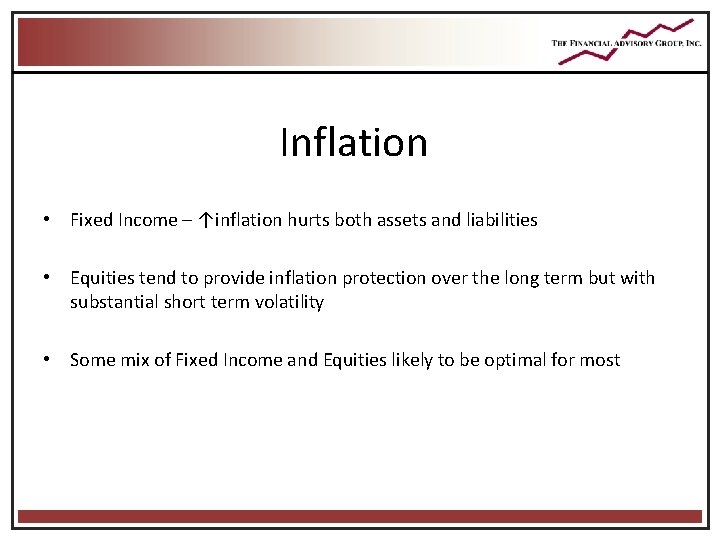
Inflation • Fixed Income – ↑inflation hurts both assets and liabilities • Equities tend to provide inflation protection over the long term but with substantial short term volatility • Some mix of Fixed Income and Equities likely to be optimal for most
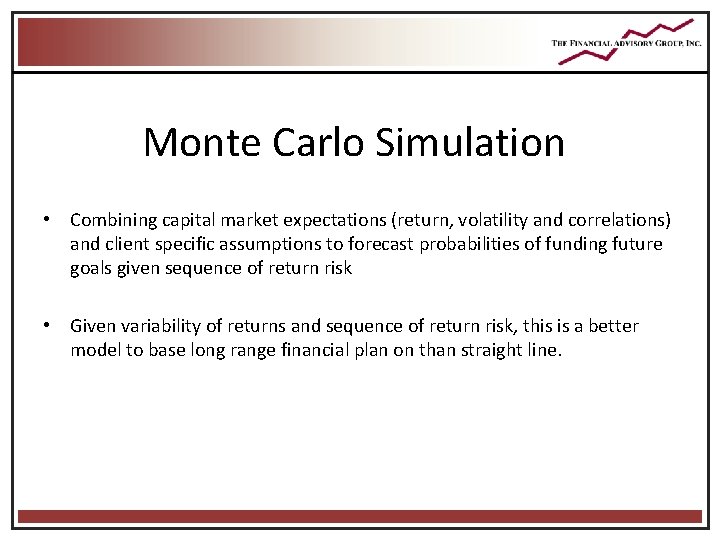
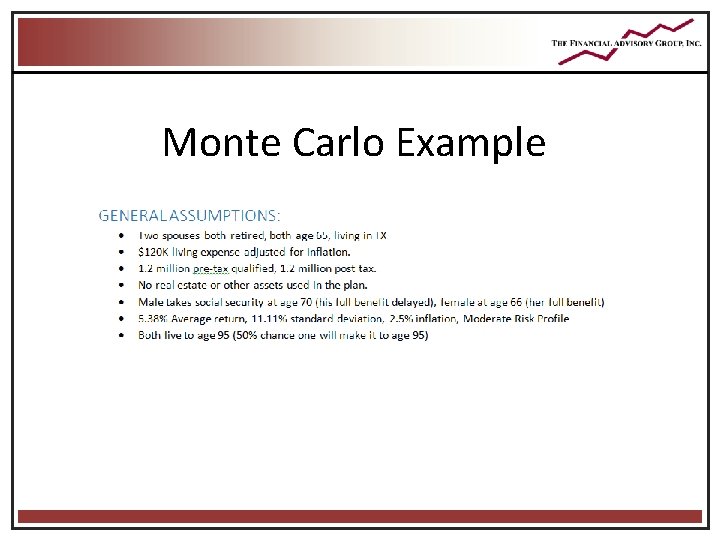
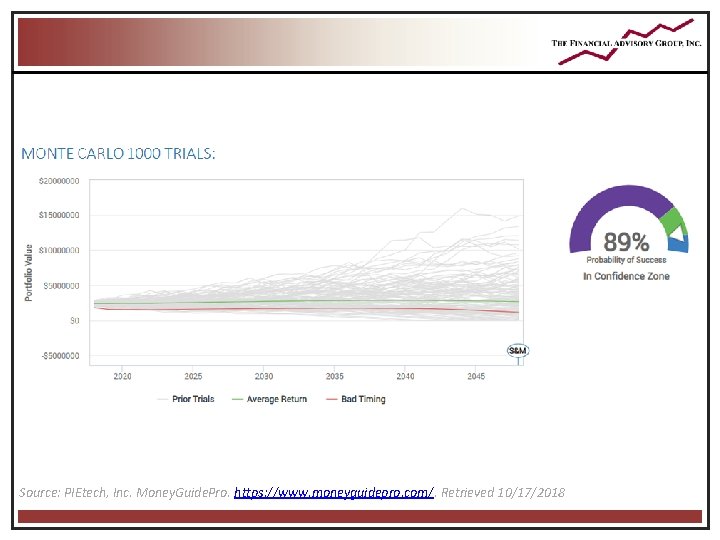
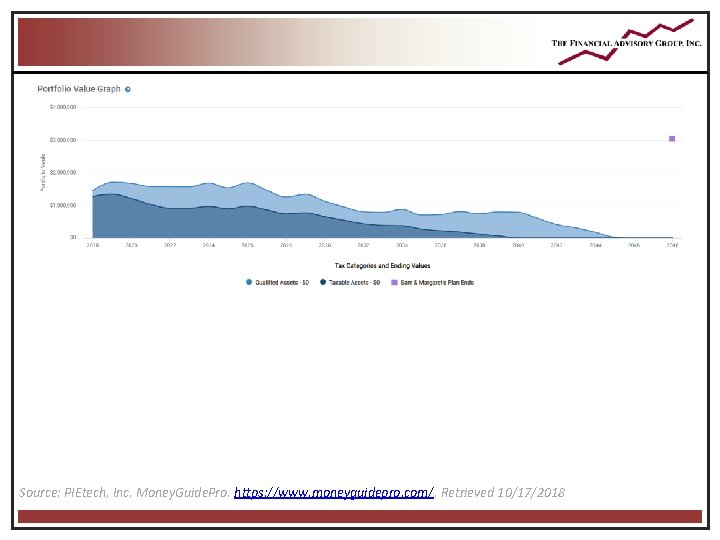
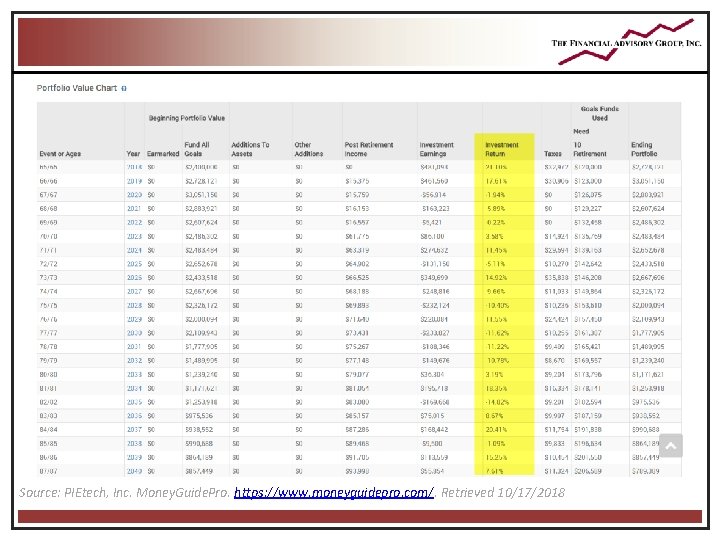
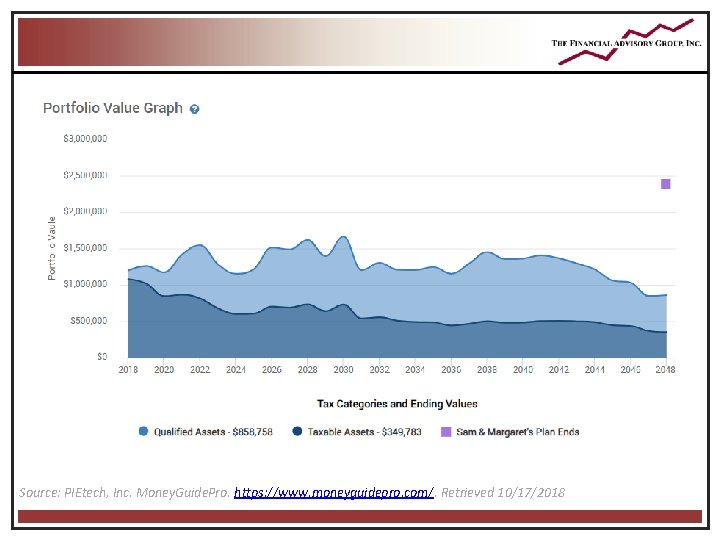
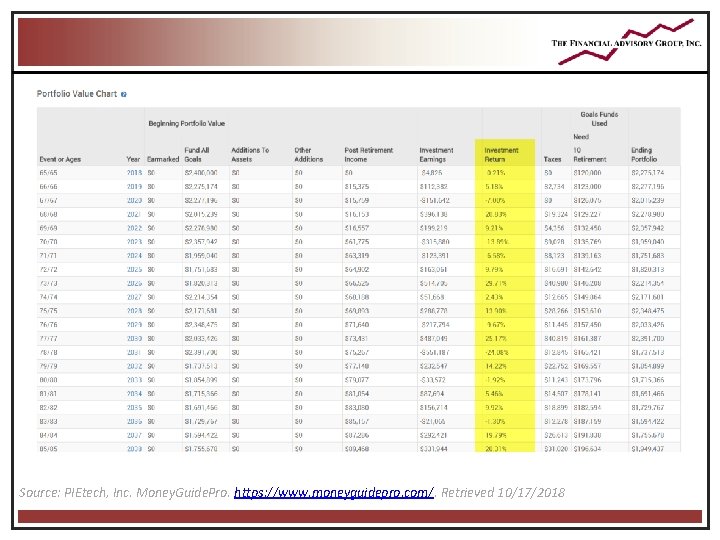
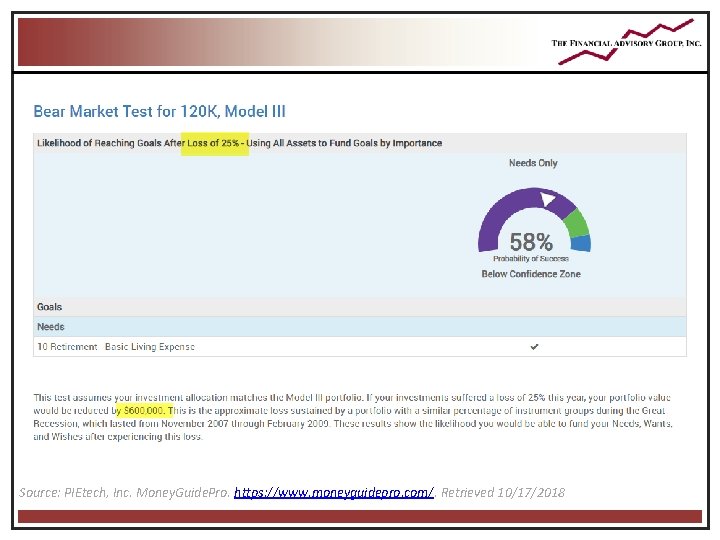
Monte Carlo Simulation • Combining capital market expectations (return, volatility and correlations) and client specific assumptions to forecast probabilities of funding future goals given sequence of return risk • Given variability of returns and sequence of return risk, this is a better model to base long range financial plan on than straight line.
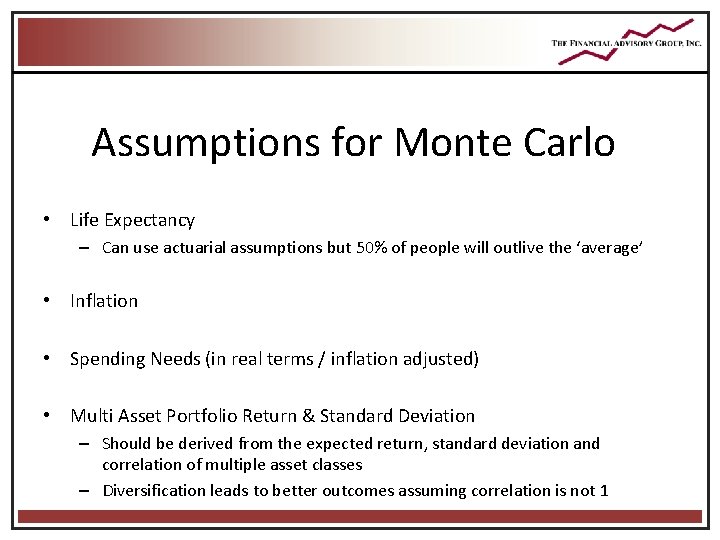
Assumptions for Monte Carlo • Life Expectancy – Can use actuarial assumptions but 50% of people will outlive the ‘average’ • Inflation • Spending Needs (in real terms / inflation adjusted) • Multi Asset Portfolio Return & Standard Deviation – Should be derived from the expected return, standard deviation and correlation of multiple asset classes – Diversification leads to better outcomes assuming correlation is not 1
What Do we Solve For? • Probability of funding all goals = not running out of money – Alternatively, probability that you may have to modify your plan • Risk ≠ standard deviation
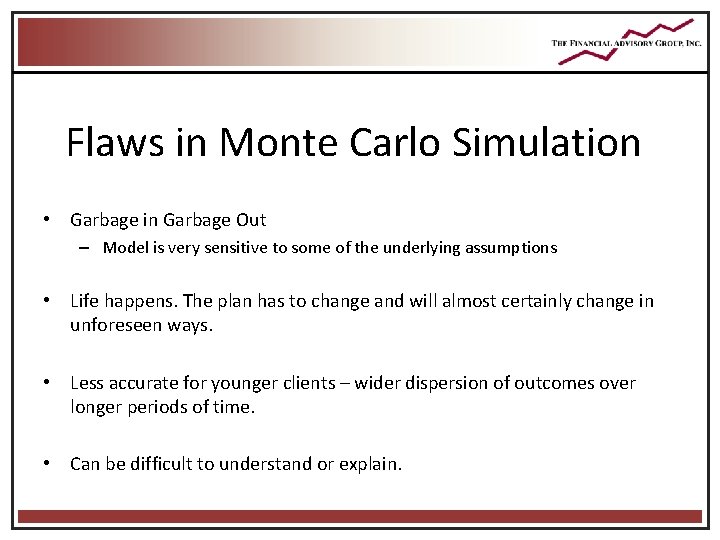
Flaws in Monte Carlo Simulation • Garbage in Garbage Out – Model is very sensitive to some of the underlying assumptions • Life happens. The plan has to change and will almost certainly change in unforeseen ways. • Less accurate for younger clients – wider dispersion of outcomes over longer periods of time. • Can be difficult to understand or explain.
Monte Carlo Example
Source: PIEtech, Inc. Money. Guide. Pro. https: //www. moneyguidepro. com/. Retrieved 10/17/2018
Source: PIEtech, Inc. Money. Guide. Pro. https: //www. moneyguidepro. com/. Retrieved 10/17/2018
Source: PIEtech, Inc. Money. Guide. Pro. https: //www. moneyguidepro. com/. Retrieved 10/17/2018
Source: PIEtech, Inc. Money. Guide. Pro. https: //www. moneyguidepro. com/. Retrieved 10/17/2018
Source: PIEtech, Inc. Money. Guide. Pro. https: //www. moneyguidepro. com/. Retrieved 10/17/2018
Source: PIEtech, Inc. Money. Guide. Pro. https: //www. moneyguidepro. com/. Retrieved 10/17/2018
Source: PIEtech, Inc. Money. Guide. Pro. https: //www. moneyguidepro. com/. Retrieved 10/17/2018
Source: PIEtech, Inc. Money. Guide. Pro. https: //www. moneyguidepro. com/. Retrieved 10/17/2018
Source: PIEtech, Inc. Money. Guide. Pro. https: //www. moneyguidepro. com/. Retrieved 10/17/2018
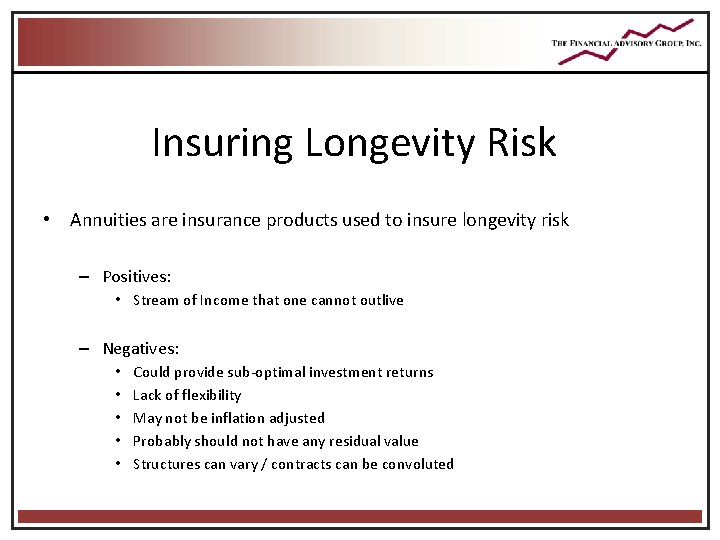
Insuring Longevity Risk • Annuities are insurance products used to insure longevity risk – Positives: • Stream of Income that one cannot outlive – Negatives: • • • Could provide sub-optimal investment returns Lack of flexibility May not be inflation adjusted Probably should not have any residual value Structures can vary / contracts can be convoluted
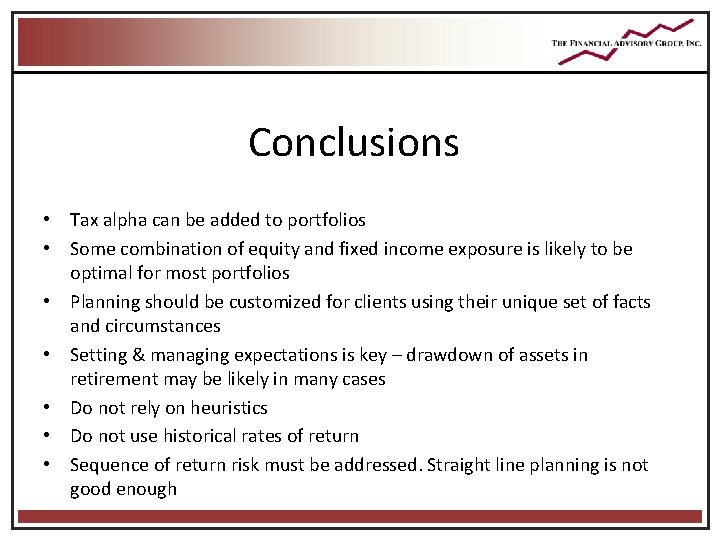
Conclusions • Tax alpha can be added to portfolios • Some combination of equity and fixed income exposure is likely to be optimal for most portfolios • Planning should be customized for clients using their unique set of facts and circumstances • Setting & managing expectations is key – drawdown of assets in retirement may be likely in many cases • Do not rely on heuristics • Do not use historical rates of return • Sequence of return risk must be addressed. Straight line planning is not good enough
Questions? Thomas Sartor, CPA Senior Financial Analyst The Financial Advisory Group, Inc. 5599 San Felipe, Ste. 900 Houston, TX 77056 Main: (713) 627 -7660 Direct: (713) 627 -4252 thomas. sartor@finadvisors. com