Takashi Hosokawa NAOJ Shuichiro Inutsuka Kyoto Hosokawa Inutsuka
- Slides: 12
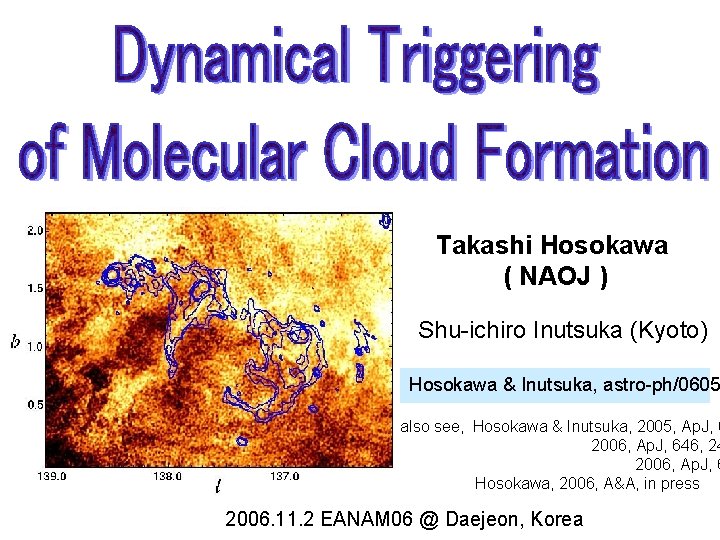
Takashi Hosokawa ( NAOJ ) Shu-ichiro Inutsuka (Kyoto) Hosokawa & Inutsuka, astro-ph/0605 also see, Hosokawa & Inutsuka, 2005, Ap. J, 6 2006, Ap. J, 646, 24 2006, Ap. J, 6 Hosokawa, 2006, A&A, in press 2006. 11. 2 EANAM 06 @ Daejeon, Korea
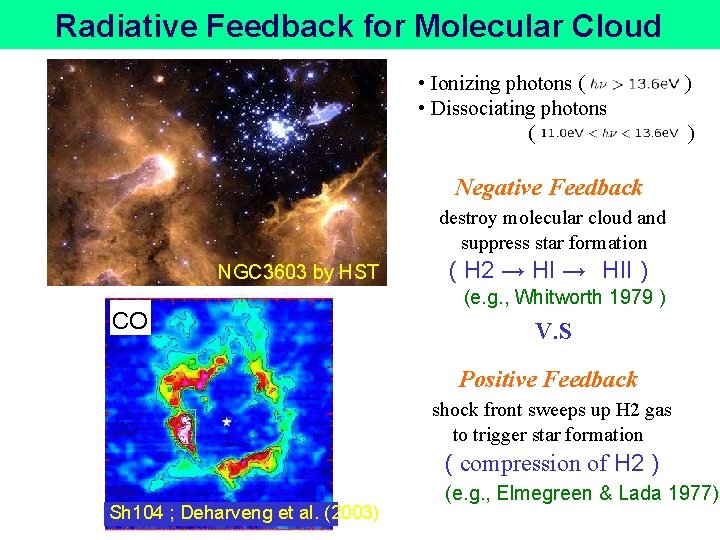
Radiative Feedback for Molecular Cloud • Ionizing photons ( • Dissociating photons ( ) ) Negative Feedback destroy molecular cloud and suppress star formation NGC 3603 by HST CO ( H 2 → HI → HII ) (e. g. , Whitworth 1979 ) V. S Positive Feedback shock front sweeps up H 2 gas to trigger star formation ( compression of H 2 ) Sh 104 ; Deharveng et al. (2003) (e. g. , Elmegreen & Lada 1977)
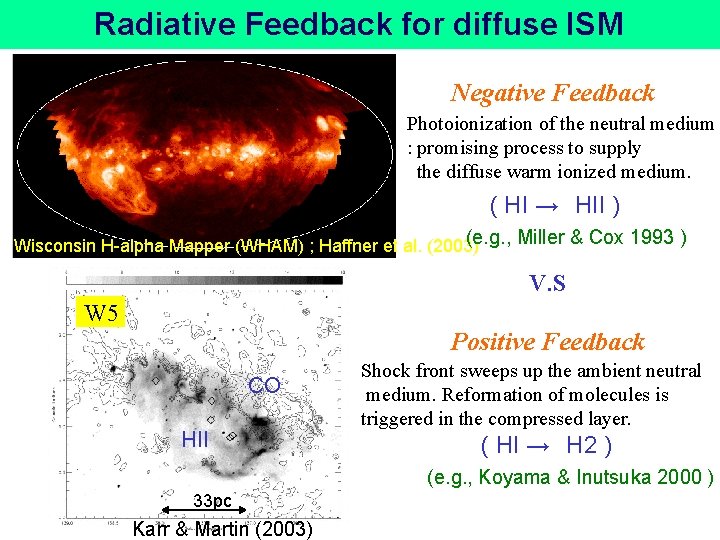
Radiative Feedback for diffuse ISM Negative Feedback Photoionization of the neutral medium : promising process to supply the diffuse warm ionized medium. ( HI → HII ) (e. g. , Miller & Cox 1993 ) Wisconsin H-alpha Mapper (WHAM) ; Haffner et al. (2003) V. S W 5 Positive Feedback CO HII Shock front sweeps up the ambient neutral medium. Reformation of molecules is triggered in the compressed layer. ( HI → H 2 ) (e. g. , Koyama & Inutsuka 2000 ) 33 pc Karr & Martin (2003)
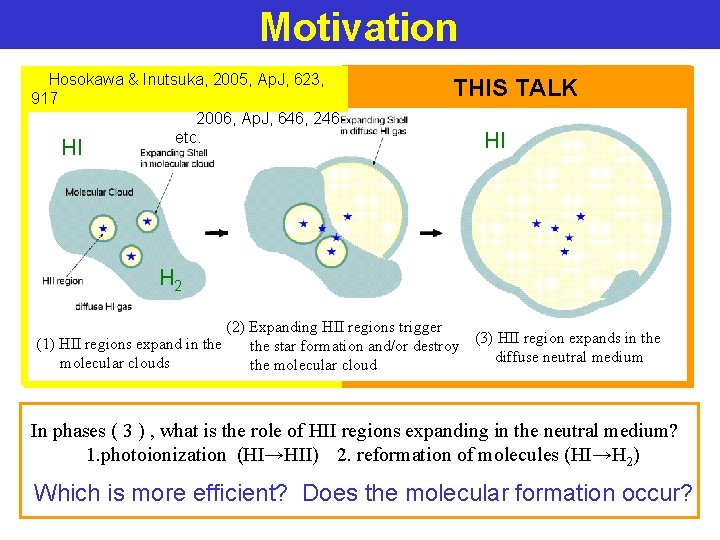
Motivation Hosokawa & Inutsuka, 2005, Ap. J, 623, 917 2006, Ap. J, 646, 246 etc. HI THIS TALK HI H 2 (2) Expanding HII regions trigger (3) HII region expands in the (1) HII regions expand in the star formation and/or destroy diffuse neutral medium molecular clouds the molecular cloud In phases ( 3 ) , what is the role of HII regions expanding in the neutral medium? 1. photoionization (HI→HII) 2. reformation of molecules (HI→H 2) Which is more efficient? Does the molecular formation occur?
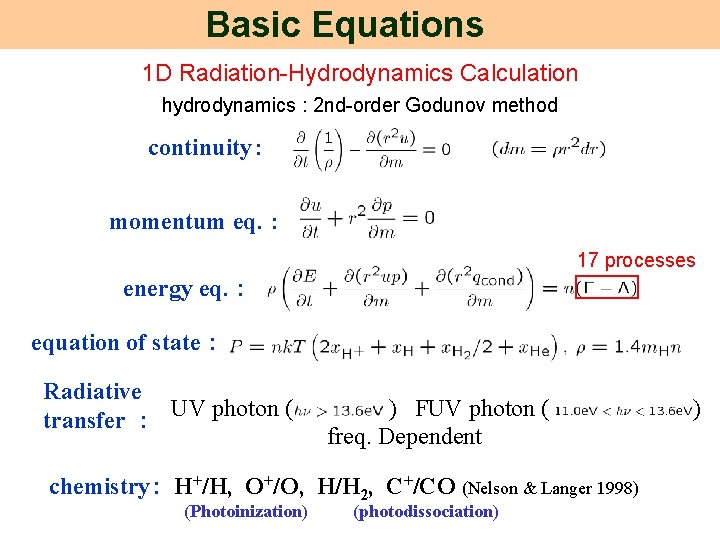
Basic Equations 1 D Radiation-Hydrodynamics Calculation hydrodynamics : 2 nd-order Godunov method continuity: momentum eq. : 17 processes energy eq. : equation of state : Radiative UV photon ( transfer : ) FUV photon ( freq. Dependent chemistry: H+/H, O+/O, H/H 2, C+/CO (Nelson & Langer 1998) (Photoinization) (photodissociation) )
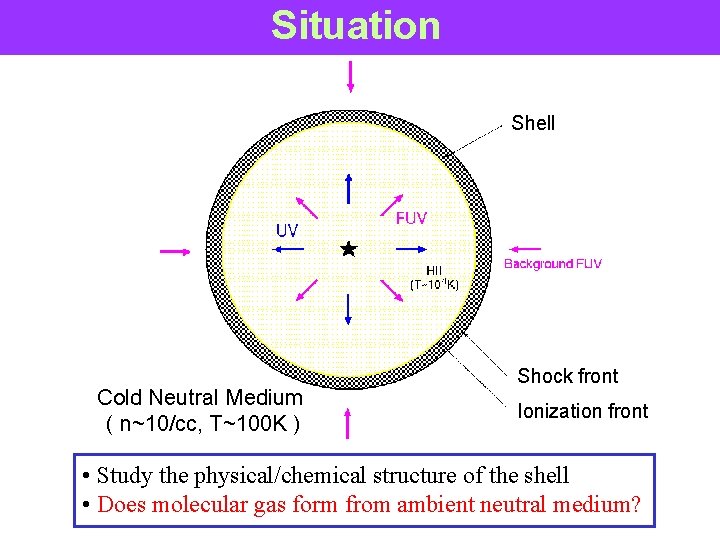
Situation Shell Cold Neutral Medium ( n~10/cc, T~100 K ) Shock front Ionization front • Study the physical/chemical structure of the shell • Does molecular gas form from ambient neutral medium?
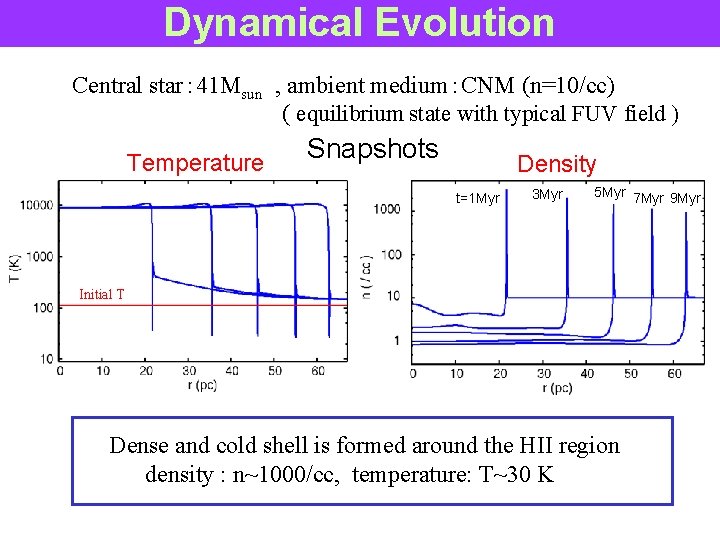
Dynamical Evolution Central star: 41 Msun , ambient medium:CNM (n=10/cc) ( equilibrium state with typical FUV field ) Temperature Snapshots Density t=1 Myr 3 Myr 5 Myr 7 Myr 9 Myr Initial T Dense and cold shell is formed around the HII region density : n~1000/cc, temperature: T~30 K
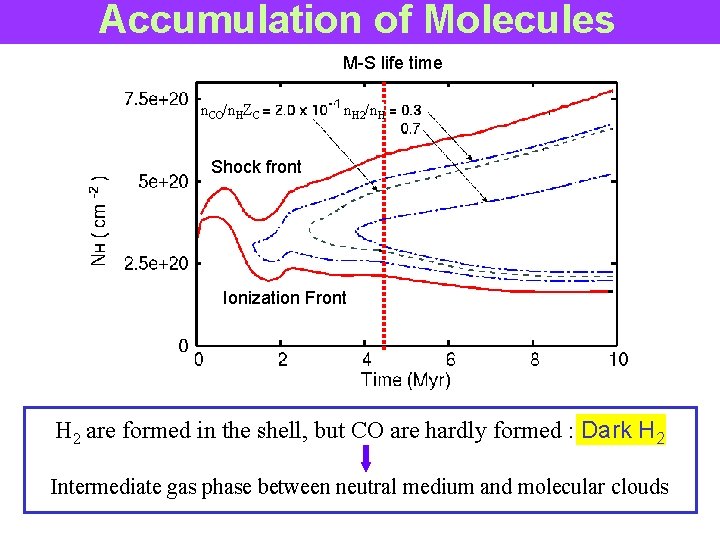
Accumulation of Molecules M-S life time n. CO/n. HZC n. H 2/n. H Shock front Ionization Front H 2 are formed in the shell, but CO are hardly formed : Dark H 2 Intermediate gas phase between neutral medium and molecular clouds
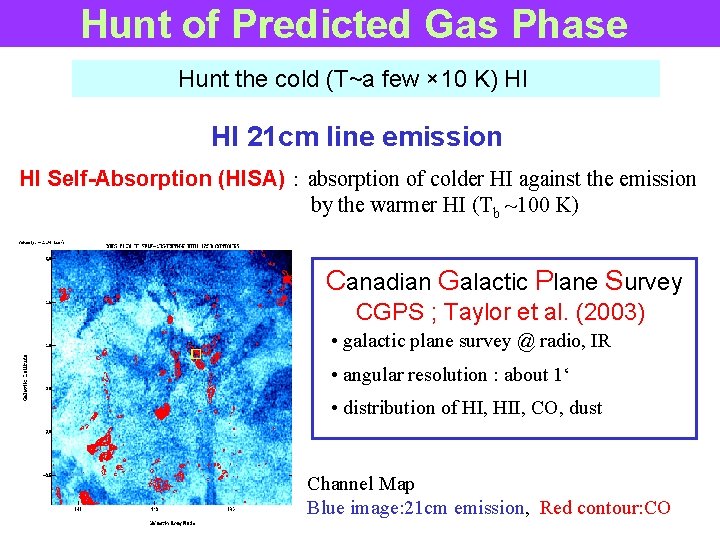
Hunt of Predicted Gas Phase Hunt the cold (T~a few × 10 K) HI HI 21 cm line emission HI Self-Absorption (HISA) : absorption of colder HI against the emission by the warmer HI (Tb ~100 K) Canadian Galactic Plane Survey CGPS ; Taylor et al. (2003) • galactic plane survey @ radio, IR • angular resolution : about 1‘ • distribution of HI, HII, CO, dust Channel Map Blue image: 21 cm emission, Red contour: CO
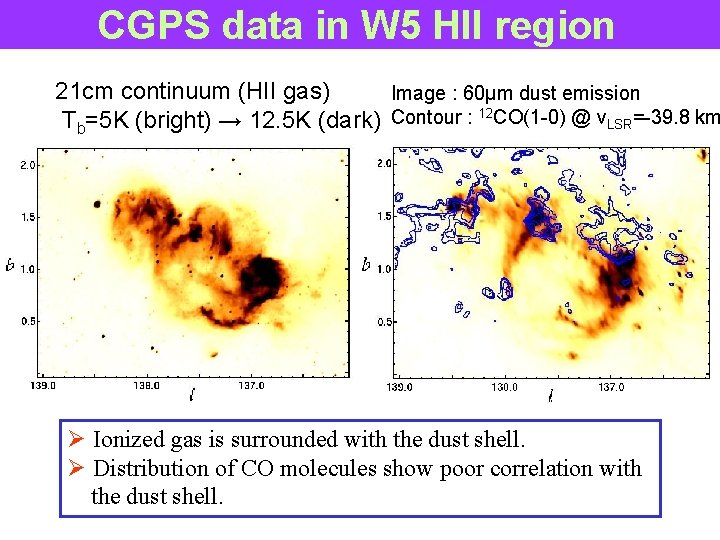
CGPS data in W 5 HII region 21 cm continuum (HII gas) Image : 60μm dust emission Tb=5 K (bright) → 12. 5 K (dark) Contour : 12 CO(1 -0) @ v. LSR=-39. 8 km Ø Ionized gas is surrounded with the dust shell. Ø Distribution of CO molecules show poor correlation with the dust shell.
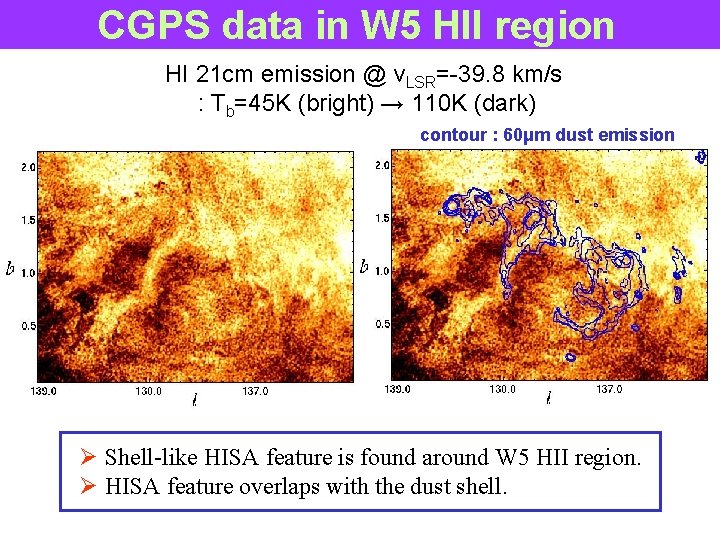
CGPS data in W 5 HII region HI 21 cm emission @ v. LSR=-39. 8 km/s : Tb=45 K (bright) → 110 K (dark) contour : 60μm dust emission Ø Shell-like HISA feature is found around W 5 HII region. Ø HISA feature overlaps with the dust shell.
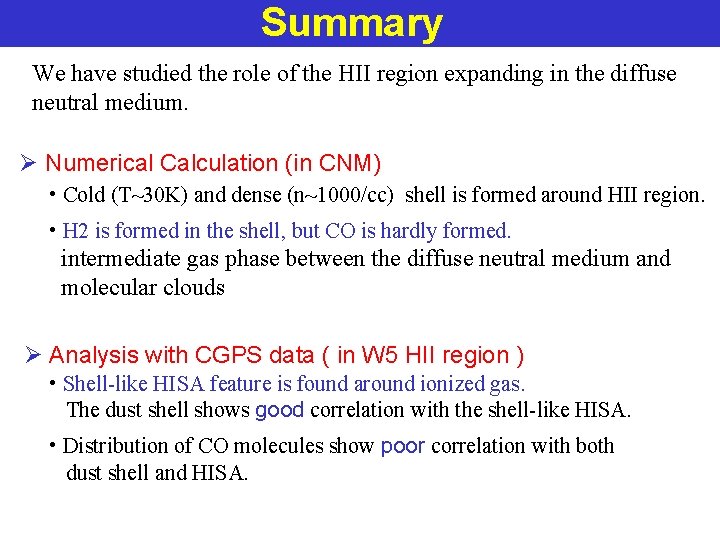
Summary We have studied the role of the HII region expanding in the diffuse neutral medium. Ø Numerical Calculation (in CNM) • Cold (T~30 K) and dense (n~1000/cc) shell is formed around HII region. • H 2 is formed in the shell, but CO is hardly formed. intermediate gas phase between the diffuse neutral medium and molecular clouds Ø Analysis with CGPS data ( in W 5 HII region ) • Shell-like HISA feature is found around ionized gas. The dust shell shows good correlation with the shell-like HISA. • Distribution of CO molecules show poor correlation with both dust shell and HISA.