
LEPS Experiments Takashi NAKANO RCNP Osaka University Joint


- Slides: 39
LEPS Experiments Takashi NAKANO (RCNP, Osaka University) Joint Symposium of 'Exotic Hadron' and 'Hadrons in Nuclei' New Frontiers in QCD 2010 Feb. 18 th
LEPS Collaboration Research Center for Nuclear Physics, Osaka University :D. S. Ahn, M. Fujiwara, T. Hotta, Y. Kato, K. Kino, H. Kohri, Y. Maeda, T. Mibe, N. Muramatsu, T. Nakano, M. Niiyama, T. Sawada, M. Sumihama, M. Uchida, M. Yosoi, T. Yorita, R. G. T. Zegers Department of Physics, Pusan National University :J. K. Ahn School of Physics, Seoul National University :H. C. Bhang Department of Physics, Konan University :H. Akimune Japan Atomic Energy Research Institute / SPring-8 :Y. Asano Institute of Physics, Academia Sinica :W. C. Chang, J. Y. Chen Japan Synchrotron Radiation Research Institute (JASRI) / SPring-8 : S. Date', H. Ejiri, N. Kumagai, Y. Ohashi, H. Ohkuma, H. Toyokawa Department of Physics and Astronomy, Ohio University :K. Hicks Department of Physics, Kyoto University :K. Imai, H. Fujimura, M. Miyabe, Y. Nakatsugawa, T. Tsunemi Department of Physics, Chiba University :H. Kawai, T. Ooba, Y. Shiino Wakayama Medical University :S. Makino Department of Physics and Astrophysics, Nagoya University :S. Fukui Department of Physics, Yamagata University :T. Iwata Department of Physics, Osaka University :S. Ajimura, K. Horie, M. Nomachi, A. Sakaguchi, S. Shimizu, Y. Sugaya Department of Physics and Engineering Physics, University of Saskatchewan :C. Rangacharyulu Laboratory of Nuclear Science, Tohoku University :T. Ishikawa, H. Shimizu Department of Applied Physics, Miyazaki University :T. Matsuda, Y. Toi Institute for Protein Research, Osaka University :M. Yoshimura National Defense Academy in Japan :T. Matsumura 2
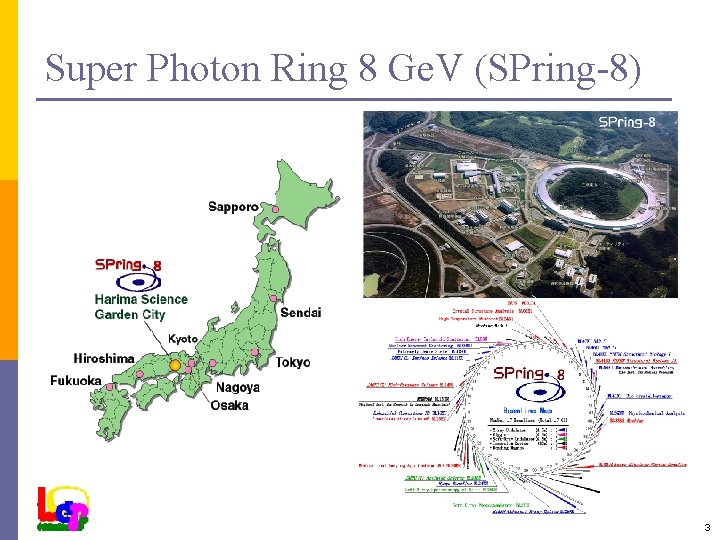
Super Photon Ring 8 Ge. V (SPring-8) 3
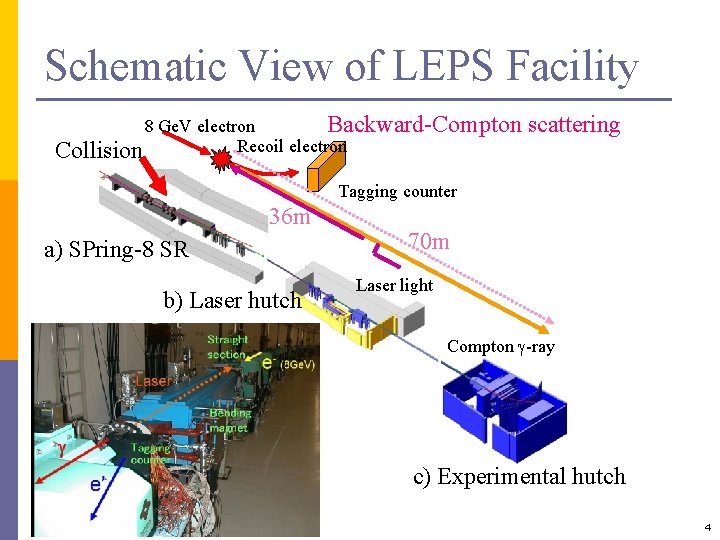
Schematic View of LEPS Facility 8 Ge. V electron Backward-Compton Recoil electron Collision scattering Tagging counter 36 m a) SPring-8 SR b) Laser hutch 70 m Laser light Compton -ray c) Experimental hutch 4
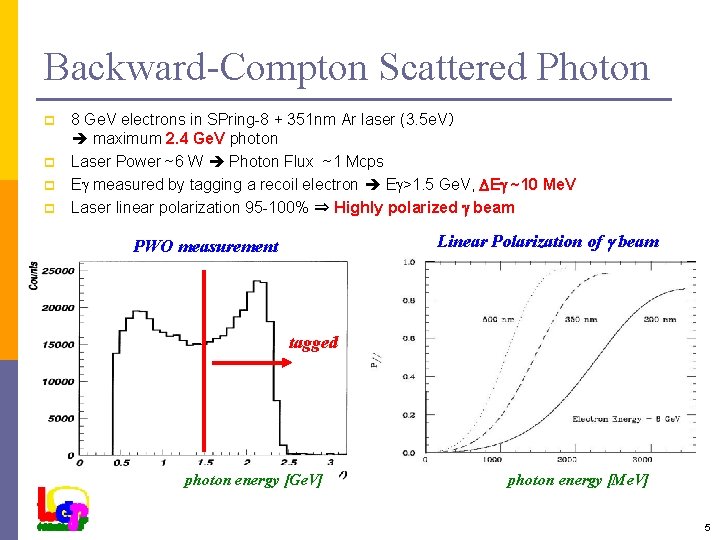
Backward-Compton Scattered Photon p p 8 Ge. V electrons in SPring-8 + 351 nm Ar laser (3. 5 e. V) maximum 2. 4 Ge. V photon Laser Power ~6 W Photon Flux ~1 Mcps E measured by tagging a recoil electron E >1. 5 Ge. V, E ~10 Me. V Laser linear polarization 95 -100% ⇒ Highly polarized beam Linear Polarization of beam PWO measurement tagged photon energy [Ge. V] photon energy [Me. V] 5
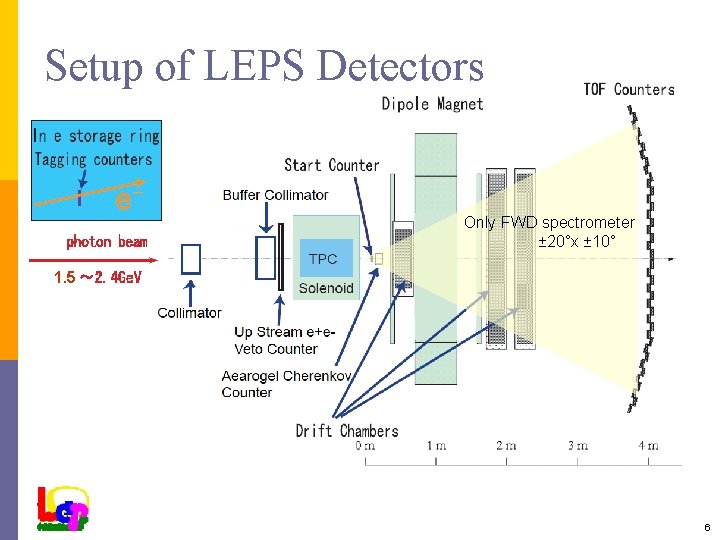
Setup of LEPS Detectors Only FWD spectrometer ± 20°x ± 10° 1. 5 6
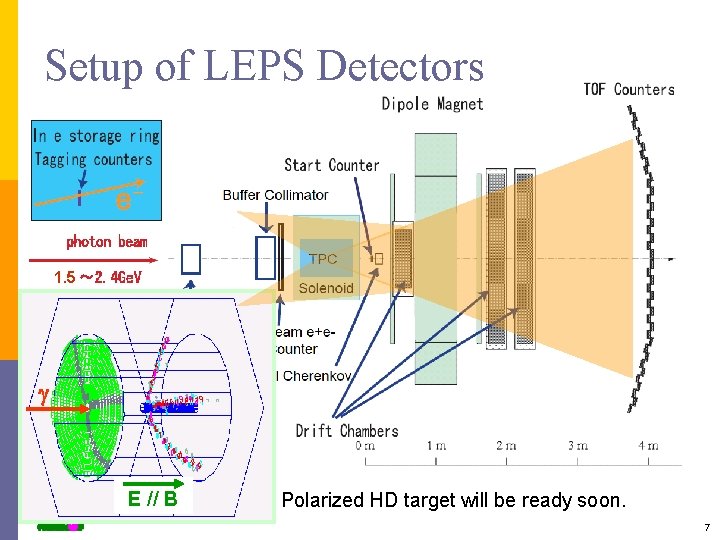
Setup of LEPS Detectors 1. 5 E // B Polarized HD target will be ready soon. 7
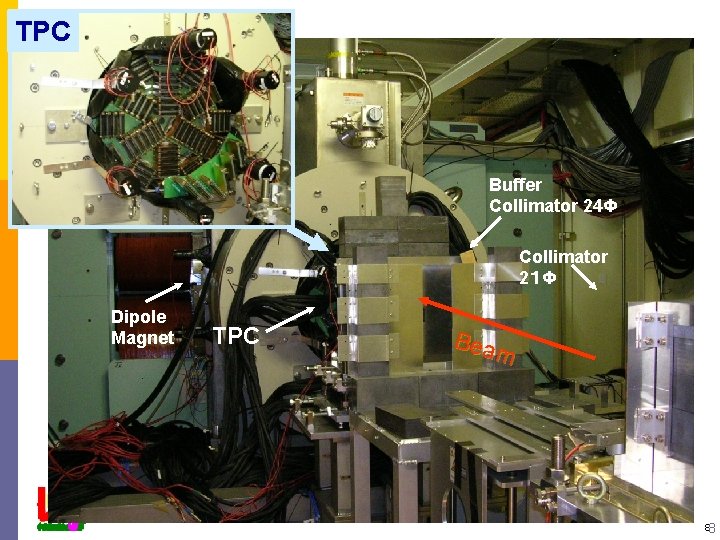
TPC Solenoid Magnet Buffer Collimator 24Φ Collimator 21Φ Dipole Magnet TPC Bea m 88
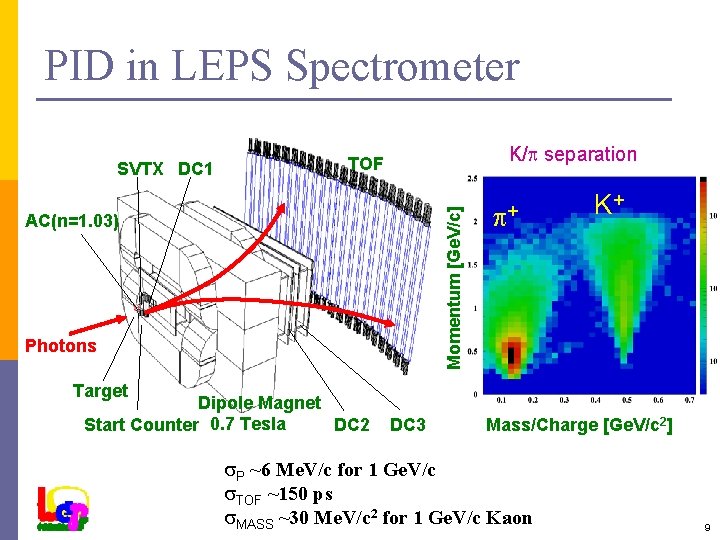
PID in LEPS Spectrometer K/p separation TOF Momentum [Ge. V/c] SVTX DC 1 AC(n=1. 03) Photons p+ K+ Target Dipole Magnet Start Counter 0. 7 Tesla DC 2 DC 3 Mass/Charge [Ge. V/c 2] P ~6 Me. V/c for 1 Ge. V/c TOF ~150 ps MASS ~30 Me. V/c 2 for 1 Ge. V/c Kaon 9
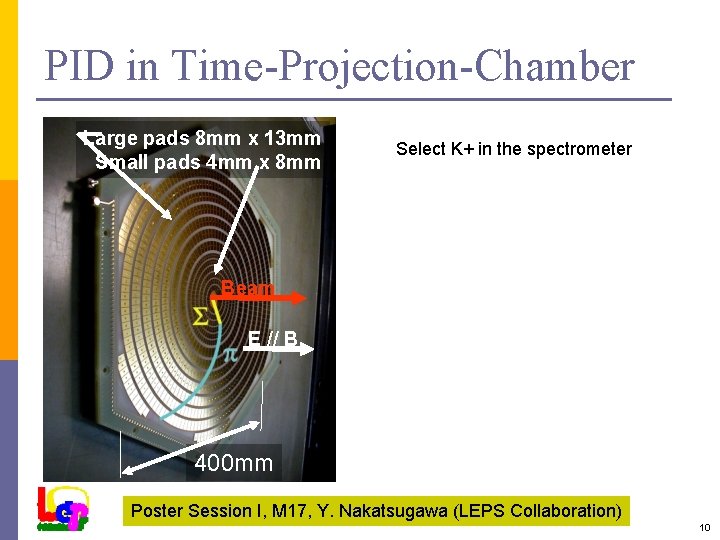
PID in Time-Projection-Chamber Large pads 8 mm x 13 mm Small pads 4 mm x 8 mm Select K+ in the spectrometer Beam E // B 400 mm Poster Session I, M 17, Y. Nakatsugawa (LEPS Collaboration) 10
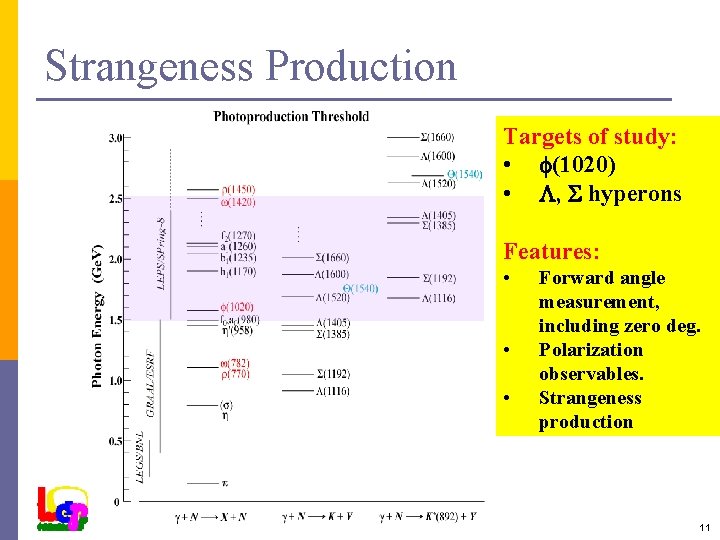
Strangeness Production Targets of study: • (1020) • , hyperons Features: • • • Forward angle measurement, including zero deg. Polarization observables. Strangeness production 11
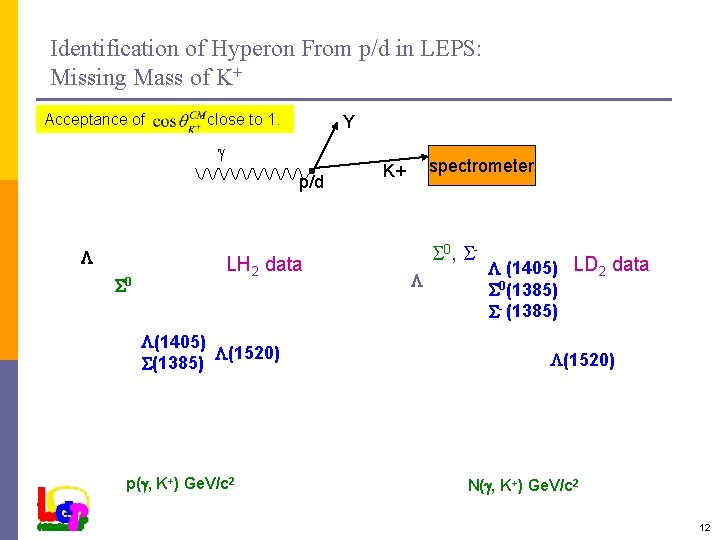
Identification of Hyperon From p/d in LEPS: Missing Mass of K+ Acceptance of close to 1. Y p/d 0 LH 2 data (1405) (1520) (1385) p( , K+) Ge. V/c 2 spectrometer K+ 0, (1405) LD 2 data 0(1385) - (1385) (1520) N( , K+) Ge. V/c 2 12
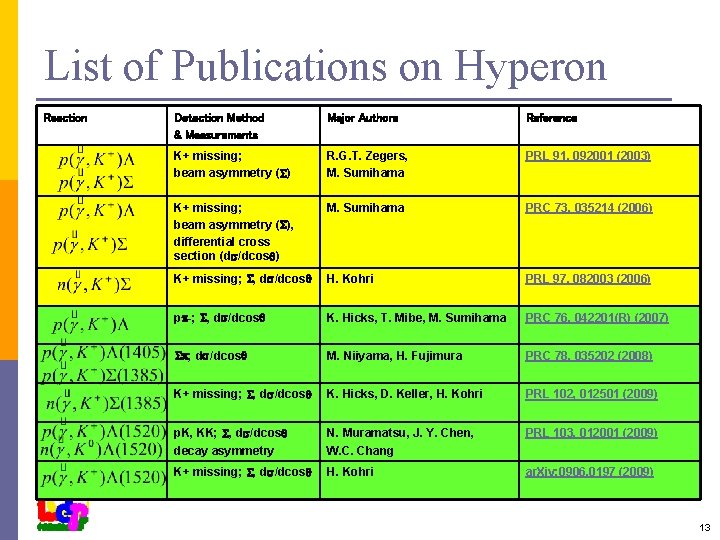
List of Publications on Hyperon Reaction Detection Method & Measurements Major Authors Reference K+ missing; beam asymmetry ( ) R. G. T. Zegers, M. Sumihama PRL 91, 092001 (2003) K+ missing; beam asymmetry ( ), differential cross section (d /dcos ) M. Sumihama PRC 73, 035214 (2006) K+ missing; , d /dcos H. Kohri PRL 97, 082003 (2006) p -; , d /dcos K. Hicks, T. Mibe, M. Sumihama PRC 76, 042201(R) (2007) ; d /dcos M. Niiyama, H. Fujimura PRC 78, 035202 (2008) K+ missing; , d /dcos K. Hicks, D. Keller, H. Kohri PRL 102, 012501 (2009) p. K, KK; , d /dcos decay asymmetry N. Muramatsu, J. Y. Chen, W. C. Chang PRL 103, 012001 (2009) K+ missing; , d /dcos H. Kohri ar. Xiv: 0906. 0197 (2009) 13
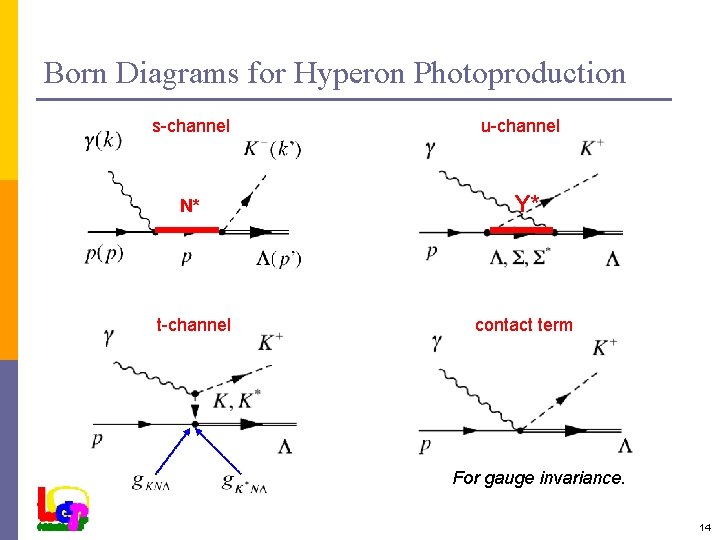
Born Diagrams for Hyperon Photoproduction s-channel u-channel N* Y* t-channel contact term For gauge invariance. 14
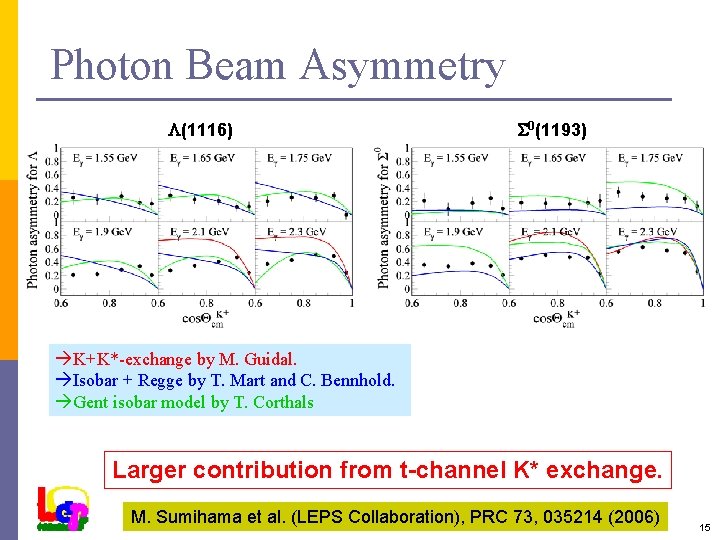
Photon Beam Asymmetry (1116) 0(1193) K+K*-exchange by M. Guidal. Isobar + Regge by T. Mart and C. Bennhold. Gent isobar model by T. Corthals Larger contribution from t-channel K* exchange. M. Sumihama et al. (LEPS Collaboration), PRC 73, 035214 (2006) 15
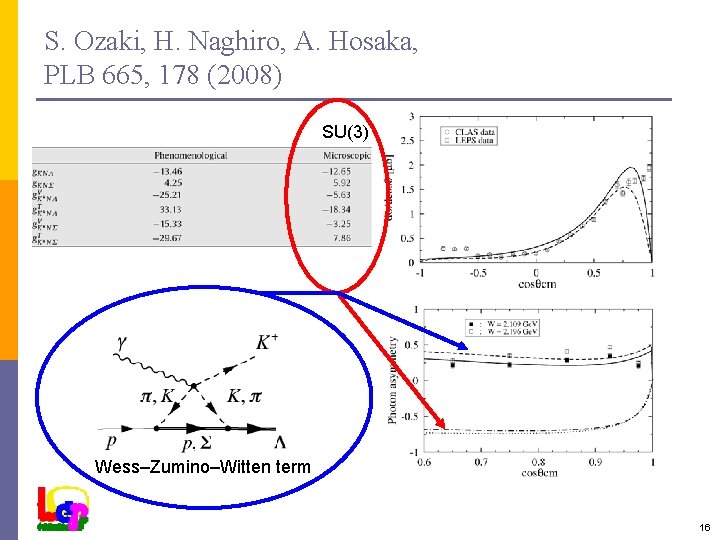
S. Ozaki, H. Naghiro, A. Hosaka, PLB 665, 178 (2008) SU(3) Wess–Zumino–Witten term 16
(1520) 17
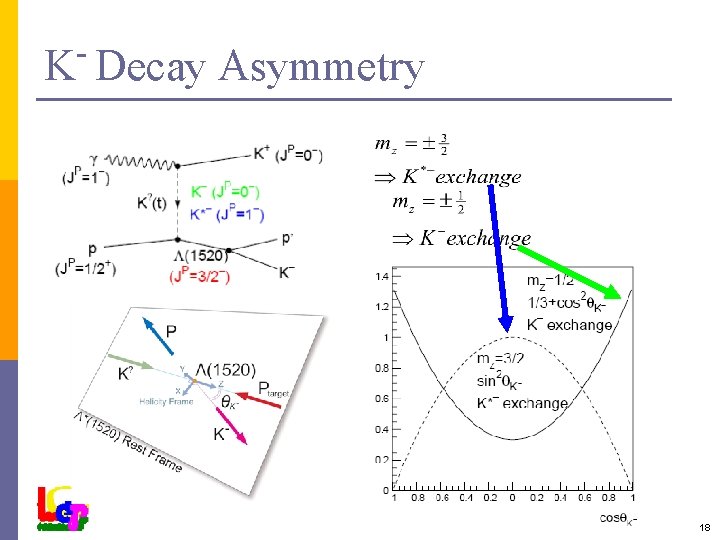
K Decay Asymmetry 18
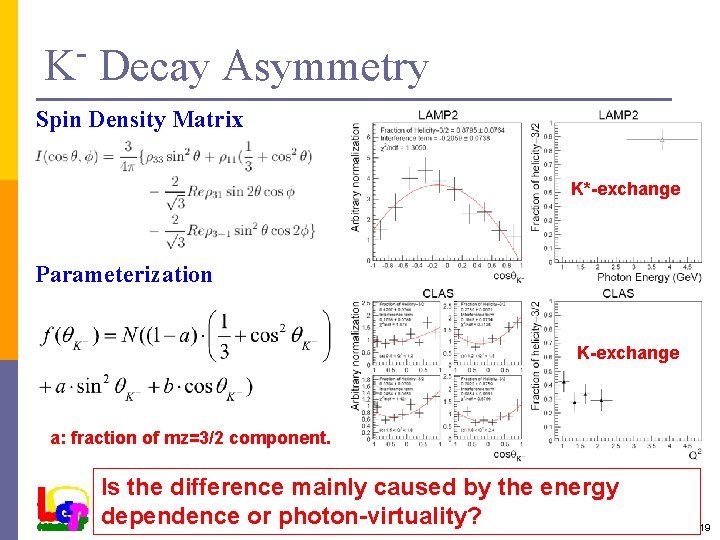
K Decay Asymmetry Spin Density Matrix K*-exchange Parameterization K-exchange a: fraction of mz=3/2 component. Is the difference mainly caused by the energy dependence or photon-virtuality? 19
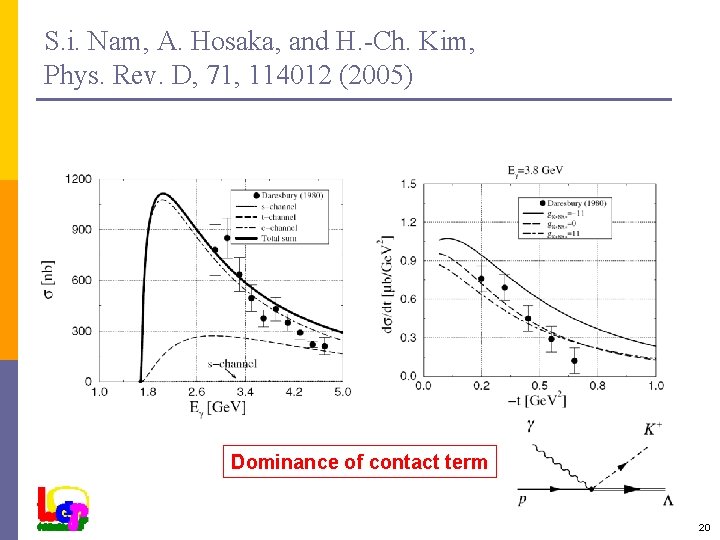
S. i. Nam, A. Hosaka, and H. -Ch. Kim, Phys. Rev. D, 71, 114012 (2005) Dominance of contact term 20
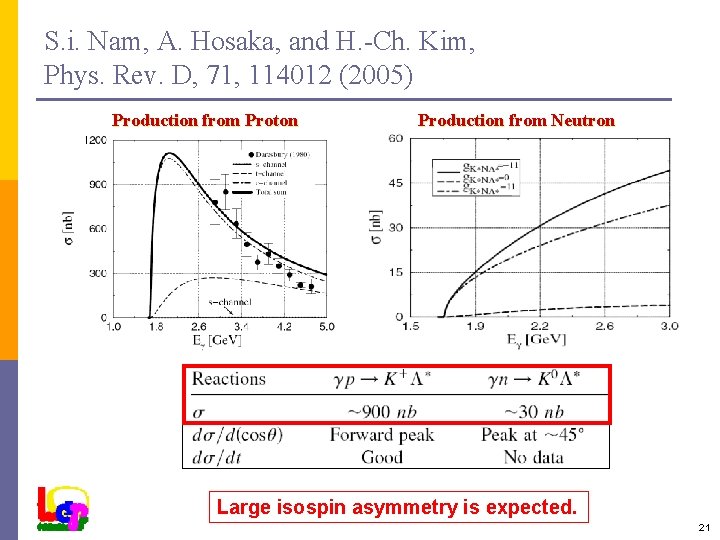
S. i. Nam, A. Hosaka, and H. -Ch. Kim, Phys. Rev. D, 71, 114012 (2005) Production from Proton Production from Neutron Large isospin asymmetry is expected. 21
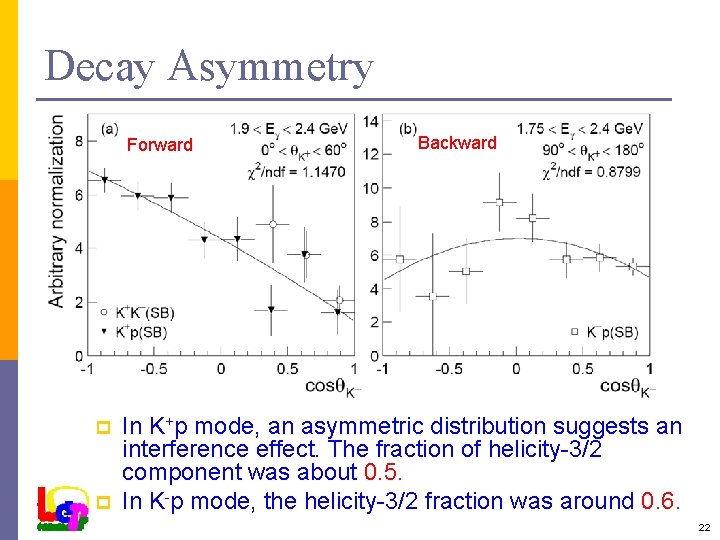
Decay Asymmetry Forward p p Backward In K+p mode, an asymmetric distribution suggests an interference effect. The fraction of helicity-3/2 component was about 0. 5. In K-p mode, the helicity-3/2 fraction was around 0. 6. 22
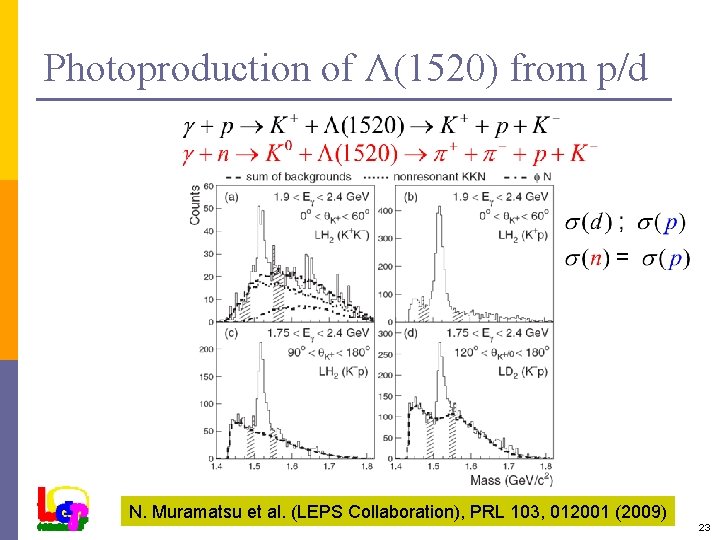
Photoproduction of Λ(1520) from p/d N. Muramatsu et al. (LEPS Collaboration), PRL 103, 012001 (2009) 23
A Large Isospin Asymmetry in Q+ Production A. Hosaka, Workshop of “Challenge to New Exotic Hadrons with Heavy Quarks”. 24
Backward 0 p , h, w, h’, f productions 25
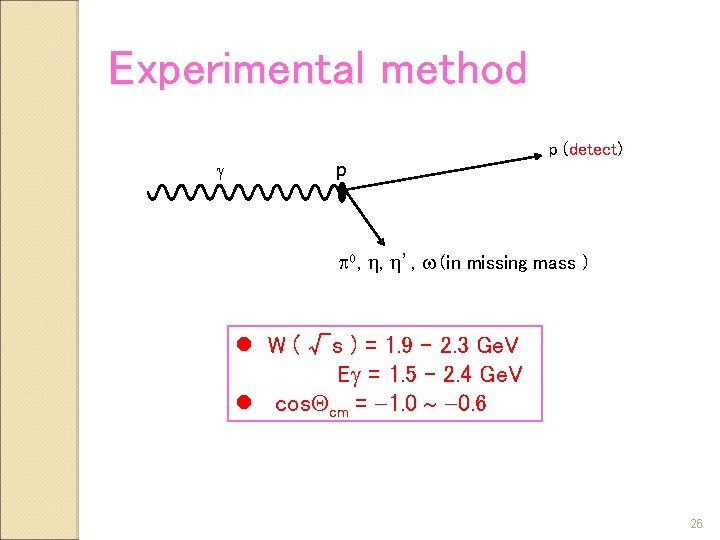
Experimental method p (detect) p p 0, h, h’, w (in missing mass ) l W ( √s ) = 1. 9 – 2. 3 Ge. V E = 1. 5 – 2. 4 Ge. V l cos. Qcm = -1. 0 ~ -0. 6 26
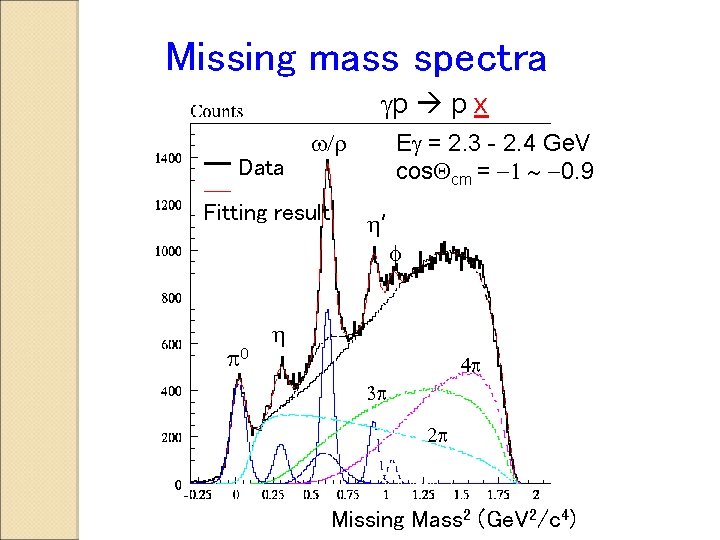
Missing mass spectra p p x Data w/r Fitting result p 0 E = 2. 3 - 2. 4 Ge. V cos. Qcm = -1 ~ -0. 9 h’ f h 4 p 3 p 2 p Missing Mass 227(Ge. V 2/c 4)
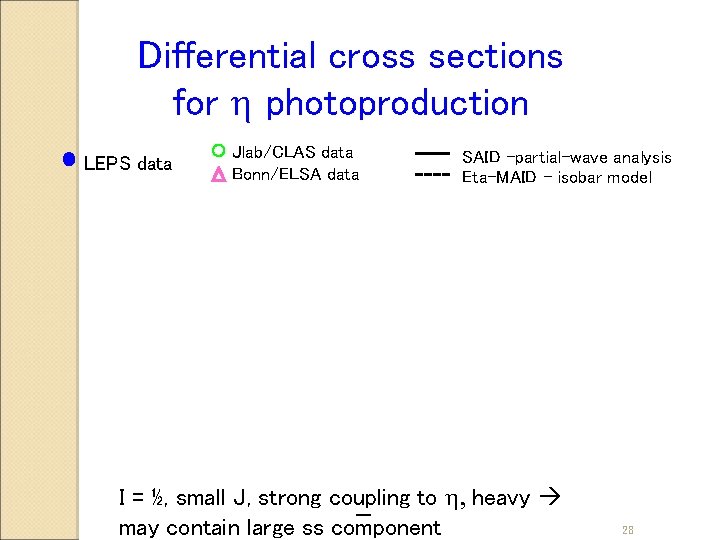
Differential cross sections for h photoproduction LEPS data Jlab/CLAS data Bonn/ELSA data SAID -partial-wave analysis Eta-MAID - isobar model I = ½, small J, strong coupling to h, heavy may contain large ss component 28
+ Q (1530) 29
Baryon masses in constituent quark model mu ~ md = 300 ~ 350 Me. V, ms=mu(d)+130~180 Me. V • Mainly 3 quark baryons: M ~ 3 mq + (strangeness)+(symmetry) • p, K, and h are light: Nambu-Goldstone bosons of spontaneously broken chiral symmetry. • 5 -quark baryons, naively: M ~ 5 mq + (strangeness) +(symmetry) 1700~1900 Me. V for Q+
Experimental status • Not seen in the most of the high energy experiments: The production rate of Q+/ (1520) is less than 1%. • Production rate depends on reaction mechanism. • No signal observation in CLAS p, KEK-PS (p-, K-), (K+, p+) experiments. • K* coupling should be VERY small. • The width must be less than 1 Me. V. (DIANA and KEK-B) reverse reaction of the Q+ decay: Q+ n K+ • K coupling should be small. • LEPS could be inconsistent with CLAS d experiment (CLAS-g 10). • Strong angle or energy dependence.
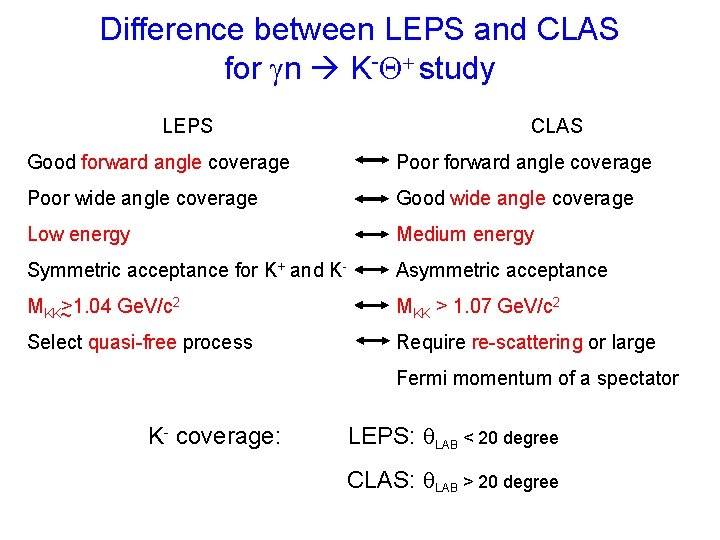
Difference between LEPS and CLAS for n K-Q+ study LEPS CLAS Good forward angle coverage Poor wide angle coverage Good wide angle coverage Low energy Medium energy Symmetric acceptance for K+ and K- Asymmetric acceptance MKK~ >1. 04 Ge. V/c 2 MKK > 1. 07 Ge. V/c 2 Select quasi-free process Require re-scattering or large Fermi momentum of a spectator K- coverage: LEPS: q. LAB < 20 degree CLAS: q. LAB > 20 degree
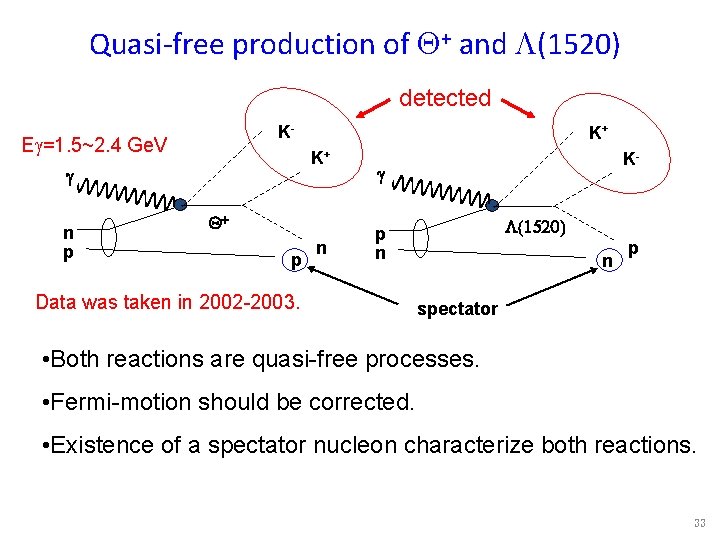
Quasi-free production of Q+ and (1520) detected K- E =1. 5~2. 4 Ge. V K+ n p K+ Q+ p n K- (1520) p n Data was taken in 2002 -2003. n p spectator • Both reactions are quasi-free processes. • Fermi-motion should be corrected. • Existence of a spectator nucleon characterize both reactions. 33
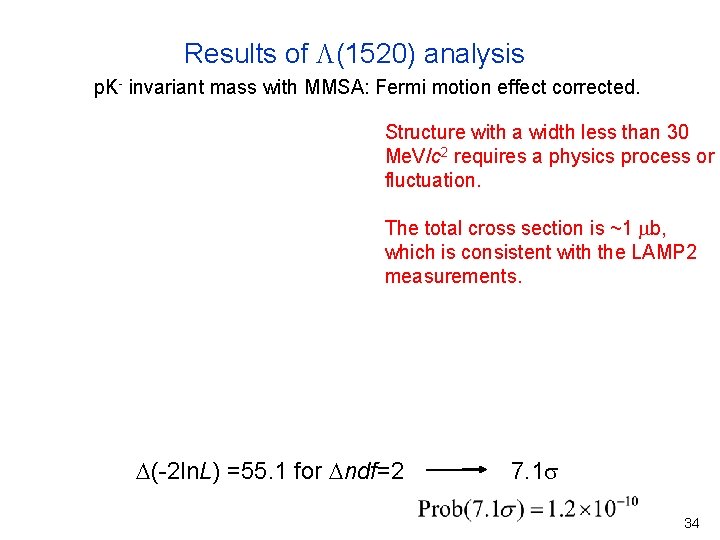
Results of (1520) analysis +) missing mass: No correction on Fermi motion effect. p. K- invariant mass with MMSA: Fermi motion effect corrected. Simple ( , K Structure with a width less than 30 Me. V/c 2 requires a physics process or fluctuation. The total cross section is ~1 mb, which is consistent with the LAMP 2 measurements. D(-2 ln. L) =55. 1 for Dndf=2 7. 1 34
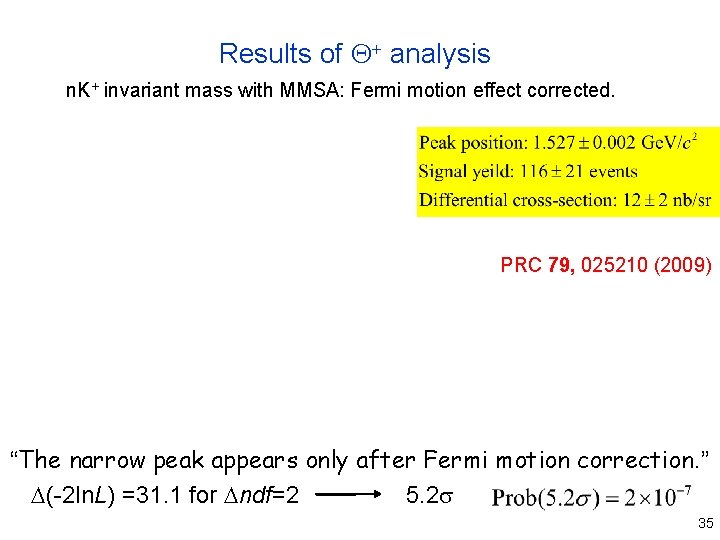
Results of Q+ analysis + invariant mass with MMSA: Fermi motion effect corrected. -) missing mass: No correction on Fermi motion effect. n. K Simple ( , K PRC 79, 025210 (2009) “The narrow peak appears only after Fermi motion correction. ” D(-2 ln. L) =31. 1 for Dndf=2 5. 2 35
Next step Probability of 1/5000000 may not be low enough. “Extraordinary claim requires an extraordinary evidence. ” High statistics data was collected in 2006 -2007 with the same experimental setup. Blind analysis is under way to check the Θ+ peak
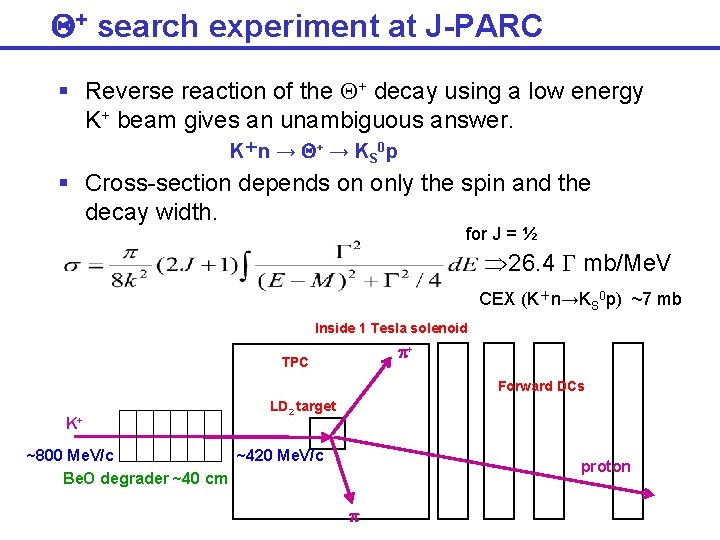
Q+ search experiment at J-PARC § Reverse reaction of the Q+ decay using a low energy K+ beam gives an unambiguous answer. K+n → Q+ → KS 0 p § Cross-section depends on only the spin and the decay width. for J = ½ Þ 26. 4 mb/Me. V CEX (K+n→KS 0 p) ~7 mb Inside 1 Tesla solenoid + TPC Forward DCs K+ LD 2 target ~800 Me. V/c ~420 Me. V/c Be. O degrader ~40 cm proton -
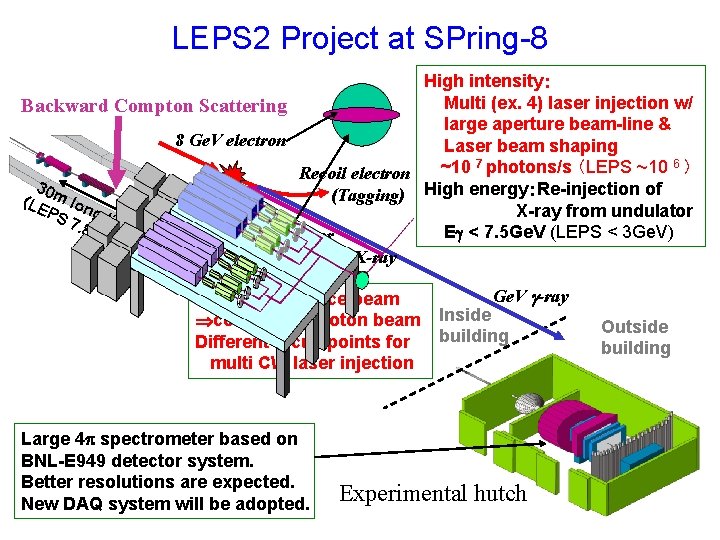
LEPS 2 Project at SPring-8 High intensity: Multi (ex. 4) laser injection w/ Backward Compton Scattering large aperture beam-line & 8 Ge. V electron Laser beam shaping 7 6 Recoil electron ~10 photons/s (LEPS ~10 ) 30 m (Tagging) High energy:Re-injection of (LE lon X-ray from undulator g PS 7. 8 line m) E < 7. 5 Ge. V (LEPS < 3 Ge. V) Laser or re-injected X-ray Better divergence beam collimated photon beam Different focus points for multi CW laser injection Large 4 spectrometer based on BNL-E 949 detector system. Better resolutions are expected. New DAQ system will be adopted. Ge. V -ray Inside building Experimental hutch Outside building
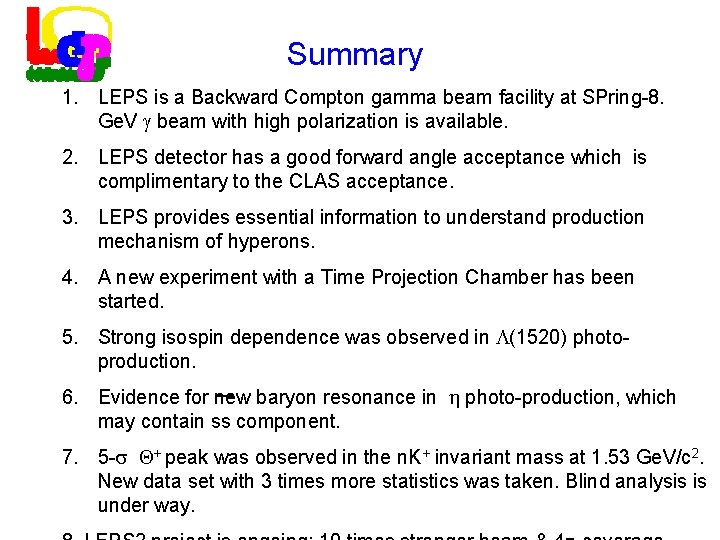
Summary 1. LEPS is a Backward Compton gamma beam facility at SPring-8. Ge. V beam with high polarization is available. 2. LEPS detector has a good forward angle acceptance which is complimentary to the CLAS acceptance. 3. LEPS provides essential information to understand production mechanism of hyperons. 4. A new experiment with a Time Projection Chamber has been started. 5. Strong isospin dependence was observed in (1520) photoproduction. 6. Evidence for new baryon resonance in h photo-production, which may contain ss component. 7. 5 - Q+ peak was observed in the n. K+ invariant mass at 1. 53 Ge. V/c 2. New data set with 3 times more statistics was taken. Blind analysis is under way.