Studying Nanophysics Using Methods from High Energy Theory
- Slides: 36
Studying Nanophysics Using Methods from High Energy Theory Some beautiful theories can be carried over from one field of physics to another -eg. High Energy to Condensed Matter n “The unreasonable effectiveness of Mathematics in the Natural Sciences” n
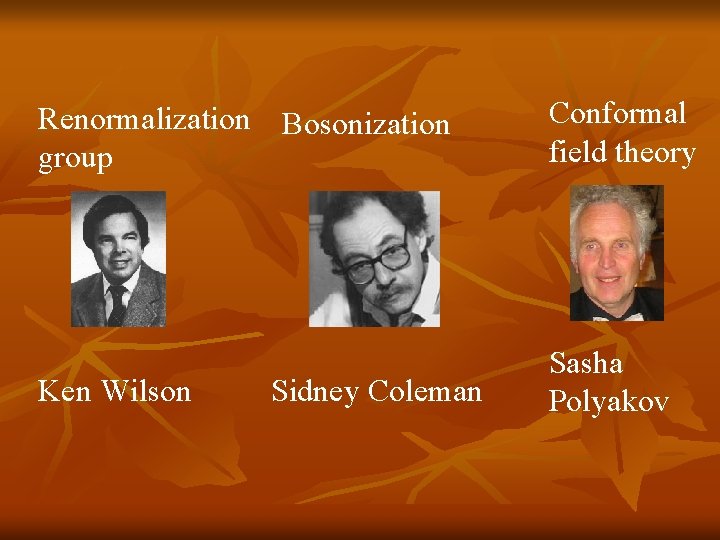
Renormalization Bosonization group Conformal field theory Ken Wilson Sasha Polyakov Sidney Coleman
Renormalization Group Low energy effective Hamiltonians sometimes have elegant, symmetric and universal form despite forbidding looking form of microscopic models n These effective Hamiltonians sometimes contain “running” coupling constants that depend on characteristic energy/length scale n
Bosonization & Conformal Field Theory Interactions between nano-structures and macroscopic non-interacting electron gas can often be reduced to effective models in (1+1) dimensions -eg. by projecting into s-wave channel n This can allow application of these powerful methods of quantum field theory in (1+1) D n
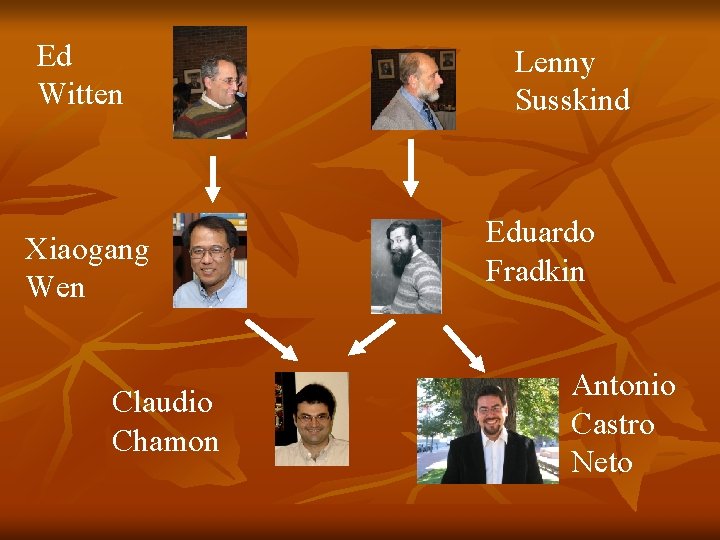
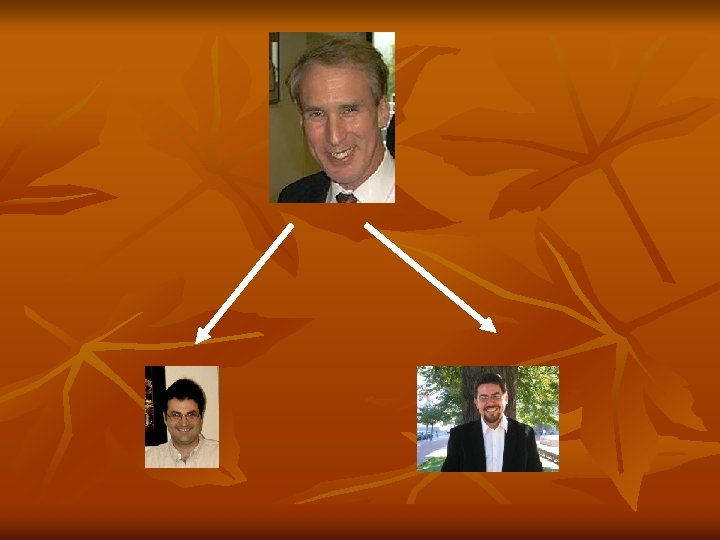
• Another way of seeing the influence of High Energy Physics on Condensed Matter Physics is to look at some “academic family trees” -eg. Condensed Matter Theory group At Boston University
Ed Witten Xiaogang Wen Claudio Chamon Lenny Susskind Eduardo Fradkin Antonio Castro Neto
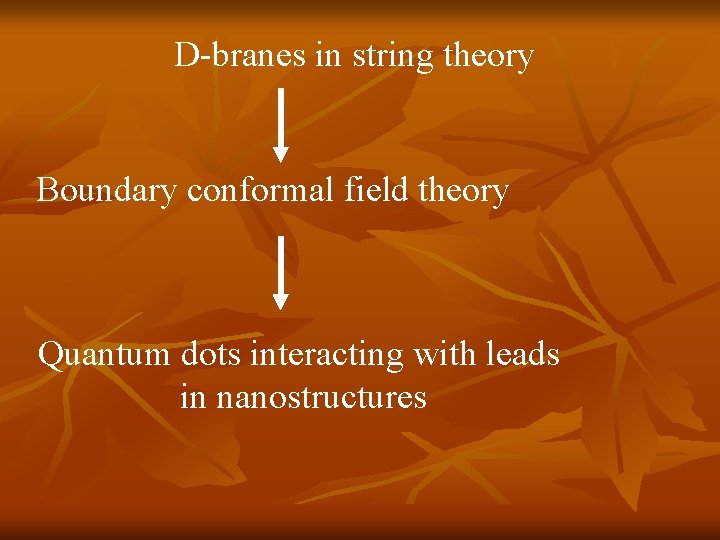
D-branes in string theory Boundary conformal field theory Quantum dots interacting with leads in nanostructures
The Kondo Problem A famous model on which many ideas of RG were first developed, including perhaps asymptotic freedom n Describes a single quantum spin interacting with conduction electrons in a metal n Since all interactions are at r=0 only we can normally reformulate model in (1+1) D n
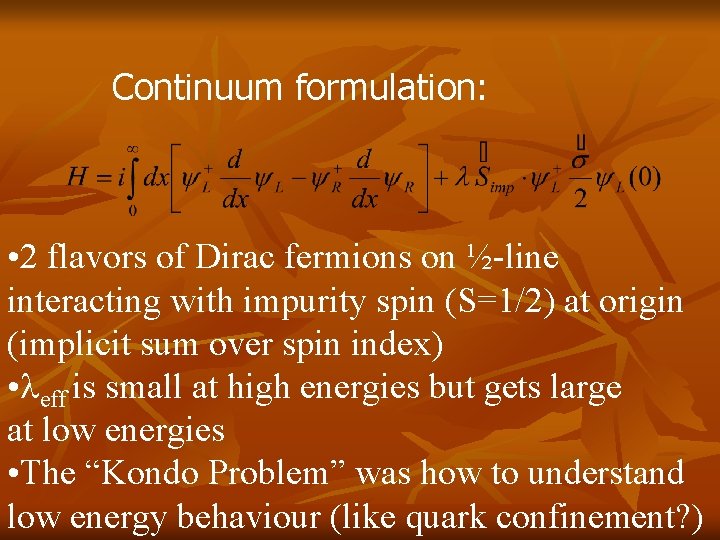
Continuum formulation: • 2 flavors of Dirac fermions on ½-line interacting with impurity spin (S=1/2) at origin (implicit sum over spin index) • eff is small at high energies but gets large at low energies • The “Kondo Problem” was how to understand low energy behaviour (like quark confinement? )
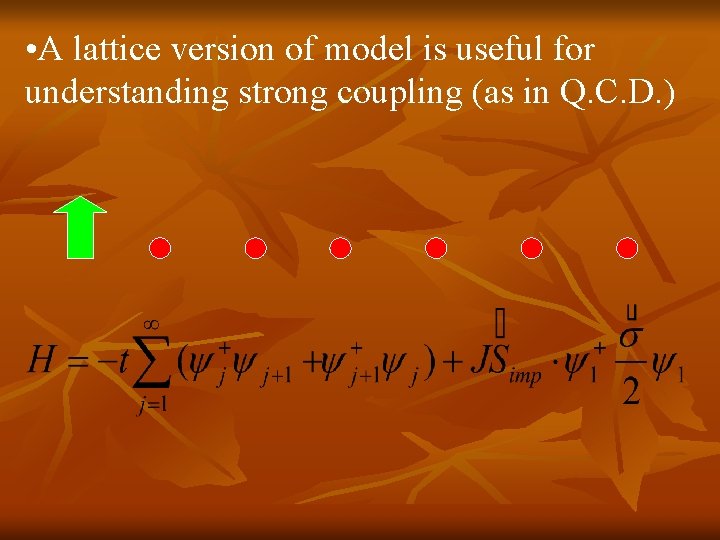
• A lattice version of model is useful for understanding strong coupling (as in Q. C. D. )
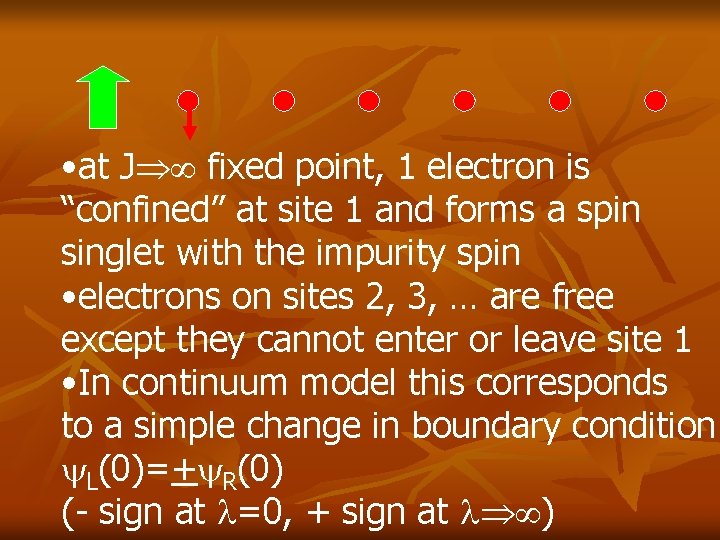
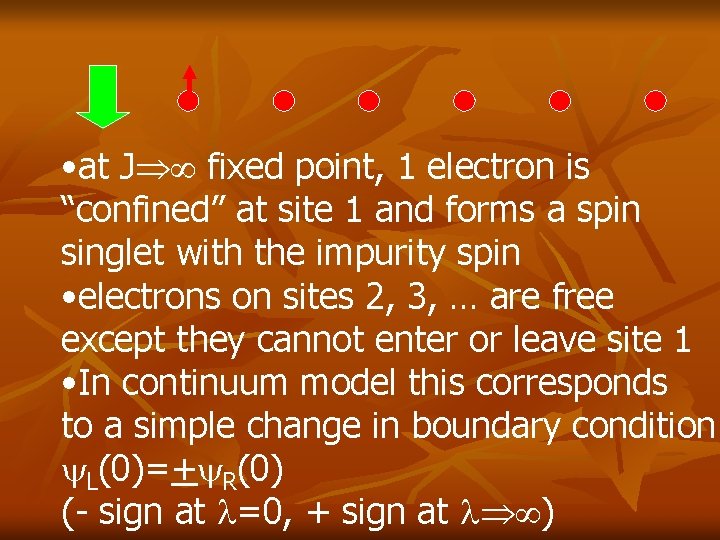
• at J fixed point, 1 electron is “confined” at site 1 and forms a spin singlet with the impurity spin • electrons on sites 2, 3, … are free except they cannot enter or leave site 1 • In continuum model this corresponds to a simple change in boundary condition L(0)=+ R(0) (- sign at =0, + sign at )
• at J fixed point, 1 electron is “confined” at site 1 and forms a spin singlet with the impurity spin • electrons on sites 2, 3, … are free except they cannot enter or leave site 1 • In continuum model this corresponds to a simple change in boundary condition L(0)=+ R(0) (- sign at =0, + sign at )
• A description of low energy behavior actually focuses on the other, approximately free, electrons, not involved in the singlet formation • These electrons have induced self-interactions, localized near r=0, resulting from screening of impurity spin • These interactions are “irrelevant” and corresponding corrections to free electron behavior vanish as energy 0
• a deep understanding of how this works can be obtained using “bosonization” • i. e. replace free fermions by free bosons • this allows representation of the spin and charge degrees of freedom of electrons by independent boson fields • it can then be seen that the Kondo interaction only involves the spin boson field • an especially elegant version is Witten’s “non-abelian bosonization” which involves non-trivial conformal field theories
Boundary Critical Phenomena & Boundary CFT • Very generally, 1 D Hamiltonians which are massless/critical in the bulk with interactions at the boundary renormalize to conformally invariant boundary conditions at low energies • Basic Kondo model is a trivial example where low energy boundary condition leaves fermions non-interacting • A “local Fermi liquid” fixed point
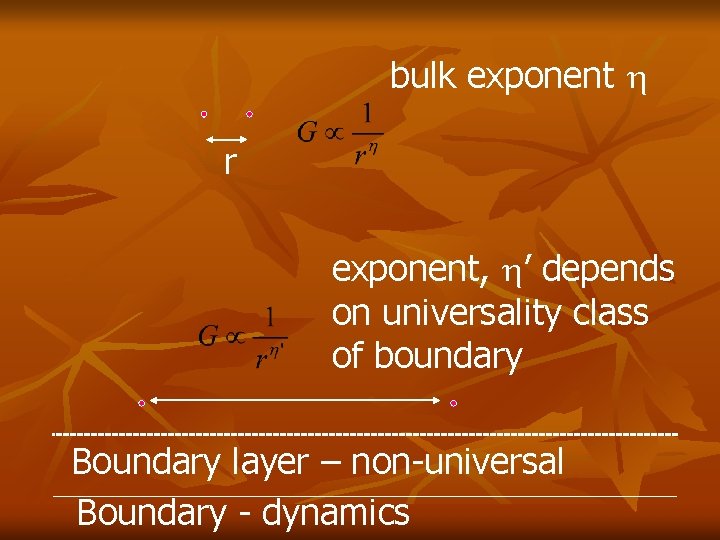
bulk exponent r exponent, ’ depends on universality class of boundary Boundary layer – non-universal Boundary - dynamics
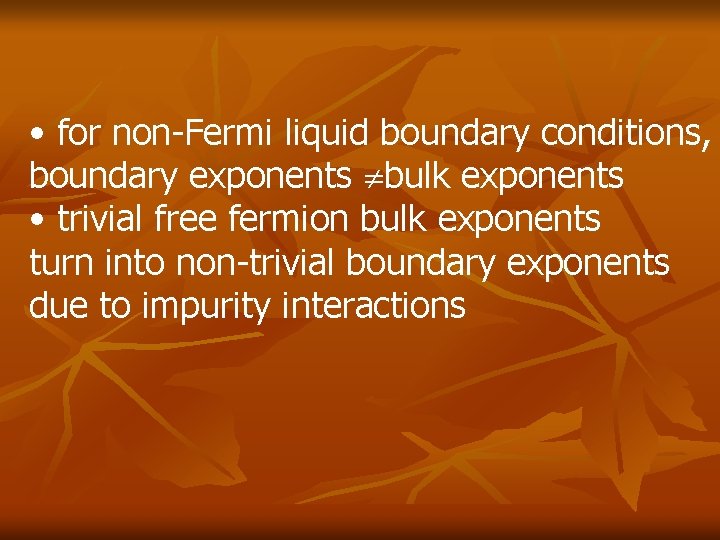
• for non-Fermi liquid boundary conditions, boundary exponents bulk exponents • trivial free fermion bulk exponents turn into non-trivial boundary exponents due to impurity interactions
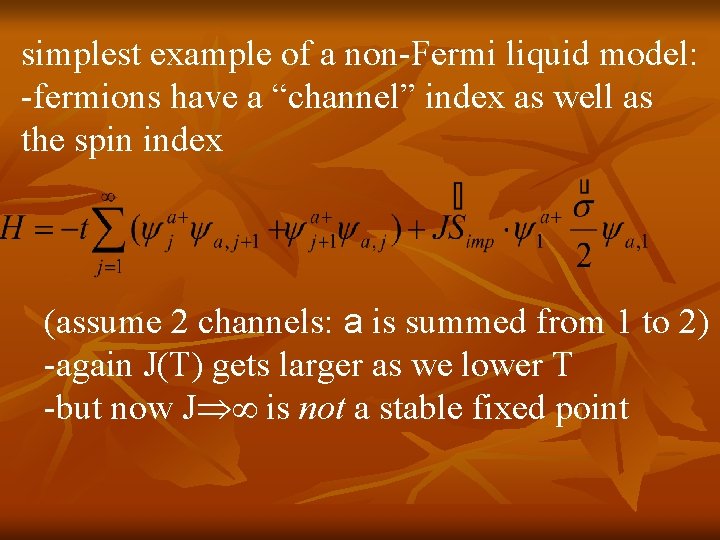
simplest example of a non-Fermi liquid model: -fermions have a “channel” index as well as the spin index (assume 2 channels: a is summed from 1 to 2) -again J(T) gets larger as we lower T -but now J is not a stable fixed point
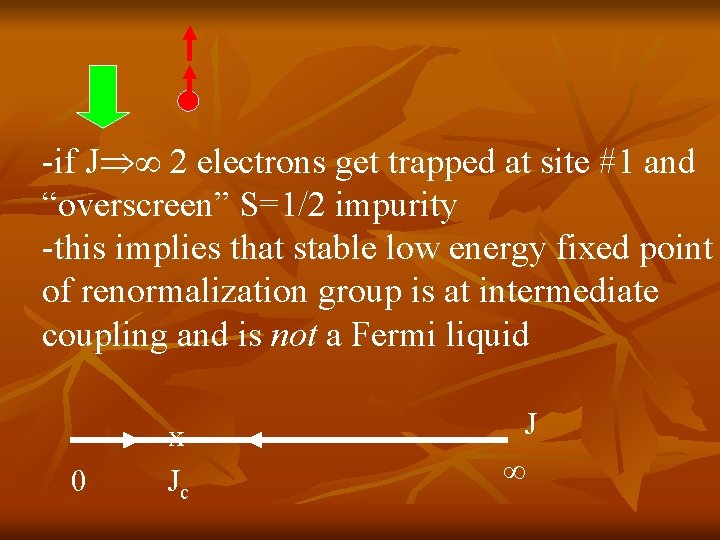
-if J 2 electrons get trapped at site #1 and “overscreen” S=1/2 impurity -this implies that stable low energy fixed point of renormalization group is at intermediate coupling and is not a Fermi liquid 0 x Jc J
using field theory methods, this low energy behavior is described by a Wess-Zumino-Witten conformal field theory (with Kac-Moody central charge k=2) -this field theory approach predicts exact critical behavior -various other nanostructures with several quantum dots and several channels also exhibit non-Fermi liquid behavior and can be solved by Conformal Field Theory/ Renormalization Group methods
the recent advent of precision experimental techniques have lead to a quest for experimental realizations of this novel physics in nanoscale systems
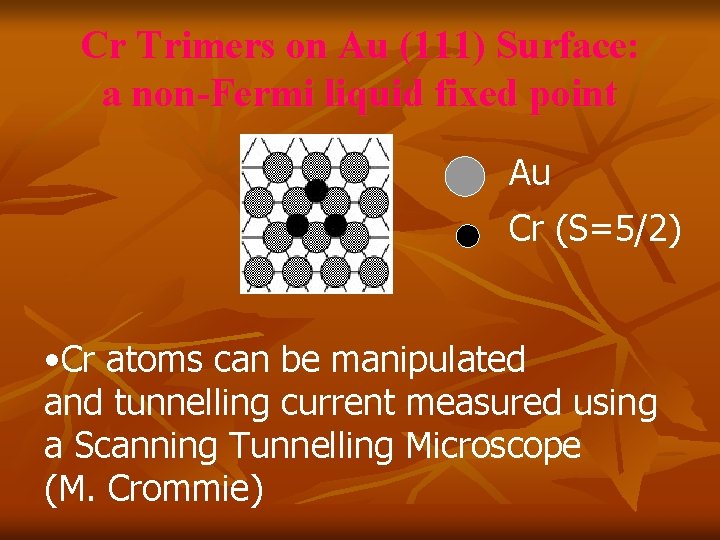
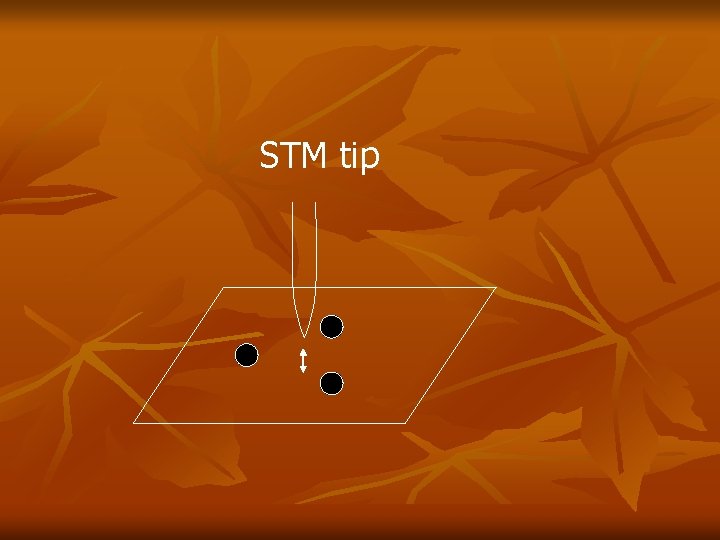
Cr Trimers on Au (111) Surface: a non-Fermi liquid fixed point Au Cr (S=5/2) • Cr atoms can be manipulated and tunnelling current measured using a Scanning Tunnelling Microscope (M. Crommie)
STM tip
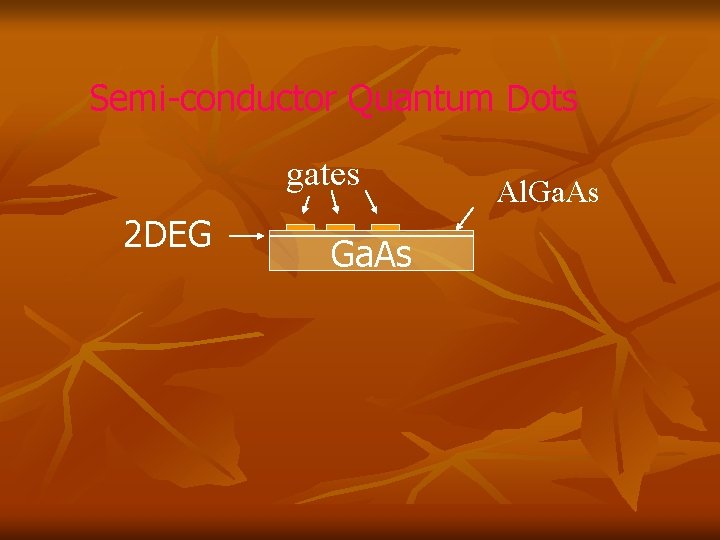
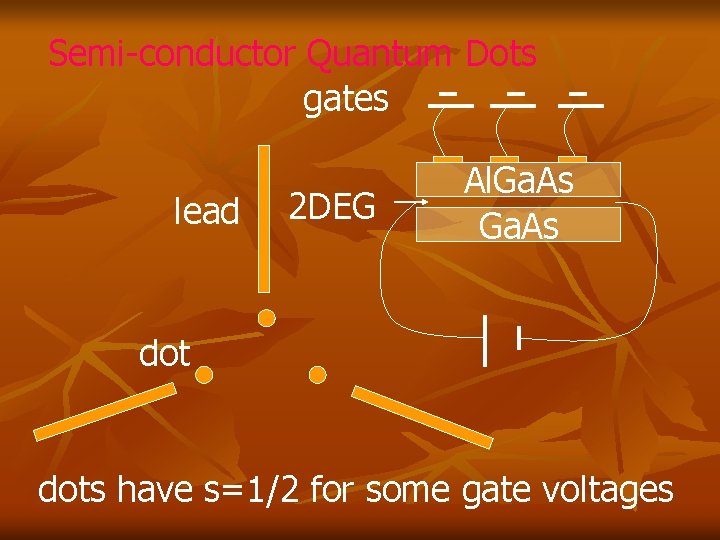
Semi-conductor Quantum Dots gates 2 DEG Ga. As Al. Ga. As
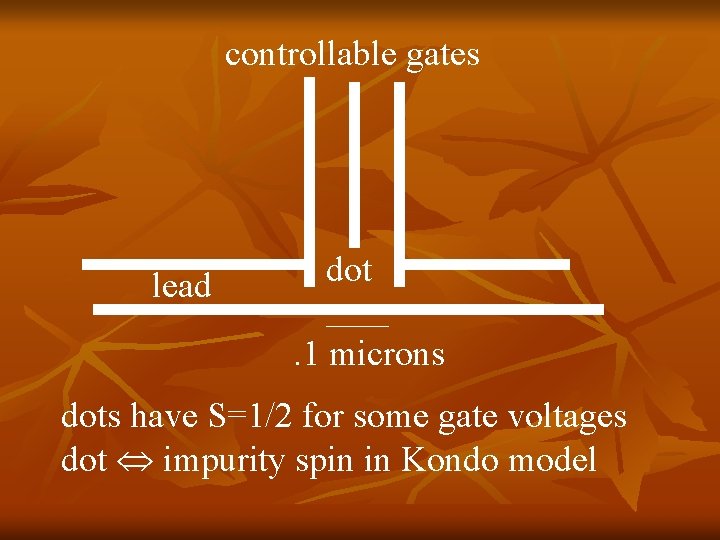
controllable gates lead dot. 1 microns dots have S=1/2 for some gate voltages dot impurity spin in Kondo model
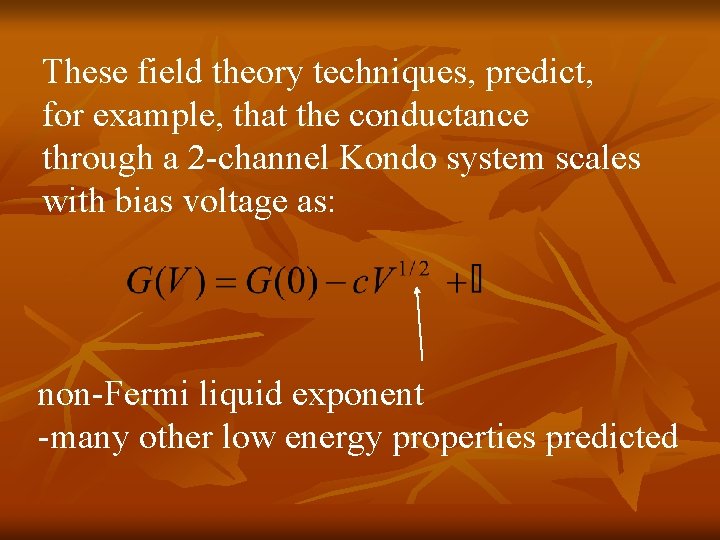
These field theory techniques, predict, for example, that the conductance through a 2 -channel Kondo system scales with bias voltage as: non-Fermi liquid exponent -many other low energy properties predicted
-the highly controllable interactions between semi-conductor quantum dots makes them an attractive candidate for qubits in a future quantum computer
the Boston University condensed matter group, which Larry Sulak played a vital role in assembling, is well-positioned to make important contributions to future developments in nano-science using methods from high energy theory (among other methods)
Semi-conductor Quantum Dots gates lead 2 DEG Al. Ga. As dots have s=1/2 for some gate voltages
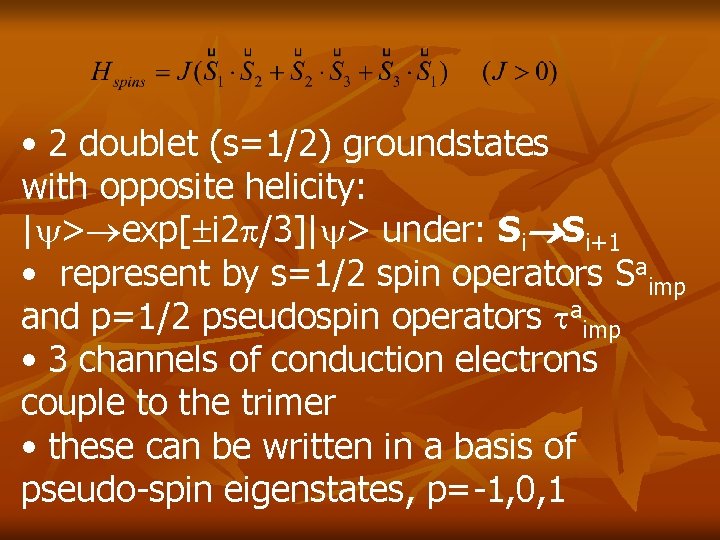
• 2 doublet (s=1/2) groundstates with opposite helicity: | > exp[ i 2 /3]| > under: Si Si+1 • represent by s=1/2 spin operators Saimp and p=1/2 pseudospin operators aimp • 3 channels of conduction electrons couple to the trimer • these can be written in a basis of pseudo-spin eigenstates, p=-1, 0, 1
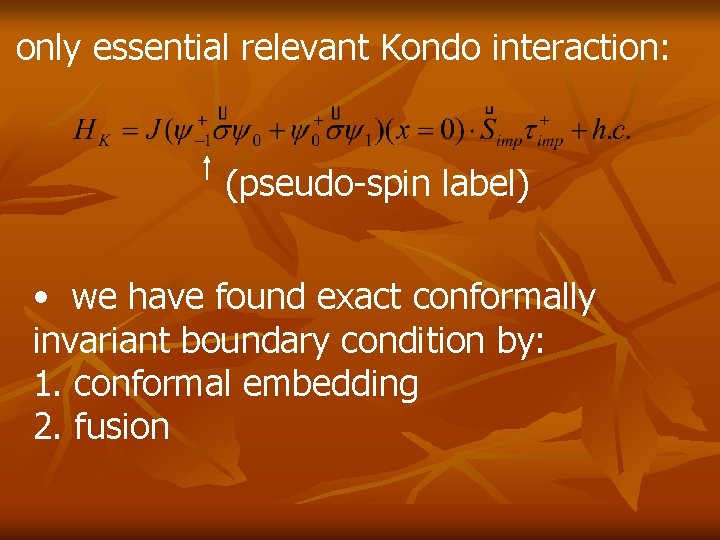
only essential relevant Kondo interaction: (pseudo-spin label) • we have found exact conformally invariant boundary condition by: 1. conformal embedding 2. fusion
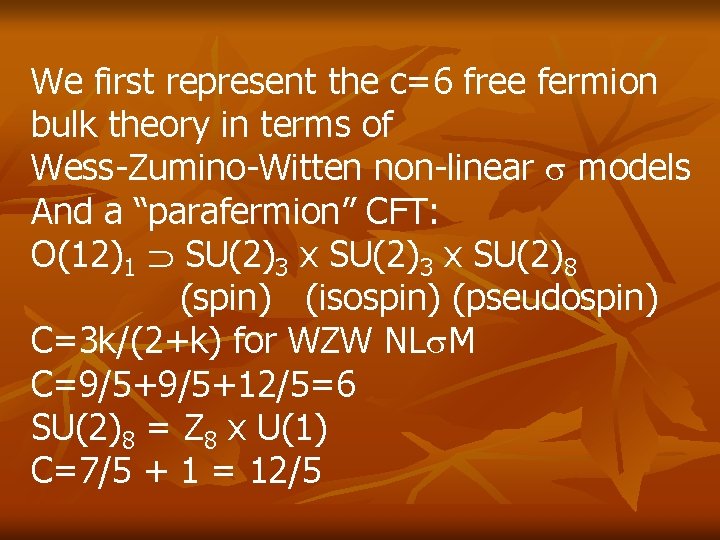
We first represent the c=6 free fermion bulk theory in terms of Wess-Zumino-Witten non-linear models And a “parafermion” CFT: O(12)1 SU(2)3 x SU(2)8 (spin) (isospin) (pseudospin) C=3 k/(2+k) for WZW NL M C=9/5+12/5=6 SU(2)8 = Z 8 x U(1) C=7/5 + 1 = 12/5
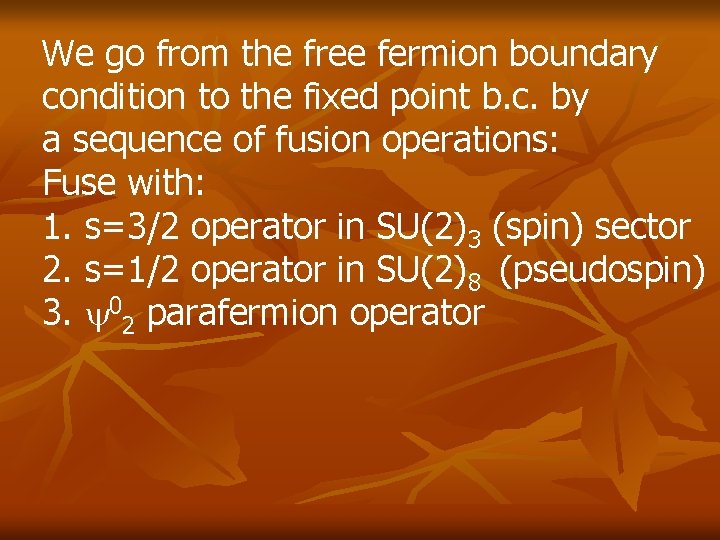
We go from the free fermion boundary condition to the fixed point b. c. by a sequence of fusion operations: Fuse with: 1. s=3/2 operator in SU(2)3 (spin) sector 2. s=1/2 operator in SU(2)8 (pseudospin) 3. 02 parafermion operator
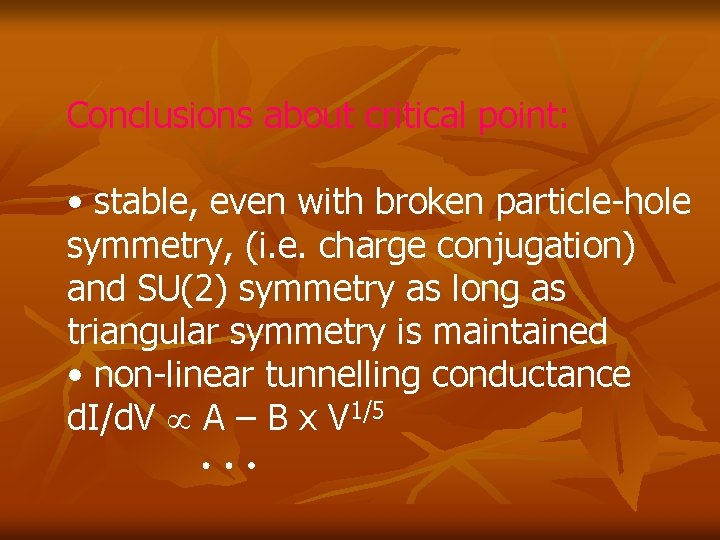
Conclusions about critical point: • stable, even with broken particle-hole symmetry, (i. e. charge conjugation) and SU(2) symmetry as long as triangular symmetry is maintained • non-linear tunnelling conductance d. I/d. V A – B x V 1/5