STUDY MATERIAL FOR MA IN ENGLISH 4 TH


- Slides: 17
STUDY MATERIAL FOR MA IN ENGLISH 4 TH SEMESTER COURSE EM 18: HOTEL CALIFORNIA LECTURE 1 BY DR SAUNAK SAMAJDAR
Please do not click anything till song finishes. Listen well. • While there have been many theories that contemplate what the song represents, the Eagles' band members have revealed in multiple interviews that the true meaning behind "Hotel California" is a commentary on the hedonism and selfindulgence of America. • “It’s basically a song about the dark underbelly of the American dream and about excess in America, which is something we knew a lot about, ” Henley said in a 2002 interview with "60 Minutes. "
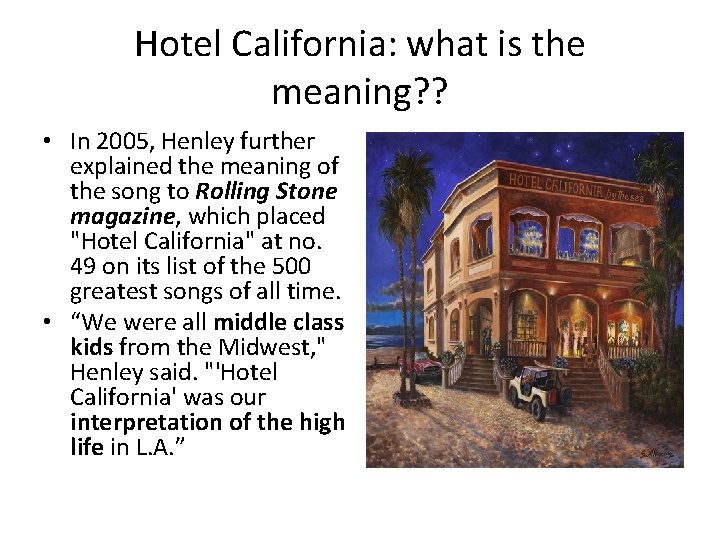
Hotel California: what is the meaning? ? • In 2005, Henley further explained the meaning of the song to Rolling Stone magazine, which placed "Hotel California" at no. 49 on its list of the 500 greatest songs of all time. • “We were all middle class kids from the Midwest, " Henley said. "'Hotel California' was our interpretation of the high life in L. A. ”
California and class • While most people tend to • California itself is seen as a think of Hotel California as a metaphor for escapism and somewhat romantic or the never-ending search for melancholy song, or simply pleasure and fulfilment. It related to traveling and is little wonder that this staying in a nice hotel in song became a classic icon California, they are usually for an entire generation. quite surprised to discover that it is actually a scathing social commentary on the materialism and hedonism of contemporary American life.
Structurally, • The song is in six verses, with a refrain repeated with some variation after the second and fourth verses. Among the difficulties in interpreting this song is the fact that some of the lines are rather obscure, there are built-in ambiguities in a number of passages, and puns and double meanings have been consciously utilized in several places. Now, let us examine the lyrics line by line.
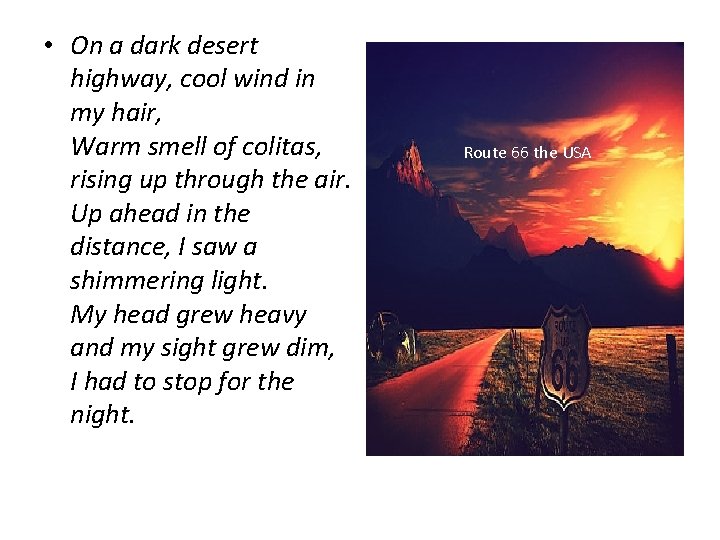
• On a dark desert highway, cool wind in my hair, Warm smell of colitas, rising up through the air. Up ahead in the distance, I saw a shimmering light. My head grew heavy and my sight grew dim, I had to stop for the night. Route 66 the USA
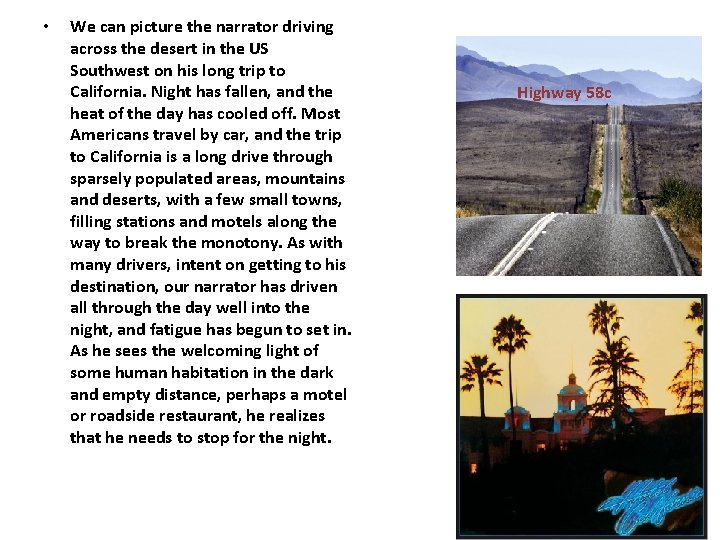
• We can picture the narrator driving across the desert in the US Southwest on his long trip to California. Night has fallen, and the heat of the day has cooled off. Most Americans travel by car, and the trip to California is a long drive through sparsely populated areas, mountains and deserts, with a few small towns, filling stations and motels along the way to break the monotony. As with many drivers, intent on getting to his destination, our narrator has driven all through the day well into the night, and fatigue has begun to set in. As he sees the welcoming light of some human habitation in the dark and empty distance, perhaps a motel or roadside restaurant, he realizes that he needs to stop for the night. Highway 58 c
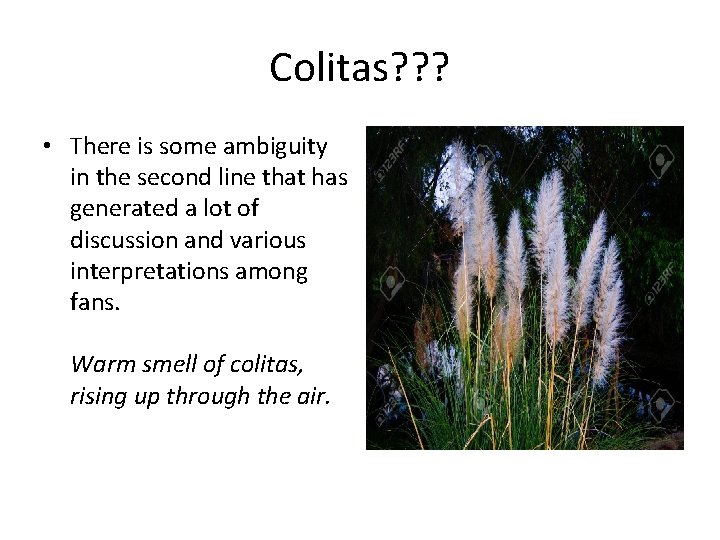
Colitas? ? ? • There is some ambiguity in the second line that has generated a lot of discussion and various interpretations among fans. Warm smell of colitas, rising up through the air.
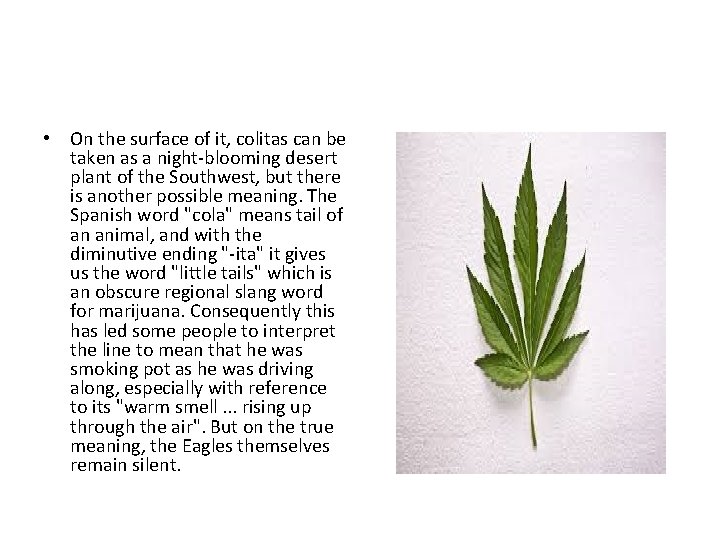
• On the surface of it, colitas can be taken as a night-blooming desert plant of the Southwest, but there is another possible meaning. The Spanish word "cola" means tail of an animal, and with the diminutive ending "-ita" it gives us the word "little tails" which is an obscure regional slang word for marijuana. Consequently this has led some people to interpret the line to mean that he was smoking pot as he was driving along, especially with reference to its "warm smell. . . rising up through the air". But on the true meaning, the Eagles themselves remain silent.
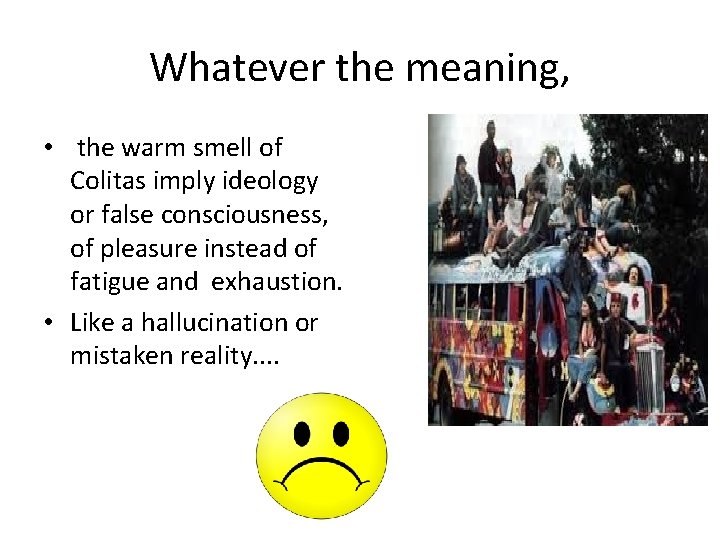
Whatever the meaning, • the warm smell of Colitas imply ideology or false consciousness, of pleasure instead of fatigue and exhaustion. • Like a hallucination or mistaken reality. .
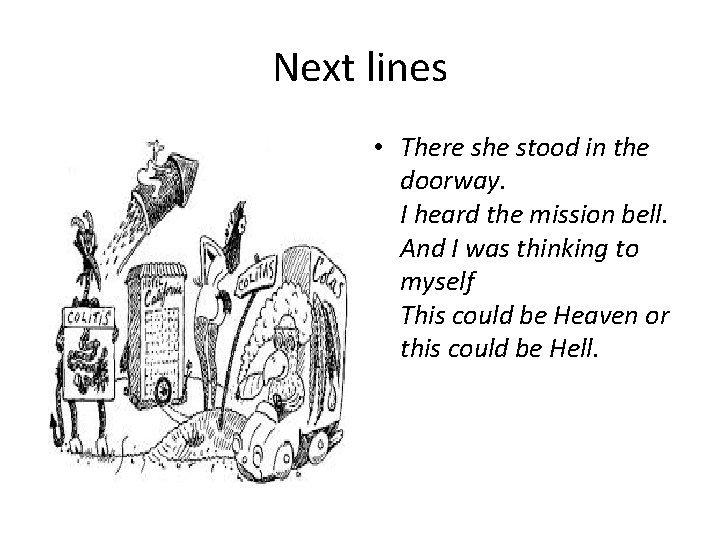
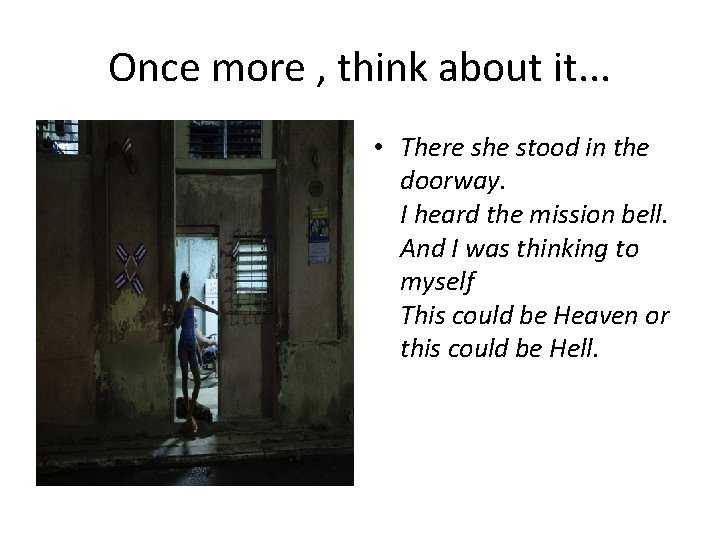
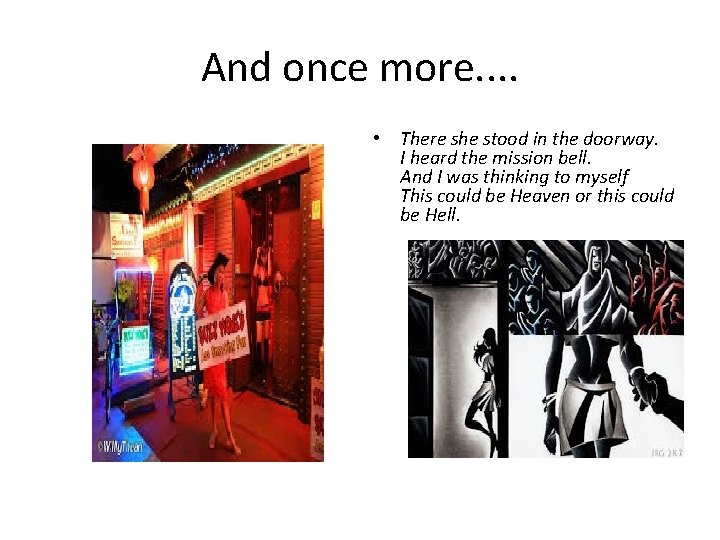
Next lines • There she stood in the doorway. I heard the mission bell. And I was thinking to myself This could be Heaven or this could be Hell.
• The female is anonymous. • In English we usually do Kind of alienated from her not use a personal particular identity, and pronoun until after the reduced to a personal individual has been pronoun. . . SHE introduced into the discourse. In normal speech we would say, "There was a woman standing in the doorway, " and then the subsequent reference would use "she".
Once more , think about it. . . • There she stood in the doorway. I heard the mission bell. And I was thinking to myself This could be Heaven or this could be Hell.
And once more. . • There she stood in the doorway. I heard the mission bell. And I was thinking to myself This could be Heaven or this could be Hell.
• The line "I heard the mission bell" introduces several features. On the one hand it gives us a sense of place. The Spanish missions established throughout the region long before any Englishspeaking settlers set foot in the area are among the characteristic cultural icons of Southern California and the US Southwest. Many of the cities and towns of California grew up around these missions, and were named after them: San Diego, Santa Barbara, San Luis Obispo, San Francisco, San Juan Capistrano, and of course Los Angeles, the City of Angels. There is nothing more evocative of the special character of this region than the sound of the ancient mission bells. • there is an ambiguous two-sided significance to the Spanish missions bells - they symbolize the call to salvation on the one hand, and they also symbolize the colonization of the region and the suppression of the Native American peoples and cultures. And this leads us directly to the next line where the protagonist thinks to himself, "This could be Heaven or this could be Hell. "
Mission Bells • http: //eng 1. sgarrigues. net/hotel-california--mission-bells. html • Please go through this link once This lecture has been prepared with the help of a prose essay by Stephen Garrigues, Professor, Dept. of English Language and Literature Kyungpook National University