Student Learning Development Essay writing skills Student Learning



- Slides: 37
Student Learning Development Essay writing skills
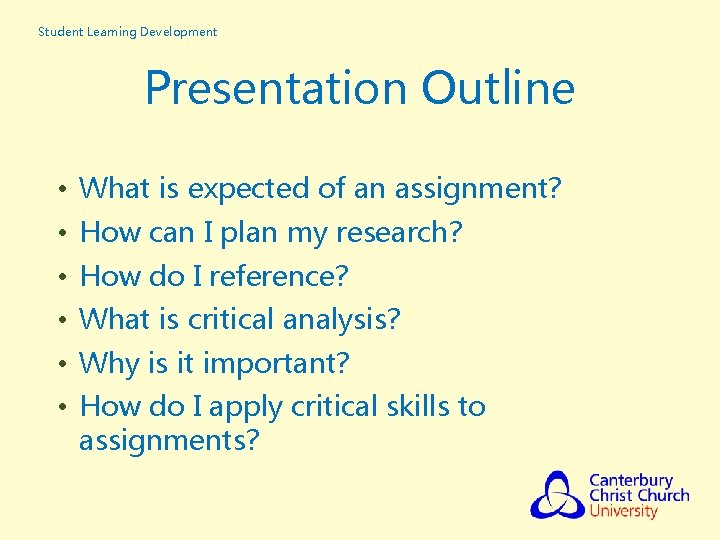
Student Learning Development Presentation Outline • What is expected of an assignment? • How can I plan my research? • How do I reference? • What is critical analysis? • Why is it important? • How do I apply critical skills to assignments?
Student Learning Development What is expected of an assignment? The aim of writing your essay is to put forward: ü your own answer to the question, well-researched but showing your own thinking and understanding As a result, you need to: ü develop your own argument, based on reading, research and thinking ü write it clearly supported by relevant sources from the literature
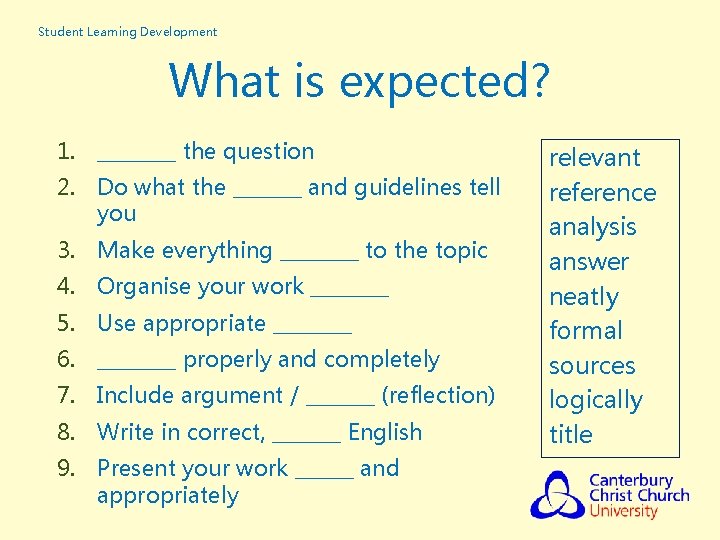
Student Learning Development What is expected? 1. ____ the question 2. Do what the _______ and guidelines tell you 3. Make everything ____ to the topic 4. Organise your work ____ 5. Use appropriate ____ 6. ____ properly and completely 7. Include argument / _______ (reflection) 8. Write in correct, _______ English 9. Present your work ______ and appropriately relevant reference analysis answer neatly formal sources logically title
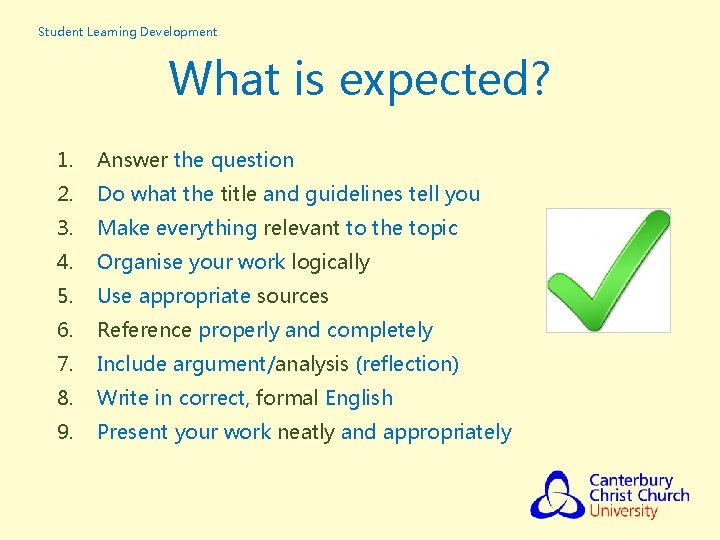
Student Learning Development What is expected? 1. Answer the question 2. Do what the title and guidelines tell you 3. Make everything relevant to the topic 4. Organise your work logically 5. Use appropriate sources 6. Reference properly and completely 7. Include argument/analysis (reflection) 8. Write in correct, formal English 9. Present your work neatly and appropriately
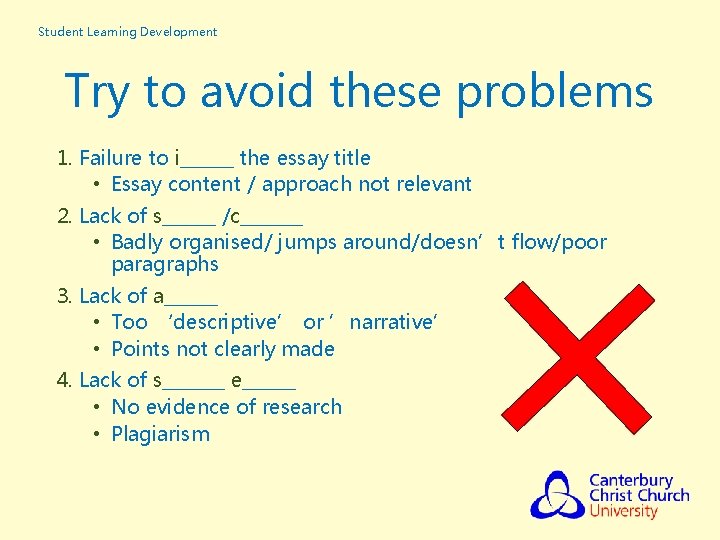
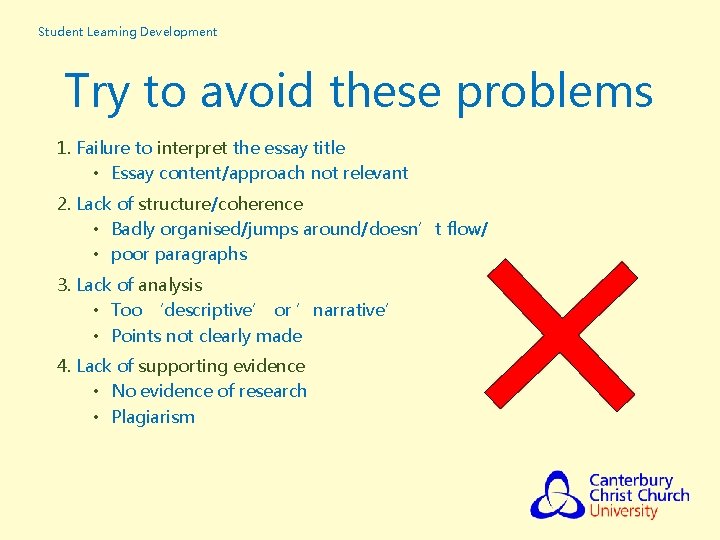
Student Learning Development Try to avoid these problems 1. Failure to i______ the essay title • Essay content / approach not relevant 2. Lack of s______ /c_______ • Badly organised/ jumps around/doesn’t flow/poor paragraphs 3. Lack of a______ • Too ‘descriptive’ or ’narrative’ • Points not clearly made 4. Lack of s_______ e______ • No evidence of research • Plagiarism
Student Learning Development Try to avoid these problems 1. Failure to interpret the essay title • Essay content/approach not relevant 2. Lack of structure/coherence • Badly organised/jumps around/doesn’t flow/ • poor paragraphs 3. Lack of analysis • Too ‘descriptive’ or ’narrative’ • Points not clearly made 4. Lack of supporting evidence • No evidence of research • Plagiarism
Student Learning Development How can I plan my research? Your whole essay should fit together to answer the question: • Your introduction sets your essay in context, preparing people to read and understand the text • The main body leads people logically, step by step through each point in your answer • Your conclusion pulls them together and sums up the most important things in your answer • References should give full details of all the sources you refer to in your assignment
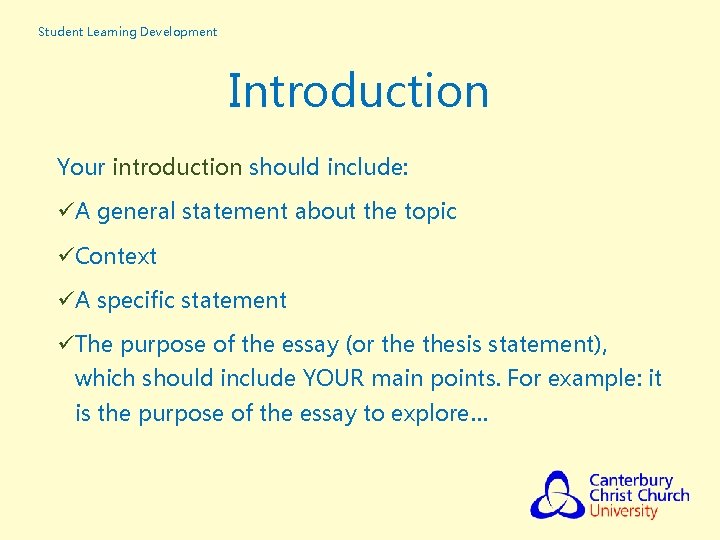
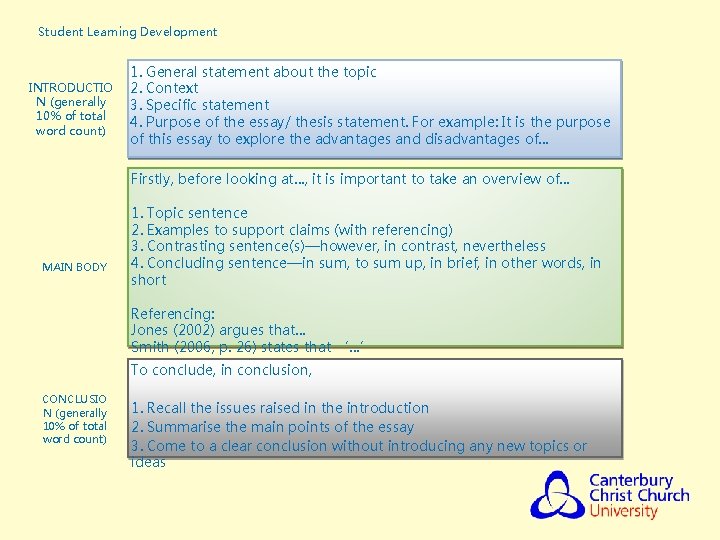
Student Learning Development Introduction Your introduction should include: üA general statement about the topic üContext üA specific statement üThe purpose of the essay (or thesis statement), which should include YOUR main points. For example: it is the purpose of the essay to explore…
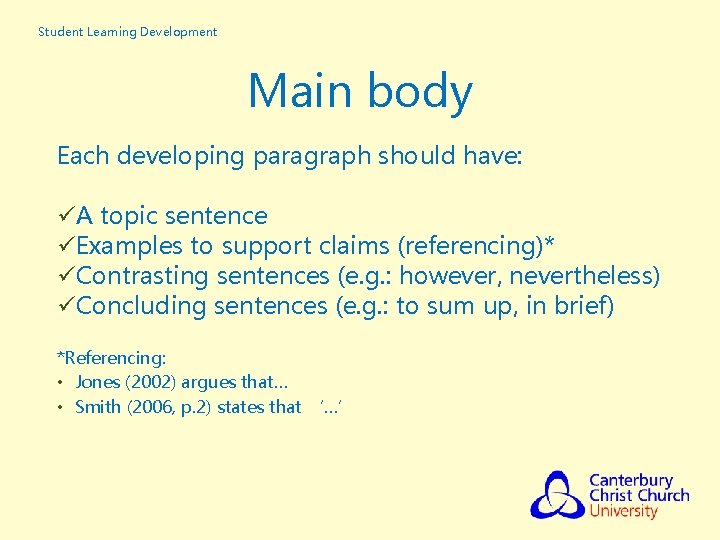
Student Learning Development Main body Each developing paragraph should have: üA topic sentence üExamples to support claims (referencing)* üContrasting sentences (e. g. : however, nevertheless) üConcluding sentences (e. g. : to sum up, in brief) *Referencing: • Jones (2002) argues that… • Smith (2006, p. 2) states that ‘…’
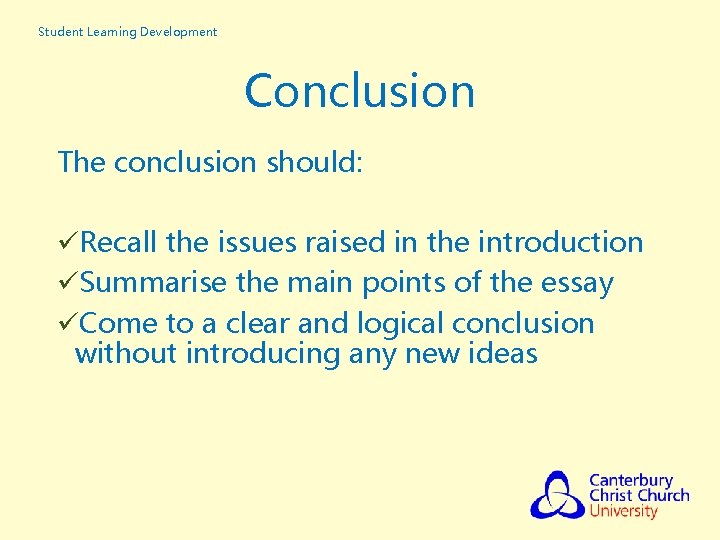
Student Learning Development Conclusion The conclusion should: üRecall the issues raised in the introduction üSummarise the main points of the essay üCome to a clear and logical conclusion without introducing any new ideas
Student Learning Development INTRODUCTIO N (generally 10% of total word count) 1. General statement about the topic 2. Context 3. Specific statement 4. Purpose of the essay/ thesis statement. For example: It is the purpose of this essay to explore the advantages and disadvantages of. . . Firstly, before looking at…, it is important to take an overview of… MAIN BODY 1. Topic sentence 2. Examples to support claims (with referencing) 3. Contrasting sentence(s)—however, in contrast, nevertheless 4. Concluding sentence—in sum, to sum up, in brief, in other words, in short Referencing: Jones (2002) argues that… Smith (2006, p. 26) states that ‘…’ To conclude, in conclusion, CONCLUSIO N (generally 10% of total word count) 1. Recall the issues raised in the introduction 2. Summarise the main points of the essay 3. Come to a clear conclusion without introducing any new topics or ideas
Student Learning Development Referencing
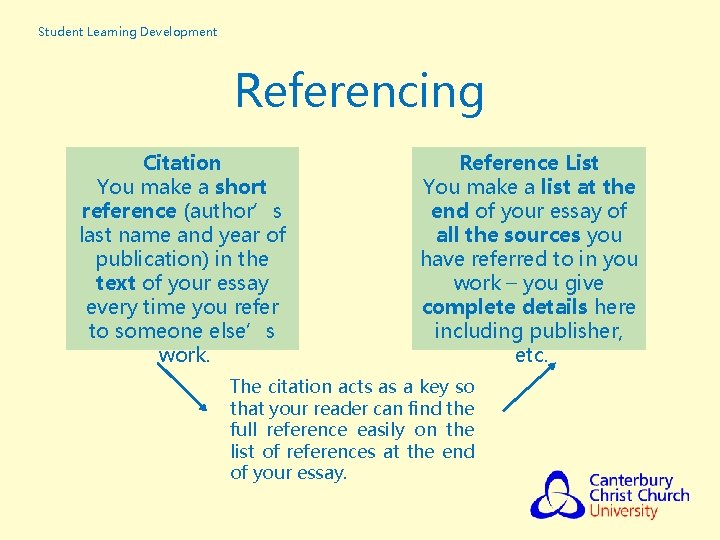
Student Learning Development Referencing Citation You make a short reference (author’s last name and year of publication) in the text of your essay every time you refer to someone else’s work. Reference List You make a list at the end of your essay of all the sources you have referred to in you work – you give complete details here including publisher, etc. The citation acts as a key so that your reader can find the full reference easily on the list of references at the end of your essay.
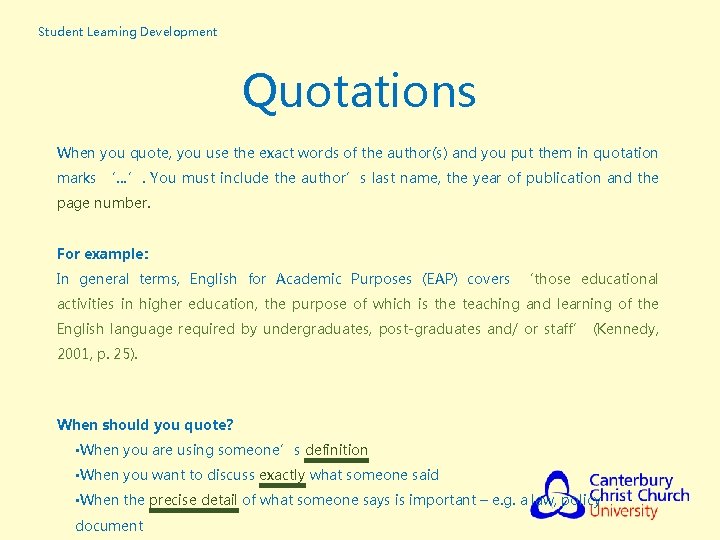
Student Learning Development Quotations When you quote, you use the exact words of the author(s) and you put them in quotation marks ‘…’. You must include the author’s last name, the year of publication and the page number. For example: In general terms, English for Academic Purposes (EAP) covers ‘those educational activities in higher education, the purpose of which is the teaching and learning of the English language required by undergraduates, post-graduates and/ or staff’ (Kennedy, 2001, p. 25). When should you quote? • When you are using someone’s definition • When you want to discuss exactly what someone said • When the precise detail of what someone says is important – e. g. a law, policy document
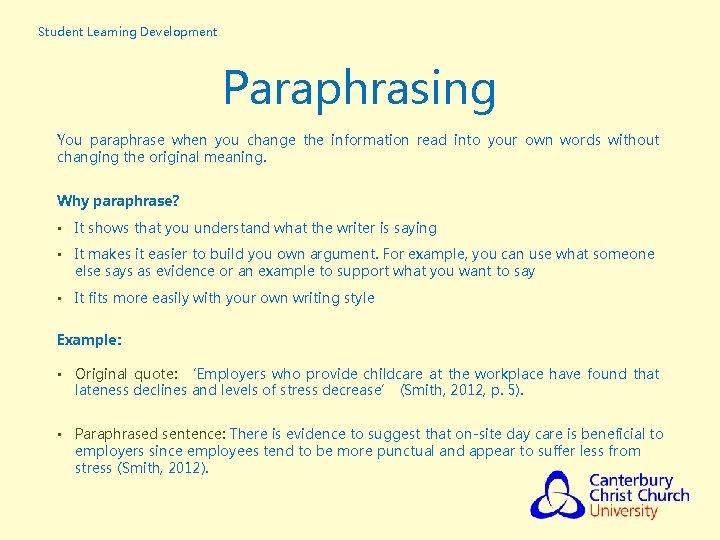
Student Learning Development Paraphrasing You paraphrase when you change the information read into your own words without changing the original meaning. Why paraphrase? • It shows that you understand what the writer is saying • It makes it easier to build you own argument. For example, you can use what someone else says as evidence or an example to support what you want to say • It fits more easily with your own writing style Example: • Original quote: ‘Employers who provide childcare at the workplace have found that lateness declines and levels of stress decrease’ (Smith, 2012, p. 5). • Paraphrased sentence: There is evidence to suggest that on-site day care is beneficial to employers since employees tend to be more punctual and appear to suffer less from stress (Smith, 2012).
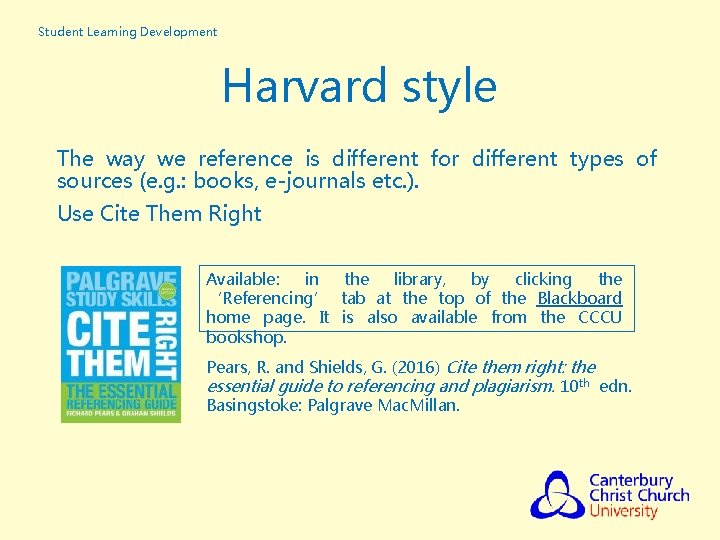
Student Learning Development Harvard style The way we reference is different for different types of sources (e. g. : books, e-journals etc. ). Use Cite Them Right Available: in the library, by clicking the ‘Referencing’ tab at the top of the Blackboard home page. It is also available from the CCCU bookshop. Pears, R. and Shields, G. (2016) Cite them right: the essential guide to referencing and plagiarism. 10 th edn. Basingstoke: Palgrave Mac. Millan.
Student Learning Development Critical Analysis
Student Learning Development What is critical analysis? ‘It is a cognitive activity, associated with using the mind. Learning to think in critically analytical and evaluative ways means using mental processes such as attention, categorisation, selection, and judgement’ (Cottrell, 2005, p. 1).
Student Learning Development Definitions – issues involved in reading and writing Critical: containing detailed judgements of good and bad qualities of something. Analysis: the separation of something into its constituent parts to understand what it contains. Discussion: a detailed consideration of the ideas relating to a topic. Argument: the reasons put forward to support or oppose an opinion.
Student Learning Development Issues involved in analysis • Weighing up evidence • Thinking critically about given terms and definitions • Seeing links between ideas or between ideas and events • Expressing your own ideas • Interpreting significance information to find its • Arguing against some ideas and in support of others
Student Learning Development Why is critical analysis important? ‘Skills in critical thinking bring precision to the way you think and work’ (Cottrell, 2005, p. 4).
Student Learning Development Benefits of reading critically • Improved attention to detail and observation • Improved ability to question: you shouldn’t believe everything you read or hear • More focused reading • Improved ability to identify the key points in a text or the message rather than becoming distracted by less important material • Knowledge of how to get to your own point across more easily • Identifying trends and patterns • Looking at the same information from several points of view • Objectivity • Considering implications and consequences
Student Learning Development Using critical analysis to prepare an assignment Step 1: explore the question • Do you understand it? • Can you rewrite it in your own words? • What is it asking you to focus upon? • What are the key debates it refers to?
Student Learning Development Exploring the title There are 3 things to look at: • Topic/content words or phrases • These tell you the main subject of the assignment • Limiting/focus words • These tell you what aspects of the topic to write about • Direction words • These tell you what to do
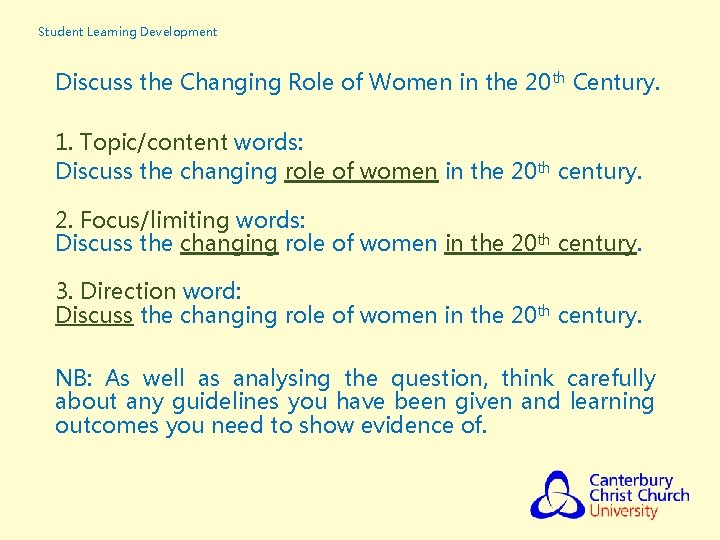
Student Learning Development Discuss the Changing Role of Women in the 20 th Century. 1. Topic/content words: Discuss the changing role of women in the 20 th century. 2. Focus/limiting words: Discuss the changing role of women in the 20 th century. 3. Direction word: Discuss the changing role of women in the 20 th century. NB: As well as analysing the question, think carefully about any guidelines you have been given and learning outcomes you need to show evidence of.
Student Learning Development Step 1: explore the topic • • What do you already know about the topic? Make some brief notes and summarise your ideas What does your current knowledge of this topic contribute to your assessment of this material? Have you already undertaken research in this area? Think about the issues which surround this topic. Can you identify the key threads?
Student Learning Development Step 2: develop your argument • Your aim is to present your view on this topic; to ‘argue’ your case via the creation of a clear, strong, coherent argument to support your ideas • Your argument conclusions should underpin your • Think about how you will convince your reader of your viewpoint
Student Learning Development Step 3: create a convincing argument Complete the following sentence: People should be encouraged to smoke because…
Student Learning Development Did you find this difficult? Perhaps you have particular principles or feelings that influenced your ability to respond to the task? Here are some reasons you could have given: • smoking lowers the cost of geriatric care because smokers tend to die younger than non-smokers • smokers generate employment in the tobacco industry • smoking raises taxes • smoking saves on pension payments because smokers tend to die younger than non-smokers Looking at this list, were you itching to argue against some of them? If so, you can see how valuable this is in stimulating thinking! This activity will help you appreciate that we can consider other points of view, even if we do not agree with them (adapted from The Open University, 2013).
Student Learning Development Step 4: use evidence to support your viewpoint • • • Having explored the literature, show what evidence is available Assess its strengths and weaknesses Consider current theories Identify areas of debate/disagreement Are there discussions/debates/theories which are not in accord with your viewpoint? Consider the evidence that they are based on. Is it convincing?
Student Learning Development Step 5: Present your argument in a clear and coherent way • Structure your argument by moving from point to point • It has to be logical, clear, coherent, working towards the conclusion • Think about the most logical way of presenting the discussion • Visualise your argument as a series of stepping stones laid out clearly on a path towards your conclusion which should be logical based Identify on clearthe reasoning well Try using this idea when reading. content of supported bystone evidence. each stepping as the path which heads towards the conclusion.
Student Learning Development Step 6: Academic writing • • When putting your discussion together, try to avoid presenting a list of evidence (who says what) Formulate and articulate your views of current ideas/arguments. Can you evaluate the strengths and weaknesses of these arguments? Explore and suggest the limitations of studies Show material links
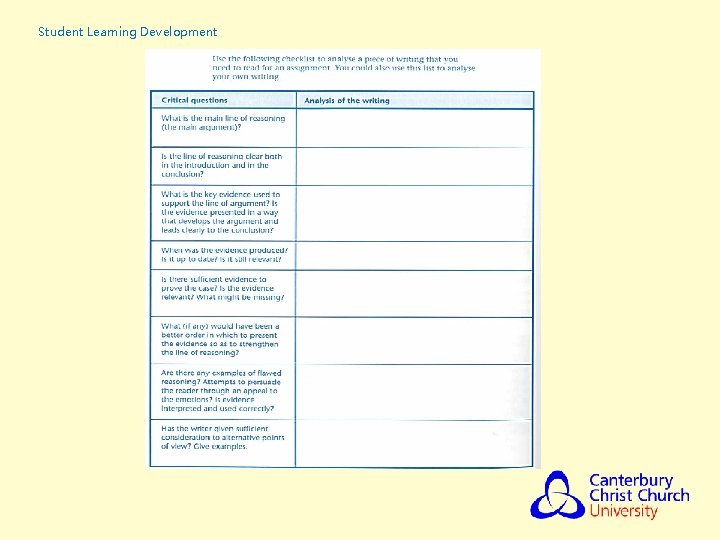
Student Learning Development
Student Learning Development To sum up, • The development of critical and analytical thinking and writing skills is an important aspect of studying in higher education • When learning about and exploring new ideas, issues, theories and texts, it is important not to accept everything without first questioning it • This means using critical and analytical thinking skills to assess information and ideas which are new to you
Student Learning Development References Cottrell, S. (2003) The Study Skills Handbook. Basingstoke: Palgrave. Cottrell, S. (2005) Critical Thinking Skills. Basingstoke: Palgrave.