
Skills Development Strategy Presentation by Adrienne Bird Chief

Skills Development Strategy, Presentation by Adrienne Bird, Chief Director: Employment and Skills Development Services, Department of Labour, 26 October 1999.
SKILLS DEVELOPMENT ACT - PURPOSE i. To improve the quality of life of workers, their prospects of work and labour mobility ii. To improve productivity in the workplace and the iii. competitiveness of employers iii. To promote self-employment iv. To improve the delivery of social services v. To increase the levels of investment in education and vi. training in the labour market and to improve the return vii. on that investment
SKILLS DEVELOPMENT ACT - INSTITUTIONS i. Minister of Labour ii. Director General: Labour – Accounting Officer iii. National Skills Authority (NSA) iv. Sector Education and Training Authorities (SETAs) v. Department of Labour: Programme: Employment and Skills Development Services (Directorate: Skills Development Unit, Funding, National Skills Authority Secretariat, Employment Services and Indlela/COTT)
FUNCTIONS OF THE NATIONAL SKILLS AUTHORITY Ø ADVISE MINISTER ON: • National SD policy and strategy • Implementation of strategy • Allocation of subsidies from NSF Ø LIAISON WITH SETAS Ø REPORT TO MINISTER ON IMPLEMENTATION OF STRATEGY Ø CONDUCT INVESTIGATIONS
COMPOSITION OF THE NATIONAL SKILLS AUTHORITY i. Chairperson ii. Executive Officer iii. Organised business (BSA and Nafcoc) iv. Organised labour (Cosatu, Nactu and Fedusa) v. Government departments (Labour, Education, DPSA, DTI, DACST) vi. Community (Youth, Women, People with disabilities, Rural, Civic) vii. Representatives from education and training providers (higher, further, ABET and private)
NATIONAL SKILLS AUTHORITY Ø NSA established on 12 April 1999 Ø Chairperson not yet appointed, two acting co-chairpersons from Labour and Business Ø Mr. Sam Morotoba = Executive Officer, National Skills Authority Ø 2 NSA meetings, 1 special NSA and 3 EXCO meetings were held this year
NSA POLICY ADVICE TO MINISTER TO DATE Ø Critical path for the implementation of the Skills Development Act Ø Demarcation of Sector Education and Training Authorities – Publication of Government Gazette on 7 September 1999 – Gazette Number: 20442 Ø Grant disbursement to employers by a SETA or chamber – Regulation Number R. 1231 Gazette Number 20552 dated 15 October 1999 Ø Published for public comment, comment to be received on 15 November 1999, NSA to consider on 18 November 1999
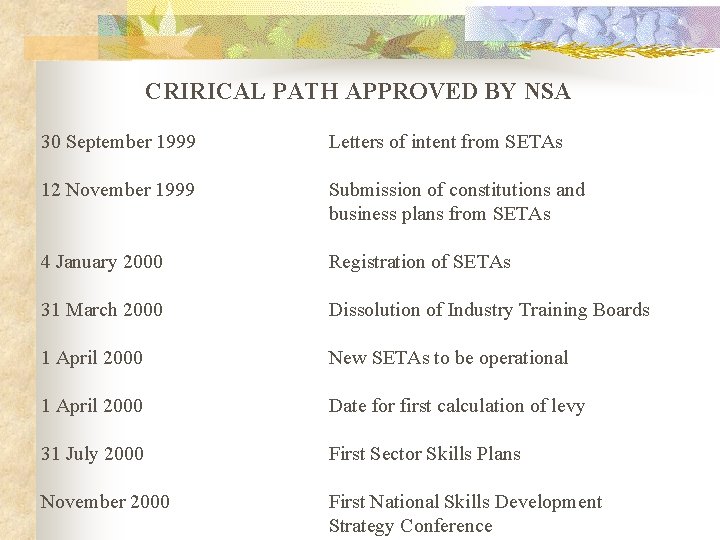
CRIRICAL PATH APPROVED BY NSA 30 September 1999 Letters of intent from SETAs 12 November 1999 Submission of constitutions and business plans from SETAs 4 January 2000 Registration of SETAs 31 March 2000 Dissolution of Industry Training Boards 1 April 2000 New SETAs to be operational 1 April 2000 Date for first calculation of levy 31 July 2000 First Sector Skills Plans November 2000 First National Skills Development Strategy Conference
SETA DEMARCATION i. Accounting and other Financial services ii. Banking iii. Chemical and Allied Industries iv. Clothing, Textiles, Leather and Footwear v. Construction vi. Defence vii. Education, Training and Development Practices viii. Energy ix. Food x. Forestry, Furniture, Pulp & Paper Board, and Wood Products xi. Health and Welfare xii. Information Systems (IT), Electronics and Telecommunication Technologies xiii. Insurance
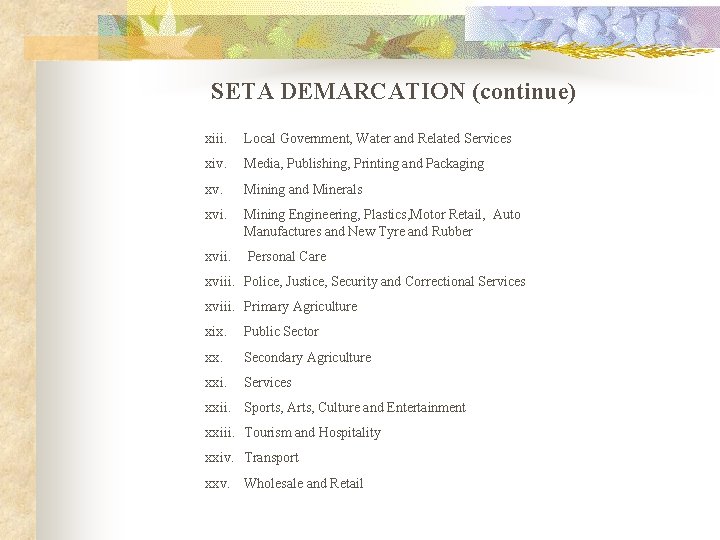
SETA DEMARCATION (continue) xiii. Local Government, Water and Related Services xiv. Media, Publishing, Printing and Packaging xv. Mining and Minerals xvi. Mining Engineering, Plastics, Motor Retail, Auto Manufactures and New Tyre and Rubber xvii. Personal Care xviii. Police, Justice, Security and Correctional Services xviii. Primary Agriculture xix. Public Sector xx. Secondary Agriculture xxi. Services xxii. Sports, Arts, Culture and Entertainment xxiii. Tourism and Hospitality xxiv. Transport xxv. Wholesale and Retail
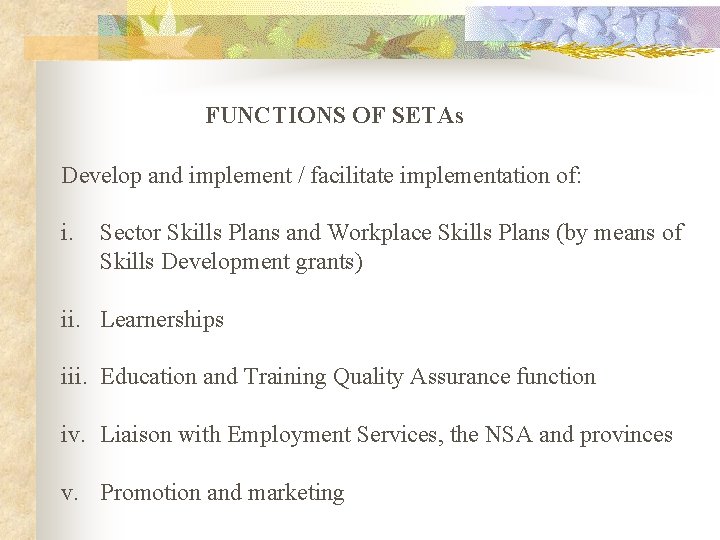
FUNCTIONS OF SETAs Develop and implement / facilitate implementation of: i. Sector Skills Plans and Workplace Skills Plans (by means of Skills Development grants) ii. Learnerships iii. Education and Training Quality Assurance function iv. Liaison with Employment Services, the NSA and provinces v. Promotion and marketing
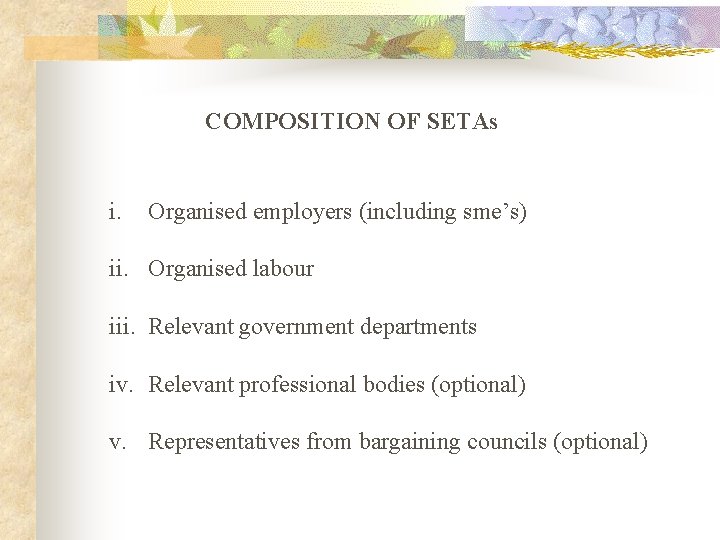
COMPOSITION OF SETAs i. Organised employers (including sme’s) ii. Organised labour iii. Relevant government departments iv. Relevant professional bodies (optional) v. Representatives from bargaining councils (optional)
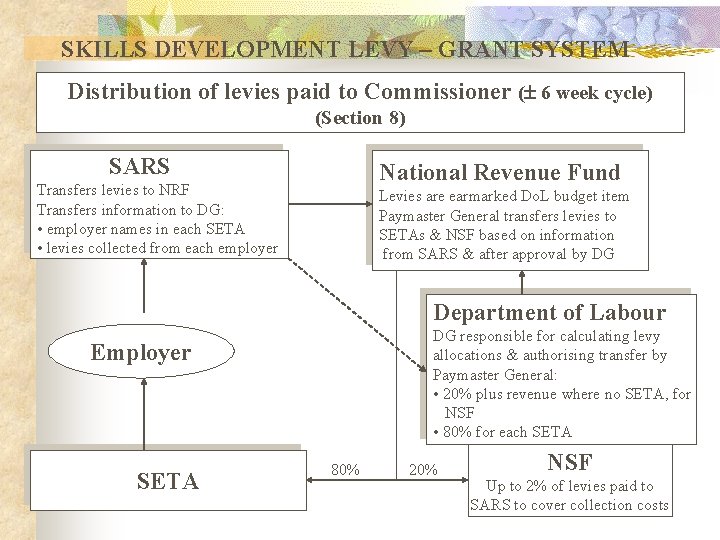
SKILLS DEVELOPMENT LEVY – GRANT SYSTEM Distribution of levies paid to Commissioner ( 6 week cycle) (Section 8) SARS National Revenue Fund Transfers levies to NRF Transfers information to DG: • employer names in each SETA • levies collected from each employer Levies are earmarked Do. L budget item Paymaster General transfers levies to SETAs & NSF based on information from SARS & after approval by DG Department of Labour DG responsible for calculating levy allocations & authorising transfer by Paymaster General: • 20% plus revenue where no SETA, for NSF • 80% for each SETA Employer SETA 80% 20% NSF Up to 2% of levies paid to SARS to cover collection costs
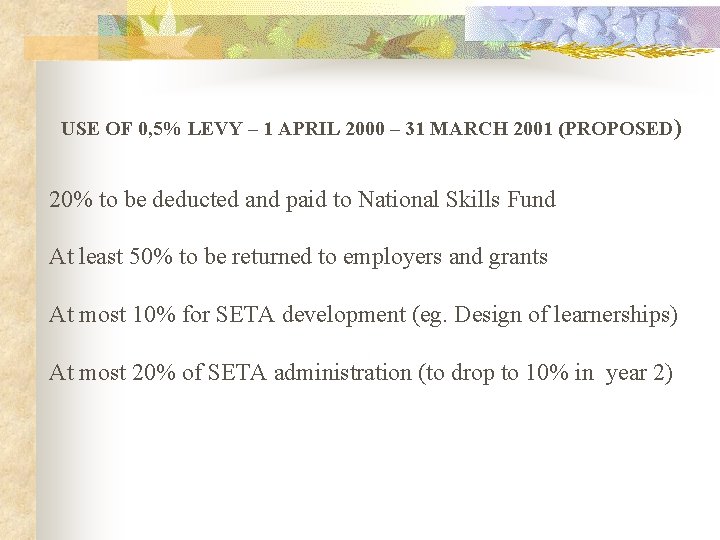
USE OF 0, 5% LEVY – 1 APRIL 2000 – 31 MARCH 2001 (PROPOSED) 20% to be deducted and paid to National Skills Fund At least 50% to be returned to employers and grants At most 10% for SETA development (eg. Design of learnerships) At most 20% of SETA administration (to drop to 10% in year 2)
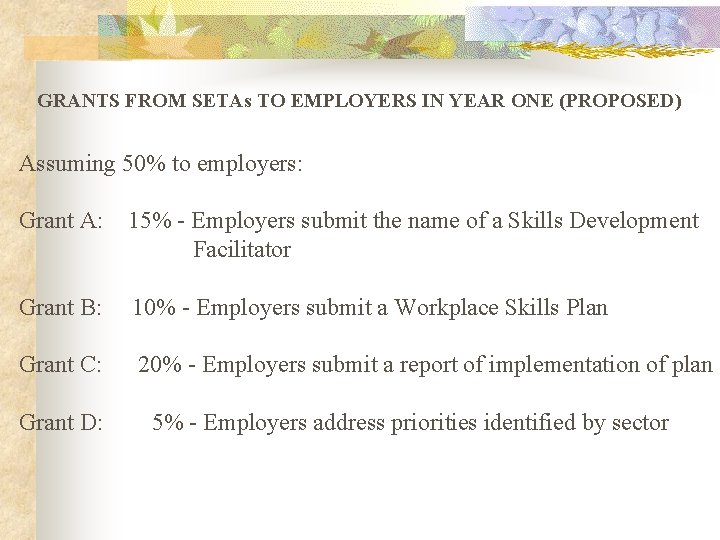
GRANTS FROM SETAs TO EMPLOYERS IN YEAR ONE (PROPOSED) Assuming 50% to employers: Grant A: 15% - Employers submit the name of a Skills Development Facilitator Grant B: 10% - Employers submit a Workplace Skills Plan Grant C: 20% - Employers submit a report of implementation of plan Grant D: 5% - Employers address priorities identified by sector

NATIONAL SKILLS FUND (PROPOSED) MINISTER National DG Skills Authority National Skills Fund Unemployed SME’s Target Incentive-2 Groups Social Plan Incentive-3 Employment Learnerships generation Incentive-5 Incentive-4 Incentive-1 Do. L PROVINCIAL OFFICE SETA PROVIDERS COMPANIES/PROVIDERS/LEARNERS
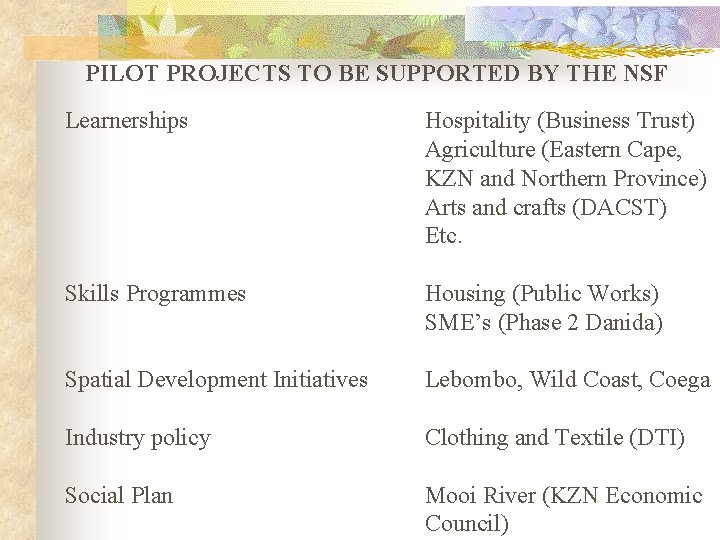
PILOT PROJECTS TO BE SUPPORTED BY THE NSF Learnerships Hospitality (Business Trust) Agriculture (Eastern Cape, KZN and Northern Province) Arts and crafts (DACST) Etc. Skills Programmes Housing (Public Works) SME’s (Phase 2 Danida) Spatial Development Initiatives Lebombo, Wild Coast, Coega Industry policy Clothing and Textile (DTI) Social Plan Mooi River (KZN Economic Council)

EUROPEAN UNION IMPLEMENTATION SUPPORT Labour Market Skills Development Programme 46 million Euro’s = R 280 million Six projects: Project 1 – Capacity of Programme: ESDS Project 2 – Strategic planning and information systems Project 3 – Learnerships and skills programmes Project 4 – In-service training (for those employed) Project 5 – SETAs and NSA Project 6 – Funding – levy/grant and NSF

CAPACITY BUILDING Elective Higher degree Level 7/8 B. Degree in Org. Leadership National Diploma in Organisation Management Level 5 National Certificate in Organisation Administration Level 5 National Certificate in Workplace Skills Level 4 Information Processing Communication Strategic thinking Generic Operations management Project management Democratic processes Quality process
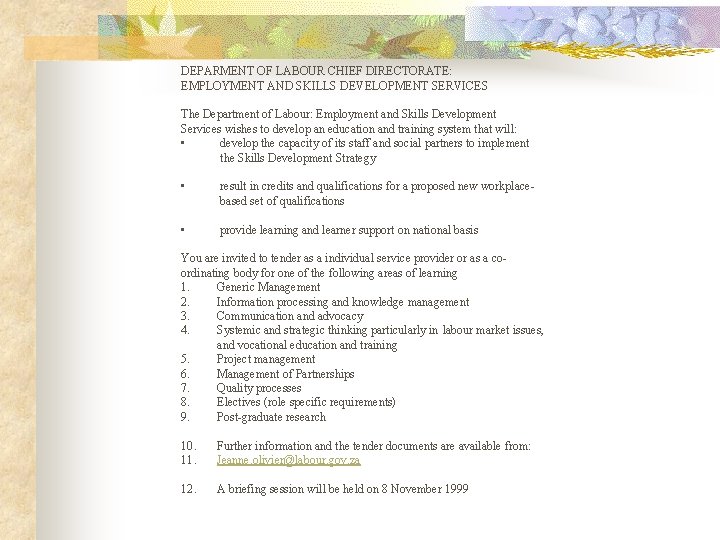
DEPARMENT OF LABOUR CHIEF DIRECTORATE: EMPLOYMENT AND SKILLS DEVELOPMENT SERVICES The Department of Labour: Employment and Skills Development Services wishes to develop an education and training system that will: • develop the capacity of its staff and social partners to implement the Skills Development Strategy • result in credits and qualifications for a proposed new workplacebased set of qualifications • provide learning and learner support on national basis You are invited to tender as a individual service provider or as a coordinating body for one of the following areas of learning 1. Generic Management 2. Information processing and knowledge management 3. Communication and advocacy 4. Systemic and strategic thinking particularly in labour market issues, and vocational education and training 5. Project management 6. Management of Partnerships 7. Quality processes 8. Electives (role specific requirements) 9. Post-graduate research 10. 11. Further information and the tender documents are available from: Jeanne. olivier@labour. gov. za 12. A briefing session will be held on 8 November 1999
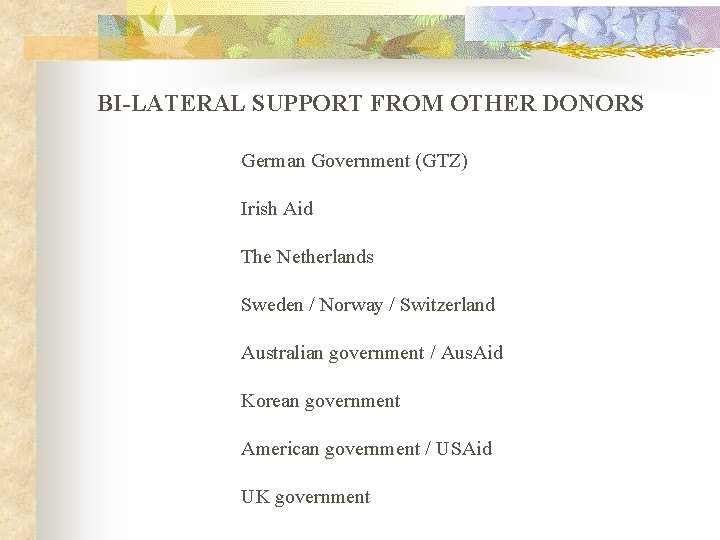
BI-LATERAL SUPPORT FROM OTHER DONORS German Government (GTZ) Irish Aid The Netherlands Sweden / Norway / Switzerland Australian government / Aus. Aid Korean government American government / USAid UK government
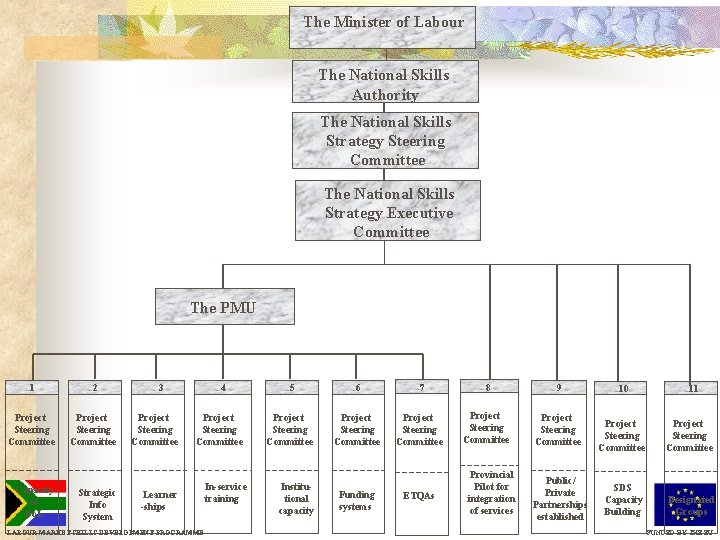
The Minister of Labour The National Skills Authority The National Skills Strategy Steering Committee The National Skills Strategy Executive Committee The PMU 1 2 Project Steering Committee Capacity of Do. L Strategic Info System 3 Project Steering Committee 4 Project Steering Committee Learner -ships LABOUR MARKET SKILLS DEVELOPMENT PROGRAMME In-service training 5 6 Project Steering Committee Institutional capacity Funding systems 7 Project Steering Committee ETQAs 8 9 Project Steering Committee Provincial Pilot for integration of services Public/ Private Partnerships established 10 11 Project Steering Committee SDS Capacity Building Designated Groups FUNDED BY THE EU
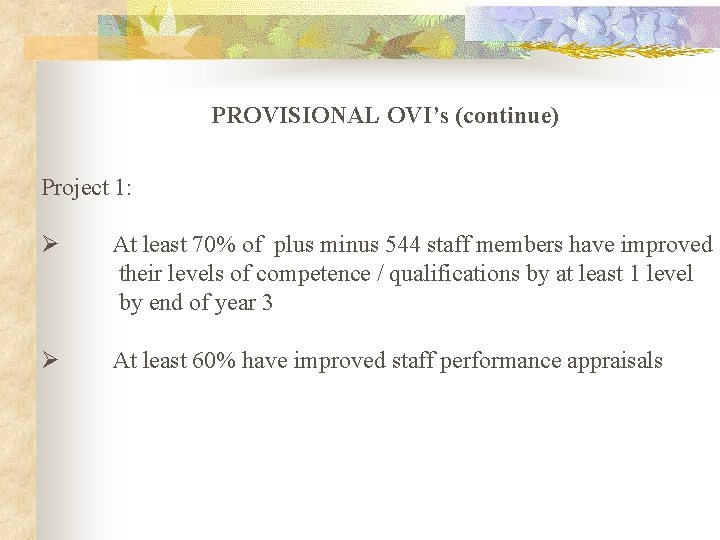
PROVISIONAL OVI’s (continue) Project 1: Ø At least 70% of plus minus 544 staff members have improved their levels of competence / qualifications by at least 1 level by end of year 3 Ø At least 60% have improved staff performance appraisals
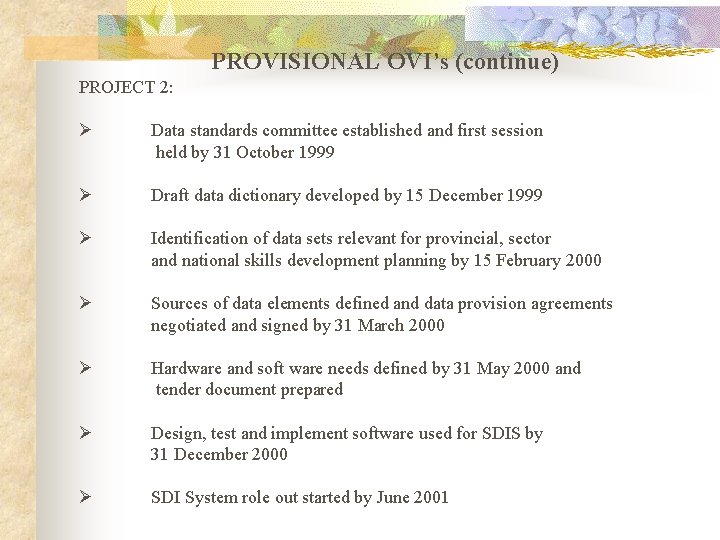
PROVISIONAL OVI’s (continue) PROJECT 2: Ø Data standards committee established and first session held by 31 October 1999 Ø Draft data dictionary developed by 15 December 1999 Ø Identification of data sets relevant for provincial, sector and national skills development planning by 15 February 2000 Ø Sources of data elements defined and data provision agreements negotiated and signed by 31 March 2000 Ø Hardware and soft ware needs defined by 31 May 2000 and tender document prepared Ø Design, test and implement software used for SDIS by 31 December 2000 Ø SDI System role out started by June 2001
PROVISIONAL OVI’s PROJECT 3: Ø Provincial workshops held Ø Ø Decentralised tasks identified and agreed upon by Do. L provincial offices Job descriptions designed Ø Staff appointment / redeployed Ø Training Materials developed Ø Staff development support system established
PROVISIONAL OVI’s (continue) PROJECT 6: Ø Financial management reporting formats developed by March 2000 Ø NSF incentive implementation plan by October 2000 Ø Window funding incentives manual by October 2000 Ø NSF financial recommendations on budgeting process for window incentives by October 2000 Ø Computer specification for NSF disbursement by March 2000 Ø NSF skills programme marketing document by February 2000 Ø 90% of incentive windows utilised by the end of the year

MARKETING STRATEGY Marketing strategy is being designed – to be designed by the end of 1999 and implemented from 2000.
- Slides: 27