Strongly Correlated Systems of Ultracold Atoms Theory work



- Slides: 21
Strongly Correlated Systems of Ultracold Atoms Theory work at CUA
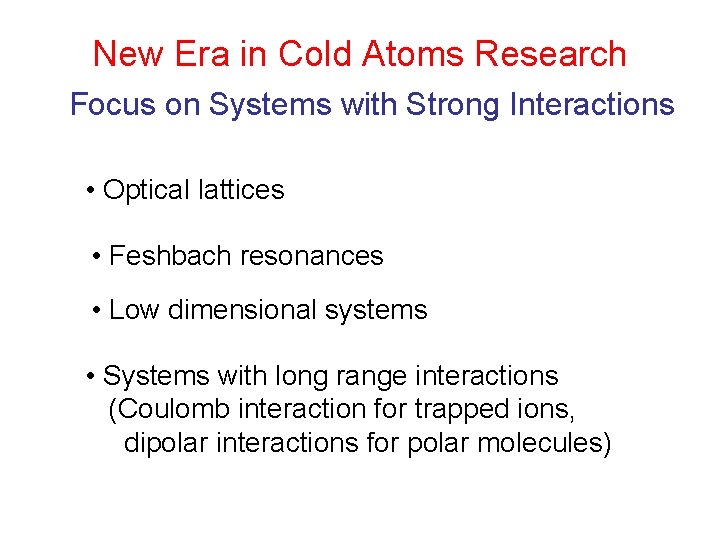
New Era in Cold Atoms Research Focus on Systems with Strong Interactions • Optical lattices • Feshbach resonances • Low dimensional systems • Systems with long range interactions (Coulomb interaction for trapped ions, dipolar interactions for polar molecules)
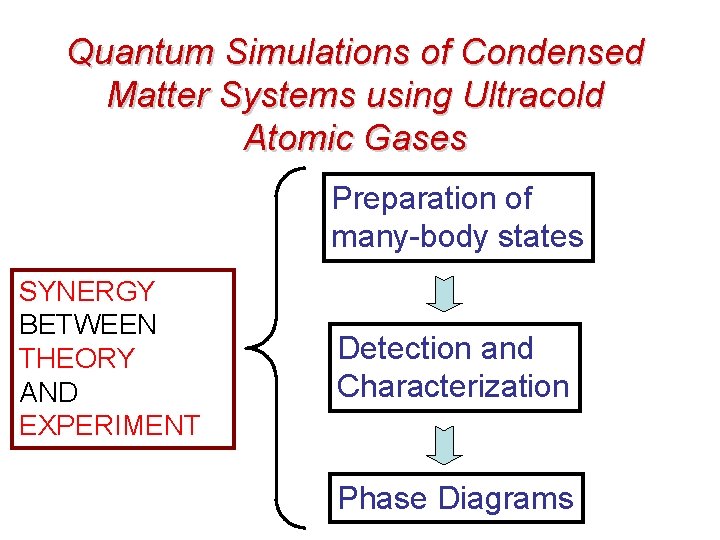
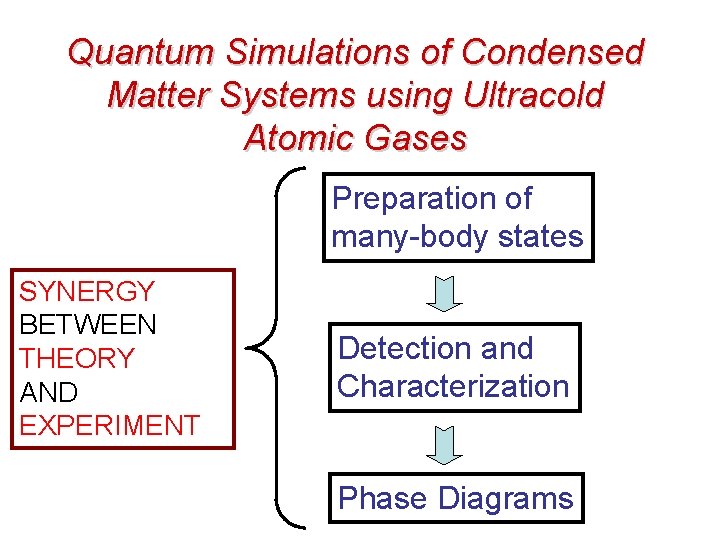
Quantum Simulations of Condensed Matter Systems using Ultracold Atomic Gases Preparation of many-body states SYNERGY BETWEEN THEORY AND EXPERIMENT Detection and Characterization Phase Diagrams
Preparation of many-body states
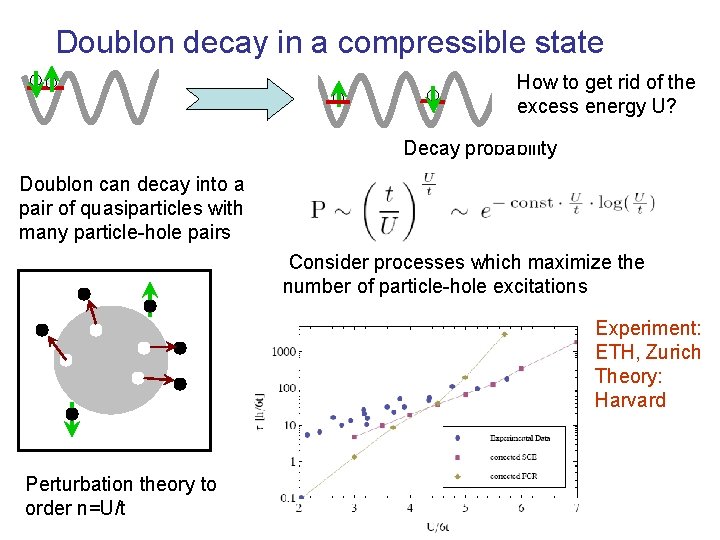
Doublon decay in a compressible state How to get rid of the excess energy U? Decay probability Doublon can decay into a pair of quasiparticles with many particle-hole pairs Consider processes which maximize the number of particle-hole excitations Experiment: ETH, Zurich Theory: Harvard Perturbation theory to order n=U/t
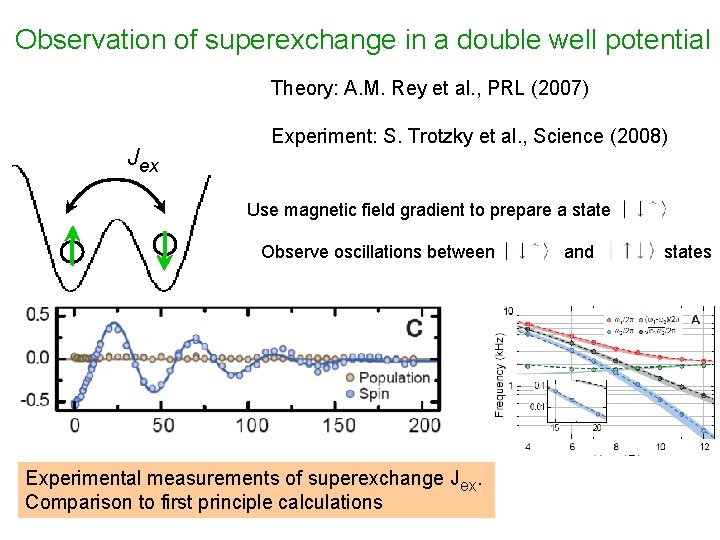
Observation of superexchange in a double well potential Theory: A. M. Rey et al. , PRL (2007) Jex Experiment: S. Trotzky et al. , Science (2008) Use magnetic field gradient to prepare a state Observe oscillations between Experimental measurements of superexchange Jex. Comparison to first principle calculations and states
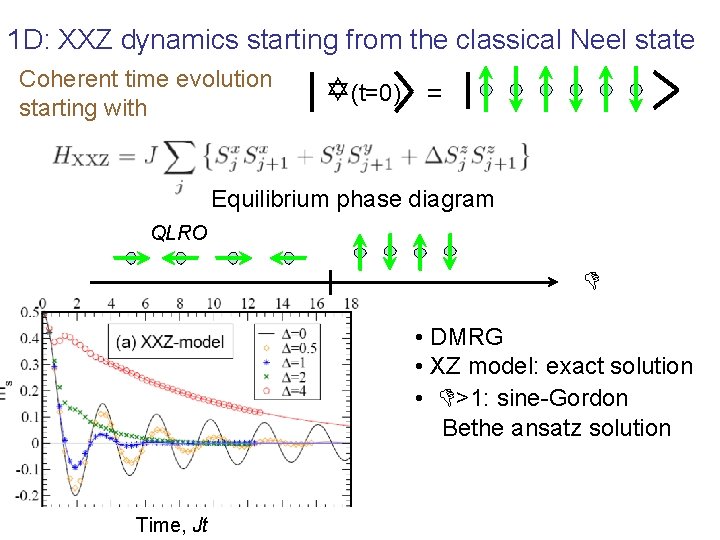
1 D: XXZ dynamics starting from the classical Neel state Coherent time evolution starting with Y(t=0) = Equilibrium phase diagram QLRO D • DMRG • XZ model: exact solution • D>1: sine-Gordon Bethe ansatz solution Time, Jt
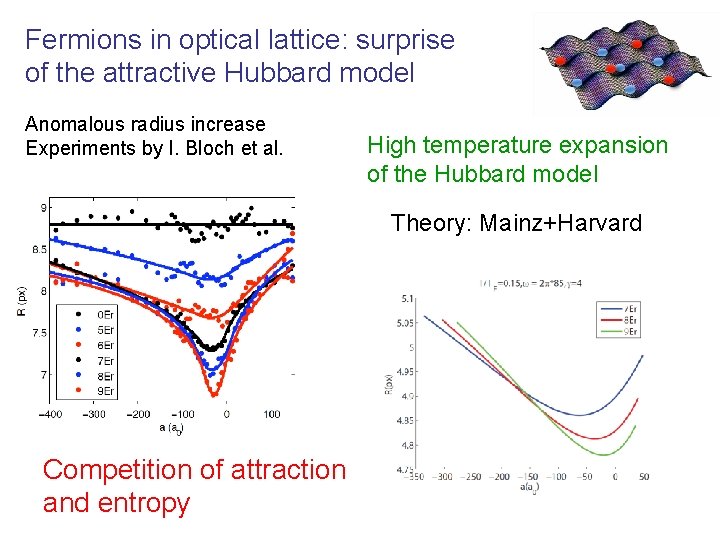
Fermions in optical lattice: surprise of the attractive Hubbard model Anomalous radius increase Experiments by I. Bloch et al. High temperature expansion of the Hubbard model Theory: Mainz+Harvard Competition of attraction and entropy
DETECTION AND CHARACTERIZATION PHASE DIAGRAMS
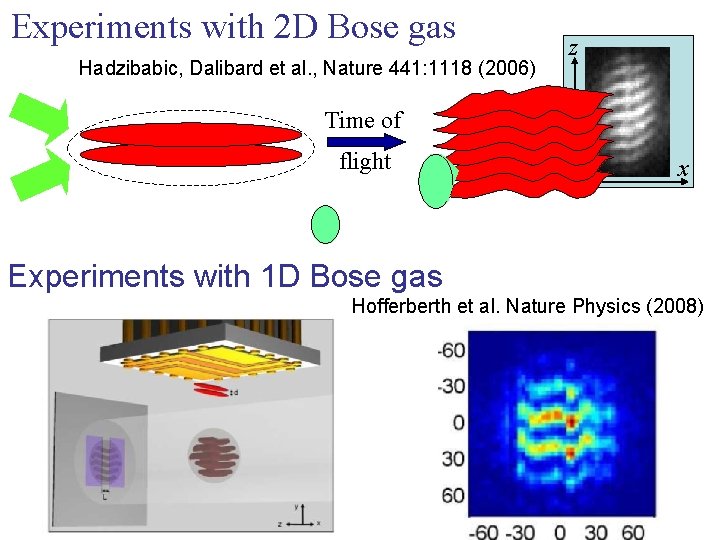
Experiments with 2 D Bose gas Hadzibabic, Dalibard et al. , Nature 441: 1118 (2006) z Time of flight x Experiments with 1 D Bose gas Hofferberth et al. Nature Physics (2008)
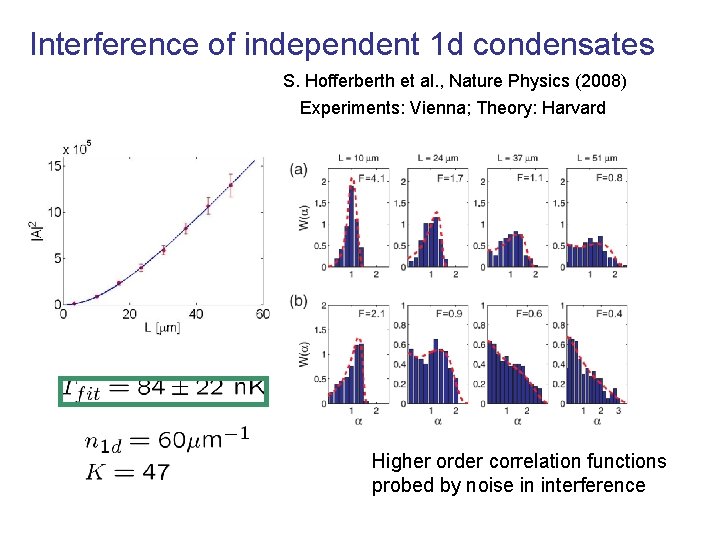
Interference of independent 1 d condensates S. Hofferberth et al. , Nature Physics (2008) Experiments: Vienna; Theory: Harvard Higher order correlation functions probed by noise in interference
OUTLOOK: NONEQUILIBRIUM DYNAMICS NEW PERSPECTIVE ON MANY-BODY SYSTEMS
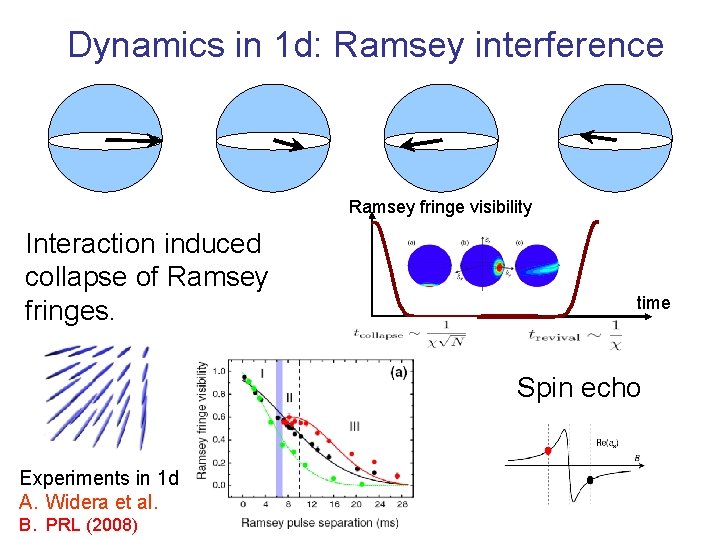
Dynamics in 1 d: Ramsey interference Ramsey fringe visibility Interaction induced collapse of Ramsey fringes. time Spin echo Experiments in 1 d tubes: A. Widera et al. B. PRL (2008)
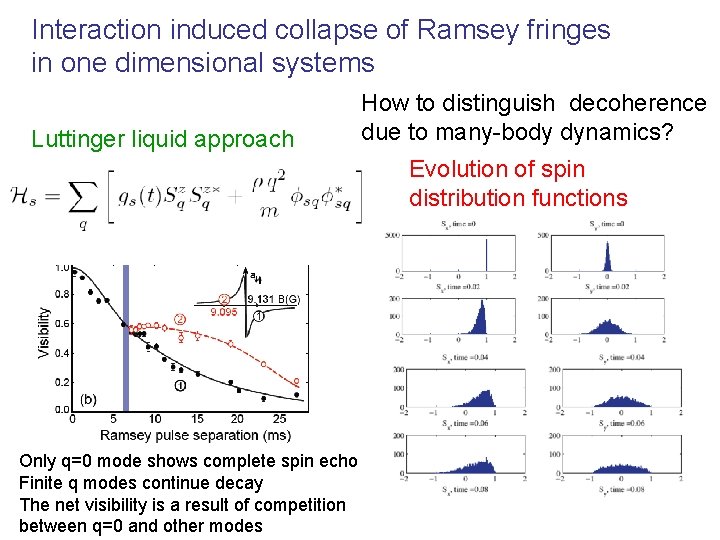
Interaction induced collapse of Ramsey fringes in one dimensional systems Luttinger liquid approach How to distinguish decoherence due to many-body dynamics? Evolution of spin distribution functions Only q=0 mode shows complete spin echo Finite q modes continue decay The net visibility is a result of competition between q=0 and other modes
OUTLOOK: QUANTUM MANY-BODY SYSTEMS IN THE PRESENSE OF NONEQUILIBRIUM NOISE NEW PERSPECTIVE ON MANY-BODY SYSTEMS
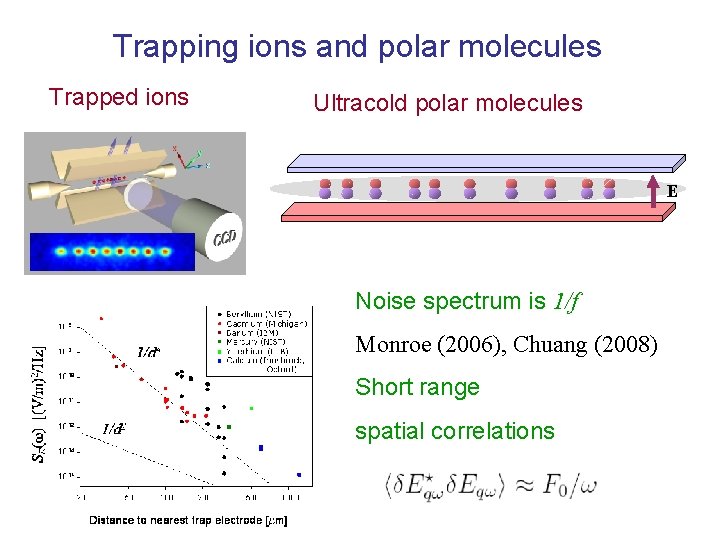
Trapping ions and polar molecules Trapped ions Ultracold polar molecules E Noise spectrum is 1/f Monroe (2006), Chuang (2008) Short range spatial correlations
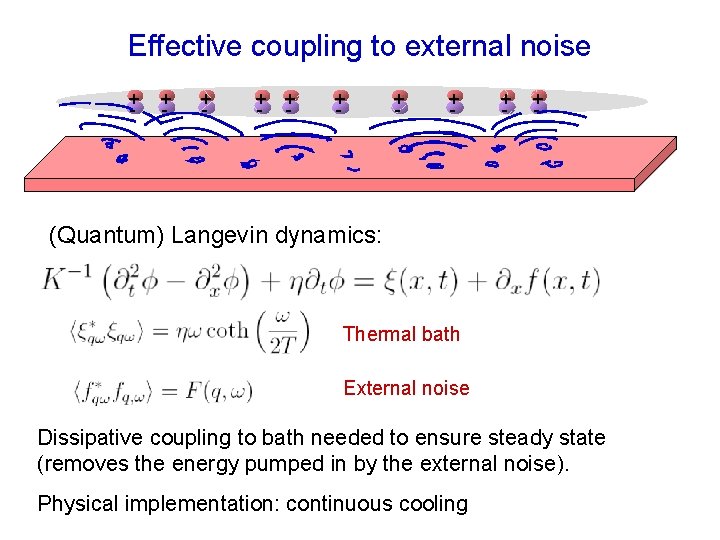
Effective coupling to external noise + - + - + - (Quantum) Langevin dynamics: Thermal bath External noise Dissipative coupling to bath needed to ensure steady state (removes the energy pumped in by the external noise). Physical implementation: continuous cooling
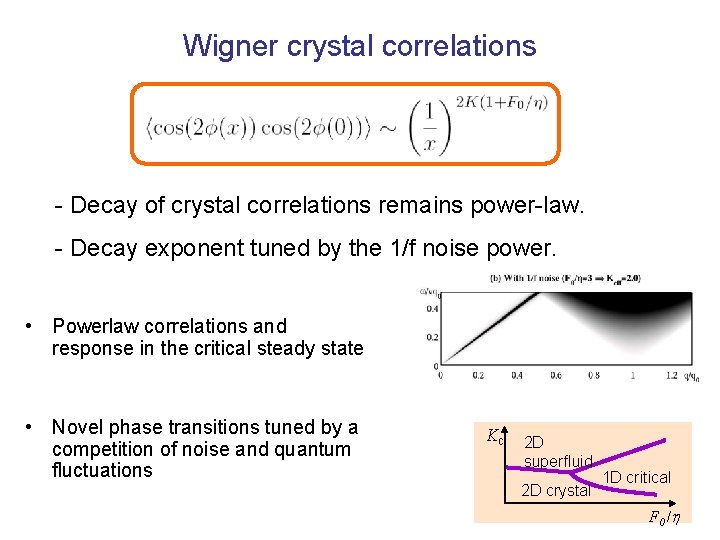
Wigner crystal correlations - Decay of crystal correlations remains power-law. - Decay exponent tuned by the 1/f noise power. • Powerlaw correlations and response in the critical steady state • Novel phase transitions tuned by a competition of noise and quantum fluctuations Kc 2 2 D superfluid 2 D crystal 1 D critical F 0 /h
Quantum Simulations of Condensed Matter Systems using Ultracold Atomic Gases Preparation of many-body states SYNERGY BETWEEN THEORY AND EXPERIMENT Detection and Characterization Phase Diagrams