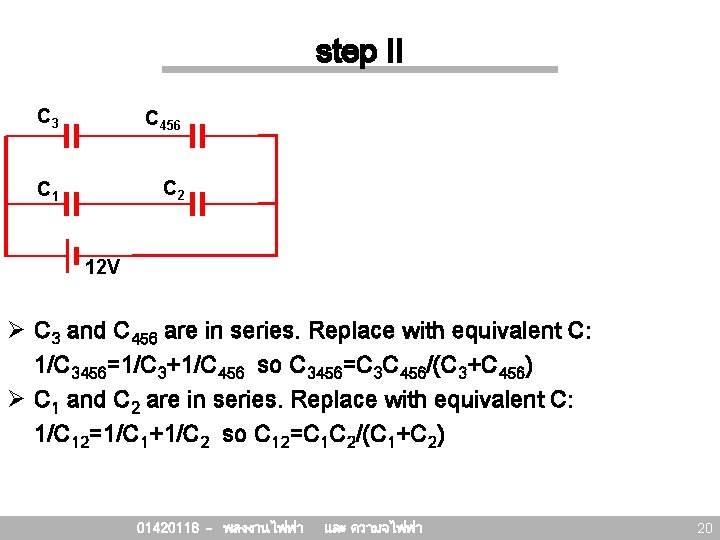
step II C 3 C 456 C 1




- Slides: 27
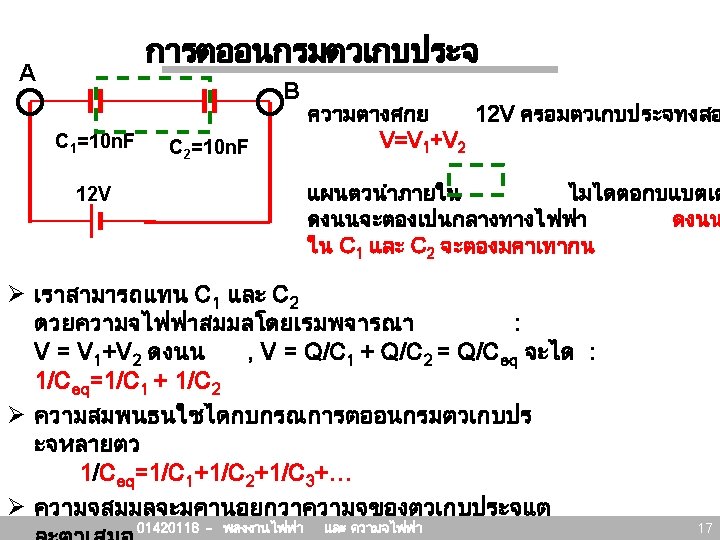
step II C 3 C 456 C 1 C 2 12 V Ø C 3 and C 456 are in series. Replace with equivalent C: 1/C 3456=1/C 3+1/C 456 so C 3456=C 3 C 456/(C 3+C 456) Ø C 1 and C 2 are in series. Replace with equivalent C: 1/C 12=1/C 1+1/C 2 so C 12=C 1 C 2/(C 1+C 2) 01420118 - พลงงานไฟฟา และ ความจไฟฟา 20
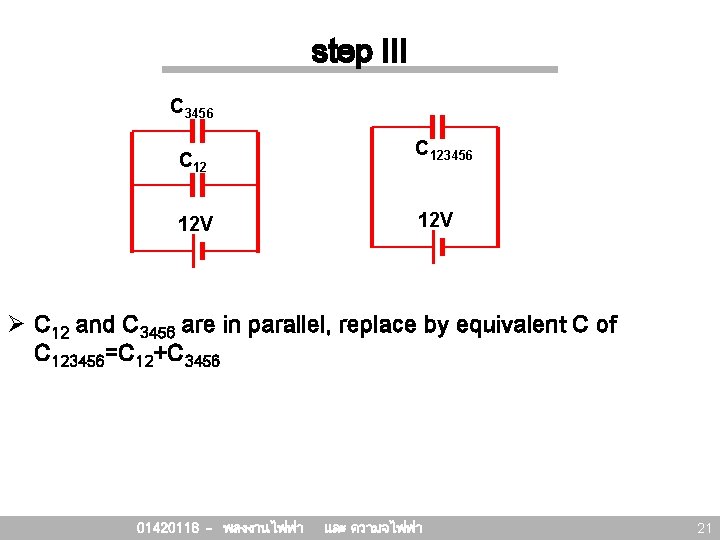
step III C 3456 C 12 12 V C 123456 12 V Ø C 12 and C 3456 are in parallel, replace by equivalent C of C 123456=C 12+C 3456 01420118 - พลงงานไฟฟา และ ความจไฟฟา 21
problem C 3 A C 4 C 5 B C 2 C 1=10 n. F C 2=20 n. F C 3=10 n. F C 4=10 n. F What is Vab? C 5=20 n. F 12 V Ø Ø Ø Ø V 12=V 345=12 V C 45=C 4+C 5=10 n. F+20 n. F=30 n. F C 345=C 3 C 45/(C 3+C 45)=300/40=7. 5 n. F Q 345=V 345 C 345=12 V*7. 5 n. F=90 n. C Q 45=Q 345 V 45=Q 45/C 45=90 n. C/30 n. F=3 V check V 3=Q 3/C 3=Q 345/C 3=90 n. C/10 n. F=9 V V 3+V 45=12 V okay! 01420118 - พลงงานไฟฟา และ ความจไฟฟา 22
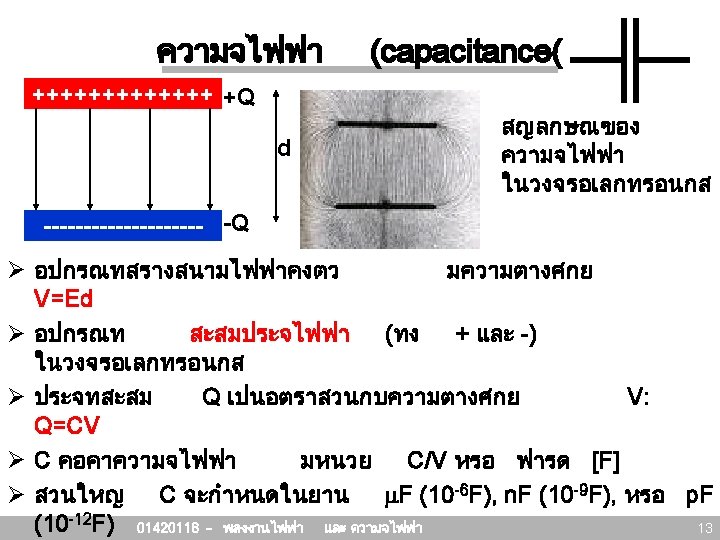
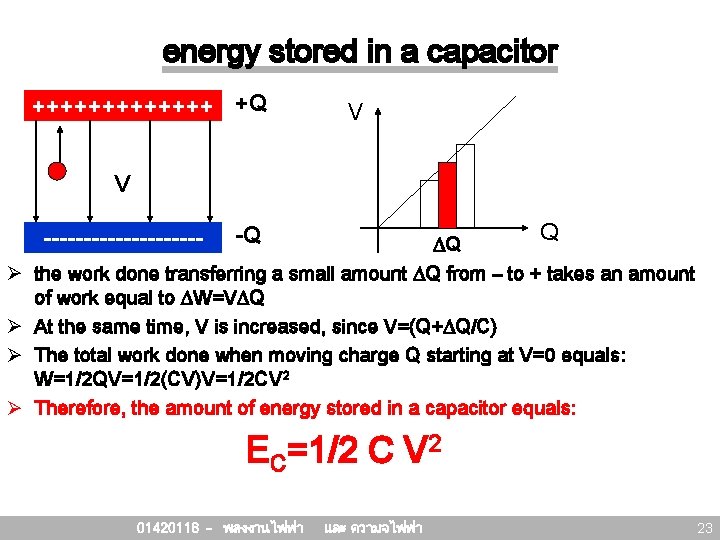
energy stored in a capacitor +++++++ +Q V V ---------- Ø Ø Q -Q Q the work done transferring a small amount Q from – to + takes an amount of work equal to W=V Q At the same time, V is increased, since V=(Q+ Q/C) The total work done when moving charge Q starting at V=0 equals: W=1/2 QV=1/2(CV)V=1/2 CV 2 Therefore, the amount of energy stored in a capacitor equals: EC=1/2 C V 2 01420118 - พลงงานไฟฟา และ ความจไฟฟา 23
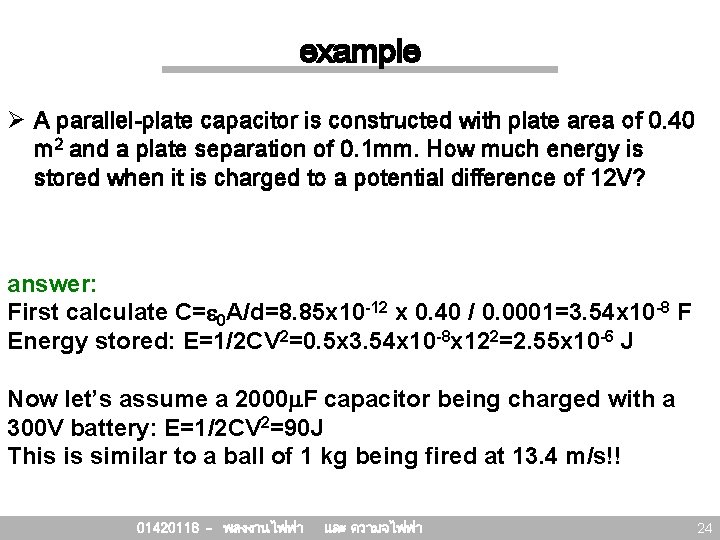
example Ø A parallel-plate capacitor is constructed with plate area of 0. 40 m 2 and a plate separation of 0. 1 mm. How much energy is stored when it is charged to a potential difference of 12 V? answer: First calculate C= 0 A/d=8. 85 x 10 -12 x 0. 40 / 0. 0001=3. 54 x 10 -8 F Energy stored: E=1/2 CV 2=0. 5 x 3. 54 x 10 -8 x 122=2. 55 x 10 -6 J Now let’s assume a 2000 F capacitor being charged with a 300 V battery: E=1/2 CV 2=90 J This is similar to a ball of 1 kg being fired at 13. 4 m/s!! 01420118 - พลงงานไฟฟา และ ความจไฟฟา 24
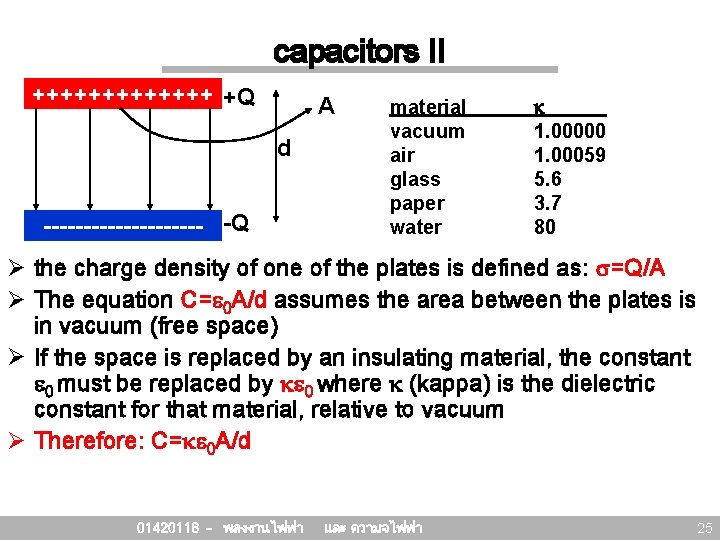
capacitors II +++++++ +Q A d ---------- -Q material vacuum air glass paper water 1. 00000 1. 00059 5. 6 3. 7 80 Ø the charge density of one of the plates is defined as: =Q/A Ø The equation C= 0 A/d assumes the area between the plates is in vacuum (free space) Ø If the space is replaced by an insulating material, the constant 0 must be replaced by 0 where (kappa) is the dielectric constant for that material, relative to vacuum Ø Therefore: C= 0 A/d 01420118 - พลงงานไฟฟา และ ความจไฟฟา 25
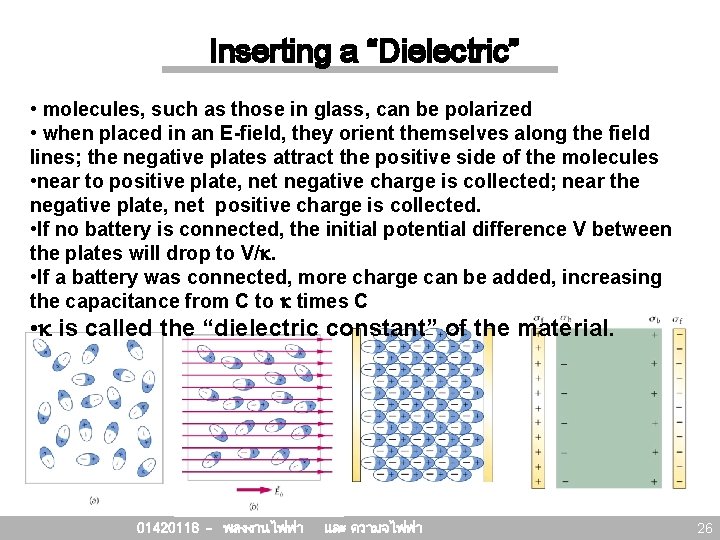
Inserting a “Dielectric” • molecules, such as those in glass, can be polarized • when placed in an E-field, they orient themselves along the field lines; the negative plates attract the positive side of the molecules • near to positive plate, net negative charge is collected; near the negative plate, net positive charge is collected. • If no battery is connected, the initial potential difference V between the plates will drop to V/. • If a battery was connected, more charge can be added, increasing the capacitance from C to times C • is called the “dielectric constant” of the material. 01420118 - พลงงานไฟฟา และ ความจไฟฟา 26
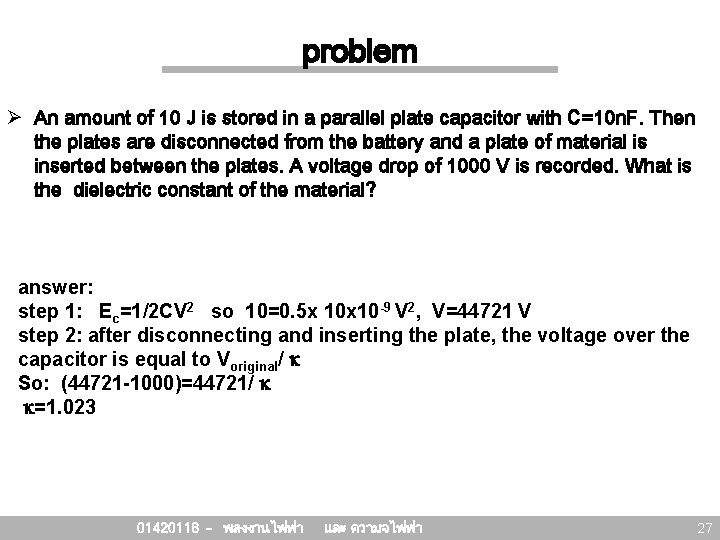
problem Ø An amount of 10 J is stored in a parallel plate capacitor with C=10 n. F. Then the plates are disconnected from the battery and a plate of material is inserted between the plates. A voltage drop of 1000 V is recorded. What is the dielectric constant of the material? answer: step 1: Ec=1/2 CV 2 so 10=0. 5 x 10 -9 V 2, V=44721 V step 2: after disconnecting and inserting the plate, the voltage over the capacitor is equal to Voriginal/ So: (44721 -1000)=44721/ =1. 023 01420118 - พลงงานไฟฟา และ ความจไฟฟา 27
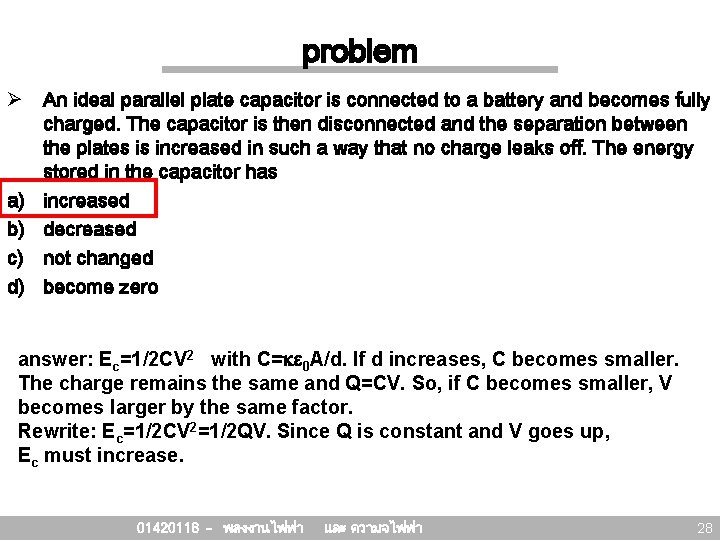
problem Ø An ideal parallel plate capacitor is connected to a battery and becomes fully charged. The capacitor is then disconnected and the separation between the plates is increased in such a way that no charge leaks off. The energy stored in the capacitor has a) increased b) decreased c) not changed d) become zero answer: Ec=1/2 CV 2 with C= 0 A/d. If d increases, C becomes smaller. The charge remains the same and Q=CV. So, if C becomes smaller, V becomes larger by the same factor. Rewrite: Ec=1/2 CV 2=1/2 QV. Since Q is constant and V goes up, Ec must increase. 01420118 - พลงงานไฟฟา และ ความจไฟฟา 28
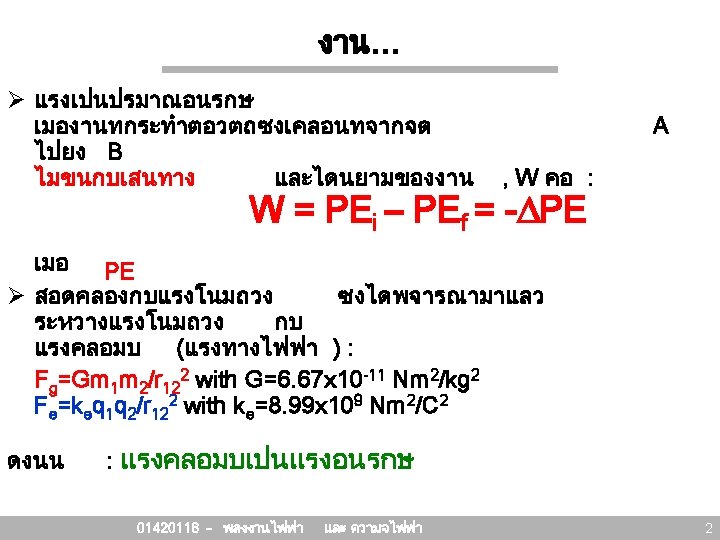
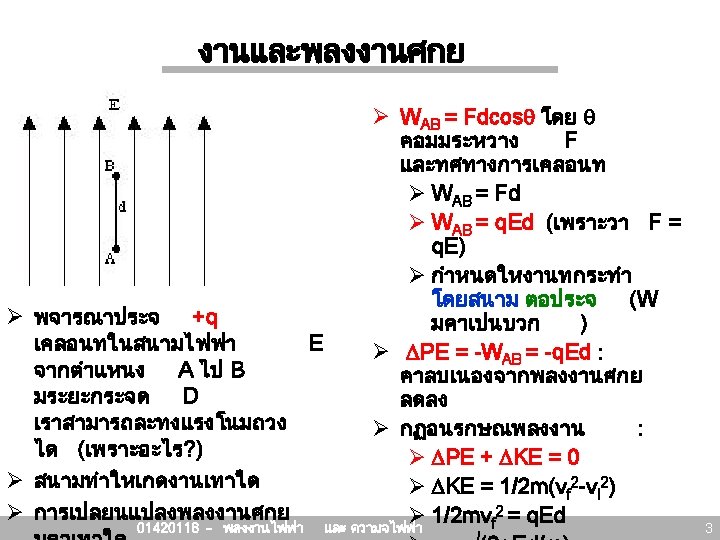
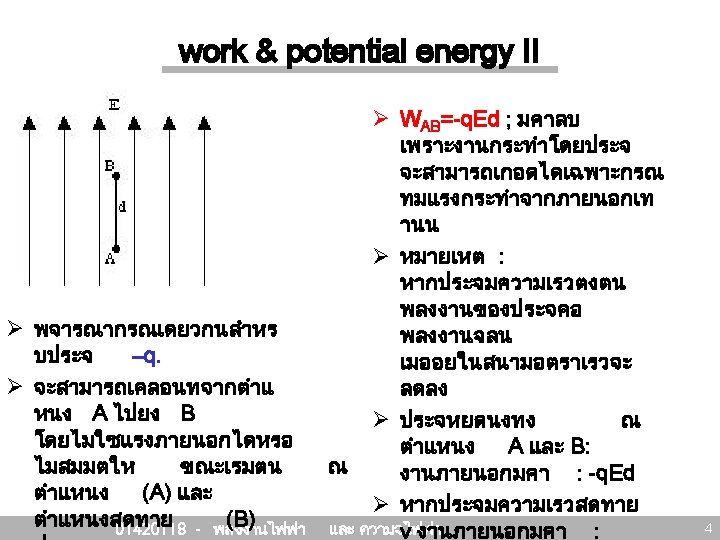
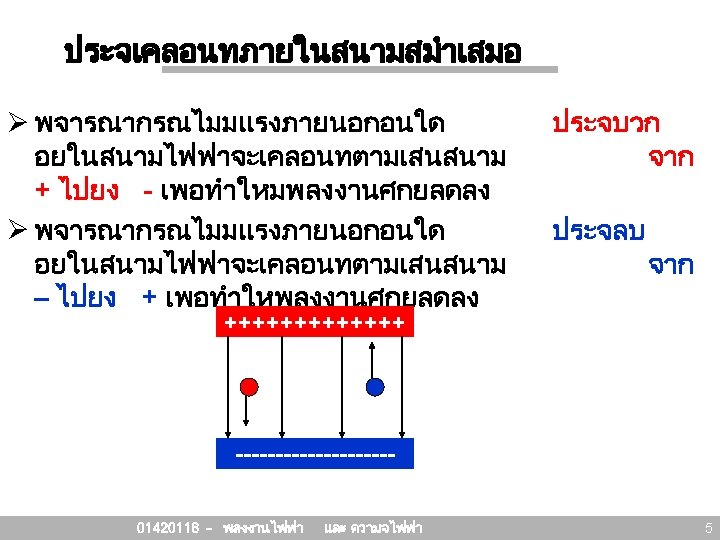
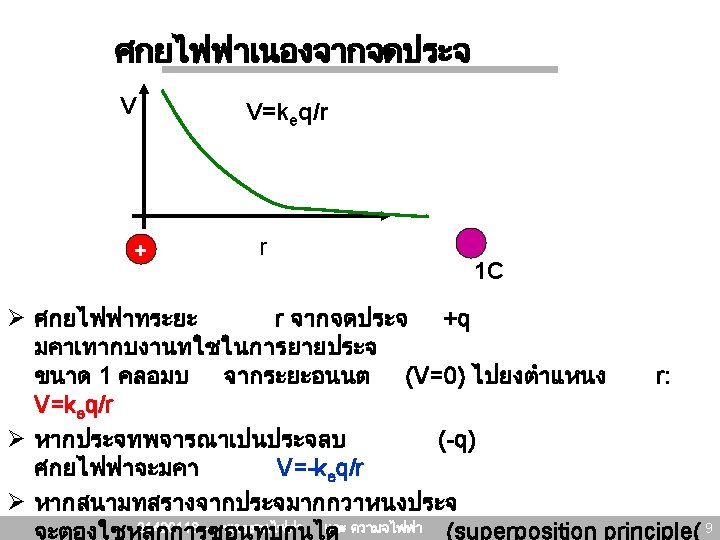
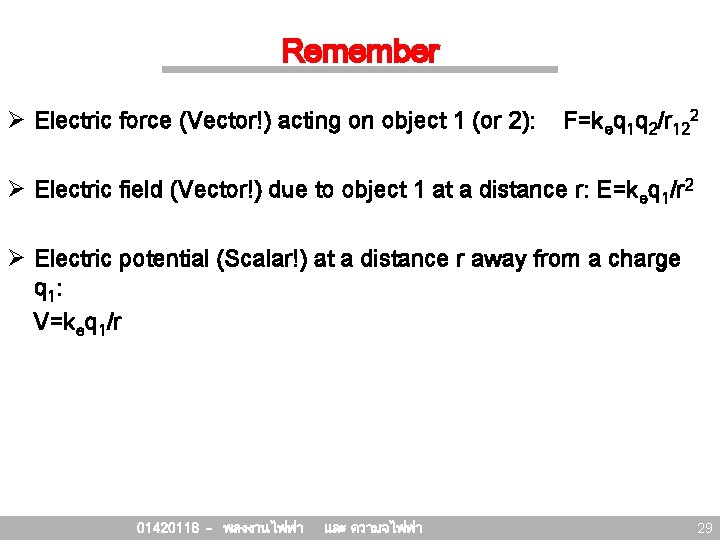
Remember Ø Electric force (Vector!) acting on object 1 (or 2): F=keq 1 q 2/r 122 Ø Electric field (Vector!) due to object 1 at a distance r: E=keq 1/r 2 Ø Electric potential (Scalar!) at a distance r away from a charge q 1: V=keq 1/r 01420118 - พลงงานไฟฟา และ ความจไฟฟา 29