Stef Petryszyn Definition Aeronautics is the study of
- Slides: 20
Stef Petryszyn
Definition Aeronautics is the study of the science of flight. Aeronautics is the method of designing an airplane or other flying machine. There are four basic areas that aeronautical engineers must understand in order to be able to design planes. To design a plane, engineers must understand all of these elements. 1. Aerodynamics – study of how air flows around the airplane 2. Propulsion - study of how to design an engine that will provide thrust that is needed for a plane to take off and fly through the air 3. Materials and Structures - study of what materials are to be used on the plane and in the engine and how those materials make the plane strong enough to fly effectively 4. Stability and Control - study of how to control the speed, direction, altitude and other conditions that affect how a plane flies
Careers in Aerospace • Scientists • Engineers • Technicians
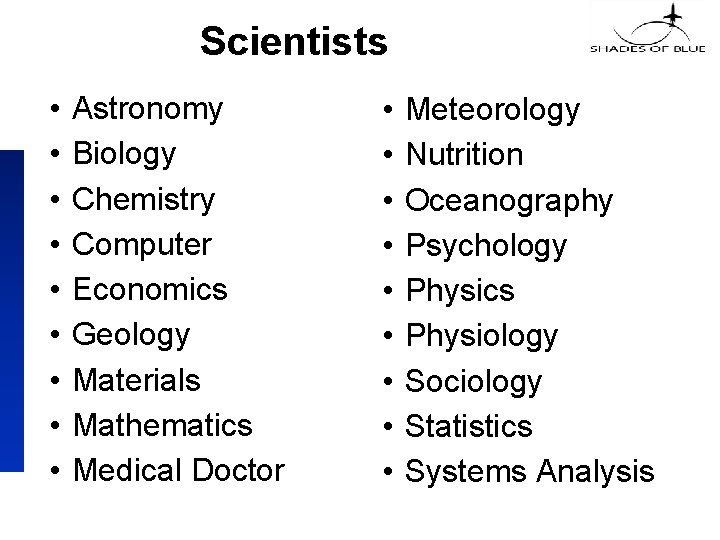
Scientists • • • Astronomy Biology Chemistry Computer Economics Geology Materials Mathematics Medical Doctor • • • Meteorology Nutrition Oceanography Psychology Physics Physiology Sociology Statistics Systems Analysis
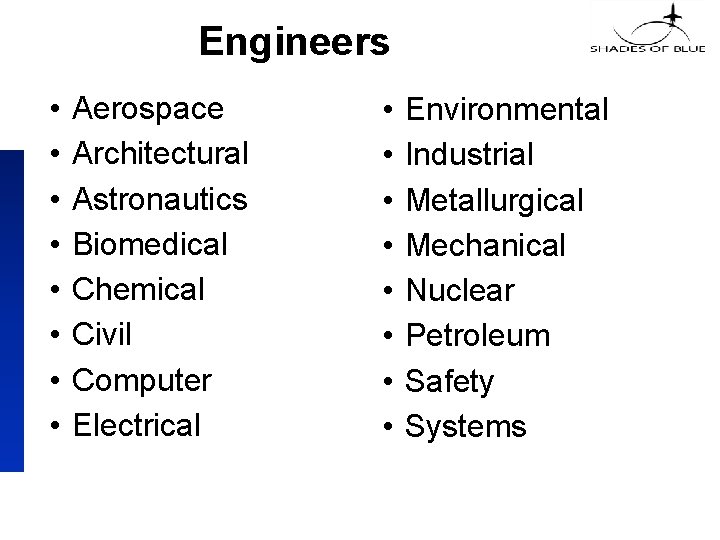
Engineers • • Aerospace Architectural Astronautics Biomedical Chemical Civil Computer Electrical • • Environmental Industrial Metallurgical Mechanical Nuclear Petroleum Safety Systems
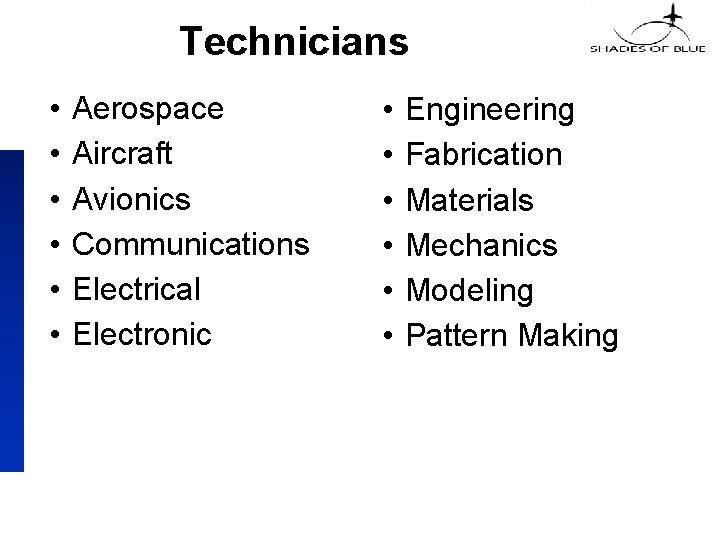
Technicians • • • Aerospace Aircraft Avionics Communications Electrical Electronic • • • Engineering Fabrication Materials Mechanics Modeling Pattern Making
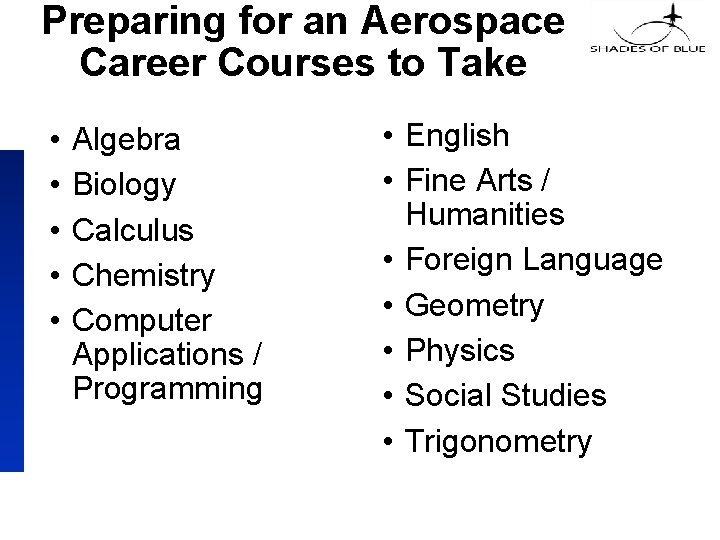
Preparing for an Aerospace Career Courses to Take • • • Algebra Biology Calculus Chemistry Computer Applications / Programming • English • Fine Arts / Humanities • Foreign Language • Geometry • Physics • Social Studies • Trigonometry
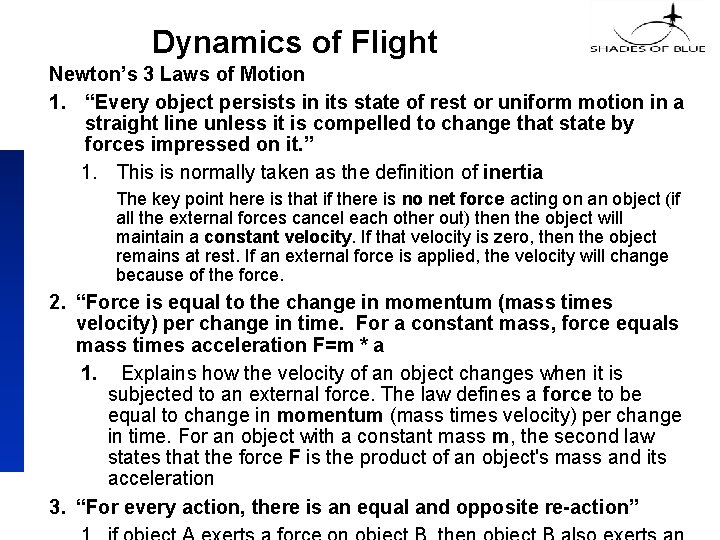
Dynamics of Flight Newton’s 3 Laws of Motion 1. “Every object persists in its state of rest or uniform motion in a straight line unless it is compelled to change that state by forces impressed on it. ” 1. This is normally taken as the definition of inertia The key point here is that if there is no net force acting on an object (if all the external forces cancel each other out) then the object will maintain a constant velocity. If that velocity is zero, then the object remains at rest. If an external force is applied, the velocity will change because of the force. 2. “Force is equal to the change in momentum (mass times velocity) per change in time. For a constant mass, force equals mass times acceleration F=m * a 1. Explains how the velocity of an object changes when it is subjected to an external force. The law defines a force to be equal to change in momentum (mass times velocity) per change in time. For an object with a constant mass m, the second law states that the force F is the product of an object's mass and its acceleration 3. “For every action, there is an equal and opposite re-action”
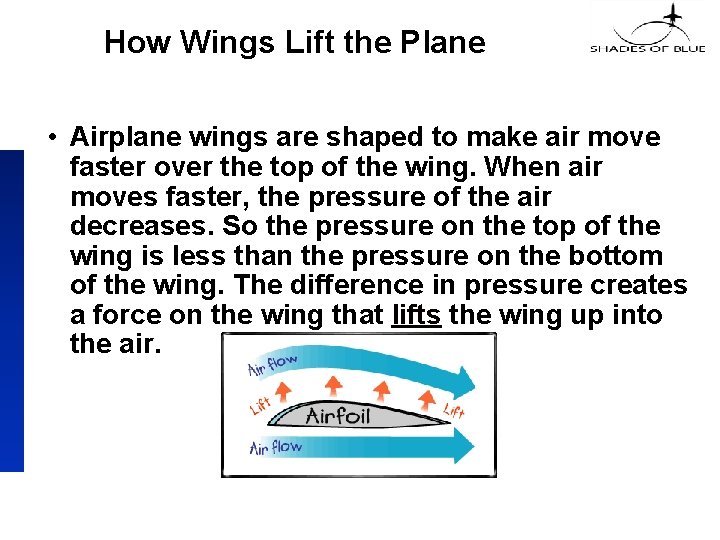
How Wings Lift the Plane • Airplane wings are shaped to make air move faster over the top of the wing. When air moves faster, the pressure of the air decreases. So the pressure on the top of the wing is less than the pressure on the bottom of the wing. The difference in pressure creates a force on the wing that lifts the wing up into the air.
Laws of Motion 1. If an object is not moving, it will not start moving by itself. If an object is moving, it will not stop or change direction unless something pushes it. 2. Objects will move farther and faster when they are pushed harder. 3. When an object is pushed in one direction, there is always a resistance of the same size in the opposite direction.
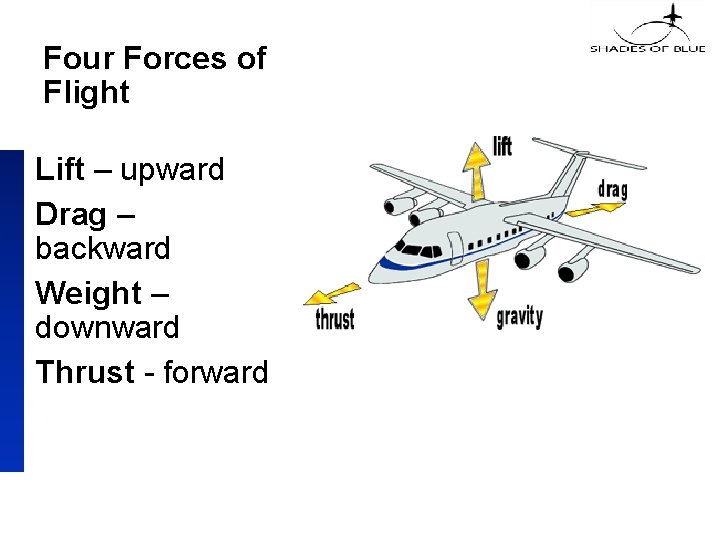
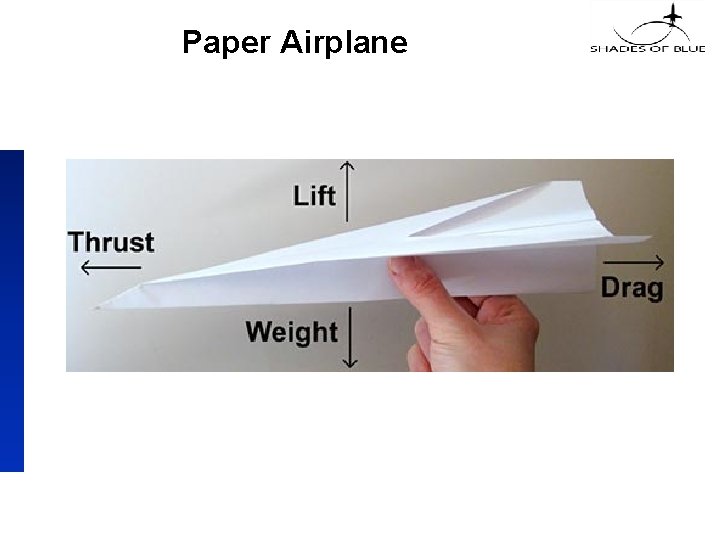
Four Forces of Flight Lift – upward Drag – backward Weight – downward Thrust - forward
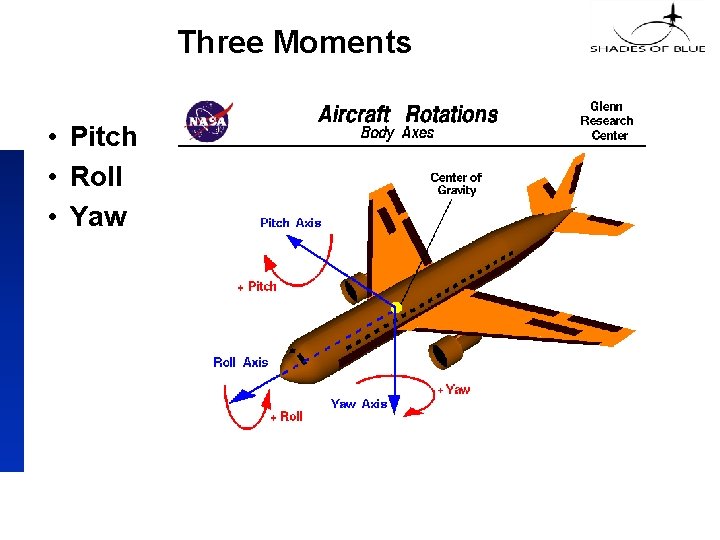
Three Moments • Pitch • Roll • Yaw
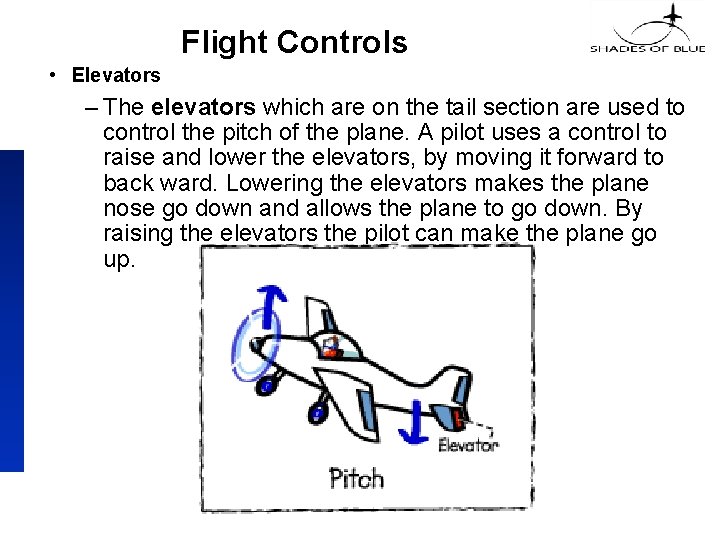
Flight Controls • Elevators – The elevators which are on the tail section are used to control the pitch of the plane. A pilot uses a control to raise and lower the elevators, by moving it forward to back ward. Lowering the elevators makes the plane nose go down and allows the plane to go down. By raising the elevators the pilot can make the plane go up.
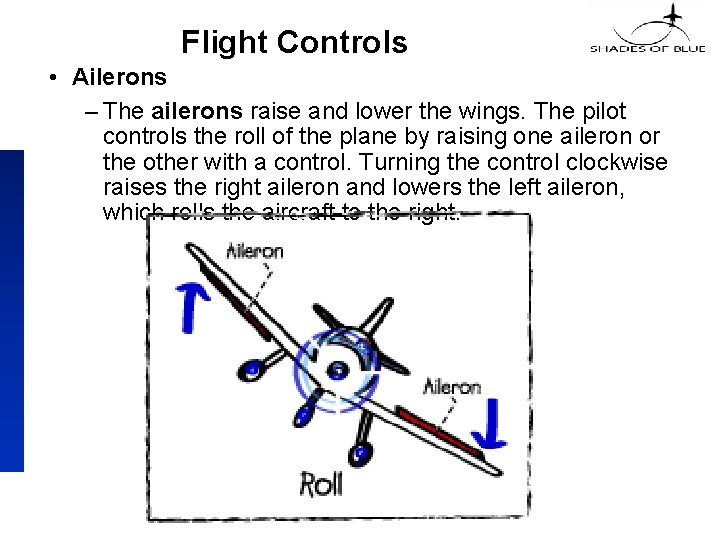
Flight Controls • Ailerons – The ailerons raise and lower the wings. The pilot controls the roll of the plane by raising one aileron or the other with a control. Turning the control clockwise raises the right aileron and lowers the left aileron, which rolls the aircraft to the right.
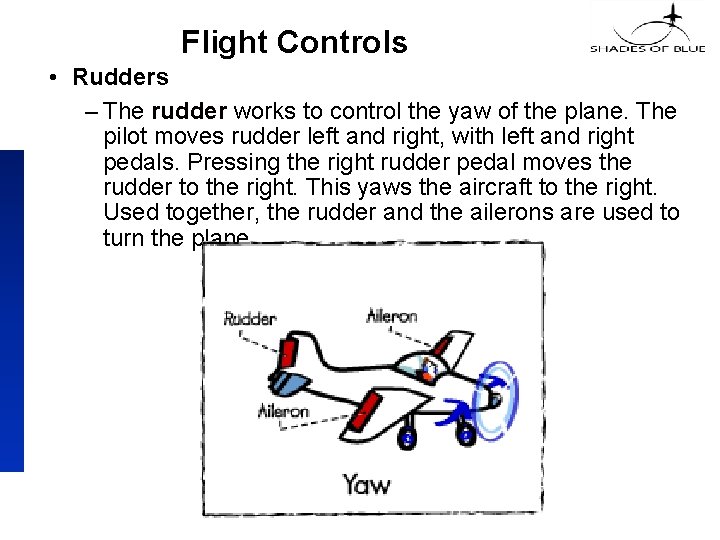
Flight Controls • Rudders – The rudder works to control the yaw of the plane. The pilot moves rudder left and right, with left and right pedals. Pressing the right rudder pedal moves the rudder to the right. This yaws the aircraft to the right. Used together, the rudder and the ailerons are used to turn the plane.
Paper Airplane
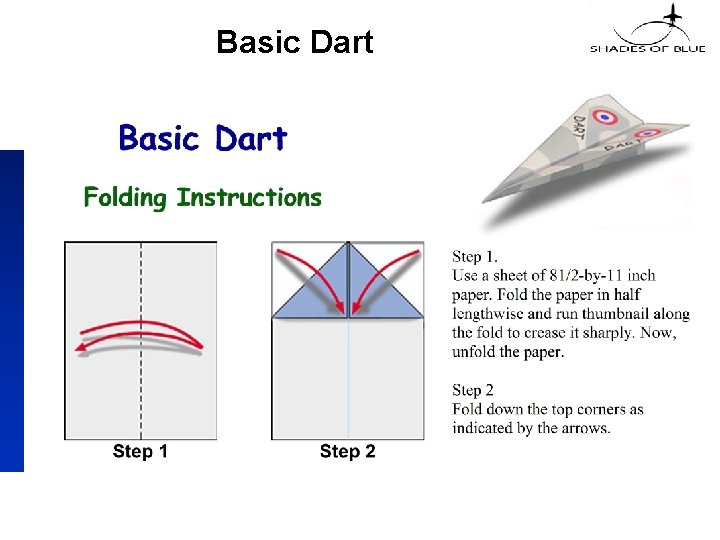
Basic Dart
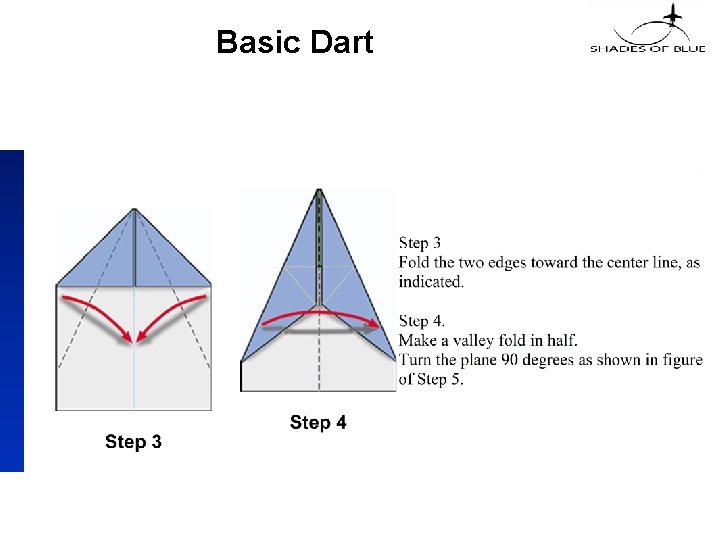
Basic Dart
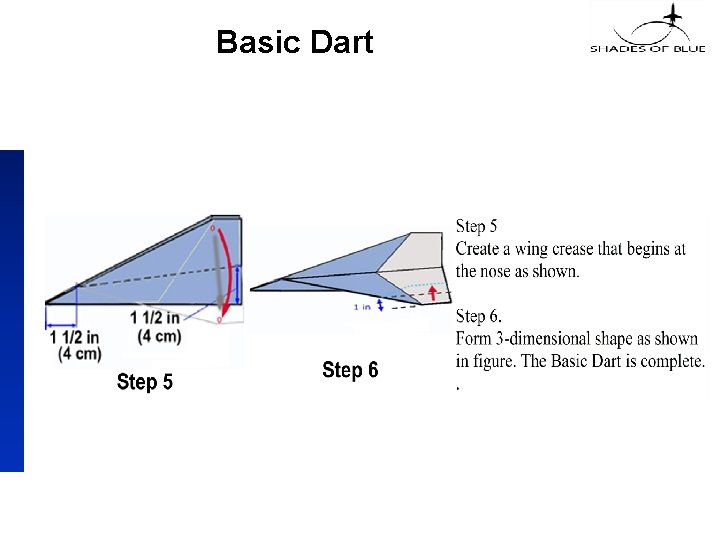
Basic Dart
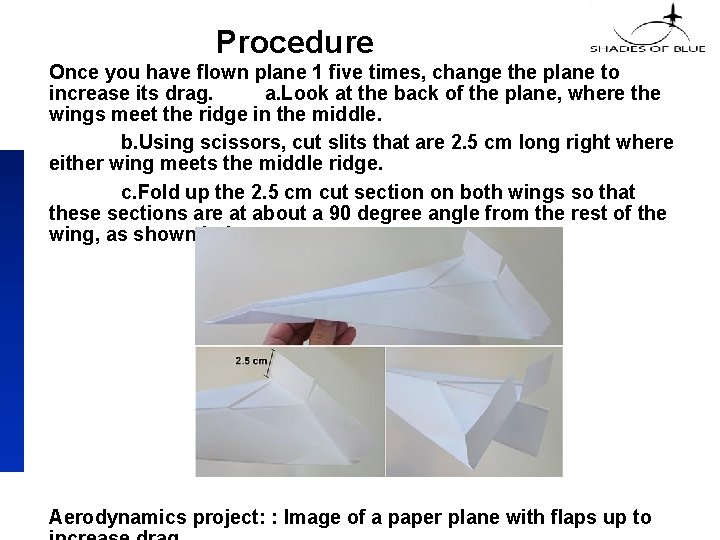
Procedure Once you have flown plane 1 five times, change the plane to increase its drag. a. Look at the back of the plane, where the wings meet the ridge in the middle. b. Using scissors, cut slits that are 2. 5 cm long right where either wing meets the middle ridge. c. Fold up the 2. 5 cm cut section on both wings so that these sections are at about a 90 degree angle from the rest of the wing, as shown below. Aerodynamics project: : Image of a paper plane with flaps up to