SPro UT Shallow Processing with Unification and Typed

![XTDL Formalism loc-pp : > morph & [POS Prep & #preposition, INFL [CASE #1,](https://slidetodoc.com/presentation_image/44d353a8274141f00cbaacdf63fd756d/image-12.jpg "XTDL Formalism loc-pp : > morph & [POS Prep & #preposition, INFL [CASE #1,")
![Morphology Compound Recognition & Segmentation for German “Biergartenfest” [Bier [garten fest]] vs. [[Bier garten]](https://slidetodoc.com/presentation_image/44d353a8274141f00cbaacdf63fd756d/image-21.jpg "Morphology Compound Recognition & Segmentation for German “Biergartenfest” [Bier [garten fest]] vs. [[Bier garten]")
- Slides: 33
SPro. UT Shallow Processing with Unification and Typed Feature Structures Jakub Piskorski Language Technology Lab DFKI Gmb. H Jakub Piskorski Warszawa, 6. 10. 2003
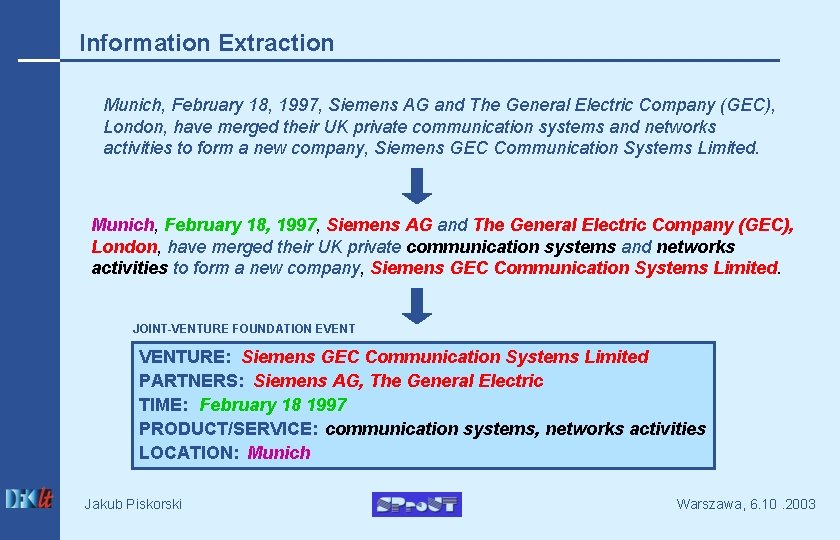
Information Extraction Munich, February 18, 1997, Siemens AG and The General Electric Company (GEC), London, have merged their UK private communication systems and networks activities to form a new company, Siemens GEC Communication Systems Limited. JOINT-VENTURE FOUNDATION EVENTURE: Siemens GEC Communication Systems Limited PARTNERS: Siemens AG, The General Electric TIME: February 18 1997 PRODUCT/SERVICE: communication systems, networks activities LOCATION: Munich Jakub Piskorski Warszawa, 6. 10. 2003
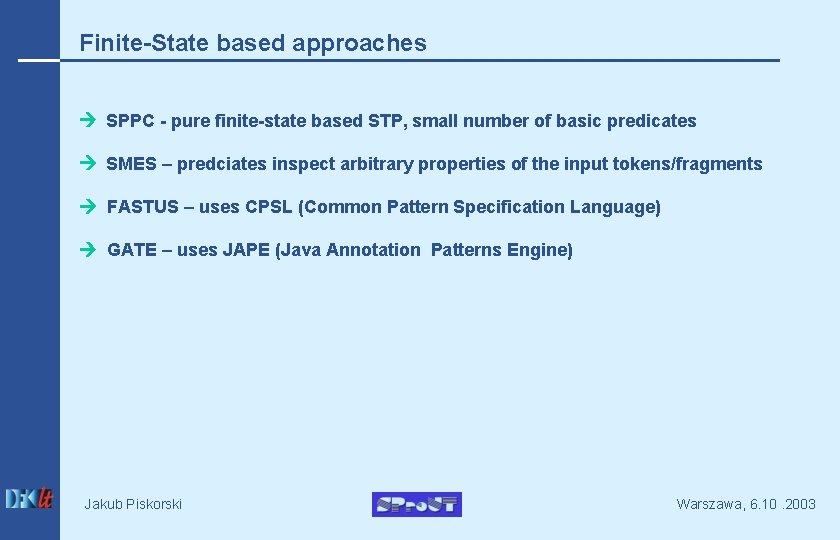
Finite-State based approaches SPPC - pure finite-state based STP, small number of basic predicates SMES – predciates inspect arbitrary properties of the input tokens/fragments FASTUS – uses CPSL (Common Pattern Specification Language) GATE – uses JAPE (Java Annotation Patterns Engine) Jakub Piskorski Warszawa, 6. 10. 2003
Motivation for SPro. UT One System for Multilingual and Domain Adaptive Shallow Text Processing Trade-off between efficiency and expressiveness Modularity Flexible integration of different processing modules Portability Industrial standards Jakub Piskorski Warszawa, 6. 10. 2003
Credits SPro. UT is a joint work by: Witold Drożdżyński, Ulrich Krieger, Jakub Piskorski, Ulrich Schäfer, Feiyu Xu Jakub Piskorski Warszawa, 6. 10. 2003
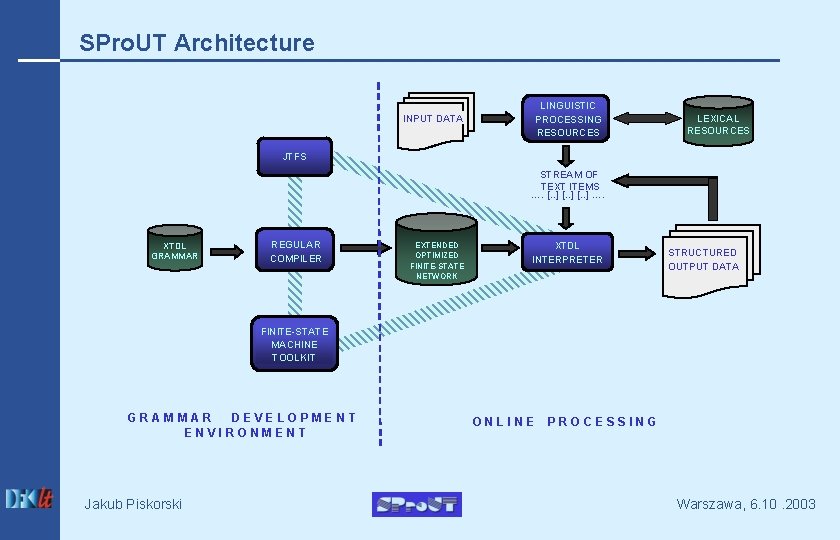
SPro. UT Architecture LINGUISTIC PROCESSING RESOURCES INPUT DATA LEXICAL RESOURCES JTFS STREAM OF TEXT ITEMS …. [. . ] …. XTDL GRAMMAR REGULAR COMPILER EXTENDED OPTIMIZED FINITE-STATE NETWORK XTDL INTERPRETER STRUCTURED OUTPUT DATA FINITE-STATE MACHINE TOOLKIT GRAMMAR DEVELOPMENT ENVIRONMENT Jakub Piskorski ONLINE PROCESSING Warszawa, 6. 10. 2003
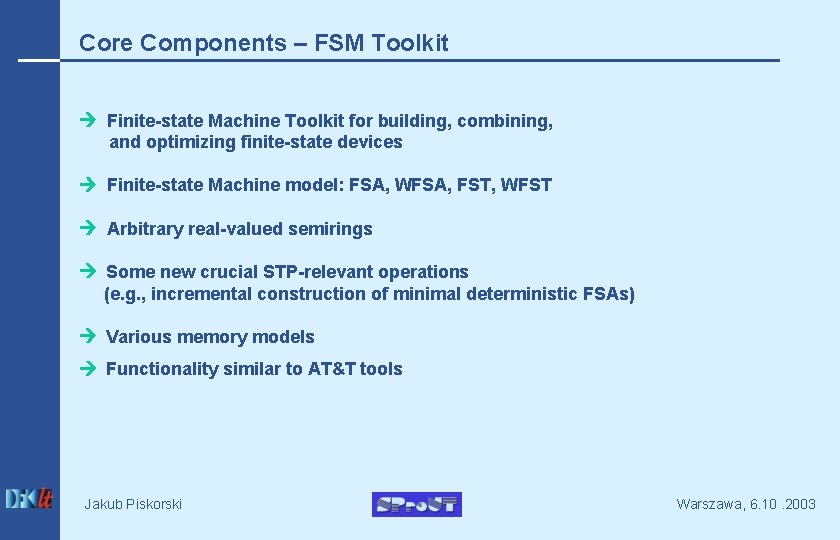
Core Components – FSM Toolkit Finite-state Machine Toolkit for building, combining, and optimizing finite-state devices Finite-state Machine model: FSA, WFSA, FST, WFST Arbitrary real-valued semirings Some new crucial STP-relevant operations (e. g. , incremental construction of minimal deterministic FSAs) Various memory models Functionality similar to AT&T tools Jakub Piskorski Warszawa, 6. 10. 2003
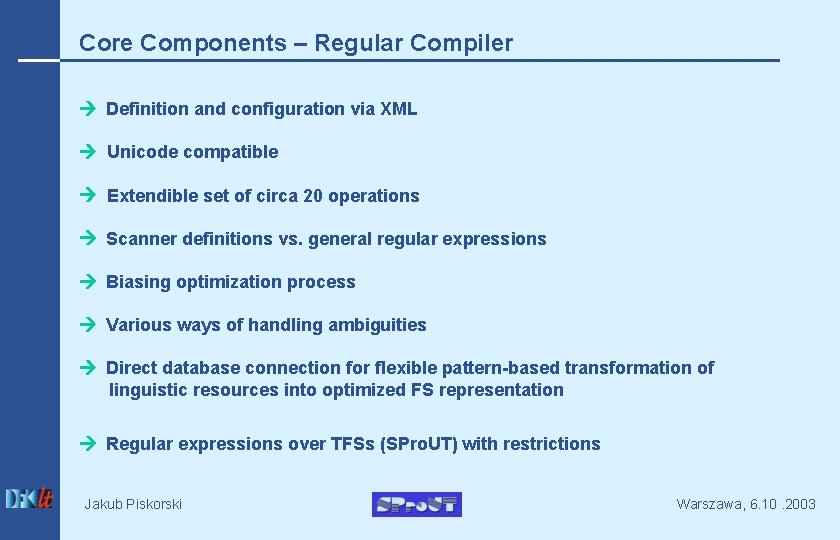
Core Components – Regular Compiler Definition and configuration via XML Unicode compatible Extendible set of circa 20 operations Scanner definitions vs. general regular expressions Biasing optimization process Various ways of handling ambiguities Direct database connection for flexible pattern-based transformation of linguistic resources into optimized FS representation Regular expressions over TFSs (SPro. UT) with restrictions Jakub Piskorski Warszawa, 6. 10. 2003
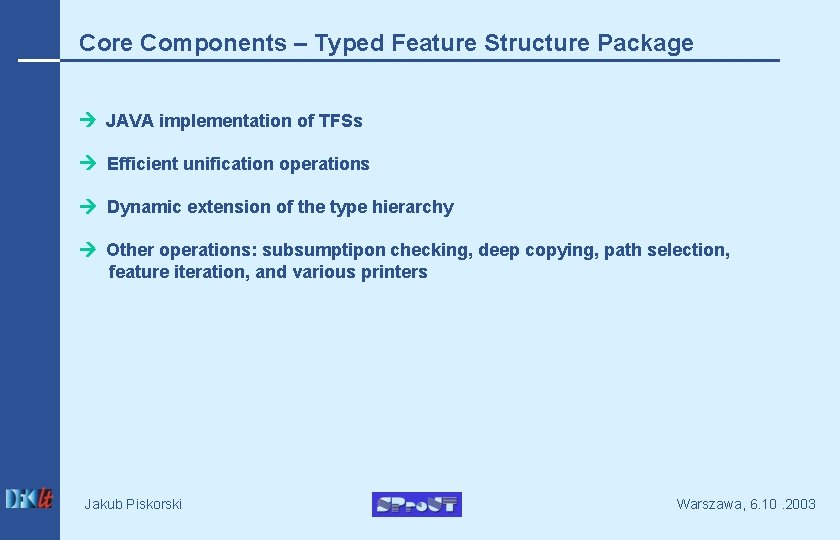
Core Components – Typed Feature Structure Package JAVA implementation of TFSs Efficient unification operations Dynamic extension of the type hierarchy Other operations: subsumptipon checking, deep copying, path selection, feature iteration, and various printers Jakub Piskorski Warszawa, 6. 10. 2003
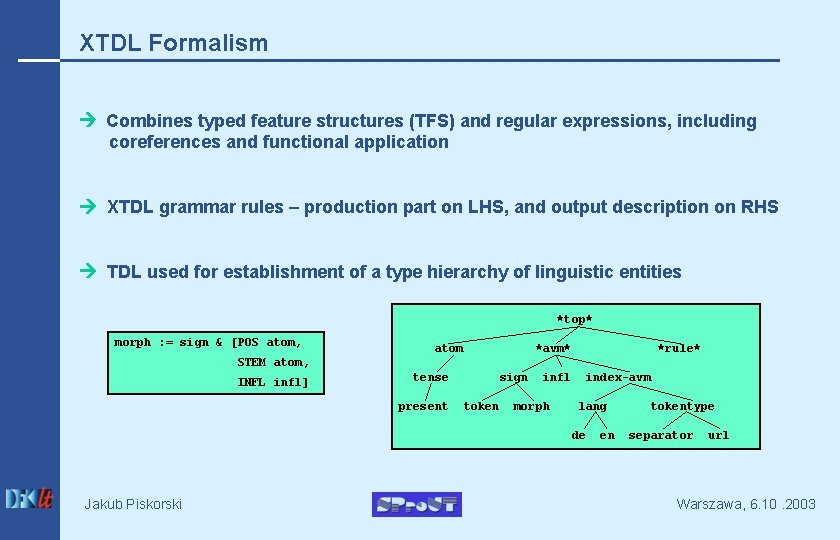
XTDL Formalism Combines typed feature structures (TFS) and regular expressions, including coreferences and functional application XTDL grammar rules – production part on LHS, and output description on RHS TDL used for establishment of a type hierarchy of linguistic entities *top* morph : = sign & [POS atom, STEM atom, INFL infl] atom *avm* tense present sign token *rule* infl morph index-avm lang de Jakub Piskorski en tokentype separator url Warszawa, 6. 10. 2003
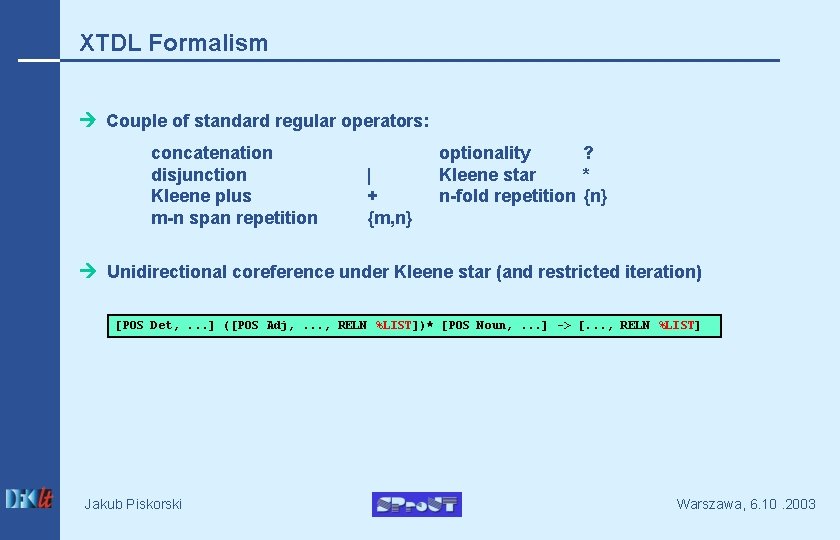
XTDL Formalism Couple of standard regular operators: concatenation disjunction Kleene plus m-n span repetition | + {m, n} optionality ? Kleene star * n-fold repetition {n} Unidirectional coreference under Kleene star (and restricted iteration) [POS Det, . . . ] ([POS Adj, . . . , RELN %LIST])* [POS Noun, . . . ] -> [. . . , RELN %LIST] Jakub Piskorski Warszawa, 6. 10. 2003
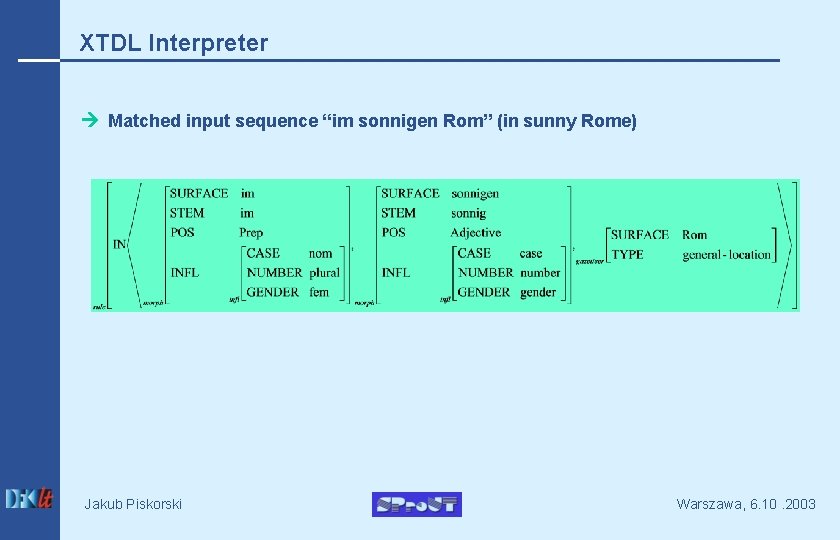
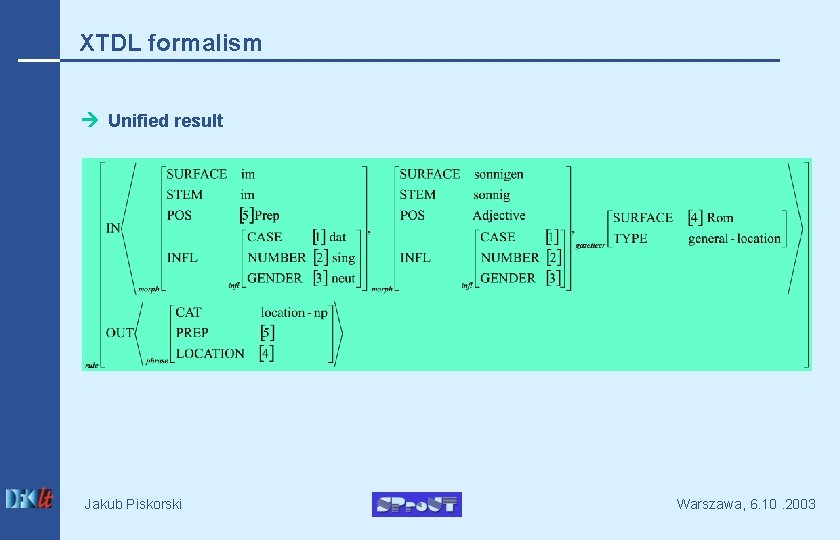
XTDL Formalism loc-pp : > morph & [POS Prep & #preposition, INFL [CASE #1, NUMBER #2, GENDER #3]] morph & [POS Determiner, INFL [CASE #1, NUMBER #2, GENDER #3]] ? morph & [POS Adjective, INFL [CASE #1, NUMBER #2, GENDER #3]] * gazetteer & [TYPE general-location, SURFACE #location] -> [CAT location-pp, PREP #preposition LOCATION #location]. Jakub Piskorski Warszawa, 6. 10. 2003
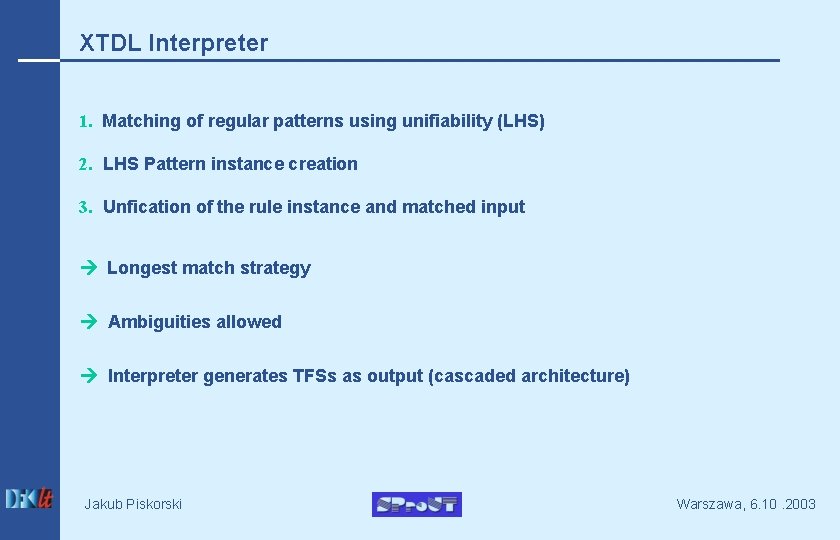
XTDL Interpreter 1. Matching of regular patterns using unifiability (LHS) 2. LHS Pattern instance creation 3. Unfication of the rule instance and matched input Longest match strategy Ambiguities allowed Interpreter generates TFSs as output (cascaded architecture) Jakub Piskorski Warszawa, 6. 10. 2003
XTDL Interpreter Matched input sequence “im sonnigen Rom” (in sunny Rome) Jakub Piskorski Warszawa, 6. 10. 2003
XTDL Interpreter Rule with an instantiated pattern on the LHS Jakub Piskorski Warszawa, 6. 10. 2003
XTDL formalism Unified result Jakub Piskorski Warszawa, 6. 10. 2003
Linguistic Processing Resources Tokenization Gazetteer Extended Gazetteer Morphology Sentence Splitter Reference Matcher Jakub Piskorski Warszawa, 6. 10. 2003
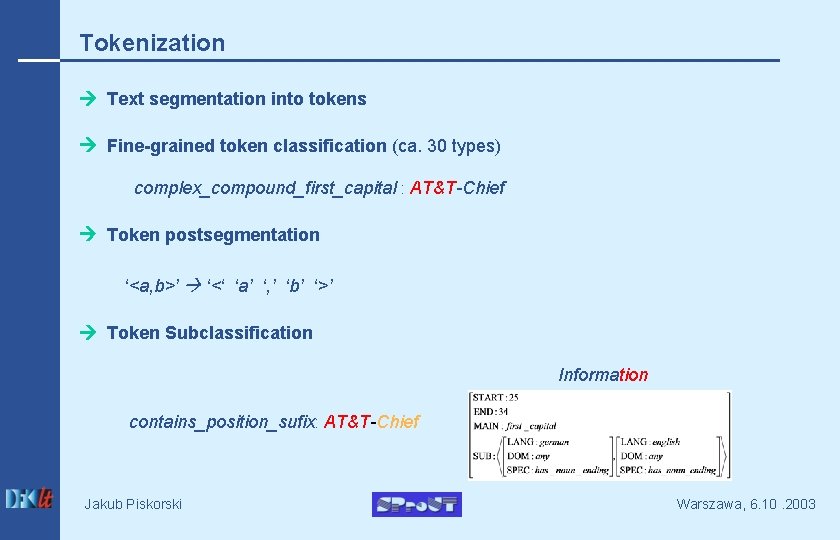
Tokenization Text segmentation into tokens Fine-grained token classification (ca. 30 types) complex_compound_first_capital : AT&T-Chief Token postsegmentation ‘<a, b>’ ‘<‘ ‘a’ ‘, ’ ‘b’ ‘>’ Token Subclassification Information contains_position_sufix: AT&T-Chief Jakub Piskorski Warszawa, 6. 10. 2003
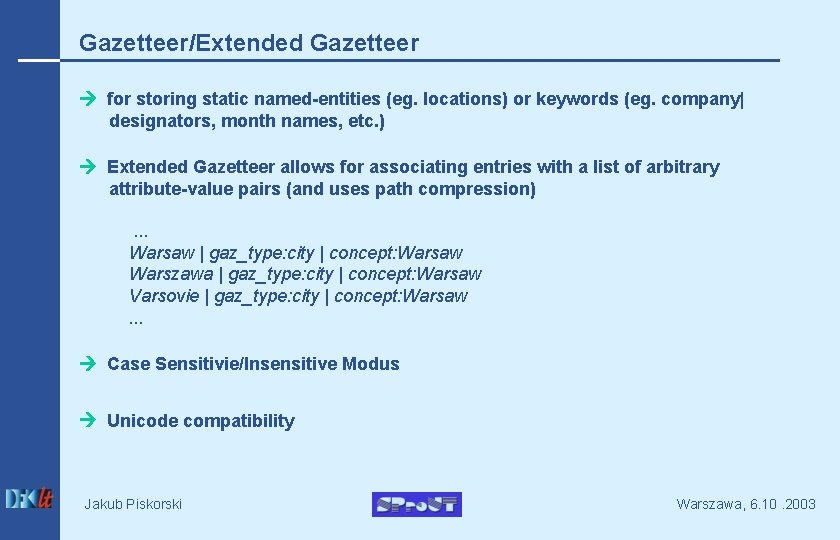
Gazetteer/Extended Gazetteer for storing static named-entities (eg. locations) or keywords (eg. company| designators, month names, etc. ) Extended Gazetteer allows for associating entries with a list of arbitrary attribute-value pairs (and uses path compression). . . Warsaw | gaz_type: city | concept: Warsaw Warszawa | gaz_type: city | concept: Warsaw Varsovie | gaz_type: city | concept: Warsaw. . . Case Sensitivie/Insensitive Modus Unicode compatibility Jakub Piskorski Warszawa, 6. 10. 2003
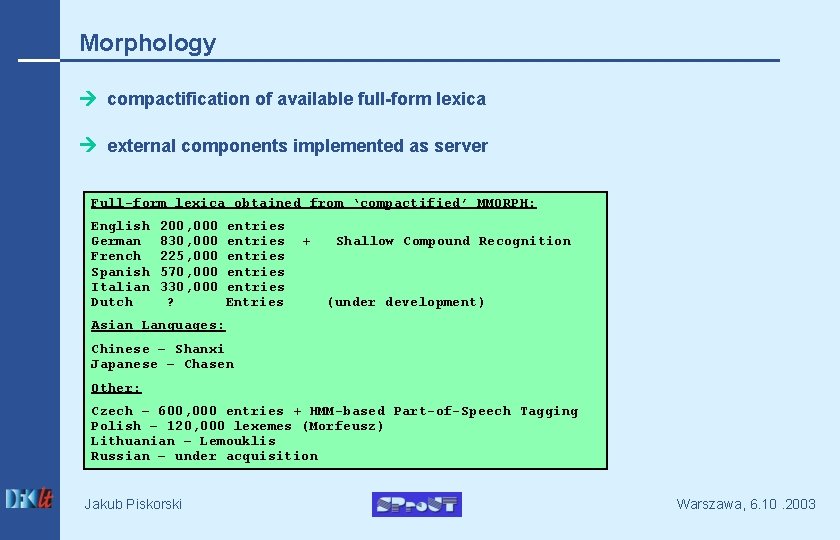
Morphology compactification of available full-form lexica external components implemented as server Full-form lexica obtained from ‘compactified’ MMORPH: English German French Spanish Italian Dutch 200, 000 830, 000 225, 000 570, 000 330, 000 ? entries entries Entries + Shallow Compound Recognition (under development) Asian Languages: Chinese – Shanxi Japanese – Chasen Other: Czech – 600, 000 entries + HMM-based Part-of-Speech Tagging Polish – 120, 000 lexemes (Morfeusz) Lithuanian – Lemouklis Russian – under acquisition Jakub Piskorski Warszawa, 6. 10. 2003
Morphology Compound Recognition & Segmentation for German “Biergartenfest” [Bier [garten fest]] vs. [[Bier garten] fest] “Wein“ + “sorten“ (wine types) “Wein” + “s“ + “orten“ (wine places) („Autoradiozubehör“ – radio car equipment) Autoradiozubehör Autoradiozubehör Next: Adoptation for processing Dutch compounds Jakub Piskorski Warszawa, 6. 10. 2003
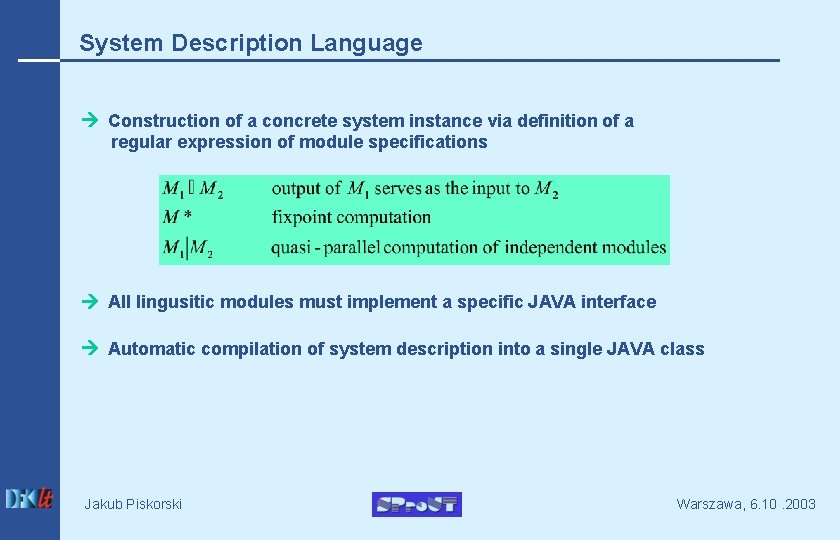
System Description Language Construction of a concrete system instance via definition of a regular expression of module specifications All lingusitic modules must implement a specific JAVA interface Automatic compilation of system description into a single JAVA class Jakub Piskorski Warszawa, 6. 10. 2003
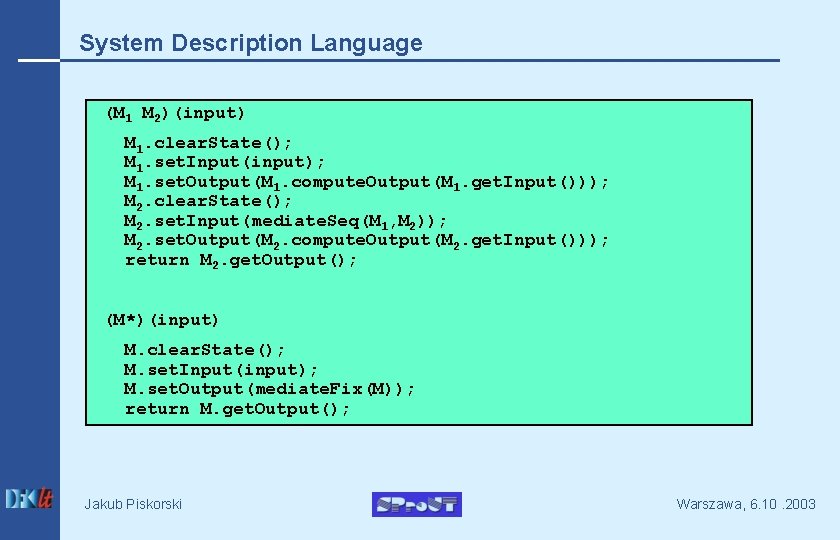
System Description Language (M 1 M 2)(input) M 1. clear. State(); M 1. set. Input(input); M 1. set. Output(M 1. compute. Output(M 1. get. Input())); M 2. clear. State(); M 2. set. Input(mediate. Seq(M 1, M 2)); M 2. set. Output(M 2. compute. Output(M 2. get. Input())); return M 2. get. Output(); (M*)(input) M. clear. State(); M. set. Input(input); M. set. Output(mediate. Fix(M)); return M. get. Output(); Jakub Piskorski Warszawa, 6. 10. 2003
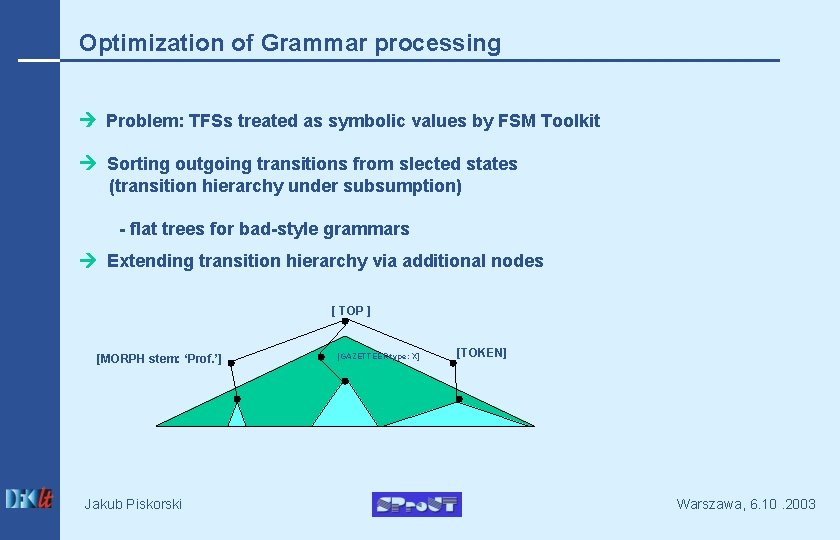
Optimization of Grammar processing Problem: TFSs treated as symbolic values by FSM Toolkit Sorting outgoing transitions from slected states (transition hierarchy under subsumption) - flat trees for bad-style grammars Extending transition hierarchy via additional nodes [ TOP ] [MORPH stem: ‘Prof. ’] Jakub Piskorski [GAZETTEER type: X] [TOKEN] Warszawa, 6. 10. 2003
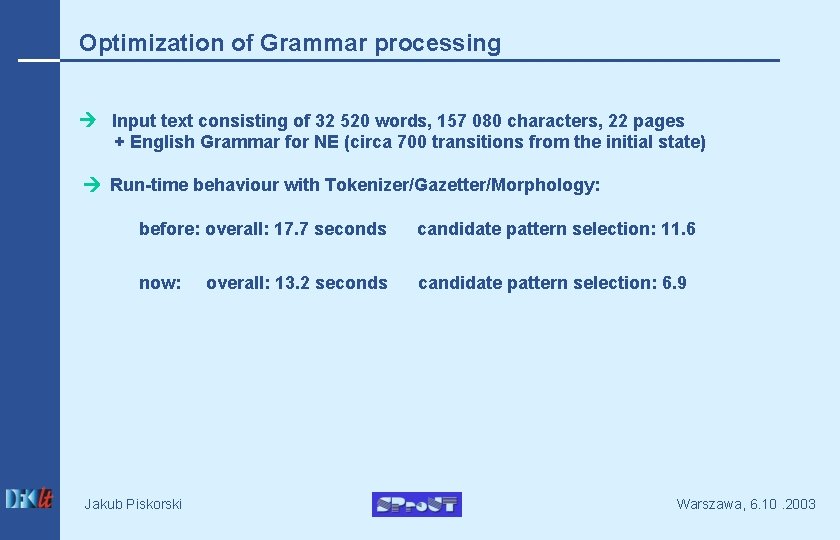
Optimization of Grammar processing Input text consisting of 32 520 words, 157 080 characters, 22 pages + English Grammar for NE (circa 700 transitions from the initial state) Run-time behaviour with Tokenizer/Gazetter/Morphology: before: overall: 17. 7 seconds candidate pattern selection: 11. 6 now: candidate pattern selection: 6. 9 Jakub Piskorski overall: 13. 2 seconds Warszawa, 6. 10. 2003
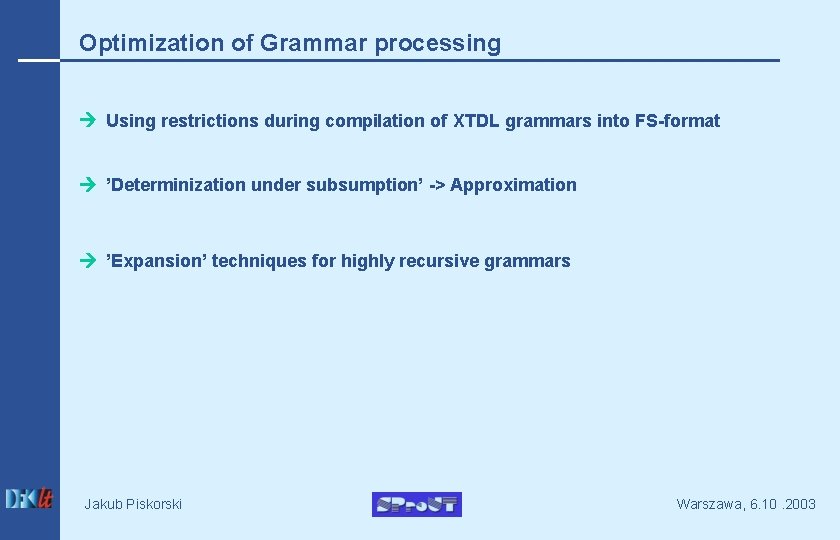
Optimization of Grammar processing Using restrictions during compilation of XTDL grammars into FS-format ’Determinization under subsumption’ -> Approximation ’Expansion’ techniques for highly recursive grammars Jakub Piskorski Warszawa, 6. 10. 2003
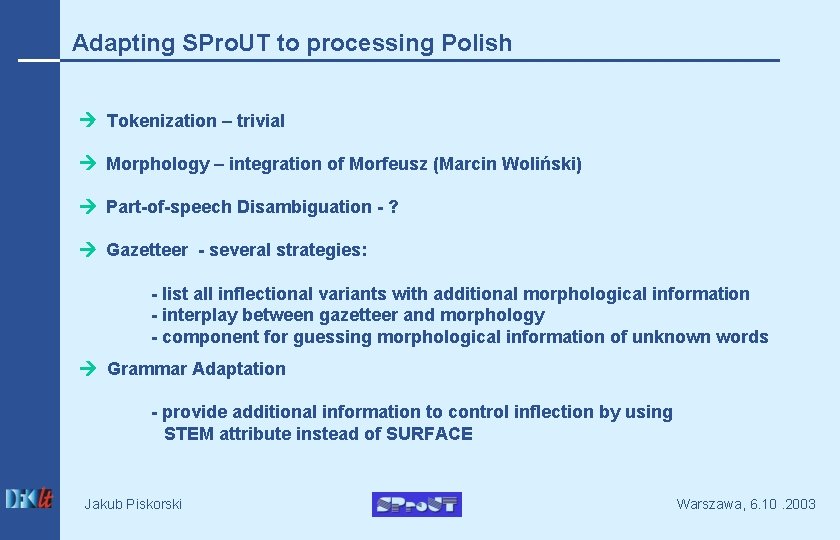
Adapting SPro. UT to processing Polish Tokenization – trivial Morphology – integration of Morfeusz (Marcin Woliński) Part-of-speech Disambiguation - ? Gazetteer - several strategies: - list all inflectional variants with additional morphological information - interplay between gazetteer and morphology - component for guessing morphological information of unknown words Grammar Adaptation - provide additional information to control inflection by using STEM attribute instead of SURFACE Jakub Piskorski Warszawa, 6. 10. 2003
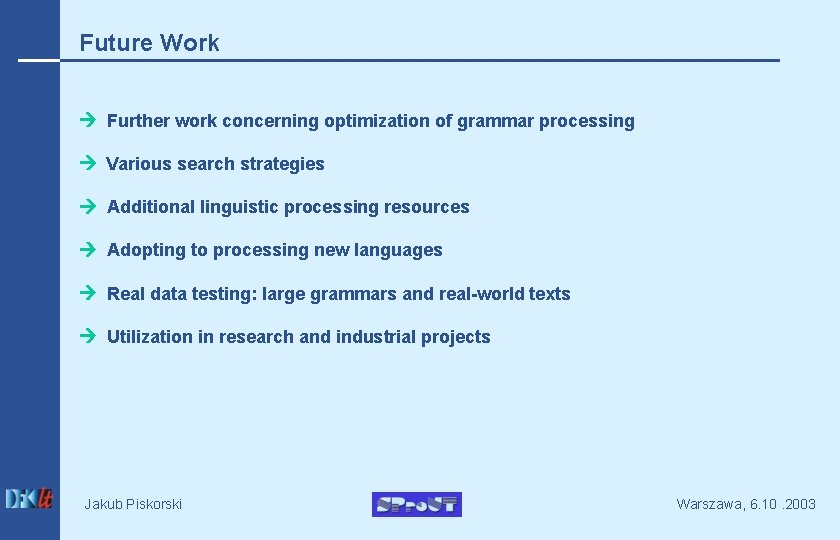
Future Work Further work concerning optimization of grammar processing Various search strategies Additional linguistic processing resources Adopting to processing new languages Real data testing: large grammars and real-world texts Utilization in research and industrial projects Jakub Piskorski Warszawa, 6. 10. 2003
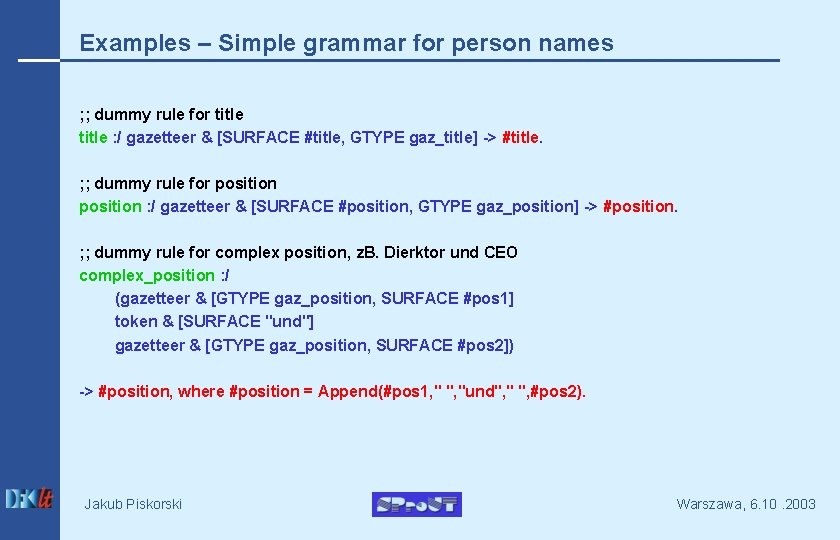
Examples – Simple grammar for person names ; ; dummy rule for title : / gazetteer & [SURFACE #title, GTYPE gaz_title] -> #title. ; ; dummy rule for position : / gazetteer & [SURFACE #position, GTYPE gaz_position] -> #position. ; ; dummy rule for complex position, z. B. Dierktor und CEO complex_position : / (gazetteer & [GTYPE gaz_position, SURFACE #pos 1] token & [SURFACE "und"] gazetteer & [GTYPE gaz_position, SURFACE #pos 2]) -> #position, where #position = Append(#pos 1, " ", "und", " ", #pos 2). Jakub Piskorski Warszawa, 6. 10. 2003
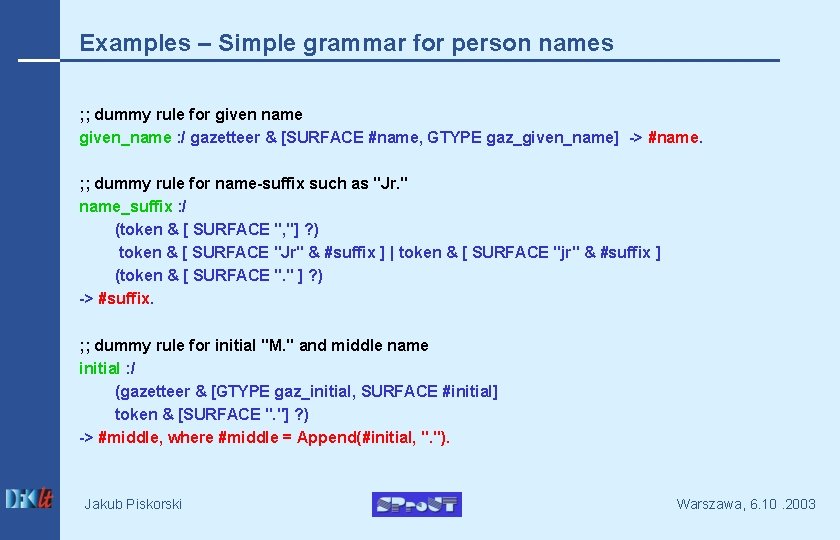
Examples – Simple grammar for person names ; ; dummy rule for given name given_name : / gazetteer & [SURFACE #name, GTYPE gaz_given_name] -> #name. ; ; dummy rule for name-suffix such as "Jr. " name_suffix : / (token & [ SURFACE ", "] ? ) token & [ SURFACE "Jr" & #suffix ] | token & [ SURFACE "jr" & #suffix ] (token & [ SURFACE ". " ] ? ) -> #suffix. ; ; dummy rule for initial "M. " and middle name initial : / (gazetteer & [GTYPE gaz_initial, SURFACE #initial] token & [SURFACE ". "] ? ) -> #middle, where #middle = Append(#initial, ". "). Jakub Piskorski Warszawa, 6. 10. 2003
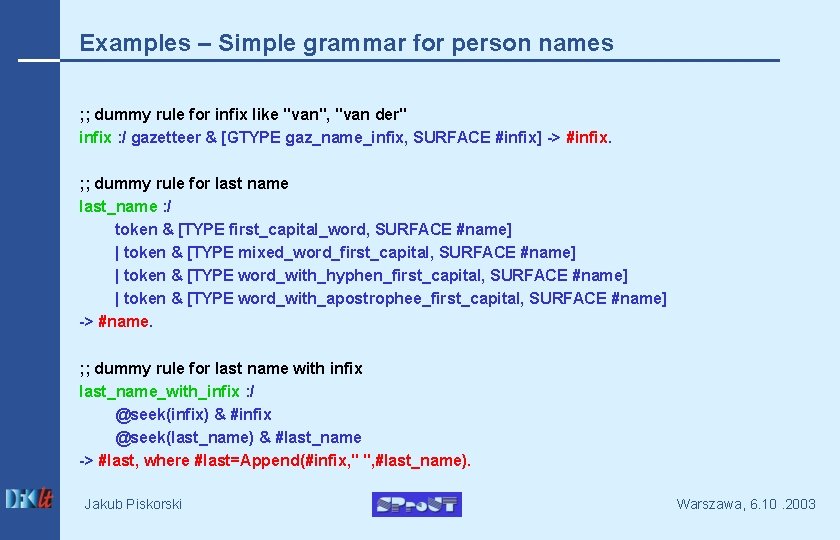
Examples – Simple grammar for person names ; ; dummy rule for infix like "van", "van der" infix : / gazetteer & [GTYPE gaz_name_infix, SURFACE #infix] -> #infix. ; ; dummy rule for last name last_name : / token & [TYPE first_capital_word, SURFACE #name] | token & [TYPE mixed_word_first_capital, SURFACE #name] | token & [TYPE word_with_hyphen_first_capital, SURFACE #name] | token & [TYPE word_with_apostrophee_first_capital, SURFACE #name] -> #name. ; ; dummy rule for last name with infix last_name_with_infix : / @seek(infix) & #infix @seek(last_name) & #last_name -> #last, where #last=Append(#infix, " ", #last_name). Jakub Piskorski Warszawa, 6. 10. 2003
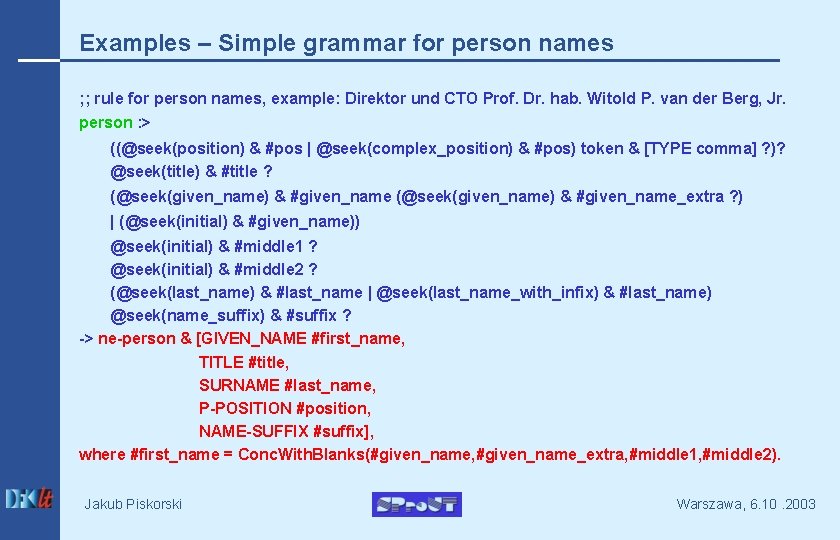
Examples – Simple grammar for person names ; ; rule for person names, example: Direktor und CTO Prof. Dr. hab. Witold P. van der Berg, Jr. person : > ((@seek(position) & #pos | @seek(complex_position) & #pos) token & [TYPE comma] ? )? @seek(title) & #title ? (@seek(given_name) & #given_name_extra ? ) | (@seek(initial) & #given_name)) @seek(initial) & #middle 1 ? @seek(initial) & #middle 2 ? (@seek(last_name) & #last_name | @seek(last_name_with_infix) & #last_name) @seek(name_suffix) & #suffix ? -> ne-person & [GIVEN_NAME #first_name, TITLE #title, SURNAME #last_name, P-POSITION #position, NAME-SUFFIX #suffix], where #first_name = Conc. With. Blanks(#given_name, #given_name_extra, #middle 1, #middle 2). Jakub Piskorski Warszawa, 6. 10. 2003
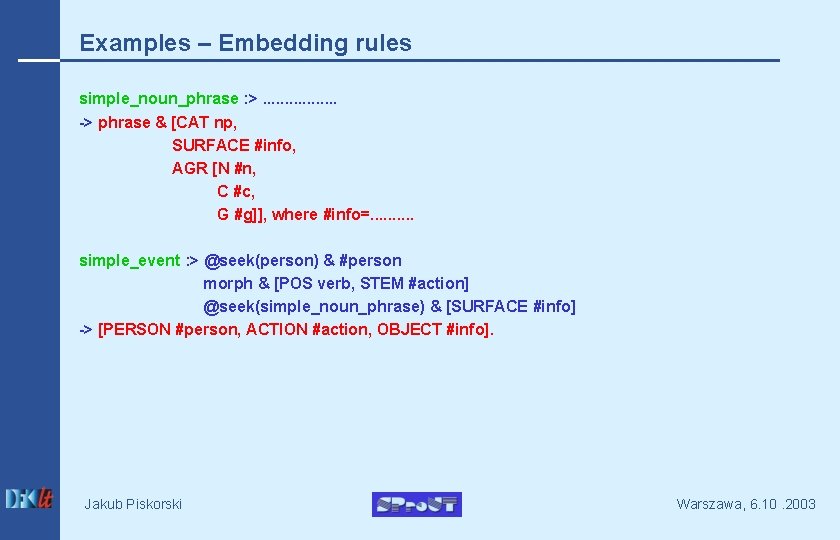
Examples – Embedding rules simple_noun_phrase : >. . . . -> phrase & [CAT np, SURFACE #info, AGR [N #n, C #c, G #g]], where #info=. . simple_event : > @seek(person) & #person morph & [POS verb, STEM #action] @seek(simple_noun_phrase) & [SURFACE #info] -> [PERSON #person, ACTION #action, OBJECT #info]. Jakub Piskorski Warszawa, 6. 10. 2003