Spectroscopic Study of Local Interactions of Platinum in









- Slides: 20
Spectroscopic Study of Local Interactions of Platinum in Small [Cex. Oy]Ptx ‾ Clusters Manisha Ray Prof. Caroline C. Jarrold group Department of Chemistry International Symposium on Molecular Spectroscopy June 20 -24, 2016, Champaign-Urbana, Illinois
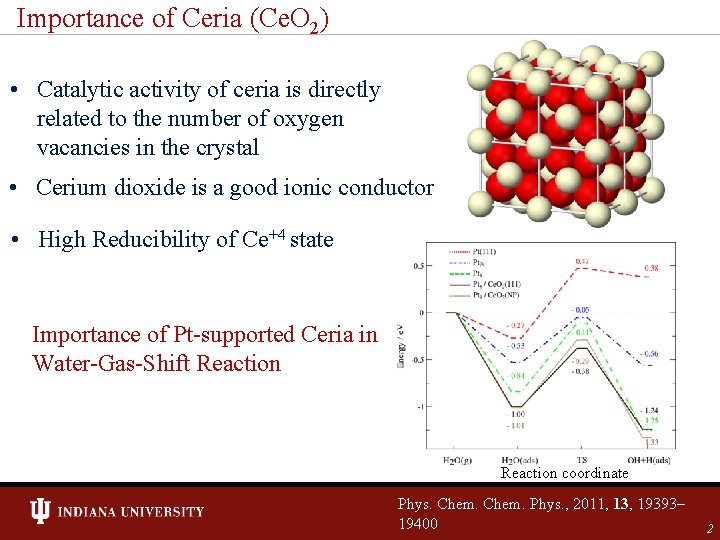
Importance of Ceria (Ce. O 2) • Catalytic activity of ceria is directly related to the number of oxygen vacancies in the crystal • Cerium dioxide is a good ionic conductor • High Reducibility of Ce+4 state Importance of Pt-supported Ceria in Water-Gas-Shift Reaction coordinate Phys. Chem. Phys. , 2011, 13, 19393– 19400 2
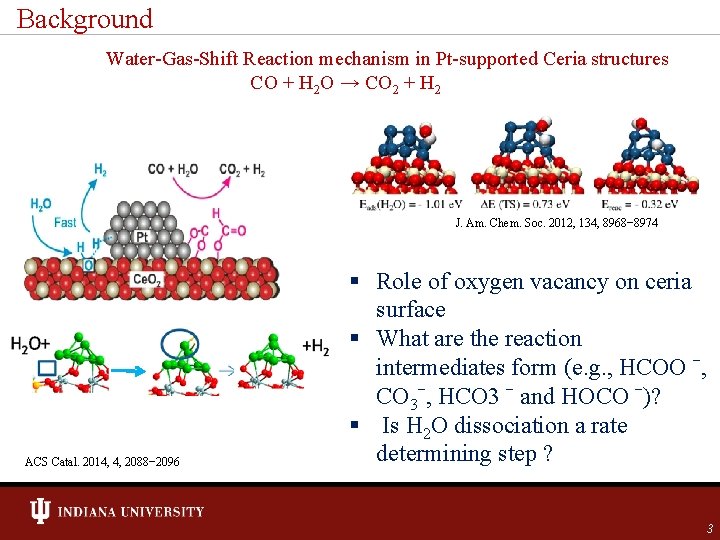
Background Water-Gas-Shift Reaction mechanism in Pt-supported Ceria structures CO + H 2 O → CO 2 + H 2 J. Am. Chem. Soc. 2012, 134, 8968− 8974 ACS Catal. 2014, 4, 2088− 2096 § Role of oxygen vacancy on ceria surface § What are the reaction intermediates form (e. g. , HCOO ˉ, CO 3ˉ, HCO 3 ˉ and HOCO ˉ)? § Is H 2 O dissociation a rate determining step ? 3
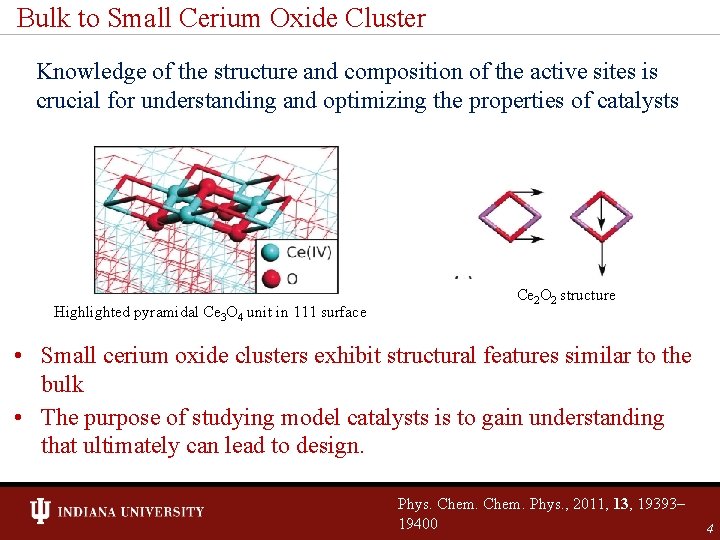
Bulk to Small Cerium Oxide Cluster Knowledge of the structure and composition of the active sites is crucial for understanding and optimizing the properties of catalysts Highlighted pyramidal Ce 3 O 4 unit in 111 surface Ce 2 O 2 structure • Small cerium oxide clusters exhibit structural features similar to the bulk • The purpose of studying model catalysts is to gain understanding that ultimately can lead to design. Phys. Chem. Phys. , 2011, 13, 19393– 19400 4
Experimental Apparatus TOF mass spectrometry combined with Anion Photoelectron Spectroscopy TOF Mass Spectrometer GENERAT Reactant E Carrier gas CLUSTER lines S Ablation laser hits metal target Electron detector ANION MASS SPEC PES interaction region PES Ion detector 5
Method Principle of Anion Photoelectron Spectroscopy and Significance of β parameter Spectra are collected with the laser polarization perpendicular and parallel to the electron drift direction. Depending on orbital types, β varies as -1<β˂2 Selection Rule, 6
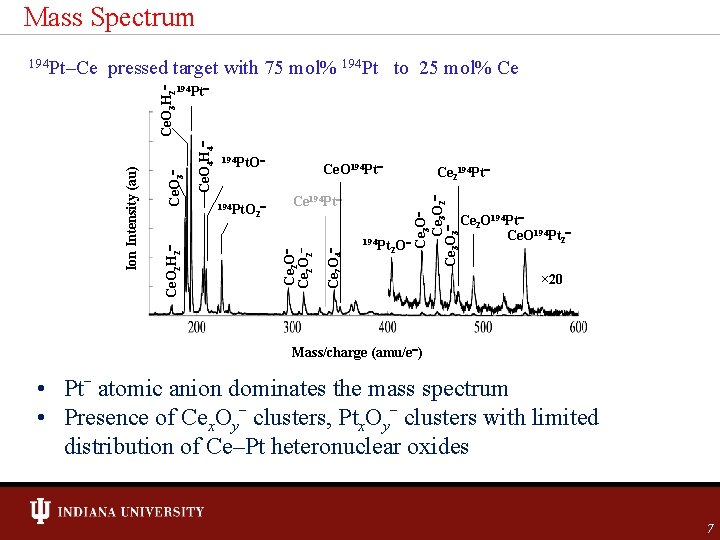
Mass Spectrum 194 Pt. O 194 Pt 2 O Ce 3 O 2 Ce 3 O 3 Ce 2194 Pt Ce 2 O 4 194 Pt. O 2 Ce. O 194 Pt Ce 2 O 2 Ce. O 4 H 4 Ce. O 3 194 Pt Ce. O 2 H 2 Ion Intensity (au) Ce. O 3 H 2 194 Pt–Ce pressed target with 75 mol% 194 Pt to 25 mol% Ce 2 O 194 Pt Ce. O 194 Pt 2 × 20 Mass/charge (amu/e ) • Ptˉ atomic anion dominates the mass spectrum • Presence of Cex. Oyˉ clusters, Ptx. Oyˉ clusters with limited distribution of Ce–Pt heteronuclear oxides 7
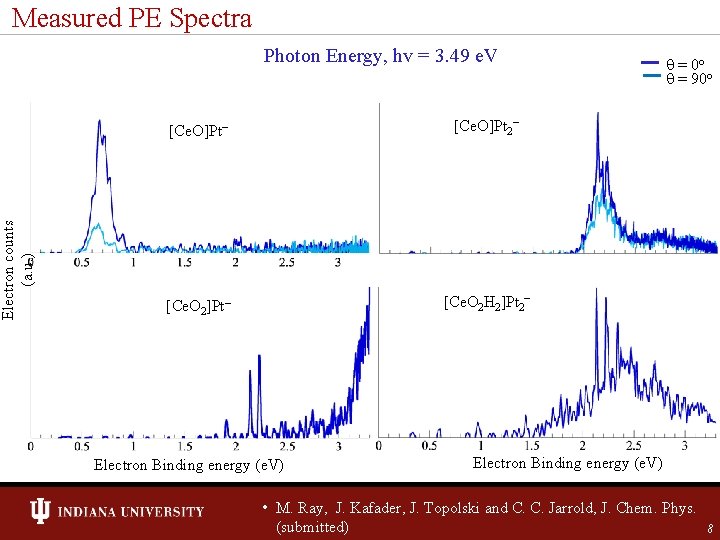
Electron counts (a. u. ) Measured PE Spectra Photon Energy, hv = 3. 49 e. V [Ce. O]Pt 2 [Ce. O 2]Pt [Ce. O 2 H 2]Pt 2 Electron Binding energy (e. V) = 0 o = 90 o Electron Binding energy (e. V) • M. Ray, J. Kafader, J. Topolski and C. C. Jarrold, J. Chem. Phys. (submitted) 8
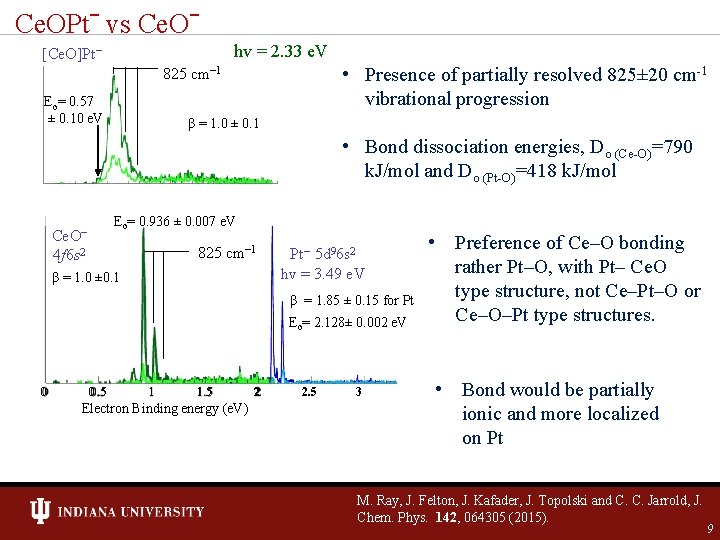
Ce. OPtˉ vs Ce. Oˉ hv = 2. 33 e. V [Ce. O]Pt 825 cm 1 Eo= 0. 57 ± 0. 10 e. V • Presence of partially resolved 825± 20 cm-1 vibrational progression β = 1. 0 ± 0. 1 • Bond dissociation energies, Do (Ce-O)=790 k. J/mol and Do (Pt-O)=418 k. J/mol Ce. O Eo= 0. 936 ± 0. 007 e. V 4 f 6 s 2 825 cm 1 β = 1. 0 ± 0. 1 Pt 5 d 96 s 2 hv = 3. 49 e. V β = 1. 85 ± 0. 15 for Pt Eo= 2. 128± 0. 002 e. V 0 0. 5 1 1. 5 2 2. 5 3 Electron Binding energy (e. V) • Preference of Ce–O bonding rather Pt–O, with Pt– Ce. O type structure, not Ce–Pt–O or Ce–O–Pt type structures. • Bond would be partially ionic and more localized on Pt M. Ray, J. Felton, J. Kafader, J. Topolski and C. C. Jarrold, J. Chem. Phys. 142, 064305 (2015). 9
Computational Details • GAUSSIAN 09 suite of electronic structure programs • B 3 LYP hybrid density functional method • For Cerium, 28 electron quasirelativistic pseudopotential and atomic natural basis for valence electrons named ECP 28 MWB_ANO, consists of (14 s 13 p 10 d 8 f 6 g)/ [6 s 6 p 5 d 4 f 3 g] functions • For Pt, 60 electron ECP 60 MWB quasirelativistic pseudopotential with valence electron basis set consists of (8 s 7 p 6 d 2 f 1 g)/[6 s 5 p 3 d 2 f 1 g] functions • aug-cc-pv-tz basis set was used for O-atom • No spin orbit coupling is considered in the calculations • M. Ray, J. Felton, J. Kafader, J. Topolski and C. C. Jarrold, J. Chem. Phys. 142, 064305 (2015). • J. O. Kafader, M. Ray, and C. C. Jarrold, J. Chem. Phys. 142, 034305 (2015). • J. O. Kafader, M. Ray, and C. C. Jarrold, J. Chem. Phys. , 143, (2015) http: //www. uni-stuttgart. de/theochem/ University of Stuttgart Institute for theoretical chemistry 10
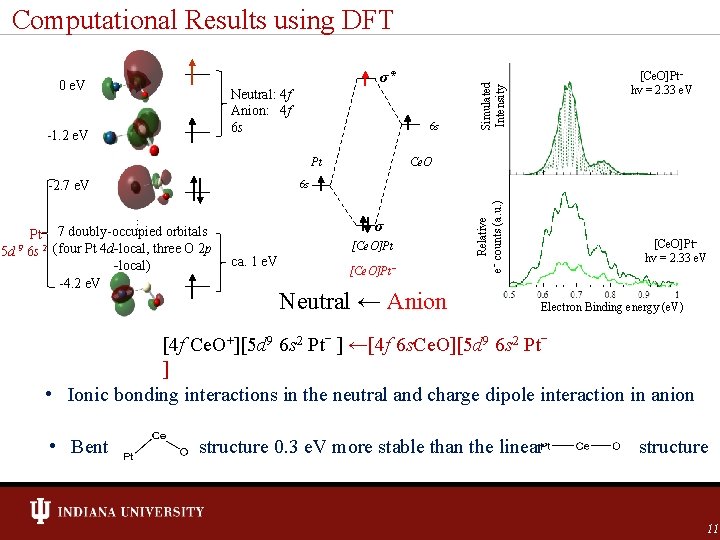
σ* 0 e. V Neutral: 4 f Anion: 4 f 6 s -1. 2 e. V 6 s [Ce. O]Pt hv = 2. 33 e. V Ce. O Pt -2. 7 e. V Simulated Intensity Computational Results using DFT σ [Ce. O]Pt ca. 1 e. V [Ce. O]Ptˉ Neutral ← Anion Relative Pt 7 doubly-occupied orbitals 5 d 9 6 s 2 (four Pt 4 d-local, three O 2 p -local) -4. 2 e. V e counts (a. u. ) … 6 s [Ce. O]Pt hv = 2. 33 e. V Electron Binding energy (e. V) [4 f Ce. O+][5 d 9 6 s 2 Ptˉ ] ←[4 f 6 s. Ce. O][5 d 9 6 s 2 Ptˉ ] • Ionic bonding interactions in the neutral and charge dipole interaction in anion • Bent structure 0. 3 e. V more stable than the linear structure 11
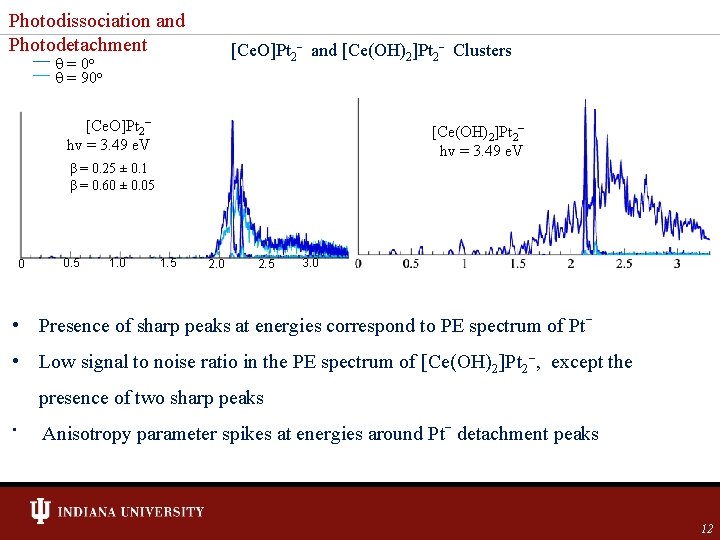
Photodissociation and Photodetachment [Ce. O]Pt 2 and [Ce(OH)2]Pt 2 Clusters = 0 o = 90 o [Ce. O]Pt 2 hv = 3. 49 e. V [Ce(OH)2]Pt 2 hv = 3. 49 e. V β = 0. 25 ± 0. 1 β = 0. 60 ± 0. 05 0 0. 5 1. 0 1. 5 2. 0 2. 5 3. 0 • Presence of sharp peaks at energies correspond to PE spectrum of Ptˉ • Low signal to noise ratio in the PE spectrum of [Ce(OH)2]Pt 2 , except the presence of two sharp peaks • Anisotropy parameter spikes at energies around Ptˉ detachment peaks 12
Computational Results using DFT [Ce. O]Pt 2 • The detachment transition is from a π*5 d-5 d orbital [4 f Ce. O+]∙ [5 d 10]σ2 g, 6 s. Pt 22ˉ Ce. OPt + Ptˉ Singly occupied Ce 4 f 0 e. V Singly occupied in neutral, doubly occupied in anion Pt 2 * 1. 5 e. V Doubly occupied Ce-O 3. 0 e. V Electron Binding energy (e. V) • … [Ce. O]Pt 2 = 90 o; hv = 3. 49 e. V Simulation … • Photodissociation Simulated and e Intensity • The negative charge is shifted from 6 s- (LUMO) into the 5 d based Pt 2 local orbitals Unoccupied Pt 2 * 1 e. V Promotion of an e- to LUMO will weaken the Pt-Pt bond and facilitate overlap between Pt atoms and Ce. O Doubly occupied Pt 2 4. 0 e. V … [4 f Ce. O+]∙[…(π5 d-5 d *)3]σ2 g, 6 s. Pt 2ˉ Unoccupied Ce. O 6 s 2. 7 e. V 13
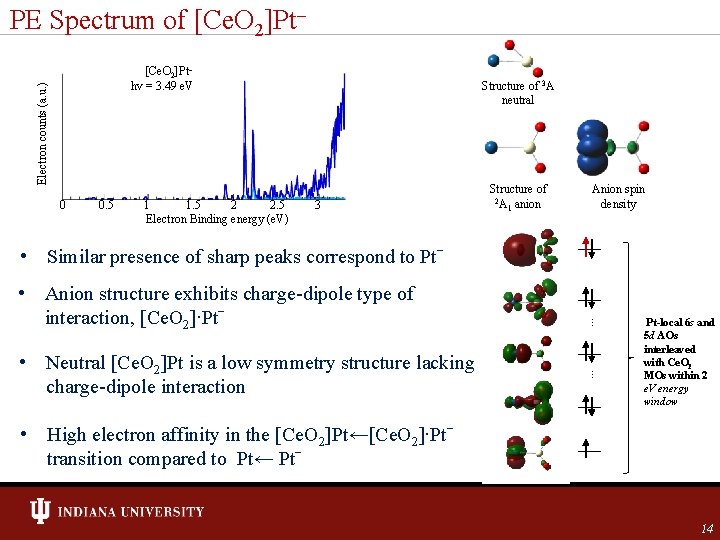
Electron counts (a. u. ) PE Spectrum of [Ce. O 2]Pt hv = 3. 49 e. V 0 0. 5 1 1. 5 2 2. 5 3 Electron Binding energy (e. V) Structure of 3 A neutral Structure of 2 A anion 1 Anion spin density • Neutral [Ce. O 2]Pt is a low symmetry structure lacking charge-dipole interaction … • Anion structure exhibits charge-dipole type of interaction, [Ce. O 2]∙Ptˉ … • Similar presence of sharp peaks correspond to Ptˉ Pt-local 6 s and 5 d AOs interleaved with Ce. O 2 MOs within 2 e. V energy window • High electron affinity in the [Ce. O 2]Pt←[Ce. O 2]∙Ptˉ transition compared to Pt← Ptˉ 14
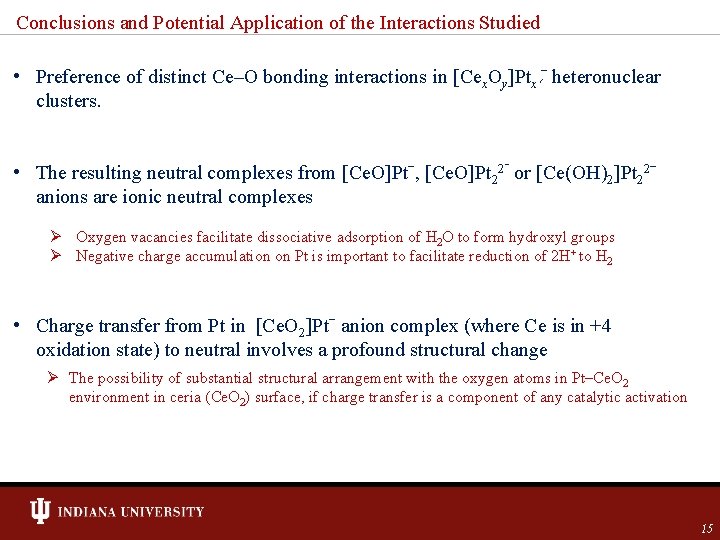
Conclusions and Potential Application of the Interactions Studied • Preference of distinct Ce–O bonding interactions in [Cex. Oy]Ptx ˉ heteronuclear clusters. • The resulting neutral complexes from [Ce. O]Ptˉ, [Ce. O]Pt 22ˉ or [Ce(OH)2]Pt 22ˉ anions are ionic neutral complexes Ø Oxygen vacancies facilitate dissociative adsorption of H 2 O to form hydroxyl groups Ø Negative charge accumulation on Pt is important to facilitate reduction of 2 H+ to H 2 • Charge transfer from Pt in [Ce. O 2]Ptˉ anion complex (where Ce is in +4 oxidation state) to neutral involves a profound structural change Ø The possibility of substantial structural arrangement with the oxygen atoms in Pt–Ce. O 2 environment in ceria (Ce. O 2) surface, if charge transfer is a component of any catalytic activation 15
Acknowledgment Caroline Chick Jarrold Jared Kafader Josey Topolski Kellyn Patros Brett Williams Vicmarie Marrero-Colon Big Red II Supercomputer at Indiana University Previous Group Members NSF Grant CHE-1265991 Dr. Jeremy Felton Dr. Sarah Waller 16
October 30, 2020
Principle of Anion Photoelectron Spectroscopy and Significance of β parameter Expected Possible anion to neutral transition in [Ce. O]Pt 2 system [5 d 9]σ2 g, 6 s ← [5 d 9]σ2 g, 6 s σu, 6 s (Triplet Neutral state) (Quartet anionic state) October 30, 2020
Photodissociation and Photodetachment October 30, 2020 [Ce. O]Pt 2 and [Ce(OH)2]Pt 2 Clusters [Ce. O]Pt 2 hv = 3. 49 e. V β = 0. 25 ± 0. 1 β = 0. 60 ± 0. 05 [Ce(OH)2]Pt 2 hv = 3. 49 e. V = 0 o = 90 o 0 0. 5 1. 5 2. 5 3 Pt hv = 3. 49 e. V 0 0. 5 1. 5 2. 5 3 12
Photodissociation and Photodetachment October 30, 2020 [Ce. O]Pt 2 and [Ce(OH)2]Pt 2 Clusters 0 0. 5 1. 0 1. 5 0 2. 0 0. 5 1 1. 5 2 1. 5 1 0. 5 0 3. 0 2. 5 2 2. 5 3 3 13