Space plasmas examples and phenomenology Solar interior and
- Slides: 32
Space plasmas, examples and phenomenology • Solar interior and atmosphere • Solar corona and wind • Heliosphere and energetic particles • Earth‘s magnetosphere • Planetary magnetospheres • The Earth‘s bow shock • Cometary plasmas
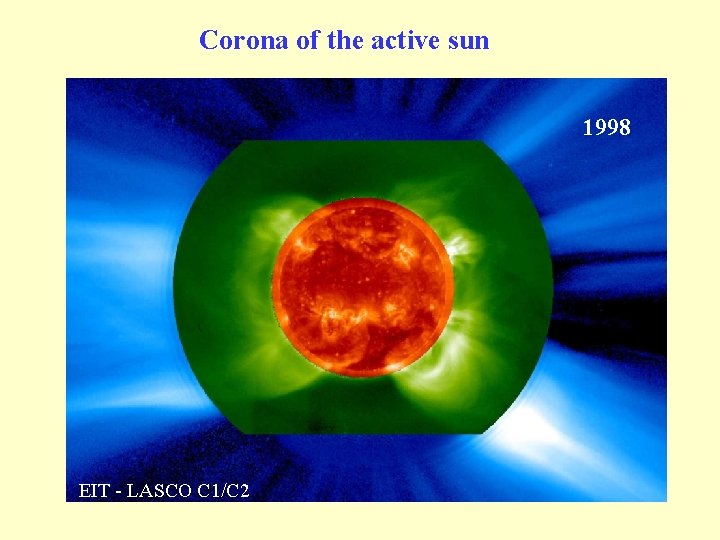
Corona of the active sun 1998 EIT - LASCO C 1/C 2
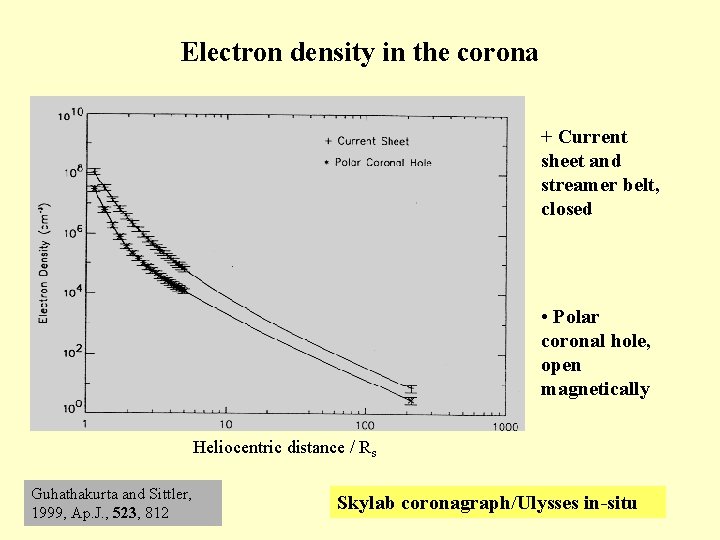
Electron density in the corona + Current sheet and streamer belt, closed • Polar coronal hole, open magnetically Heliocentric distance / Rs Guhathakurta and Sittler, 1999, Ap. J. , 523, 812 Skylab coronagraph/Ulysses in-situ
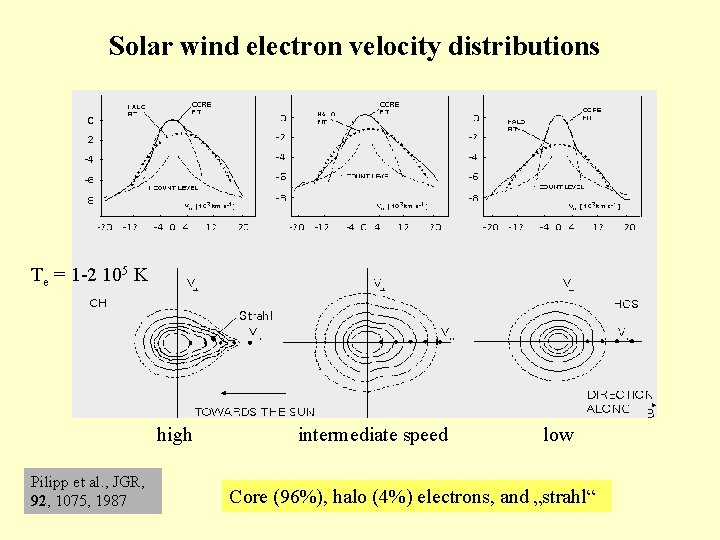
Solar wind electron velocity distributions Te = 1 -2 105 K high Pilipp et al. , JGR, 92, 1075, 1987 intermediate speed low Core (96%), halo (4%) electrons, and „strahl“
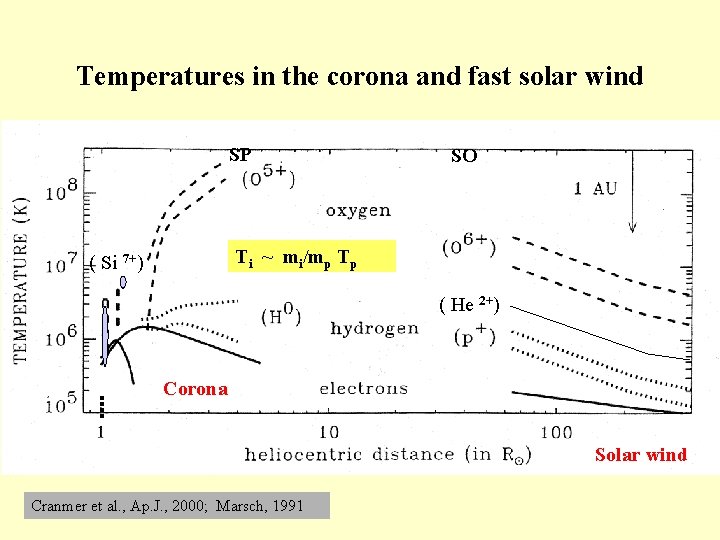
Temperatures in the corona and fast solar wind SP SO Ti ~ mi/mp Tp ( Si 7+) ( He 2+) Corona Solar wind Cranmer et al. , Ap. J. , 2000; Marsch, 1991
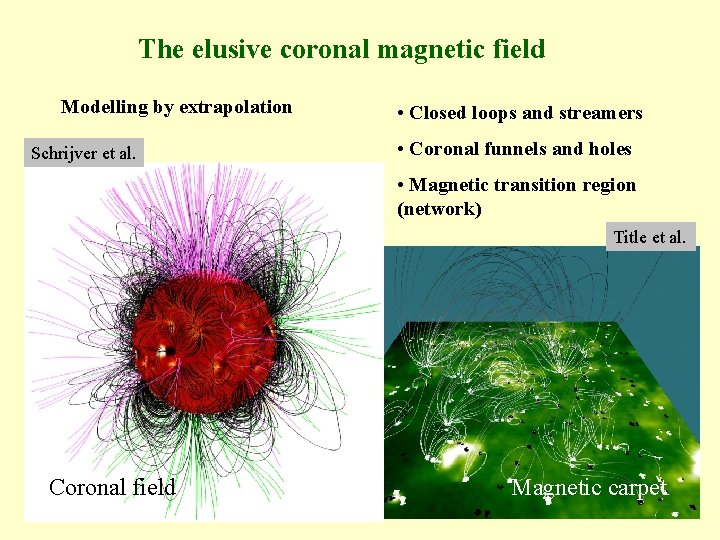
The elusive coronal magnetic field Modelling by extrapolation Schrijver et al. • Closed loops and streamers • Coronal funnels and holes • Magnetic transition region (network) Title et al. Coronal field Magnetic carpet
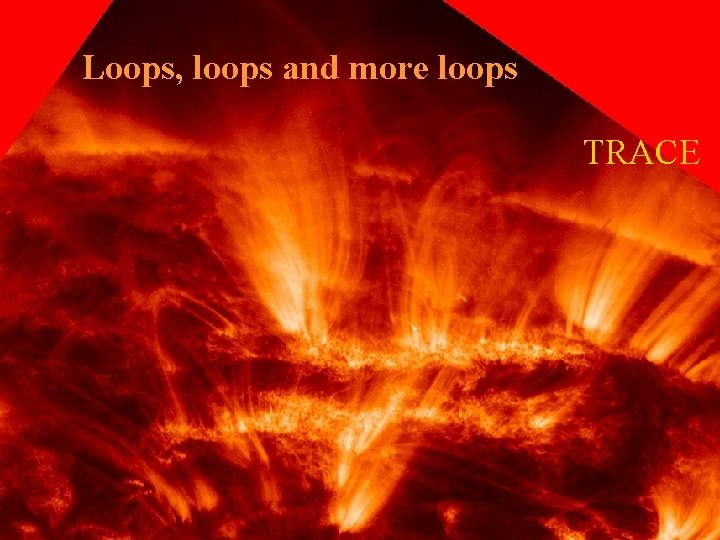
Loops, loops and more loops TRACE
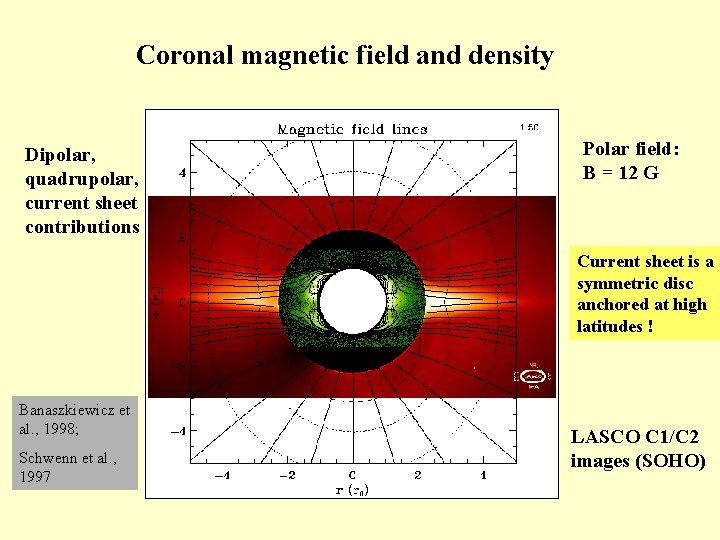
Coronal magnetic field and density Dipolar, quadrupolar, current sheet contributions Polar field: B = 12 G Current sheet is a symmetric disc anchored at high latitudes ! Banaszkiewicz et al. , 1998; Schwenn et al. , 1997 LASCO C 1/C 2 images (SOHO)
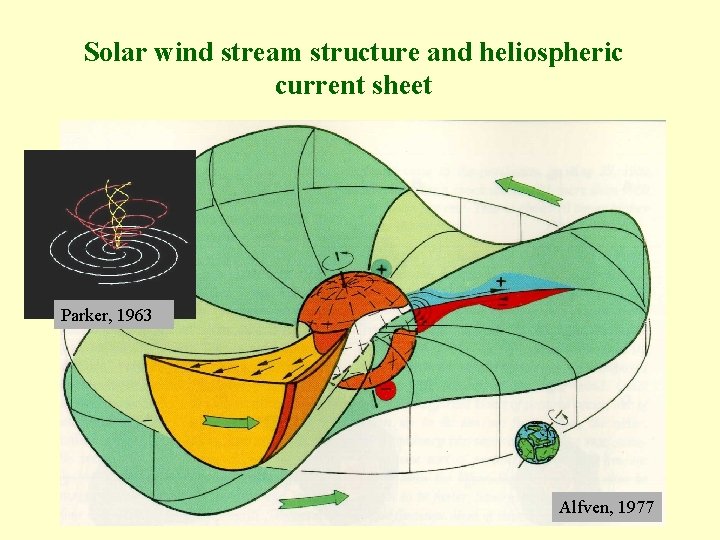
Solar wind stream structure and heliospheric current sheet Parker, 1963 Alfven, 1977
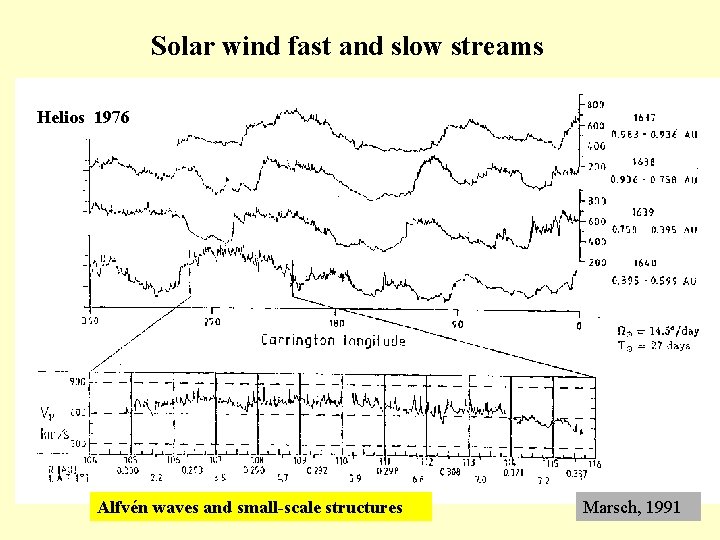
Solar wind fast and slow streams Helios 1976 Alfvén waves and small-scale structures Marsch, 1991
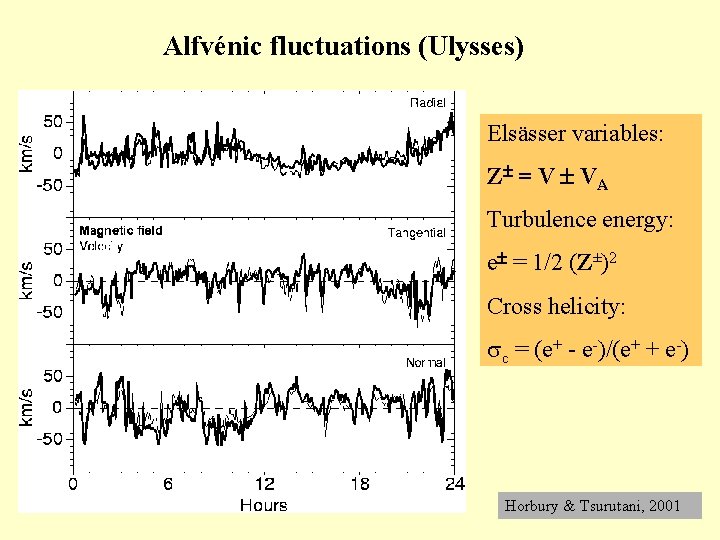
Alfvénic fluctuations (Ulysses) Elsässer variables: Z = V VA Turbulence energy: e = 1/2 (Z±)2 Cross helicity: c = (e+ - e-)/(e+ + e-) Horbury & Tsurutani, 2001
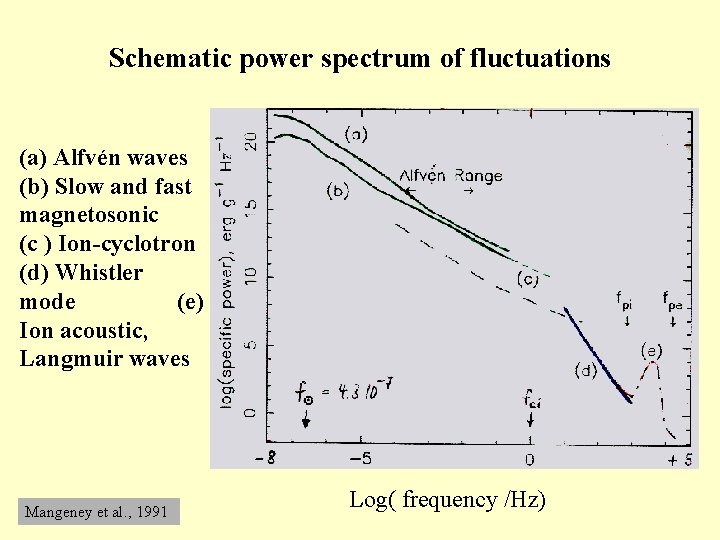
Schematic power spectrum of fluctuations (a) Alfvén waves (b) Slow and fast magnetosonic (c ) Ion-cyclotron (d) Whistler mode (e) Ion acoustic, Langmuir waves Mangeney et al. , 1991 Log( frequency /Hz)
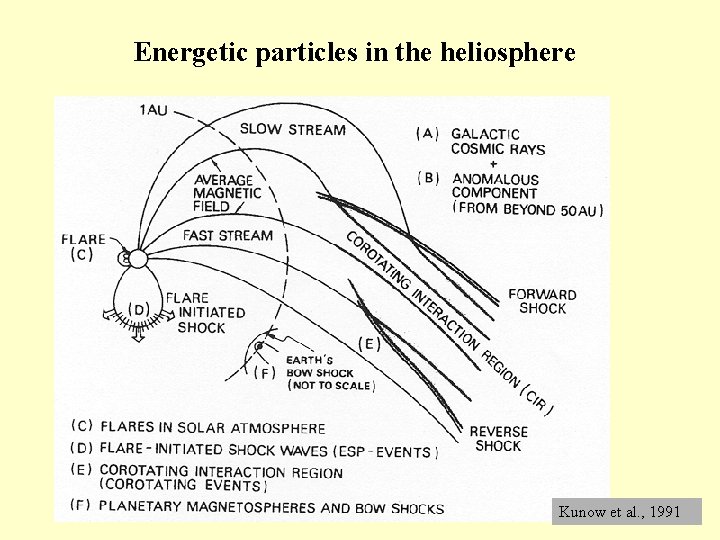
Energetic particles in the heliosphere Kunow et al. , 1991
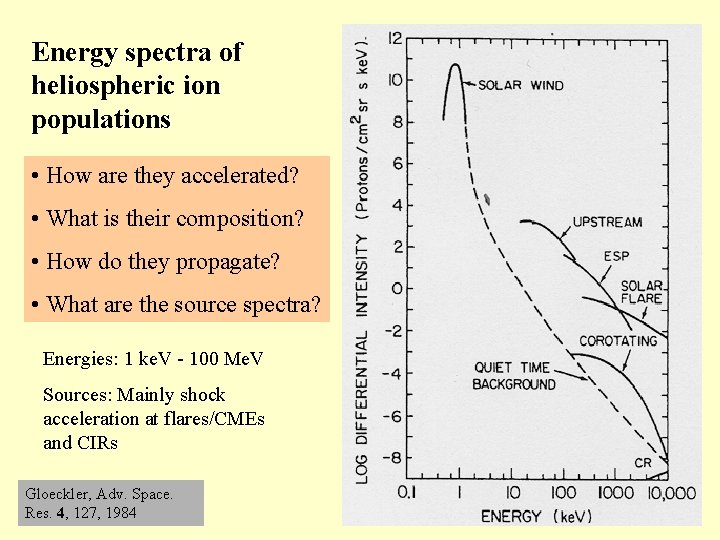
Energy spectra of heliospheric ion populations • How are they accelerated? • What is their composition? • How do they propagate? • What are the source spectra? Energies: 1 ke. V - 100 Me. V Sources: Mainly shock acceleration at flares/CMEs and CIRs Gloeckler, Adv. Space. Res. 4, 127, 1984
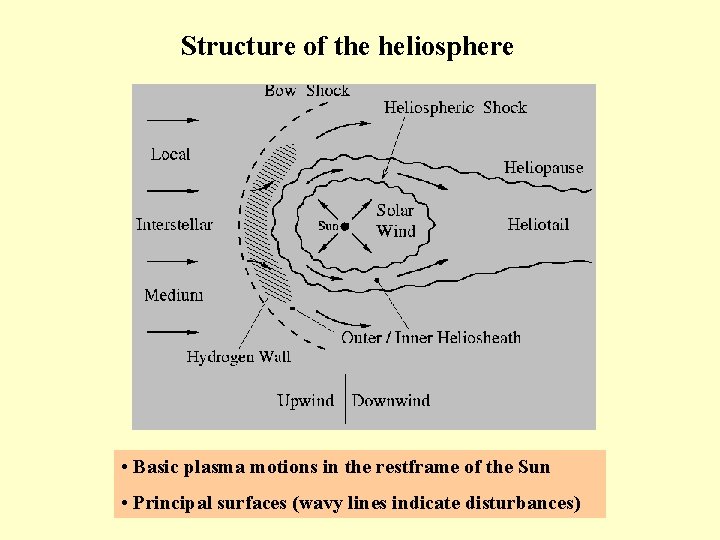
Structure of the heliosphere • Basic plasma motions in the restframe of the Sun • Principal surfaces (wavy lines indicate disturbances)
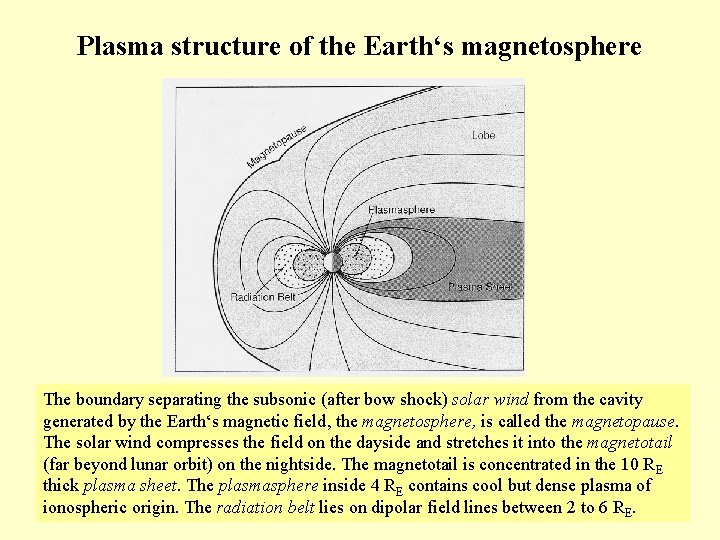
Plasma structure of the Earth‘s magnetosphere The boundary separating the subsonic (after bow shock) solar wind from the cavity generated by the Earth‘s magnetic field, the magnetosphere, is called the magnetopause. The solar wind compresses the field on the dayside and stretches it into the magnetotail (far beyond lunar orbit) on the nightside. The magnetotail is concentrated in the 10 RE thick plasma sheet. The plasmasphere inside 4 RE contains cool but dense plasma of ionospheric origin. The radiation belt lies on dipolar field lines between 2 to 6 RE.
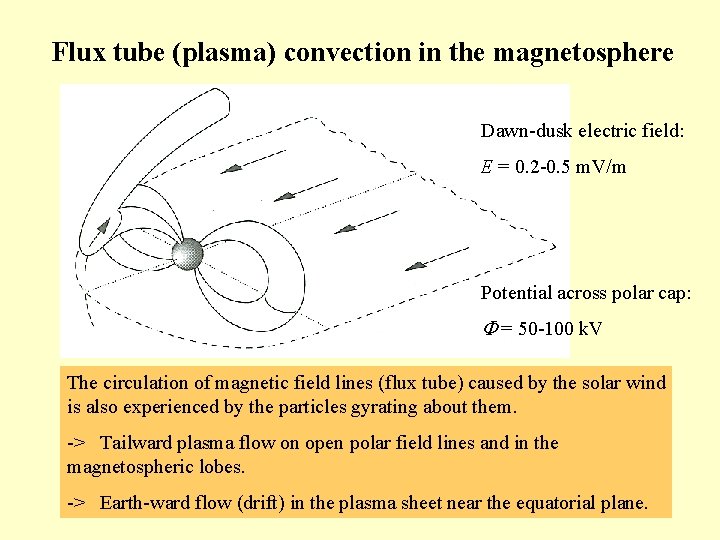
Flux tube (plasma) convection in the magnetosphere Dawn-dusk electric field: E = 0. 2 -0. 5 m. V/m Potential across polar cap: = 50 -100 k. V The circulation of magnetic field lines (flux tube) caused by the solar wind is also experienced by the particles gyrating about them. -> Tailward plasma flow on open polar field lines and in the magnetospheric lobes. -> Earth-ward flow (drift) in the plasma sheet near the equatorial plane.
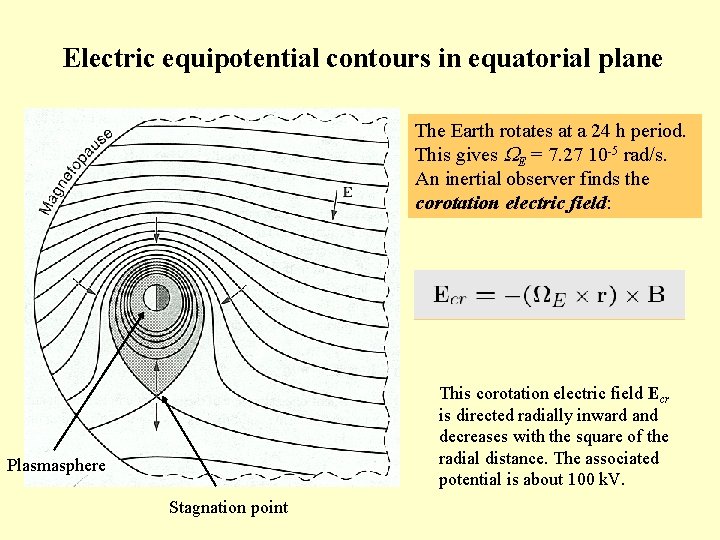
Electric equipotential contours in equatorial plane The Earth rotates at a 24 h period. This gives E = 7. 27 10 -5 rad/s. An inertial observer finds the corotation electric field: This corotation electric field Ecr is directed radially inward and decreases with the square of the radial distance. The associated potential is about 100 k. V. Plasmasphere Stagnation point
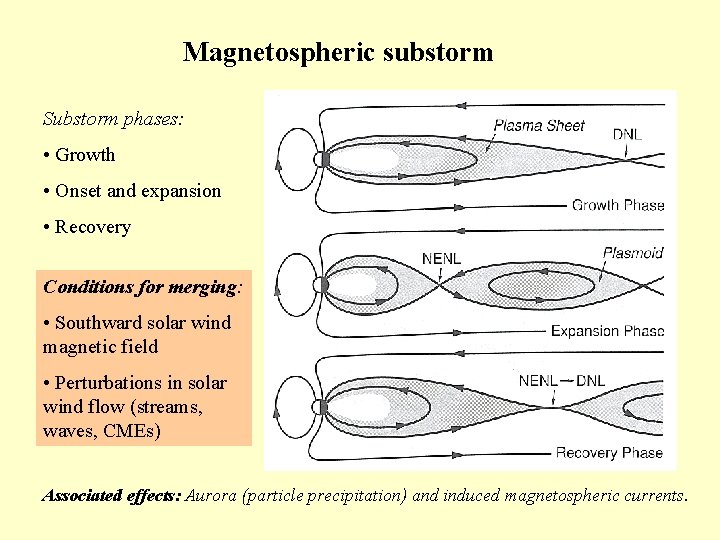
Magnetospheric substorm Substorm phases: • Growth • Onset and expansion • Recovery Conditions for merging: • Southward solar wind magnetic field • Perturbations in solar wind flow (streams, waves, CMEs) Associated effects: Aurora (particle precipitation) and induced magnetospheric currents.
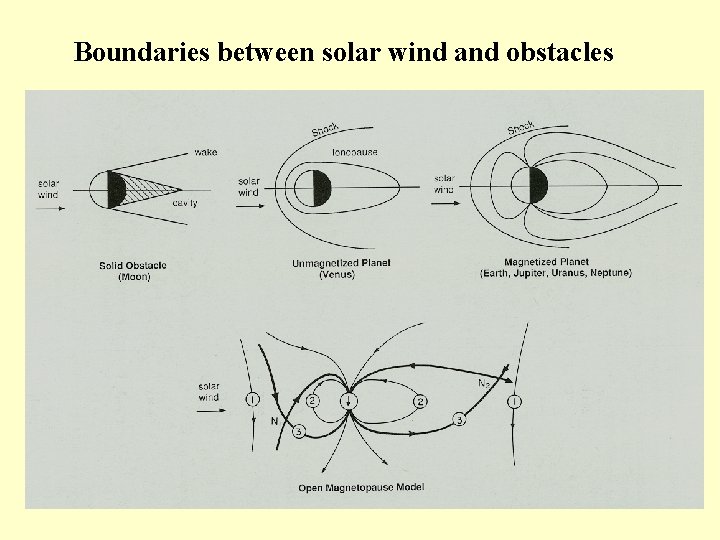
Boundaries between solar wind and obstacles
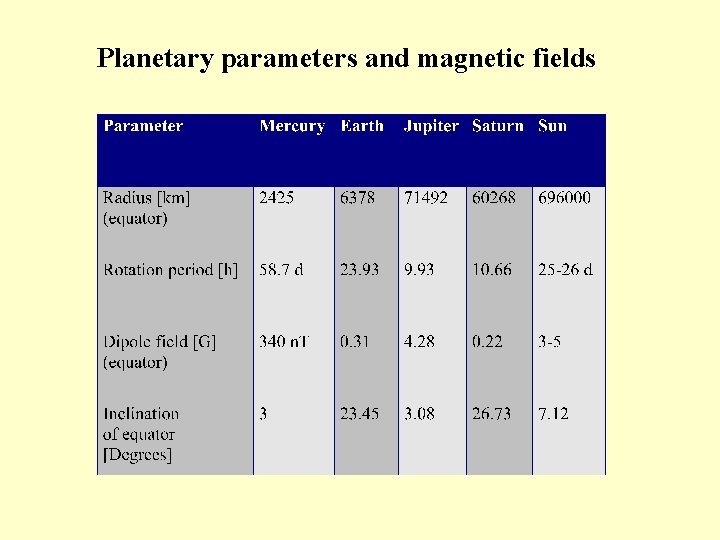
Planetary parameters and magnetic fields
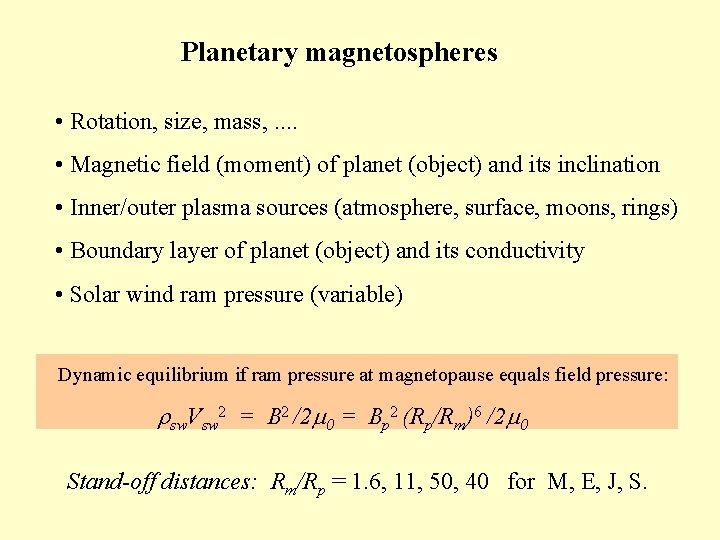
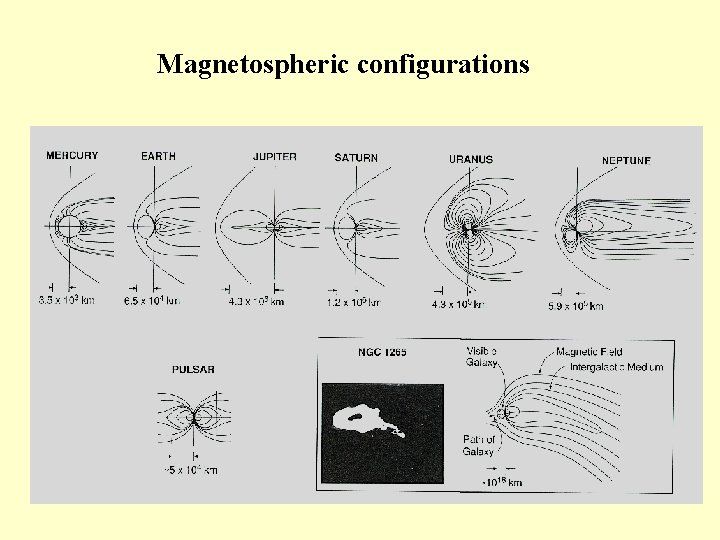
Planetary magnetospheres • Rotation, size, mass, . . • Magnetic field (moment) of planet (object) and its inclination • Inner/outer plasma sources (atmosphere, surface, moons, rings) • Boundary layer of planet (object) and its conductivity • Solar wind ram pressure (variable) Dynamic equilibrium if ram pressure at magnetopause equals field pressure: sw. Vsw 2 = B 2 /2 0 = Bp 2 (Rp/Rm)6 /2 0 Stand-off distances: Rm/Rp = 1. 6, 11, 50, 40 for M, E, J, S.
Magnetospheric configurations
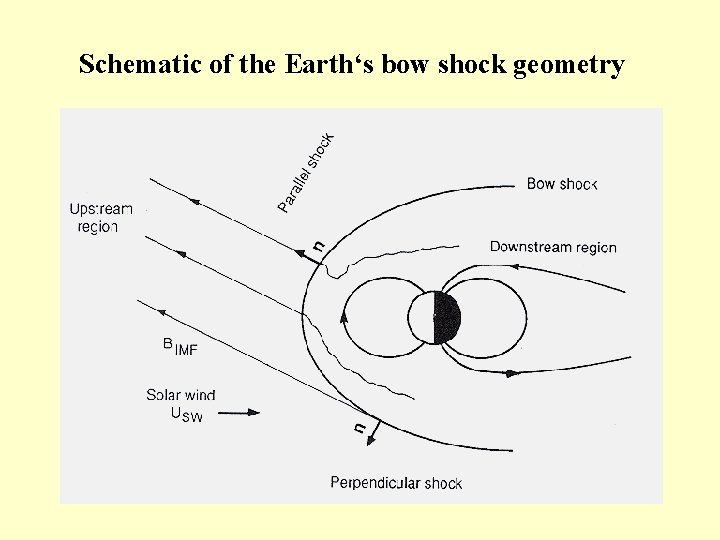
Schematic of the Earth‘s bow shock geometry
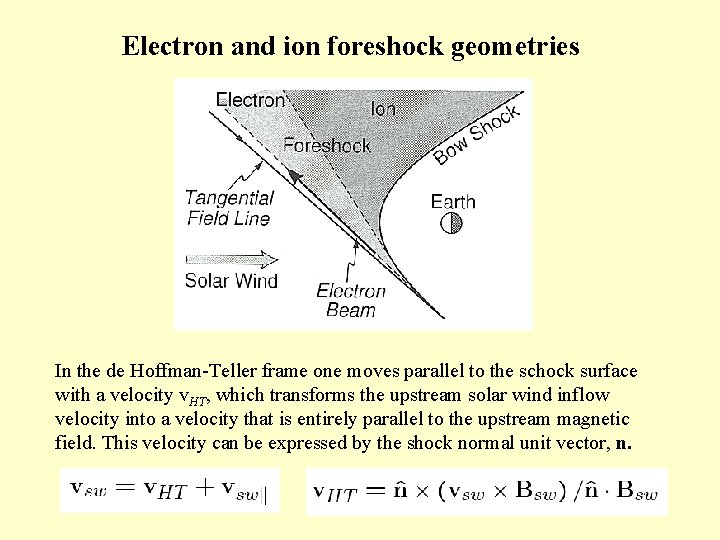
Electron and ion foreshock geometries In the de Hoffman-Teller frame one moves parallel to the schock surface with a velocity v. HT, which transforms the upstream solar wind inflow velocity into a velocity that is entirely parallel to the upstream magnetic field. This velocity can be expressed by the shock normal unit vector, n.
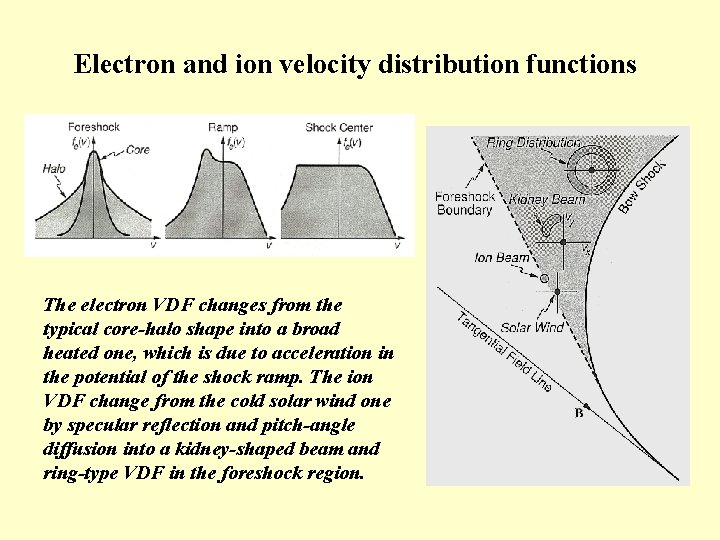
Electron and ion velocity distribution functions The electron VDF changes from the typical core-halo shape into a broad heated one, which is due to acceleration in the potential of the shock ramp. The ion VDF change from the cold solar wind one by specular reflection and pitch-angle diffusion into a kidney-shaped beam and ring-type VDF in the foreshock region.
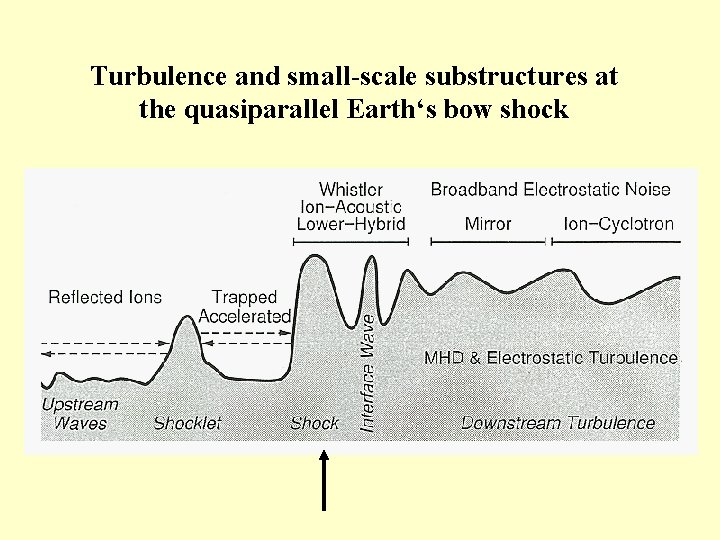
Turbulence and small-scale substructures at the quasiparallel Earth‘s bow shock
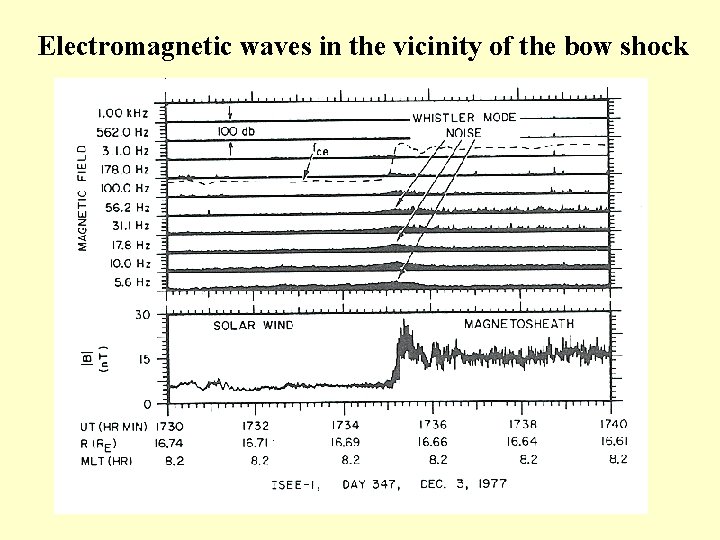
Electromagnetic waves in the vicinity of the bow shock
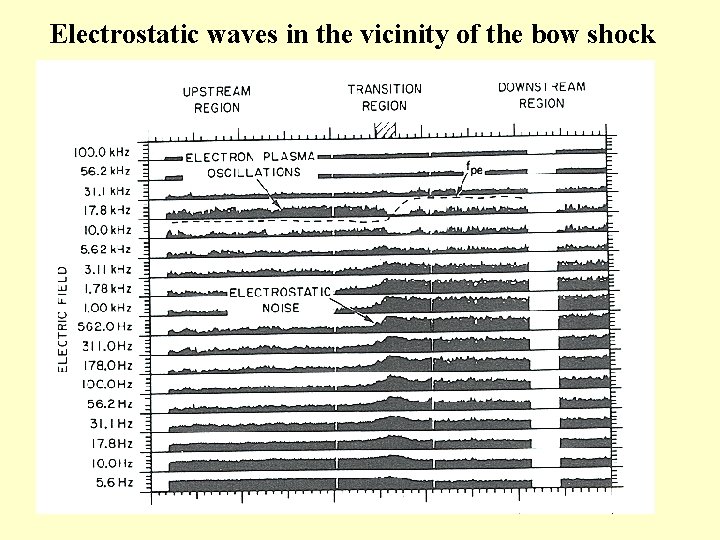
Electrostatic waves in the vicinity of the bow shock
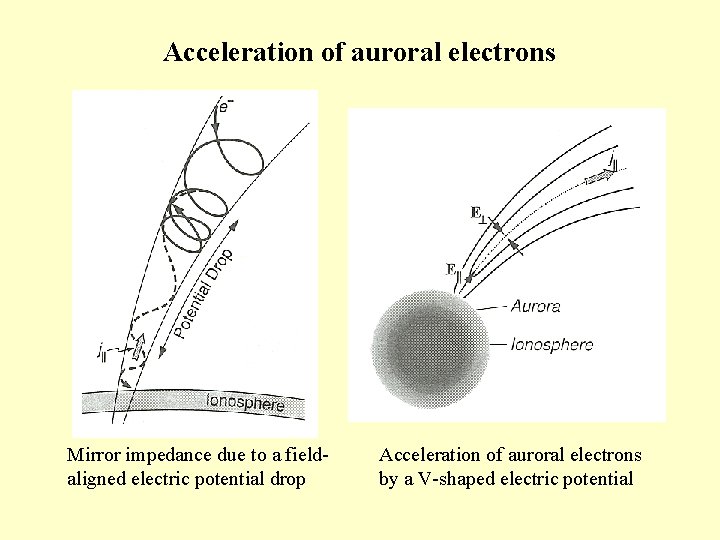
Acceleration of auroral electrons Mirror impedance due to a fieldaligned electric potential drop Acceleration of auroral electrons by a V-shaped electric potential
Key phenomena in space plasmas • Dynamic magnetic fields • Plasma confinement and flows (wind) • Formation of magnetospheres • Magnetohydrodynamic waves • Shocks and turbulence • Multitude of plasma waves • Particle heating and acceleration
Complexity in space plasmas • Highly structured nonuniform magnetic fields • Multi-component plasmas from various sources • Velocity distributions far from thermal equlibrium • Multi-scale spatial and temporal processes • Sharp but dynamic boundaries and interfaces • Waves and turbulences everywhere • Ubiquitous energetic particles