Slide 1 Sociology in Modules chapter six Richard
- Slides: 35
Slide 1 Sociology in Modules chapter six Richard T. Schaefer 1 st Edition The Mass Media © 2011 The Mc. Graw-Hill Companies, Inc. All rights reserved.
Slide 2 The Mass Media 6 • Module 20: Sociological Perspectives on the Media • Module 21: The Audience • Module 22: The Media’s Global Reach © 2011 The Mc. Graw-Hill Companies, Inc. All rights reserved.
Slide 3 A Look Ahead █ █ How does the mass media affect our social institutions and how do they influence our social behavior? Why are the media so influential? Who benefits from media influence and why? How do we maintain cultural and ethical standards in the face of negative media images? © 2011 The Mc. Graw-Hill Companies, Inc. All rights reserved.
Module 20 Slide 4 Sociological Perspectives on the Media █ █ Mass media: Print and electronic means of communication that carry messages to widespread audiences New forms of mass media changed people’s viewing and listening habits – Cultural convergence: flow of content across multiple media and the accompanying migration of media audiences © 2011 The Mc. Graw-Hill Companies, Inc. All rights reserved.
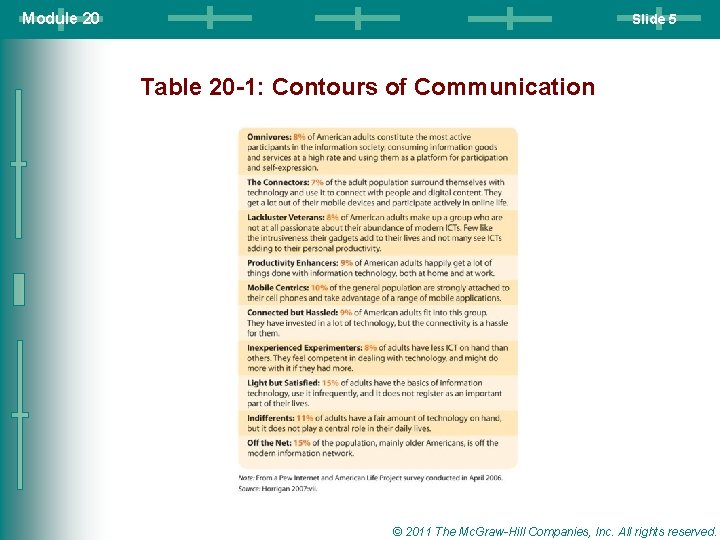
Module 20 Slide 5 Table 20 -1: Contours of Communication © 2011 The Mc. Graw-Hill Companies, Inc. All rights reserved.
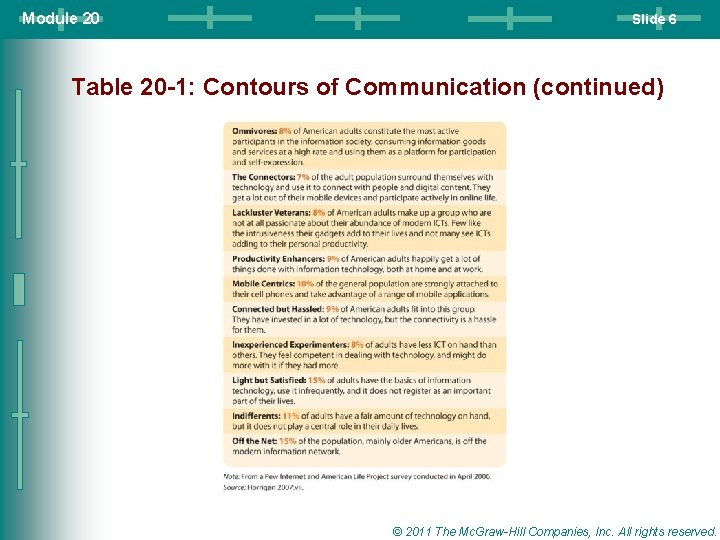
Module 20 Slide 6 Table 20 -1: Contours of Communication (continued) © 2011 The Mc. Graw-Hill Companies, Inc. All rights reserved.
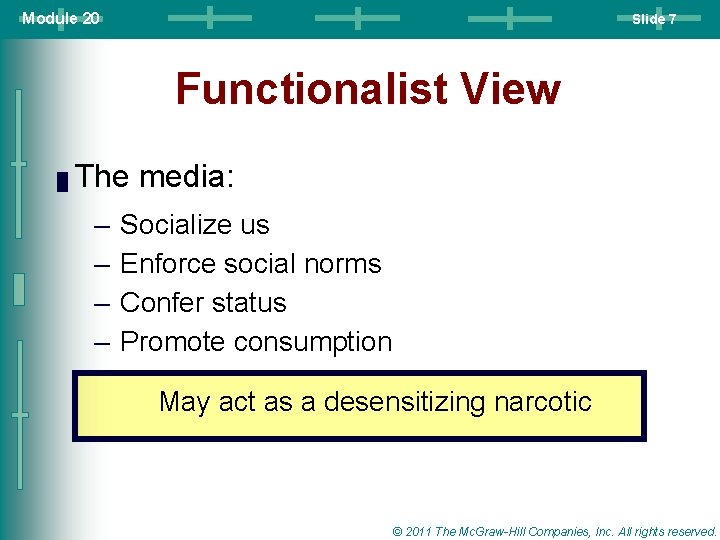
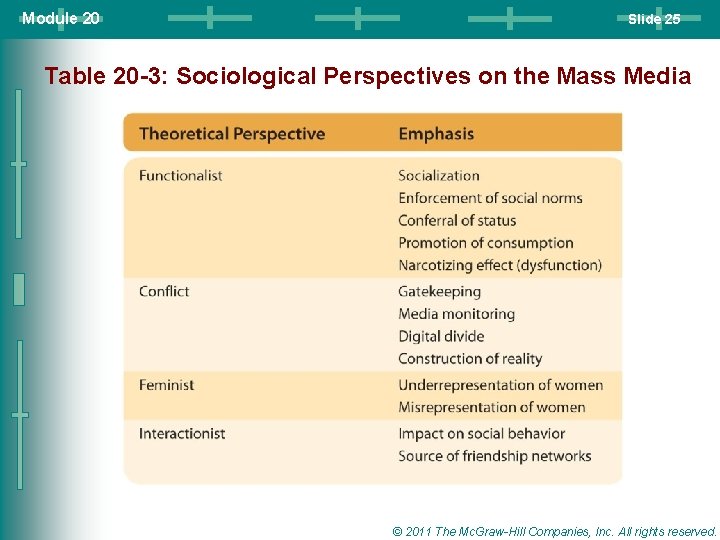
Module 20 Slide 7 Functionalist View █ The media: – – Socialize us Enforce social norms Confer status Promote consumption May act as a desensitizing narcotic © 2011 The Mc. Graw-Hill Companies, Inc. All rights reserved.
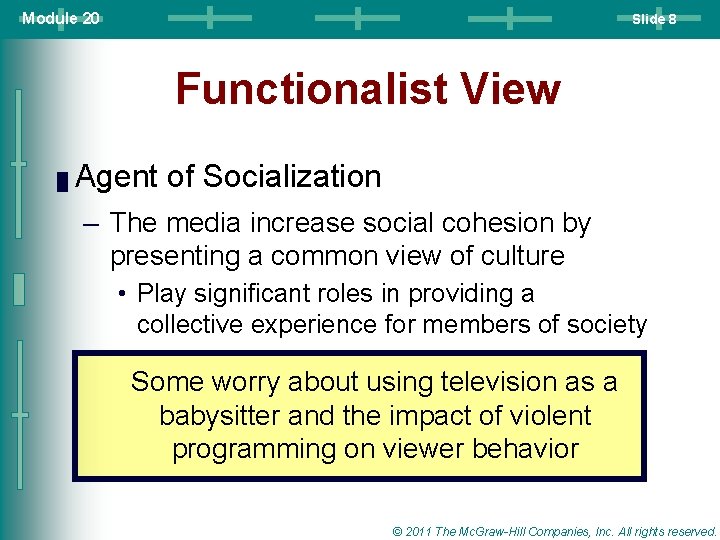
Module 20 Slide 8 Functionalist View █ Agent of Socialization – The media increase social cohesion by presenting a common view of culture • Play significant roles in providing a collective experience for members of society Some worry about using television as a babysitter and the impact of violent programming on viewer behavior © 2011 The Mc. Graw-Hill Companies, Inc. All rights reserved.
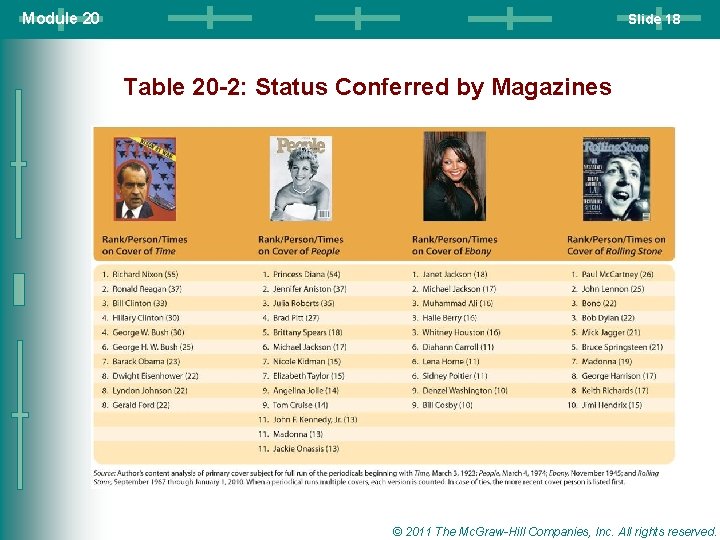
Module 20 Slide 9 Functionalist View █ Enforcer of Social Norms – Media often reaffirm proper behavior – Media play critical role in human sexuality – Also can glorify disapproved behavior █ Conferral of Status – Singles out one from thousands of other people or similarly placed issues, making them significant © 2011 The Mc. Graw-Hill Companies, Inc. All rights reserved.
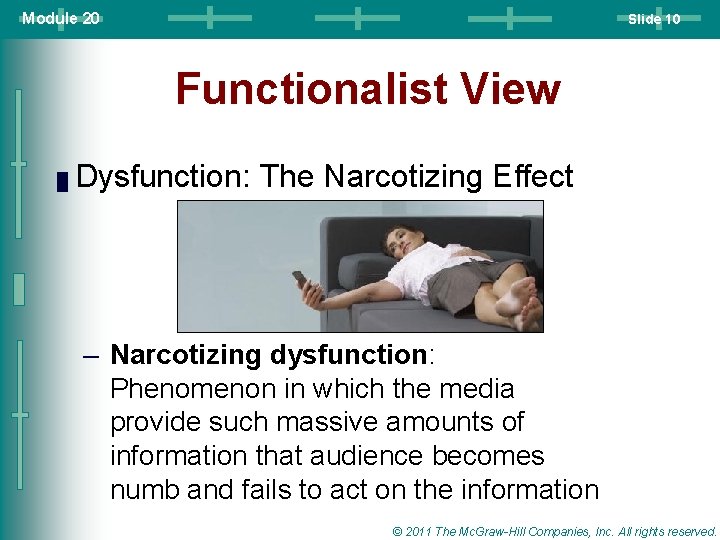
Module 20 Slide 10 Functionalist View █ Dysfunction: The Narcotizing Effect – Narcotizing dysfunction: Phenomenon in which the media provide such massive amounts of information that audience becomes numb and fails to act on the information © 2011 The Mc. Graw-Hill Companies, Inc. All rights reserved.
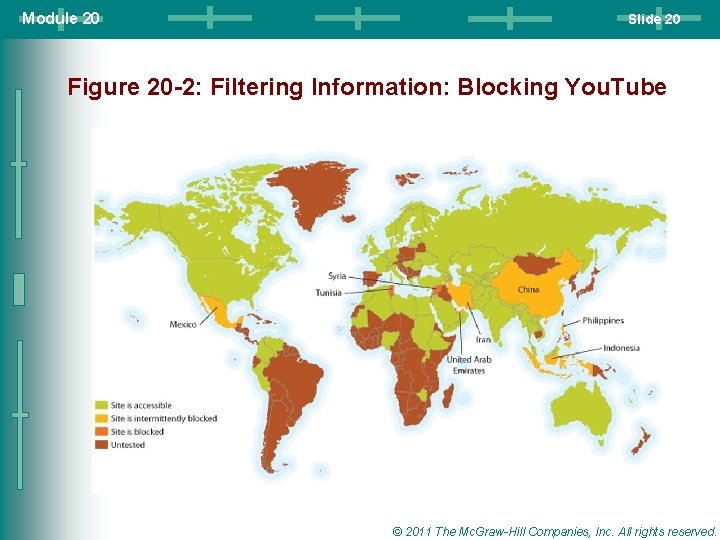
Module 20 Slide 11 Conflict View █ █ Conflict theorists emphasize that media reflect and exacerbate divisions of society and world Gatekeeping: How material must travel through a series of checkpoints before reaching the public Gatekeeping less dominant on Internet, but Chinese release “Green Wall” software © 2011 The Mc. Graw-Hill Companies, Inc. All rights reserved.
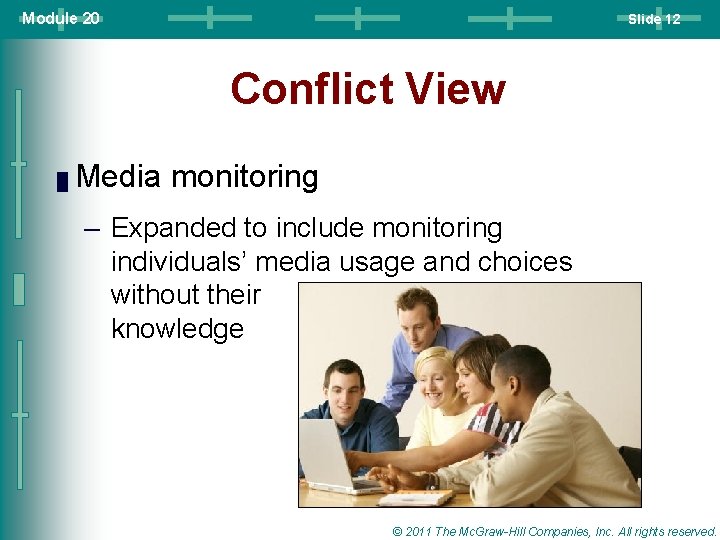
Module 20 Slide 12 Conflict View █ Media monitoring – Expanded to include monitoring individuals’ media usage and choices without their knowledge © 2011 The Mc. Graw-Hill Companies, Inc. All rights reserved.
Module 20 Slide 13 Conflict View █ Digital divide: Low-income groups, racial and ethnic minorities, rural residents, and citizens of developing countries have less access to latest technology Internet and new media becoming essential to economic progress © 2011 The Mc. Graw-Hill Companies, Inc. All rights reserved.
Module 20 Slide 14 Conflict View █ Dominant ideology: Set of cultural beliefs and practices that help maintain powerful social, economic, and political interests – Stereotypes: Unreliable generalization about all members of a group that do not recognize individual differences within the group © 2011 The Mc. Graw-Hill Companies, Inc. All rights reserved.
Module 20 Slide 15 Conflict View █ Dominant Ideology – U. S. media still widely imitated – U. S. media rely on overseas markets for program ideas and distribution – Television moving away from U. S. domination Nations that feel a loss of identity may try to defend against the cultural invasion © 2011 The Mc. Graw-Hill Companies, Inc. All rights reserved.
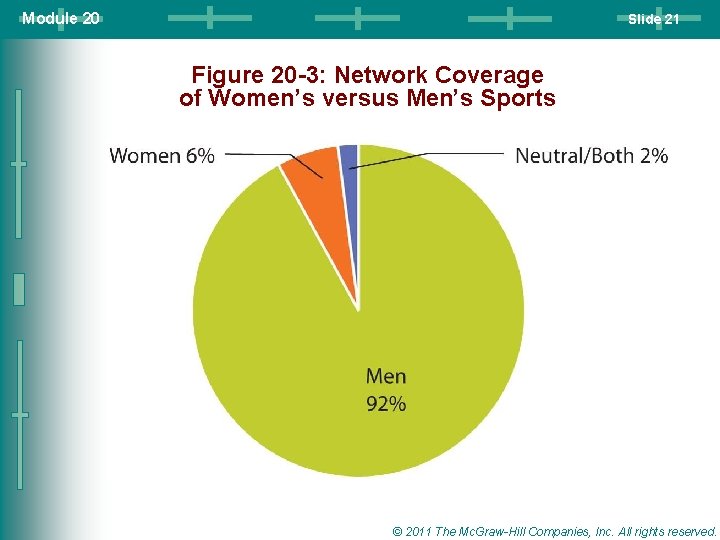
Module 20 Slide 16 Feminist View █ Feminists share conflict theorists’ view that mass media stereotype and misrepresent social reality – Women underrepresented – Perpetuate stereotypical views of gender – Emphasis on traditional sex roles and normalize violence against women – Cautiously optimistic about new media © 2011 The Mc. Graw-Hill Companies, Inc. All rights reserved.
Module 20 Slide 17 Interactionist View █ Interactionists especially interested in shared understandings of everyday behavior – Examine media on microlevel to see how they shape day-to-day social behavior – Perpetuate stereotypical views of gender – Rise of Internet facilitated new forms of communication and social interaction © 2011 The Mc. Graw-Hill Companies, Inc. All rights reserved.
Module 20 Slide 18 Table 20 -2: Status Conferred by Magazines © 2011 The Mc. Graw-Hill Companies, Inc. All rights reserved.
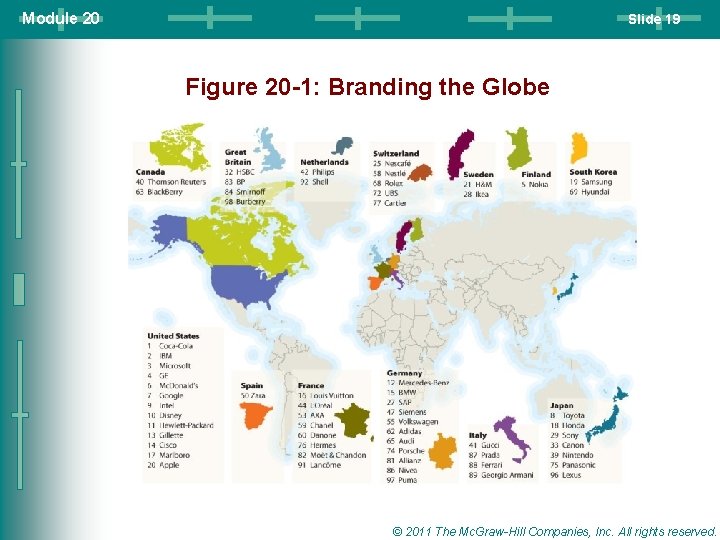
Module 20 Slide 19 Figure 20 -1: Branding the Globe © 2011 The Mc. Graw-Hill Companies, Inc. All rights reserved.
Module 20 Slide 20 Figure 20 -2: Filtering Information: Blocking You. Tube © 2011 The Mc. Graw-Hill Companies, Inc. All rights reserved.
Module 20 Slide 21 Figure 20 -3: Network Coverage of Women’s versus Men’s Sports © 2011 The Mc. Graw-Hill Companies, Inc. All rights reserved.
Module 20 Slide 22 Research Today █ Diversity in Reality Television – Do you watch reality TV? If so, have you noted tension or conflict based on race, social class, or sex? – What does the popularity of reality TV shows tell us about our culture and society? © 2011 The Mc. Graw-Hill Companies, Inc. All rights reserved.
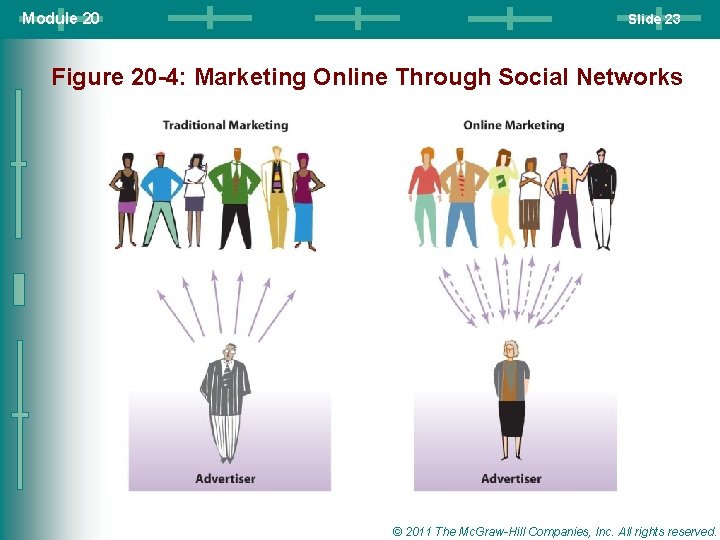
Module 20 Slide 23 Figure 20 -4: Marketing Online Through Social Networks © 2011 The Mc. Graw-Hill Companies, Inc. All rights reserved.
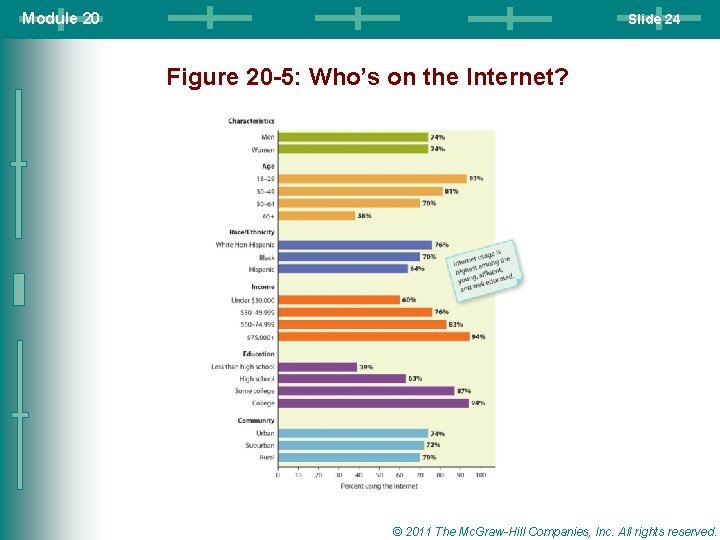
Module 20 Slide 24 Figure 20 -5: Who’s on the Internet? © 2011 The Mc. Graw-Hill Companies, Inc. All rights reserved.
Module 20 Slide 25 Table 20 -3: Sociological Perspectives on the Mass Media © 2011 The Mc. Graw-Hill Companies, Inc. All rights reserved.
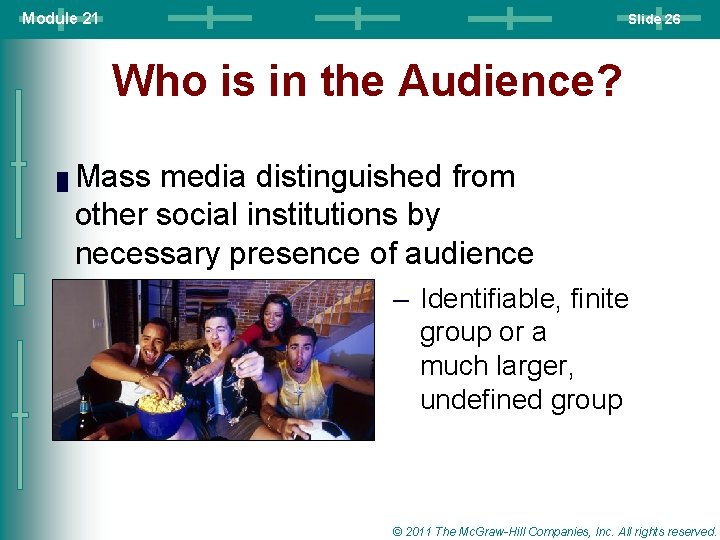
Module 21 Slide 26 Who is in the Audience? █ Mass media distinguished from other social institutions by necessary presence of audience – Identifiable, finite group or a much larger, undefined group © 2011 The Mc. Graw-Hill Companies, Inc. All rights reserved.
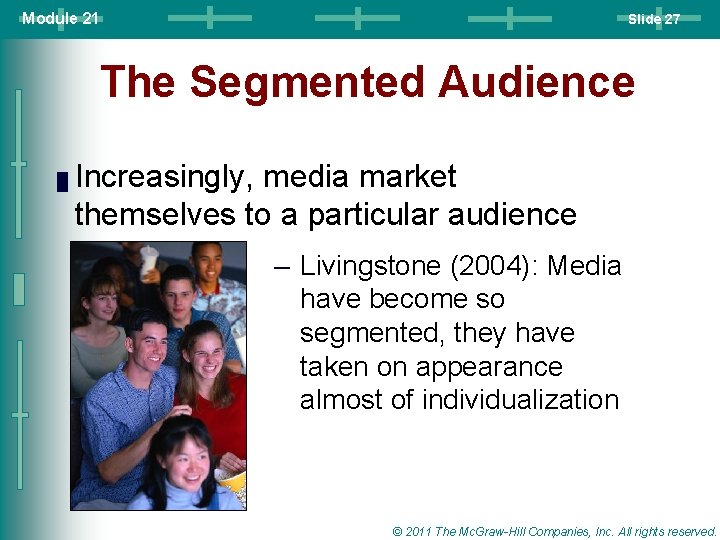
Module 21 Slide 27 The Segmented Audience █ Increasingly, media market themselves to a particular audience – Livingstone (2004): Media have become so segmented, they have taken on appearance almost of individualization © 2011 The Mc. Graw-Hill Companies, Inc. All rights reserved.
Module 21 Slide 28 Audience Behavior █ Opinion leader: Someone who, through day-to-day personal contacts and communication, influences opinions and decisions of others – Members of an audience do not all interpret media in the same way – Hunt (1997): race caused different reactions to media more than gender and class © 2011 The Mc. Graw-Hill Companies, Inc. All rights reserved.
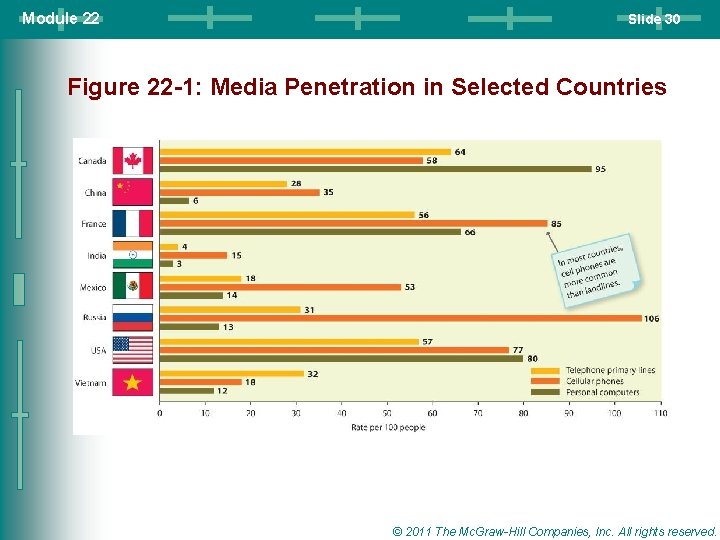
Module 22 Slide 29 The Media’s Global Reach █ █ Mc. Luhan predicted a global village Gitlin considers “global torrent” more apt metaphor – Internet will increasingly reach directly into workplaces, schools, and homes – Reference materials and data banks now accessible across national boundaries © 2011 The Mc. Graw-Hill Companies, Inc. All rights reserved.
Module 22 Slide 30 Figure 22 -1: Media Penetration in Selected Countries © 2011 The Mc. Graw-Hill Companies, Inc. All rights reserved.
Module 22 Slide 31 Sociology in the Global Community █ Al Jazeera is on the Air – Do you find news outlets in the United States biased? How would you judge? – What do you think of the new Al Hurra network in the Middle East? Can it win over the hearts and minds of viewers there? Should the U. S. government be using taxpayers’ dollars to fund the effort? © 2011 The Mc. Graw-Hill Companies, Inc. All rights reserved.
Module 22 Slide 32 Media Concentration – Increasingly, a small number of very large corporations own the media production and distribution process – Causes reduction in information outlets and increase in cross-promotion – Stations on automated programming cannot always serve their listeners © 2011 The Mc. Graw-Hill Companies, Inc. All rights reserved.
Module 22 Slide 33 Media Concentration █ Understanding the Issue – A few multinational corporations dominate publishing, broadcasting, and film industries – Deserve special attention because they filter how we view reality – Internet significant exception • Accessible to millions of producers of media content © 2011 The Mc. Graw-Hill Companies, Inc. All rights reserved.
Module 22 Slide 34 Media Concentration █ Applying Sociology – Functionalists: consolidation a step toward greater economic efficiency – Conflict theorists: concentration stifles opportunities for minority ownership – Interactionists: changes way people obtain news © 2011 The Mc. Graw-Hill Companies, Inc. All rights reserved.
Module 22 Slide 35 Media Concentration █ Initiating Policy – For many, the Telecommunications Act of 1996 is obsolete • Eliminated most restrictions on media ownership • Lack of governmental restraint of media concentration ascribed to unique relationship between politicians and media industry © 2011 The Mc. Graw-Hill Companies, Inc. All rights reserved.