CHAPTER 14 Education Sociology in Modules 4 th

- Slides: 33
CHAPTER 14 Education Sociology in Modules, 4 th edition Richard T. Schaefer ©Mc. Graw-Hill Education. All rights reserved. Authorized only for instructor use in the classroom. No reproduction or further distribution permitted without the prior written consent of Mc. Graw-Hill Education.
Chapter Modules • Module 43 Sociological Perspectives on Education • Module 44 Schools as Formal Institutions ©Mc. Graw-Hill Education.
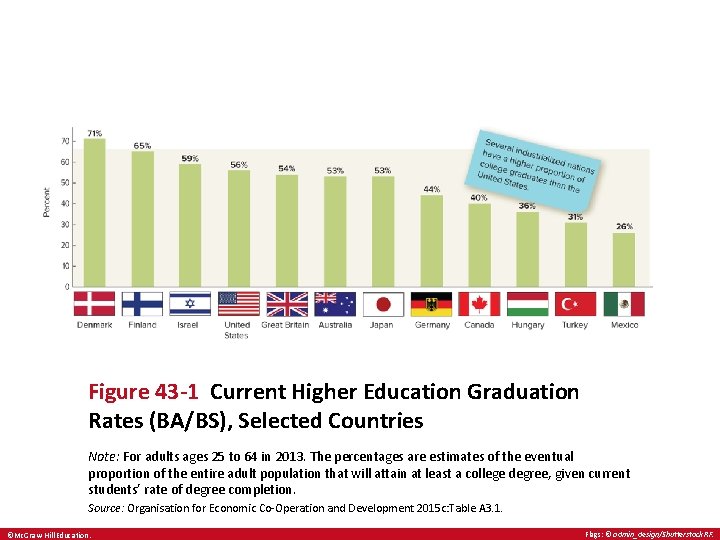
Module 43 Sociological Perspectives on Education • Education: formal process of learning in which some people consciously teach, while others adopt the social role of learner • In past few decades, increasing numbers in the U. S. obtained high school diplomas, college degrees, and advanced professional degrees • Education a vast and complex social institution – Prepares citizens for roles demanded by other social institutions, such as the family, government, and economy ©Mc. Graw-Hill Education.
Figure 43 -1 Current Higher Education Graduation Rates (BA/BS), Selected Countries Note: For adults ages 25 to 64 in 2013. The percentages are estimates of the eventual proportion of the entire adult population that will attain at least a college degree, given current students’ rate of degree completion. Source: Organisation for Economic Co-Operation and Development 2015 c: Table A 3. 1. ©Mc. Graw-Hill Education. Flags: © admin_design/Shutterstock RF.
Functionalist Perspective • Transmitting Culture – Exposing young people to existing beliefs, norms, and values of their culture – All governments use education to shape culture—some more forcefully than others • Promoting Social and Political Integration – Common identity and social integration fostered by education contributes to societal stability and consensus • Promotion of a common language ©Mc. Graw-Hill Education.
Functionalist Perspective (2) • Maintaining Social Control – Schools teach students punctuality, discipline, scheduling, responsible work habits, and how to negotiate complexities of a bureaucratic organization – Schools direct and restrict students’ aspirations • Serving as an Agent of Change – Best indicator of a person’s lifetime earnings is still the number of years of formal schooling received – Formal schooling also associated with openness to new ideas and liberal social and political viewpoints • Stresses critical thinking skills ©Mc. Graw-Hill Education.
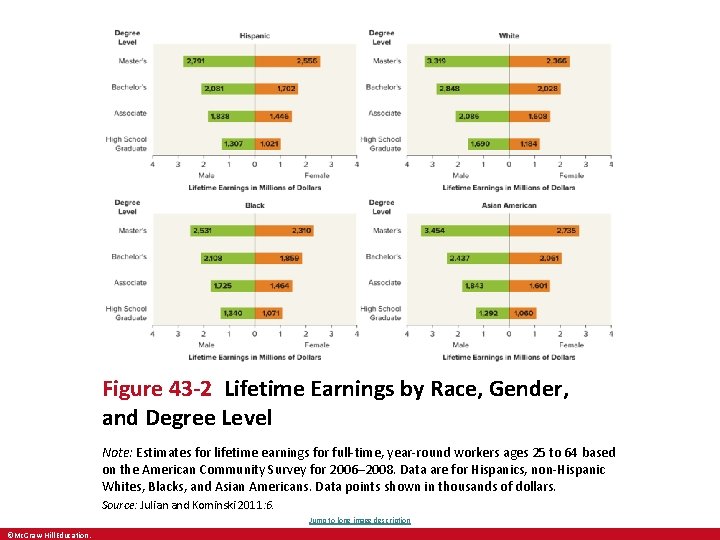
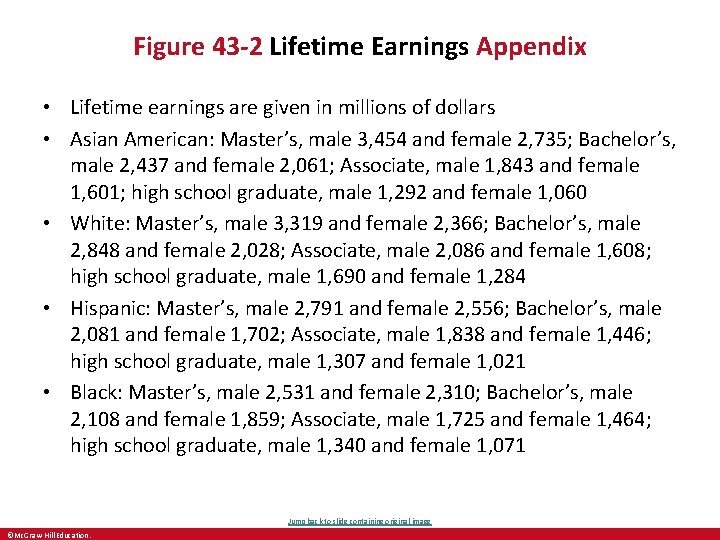
Figure 43 -2 Lifetime Earnings by Race, Gender, and Degree Level Note: Estimates for lifetime earnings for full-time, year-round workers ages 25 to 64 based on the American Community Survey for 2006– 2008. Data are for Hispanics, non-Hispanic Whites, Blacks, and Asian Americans. Data points shown in thousands of dollars. Source: Julian and Kominski 2011: 6. Jump to long image description ©Mc. Graw-Hill Education.
Conflict Perspective • Education is an instrument of elite domination • Educational systems socialize students into values dictated by the powerful; and stifle individualism and creativity to promote relatively insignificant change ©Mc. Graw-Hill Education.
Conflict Perspective (2) • The Hidden Curriculum – Hidden curriculum: standards of behavior deemed proper and taught subtly in schools • Credentialism – Credentialism: increase in the lowest level of education needed to enter a field – Number of occupations viewed as professions has risen – May reinforce social inequality ©Mc. Graw-Hill Education.
Conflict Perspective (3) • Bestowal of Status – Education can distribute members among a variety of social positions by sorting people into appropriate levels and courses of study – Tracking: practice of placing students in specific curriculum groups on the basis of test scores and other criteria – Correspondence principle: promotes values expected of individuals in each social class, perpetuating social class divisions ©Mc. Graw-Hill Education.
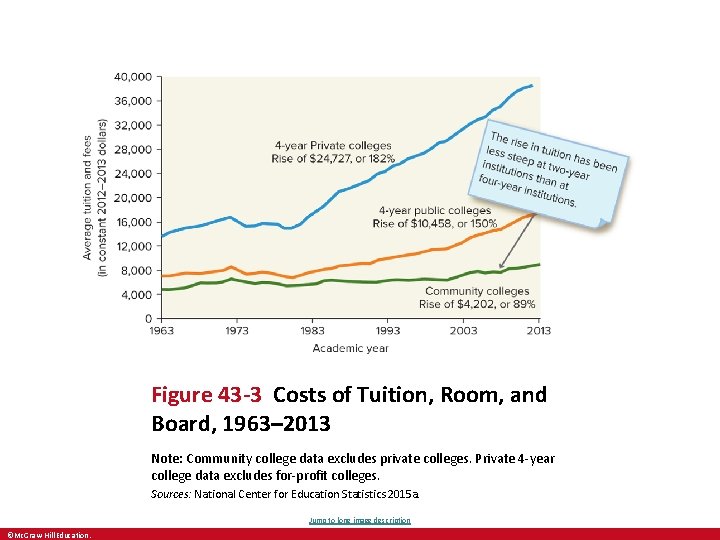
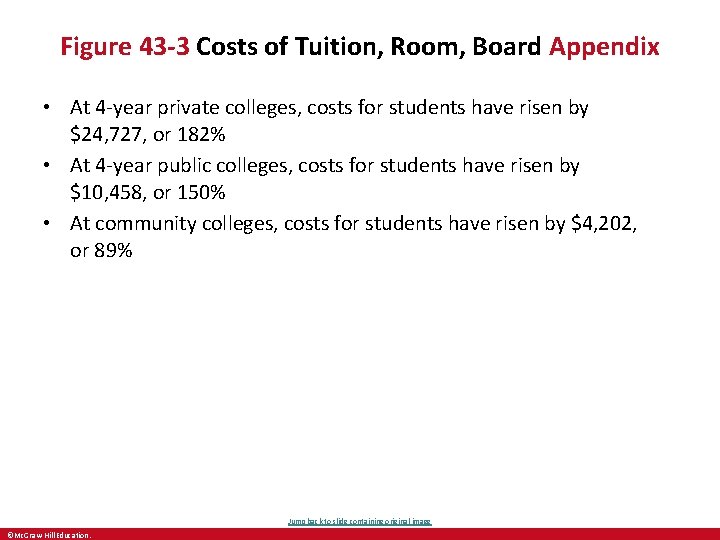
Figure 43 -3 Costs of Tuition, Room, and Board, 1963– 2013 Note: Community college data excludes private colleges. Private 4 -year college data excludes for-profit colleges. Sources: National Center for Education Statistics 2015 a. Jump to long image description ©Mc. Graw-Hill Education.
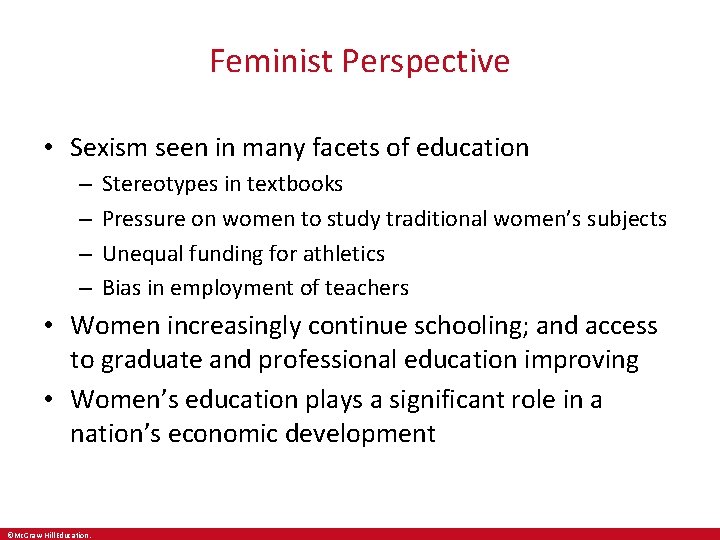
Feminist Perspective • Sexism seen in many facets of education – – Stereotypes in textbooks Pressure on women to study traditional women’s subjects Unequal funding for athletics Bias in employment of teachers • Women increasingly continue schooling; and access to graduate and professional education improving • Women’s education plays a significant role in a nation’s economic development ©Mc. Graw-Hill Education.
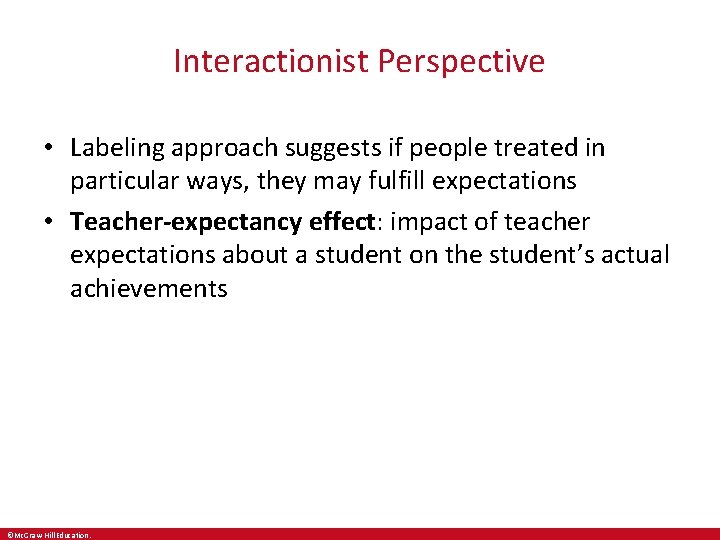
Interactionist Perspective • Labeling approach suggests if people treated in particular ways, they may fulfill expectations • Teacher-expectancy effect: impact of teacher expectations about a student on the student’s actual achievements ©Mc. Graw-Hill Education.
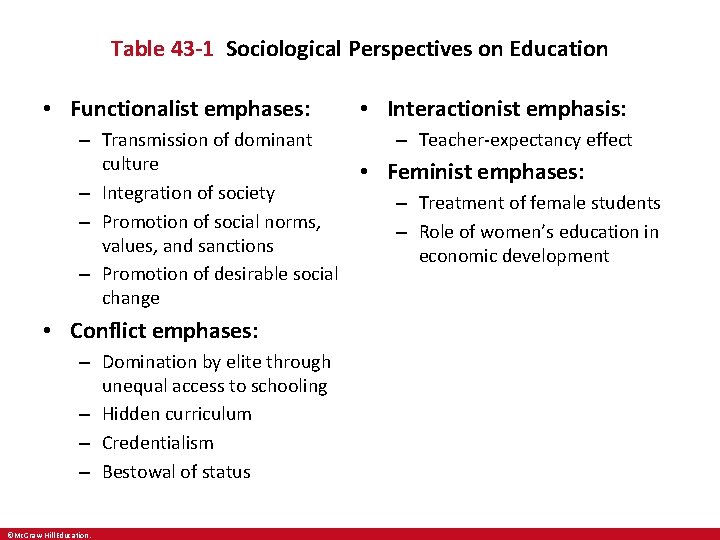
Table 43 -1 Sociological Perspectives on Education • Functionalist emphases: • Interactionist emphasis: – Teacher-expectancy effect – Transmission of dominant culture • Feminist emphases: – Integration of society – Treatment of female students – Promotion of social norms, – Role of women’s education in values, and sanctions economic development – Promotion of desirable social change • Conflict emphases: – Domination by elite through unequal access to schooling – Hidden curriculum – Credentialism – Bestowal of status ©Mc. Graw-Hill Education.
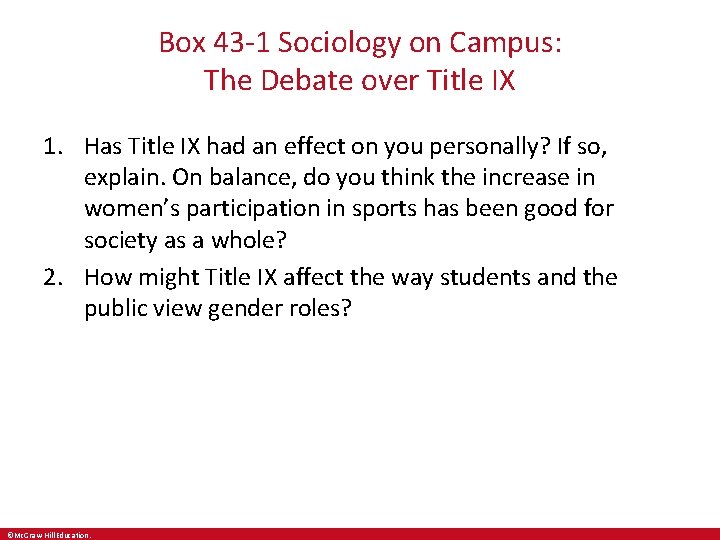
Box 43 -1 Sociology on Campus: The Debate over Title IX 1. Has Title IX had an effect on you personally? If so, explain. On balance, do you think the increase in women’s participation in sports has been good for society as a whole? 2. How might Title IX affect the way students and the public view gender roles? ©Mc. Graw-Hill Education.
Module 44 Schools as Formal Organizations • U. S. has about 15 million high school students today • Schools are similar to factories, hospitals, and business firms – Do not operate autonomously; influenced by the market of potential students ©Mc. Graw-Hill Education.
Bureaucratization of Schools • Weber’s characteristics of bureaucracy: – – – ©Mc. Graw-Hill Education. Division of labor Hierarchy of authority Written rules and regulations Impersonality Employment based on technical qualifications
Bureaucratization of Schools (2) • Functionalists: positive view of teacher specialization, clear chain of command, uniformly applied rules, and protection of teachers’ jobs – Bureaucratization increases the likelihood that students, teachers, and administrators will be treated fairly • Conflict theorists: harmful consequences for disadvantaged people – Curricula reflecting values, interests, and lifestyles only of the most powerful groups – Little influence of low-income and minority parents ©Mc. Graw-Hill Education.
Bureaucratization of Schools (3) • Significant countertrend in United States: increasing availability of education over the Internet – Flexibility for those at a distance or with a disability – May have an impact on instructors’ status as employees and on alternative forms of education ©Mc. Graw-Hill Education.
Teachers: Employees and Instructors • Teachers undergo many perplexing stresses – Between a quarter and a third of new teachers quit within the first three years • Fewer students choose teaching as a career due to the perceived low income – In 2015, 2. 4% of male and 5. 1% of female first-year college students interested in elementary or high school teaching ©Mc. Graw-Hill Education.
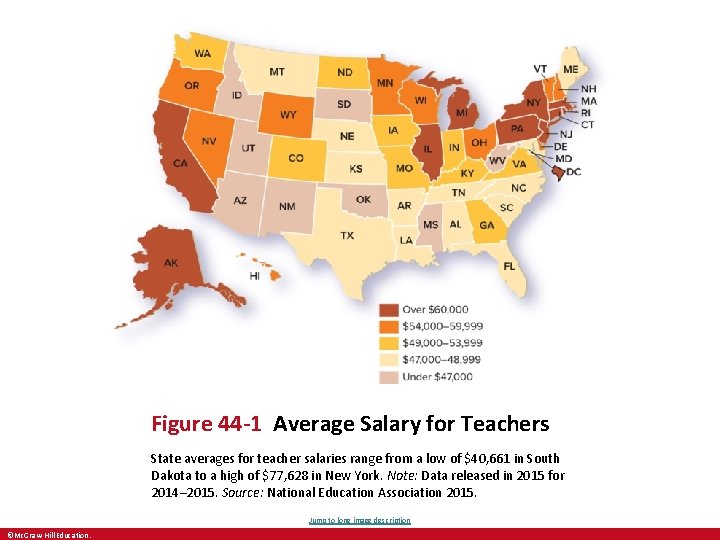
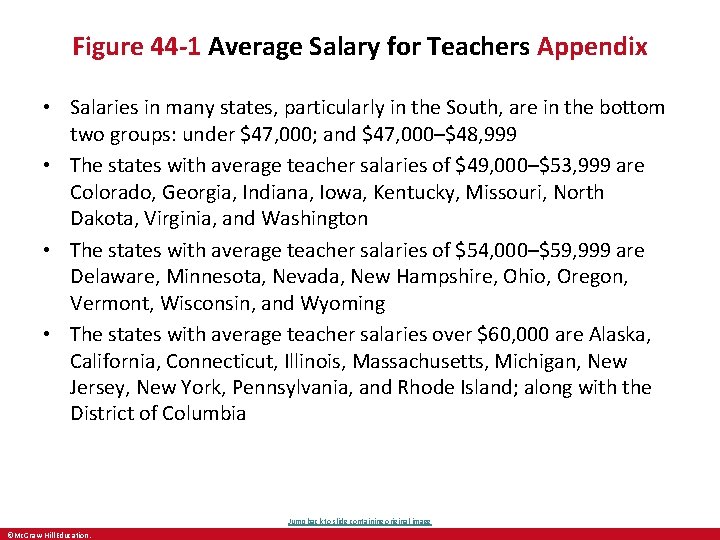
Figure 44 -1 Average Salary for Teachers State averages for teacher salaries range from a low of $40, 661 in South Dakota to a high of $77, 628 in New York. Note: Data released in 2015 for 2014– 2015. Source: National Education Association 2015. Jump to long image description ©Mc. Graw-Hill Education.
Student Subcultures • Student subcultures complex and diverse • High school cliques and social groups form according to multiple factors – Intense peer group pressure to conform – Gay and lesbian students particularly vulnerable ©Mc. Graw-Hill Education.
Student Subcultures (2) • Four distinctive subcultures among college students: – – Collegiate Academic Vocational Nonconformist • Students exposed to competing subcultures and must determine which seem most in line with their own feelings and interests ©Mc. Graw-Hill Education.
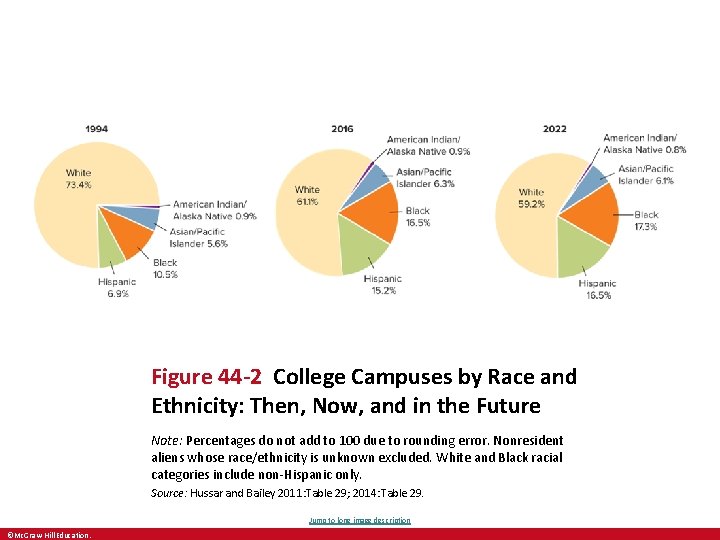
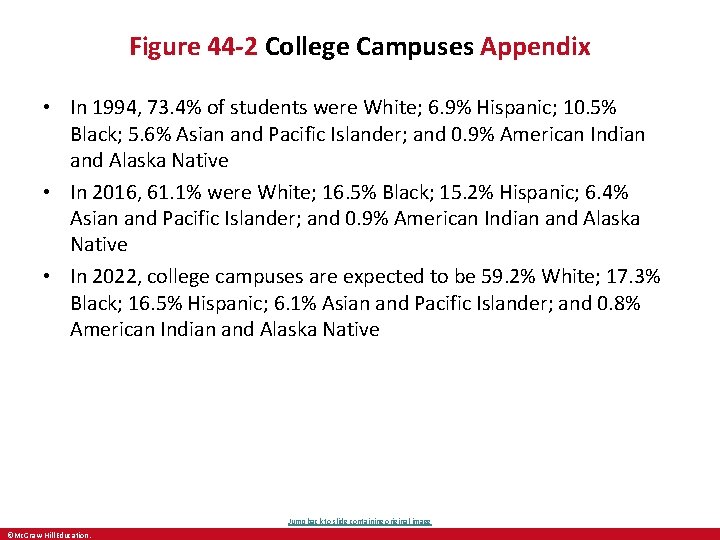
Figure 44 -2 College Campuses by Race and Ethnicity: Then, Now, and in the Future Note: Percentages do not add to 100 due to rounding error. Nonresident aliens whose race/ethnicity is unknown excluded. White and Black racial categories include non-Hispanic only. Source: Hussar and Bailey 2011: Table 29; 2014: Table 29. Jump to long image description ©Mc. Graw-Hill Education.
Homeschooling • About 1. 7 million students schooled at home – Critics argue homeschooled children isolated from larger community – Proponents claim homeschooling a good alternative for children with ADHD and learning disorders • Quality control an issue • Homeschooling parents tend to have higher-thanaverage incomes and educational levels ©Mc. Graw-Hill Education.
Taking Sociology to Work: Diane Belcher Gray, Assistant Director of Volunteer Services, New River Community College 1. Have you, like Diane Belcher Gray, realized through education that something you were doing without thinking about it has helped to prepare you for employment? Explain. 2. Do some research on Dublin, Virginia, and the surrounding area. What kind of economy does this community have? Relate the layoffs the community has been experiencing to larger societal forces. ©Mc. Graw-Hill Education.
Box 44 -1 Research Today: Violence in the Schools 1. Has a shooting or other violent episode ever occurred at your school? If so, how did students react? Do you feel safer at school than at home, as experts say you are? 2. What steps have administrators at your school taken to prevent violence? Have they been effective, or should other steps be taken? ©Mc. Graw-Hill Education.
Review • Education is a cultural universal found throughout the world in various forms • In this chapter: – Sociological views of education – Analysis of schools as an example of formal organizations ©Mc. Graw-Hill Education. All rights reserved. Authorized only for instructor use in the classroom. No reproduction or further distribution permitted without the prior written consent of Mc. Graw-Hill Education.
Long image descriptions APPENDIX A ©Mc. Graw-Hill Education
Figure 43 -2 Lifetime Earnings Appendix • Lifetime earnings are given in millions of dollars • Asian American: Master’s, male 3, 454 and female 2, 735; Bachelor’s, male 2, 437 and female 2, 061; Associate, male 1, 843 and female 1, 601; high school graduate, male 1, 292 and female 1, 060 • White: Master’s, male 3, 319 and female 2, 366; Bachelor’s, male 2, 848 and female 2, 028; Associate, male 2, 086 and female 1, 608; high school graduate, male 1, 690 and female 1, 284 • Hispanic: Master’s, male 2, 791 and female 2, 556; Bachelor’s, male 2, 081 and female 1, 702; Associate, male 1, 838 and female 1, 446; high school graduate, male 1, 307 and female 1, 021 • Black: Master’s, male 2, 531 and female 2, 310; Bachelor’s, male 2, 108 and female 1, 859; Associate, male 1, 725 and female 1, 464; high school graduate, male 1, 340 and female 1, 071 Jump back to slide containing original image ©Mc. Graw-Hill Education.
Figure 43 -3 Costs of Tuition, Room, Board Appendix • At 4 -year private colleges, costs for students have risen by $24, 727, or 182% • At 4 -year public colleges, costs for students have risen by $10, 458, or 150% • At community colleges, costs for students have risen by $4, 202, or 89% Jump back to slide containing original image ©Mc. Graw-Hill Education.
Figure 44 -1 Average Salary for Teachers Appendix • Salaries in many states, particularly in the South, are in the bottom two groups: under $47, 000; and $47, 000–$48, 999 • The states with average teacher salaries of $49, 000–$53, 999 are Colorado, Georgia, Indiana, Iowa, Kentucky, Missouri, North Dakota, Virginia, and Washington • The states with average teacher salaries of $54, 000–$59, 999 are Delaware, Minnesota, Nevada, New Hampshire, Ohio, Oregon, Vermont, Wisconsin, and Wyoming • The states with average teacher salaries over $60, 000 are Alaska, California, Connecticut, Illinois, Massachusetts, Michigan, New Jersey, New York, Pennsylvania, and Rhode Island; along with the District of Columbia Jump back to slide containing original image ©Mc. Graw-Hill Education.
Figure 44 -2 College Campuses Appendix • In 1994, 73. 4% of students were White; 6. 9% Hispanic; 10. 5% Black; 5. 6% Asian and Pacific Islander; and 0. 9% American Indian and Alaska Native • In 2016, 61. 1% were White; 16. 5% Black; 15. 2% Hispanic; 6. 4% Asian and Pacific Islander; and 0. 9% American Indian and Alaska Native • In 2022, college campuses are expected to be 59. 2% White; 17. 3% Black; 16. 5% Hispanic; 6. 1% Asian and Pacific Islander; and 0. 8% American Indian and Alaska Native Jump back to slide containing original image ©Mc. Graw-Hill Education.