Six Track for GPU R De Maria Six
- Slides: 6
Six. Track for GPU R. De Maria
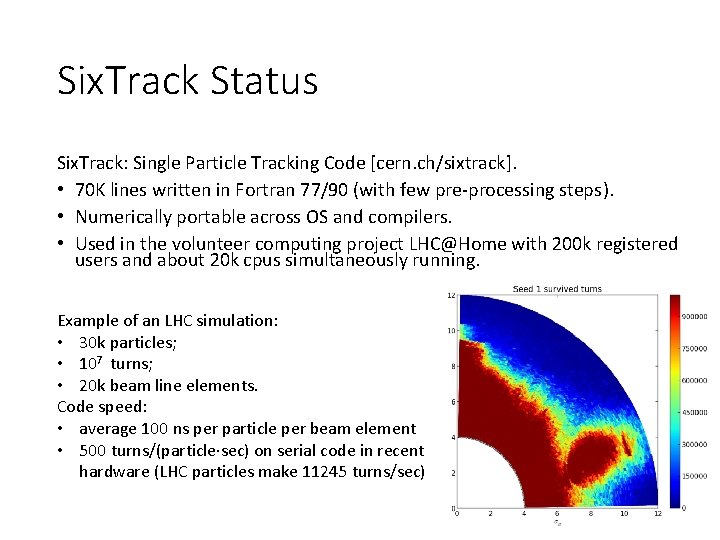
Six. Track Status Six. Track: Single Particle Tracking Code [cern. ch/sixtrack]. • 70 K lines written in Fortran 77/90 (with few pre-processing steps). • Numerically portable across OS and compilers. • Used in the volunteer computing project LHC@Home with 200 k registered users and about 20 k cpus simultaneously running. Example of an LHC simulation: • 30 k particles; • 107 turns; • 20 k beam line elements. Code speed: • average 100 ns per particle per beam element • 500 turns/(particle∙sec) on serial code in recent hardware (LHC particles make 11245 turns/sec)
Six. Track GPU Status GPU porting is being explored in the context of • LHC@Home to use volunteer GPU: • heterogeneous hardware and software hard to test and fully deploy, many low-end GPU expected (low FP 64 FLOPS count). • D. Mikushin (Applied Parallel Computing LLC) [indico/event/450856] demonstrated deploying with CUDA + additional compilation stages + code annotations + special compiler software (numerically ok without FMAC instructions, no benchmark available). • Standalone tracking library (Six. Track. Lib) to be used with other codes (including Six. Track itself): • lightweight code being written in C/Open. CL for flexibility/portability (CERN&GSo. C’ 14 -’ 15). • speed-up of 250 x w. r. t single i 7 core with AMD-280 X (~1 TFLOPS FP 64, ~300 CHF) on first tests driven by pyopencl. • ongoing development: Open. CL not completed yet, pure python version benchmarked on components done for the LHC. Hardware for single particle simulations: • High FP 64 FLOPS counts. • Memory bandwidth and memory size less important.
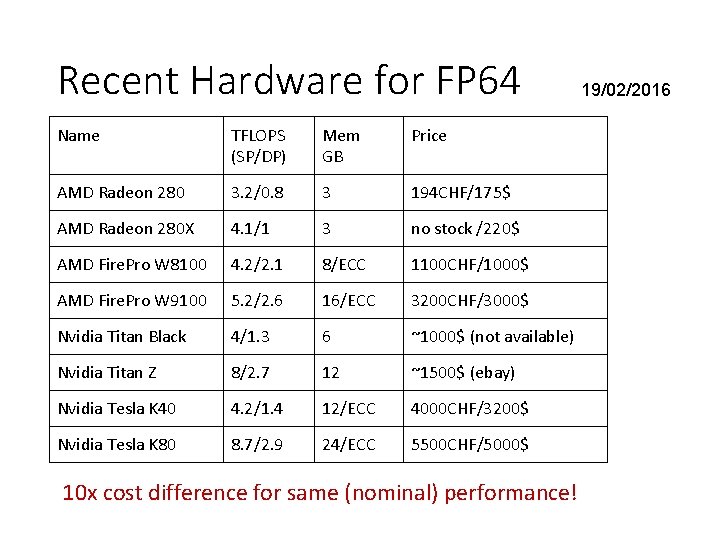
Recent Hardware for FP 64 Name TFLOPS (SP/DP) Mem GB Price AMD Radeon 280 3. 2/0. 8 3 194 CHF/175$ AMD Radeon 280 X 4. 1/1 3 no stock /220$ AMD Fire. Pro W 8100 4. 2/2. 1 8/ECC 1100 CHF/1000$ AMD Fire. Pro W 9100 5. 2/2. 6 16/ECC 3200 CHF/3000$ Nvidia Titan Black 4/1. 3 6 ~1000$ (not available) Nvidia Titan Z 8/2. 7 12 ~1500$ (ebay) Nvidia Tesla K 40 4. 2/1. 4 12/ECC 4000 CHF/3200$ Nvidia Tesla K 80 8. 7/2. 9 24/ECC 5500 CHF/5000$ 10 x cost difference for same (nominal) performance! 19/02/2016
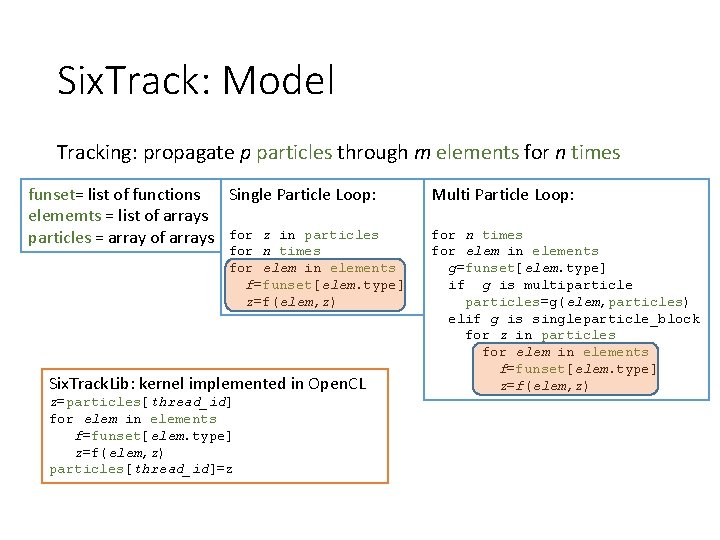
Six. Track: Model Tracking: propagate p particles through m elements for n times funset= list of functions Single Particle Loop: elememts = list of arrays particles = array of arrays for z in particles for n times for elem in elements f=funset[elem. type] z=f(elem, z) Six. Track. Lib: kernel implemented in Open. CL z=particles[thread_id] for elem in elements f=funset[elem. type] z=f(elem, z) particles[thread_id]=z Multi Particle Loop: for n times for elem in elements g=funset[elem. type] if g is multiparticles=g(elem, particles) elif g is singleparticle_block for z in particles for elem in elements f=funset[elem. type] z=f(elem, z)
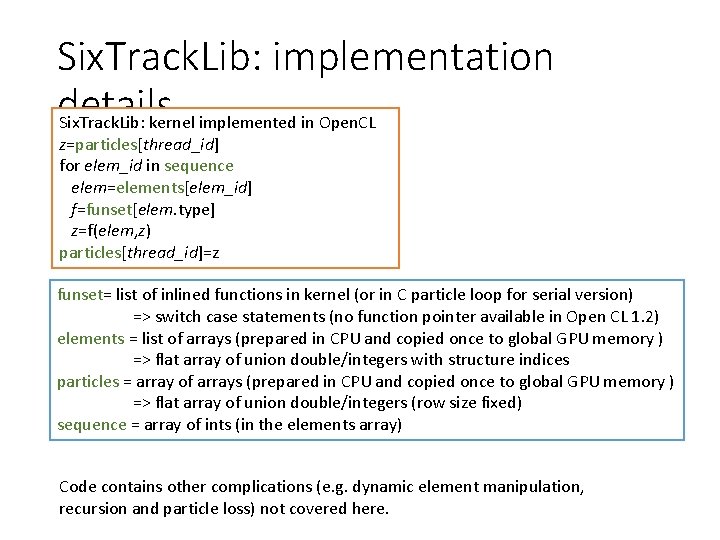
Six. Track. Lib: implementation details Six. Track. Lib: kernel implemented in Open. CL z=particles[thread_id] for elem_id in sequence elem=elements[elem_id] f=funset[elem. type] z=f(elem, z) particles[thread_id]=z funset= list of inlined functions in kernel (or in C particle loop for serial version) => switch case statements (no function pointer available in Open CL 1. 2) elements = list of arrays (prepared in CPU and copied once to global GPU memory ) => flat array of union double/integers with structure indices particles = array of arrays (prepared in CPU and copied once to global GPU memory ) => flat array of union double/integers (row size fixed) sequence = array of ints (in the elements array) Code contains other complications (e. g. dynamic element manipulation, recursion and particle loss) not covered here.