Session 14 Capacity Management http www pom edumpclecturesinmanufacturingplanning
- Slides: 17
Session 14 Capacity Management http: //www. pom. edu/mpc/lectures_in_manufacturing_planning. htm lecture session 15 • • • Capacity Planning Issues Finite Capacity Planning Example Twin Disc Capacity Bills Example Applicon Capacity Bills Example Concluding Principles 1
Capacity Planning Issues • To determine the capacity required to achieve the MPS relative to the capacity available • To make necessary capacity adjustments before creating crises • To determine an the appropriate level of safety capacity • To determine the required level of detail and the critical machines and work centers • To use an appropriate technique given the tradeoff between accuracy and computational effort 2
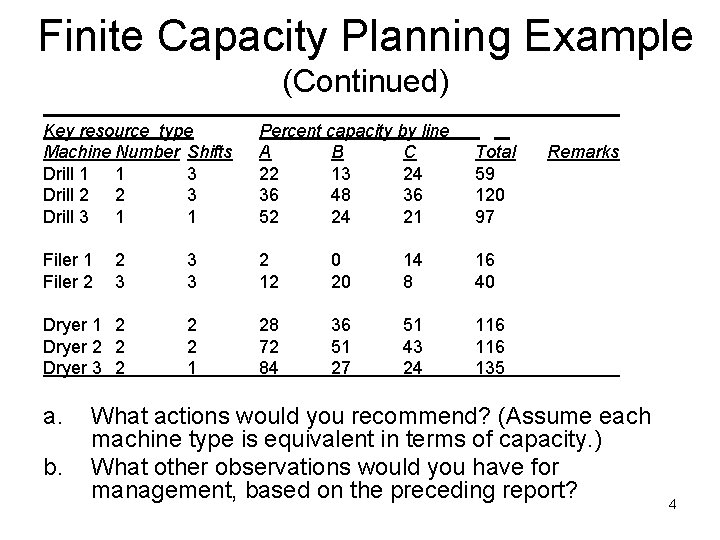
Finite Capacity Planning Example The Single Square Company summarizes the capacity requirements for three of its key resources from each of its three product lines. A typical report (before any action is taken) is shown on the next slide. 3
Finite Capacity Planning Example (Continued) Key resource type Machine Number Shifts Drill 1 1 3 Drill 2 2 3 Drill 3 1 1 Percent capacity by line A B C 22 13 24 36 48 36 52 24 21 Total 59 120 97 Filer 1 Filer 2 2 3 3 3 2 12 0 20 14 8 16 40 Dryer 1 2 Dryer 2 2 Dryer 3 2 2 2 1 28 72 84 36 51 27 51 43 24 116 135 a. b. Remarks What actions would you recommend? (Assume each machine type is equivalent in terms of capacity. ) What other observations would you have for management, based on the preceding report? 4
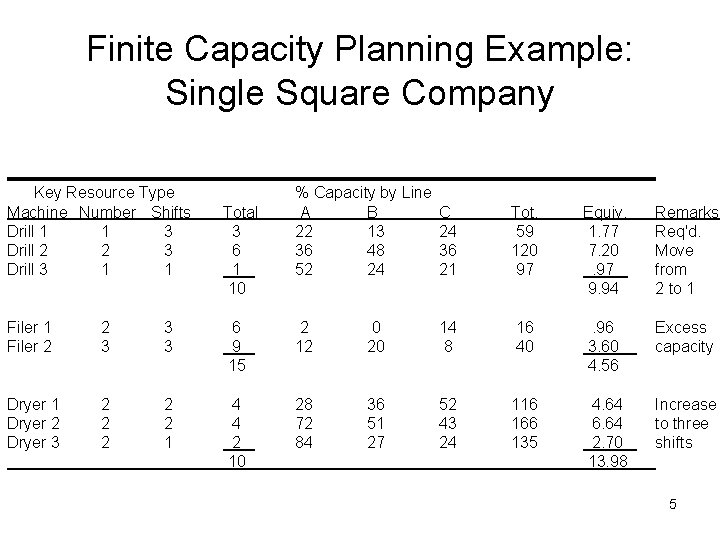
Finite Capacity Planning Example: Single Square Company Key Resource Type Machine Number Shifts Drill 1 1 3 Drill 2 2 3 Drill 3 1 1 Total 3 6 1 10 % Capacity by Line A B 22 13 36 48 52 24 C 24 36 21 Tot. 59 120 97 Equiv. 1. 77 7. 20. 97 9. 94 Remarks Req'd. Move from 2 to 1 Filer 2 2 3 3 3 6 9 15 2 12 0 20 14 8 16 40 . 96 3. 60 _ 4. 56 Excess capacity Dryer 1 Dryer 2 Dryer 3 2 2 2 1 4 4 2 10 28 72 84 36 51 27 52 43 24 116 166 135 4. 64 6. 64 2. 70 13. 98 Increase to three shifts 5
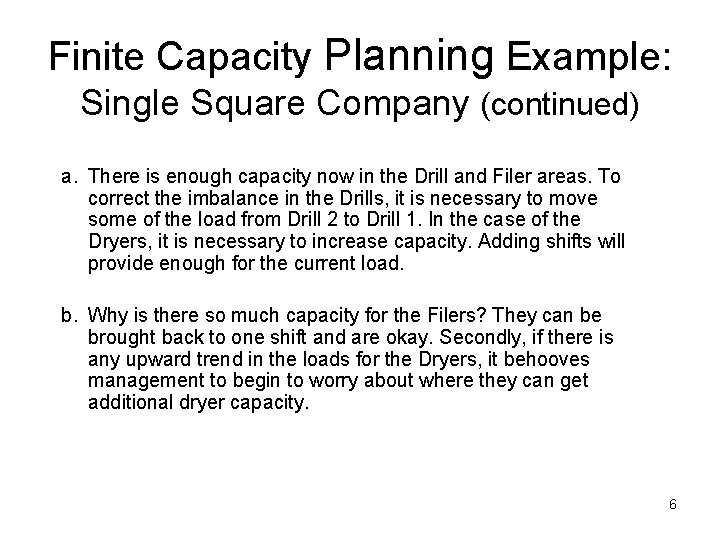
Finite Capacity Planning Example: Single Square Company (continued) a. There is enough capacity now in the Drill and Filer areas. To correct the imbalance in the Drills, it is necessary to move some of the load from Drill 2 to Drill 1. In the case of the Dryers, it is necessary to increase capacity. Adding shifts will provide enough for the current load. b. Why is there so much capacity for the Filers? They can be brought back to one shift and are okay. Secondly, if there is any upward trend in the loads for the Dryers, it behooves management to begin to worry about where they can get additional dryer capacity. 6
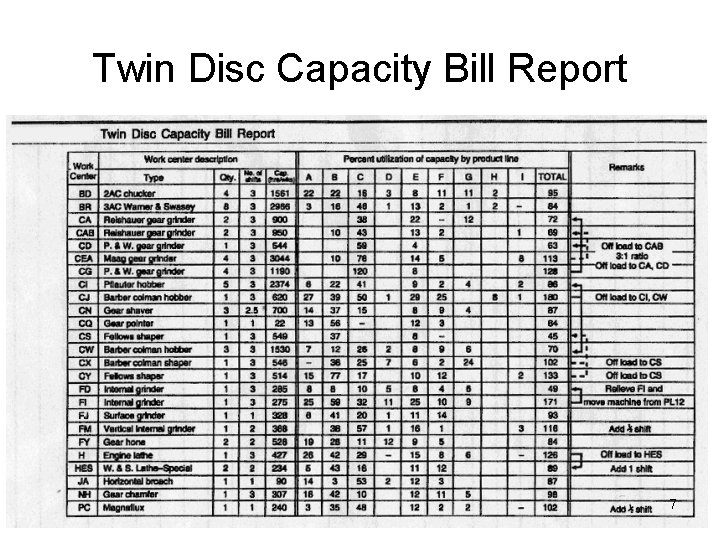
Twin Disc Capacity Bill Report 7
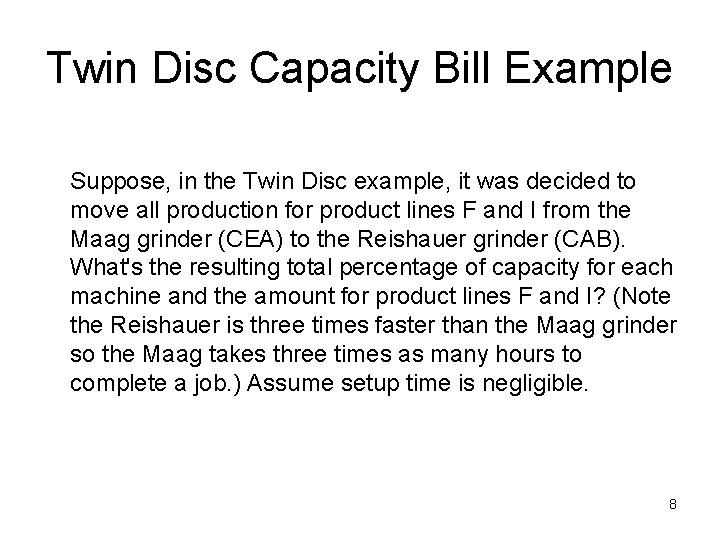
Twin Disc Capacity Bill Example Suppose, in the Twin Disc example, it was decided to move all production for product lines F and I from the Maag grinder (CEA) to the Reishauer grinder (CAB). What's the resulting total percentage of capacity for each machine and the amount for product lines F and I? (Note the Reishauer is three times faster than the Maag grinder so the Maag takes three times as many hours to complete a job. ) Assume setup time is negligible. 8
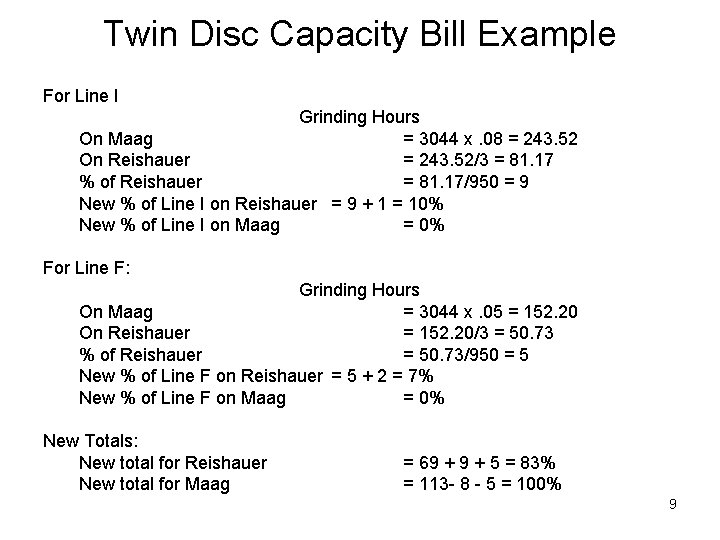
Twin Disc Capacity Bill Example For Line I Grinding Hours On Maag = 3044 x. 08 = 243. 52 On Reishauer = 243. 52/3 = 81. 17 % of Reishauer = 81. 17/950 = 9 New % of Line I on Reishauer = 9 + 1 = 10% New % of Line I on Maag = 0% For Line F: Grinding Hours On Maag = 3044 x. 05 = 152. 20 On Reishauer = 152. 20/3 = 50. 73 % of Reishauer = 50. 73/950 = 5 New % of Line F on Reishauer = 5 + 2 = 7% New % of Line F on Maag = 0% New Totals: New total for Reishauer New total for Maag = 69 + 5 = 83% = 113 - 8 - 5 = 100% 9
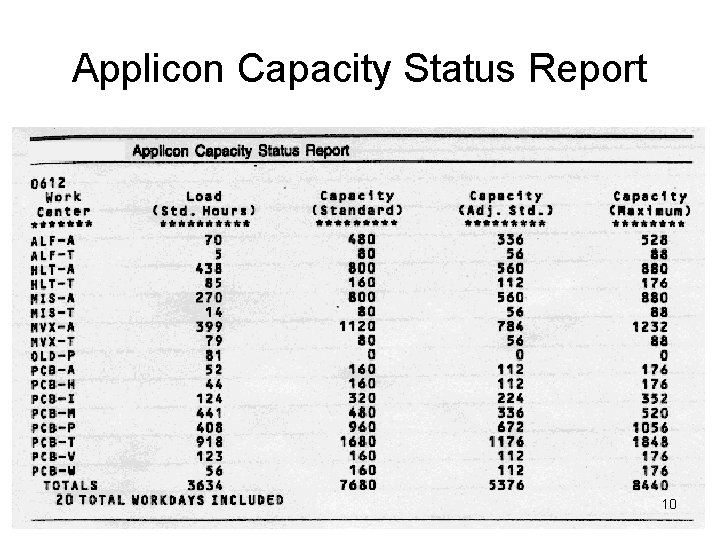
Applicon Capacity Status Report 10
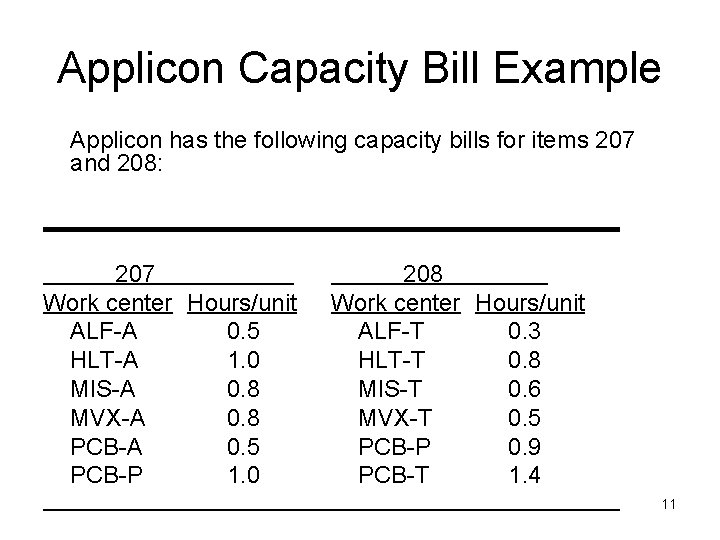
Applicon Capacity Bill Example Applicon has the following capacity bills for items 207 and 208: 207 Work center Hours/unit ALF-A 0. 5 HLT-A 1. 0 MIS-A 0. 8 MVX-A 0. 8 PCB-A 0. 5 PCB-P 1. 0 208 Work center Hours/unit ALF-T 0. 3 HLT-T 0. 8 MIS-T 0. 6 MVX-T 0. 5 PCB-P 0. 9 PCB-T 1. 4 11
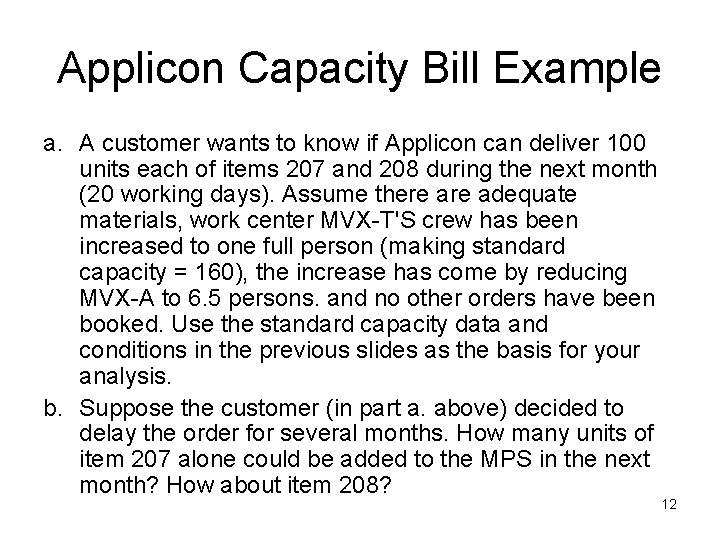
Applicon Capacity Bill Example a. A customer wants to know if Applicon can deliver 100 units each of items 207 and 208 during the next month (20 working days). Assume there adequate materials, work center MVX-T'S crew has been increased to one full person (making standard capacity = 160), the increase has come by reducing MVX-A to 6. 5 persons. and no other orders have been booked. Use the standard capacity data and conditions in the previous slides as the basis for your analysis. b. Suppose the customer (in part a. above) decided to delay the order for several months. How many units of item 207 alone could be added to the MPS in the next month? How about item 208? 12
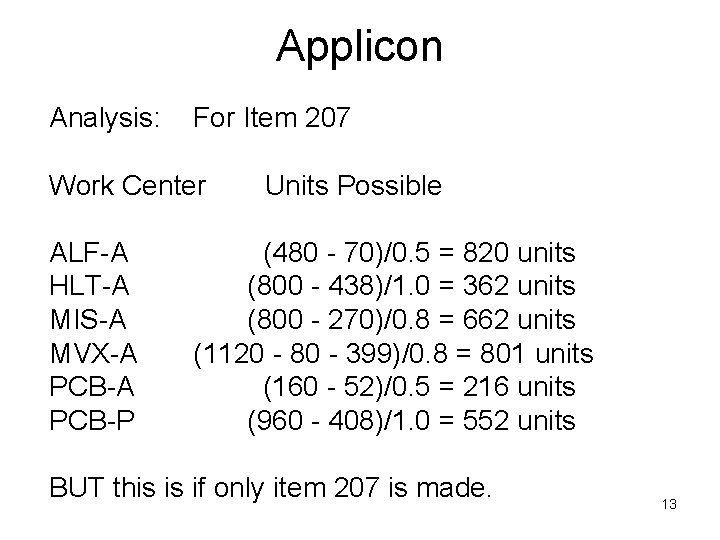
Applicon Analysis: For Item 207 Work Center ALF-A HLT-A MIS-A MVX-A PCB-P Units Possible (480 - 70)/0. 5 = 820 units (800 - 438)/1. 0 = 362 units (800 - 270)/0. 8 = 662 units (1120 - 80 - 399)/0. 8 = 801 units (160 - 52)/0. 5 = 216 units (960 - 408)/1. 0 = 552 units BUT this is if only item 207 is made. 13
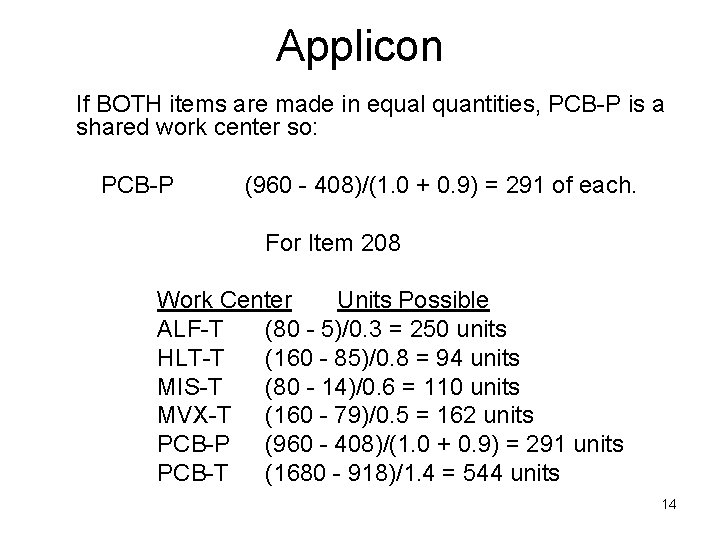
Applicon If BOTH items are made in equal quantities, PCB-P is a shared work center so: PCB-P (960 - 408)/(1. 0 + 0. 9) = 291 of each. For Item 208 Work Center Units Possible ALF-T (80 - 5)/0. 3 = 250 units HLT-T (160 - 85)/0. 8 = 94 units MIS-T (80 - 14)/0. 6 = 110 units MVX-T (160 - 79)/0. 5 = 162 units PCB-P (960 - 408)/(1. 0 + 0. 9) = 291 units PCB-T (1680 - 918)/1. 4 = 544 units 14
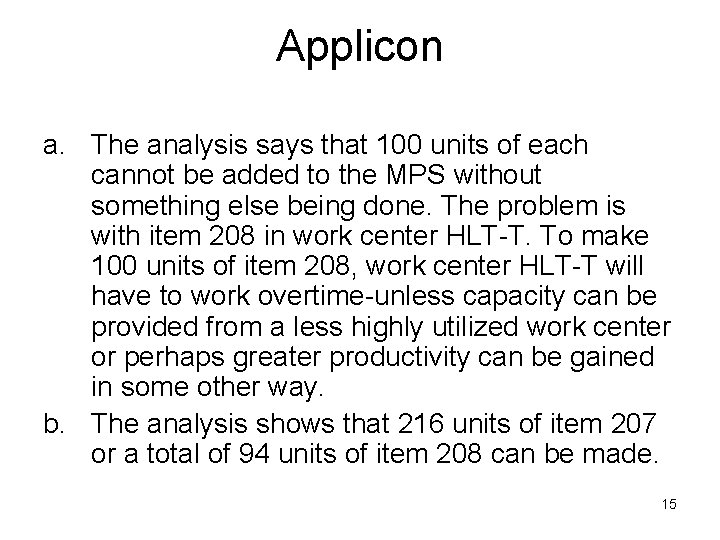
Applicon a. The analysis says that 100 units of each cannot be added to the MPS without something else being done. The problem is with item 208 in work center HLT-T. To make 100 units of item 208, work center HLT-T will have to work overtime-unless capacity can be provided from a less highly utilized work center or perhaps greater productivity can be gained in some other way. b. The analysis shows that 216 units of item 207 or a total of 94 units of item 208 can be made. 15
Concluding Principles • Capacity plans must be developed concurrently with material plans if the material plans are to be realized. • The capacity measure should reflect realizable output from the key resources. • It's not always capacity that should change when capacity availability doesn't equal need. • Capacity not only must be planned, but use of that capacity must also be monitored and controlled. • Capacity planning techniques can be applied to selected key resources (which need not correspond to production work 16 centers).
Concluding Principles • The particular capacity planning technique(s) chosen must match the level of detail and actual company circumstances to permit making effective management decisions. • The more detail in the capacity planning system, the more data and data base maintenance are required. • The better the resource and production planning process, the less difficult the capacity planning process. • The better the shop-floor system, the less short-term capacity planning is required. • Capacity planning can be simplified in a JIT environment. 17