Sectional Conflict Intensifies PreCivil War Chapter 8 section


- Slides: 24
Sectional Conflict Intensifies (Pre-Civil War) Chapter 8 section 1
Slavery and Western Expansion Section 1 � � � The spread of slavery into the new territories became the overriding political issue of the 1850’s. Admitting new states that were free or slaves would upset the balance of political power between Northern and Southern states. The North worried that the new territories gained from Mexico might choose to become slave states due to their location and needed a way to stop it as it would upset the balance of power in Congress.
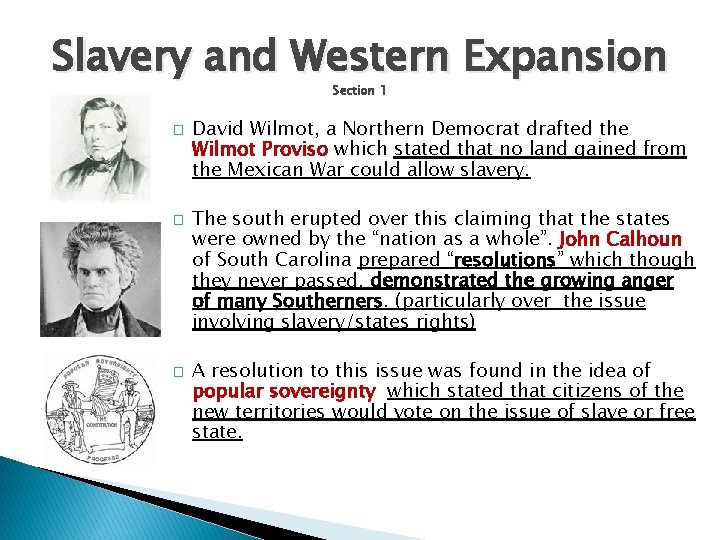
Slavery and Western Expansion Section 1 � � � David Wilmot, a Northern Democrat drafted the Wilmot Proviso which stated that no land gained from the Mexican War could allow slavery. The south erupted over this claiming that the states were owned by the “nation as a whole”. John Calhoun of South Carolina prepared “resolutions” which though they never passed, demonstrated the growing anger of many Southerners. (particularly over the issue involving slavery/states rights) A resolution to this issue was found in the idea of popular sovereignty which stated that citizens of the new territories would vote on the issue of slave or free state.
Slavery and Western Expansion Section 1 � � The issue would come up again because of a discovery in the territory of California. In 1848 gold was discovered in California and thousands headed that way hoping to strike it rich. By 1849 more than 80, 000 had moved there and they applied for statehood. Southerners feared the imbalance of power in the free states hands and started talking about secession-taking their states out of the Union.
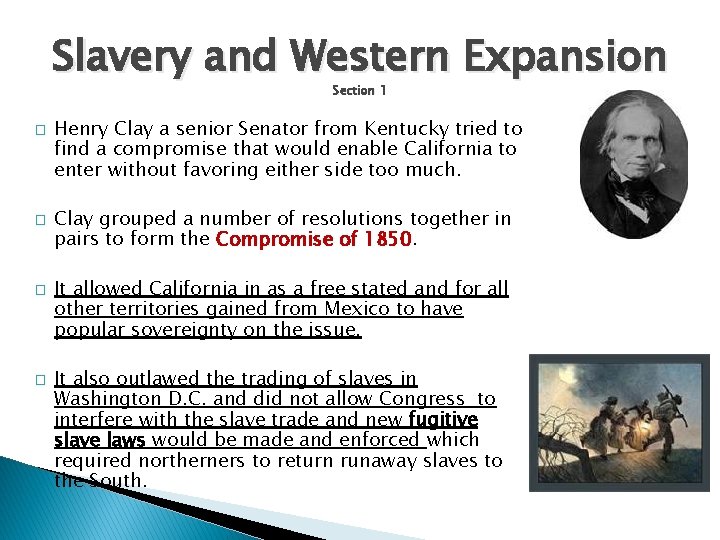
Slavery and Western Expansion Section 1 � � Henry Clay a senior Senator from Kentucky tried to find a compromise that would enable California to enter without favoring either side too much. Clay grouped a number of resolutions together in pairs to form the Compromise of 1850. It allowed California in as a free stated and for all other territories gained from Mexico to have popular sovereignty on the issue. It also outlawed the trading of slaves in Washington D. C. and did not allow Congress to interfere with the slave trade and new fugitive slave laws would be made and enforced which required northerners to return runaway slaves to the South.
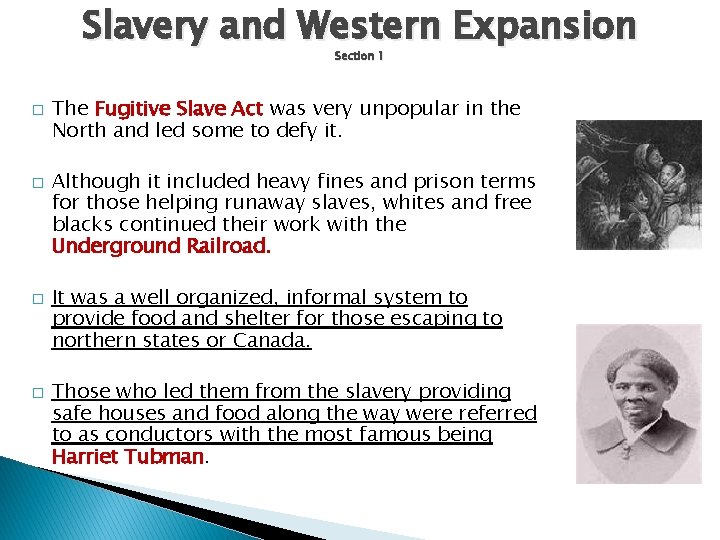
Slavery and Western Expansion Section 1 � � The Fugitive Slave Act was very unpopular in the North and led some to defy it. Although it included heavy fines and prison terms for those helping runaway slaves, whites and free blacks continued their work with the Underground Railroad. It was a well organized, informal system to provide food and shelter for those escaping to northern states or Canada. Those who led them from the slavery providing safe houses and food along the way were referred to as conductors with the most famous being Harriet Tubman.
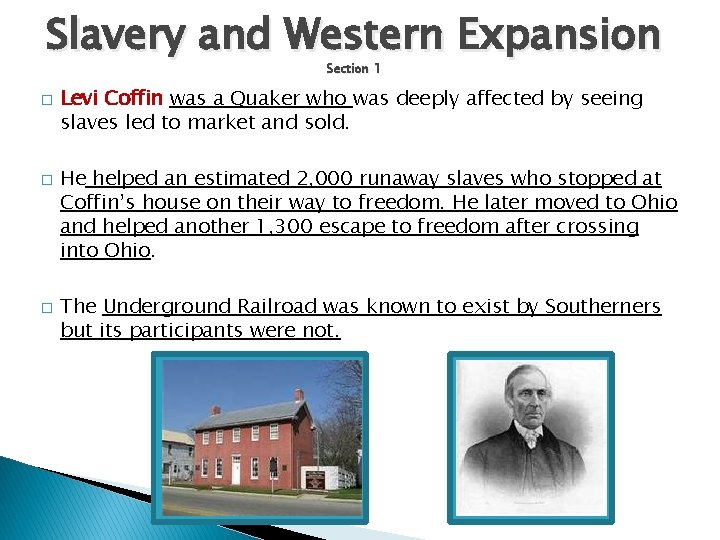
Slavery and Western Expansion Section 1 � � � Levi Coffin was a Quaker who was deeply affected by seeing slaves led to market and sold. He helped an estimated 2, 000 runaway slaves who stopped at Coffin’s house on their way to freedom. He later moved to Ohio and helped another 1, 300 escape to freedom after crossing into Ohio. The Underground Railroad was known to exist by Southerners but its participants were not.
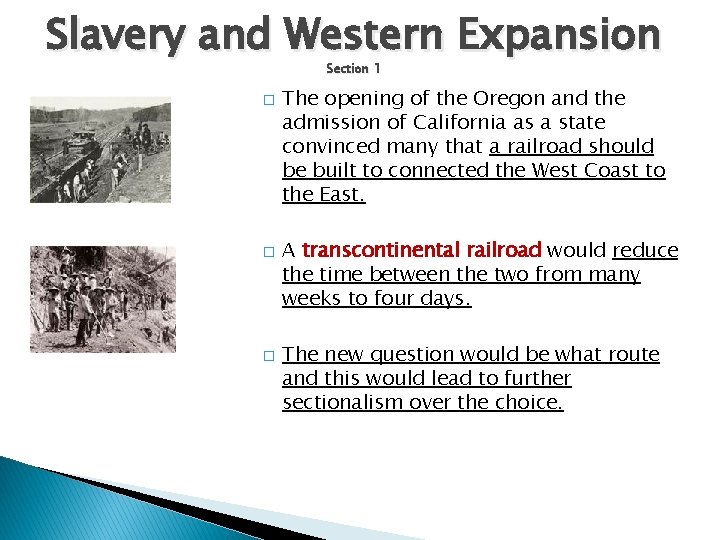
Slavery and Western Expansion Section 1 � � � The opening of the Oregon and the admission of California as a state convinced many that a railroad should be built to connected the West Coast to the East. A transcontinental railroad would reduce the time between the two from many weeks to four days. The new question would be what route and this would lead to further sectionalism over the choice.
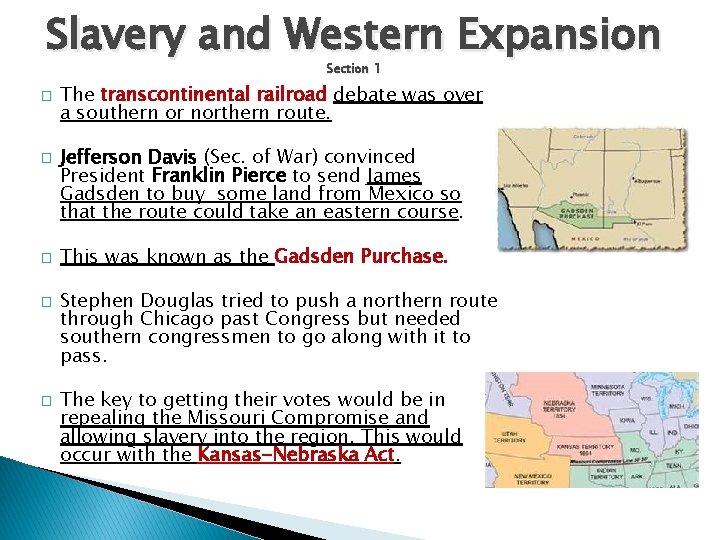
Slavery and Western Expansion Section 1 � � � The transcontinental railroad debate was over a southern or northern route. Jefferson Davis (Sec. of War) convinced President Franklin Pierce to send James Gadsden to buy some land from Mexico so that the route could take an eastern course. This was known as the Gadsden Purchase. Stephen Douglas tried to push a northern route through Chicago past Congress but needed southern congressmen to go along with it to pass. The key to getting their votes would be in repealing the Missouri Compromise and allowing slavery into the region. This would occur with the Kansas-Nebraska Act.
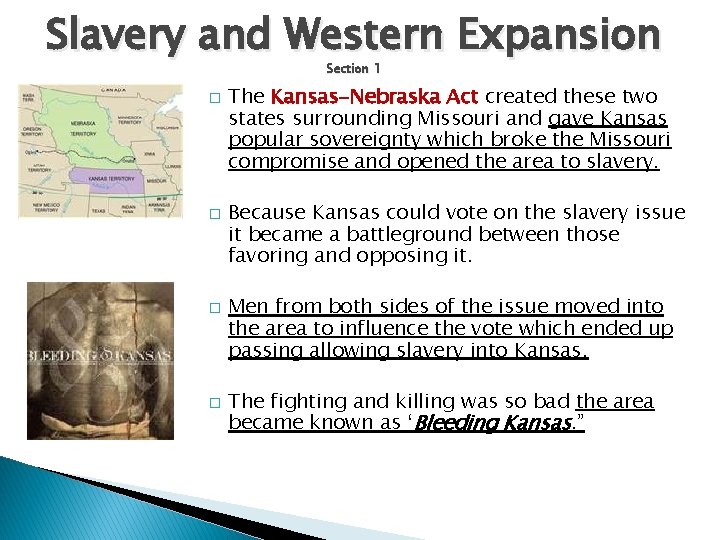
Slavery and Western Expansion Section 1 � � The Kansas-Nebraska Act created these two states surrounding Missouri and gave Kansas popular sovereignty which broke the Missouri compromise and opened the area to slavery. Because Kansas could vote on the slavery issue it became a battleground between those favoring and opposing it. Men from both sides of the issue moved into the area to influence the vote which ended up passing allowing slavery into Kansas. The fighting and killing was so bad the area became known as ‘Bleeding Kansas. ”
Slavery and Western Expansion Section 1 � � In Congress, slavery was hotly debated in the new territories. In Congress abolitionist Senator Charles Sumner accused South Carolina Senator Andrew Butler among others of forcing Kansas into ranks of slave states. His harsh words angered Butler’s cousin, Rep. Preston Brooks who yelled at Sumner. He then raised his walking cane and proceeded to severely beat Sumner. In the south he was viewed as a hero and as a villain in the North. This just increased the divide between North and South.
Sectional Conflict Intensifies Chapter 8 section 2
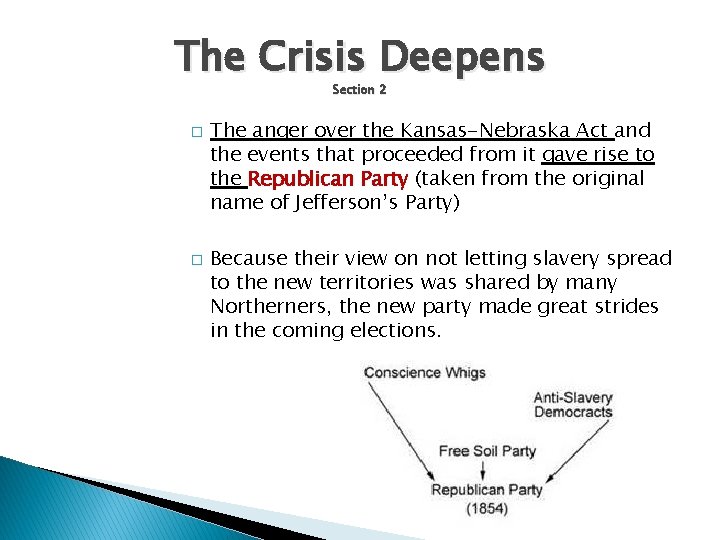
The Crisis Deepens Section 2 � � The anger over the Kansas-Nebraska Act and the events that proceeded from it gave rise to the Republican Party (taken from the original name of Jefferson’s Party) Because their view on not letting slavery spread to the new territories was shared by many Northerners, the new party made great strides in the coming elections.
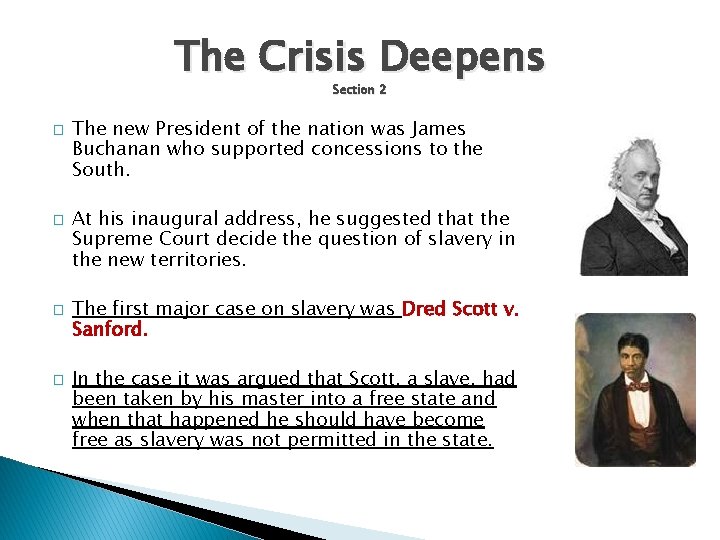
The Crisis Deepens Section 2 � � The new President of the nation was James Buchanan who supported concessions to the South. At his inaugural address, he suggested that the Supreme Court decide the question of slavery in the new territories. The first major case on slavery was Dred Scott v. Sanford. In the case it was argued that Scott, a slave, had been taken by his master into a free state and when that happened he should have become free as slavery was not permitted in the state.
The Crisis Deepens Section 2 � � � Dred Scott’s case went all the way to the Supreme Court and they decided that Scott was not a citizen and could not have his case brought to court. The case also ruled that the federal government could not outlaw slavery in the territories because to do so was unconstitutional. The South viewed it as a victory and the North saw it as a travesty of justice.
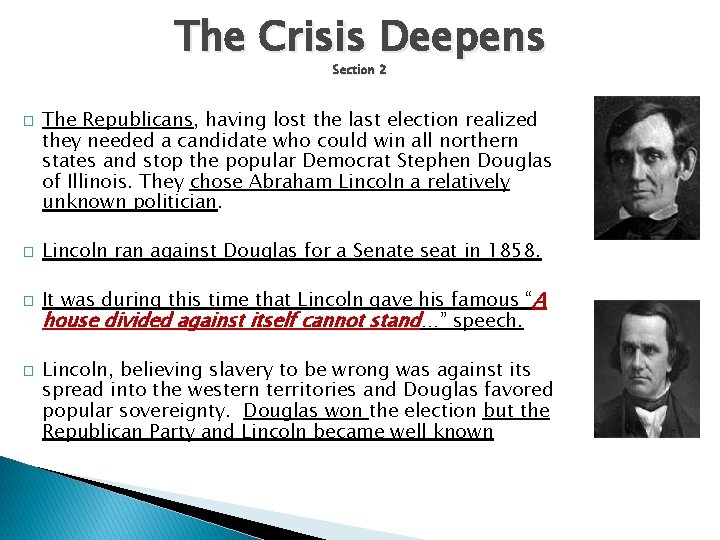
The Crisis Deepens Section 2 � � The Republicans, having lost the last election realized they needed a candidate who could win all northern states and stop the popular Democrat Stephen Douglas of Illinois. They chose Abraham Lincoln a relatively unknown politician. Lincoln ran against Douglas for a Senate seat in 1858. It was during this time that Lincoln gave his famous “A house divided against itself cannot stand…” speech. Lincoln, believing slavery to be wrong was against its spread into the western territories and Douglas favored popular sovereignty. Douglas won the election but the Republican Party and Lincoln became well known
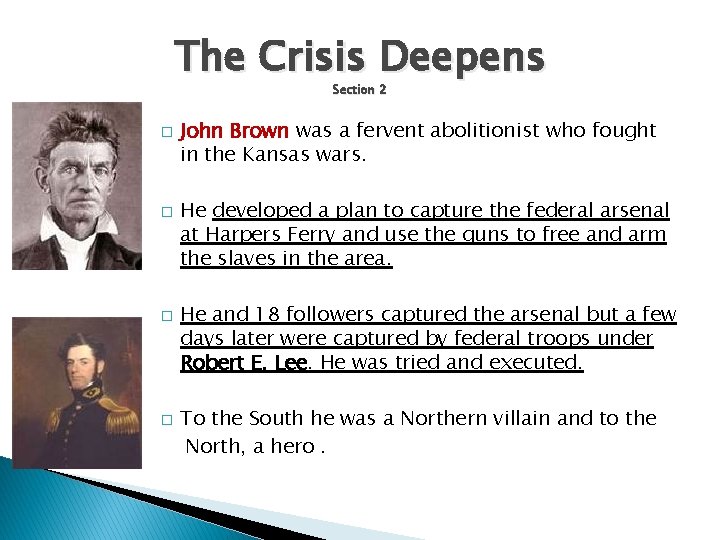
The Crisis Deepens Section 2 � � John Brown was a fervent abolitionist who fought in the Kansas wars. He developed a plan to capture the federal arsenal at Harpers Ferry and use the guns to free and arm the slaves in the area. He and 18 followers captured the arsenal but a few days later were captured by federal troops under Robert E. Lee. He was tried and executed. To the South he was a Northern villain and to the North, a hero.
Sectional Conflict Intensifies Chapter 8 section 3
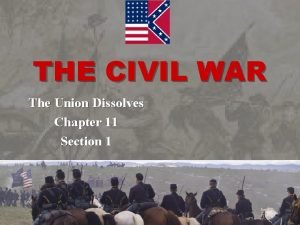
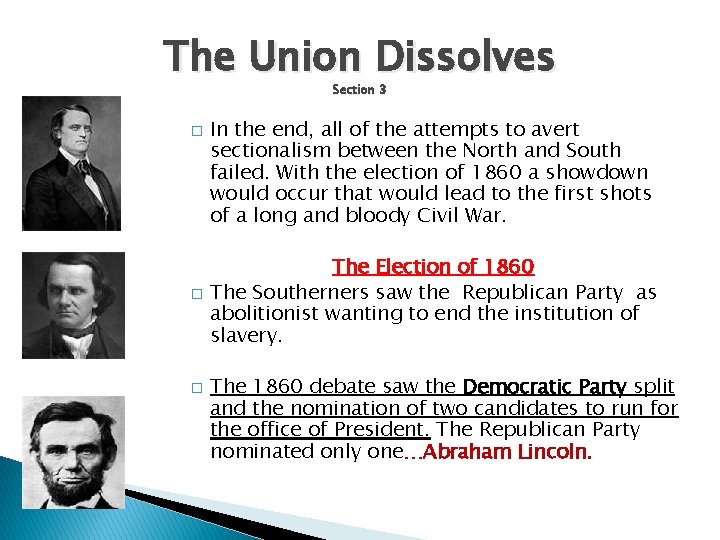
The Union Dissolves Section 3 � � � In the end, all of the attempts to avert sectionalism between the North and South failed. With the election of 1860 a showdown would occur that would lead to the first shots of a long and bloody Civil War. The Election of 1860 The Southerners saw the Republican Party as abolitionist wanting to end the institution of slavery. The 1860 debate saw the Democratic Party split and the nomination of two candidates to run for the office of President. The Republican Party nominated only one…Abraham Lincoln.
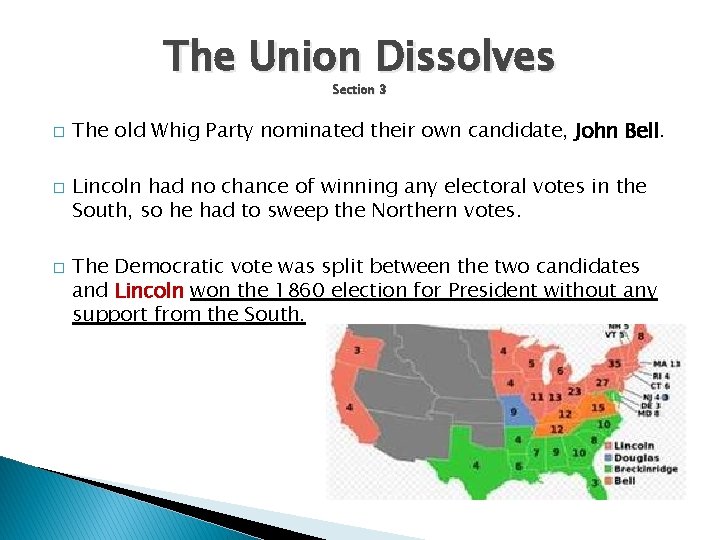
The Union Dissolves Section 3 � � � The old Whig Party nominated their own candidate, John Bell. Lincoln had no chance of winning any electoral votes in the South, so he had to sweep the Northern votes. The Democratic vote was split between the two candidates and Lincoln won the 1860 election for President without any support from the South.
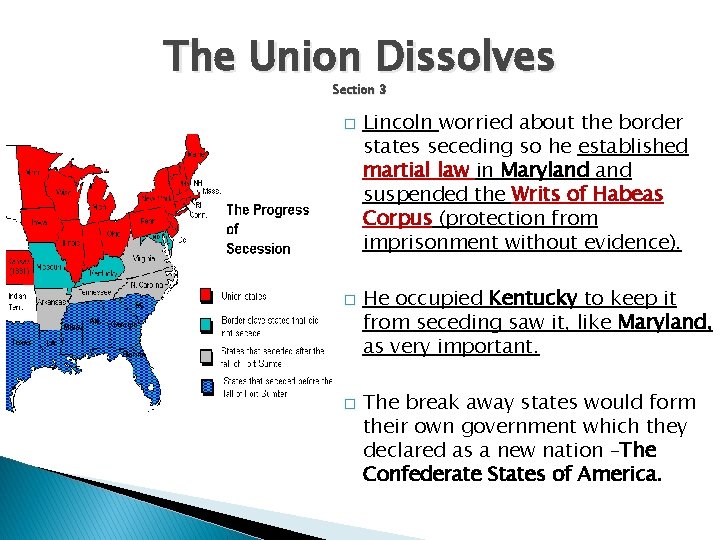
The Union Dissolves Section 3 � � For the South the election of a Republican President represented a victory for abolitionist. They saw an end to slavery with no recourse but to secede from the union. Almost immediately after Lincoln was elected, South Carolina voted to leave the Union and by February 6 more states joined. After the fall of Fort Sumter, 4 more states would join for a total of 11 states leaving the Union.
The Union Dissolves Section 3 � � � Lincoln worried about the border states seceding so he established martial law in Maryland suspended the Writs of Habeas Corpus (protection from imprisonment without evidence). He occupied Kentucky to keep it from seceding saw it, like Maryland, as very important. The break away states would form their own government which they declared as a new nation –The Confederate States of America.
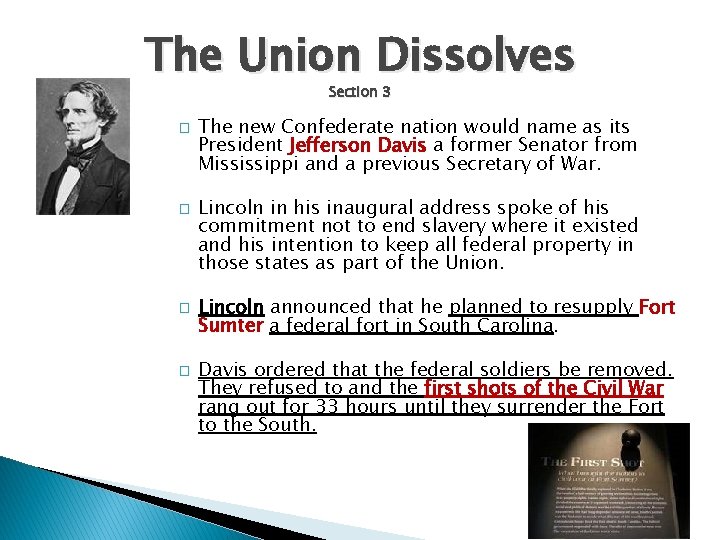
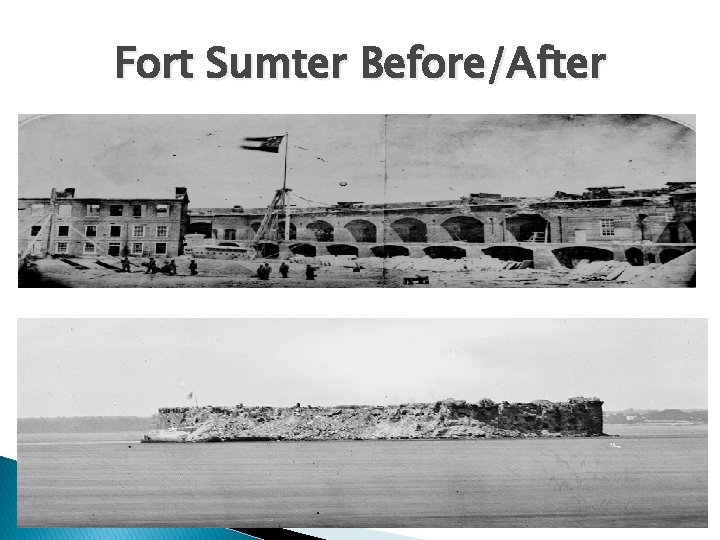
The Union Dissolves Section 3 � � The new Confederate nation would name as its President Jefferson Davis a former Senator from Mississippi and a previous Secretary of War. Lincoln in his inaugural address spoke of his commitment not to end slavery where it existed and his intention to keep all federal property in those states as part of the Union. Lincoln announced that he planned to resupply Fort Sumter a federal fort in South Carolina. Davis ordered that the federal soldiers be removed. They refused to and the first shots of the Civil War rang out for 33 hours until they surrender the Fort to the South.
Fort Sumter Before/After